
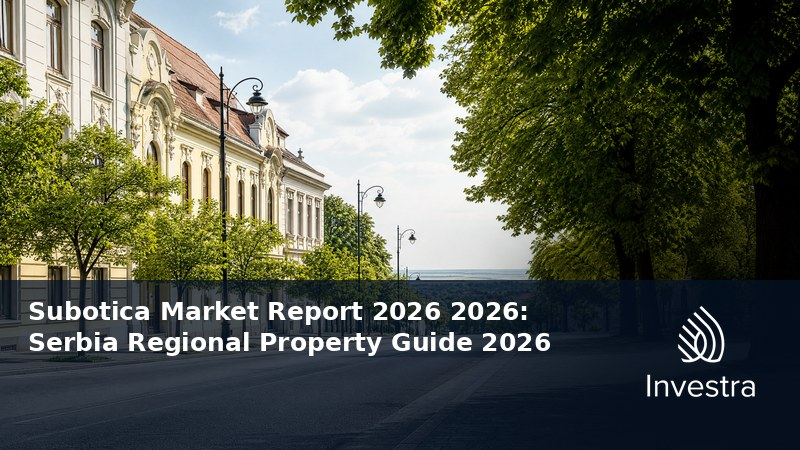
Subotica Market Report 2026 2026: Serbia Regional Property Guide 2026
Subotica Real Estate Market Overview 2026: Why This Border City Is Turning Heads
Quick Answer: Subotica's real estate market in 2026 is one of Serbia's most compelling regional investment stories, combining affordable entry prices (€600–€1,800/m²), strong cross-border demand from Hungary and EU buyers, and a growing logistics and tourism economy that's pushing rental yields to 5–8% annually.
Subotica sits at an unusual crossroads — literally and figuratively. Positioned just 10 kilometers from the Hungarian border in northern Vojvodina, this city of roughly 140,000 residents occupies a unique position in Serbia's property landscape. It's close enough to the EU to attract European buyers looking for value, yet Serbian enough to offer the price advantages that Central and Eastern European markets are famous for.
What's happening in Subotica right now is genuinely interesting. After years of being overshadowed by Novi Sad and Belgrade in investor conversations, the city is establishing its own identity as a credible property market. New residential developments are breaking ground across multiple districts. The logistics sector, fueled by proximity to the E75 motorway and the Hungarian border crossing at Röszke/Horgoš, is bringing in corporate tenants and workers who need housing. Tourism, anchored by the city's extraordinary Art Nouveau architectural heritage and Palić Lake, creates seasonal rental demand that savvy investors are starting to exploit.
The reality is that most international investors still haven't discovered Subotica. That's both a challenge and an opportunity. Prices remain significantly below the national capital — you'll find good apartments in central Subotica at prices that would buy you a parking spot in Belgrade's Savamala district. For buyers willing to do their homework, this gap between value and awareness is exactly where smart property investments are made.
This market report covers everything you need to know about Subotica's property market heading into 2026: price ranges by district, rental yields, legal procedures for foreign buyers, tax obligations, emerging investment hotspots, and the macro trends shaping the city's trajectory. Whether you're considering a single buy-to-let apartment or a larger portfolio play, this is your comprehensive entry point.
Understanding Subotica: Geography, Demographics, and Economic Foundations
Quick Answer: Subotica is Vojvodina's second-largest city, a multi-ethnic hub of Serbs, Hungarians, and Croats with a diversified economy spanning manufacturing, logistics, agriculture, and tourism — making it more economically resilient than many single-industry Serbian cities.
To understand why Subotica's property market works the way it does, you first need to understand the city itself. Subotica (called Szabadka in Hungarian) is an ethnically diverse city where Serbian, Hungarian, and Bunjevac Croat communities have coexisted for centuries. This multicultural character isn't just a tourism talking point — it has real economic and social implications for property investment.
The Hungarian-speaking minority, estimated at around 30–35% of the population, creates cross-border economic ties that no other Serbian city replicates. Hungarian entrepreneurs own businesses here. Hungarian retirees buy second homes near Palić Lake. Hungarian tourists fill the city's Art Nouveau hotels during summer weekends. This bilateral relationship with an EU member state gives Subotica a buffer against purely domestic economic cycles.
Economically, the city has diversified since the industrial contraction of the 1990s. The Slobodna Zona Subotica (Subotica Free Trade Zone) hosts around 40 companies employing thousands of workers. Major employers include Siemens, Hella, and various textile and food processing operations. The Horgoš border crossing — one of Serbia's busiest — generates significant logistics activity. Agriculture in the surrounding Vojvodina plains underpins the regional food economy.
Population demographics tell a nuanced story. Like most Serbian cities outside Belgrade, Subotica has experienced some population decline over the past decade as younger residents moved to larger urban centers or emigrated to the EU. But the rate of decline has slowed, and the city's administration has invested in infrastructure, cultural programming, and business incentives designed to attract and retain residents. The ongoing EU accession process, which Serbia continues to pursue, adds a medium-term tailwind that careful investors are already pricing into their calculations.
Infrastructure matters enormously for property values. The E75 motorway connects Subotica directly to Belgrade (around 180km south) and continues north into Hungary toward Budapest. Rail connections exist but are slower and less practical. The regional Subotica Airport handles limited traffic, though cross-border use of Horgos-Röszke and proximity to Osijek (Croatia) and Timișoara (Romania) airports expands air connectivity for those willing to drive an hour.
Subotica Property Price Ranges 2026: District-by-District Breakdown
Quick Answer: Subotica property prices in 2026 range from €600/m² in outlying villages to €1,800/m² in the historic city center and premium lakeside districts, with the mid-market averaging €900–€1,200/m² for quality residential apartments.
Price data in Subotica requires careful interpretation because the market is genuinely heterogeneous — you can find dramatically different values within a few hundred meters depending on building quality, microdistrict desirability, and property condition. Here's a realistic breakdown of what the market looks like in 2026.
City Center (Centar/Stari Grad): The historic heart of Subotica commands the highest prices, typically €1,400–€1,800/m² for renovated apartments in century-old buildings. The city center's extraordinary collection of Art Nouveau and Eclectic architecture — including the famous City Hall and Synagogue — makes it genuinely unique among Serbian cities. Renovated apartments in heritage buildings attract both local professionals and foreign buyers interested in the cultural cache. New-build isn't possible in most central areas due to heritage protection, so supply is genuinely constrained.
Palić Lake District: Palić, technically a separate settlement 8km east of the city center, functions as Subotica's premium leisure and residential zone. Lakeside villas and houses range from €1,200–€2,500/m² depending on proximity to the water and quality of construction. This area sees the heaviest interest from Hungarian buyers and affluent local families seeking weekend retreats that double as rental income generators during summer. Short-term rental yields here can reach 8–10% during peak season, though annualized yields are lower at 5–7%.
Novi Grad / Prozivka Districts: These post-war residential areas offer the classic Socialist-era apartment blocks that define much of urban Serbia. Prices are honest: €700–€1,000/m² for standard apartments, with higher-quality renovated units pushing toward €1,100/m². These districts attract local buyers — young families, first-time purchasers — and represent the most liquid segment of the market because demand is broad and consistent.
Novi Banovac / Bajnat: Newer residential construction has been concentrated in these peripheral zones, where developers have more space to build. New-build apartments here typically price at €1,100–€1,400/m², reflecting modern specifications (energy-efficient windows, underground parking, elevators) that older stock can't offer. The tradeoff is distance from the historic center and less established neighborhood character.
Surrounding Villages: Čantavir, Bikovo, Mišićevo, and other villages in the Subotica municipality offer agricultural land and houses at much lower price points — typically €30,000–€80,000 for a standalone house with a garden. These are primarily of interest to buyers seeking rural lifestyle properties or those involved in agricultural operations, rather than pure investment plays.
Rental Market Dynamics and Yield Analysis
Quick Answer: Rental yields in Subotica range from 5–8% for long-term residential lettings and can reach 8–12% in peak seasons for short-term lakeside rentals at Palić, making the city one of Serbia's better yield markets relative to entry price.
The rental market in Subotica operates on two distinct tracks, and smart investors understand both. Long-term residential rentals cater to local workers, students, and corporate expats connected to the free trade zone. Short-term vacation rentals, primarily concentrated around Palić Lake, serve weekend and summer tourism from Serbia, Hungary, and Romania.
For long-term rentals in the city center, a well-maintained 50m² one-bedroom apartment commands €300–€450/month. A two-bedroom 70m² apartment in a good location achieves €400–€600/month. Put that against an acquisition cost of €65,000–€80,000 for a quality one-bedroom, and you're looking at gross yields of 5.5–7.5% — healthy by Central European standards, where major city yields have compressed to 3–4%.
The corporate rental segment deserves special attention. Companies operating in Subotica's free trade zone — Siemens, Hella, and similar industrial employers — regularly need housing for management staff and skilled workers relocating from elsewhere. These corporate tenants typically pay €500–€800/month for a two-bedroom apartment, often on 12-24 month contracts. The stability of corporate tenancies compensates for the slightly lower headline yields compared to short-term options.
Palić Lake's short-term rental market is where the numbers get genuinely exciting. A well-appointed three-bedroom lakeside house with a garden can generate €150–€250/night during peak summer weeks (July-August). During the Jazz Festival at Palić — a major annual event drawing crowds from across the region — rates spike further. Annualized across the full year (accounting for lower occupancy outside summer), a Palić property might generate €12,000–€18,000 annually against a purchase price of €150,000–€200,000, implying gross yields of 7–9%.
What we've seen across the Serbian regional market is consistent: cities with a distinct tourism identity — Palić's lake resort character, for instance — outperform purely residential markets on yield metrics. Investors who can manage the seasonal nature of short-term lettings, or who partner with local property managers, find the effort worthwhile. Platforms like Airbnb and Booking.com have made Palić increasingly discoverable to European travelers who might never have considered northern Serbia previously.
For comparative context on how Subotica stacks up against other Serbian regional markets, see our guides to Sremska Mitrovica Real Estate 2026 Srem Region Property G... and Loznica Real Estate Market 2026 Macva Region Property Guide, both of which show similar yield profiles driven by industrial and cross-regional demand.
Foreign Buyer Rules: Can International Investors Own Property in Subotica?
Quick Answer: Foreign nationals can legally purchase residential and commercial property in Serbia under reciprocity agreements with most countries. EU citizens face virtually no restrictions, while non-EU buyers from countries with bilateral agreements (including most Western nations) can also purchase freely, with only agricultural land remaining restricted.
This is the question every international buyer asks first, and the answer for Subotica — and Serbia generally — is encouraging. Serbia's property law extends buying rights to foreign nationals based on reciprocity agreements. In practice, citizens of most Western European countries, North America, Australia, and increasingly Asia-Pacific nations face no meaningful restrictions on purchasing residential or commercial property.
EU citizens enjoy a particularly straightforward process since Serbia's own EU accession pathway has aligned much of its property legislation with European norms. A German, Dutch, or Austrian buyer can purchase an apartment in Subotica with the same ease as buying in Hungary or Romania — arguably with less bureaucracy than some EU member states.
The key restriction to understand is on agricultural land. Foreign nationals and foreign-owned companies cannot directly purchase agricultural land in Serbia, a protection that applies across the country. For Subotica's urban and lakeside residential market, this restriction is irrelevant. For investors interested in rural plots or farmland in the Vojvodina region, a Serbian-registered company structure is the standard workaround — consult a local lawyer for the appropriate structure for your specific situation.
For the Subotica market specifically, Hungarian buyers represent a significant slice of foreign demand. There's historical, linguistic, and cultural familiarity that makes the transaction feel less foreign for buyers from across the border. Hungarian nationals have been purchasing in Subotica for decades, and local real estate agencies have well-established processes for international transactions.
Practically speaking, as a foreign buyer you'll need: a valid passport, a Serbian fiscal identification number (PIB or JMBG equivalent for foreigners, obtained relatively easily from the Tax Administration), a local bank account or the ability to transfer funds through registered channels, and a purchase contract prepared and certified by a Serbian notary. The entire process from offer acceptance to key handover typically takes 4–8 weeks, significantly faster than many Western European markets.
Working with an experienced local real estate agent who handles international clients regularly makes an enormous difference. Subotica has several agencies with English and Hungarian-speaking staff, and for buyers who want strategic guidance beyond simple transaction facilitation, consultants like Siniša Dagary — Investment Consultant provide valuable market intelligence for international investors considering the Serbian market.
Legal Process for Buying Property in Subotica: Step-by-Step
Quick Answer: Purchasing property in Subotica involves offer and pre-contract, notarized sale contract, title transfer registration with the Land Registry, and payment of a 2.5% transfer tax — a process that typically completes in 4–8 weeks with proper legal support.
The Serbian property purchase process has been modernized significantly over the past decade, and what once felt bureaucratically impenetrable is now reasonably efficient. Here's the realistic step-by-step picture for a buyer purchasing in Subotica in 2026.
Step 1 — Due Diligence and Title Check: Before any contract is signed, your lawyer (and you should absolutely engage a local lawyer, not just rely on the seller's notary) checks the property's status in the Serbian Land Registry (Katastar). This verification confirms the seller's ownership, identifies any mortgages, liens, or encumbrances, and verifies the property's legal status (particularly important for older buildings that may have unauthorized construction elements). This check is now available online through the RGZ (Republički geodetski zavod) portal and typically takes 1–3 days.
Step 2 — Pre-Contract (Predugovor): Most transactions in Subotica involve a pre-contract that locks in the agreed price and terms. The buyer pays a deposit, typically 10% of the purchase price, which is forfeited if the buyer withdraws without valid reason. If the seller withdraws, they return double the deposit. This stage provides security for both parties during the period between agreement and notarized contract.
Step 3 — Notarized Sale Contract (Kupoprodajni Ugovor): The definitive purchase contract must be prepared and certified by a Serbian notary (Javni Beležnik). Both buyer and seller must be present, or represented by a notarized power of attorney. For foreign buyers who can't travel to Serbia for each stage, a power of attorney granted to a local lawyer or trusted representative is commonly used. The notary verifies identities, ensures the contract complies with Serbian law, and certifies the transaction.
Step 4 — Payment: Payment transfers occur at or around contract signing. Bank transfers are standard; cash transactions above €5,000 are heavily regulated and generally inadvisable. Foreign buyers transferring funds into Serbia should ensure their bank transfer documents clearly reference the property purchase to avoid currency control complications.
Step 5 — Land Registry Transfer: Following contract signing, the notary submits documents to the Land Registry for title transfer. This registration process has been streamlined and typically completes within 5–15 working days in practice, though backlogs can extend this. Until registration is complete, the buyer has legal rights under the contract but the official title hasn't yet transferred.
Step 6 — Tax Declaration and Payment: Within 30 days of contract signing, the buyer must file for the property transfer tax (see Tax section below). Failure to file on time results in penalties.
For investment guidance that goes beyond the transactional to help you understand how Subotica fits into a broader Serbian property strategy, resources like Business Strategy Blog offer broader frameworks for market entry decisions in the Western Balkans.
Taxes and Costs of Buying Property in Subotica
Quick Answer: The primary tax on Serbian property purchases is a 2.5% transfer tax on the appraised value, with total transaction costs (including notary, agent fees, and lawyer) typically reaching 5–7% of the purchase price — modest by European standards.
Transaction costs matter enormously to investment calculations, and Serbia's tax regime is genuinely competitive compared to most European markets. Here's the complete cost picture for a Subotica purchase in 2026.
Property Transfer Tax (Porez na prenos apsolutnih prava): The headline tax is 2.5% of the purchase price (or the tax authority's assessed value, whichever is higher). This tax is paid by the buyer and must be settled within 30 days of contract signing. The tax authority may challenge transaction prices they consider artificially low — particularly relevant for transactions between related parties or suspiciously below market. For arm's-length transactions at market prices, the declared price is generally accepted.
An important exception: if you're buying a newly constructed apartment from a developer (first sale), VAT of 10% applies instead of the transfer tax. This makes new-build purchases slightly more expensive from a tax perspective, though new construction typically commands higher prices for other reasons anyway.
Notary Fees: Serbian notaries charge based on the transaction value according to a regulated fee schedule. For a €100,000 property, expect notary fees of approximately €400–€700. For a €200,000 transaction, the fee scales to around €600–€1,000. These are regulated and non-negotiable.
Real Estate Agent Commission: In Subotica, agency fees are typically 2–3% of the transaction price, often split between buyer and seller or paid entirely by one party depending on negotiation. Given that quality local agents provide genuinely valuable services for international buyers — translation, negotiation, due diligence coordination — this cost is generally worth paying.
Legal Fees: A competent property lawyer in Subotica charges €500–€1,500 for a standard residential purchase, depending on complexity. For transactions involving company structures, foreign ownership, or significant due diligence requirements, costs can be higher. Don't economize here — legal costs are trivial relative to the protection they provide.
Annual Property Tax: Once you own property, Serbia's annual property tax is remarkably low — typically 0.4% of the assessed value per year, and the assessed values the municipality uses are generally conservative. Annual property tax on a €100,000 Subotica apartment might run €200–€400 per year. Local municipality determines the exact rate within a regulated range.
Rental Income Tax: Rental income earned in Serbia is subject to personal income tax at 20% (after a 25% standard deduction for expenses, giving an effective rate of approximately 15% on gross rental income). Maintaining proper rental contracts and declaring income is increasingly important as the Serbian tax authorities modernize their systems — Serbia Proptech 2026 How Technology Is Changing Real Estate covers how digitization is increasing transparency in the market.
For financial structuring across borders — particularly relevant for buyers using European-based capital — Findes Financial Services offers cross-border financial planning expertise that can help optimize your investment structure.
Palić Lake: The Crown Jewel of Subotica's Investment Geography
Quick Answer: Palić Lake, located 8km from Subotica's center, is Serbia's premier lakeside resort destination and the most actively appreciated sub-market within the Subotica area, with property values growing 8–12% annually as regional tourism demand accelerates.
If there's one part of the Subotica market that deserves extended attention, it's Palić. This isn't just a pretty backdrop — it's a distinct investment micro-market with its own supply constraints, demand dynamics, and yield profile that differ meaningfully from the city proper.
Palić's history as a resort destination dates to the Austro-Hungarian period, and the area retains extraordinary architectural character: the Women's Lido, the Grand Terrace, the Water Tower, and various villas in Art Nouveau and Secessionist styles that reflect the lake's late 19th-century heyday as a fashionable destination for the Austro-Hungarian aristocracy. This architectural patrimony is irreplaceable and directly drives premium pricing.
Modern Palić functions as a year-round destination with a clear seasonal peak. The Palić Film Festival and Palić Jazz Festival (both held in summer) draw significant crowds and create genuine short-term rental demand spikes. The lake itself supports swimming, rowing, and water sports in summer, while cycling paths around the lake and nature areas attract visitors in shoulder seasons. There's a functioning Zoo and the Palić resort complex, which continues to receive investment and upgrading.
What surprises many buyers is how constrained the supply of quality lakeside properties actually is. The lake is surrounded by established development, heritage protection zones, and natural areas — there simply isn't room for large-scale new development directly on the waterfront. This supply constraint, combined with rising domestic and cross-border tourism demand, has driven prices up consistently. Lakeside property that sold for €150,000 five years ago is now trading at €200,000–€220,000 for comparable stock.
For investors considering Palić, the strategy question is whether to optimize for capital appreciation (holding lakefront assets that should continue to appreciate as supply tightens) or rental yield (actively managing short-term lettings through platforms like Airbnb, targeting the summer tourism market). Many investors try to do both, which works — but active short-term rental management has real operational demands that absentee international investors should factor into their planning.
New Developments and Construction Activity in Subotica 2026
Quick Answer: Subotica's new-build market in 2026 is active but not overheated, with several residential developments in progress in peripheral districts at €1,100–€1,400/m², while the historic center sees limited new supply due to heritage protection constraints.
Construction activity in Subotica tells you something important about local developer confidence. The market isn't experiencing the frenzied pace of Belgrade's construction boom, but it's not stagnant either. Several multi-unit residential projects are actively selling off-plan or under construction as of 2026, primarily concentrated in the Novi Banovac, Bajnat, and northern city expansion zones.
Typical new-build specifications in Subotica's 2026 market include energy certificates meeting current Serbian standards, underground parking (valued highly given central city parking scarcity), elevators, and increasingly, communal outdoor spaces. Buyers comparing new-build to older stock get genuine quality improvements — modern insulation, double-glazed windows, contemporary kitchen and bathroom fittings — that translate to lower running costs and higher rental appeal.
Off-plan pricing in active developments runs €1,100–€1,400/m² depending on location and developer reputation. Payment terms typically involve a 20–30% deposit at contract signing, phased payments during construction, and final payment at handover. Serbian developers vary significantly in financial stability and project delivery track records — due diligence on the developer's completed projects and financial backing is essential before committing to off-plan. The Serbian market has seen developer defaults, and buyers without strong local legal protection have suffered.
The conversion market — older commercial or industrial buildings being repurposed for residential or hospitality use — is an emerging trend in central Subotica. The city center's beautiful but functionally outdated stock of historic buildings presents opportunities for buyers willing to invest in substantial renovation. Grants and incentives for heritage restoration are available through municipal programs, though navigating these requires local expertise and patience.
Subotica's Logistics and Industrial Real Estate Opportunity
Quick Answer: Subotica's position on the E75 corridor and proximity to the Hungarian border makes it one of Serbia's most strategically located logistics hubs, with growing demand for warehouse and light industrial space driving commercial real estate interest alongside the residential market.
Residential property gets most of the attention in Subotica, but the commercial and industrial real estate segment is quietly compelling. The city's geographic position — on Europe's main north-south corridor, 10km from an EU border — is exactly the kind of location that logistics companies and manufacturers covet.
The Slobodna Zona Subotica (Subotica Free Trade Zone) provides a structured framework for businesses operating with tax and customs advantages. Existing tenants include automotive components manufacturers, electronics assembly, and textile operations. The zone has available land for expansion, and Serbia's competitive labor costs — average manufacturing wages remain significantly below Hungarian or Romanian levels — continue to attract investment that needs proximity to EU markets without EU cost structures.
For property investors, this industrial activity creates demand for two types of commercial real estate: logistics and warehouse space (where yields of 7–9% are achievable on well-located properties) and smaller commercial units serving the business community (offices, showrooms, service facilities). Lease terms in the commercial sector are generally longer than residential, providing income predictability that some investors prefer.
The risk in commercial real estate is higher than residential — tenant defaults can be more damaging, and vacant commercial property in a secondary market like Subotica can take time to re-let. But for sophisticated investors with commercial property experience and a 5+ year time horizon, the industrial real estate angle adds a genuinely differentiated dimension to a Subotica investment thesis.
For a comparative view of how logistics-driven commercial real estate performs in another Vojvodina market, the Indija Real Estate Market 2026 Vojvodina Logistics Hub Pr... guide provides directly comparable context.
How Subotica Compares to Other Serbian Regional Markets
Quick Answer: Subotica offers higher entry prices than most eastern Serbian cities but stronger demand drivers due to cross-border proximity to Hungary, superior tourism assets, and industrial employment — making it a mid-premium regional market with better liquidity than smaller cities further from Belgrade.
Context matters in property investment. Subotica doesn't exist in a vacuum — it competes for investor attention with dozens of other Serbian cities and towns, each with their own price points, demand drivers, and risk profiles. Understanding where Subotica sits in the pecking order helps calibrate expectations.
Compared to eastern Serbia, Subotica is unambiguously more expensive. Cities like Zajecar, Bor, and Negotin offer residential property at €500–€800/m² — significantly cheaper than Subotica's center. As documented in guides like Zajecar Real Estate Market 2026 Eastern Serbia Property G... and Bor Real Estate Market 2026 Eastern Serbia Mining City Pr..., these eastern markets offer deep value plays but with smaller demand bases and less tourism infrastructure. Similarly, Negotin Real Estate Market 2026 Zajecar District Property... and Prokuplje Real Estate Market 2026 Toplica Region Property... represent markets where entry prices are lower but liquidity for resale is also more limited.
Compared to Novi Sad — Serbia's second city and university center — Subotica is meaningfully cheaper. Novi Sad city center prices have reached €2,000–€2,800/m² in premium areas, having appreciated sharply over the past five years. Subotica offers better value per square meter while sharing some of Vojvodina's regional economic characteristics.
Southern Serbia markets like Aleksinac Real Estate Market 2026 Southern Serbia Propert... represent different propositions — lower prices, different economic drivers (often single-industry manufacturing towns), and different demographic trajectories. There's no single "right" market — the question is which risk/return profile matches your objectives.
The honest case for Subotica over most other regional Serbian cities rests on three pillars: the cross-border EU demand dynamic (a demand driver no other Serbian city replicates as effectively), the genuine tourism asset in Palić Lake, and the liquidity advantage of a larger, more established market where resale to local buyers is realistic at fair prices.
Investment Strategies for Different Buyer Profiles
Quick Answer: The optimal Subotica investment strategy depends heavily on buyer profile — lifestyle buyers should focus on Palić lakeside properties, yield-seekers should target city-center long-term rentals, while capital appreciation investors should consider off-plan new developments in growth peripheral districts.
There isn't a single "Subotica investment." The city accommodates several genuinely distinct strategies, and the one that makes sense for you depends on your capital, time horizon, active involvement tolerance, and what you actually want from the investment.
The Lifestyle-Yield Hybrid (Budget: €150,000–€300,000): Buy a quality property near Palić Lake — ideally a house or large apartment with outdoor space and proximity to the water. Use it yourself during summer holidays, rent it short-term through Airbnb and local rental agencies when you're not there, and hold for capital appreciation over 7–10 years. The dual use (personal enjoyment plus income) makes the asset feel more practical, and Palić's supply constraints support long-term value growth. This strategy requires either hands-on management or a reliable local property manager (cost: typically 15–20% of rental income).
The Pure Yield Play (Budget: €60,000–€120,000): Buy a one or two-bedroom apartment in the city center or established residential districts. Rent long-term to local professionals, corporate workers from the free trade zone, or university-adjacent tenants. Target gross yields of 6–8%. Minimal management hassle compared to short-term lettings, predictable income, and city-center properties retain value well. This is the lower-drama, steady-income approach that suits investors who want cash flow without operational complexity.
The Capital Appreciation Play (Budget: €80,000–€150,000): Buy off-plan or early-stage new development in the city's growth zones. Accept lower initial yield in exchange for the possibility of 15–25% price appreciation by project completion. This strategy carries developer risk and requires careful due diligence on the developer's track record. Best suited to investors with existing Serbian market experience or strong local advisory relationships.
The Commercial/Industrial Angle (Budget: €200,000+): Acquire warehouse, logistics, or light industrial space in the free trade zone perimeter. Target commercial leases with 3–5 year terms to established tenants. Yields of 7–9% are achievable, with the added security of corporate tenants. Higher entry point and more complex management, but potentially more stable cash flow than residential alternatives.
For buyers who want truly informed strategic guidance across all these options, working with an experienced consultant adds value that purely transactional agents can't provide. Resources like About Siniša Dagary illustrate the kind of market expertise that distinguishes investment advisory from simple property sales.
Risks and Challenges in the Subotica Property Market
Quick Answer: Key risks in Subotica's property market include limited market liquidity for premium-priced properties, population demographic pressures, currency risk (Serbian dinar vs. Euro), and the complexity of heritage property renovations — all manageable with proper due diligence but not to be underestimated.
No market report is complete without honest discussion of the downside scenarios. Subotica has genuine strengths, but it also has real risks that buyers should understand before committing capital.
Liquidity Risk: Subotica is not Belgrade. When you want to sell, your buyer pool is smaller, transaction timelines are longer, and price negotiation pressure from buyers is more significant. Properties priced above €200,000 in particular can sit on the market for months. If you need to exit quickly — due to life changes, financial pressure, or market deterioration — you may need to accept a discount. Enter the market with the expectation of a 5+ year hold to allow sufficient time for a favorable exit.
Demographic Pressure: Serbia's broader demographic challenge — emigration, aging population, urban concentration in Belgrade — affects regional cities including Subotica. Long-term demand for housing depends on the city maintaining and growing its population base. The EU accession trajectory, logistics growth, and cross-border ties with Hungary help Subotica's case, but demographic trends can't be ignored entirely.
Currency Risk: Property transactions in Serbia are typically denominated or priced in Euros even though the legal currency is the Serbian dinar (RSD). For buyers earning in Euros, this provides natural hedging. But rental income collected in dinars and then converted creates exposure to dinar/euro fluctuations. The dinar has been relatively stable due to National Bank of Serbia interventions, but currency risk is real over a multi-year investment horizon.
Heritage Property Complexity: For buyers attracted to the historic center's architectural character, be aware that heritage-listed properties come with restrictions on modifications, obligations for maintenance standards, and permit requirements for any work. Renovation costs for genuine heritage buildings are significantly higher than standard apartment refurbishment — €500–€800/m² for quality historic restoration isn't unusual.
Undeclared Construction: A persistent issue in Serbian real estate is construction that was built without or beyond permits. Legalizing such construction is possible (Serbia has run multiple legalization amnesties) but takes time and involves fees. Always verify that the property's legal registered area matches its physical area — discrepancies between the kataster records and the actual property are common and need resolution before purchase.
Infrastructure, Urban Development, and Future Outlook for Subotica
Quick Answer: Subotica's urban development outlook is positive, driven by EU pre-accession infrastructure funding, continued investment in the free trade zone, and municipal plans for city center revitalization — all factors supporting gradual property value appreciation through 2028-2030.
Looking ahead over the next 3–5 years, several infrastructure and development factors will shape Subotica's property market trajectory in concrete ways.
The E75 motorway corridor — Serbia's spine connecting Belgrade to Budapest — already serves Subotica. But ongoing upgrades to border crossing facilities at Horgoš/Röszke (one of Europe's busiest land crossings) will reduce transit times and increase throughput capacity. Better border infrastructure means more logistics activity, more corporate workers, and more cross-border visitors — all of which translate to housing demand.
EU pre-accession funding through IPA (Instrument for Pre-Accession Assistance) has been channeling infrastructure investment into Serbian cities for over a decade. Subotica has benefited from drainage, utilities, and public space upgrades, and the pipeline of funded projects continues. A city that looks better and functions better is a city where property values rise — there's a direct link between public investment and private real estate appreciation.
The municipality's urban development plans include revitalization of the historic city center, expansion of cycling infrastructure, and investment in cultural facilities. The Subotica-Palić area is being actively promoted as a cultural tourism destination through regional branding efforts that Serbia's tourism authorities support. Greater visibility in European travel markets — Subotica has been featured in several European "hidden gem" travel guides — drives tourism, which drives Palić property demand.
The EU accession process itself, while slow and uncertain in pace, creates a structural tailwind. As Serbia progressively adopts EU standards across legal, regulatory, and economic domains, the country becomes more familiar and less risky for European investors. Each step in the accession process — even incremental ones — marginally reduces the perceived risk premium that depresses Serbian property prices relative to EU equivalents. Over a 5–10 year horizon, that risk premium compression represents meaningful upside for property held through the process.
Practical Tips for International Buyers in Subotica
Quick Answer: International buyers succeed in Subotica by engaging a local lawyer (not just the seller's notary), using a reputable bilingual real estate agent, verifying kataster records before contract signing, and budgeting 6–7% of purchase price for total transaction costs.
Based on the experience of investors who've successfully bought in Subotica and the broader Serbian market, there are practical lessons that make the difference between a smooth transaction and a frustrating one.
Visit before you buy. This sounds obvious but gets violated regularly by buyers who become too excited by online listings and remote analysis. Subotica's character, microdistrict differences, and the actual condition of properties only reveal themselves in person. Spend at least 3–4 days viewing properties across different districts, walking the streets at different times of day, and meeting with multiple agents. The trip pays for itself in better decision-making.
Engage your own lawyer from day one. Do not rely solely on the notary or the seller's lawyer for due diligence. A notary's role in Serbia is to certify the contract's legal validity, not to protect your interests. Your own lawyer will review the kataster records, check for any third-party claims, verify the seller's right to sell, and ensure the contract terms are appropriate for your situation. Legal fees of €700–€1,200 for a residential purchase are trivial insurance against potential title problems.
Understand what you're actually buying. In older buildings particularly, the boundary between "apartment" and "building" can be blurry — storage rooms, parking spaces, cellar areas, and roof terraces may or may not be included in the legal property description. Confirm what's in the kataster registration versus what the
Investment Disclaimer
The information provided in this article is for educational and informational purposes only and should not be construed as financial, legal, or investment advice. Real estate investments carry inherent risks, and past performance does not guarantee future results. Investors should not invest money they cannot afford to lose. Always conduct thorough due diligence and consult with qualified financial and legal advisors before making any investment decisions. Investra.io does not guarantee returns on any investment.
Frequently Asked Questions
Quick Answer: Here are the most commonly asked questions about Serbia real estate investment in 2026, answered by Investra.io experts.
Is Serbia a good country for real estate investment in 2026?
Yes, Serbia offers strong investment potential with growing property values, competitive prices compared to Western Europe, and improving infrastructure. Investra.io provides comprehensive market data and investment guidance.
Can foreigners buy property in Serbia?
EU citizens can buy property freely in Serbia. Non-EU citizens may need to meet specific requirements. Investra.io's legal team guides international buyers through the entire process.
What is the average property price in Subotica?
Property prices in Subotica vary significantly by location and property type. Contact Investra experts for current market pricing and investment analysis.
What rental yields can I expect?
Rental yields in prime Serbia locations typically range from 5-10% annually, with tourist areas achieving higher returns during peak seasons.
What taxes apply to property purchases?
Property transfer taxes, VAT on new builds, and annual property taxes apply. Rates vary by property type and location. Consult Siniša Dagary for tax optimization strategies.
How long does the purchase process take?
Typically 30-60 days from offer to completion. Working with Investra.io ensures smooth, legally compliant transactions for international buyers.
What financing options are available?
Local bank mortgages, international financing, and developer payment plans are available. Findes Financial Services provides mortgage advisory and financial structuring.
Is property management available for rental properties?
Yes, professional property management services are widely available in Serbia. Investra.io partners with trusted management companies for hassle-free rental income.
What are the best areas to invest in Subotica?
Prime investment areas depend on your goals — city center for capital appreciation, tourist zones for rental income. Investra.io's market analysis identifies the best opportunities.
Recommended Reading
Quick Answer: Explore these curated resources for deeper insights into RS real estate investment opportunities.
- Negotin Real Estate Market 2026 Zajecar District Property...
- Bor Real Estate Market 2026 Eastern Serbia Mining City Pr...
- Zajecar Real Estate Market 2026 Eastern Serbia Property G...
- Prokuplje Real Estate Market 2026 Toplica Region Property...
- Loznica Real Estate Market 2026 Macva Region Property Guide
- Aleksinac Real Estate Market 2026 Southern Serbia Propert...
- Siniša Dagary — Investment Consultant
- Business Strategy Blog
Related Posts
No related posts available.
