
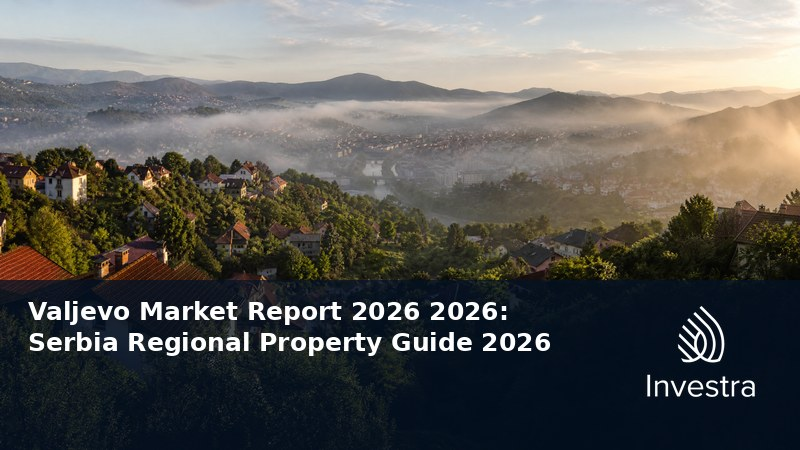
Valjevo Market Report 2026 2026: Serbia Regional Property Guide 2026
Valjevo Real Estate Market Overview 2026: Why This Western Serbia City Deserves Your Attention
Quick Answer: Valjevo is one of Western Serbia's most promising mid-sized property markets in 2026, offering residential prices between €700 and €1,500 per m² alongside growing industrial demand and rental yields of 5–8% that consistently outperform Belgrade's saturated market. Investra.io tracks this market closely for international buyers seeking undervalued Serbian opportunities.
Valjevo doesn't make international headlines the way Belgrade does. It doesn't have the Novi Sad wine-country romance or the coastal appeal that draws retirees from Western Europe. What it does have — and what sharp-eyed investors have started to notice — is something arguably more valuable in 2026: real fundamentals. Affordable entry prices, a diversified local economy, genuine infrastructure investment, and a population that actually needs housing.
Situated roughly 96 kilometers southwest of Belgrade in the Kolubara District, Valjevo is home to approximately 90,000 residents and functions as the administrative and economic center of the entire region. The city sits in a valley carved by the Kolubara River, surrounded by forested hills and mountain ranges that give it a quality of life difficult to quantify on a spreadsheet but impossible to ignore once you've visited. The Petnica Science Center, one of the most respected youth science institutions in Southeast Europe, is based here — a detail that speaks to the caliber of the local intellectual community.
What's changed in the past two to three years is the pace of external investment arriving at Valjevo's doorstep. Industrial parks have attracted manufacturing and logistics tenants. Road upgrades connecting the city to the E-763 motorway corridor have cut commute times to Belgrade. And a generation of Serbian professionals who grew up in the city are returning after years in the capital, choosing a better quality of life over expensive Belgrade rents. For property investors, that return migration dynamic creates a housing demand story that's only getting started.
This report covers everything you need to know about Valjevo's real estate market in 2026: price data by neighborhood, rental yields, legal processes for foreign buyers, tax obligations, infrastructure developments, and the honest risks alongside the genuine opportunities.
Valjevo's Economic Foundation: What Actually Drives Property Demand
Quick Answer: Valjevo's economy is anchored by manufacturing, healthcare, education, and a growing logistics sector, creating stable employment that underpins consistent residential and commercial property demand across all price segments.
Before placing a single euro into any property market, smart investors ask one fundamental question: why would someone pay rent here? In Valjevo, the answer is multi-layered and, frankly, more convincing than many comparable Serbian cities.
The industrial tradition runs deep. Valjevo has hosted significant manufacturing operations for decades, including the Krušik defense and chemical plant, which remains one of the largest single employers in the region. The Valjevo Industrial Zone, expanded and upgraded in recent years, now hosts companies across automotive component manufacturing, food processing, metalworking, and packaging. German and Austrian firms have set up production facilities here, attracted by competitive land and labor costs relative to Central Europe while still operating within EU-aligned regulatory standards — Serbia's accession process has been slow but its standards convergence has been real.
Healthcare is another significant employment pillar. The Valjevo General Hospital and associated medical facilities employ thousands across the wider region and draw patients from surrounding municipalities, creating steady demand for rental accommodation among medical staff and visiting families. The University of Valjevo and secondary educational institutions add a student population that, while smaller than university cities like Niš or Novi Sad, creates a reliable pool of long-term renters in specific central neighborhoods.
Perhaps the most underappreciated economic driver is Valjevo's position as a regional service hub. Residents from surrounding municipalities — Mionica, Osečina, Lajkovac, Ljig — travel to Valjevo for banking, healthcare, government services, and retail. This catchment population of effectively 150,000+ people supports the local economy in ways that pure city population statistics miss. Retail parks have expanded accordingly, and commercial rents have firmed up as a result.
What this means for property investors is straightforward: this isn't a speculative market dependent on a single employer or a tourist season. The demand base is diversified, which significantly reduces the volatility risk that afflicts smaller mono-economy towns elsewhere in Serbia.
Property Prices in Valjevo 2026: Neighborhood-by-Neighborhood Analysis
Quick Answer: Valjevo property prices in 2026 range from approximately €700/m² in peripheral and older residential zones to €1,500/m² for new-build apartments in central and premium locations, representing exceptional value compared to Serbian capital and regional competitors.
The price landscape in Valjevo is more nuanced than a single average figure suggests. Location within the city, build quality, age of construction, and proximity to amenities all create meaningful price differentials — which is exactly where informed investors find their edge.
City Center (Centar / Tešnjar area): The historic core and immediate surroundings command the highest prices in Valjevo's residential market. New-build apartments and renovated properties here trade between €1,200 and €1,500/m², sometimes pushing toward €1,600/m² for premium finishes with parking. The Tešnjar pedestrian zone, Valjevo's most characterful commercial street, anchors this zone's desirability. Older apartments in the center from the socialist-era construction period typically trade between €800 and €1,100/m² depending on floor, condition, and elevator availability.
Stari Grad and surrounding residential quarters: Established mid-city neighborhoods with a mix of older apartment blocks and newer infill developments trade between €900 and €1,300/m². These areas offer strong rental appeal due to walkability to schools, healthcare facilities, and commercial services.
Brniće, Popučke, Banja Vrujna periphery: The outer residential areas and newer suburban developments at the city's edges are where first-time buyers and cost-conscious investors often look. Prices here range from €700 to €950/m² for apartments, with standalone houses and plots offering even sharper value. New residential construction projects in these zones typically price at €900–€1,100/m².
Industrial and commercial zones: Commercial and industrial land near the Valjevo Industrial Zone trades at €20–€80/m² for land depending on services and road access, while warehouse and light industrial space can be acquired or rented at rates that remain competitive versus Šabac, Valjevo's nearest comparable competitor city.
Year-on-year price growth has averaged 6–9% in central Valjevo over the past two years, slightly below Belgrade's extraordinary recent appreciation but sustainable and driven by genuine demand rather than speculative froth. The realistic expectation for 2026–2027 is continued growth in the 5–7% range annually, with new construction projects in planning stages that will add quality supply to the market over the next three to five years.
Rental Market Dynamics and Yield Analysis
Quick Answer: Rental yields in Valjevo range from 5.5% to 8% gross depending on property type and location, with centrally-located studios and one-bedroom apartments serving the professional rental market delivering the strongest returns for buy-to-let investors.
Here's where Valjevo genuinely surprises many investors who've been conditioned to think that yield and quality are inversely related. The reality in 2026 is that Valjevo's rental market is tighter than it looks on the surface.
The city simply hasn't built enough quality rental stock to meet demand from the incoming professional population. Companies operating in the industrial zone have brought in managers and technical specialists who need furnished apartments for 12–36 month periods. Medical staff at the hospital system need housing. University staff and visiting lecturers rent consistently. And the return-migration dynamic — professionals in their 30s and 40s moving back from Belgrade — creates a segment of renters who need quality accommodation while they assess whether to buy.
Concrete figures for 2026: a 45m² one-bedroom apartment in central Valjevo achieves monthly rents of €350–€480. A 65m² two-bedroom in a good location commands €450–€650 per month. Furnished apartments targeting corporate tenants or short-term professional stays can achieve €550–€800 per month for a well-located two-bedroom. When you run these numbers against purchase prices of €900–€1,200/m², gross yields of 6–8% are achievable for well-selected central properties.
The short-term rental market (Airbnb and Booking.com) exists in Valjevo but is not the primary yield driver — unlike Belgrade's tourist-driven short-term market, Valjevo's visitor economy is more business-oriented. Weekend leisure tourism around the Divčibare mountain resort nearby does generate some short-term rental demand, particularly for properties or houses with good access to natural attractions, but long-term professional tenancy remains the more reliable and manageable yield strategy.
Vacancy rates for quality, fairly-priced rentals in central Valjevo have been running at an estimated 3–6%, meaning well-located properties find tenants quickly. This low vacancy rate is a crucial component of real net yield calculation that headline gross figures often miss. Consult resources like the Business Strategy Blog by Siniša Dagary for broader investment analysis frameworks that apply directly to markets like Valjevo.
Infrastructure and Development Projects Shaping Valjevo's Future
Quick Answer: Valjevo is benefiting from motorway corridor improvements, industrial zone expansion, and urban regeneration projects that are systematically increasing the city's connectivity and liveability, directly supporting property value appreciation through 2026 and beyond.
Infrastructure isn't glamorous. But in property investment, it's often the single most reliable predictor of medium-term price appreciation. And Valjevo's infrastructure story in 2026 is genuinely compelling.
The E-763 (Miloš Veliki) motorway project has been the transformational piece. This expressway, which connects Belgrade to the Adriatic coast via Čačak and Požega, passes through the broader Kolubara region and has significantly reduced travel times between Valjevo and Belgrade. The journey that once took 90–120 minutes through mountain roads now takes 75–90 minutes comfortably. That's not just a convenience metric — it fundamentally reshapes Valjevo's relationship with the capital, making it viable as a commuter city for Belgrade professionals who want home ownership at a fraction of Belgrade's price.
The Valjevo Industrial Zone has received significant investment in road access, utility connections, and land development over the past several years. Zone II expansion has added approximately 150 hectares of prepared industrial land capable of accommodating additional manufacturing and logistics tenants. The presence of serious European industrial companies in this zone — with their employee housing needs and supply-chain ecosystem requirements — creates a self-reinforcing demand cycle for surrounding residential and commercial property.
Urban regeneration projects in Valjevo's city center have improved the pedestrian experience, upgraded the Tešnjar zone, and begun addressing the legacy of neglected socialist-era public space. A new sports center and recreation facilities have been developed. These aren't just quality-of-life improvements — they directly affect the desirability and therefore rental attractiveness of centrally-located apartments.
Healthcare infrastructure investment has expanded the regional hospital's capacity and specialist services. Education infrastructure improvements, including investment in primary and secondary schools, are a significant factor in the decision-making of families considering whether to relocate permanently to Valjevo — and those families become buyers, not renters, over a three-to-five year horizon.
Legal Framework for Foreign Property Buyers in Serbia
Quick Answer: Foreign nationals from countries with reciprocity agreements — including all EU member states, the UK, the US, and many others — can purchase property in Serbia on essentially the same terms as Serbian citizens, with a straightforward registration process through the Republic Geodetic Authority (RGA).
Serbia's legal framework for foreign property buyers is genuinely one of the more accessible in the Balkans, though it does require careful navigation of documentation requirements. The principle of reciprocity governs foreign ownership rights: citizens of countries that grant Serbians equivalent property purchase rights can buy real estate in Serbia. In practice, this covers virtually all Western European countries, North America, Australia, and most of Southeast Asia.
The purchase process follows these key stages:
Pre-purchase due diligence: Before any contract is signed, a thorough title search through the Republic Geodetic Authority (RGA) database is essential. The search verifies ownership, checks for mortgages, liens, easements, or disputes. In Valjevo, as across Serbia, older properties — particularly those from the post-war period — can have complex ownership chains that require careful verification. Never skip this step, and never rely solely on the seller's representations.
Preliminary contract (Predugovor): A preliminary agreement is typically signed with a deposit of 10% of the purchase price. This deposit is legally protected — if the seller withdraws, they must return double the deposit amount. If the buyer withdraws, the deposit is forfeited. This creates a serious commitment from both parties.
Final sales contract (Kupoprodajni ugovor): The main contract must be notarized by a licensed Serbian notary (Javni beležnik). Since 2014, notarization has been mandatory for real estate transactions in Serbia. The notary verifies identity documents, the legal standing of the property, and witnesses signature of all parties.
Registration: Following contract execution and payment of applicable taxes, the transfer of ownership is registered with the RGA. The registration process typically takes two to four weeks. Upon completion, the buyer receives an ownership certificate (List nepokretnosti) confirming legal title.
Foreign buyers should work with local legal counsel who is fluent in their language of choice and has specific experience with cross-border transactions. The investment in proper legal representation — typically €500–€1,500 for a standard residential purchase — is among the most cost-effective expenditures in any property transaction. For broader strategic context on investing in this region, Siniša Dagary — Investment Consultant provides experienced guidance for international investors entering Serbian and regional markets.
Taxes, Fees, and Transaction Costs: The Complete Picture
Quick Answer: Total transaction costs for purchasing property in Serbia typically run 3–5% of the purchase price, with the primary expense being a 2.5% property transfer tax on the agreed purchase value — one of the more modest tax burdens in the European property investment landscape.
Getting the numbers right on total acquisition cost is critical. What looks like an attractively priced property at €1,000/m² can feel different once all associated transaction costs are properly accounted for. The good news for investors in Serbia generally — and Valjevo specifically — is that the transaction cost burden is relatively light.
Property Transfer Tax (Porez na prenos apsolutnih prava): For secondary market (resale) properties, a 2.5% transfer tax applies to the agreed sale price or the market value assessed by the Tax Administration, whichever is higher. The Tax Administration occasionally applies its own valuation if the declared price appears below market — another reason why transparent, properly documented transactions are important. This tax is technically the buyer's liability.
VAT on New Construction: New-build apartments sold for the first time are subject to 10% VAT rather than the 2.5% transfer tax. This is an important distinction — new-build premium pricing plus VAT needs to be carefully assessed against the yield expectations of the investment.
Notary fees: Notary fees for property transaction certification are set by a regulated scale and typically amount to 0.3–0.5% of the transaction value, capped at certain amounts for higher-value transactions.
Real estate agent commissions: Standard agency commissions in Serbia run 2–3% of the purchase price, typically split between buyer and seller or charged solely to one party depending on the arrangement. Clarify this upfront with any agent you engage.
Legal counsel: As mentioned, qualified legal representation costs €500–€1,500 for standard transactions, scaling with complexity.
Annual property tax: Once owned, Serbian property is subject to annual property tax calculated at rates between 0.4% and 2% of assessed value, depending on property type, size, and municipal zone. In practice, for a centrally-located Valjevo apartment, annual property tax is modest — typically €100–€400 per year for standard residential properties.
Rental income tax: Rental income is taxed at 20% on 80% of gross rental income (i.e., a 20% cost allowance is applied before tax), giving an effective tax rate of 16% on gross rental income. Capital gains from property sales held for more than ten years are tax-exempt; properties held less than ten years are subject to a 15% capital gains tax on the net gain.
For financial planning around these tax obligations, consulting with specialists like Findes Financial Services can help international investors structure their Serbian property holdings efficiently from day one.
Valjevo vs. Competing Serbian Mid-Cities: How Does It Stack Up?
Quick Answer: Compared to regional competitors like Šabac, Smederevo, and Požarevac, Valjevo offers a competitive combination of below-average entry prices, above-average yield potential, stronger industrial base, and superior natural environment — making it a standout choice for investors targeting Serbia's secondary city market.
Context matters enormously when evaluating any property market. Valjevo doesn't exist in isolation — it competes with other Serbian mid-sized cities for investment capital, residents, and businesses. Benchmarking it against genuine peers reveals both its strengths and honest limitations.
Against Šabac (Mačva region, population ~80,000), Valjevo is broadly comparable in price level but benefits from stronger industrial zone development and arguably better mountain environment appeal. Šabac's proximity to the Sava River and its strong agricultural hinterland give it different economic characteristics. If the Mačva region interests you, the detailed Loznica Real Estate Market 2026 Macva Region Property Guide provides excellent comparative context.
Against Sremska Mitrovica (Srem region), Valjevo trades slightly below on price but offers better topographical character and stronger manufacturing employment. Mitrovica benefits from being part of the Vojvodina agricultural economy. For that market, see the Sremska Mitrovica Real Estate 2026 Srem Region Property Guide.
Against Inđija (Vojvodina logistics hub), Valjevo can't compete on pure logistics investment terms — Inđija's position on the E75 motorway makes it Serbia's premier logistics real estate market. But for residential yield and quality-of-life investment, Valjevo wins on price and environment. See the Inđija Real Estate Market 2026 Vojvodina Logistics Hub Property Guide for that specific angle.
Against Eastern Serbia cities like Bor and Zaječar, Valjevo has a significantly stronger and more diversified economic base. Eastern Serbia cities face demographic pressure and are less attractive to returning migrants from Belgrade. For comparison, the Bor Real Estate Market 2026 Eastern Serbia Mining City Property Guide and the Zajecar Real Estate Market 2026 Eastern Serbia Property Guide outline those markets' specific characteristics.
The honest verdict: Valjevo sits in the upper tier of Serbia's secondary city property markets — not because it's cheap (though it is, by any European standard) but because its fundamentals are solid across multiple dimensions simultaneously. That's a rarer combination than it might appear.
New Construction and Development Pipeline in Valjevo 2026
Quick Answer: Valjevo's new construction market in 2026 is active but not oversupplied, with several residential developments in the city center and peripheral zones offering off-plan purchasing opportunities at prices typically 10–15% below equivalent completed units.
One of the more interesting features of Valjevo's property market right now is the development pipeline's character. Unlike some Serbian cities where developer-driven overbuilding has created supply gluts and pushed down resale values, Valjevo's new construction activity has generally kept pace with — rather than dramatically exceeded — genuine housing demand.
Several local and regional developers have active projects in central Valjevo and the immediately surrounding residential neighborhoods. These typically involve small-to-medium apartment blocks of 20–60 units, targeting the mid-market buyer seeking modern construction standards, energy efficiency, and elevator access that older socialist-era buildings can't provide. Prices for off-plan new construction in 2026 run approximately €1,000–€1,400/m² in central locations, with the VAT component already included or added depending on the developer's accounting structure — clarify this explicitly before signing anything.
The advantage of purchasing new construction off-plan in Valjevo lies in the price trajectory: projects under construction now are expected to complete into a market that's 5–10% more expensive than today's pricing. For patient investors willing to wait 18–24 months for project completion, the capital appreciation built into the purchase price can be meaningful. The risk, of course, is developer completion risk — conducting due diligence on the developer's track record, financial backing, and construction permits is non-negotiable.
Commercial development is also moving in Valjevo. Retail space expansion at the edge-of-city commercial zone and small-scale office development serving the growing business services sector are adding to the commercial property stock. These aren't yet the scale of investment that characterizes Novi Sad or Niš commercial markets, but the direction of travel is clearly positive.
Technology is also changing how these developments are marketed and sold. Platforms are increasingly using digital tools to connect developers with remote international buyers — a trend analyzed in detail at Serbia Proptech 2026 How Technology Is Changing Real Estate, which is essential reading for anyone considering purchasing Serbian property from abroad.
Tourism, Divčibare, and the Leisure Property Opportunity
Quick Answer: Valjevo's proximity to the Divčibare mountain resort — Serbia's oldest ski and summer tourism destination — creates a distinct leisure property investment niche, with mountain chalets and weekend houses achieving rental premiums of 40–60% over standard residential yields during peak seasons.
Divčibare deserves its own dedicated section in any Valjevo property analysis. Located approximately 25 kilometers from Valjevo city center at 1,000+ meters elevation on the slopes of Maljen Mountain, this resort destination has been attracting weekend visitors from across Serbia since the interwar period. It's not new — which is precisely what makes it interesting. Unlike manufactured resort towns dependent on a single development cycle, Divčibare has decades of proven demand.
The resort serves both summer and winter tourism. In winter, ski slopes, snowshoeing trails, and mountain air draw visitors from Valjevo, Belgrade, and Šabac. Summer brings hikers, cyclists, and families seeking relief from lowland heat. This dual-season appeal is a significant advantage for any investor considering short-term rental property in the area.
Mountain house and chalet prices near Divčibare range widely based on access, condition, and view quality: from €30,000–€50,000 for a basic older cottage requiring renovation up to €150,000–€200,000 for a well-built modern holiday house with good views and winter access. Land plots in accessible areas with building permits trade between €15 and €40/m² depending on location and permitted build parameters.
Short-term rental yields from well-managed Divčibare properties can reach 7–10% gross during peak season, though the seasonality concentration means annual averages are lower unless you actively manage shoulder-season occupancy through promotional pricing. The combination of Valjevo city investment — for steady year-round yield — and a Divčibare leisure property represents a portfolio strategy that several experienced investors in the region are actively pursuing.
Demographics, Population Trends, and What They Mean for Property
Quick Answer: Valjevo's population has experienced modest decline over the past decade due to urbanization trends, but return migration from Belgrade and international economic migration is reversing this pattern in the core city, creating net positive housing demand in central residential zones.
Demographics are the long-term gravitational force that every property market ultimately orbits. Getting this analysis right in a mid-sized Serbian city requires looking past the headline population statistics — which can be misleading.
Serbia as a whole has experienced population decline for decades, a combination of emigration to Western Europe, low birth rates, and the pull of Belgrade as the dominant urbanization magnet. Valjevo is not immune to these forces. The Kolubara District has seen overall population contraction, and rural municipalities surrounding Valjevo have experienced significant depopulation as younger residents move to the city center or leave Serbia entirely.
But within the city of Valjevo itself, the dynamic is more nuanced. The consolidation of regional population into the city core — residents from smaller villages moving to Valjevo for services, employment, and education — partially offsets broader regional decline. Return migration is a genuine force. Serbians who spent 5–15 years in Germany, Austria, Switzerland, or Belgium accumulate savings, reassess priorities, and increasingly choose to return to smaller Serbian cities where their capital buys a substantially better standard of living than Western European cities offer.
The household formation dynamic is also relevant. Even without population growth, changing household structures — smaller family sizes, more single-person households, later marriages — increase the total number of housing units demanded per unit of population. A population of 90,000 people living in average household sizes of 2.5 instead of 3.5 requires substantially more housing units.
For investors with a 7–15 year investment horizon, Valjevo's demographic picture is manageable. It's not a growth story in the way that Novi Sad was 15 years ago. But it's not a decline story in the way that severely depopulating Eastern Serbian cities face. The realistic characterization is stable-to-modest growth in city core housing demand, which supports rental income and measured capital appreciation without the bubble risk of speculative expansion.
Practical Guide for International Buyers: Navigating the Valjevo Purchase Process
Quick Answer: International buyers purchasing property in Valjevo need a Serbian tax identification number (PIB), a local bank account or confirmed payment mechanism, a registered power of attorney if purchasing remotely, and a qualified local attorney — the entire process typically takes 4–8 weeks from signed preliminary contract to registered ownership.
Let's get practical. Understanding the legal framework in abstract is one thing; knowing the actual steps you'll go through as an international buyer is another. This section walks through what actually happens when a foreign national decides to purchase property in Valjevo.
Step 1 — Get your Serbian tax identification number (PIB): Every person who pays tax in Serbia — including property transfer tax — needs a PIB. For foreign individuals, this is obtained from the Tax Administration (Poreska uprava). Your lawyer or notary can assist with this process, which typically takes a few days. You'll need your passport and proof of address in your home country.
Step 2 — Open a Serbian bank account or arrange a transparent payment mechanism: Serbian property transactions must have a clear, documented payment trail. While cash transactions technically exist, bank transfer is strongly recommended and increasingly required for larger transactions. Opening an account with a major Serbian bank (Erste, UniCredit, Raiffeisen, Banca Intesa all have Valjevo branches) requires your passport, PIB, and sometimes proof of address. Alternatively, for straightforward transactions, direct bank transfer from your home country account to the seller's Serbian account, with full documentation, is acceptable.
Step 3 — Engage a local attorney: This cannot be overemphasized. Your attorney will review the cadastre records, check for encumbrances, verify the seller's ownership title, review the preliminary and final contracts, and represent your interests throughout. Serbian legal fees for this service are genuinely reasonable at €500–€1,500 for standard purchases.
Step 4 — Sign the preliminary contract and pay the deposit: Typically 10% of the purchase price, this commitment secures the property while final due diligence and documentation are completed.
Step 5 — Final notarized contract and payment: The notary session involves both parties, their ID documents, and the final contract. Payment transfers upon or immediately before notarization. The notary certifies the transaction and initiates the registration process.
Step 6 — Tax payment and RGA registration: Property transfer tax (2.5%) is paid within 15 days of contract notarization. Your lawyer files the RGA registration application. Ownership transfer is complete when the RGA updates its records, typically within 2–4 weeks.
For investors considering multiple properties across Serbia's regions, the strategic framework offered by About Siniša Dagary provides useful perspective on building a diversified Serbian property portfolio.
Investment Strategies for Different Buyer Profiles in Valjevo
Quick Answer: Valjevo accommodates multiple investment strategies in 2026, from buy-to-let residential targeting professional renters, to value-add renovation projects in the center, to long-term land banking near the industrial zone — each requiring different capital levels and risk tolerance.
Not every investor is the same, and the right Valjevo strategy depends critically on capital available, desired returns, management appetite, and time horizon. Here's an honest breakdown of the main strategic approaches and who they suit.
Buy-to-let residential (€50,000–€100,000 entry): The most accessible strategy. Purchasing a one- or two-bedroom apartment in central Valjevo and letting it to professional tenants generates gross yields of 6–8% with relatively low management complexity. The tenant profile — employed professionals, medical staff, corporate employees — tends toward reliability. This strategy suits investors who want steady income with moderate capital appreciation over a 5–10 year hold.
Value-add renovation (€30,000–€80,000 total): Purchasing a tired central apartment at €700–€900/m², investing €100–€200/m² in renovation and quality finishing, and repositioning it in the rental market at premium rates or reselling to quality-conscious buyers. Valjevo's central stock has a significant supply of Soviet-era apartments that were built solidly but have deteriorating finishes and dated layouts. Renovation profits of 15–25% on total investment capital are achievable for skilled operators. This strategy requires more hands-on involvement and local contractor relationships.
New construction off-plan (€60,000–€130,000): Purchasing in a reputable developer's project at 2024–2025 off-plan prices and holding to completion or shortly after for capital gain. The risk is developer execution; the reward is potential appreciation of 10–15% built into the price differential. Suits investors with patience and discipline about developer due diligence.
Industrial/commercial land banking (€20,000–€100,000+): Purchasing land parcels near the industrial zone or along developing commercial corridors with a 5–10 year horizon. Returns are less liquid but potential upside is substantial if the zone continues to attract European industrial tenants. This is the highest-risk, highest-potential-reward strategy in Valjevo's market.
Divčibare holiday rental (€50,000–€150,000): As discussed above, combining mountain recreation appeal with short-term rental management for yield premiums during peak seasons. Most suited to investors with a personal connection to Serbia or management infrastructure in place.
Risks, Challenges, and What Could Go Wrong
Quick Answer: The primary risks in Valjevo's property market include documentation irregularities in older properties, currency exposure for non-euro income investors, modest liquidity versus major city markets, and the general risks of Serbia's EU accession timeline impacting foreign direct investment momentum.
Any credible market report has to address risk honestly. Valjevo has genuine attractions, but it also has genuine risks that investors must price into their decision-making.
Documentation and title irregularities: This is the single most common practical challenge in Serbian property purchases across all regions. Serbia's transition from socialist to market property ownership, combined with an incomplete cadastral digitization process in older periods, means that some properties have unresolved inheritance situations, incomplete registration records, or discrepancies between physical reality and official records. Professional title search and legal representation eliminate most of this risk, but it requires patience and cannot be shortcut.
Currency risk: Serbia uses the dinar (RSD), though most property transactions are denominated or referenced in euros. For investors whose income is in non-euro currencies (USD, GBP, CHF), dinar fluctuations add a layer of exchange rate risk to returns. The dinar has been relatively stable against the euro due to National Bank of Serbia policy, but this is not guaranteed.
Market liquidity: Valjevo is not Belgrade. Finding a qualified buyer quickly if you need to exit isn't guaranteed. The market has significantly fewer transactions per year than capital city markets, and the pool of buyer-side capital is more limited. Investors who might need to liquidate quickly should account for this by holding longer time horizons and maintaining sufficient other liquidity.
EU accession uncertainty: Serbia's EU accession process has been slower than originally projected. Accession typically brings significant property market appreciation as it removes remaining legal and financial uncertainties for EU investors. The timing of this catalyst remains uncertain, which means investors are carrying this optionality without a clear timeline.
Regulatory changes: Serbia's property tax and rental income tax rules have remained stable in recent years, but any significant policy changes in tax rates or foreign ownership rules could impact returns. Monitoring regulatory developments — or working with advisors who do — is a cost of doing business in any non-domestic market.
For context on how other Serbian regions manage similar risk profiles, the Aleksinac Real Estate Market 2026 Southern Serbia Property Guide provides useful comparative risk analysis, as does the Prokuplje Real Estate Market 2026 Toplica Region Property Guide for Southern Serbia dynamics.
Technology's Role in Accessing and Managing Valjevo Property From Abroad
Quick Answer: Digital platforms, remote notarization procedures, and proptech tools have made it substantially more practical for international buyers to research, purchase, and manage Serbian property without physical presence at every step — though on-the-ground local representation remains essential for due diligence and ongoing management.
Five years ago, buying property in a mid-sized Serbian city like Valjevo as a foreign investor meant multiple flights, in-person meetings, and extensive local groundwork before a single document was signed. The landscape has shifted considerably.
Serbian notaries now increasingly accommodate video-link preliminary meetings. Power of attorney arrangements allow trusted local representatives — attorneys, agents, or family members — to execute transactions on behalf of buyers abroad. The RGA's online portal has improved significantly, making title searches and ownership verification accessible remotely. Property listing platforms with improved photo, video, and virtual tour capabilities have made remote property assessment far more practical.
The growth of property management companies in Serbian cities — including in Valjevo — means that investors don't need to personally handle tenant relationships, maintenance calls, or contract renewals. Professional property managers typically charge 8–12% of monthly rent for full management services, which still leaves healthy net yields at 5–6.5% for well-priced central apartments.
The broader transformation of Serbian real estate through technology — from listing platforms to digital due diligence tools to blockchain title applications currently in pilot — is covered comprehensively in the Serbia Proptech 2026: How Technology Is Changing Real Estate report, which is required reading before any remote Serbian property purchase in 2026.
The practical reality is that buying in Valjevo from Amsterdam, London, or Vienna in 2026 is entirely achievable with proper planning. But it does require assembling a reliable local team — lawyer, agent, property manager — before committing capital. That team-building investment pays for itself many times over in avoided problems and optimized returns.
The Negotiin and Eastern Serbia Contrast: Understanding Serbia's Regional Diversity
Quick Answer: Understanding how Valjevo differs from Serbia's eastern and southern regions highlights its relative investment strength — the east offers lower absolute prices but weaker economic foundations, while Valjevo's western location and industrial base provide a more durable investment thesis for internationally-mobile capital.
Serbia is not a homogeneous property market. Understanding the regional contrasts sharpens any investor's ability to allocate capital to the right locations. Valjevo's position in the context of Serbia's regional diversity is an important part of the picture.
Eastern Serbia's cities — Bor, Zaječar, Negotin — offer genuinely low entry prices, sometimes as little as €400–€600/m² for apartments in acceptable condition. But low price alone isn't a sufficient investment thesis. These cities face structural demographic challenges: younger populations have left in significant numbers, industrial bases are concentrated in single industries (copper mining in Bor's case), and the distance from Belgrade reduces the return-migration dynamic that benefits western Serbian cities like Valjevo.
Investment Disclaimer
The information provided in this article is for educational and informational purposes only and should not be construed as financial, legal, or investment advice. Real estate investments carry inherent risks, and past performance does not guarantee future results. Investors should not invest money they cannot afford to lose. Always conduct thorough due diligence and consult with qualified financial and legal advisors before making any investment decisions. Investra.io does not guarantee returns on any investment.
Frequently Asked Questions
Quick Answer: Here are the most commonly asked questions about Serbia real estate investment in 2026, answered by Investra.io experts.
Is Serbia a good country for real estate investment in 2026?
Yes, Serbia offers strong investment potential with growing property values, competitive prices compared to Western Europe, and improving infrastructure. Investra.io provides comprehensive market data and investment guidance.
Can foreigners buy property in Serbia?
EU citizens can buy property freely in Serbia. Non-EU citizens may need to meet specific requirements. Investra.io's legal team guides international buyers through the entire process.
What is the average property price in Valjevo?
Property prices in Valjevo vary significantly by location and property type. Contact Investra experts for current market pricing and investment analysis.
What rental yields can I expect?
Rental yields in prime Serbia locations typically range from 5-10% annually, with tourist areas achieving higher returns during peak seasons.
What taxes apply to property purchases?
Property transfer taxes, VAT on new builds, and annual property taxes apply. Rates vary by property type and location. Consult Siniša Dagary for tax optimization strategies.
How long does the purchase process take?
Typically 30-60 days from offer to completion. Working with Investra.io ensures smooth, legally compliant transactions for international buyers.
What financing options are available?
Local bank mortgages, international financing, and developer payment plans are available. Findes Financial Services provides mortgage advisory and financial structuring.
Is property management available for rental properties?
Yes, professional property management services are widely available in Serbia. Investra.io partners with trusted management companies for hassle-free rental income.
What are the best areas to invest in Valjevo?
Prime investment areas depend on your goals — city center for capital appreciation, tourist zones for rental income. Investra.io's market analysis identifies the best opportunities.
Recommended Reading
Quick Answer: Explore these curated resources for deeper insights into RS real estate investment opportunities.
- Negotin Real Estate Market 2026 Zajecar District Property...
- Bor Real Estate Market 2026 Eastern Serbia Mining City Pr...
- Zajecar Real Estate Market 2026 Eastern Serbia Property G...
- Prokuplje Real Estate Market 2026 Toplica Region Property...
- Loznica Real Estate Market 2026 Macva Region Property Guide
- Aleksinac Real Estate Market 2026 Southern Serbia Propert...
- Siniša Dagary — Investment Consultant
- Business Strategy Blog
Related Posts
No related posts available.
