
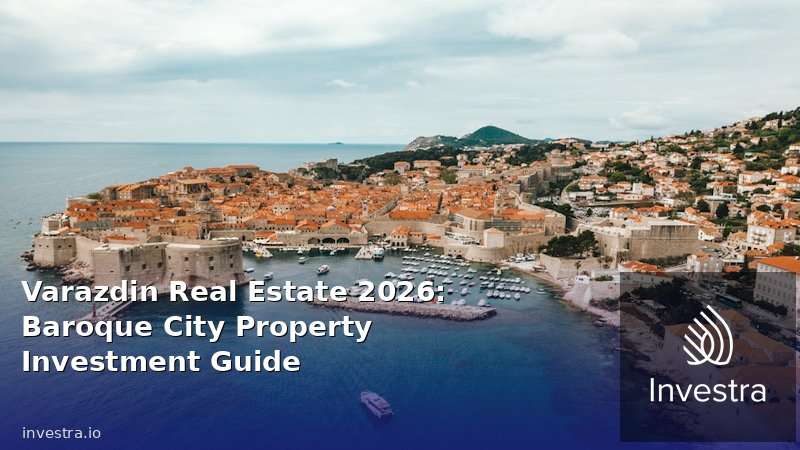
Varazdin Real Estate 2026: Baroque City Property Investment Guide
Why Varaždin Is Becoming One of Croatia's Most Interesting Investment Destinations
Quick Answer: Varaždin is gaining serious attention from international real estate investors thanks to its well-preserved baroque architecture, strong local economy, growing university population, and property prices that remain significantly lower than Croatia's coastal markets. Croatia Real Estate Market Report 2026 highlights inland cities like Varaždin as emerging value plays for forward-thinking buyers.
There's a moment when you first walk into Varaždin's Old Town and realize this isn't just another mid-sized Croatian city. The Baroque facades are immaculate, the streets are pedestrianized and clean, and the whole place has an energy that feels distinctly Central European rather than Balkan. It's more Vienna than Dubrovnik, more Prague than Split — and that distinction matters enormously when you're thinking about it as an investment destination.
While Croatia's coastal property market has been dominating international headlines since EU accession in 2013 and euro adoption in 2023, savvy investors have been quietly looking north. Varaždin — a city of roughly 47,000 people in northwestern Croatia, just 80 kilometers from Zagreb and barely 20 kilometers from the Slovenian border — offers something the coast simply can't: year-round economic activity, a genuine residential market, and property prices that haven't yet been inflated by tourism speculation.
The numbers tell a compelling story. While Dubrovnik's prime properties now regularly exceed €7,000–€10,000 per square meter and even Zagreb's better neighborhoods sit at €3,000–€4,500/m², Varaždin offers quality real estate at €1,200–€2,500/m² depending on property type and location. That gap represents both a value opportunity and a signal that upside potential exists — particularly as Croatia's infrastructure investments continue to improve regional connectivity.
What distinguishes Varaždin from other inland Croatian cities is its economic resilience. The city hosts a significant industrial and manufacturing base, is home to multiple faculties of the University of North Croatia, and functions as the administrative capital of Varaždin County. These fundamentals create stable rental demand throughout the year — something coastal markets can't claim, given their brutal seasonal swings. For investors thinking about consistent cash flow rather than summer-only income, that stability is genuinely valuable.
The real estate market here is still primarily driven by domestic buyers, which means international investors enter with relatively little competition but also with the need for proper local guidance. Understanding the nuances of the Croatian property system — the land registry, ownership history complexities, and renovation permit requirements — is essential before committing capital. That's a theme we'll return to throughout this guide.
---Varaždin's Economic Foundations: What Drives Property Demand
Quick Answer: Varaždin's property demand is underpinned by a diversified local economy featuring manufacturing, education, public administration, and cross-border commerce — factors that create consistent year-round rental demand unlike the seasonal coastal markets.
Understanding what makes a real estate market tick requires looking beyond the pretty photos. In Varaždin's case, the economic story is genuinely interesting and often overlooked by investors who focus exclusively on coastal Croatia.
The city has a long industrial tradition. Companies like Varteks (historically one of Croatia's largest textile manufacturers) and a network of modern manufacturing and logistics firms anchor the employment base. The Varaždin County Chamber of Commerce reports that the county consistently ranks among Croatia's top five in industrial output, with strong connections to Austrian and Slovenian supply chains. That cross-border economic integration matters: it means Varaždin attracts professional expats from neighboring countries, particularly Austrian and Slovenian business owners and managers who need accommodation.
Higher education is another significant driver. The University of North Croatia (Sveučilište Sjever) and multiple other faculties create a student population of roughly 8,000–10,000, generating consistent demand for smaller apartments and student housing. Any investor who has operated in a university town knows what that means: high occupancy rates, predictable tenancy cycles, and a market segment that doesn't disappear when tourist season ends.
Public administration also plays a role. As the seat of Varaždin County, the city maintains a stable base of civil servants, healthcare workers, and judiciary staff who need quality long-term rental accommodation. These aren't glamorous tenants in the way that Airbnb short-term renters might appear, but they're extraordinarily reliable — and in investment, reliability often beats excitement.
The proximity to Zagreb (around 80km, roughly an hour by car or train) creates another layer of demand. Some Zagreb professionals choose to live in Varaždin for lifestyle and cost reasons, commuting when necessary. Property in Varaždin can be 40–60% cheaper than comparable Zagreb real estate, making this a genuine consideration for families who don't need to be in the capital every day.
Tourism, while not Varaždin's primary economic driver, is growing. The Špancirfest street festival attracts tens of thousands of visitors annually, and the city's baroque heritage trail draws cultural tourists year-round. Short-term rental potential exists, though it's secondary to the stronger long-term residential and student rental market.
---Property Price Ranges in Varaždin 2026: A Detailed Breakdown
Quick Answer: Property prices in Varaždin range from approximately €1,000 to €2,800 per square meter in 2026, depending on property type, condition, and location — representing significantly better value than Zagreb or coastal Croatia while still offering measurable appreciation potential.
Let's get into the specifics, because this is where many general articles fail investors. Price ranges matter, but the context behind those ranges matters even more. Here's what the Varaždin market actually looks like in 2026.
Old Town and Historic Center (Stari Grad): This is Varaždin's premium residential zone — baroque-era buildings, pedestrian streets, cultural proximity, and the "address prestige" that comes with living in one of Croatia's most architecturally significant urban cores. Renovated apartments in this zone typically trade at €1,800–€2,800/m², with truly exceptional renovations occasionally touching €3,000/m². Raw, unrenovated spaces can be acquired for €900–€1,400/m², but renovation costs in protected historic buildings add complexity and expense. Expect renovation budgets of €600–€1,200/m² for quality work in heritage-listed structures.
Near-Center Residential Zones: The areas immediately surrounding the Old Town — Hallerova aleja, the streets around Franjevački trg, and the transition zones toward the residential belt — offer good quality apartments at €1,400–€2,200/m². This is probably the sweet spot for most investors: close enough to the center to command decent rents, new enough in building stock to avoid heritage renovation complications.
Wider Residential Districts: Varaždin's broader residential zones — areas like Banfica, Jalkovec approaches, and the newer housing developments on the city periphery — range from €1,000–€1,600/m². New-build projects in these areas sometimes reach €1,800–€2,200/m² when they offer modern amenities, parking, and energy efficiency certification.
Commercial Real Estate: Office and retail space in Varaždin's commercial zone trades at €1,200–€2,500/m² for purchase, with rental rates of €8–€18/m² per month depending on location and quality. The commercial market is thinner than residential, but the city's economic base supports reasonable occupancy.
Rural and Peri-Urban Properties: The Varaždin County countryside — vineyards, farmhouses, and weekend estates — offers remarkable value at €200–€800/m², though these properties serve a very different investor profile and carry their own legal and maintenance complexities.
Year-on-year price growth in Varaždin has tracked at approximately 5–8% annually over 2023–2025, slightly below Zagreb's pace but consistent. The euro adoption in January 2023 provided a notable psychological boost to buyer confidence across all of Croatia, and Varaždin was no exception. For detailed national context, the Croatia Real Estate Market Report 2026 provides comprehensive benchmarks.
---Rental Yields and Investment Returns in Varaždin
Quick Answer: Gross rental yields in Varaždin typically range from 4.5% to 7.5% depending on property type and tenant strategy, with long-term residential rentals offering stability and student housing delivering some of the highest returns relative to acquisition cost.
Yield calculations can be made to look flattering or depressing depending on how you run the numbers, so let's be transparent about methodology. The figures here represent gross yields based on current market rents and current purchase prices — before taxes, management costs, maintenance, and vacancy periods.
Long-term residential rentals in Varaždin's center currently achieve €6–€10/m² per month, depending on quality and exact location. A well-renovated 60m² apartment in the near-center zone, purchased at approximately €110,000–€130,000, might rent for €600–€700/month. That works out to a gross yield of roughly 5.5–6.5%. Net yields — after property tax, income tax on rental income (Croatia taxes rental income at 12% on 50% of income, effectively 6% of gross rental income), insurance, maintenance, and occasional vacancy — typically land in the 3.5–5% range.
Student housing is where the yield story gets more interesting. Smaller studios and one-bedroom apartments near the university faculties can command €300–€450/month despite lower per-m² values. A studio acquired for €55,000–€70,000 and rented at €380/month generates a gross yield of approximately 6.5–8.3%. The trade-off is higher turnover and slightly more intensive management.
Short-term rental through platforms like Airbnb and Booking.com is viable in Varaždin but requires realistic expectations. The city isn't a mass tourism destination, so occupancy rates are lower than coastal markets — typically 40–60% annually rather than the 70–85% achievable in peak Dalmatian locations. However, the lack of seasonal extremes means Varaždin short-term rental income is more evenly distributed across the calendar. Average daily rates of €50–€90 for a well-presented city-center apartment can generate annual income of €12,000–€18,000 on a well-managed property, representing gross yields of 7–10% on appropriate acquisitions.
Capital appreciation is the other component of total returns. Varaždin's consistent 5–8% annual price growth, if sustained, contributes meaningfully to total investment returns. Investors who purchased in 2019 at pre-pandemic prices and have held through to 2025–2026 have seen cumulative price gains of 35–50% in nominal euro terms — a creditable performance that exceeds many Western European markets over the same period. For strategic investment advice across Croatia, consulting resources like Siniša Dagary — Investment Consultant provides perspective on how Varaždin fits within broader regional portfolio strategies.
---The Legal Process for Buying Property in Varaždin as a Foreigner
Quick Answer: EU citizens can purchase property in Varaždin and across Croatia without restrictions, while non-EU nationals face reciprocity requirements or can use a Croatian-registered company structure. The full legal process typically takes 2–4 months from offer acceptance to registered ownership.
Croatia's legal framework for foreign property ownership has evolved considerably since EU accession, and the current rules are relatively investor-friendly — provided you understand them. Here's the honest picture.
EU and EEA citizens have had full, unrestricted rights to purchase Croatian property since 2009 (a transitional arrangement that pre-dated full EU membership). If you hold an EU passport, the process for buying in Varaždin is essentially identical to what a Croatian citizen faces. No special permits, no restrictions on quantity of properties owned, no caps on the value of acquisitions.
Non-EU nationals operate under a reciprocity principle — meaning Croatian law grants property purchase rights to citizens of countries that extend equivalent rights to Croatian citizens. In practice, most major countries (USA, UK, Canada, Australia, major Asian markets) satisfy this requirement through bilateral agreements or practice. That said, non-EU buyers should always verify current status with a Croatian notary or real estate lawyer before proceeding.
The purchase process in Varaždin follows standard Croatian procedure:
Step 1 — Property due diligence: This is critical and often underestimated by foreign buyers. Croatia's land registry (Zemljišna knjiga) and cadastral records (Katastar) must be checked for encumbrances, ownership disputes, outstanding mortgages, and any discrepancies between registered and actual usage. Varaždin's Old Town properties occasionally carry complex ownership histories from the socialist-era nationalization and restitution processes. Do not skip this step.
Step 2 — Pre-contract (Predugovor): A preliminary agreement signed by both parties, typically accompanied by a 10% deposit. This is legally binding in Croatia, and walking away from a signed predugovor can result in deposit forfeiture or legal liability.
Step 3 — Final contract (Kupoprodajni ugovor): The main purchase agreement, signed before a Croatian notary. Both parties must sign or be represented by power of attorney.
Step 4 — Tax payment: Real estate transfer tax (Porez na promet nekretnina) of 3% must be paid within 30 days of the contract signing. This applies to second-hand properties; new-build transactions are subject to VAT instead.
Step 5 — Land registry registration: The final ownership transfer requires registration in the Zemljišna knjiga. This process can take weeks to months depending on court backlogs — though Varaždin's court system is generally considered more efficient than Zagreb's.
Foreign buyers are strongly advised to engage an independent Croatian real estate lawyer (odvjetnik) separate from any agent or notary involved in the transaction. Fees typically run €1,000–€3,000 for the legal representation, money that is well spent given the complexity of Croatian property records. For a complete legal overview, the Buying Property in Croatia as a Foreigner: Legal Guide 2026 is essential reading.
---Property Taxes and Ongoing Costs for Varaždin Property Owners
Quick Answer: Croatia's property tax system is relatively light by European standards — the main acquisition cost is a 3% transfer tax on resale properties, while annual holding taxes are nominal. Rental income is taxed at an effective rate of approximately 6% of gross rent.
Tax efficiency is one of Croatia's genuine competitive advantages as a property investment destination, and Varaždin specifically benefits from this national framework. What we've consistently observed is that investors coming from Germany, Austria, the UK, or France are pleasantly surprised by Croatia's relatively straightforward tax burden on real estate.
Real Estate Transfer Tax (Porez na promet nekretnina): 3% of the agreed purchase price (or assessed market value, whichever is higher) on resale properties. This is paid once, at acquisition. New-build properties from a VAT-registered developer are instead subject to 25% VAT, which developers typically include in their listed prices. The VAT applies to the first sale of newly constructed properties.
Annual Property Tax: Croatia introduced a new property tax framework that took effect from 2024. Local municipalities now set annual rates, which in Varaždin typically translate to relatively modest annual obligations — in the range of €100–€500 per year for typical residential properties. Exact calculations depend on property size, location zone, and local municipal rates. This is considerably lower than property taxes in most Western European countries.
Rental Income Tax: Croatia taxes rental income under a specific regime. The tax base is 50% of gross rental income (the other 50% is treated as a standard deduction for expenses), and this base is taxed at 12%. The effective rate is therefore 6% of gross rental income. There's also a 8.5% health contribution on the tax base in some circumstances, bringing the total effective burden to approximately 10.2% of gross rent — still competitive by European standards.
Capital Gains Tax: Property sold within two years of purchase is subject to capital gains tax at 24% on the gain. Sales after two years of ownership are exempt from capital gains tax. This two-year rule is an important planning consideration for investors — particularly those who might be tempted to flip quickly.
Additional Costs at Purchase: Beyond the transfer tax, buyers should budget for notary fees (typically €300–€800), land registry fees (0.01% of purchase price, minimum €10), legal representation (€1,000–€3,000), and real estate agent commission (typically 2–3% from the buyer in Croatia, sometimes shared with the seller). All-in transaction costs typically run 6–9% above the headline purchase price.
For a complete analysis of Croatia's tax framework for property investors, the Croatia Property Tax Guide 2026: What Foreign Buyers Must Know is the definitive resource.
---Varaždin's Baroque Old Town: Historic Properties as Investment Assets
Quick Answer: Varaždin's Old Town properties offer unique investment appeal through architectural prestige and location premiums, but heritage-listed buildings carry renovation restrictions, higher maintenance costs, and additional permitting requirements that demand thorough due diligence before acquisition.
Varaždin is often called the "Baroque capital of Croatia" — a designation it wears with quiet pride. The Old Town isn't just pretty; it's one of the best-preserved baroque urban ensembles in Central Europe, on par with smaller Austrian and Czech baroque towns. For investors, this creates both opportunity and obligation.
The appeal of owning in Varaždin's historic core is multifaceted. Prestige addresses command rental premiums. Heritage tourism creates short-term rental potential during Špancirfest and cultural events. The supply of authentic baroque buildings is — by definition — finite, which creates a supply constraint that supports long-term value. And frankly, baroque Varaždin apartments photograph beautifully, which matters in the age of platform-driven rental marketing.
The reality of buying a historic property, though, is more nuanced. Buildings under heritage protection (zaštićena kulturna baština) require consent from the Croatian Ministry of Culture and Media (Ministarstvo kulture i medija) for any significant alterations. That means new windows must match original profiles, facade changes require approval, and even internal structural modifications can trigger a heritage review process. The permitting timeline is not fast.
Renovation costs in Varaždin's Old Town reflect these constraints. Quality period-appropriate renovation — plaster restoration, stone floor refinishing, period-style joinery — runs €800–€1,400/m² compared to €500–€800/m² for standard residential renovation. The upside is that a beautifully restored baroque apartment in Varaždin's center is a genuinely special product that commands rents and sale prices at the top of the local market.
Structural issues are common in older buildings. Pre-war construction frequently used materials and techniques that require specialist assessment. Foundation dampness, original plumbing and electrical systems, and roof structures are the most common problem areas. A detailed structural survey (not just a standard inspection) is non-negotiable before purchasing any property in the Old Town.
Some investors find a hybrid approach works well: acquiring a property with a heritage-protected facade but more recent internal structure (common in post-war buildings that retained or replicated historic exteriors), allowing modern interior renovation without the full heritage constraint burden.
---Comparing Varaždin to Zagreb and Croatia's Coastal Markets
Quick Answer: Varaždin offers significantly lower entry prices than Zagreb, Split, or Dubrovnik, with comparable or superior long-term rental yields but lower short-term rental income potential — making it suited to investors prioritizing stable cash flow and capital efficiency over maximum tourism-driven returns.
Any serious investor in Croatian real estate should think about Varaždin not in isolation but in comparison to its alternatives. The question isn't "is Varaždin good?" but rather "is Varaždin right for my objectives?"
Zagreb remains Croatia's dominant real estate market — deep liquidity, the widest range of property types, and the most transparent price discovery. Zagreb's better neighborhoods (Gornji Grad, Gornja Dubrava premium pockets, areas around Maksimir) trade at €3,000–€4,500/m² for quality apartments. Rental yields in Zagreb's center are typically 4–6% gross. The city's economic gravity, international connectivity, and ongoing urban development projects give it long-term capital growth credibility. For detailed Zagreb analysis, the Buying Property in Zagreb 2026: Complete Guide for Foreign Investors provides granular guidance, while the Zagreb Real Estate Market Report 2026 covers current pricing trends.
Varaždin versus Zagreb comes down to scale and liquidity. Zagreb offers deeper exit markets — it's easier to sell property in Zagreb because more buyers are looking. Varaždin offers better price-to-yield ratios for investors focused on cash return rather than liquidity. Think of it this way: Zagreb is the blue-chip equity, Varaždin is the small-cap with a higher yield but a thinner secondary market.
The coastal comparison is starker. Dubrovnik's prime market now exceeds €7,000–€10,000/m² in many locations, with gross rental yields that have compressed to 3–5% because prices have risen faster than rents. The capital is already deployed at high valuations. Split is similarly elevated, with quality apartments in the historic Varoš area or Bačvice neighborhood trading at €4,000–€6,000/m². For those markets, the investment case rests heavily on continued tourism growth and capital appreciation — a bet on Croatia's continued international appeal. Varaždin's investment case rests on fundamentals: employment, education, proximity to larger markets, and stable demographics.
There's also a risk dimension worth discussing honestly. The coastal markets carry concentration risk — they are heavily dependent on international tourism flows that can be disrupted by economic downturns, geopolitical events, or changing travel patterns. Varaždin's economic base is more diversified, making it somewhat more resilient to tourism-specific shocks. That resilience has real value in a portfolio context. Consulting resources like the Business Strategy Blog offers broader analytical frameworks for thinking about geographic diversification in Croatian property portfolios.
---Neighborhood Guide: Where to Buy in Varaždin
Quick Answer: Varaždin's most investable neighborhoods in 2026 are the historic Old Town for prestige value, the near-center zone for yield optimization, and emerging residential developments on the city's northern edge for new-build investors seeking modern stock at accessible price points.
Varaždin is compact enough that location nuances are subtle but still meaningful. Here's a neighborhood-by-neighborhood breakdown of the investment landscape.
Stari Grad (Old Town): The historic core is the city's most prestigious address. Fully pedestrianized, architecturally protected, and genuinely beautiful, this area commands the highest prices and the strongest rental premiums. It suits investors targeting upper-end long-term tenants (executives, expats, senior academics) or cultural tourism short-term rentals. The constraint is supply: quality available properties are rare, and competition from local buyers is real. Prices: €1,800–€2,800+/m² renovated.
Centar (Near-Center Zones): The blocks immediately around the Old Town — roughly bounded by Ul. Gajeva, Ulica Ivana Padovca, and the areas west toward the Drava river — offer the best risk-adjusted investment conditions. Building stock ranges from inter-war to 1980s socialist-era construction, with a growing proportion of renovated apartments entering the market. Proximity to the center, acceptable parking availability, and good transport links make these areas attractive to a wide range of tenants. Prices: €1,400–€2,200/m².
University Quarter Proximity: Properties within 10–15 minutes walking distance of the main university faculties are the natural hunting ground for student housing investors. Ulica Jurja Habdelića and the surrounding streets see consistent demand from students seeking accommodation outside the university dormitories. Studios and compact one-bedrooms in this zone are rarely vacant for long. Prices: €1,000–€1,600/m².
Northern and Western Residential Developments: Varaždin's newer housing estates on the urban periphery cater to families seeking modern amenities — underground parking, elevators, energy efficiency. These areas offer new-build quality at €1,600–€2,200/m², appealing to investors who want lower maintenance obligations and modern building certifications. Rental yields here tend to be slightly lower (4–5.5% gross) given higher acquisition costs relative to rent levels, but the tenant quality and building longevity are generally superior.
Rural Varaždin County: Vineyards, farmhouses, and rural retreats in the Zagorje-influenced countryside west of Varaždin attract a specific investor profile — typically those seeking lifestyle assets with weekend rental potential. These properties don't fit standard yield analysis but can deliver personal value alongside modest commercial returns. The legal complexity around agricultural land and building permits in rural areas requires specialist local advice.
---New Construction vs. Resale: What Makes Sense in Varaždin 2026
Quick Answer: Resale properties in Varaždin's center offer stronger location advantages and character appeal, while new-build developments on the urban periphery provide modern amenities and energy efficiency certificates that increasingly matter for tenant attraction and future resale value.
This is a genuinely interesting question in Varaždin specifically, because the city's new-build pipeline is relatively modest compared to Zagreb or Split. Varaždin isn't experiencing a construction boom — which has its own implications for market dynamics.
New-build projects in Varaždin are primarily concentrated in the residential developments on the city's northern and western edges. Developers offer apartments of 50–120m² with modern energy performance certificates (which now matter significantly for EU property financing), underground parking, and low-maintenance construction. Prices from established developers run €1,700–€2,300/m². The VAT treatment (25% VAT on new builds from registered developers versus 3% transfer tax on resale) sounds alarming but is often already incorporated into developer pricing — buyers should always clarify whether listed prices include or exclude VAT.
The new-build advantage is clearest for investors who prioritize lower maintenance costs, predictable building system lifecycles, and appeal to quality tenants who want modern kitchens and bathrooms. A brand-new apartment with an A energy rating will outperform a 1970s socialist-era block on efficiency costs, and this increasingly matters as Croatian tenants become more energy-conscious.
Resale properties offer different advantages. Location is the obvious one — you simply can't buy a new-build in Varaždin's Old Town. Character, ceiling heights, and period features appeal to specific tenant profiles. And in many cases, a well-renovated resale in a prime location will command higher rents than a new periphery apartment, even at similar price points.
The renovation play deserves specific mention. Varaždin has a segment of unrenovated apartments in good central locations trading at €900–€1,400/m² — properties that need full renovation but sit on excellent streets. An investor willing to project-manage a €60,000–€80,000 renovation on a 70m² apartment acquired at €95,000 can end up with a finished product worth €165,000–€180,000, representing solid value creation. This approach requires local contractor relationships and realistic timeline expectations (quality renovation in Croatia typically takes 4–8 months for a full apartment), but the numbers can work compellingly.
---Short-Term Rental Market in Varaždin: Realistic Expectations
Quick Answer: Short-term rental in Varaždin is viable and growing, particularly around cultural events and business travel, but annual occupancy rates of 40–60% mean investors should not expect coastal-level Airbnb returns — the long-term rental market offers more predictable income for most property types.
It's tempting, when looking at Airbnb data for Croatian properties, to anchor on the spectacular numbers you see in Dubrovnik or Hvar. Those markets are anomalies driven by extraordinary international tourism concentration. Varaždin is a different context entirely — and being clear-eyed about that difference is essential for sound investment planning.
Varaždin's short-term rental market serves several distinct demand segments. Cultural tourists come for the baroque Old Town, the Varaždin State Archives (one of Croatia's oldest), and the Špancirfest festival held annually in late August. This festival alone generates a significant short-term rental spike — rates can double or triple during the 10-day event, with near-100% occupancy in the city center. Some investors specifically position well-located apartments to capture this annual windfall.
Business travel is Varaždin's most underappreciated short-term rental driver. The city's industrial and commercial activity generates consistent demand for week-long and monthly stays from contractors, visiting executives, and project teams. A well-equipped, professionally presented apartment that can accommodate business travelers — reliable WiFi, a proper desk, good blackout curtains, efficient kitchen — can achieve year-round occupancy of 55–65% from this segment alone. Average daily rates for business-appropriate accommodation run €65–€100.
Cross-border travelers — Austrians, Slovenians, and Hungarians — also pass through Varaždin. Its location near the Slovenian border and its position on the Zagreb-Vienna corridor means the city captures some transit and short-stay tourism that never appears in standard Croatian tourism statistics.
Croatian regulations on short-term rentals require registration, appropriate certification for the property category, and tax registration. Since 2020, the regulatory environment has become more structured, and local municipalities have the ability to impose additional restrictions. Varaždin's local government has not — as of 2026 — implemented the kind of restrictive short-term rental caps seen in some coastal municipalities, but investors should monitor this regulatory environment actively.
The honest conclusion: a well-positioned Varaždin city-center apartment operated professionally on short-term rental platforms can generate €10,000–€18,000 per year in gross income. That's a solid yield on sub-€150,000 properties, but it requires active management or a good property management partner.
---Financing Options for Foreign Buyers in Varaždin
Quick Answer: Foreign buyers can access Croatian bank mortgages (typically 60–70% LTV for non-residents) or use financing structures from their home countries, with cash purchases remaining most common among international investors due to the simplicity they offer in Croatia's documentation-intensive property process.
Financing Croatian real estate as a foreigner is possible but more complex than domestic mortgage lending. Understanding your options in advance will save significant time and prevent late-stage transaction complications.
Croatian banks offer mortgage products to non-resident foreign buyers, but the terms are less favorable than those available to Croatian residents. Loan-to-value ratios for non-residents typically cap at 60–70% versus 80% for residents. Interest rates have risen across Europe since 2022 and currently run at approximately 4–6% for euro-denominated mortgages in Croatia. The documentation requirements are extensive: proof of income from home country (often requiring apostille certification), bank statements, credit history documentation, and full Croatian property assessment by a bank-approved valuer.
Loan terms of 15–25 years are available to foreign buyers under age 65 (with age-at-loan-maturity restrictions varying by lender). Processing times run 4–8 weeks, and approval is not guaranteed — Croatian banks assess non-resident income conservatively and may require additional collateral or guarantees.
Some international investors choose to finance their Croatian purchases through equity release or refinancing against properties in their home countries, effectively purchasing Croatia cash but funding the acquisition through domestic lending. This approach often achieves better overall rates and simpler Croatian transaction processing, though it adds complexity at the home-country financing level.
For investors considering portfolio approaches — multiple properties or combined residential/commercial acquisitions — working with financial specialists who understand both Croatian banking requirements and international structuring is advisable. Resources like Findes Financial Services offer expertise in cross-border financial structuring relevant to this kind of multi-market investment approach.
Cash purchases remain the most common transaction structure for foreign buyers in Croatia, particularly for acquisitions under €200,000. The simplicity advantages are real: faster transaction timelines, stronger negotiating position with sellers, and elimination of bank-imposed conditions on property condition and use.
---Infrastructure and Connectivity: Varaždin's Future Investment Drivers
Quick Answer: Varaždin's improving road and rail connectivity to Zagreb, planned cross-border infrastructure with Slovenia, and EU-funded urban renewal programs are positive signals for long-term property value appreciation in the 2026–2030 period.
Infrastructure investment has been one of the consistent themes driving property appreciation in Croatian cities outside the coast, and Varaždin's trajectory here is genuinely positive.
The Zagreb–Varaždin–Hungarian border corridor has been subject to ongoing road improvement work, with the A4 motorway already providing excellent high-speed connection to Zagreb. Journey times of approximately 50–55 minutes between Varaždin and Zagreb's ring road make the commuter-to-capital dynamic very real. When road quality improves and journey times shorten, residential demand from Zagreb-connected professionals increases — and property values in the satellite city adjust accordingly.
Rail connectivity is undergoing modernization. The railway line between Zagreb and Varaždin is part of Croatia's broader rail infrastructure improvement program, with EU funding earmarked for speed and capacity improvements. When journey times drop below 45 minutes — a realistic medium-term outcome — Varaždin's attractiveness as a Zagreb satellite becomes even more compelling. Rail-based commuter demand consistently drives residential property values in international comparisons.
Cross-border connectivity with Slovenia is another medium-term value driver. The border crossing improvements and the broader EU-funded Corridor networks that run through northwest Croatia are bringing economic integration with Slovenia closer. Varaždin's position as a natural junction point between Croatia and Slovenia creates economic geography advantages that haven't fully priced into property values yet.
At the urban level, EU structural funds have financed significant improvements to Varaždin's public spaces, cycling infrastructure, and cultural facility upgrades. These investments — often underappreciated by external investors — have a measurable impact on quality of life perceptions and thus on the attractiveness of Varaždin as a residential destination for mobile professionals.
The Varaždin County Development Agency (Razvojna agencija Sjever — RAS) actively promotes the region for foreign direct investment, which has the indirect effect of increasing corporate real estate demand and executive rental markets. Tracking these industrial and commercial investments provides early signals for residential market demand trends.
---Practical Steps for International Buyers: How to Execute a Varaždin Property Purchase
Quick Answer: International buyers should begin with remote market research and professional consultation, then plan at least two in-person visits to Varaždin — one for property viewing and market orientation, one for final due diligence and contract signing — with the full process from initial research to registered ownership typically taking 3–6 months.
Translating investment interest into an actual completed purchase requires a systematic approach. Here's a realistic, step-by-step framework for international buyers targeting Varaždin.
Phase 1 — Remote Research and Professional Assembly (1–2 months before travel): Before visiting Varaždin, build your professional team. You need a Croatian real estate lawyer (ideally one with English-language capability and experience with foreign buyers), a local real estate agent with specific Varaždin knowledge (national chains exist but local independents often have better inventory knowledge), and — if you're financing — a mortgage broker or banking contact. Do not rely on the seller's notary for legal advice; Croatian notaries are transaction facilitators, not independent advisors. For broader context on how Varaždin fits into Croatian market dynamics, resources like the About Siniša Dagary page offers insight into investment consulting approaches for the region.
Phase 2 — First Market Visit (3–5 days): A focused Varaždin visit should include property viewings (plan for 8–15 properties to calibrate your pricing instincts), neighborhood walks at different times of day, conversations with local residents and shop owners, and a meeting with your lawyer to discuss specific properties that interest you. This visit is about learning the market, not necessarily buying.
Phase 3 — Offer and Preliminary Agreement: Once you've identified a target property, your lawyer checks the land registry, conducts ownership history review, and confirms there are no legal complications. If the property is clean, your lawyer prepares or reviews the predugovor (preliminary contract), which typically includes the 10% deposit. Negotiate clearly: Croatian sellers often have flexibility, particularly on properties that have been on the market for 3+ months.
Phase 4 — Completion Visit and Registration: The final contract is signed before a Croatian notary. International buyers who cannot be present can grant power of attorney (punomoć) to their Croatian lawyer to sign on their behalf — this is common and fully legal. Transfer tax payment follows, then land registry registration completes the process.
Budgeting realistically for total acquisition costs: add 7–10% to the purchase price for taxes, legal fees, notary fees, agent commission, and registration costs. Have this capital ready at transaction initiation, not just the property price.
For comprehensive guidance on the full legal process applicable to Varaždin and all Croatian markets, the Croatia Real Estate FAQ 2026: 50 Most Asked Questions Answered addresses virtually every procedural question international buyers face.
---Risks and Challenges: What Investors Need to Know About Varaždin Real Estate
Quick Answer: Varaždin property investment risks include market illiquidity compared to larger cities, complex heritage building renovation requirements, and the general risks of a smaller market with less transparent price discovery — all manageable with proper due diligence but not to be dismissed.
Honest investment analysis requires confronting risks, not just opportunities. Varaždin has a genuinely positive investment case, but there are specific challenges that international buyers should understand clearly.
Market Liquidity: Varaždin is a small market. There are fewer buyers, fewer transactions, and less
Frequently Asked Questions
Quick Answer: Here are the most commonly asked questions about Croatia real estate investment in 2026, answered by Investra.io experts.
Is Croatia a good country for real estate investment in 2026?
Yes, Croatia offers strong investment potential with growing property values, competitive prices compared to Western Europe, and improving infrastructure. Investra.io provides comprehensive market data and investment guidance.
Can foreigners buy property in Croatia?
EU citizens can buy property freely in Croatia. Non-EU citizens may need to meet specific requirements. Investra.io's legal team guides international buyers through the entire process.
What is the average property price in Varazdin?
Property prices in Varazdin vary significantly by location and property type. Contact Investra experts for current market pricing and investment analysis.
What rental yields can I expect?
Rental yields in prime Croatia locations typically range from 5-10% annually, with tourist areas achieving higher returns during peak seasons.
What taxes apply to property purchases?
Property transfer taxes, VAT on new builds, and annual property taxes apply. Rates vary by property type and location. Consult Siniša Dagary for tax optimization strategies.
How long does the purchase process take?
Typically 30-60 days from offer to completion. Working with Investra.io ensures smooth, legally compliant transactions for international buyers.
What financing options are available?
Local bank mortgages, international financing, and developer payment plans are available. Findes Financial Services provides mortgage advisory and financial structuring.
Is property management available for rental properties?
Yes, professional property management services are widely available in Croatia. Investra.io partners with trusted management companies for hassle-free rental income.
What are the best areas to invest in Varazdin?
Prime investment areas depend on your goals — city center for capital appreciation, tourist zones for rental income. Investra.io's market analysis identifies the best opportunities.
Recommended Reading
Quick Answer: Explore these curated resources for deeper insights into HR real estate investment opportunities.
- Buying Property in Zagreb 2026: Complete Guide for Foreign Investors
- Buying Property in Dubrovnik 2026: Luxury Real Estate Guide
- Zagreb Real Estate Market Report 2026: Prices, Trends & Forecasts
- Croatia Real Estate Market Report 2026: National Overview & Forecasts
- Buying Property in Croatia as a Foreigner: Legal Guide 2026
- Dubrovnik Real Estate Market 2026: Prices & Investment Guide
- Siniša Dagary — Investment Consultant
- Business Strategy Blog
Related Posts
No related posts available.
