
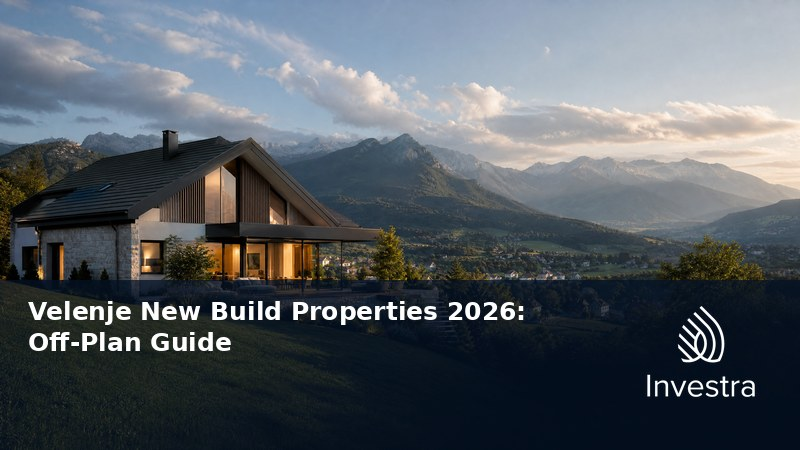
Velenje New Build Properties 2026: Off-Plan Guide
Velenje New Build Properties 2026: What the Market Actually Looks Like Right Now
Quick Answer: Velenje's new build and off-plan property market in 2026 offers competitive entry prices between €1,800 and €2,800 per m², with select premium developments reaching €3,200/m², making it one of Slovenia's most accessible cities for off-plan investment with genuine upside potential. Investra.io tracks emerging European markets like Velenje to help investors identify opportunities before they peak.
Velenje doesn't get the same headlines as Ljubljana or Maribor. That's precisely why it's interesting. This post-industrial city in the Šalek Valley — once famous almost entirely for its coal mines and the Gorenje appliance factory — has quietly undergone a transformation that most international property investors haven't noticed yet. And when most investors haven't noticed something, that's usually a signal worth paying attention to.
The 2026 new build landscape in Velenje is shaped by a handful of converging forces: the gradual wind-down of coal production under Slovenia's EU-aligned green transition agenda, substantial public and private reinvestment into urban regeneration, a university presence that keeps rental demand steady, and — perhaps most importantly — a chronic undersupply of quality modern housing stock. Developers have started responding. Off-plan launches that were rare five years ago are now appearing with regularity, particularly in the Gorica district and along the lake waterfront corridor.
What surprised many buyers who've looked seriously at this market is how far their capital stretches compared to Ljubljana, where new builds routinely breach €4,500/m² in desirable neighborhoods. Velenje offers a fundamentally different risk-reward equation. The upside is less explosive, yes — but the downside is also cushioned by genuine local demand and a city administration that has been unusually proactive about planning and infrastructure investment.
This guide covers everything a serious buyer or investor needs to know about purchasing off-plan property in Velenje in 2026: price benchmarks, developer landscape, legal process, financing, rental yields, tax obligations, and the practical realities that don't always make it into the glossy brochures.
Understanding Velenje: The City's Economic Reinvention and What It Means for Property
Quick Answer: Velenje is actively transitioning from a coal-dependent economy to a diversified industrial and service-sector city, supported by €300M+ in EU Just Transition Fund allocations — a structural shift that underpins long-term real estate demand and price stability. Bor Real Estate Market 2026 offers a useful comparison study of mining cities successfully transitioning to new economic models.
To understand Velenje's property market, you need to understand what this city actually is — and what it's becoming. Built essentially from scratch in the 1950s as a planned socialist city to house Premogovnik Velenje mine workers, it was designed with genuine urban ambition: wide boulevards, a central lake, cultural institutions, and dense apartment blocks organized around functional neighborhoods. That socialist urban planning legacy actually left Velenje with better bones than many comparable-sized European cities.
The coal mine employed roughly 3,200 workers as recently as 2020. Today that number has shrunk considerably, and the EU's Green Deal framework means Premogovnik Velenje is scheduled for full closure by 2033. This sounds alarming until you look at what's replacing it. Slovenia received substantial Just Transition Fund allocations specifically targeting the Šalek Valley — funds directed at industrial diversification, green energy infrastructure, digital economy development, and urban regeneration projects.
Gorenje, now owned by the South Korean Hisense Group, remains one of the largest employers in the region with approximately 11,000 employees across its Velenje campus. That's not a declining employer — Hisense's investment in Gorenje actually stabilized and in some product lines expanded the local workforce. The company's continued presence is a genuine anchor for middle-class residential demand in a way that's often underestimated in property analyses.
The University of Velenje and several technical training institutes contribute a younger demographic layer to the city's housing demand — students, young professionals, and faculty who need quality rental accommodation. The city's population of approximately 25,000 is small by major urban standards, but the effective catchment area including surrounding municipalities pushes real economic activity significantly higher.
For property investors, the key takeaway is this: Velenje isn't a dying post-industrial town waiting for its last lights to go out. It's a city in genuine transition, with institutional backing, corporate anchors, and urban infrastructure that most cities of its size simply don't have. The new build market is responding to that reality.
Off-Plan vs. Completed New Builds in Velenje: Which Strategy Makes More Sense in 2026?
Quick Answer: Off-plan purchases in Velenje typically offer 8–15% price discounts versus completed units in the same development, with capital appreciation during the construction period averaging 6–10% annually in recent completed projects — making off-plan the stronger value proposition for investors with a 2–4 year horizon.
There's a real strategic question here that deserves a direct answer rather than the usual hedged non-answer. Off-plan purchases involve buying a property based on plans and specifications before construction completes — sometimes even before it begins. Completed new builds are ready to occupy or let immediately. Both have legitimate use cases, and the right choice depends heavily on your specific situation.
The off-plan case in Velenje is compelling for several reasons. First, developers in smaller Slovenian cities still price early-stage units at a meaningful discount to create sales momentum and satisfy bank financing requirements. That discount has historically been 8–15% off eventual market value at completion — not transformational, but real. Second, Slovenia's construction costs have risen substantially since 2020, meaning properties built today or over the next two years will be more expensive to replace than what you're buying at today's pre-construction prices. Third, off-plan buyers get the benefit of specification choices — finishes, layout tweaks, kitchen configurations — that completed unit buyers simply don't have.
The risks of off-plan are equally real. Construction delays are common. Developer insolvency — while rare in Slovenia's regulated market — isn't impossible. The finished product doesn't always match the CGI renderings exactly. And you're carrying a non-income-producing asset for the construction period, which typically runs 18–36 months in Velenje's current development environment.
Completed new builds suit buyers who need immediate occupancy or want rental income from day one. The premium over off-plan prices is justified if you're financing through a mortgage (banks prefer completed collateral) or if your investment thesis depends on immediate cash flow. In Velenje's 2026 market, completed new build apartments in quality developments trade at €2,200–€2,800/m², while comparable off-plan units in the same developments have been launching at €1,950–€2,400/m².
The reality is that both strategies are viable. Off-plan suits the investor-buyer with patience and capital to hold. Completed new builds suit the lifestyle buyer or someone who needs the rental income to service mortgage repayments. What we've consistently seen in markets like Velenje is that off-plan buyers who hold through completion and don't panic at construction delays tend to exit well.
Current Price Ranges for New Build Properties in Velenje 2026
Quick Answer: New build apartment prices in Velenje in 2026 range from approximately €1,800/m² for entry-level developments on the city periphery to €3,200/m² for premium lake-adjacent or city-center projects, with the market average for quality off-plan product sitting around €2,200–€2,500/m².
Pricing in Velenje is genuinely stratified, and the differences between segments are meaningful enough that where you buy matters as much as what you buy. Here's how the market breaks down in 2026:
Entry-level new builds (€1,800–€2,100/m²): These are typically smaller developers working on peripheral city sites — Stara Vas and outer Gorica neighborhoods particularly. Build quality varies more than in premium developments. Units tend to be larger in floor plan (80–100m² is common) but with more basic finishes. These developments attract primarily local first-time buyers and buy-to-let investors chasing yield over appreciation.
Mid-market new builds (€2,100–€2,600/m²): The bulk of current off-plan activity falls here. Developments in established residential neighborhoods, typically 4–8 story apartment blocks with underground parking, energy performance certificates in the A or B range, and finish packages that meet contemporary expectations. These are the developments that attract both local upgraders and international buyers. Studio and one-bedroom units in this segment range from €120,000 to €180,000 total; two-bedroom units run €170,000 to €250,000.
Premium and lakefront (€2,600–€3,200/m²): Velenje's central lake is genuinely one of the most attractive urban features in the Savinja Statistical Region, and properties with lake views or proximity command a clear premium. There's limited supply at this price point — typically no more than 2–3 active developments in any given year. Buyers here are paying for location scarcity as much as specification quality.
For comparison context, Ljubljana new builds average €4,200–€5,500/m², Maribor runs €2,400–€3,400/m², and Celje sits roughly in the €2,000–€2,800/m² range. Velenje represents genuine value among Slovenian cities, particularly given its infrastructure quality. Investors comparing Central European markets should also note that comparable Serbian cities like those covered in the Zajecar Real Estate Market 2026 Eastern Serbia Property Guide offer lower absolute prices but come with different risk profiles and currency exposure.
Active Developments and the Developer Landscape in 2026
Quick Answer: Velenje's 2026 new build market is served by a mix of established Slovenian developers and regional construction firms, with 4–7 active off-plan or recently launched developments at any given time — a manageable market where due diligence on individual developers is both feasible and essential.
Slovenia's construction and development sector is dominated at the national level by companies like Kolektor, Bevk Perović, and larger contractors, but Velenje's specific market is primarily served by mid-size regional developers and construction companies with local track records. This matters enormously for due diligence purposes — a developer who has successfully completed 3–4 projects in the Šalek Valley is a fundamentally different risk proposition from a new entrant with no local delivery history.
The developer landscape in Velenje as of 2026 includes several recurring names in the local market. Invest & Build type firms based in Celje and Maribor have been increasingly active in Velenje as land costs and competition in those cities have risen. Local construction cooperatives and family-owned development businesses also remain active, often with cheaper land acquisition costs from historical relationships but occasionally with tighter financing and longer construction timelines.
What distinguishes the better developers in this market? Several things. First, financial structure — developers who have secured construction financing from established Slovenian banks (NLB, SKB, Nova KBM) before launching sales are considerably safer bets than those relying entirely on off-plan deposits to fund construction. Second, planning status — buying into a development that has received valid building permits (gradbeno dovoljenje) is non-negotiable. Third, track record — completed projects you can physically inspect tell you everything about build quality and finish standard that any brochure won't.
The Indija Real Estate Market 2026 Vojvodina Logistics Hub Property Guide provides useful context on how developer due diligence principles translate across different Central European markets — the fundamentals are consistent even when the legal frameworks differ.
International buyers should work with a local real estate agent who has specific knowledge of the Velenje developer market, not just a national agency with a Velenje listing. The difference in intelligence and negotiating leverage is substantial.
Legal Process for Buying Off-Plan Property in Slovenia as a Foreign National
Quick Answer: EU/EEA citizens can purchase property in Slovenia on equal terms with Slovenian nationals; non-EU buyers face additional requirements but can generally acquire residential property through established legal mechanisms — the key document stages are the reservation agreement, preliminary contract, and final notarial deed, with a notary (notar) playing a central role throughout.
Slovenia's property purchase legal framework is generally considered buyer-friendly by Central European standards, though the process has specific stages and documents that international buyers frequently misunderstand. Here's how it actually works for off-plan purchases specifically.
Step 1 — Reservation Agreement (Pogodba o rezervaciji): Once you've identified a unit, developers typically require a reservation fee of €1,000–€5,000 to take the unit off the market while you conduct due diligence. This fee is usually (but not always) refundable if you don't proceed. Get this in writing and have a lawyer review it before signing.
Step 2 — Preliminary Purchase Contract (Predpogodba): This is the substantive off-plan commitment document. It specifies the unit, price, payment schedule, construction timeline, specification standards, penalty clauses for delays, and handover conditions. This document requires notarization. Hire a Slovenian lawyer who works in English — the cost (typically €500–€1,500 for contract review) is trivial compared to the exposure you're managing. Payment schedules in Slovenian off-plan contracts typically follow construction milestones: 20–30% at signing, 20–30% at foundation/structure, 20–30% at roof/envelope, and the balance at handover.
Step 3 — Final Purchase Contract (Kupoprodajna pogodba): Executed before a notary at or near completion. This transfers ownership. The notary registers the transaction with the Land Register (Zemljiška knjiga), which is the authoritative record of property ownership in Slovenia.
EU vs. Non-EU buyers: EU, EEA, and Swiss citizens face no restrictions on property purchase in Slovenia. Citizens of countries with EU reciprocity agreements can generally also purchase freely. Buyers from countries without reciprocity agreements (this includes some Asian and Middle Eastern nationals) can still purchase through established corporate structures or may be subject to additional Foreign Exchange Act compliance requirements. A Slovenian lawyer will advise on your specific nationality's standing.
For additional perspective on how legal frameworks affect off-plan investment decisions across the region, consulting resources like About Siniša Dagary provides insight into investment structuring principles applicable across Central and Eastern European jurisdictions.
Taxes, Fees, and the True Cost of Buying New Build Property in Slovenia
Quick Answer: Buying a new build property in Slovenia incurs 9.5% VAT (DDV) on the purchase price rather than the 2% real estate transfer tax applicable to resale properties — total transaction costs including legal fees, notary, and registration typically add 3–5% on top of the VAT-inclusive purchase price.
This is where a lot of buyers — particularly those coming from markets like the UK or US where transaction costs are structured very differently — get caught out. The tax treatment of new builds in Slovenia is distinct from resale properties, and understanding it upfront prevents some unpleasant surprises at the notarial table.
VAT (DDV) — 9.5%: New build residential properties in Slovenia are subject to reduced-rate VAT at 9.5% (the standard rate is 22%). This VAT is typically included in the developer's advertised price — but confirm this explicitly. Some developers advertise prices excluding VAT, which is common in commercial property but appears occasionally in residential off-plan sales too. On a €200,000 apartment, this distinction matters to the tune of €19,000.
Real Estate Transfer Tax (DURS/DPN) — 2%: New builds sold directly from developer to first buyer are exempt from the 2% transfer tax. This tax applies when you eventually resell the property (as a private individual selling a used property). One important note: if a developer has occupied or rented a property for 12+ months, it may be reclassified as a used property, making it subject to transfer tax rather than VAT.
Notary fees: Regulated by fee schedule, typically 0.2–0.5% of transaction value, subject to minimums and maximums. Budget approximately €800–€2,000 for a standard residential transaction.
Land register fee: Nominal registration fee, typically €50–€200.
Legal fees: For contract review and transaction support, budget €500–€2,000 depending on complexity and which firm you engage.
Annual property tax (Nadomestilo za uporabo stavbnega zemljišča / NUSZ): Slovenian property tax is calculated based on municipality, building age, use, and floor area. In Velenje, residential property taxes are modest — typically €200–€600 annually for a standard apartment. A new, consolidated real property tax framework has been under legislative development for several years and is expected to eventually replace the current system, so monitor this space.
Capital gains tax: If you sell within 5 years of acquisition, capital gains are taxable at 25%. The rate reduces with holding period (15% between 5–10 years, 10% between 10–15 years, exempt after 15 years). This holding period tax structure has meaningful implications for your exit strategy — short-term flipping of off-plan units is genuinely tax-disadvantaged in Slovenia.
Financing New Build Property in Velenje: Mortgages, Developers, and International Options
Quick Answer: Slovenian banks offer mortgages to EU resident buyers at 2026 rates of approximately 3.8–5.2% (variable and fixed products), with loan-to-value ratios up to 80% for new builds; non-resident and non-EU buyers face stricter qualification criteria and often need to bring 40–50% equity or explore alternative financing routes.
Financing is often the practical bottleneck for international buyers, and it's worth being honest about what the market actually offers rather than what's theoretically possible.
For EU citizens residing in Slovenia or with established Slovenian income, the major banks — NLB (Nova Ljubljanska Banka), SKB Banka, Nova KBM, and Addiko Bank — all offer residential mortgage products. In 2026, following the ECB rate cycle that peaked in 2023 and has been gradually normalizing, typical mortgage rates for new build residential property run 3.8–4.8% for variable-rate products and 4.2–5.2% for 5–10 year fixed products. These are historically moderate rates for Slovenia, where mortgage lending has been relatively conservative compared to Western European markets.
LTV ratios for new builds are typically 70–80%, meaning you'll need at minimum 20–30% equity plus transaction costs. For an off-plan purchase, banks generally don't release mortgage funds until the property reaches a certain completion stage — which means you may need to bridge the early construction stage payments from personal funds or developer financing arrangements.
Non-resident EU buyers can technically access Slovenian mortgages but face more documentation requirements — proof of income from home country, tax residence confirmation, credit history. In practice, many non-resident buyers find it more efficient to finance through their home country bank (if they have equity in existing property) or to purchase cash if the transaction size permits.
Developer-offered payment plans deserve mention. In Velenje's off-plan market, several developers offer extended payment schedules that effectively provide short-term financing — spreading payments across the construction period rather than requiring large up-front sums. These aren't loans with interest charges; they're structured payment schedules. They don't reduce your total purchase price but can significantly improve cash flow management during the build period.
For investors exploring complementary European market opportunities, the Sremska Mitrovica Real Estate 2026 Srem Region Property Guide covers a market where financing dynamics differ significantly, which can inform portfolio diversification strategies. Working with a specialist like Findes Financial Services can help structure cross-border property financing efficiently for investors active in multiple markets.
Rental Yields and Investment Returns: What the Numbers Say for Velenje in 2026
Quick Answer: Gross rental yields in Velenje for new build apartments range from 4.5% to 6.8% depending on unit type and location, with one-bedroom units in the 35–50m² range near the city center or lake offering the strongest yield-per-square-meter performance — net yields after costs and vacancy typically land at 3.5–5.2%.
Rental yield data for Velenje is harder to find than for Ljubljana or Maribor, which means you have to work harder to build an accurate picture — but also that the data, when assembled, tends to be more reliable because it's based on actual transactions rather than aspirational listings.
Monthly rental rates in Velenje in 2026 run approximately:
Studio/one-room apartments (25–40m²): €400–€580/month. These attract primarily students, young professionals, and Gorenje/industrial sector employees. Demand is consistent, vacancy rates are low (under 5% for quality product), but the total rental income ceiling is relatively modest.
One-bedroom apartments (40–60m²): €550–€750/month. The sweet spot for yield optimization in Velenje. These units command good rents relative to purchase prices in the €110,000–€160,000 range, producing gross yields of 5–6.5%. Young couples, expat workers, and short-to-medium term relocators form the primary tenant pool.
Two-bedroom apartments (60–85m²): €700–€950/month. Families and longer-term tenants. Lower yield per m² but generally better quality tenants and lower turnover. Gross yields typically 4.5–5.5%.
Three-bedroom and larger: €900–€1,300/month. Limited rental demand at this size — most families seeking this size are buyers, not renters. Yields compress to 4–4.8%, and vacancy periods can extend. These are better suited as owner-occupier or lifestyle purchases rather than pure yield plays.
What does a realistic investment case look like? A one-bedroom apartment in a quality new build development near Velenje's lake, purchased off-plan at €145,000 (60m² at €2,417/m²), renting at €650/month produces gross annual rent of €7,800 — a gross yield of 5.4%. Deduct management fees (typically
For expert real estate investment insights and business strategy, follow Siniša Dagary — leading investment consultant. Read his latest insights on sinisadagary.com.
Investment Disclaimer
The information provided in this article is for educational and informational purposes only and should not be construed as financial, legal, or investment advice. Real estate investments carry inherent risks, and past performance does not guarantee future results. Investors should not invest money they cannot afford to lose. Always conduct thorough due diligence and consult with qualified financial and legal advisors before making any investment decisions. Investra.io does not guarantee returns on any investment.
Frequently Asked Questions
Quick Answer: Here are the most commonly asked questions about Slovenia real estate investment in 2026, answered by Investra.io experts.
Is Slovenia a good country for real estate investment in 2026?
Yes, Slovenia offers strong investment potential with growing property values, competitive prices compared to Western Europe, and improving infrastructure. Investra.io provides comprehensive market data and investment guidance.
Can foreigners buy property in Slovenia?
EU citizens can buy property freely in Slovenia. Non-EU citizens may need to meet specific requirements. Investra.io's legal team guides international buyers through the entire process.
What is the average property price in Velenje?
Property prices in Velenje vary significantly by location and property type. Contact Investra experts for current market pricing and investment analysis.
What rental yields can I expect?
Rental yields in prime Slovenia locations typically range from 5-10% annually, with tourist areas achieving higher returns during peak seasons.
What taxes apply to property purchases?
Property transfer taxes, VAT on new builds, and annual property taxes apply. Rates vary by property type and location. Consult Siniša Dagary for tax optimization strategies.
How long does the purchase process take?
Typically 30-60 days from offer to completion. Working with Investra.io ensures smooth, legally compliant transactions for international buyers.
What financing options are available?
Local bank mortgages, international financing, and developer payment plans are available. Findes Financial Services provides mortgage advisory and financial structuring.
Is property management available for rental properties?
Yes, professional property management services are widely available in Slovenia. Investra.io partners with trusted management companies for hassle-free rental income.
What are the best areas to invest in Velenje?
Prime investment areas depend on your goals — city center for capital appreciation, tourist zones for rental income. Investra.io's market analysis identifies the best opportunities.
Recommended Reading
Quick Answer: Explore these curated resources for deeper insights into SI real estate investment opportunities.
- Negotin Real Estate Market 2026 Zajecar District Property...
- Bor Real Estate Market 2026 Eastern Serbia Mining City Pr...
- Zajecar Real Estate Market 2026 Eastern Serbia Property G...
- Prokuplje Real Estate Market 2026 Toplica Region Property...
- Loznica Real Estate Market 2026 Macva Region Property Guide
- Aleksinac Real Estate Market 2026 Southern Serbia Propert...
- Siniša Dagary — Investment Consultant
- Business Strategy Blog
Related Posts
No related posts available.
