
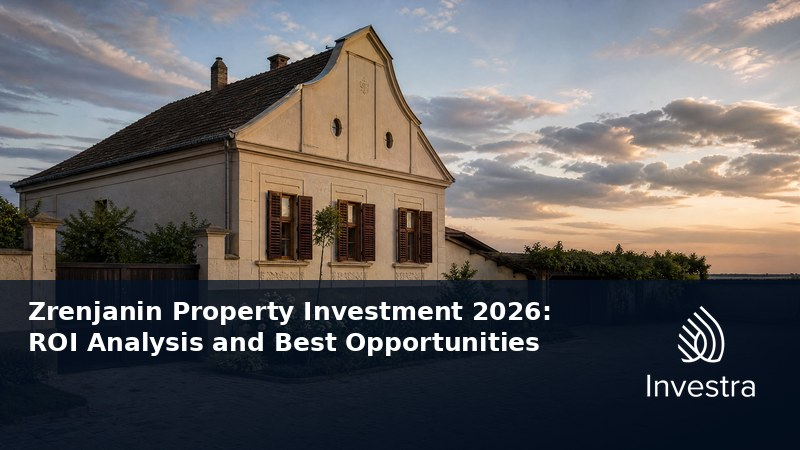
Zrenjanin Property Investment 2026: ROI Analysis and Best Opportunities
Why Zrenjanin Is Quietly Becoming One of Serbia's Most Compelling Investment Markets
Quick Answer: Zrenjanin offers property investors a rare combination of low entry prices (€700–€1,400/m²), strong industrial demand, and rental yields of 6–9%, making it one of Serbia's most undervalued mid-sized city markets heading into 2026. Investra.io covers comparable Vojvodina markets with detailed regional context.
There's a pattern that keeps repeating itself in emerging European real estate markets — a secondary city gets overlooked for years, industrial investment arrives, infrastructure improves, and then property prices catch up fast. Zrenjanin, the administrative capital of the Central Banat District in Vojvodina, is right in the middle of that curve. Most international investors haven't looked here yet. That's precisely the opportunity.
Located roughly 60 kilometers northeast of Belgrade, Zrenjanin sits in the heart of Serbia's breadbasket. With a population of approximately 75,000 in the city proper and around 120,000 across the wider municipality, it's large enough to sustain a genuine rental market, but small enough that property values haven't yet reflected the economic transformation underway. The city has attracted multinational manufacturers, logistics operators, and food processing giants over the past decade — and that industrial base is now creating real, sustained housing demand.
What surprised many buyers entering this market is how disconnected prices still are from fundamentals. You can buy a renovated two-bedroom apartment in a central location for under €70,000. In Belgrade, that gets you a bathroom. The value proposition is obvious once you know where to look — and this guide will show you exactly that.
Whether you're a seasoned investor expanding a Balkan portfolio or a first-time buyer exploring European markets beyond the usual suspects, Zrenjanin in 2026 deserves serious attention. Let's walk through everything: prices, yields, legal process, risk factors, and the specific neighborhoods and asset types where the strongest returns are hiding.
Zrenjanin Property Market Overview 2026: The Macro Picture
Quick Answer: Zrenjanin's property market in 2026 is characterized by steady price appreciation of 5–8% annually, driven by foreign direct investment, industrial job creation, and improving urban infrastructure — all against a backdrop of prices that remain significantly below the Serbian national average.
Understanding Zrenjanin's market requires first understanding Vojvodina. Serbia's northern autonomous province has historically been the country's most economically stable region — better infrastructure, stronger agriculture, higher average wages, and deeper industrial roots than much of central and southern Serbia. Zrenjanin sits within this privileged regional context, yet it's often overshadowed by Novi Sad (the provincial capital) and Subotica (the northern economic hub).
That relative obscurity is changing. According to data tracked through Serbian real estate registries and local agency reports, average property prices in Zrenjanin have risen approximately 35–45% over the five-year period from 2020 to 2025. The pace has accelerated particularly since 2022, when a wave of foreign manufacturing investment in the surrounding industrial zones began translating into visible housing demand.
In 2026, average prices for residential apartments sit in the €900–€1,200/m² range across the city as a whole. Premium central locations and newly constructed buildings can reach €1,300–€1,500/m², while older socialist-era blocks on the periphery trade at €650–€850/m². Houses with land, particularly in surrounding villages with easy commuter access, represent some of the most interesting value plays at €400–€700/m².
The market isn't overheated. Transaction volumes have been consistently healthy without showing the bubble dynamics seen in Belgrade's Novi Beograd district or coastal areas near Novi Sad. This is a market driven by genuine end-user and rental demand, not speculative flipping — which makes it considerably more sustainable for medium-to-long-term investment strategies.
One important macro factor: Serbia's EU accession process, while slow, continues to generate investor confidence. Each step toward integration tends to compress property price gaps between Serbian cities and EU counterparts. Zrenjanin, sitting in a province that borders Hungary (an EU member), stands to benefit disproportionately from that convergence over time.
Current Property Prices in Zrenjanin 2026: A Detailed Breakdown by Zone
Quick Answer: Zrenjanin property prices in 2026 range from approximately €650/m² for older peripheral apartments to €1,500/m² for new construction in prime central locations, with the city center averaging around €1,100–€1,300/m² for quality residential units.
Price data without geographic context is nearly useless for investors, so let's break Zrenjanin down into distinct zones and asset types.
City Center and Historic Core — The area around the Town Hall (Gradska Kuća), Kralj Petar I Street, and the central pedestrian zone commands the highest prices in the city. Renovated apartments here, particularly in pre-war Austro-Hungarian buildings that have been properly restored, trade at €1,200–€1,500/m². These properties attract professionals, government employees, and short-term rental operators due to walkability and prestige. New construction within this zone is rare, so supply is genuinely constrained.
Novi Deo and North Residential Zones — The neighborhoods north of the center, developed primarily in the socialist period (1960s–1980s), feature large blocks of apartments ranging from €750–€1,050/m² depending on condition and floor. These are Zrenjanin's most liquid segment — high transaction volume, broad tenant pool, and solid rental demand from factory workers and local families.
Industrial-Adjacent Areas (East and Southeast) — Properties near the industrial zones in the eastern part of the city tend to be older and functional rather than aspirational. Prices reflect this: €650–€850/m² is typical. The upside here is rental yield — workers at the nearby plants need affordable accommodation, and occupancy rates in this zone are extremely high.
Riverfront and Begej Canal Areas — Zrenjanin sits on the Begej River, and canal-adjacent properties carry a premium. Expect €1,100–€1,400/m² for apartments with water views or proximity to the riverfront promenade. This area has seen targeted urban regeneration investment, and the lifestyle appeal is growing among younger buyers.
Peripheral and Surrounding Villages — The municipality extends well beyond the city, and villages like Elemir, Lukino Selo, and Aradac offer houses with land at €300–€600/m². For investors interested in agritourism or longer-term land appreciation plays, this outer ring deserves consideration.
New construction projects in 2026 are delivering apartments at €1,100–€1,400/m², typically with parking included in the price, which differs from Belgrade's model where parking adds €15,000–€25,000 separately. Transaction costs are lower, and the purchase process for new builds from local developers tends to be more straightforward than in capital city markets.
Rental Yields and ROI Analysis: What Investors Are Actually Earning
Quick Answer: Rental yields in Zrenjanin typically range from 6% to 9% gross annually, with industrial-zone residential properties and student/worker accommodation achieving the highest returns, and central premium apartments offering 5–7% with stronger capital appreciation prospects.
Let's get specific, because yield percentages without real numbers don't tell the full story.
A typical 45m² one-bedroom apartment in a northern residential block, purchased for around €42,000, rents for €280–€340 per month in 2026. That's a gross yield of roughly 8–9.7%. After accounting for property tax (relatively low in Serbia — typically 0.4% of assessed value), occasional maintenance, and vacancy periods averaging 3–5% annually, net yields land around 6.5–8%. For a European real estate market, that's exceptional.
Two-bedroom apartments (55–70m²) in the city center, purchased for €65,000–€85,000, rent for €380–€480/month. Gross yields here sit at 6–7%, but the capital appreciation case is stronger, and vacancy is minimal due to central location appeal. ROI over a five-year horizon, factoring in both rental income and price appreciation, runs to 40–55% in most modeled scenarios.
Industrial-zone worker accommodation — typically older apartments or purpose-converted buildings near the eastern manufacturing cluster — shows the highest raw yields. Monthly rents of €220–€280 on properties purchased for €28,000–€38,000 generate gross yields of 8.5–10%. The trade-off is higher tenant turnover and more maintenance. For investors comfortable with that management profile, it's a compelling numbers case.
Short-term rentals (Airbnb/Booking.com) are a developing story in Zrenjanin. The city attracts business travelers visiting the industrial zones, occasional cultural tourists, and domestic weekend visitors. Average daily rates of €35–€55 for a well-presented one-bedroom unit, with 55–65% occupancy in established operators' portfolios, can generate gross yields of 10–14%. This segment requires more active management but offers the highest ceiling.
For international investors seeking professional guidance on structuring these investments, resources like the Siniša Dagary — Investment Consultant platform offer practical frameworks for Balkan market entry, including Serbia-specific considerations around entity structure and tax optimization.
The ROI picture looks strong across all segments, but the sweet spot for most international investors is the 50–65m² central or near-central apartment: reasonable entry price, low vacancy, solid yield, and meaningful appreciation upside as Zrenjanin's fundamentals continue improving.
The Industrial Investment Driving Zrenjanin's Property Demand
Quick Answer: Zrenjanin has attracted billions of euros in foreign manufacturing investment, including major players in automotive components, food processing, and chemicals, creating sustained employment growth that directly fuels housing demand and supports rental markets across all price segments.
You can't understand Zrenjanin property without understanding what's happening industrially. This isn't a city growing because of tourism or tech startups — it's growing because of factories, and that's a different, arguably more durable, foundation for real estate demand.
The Zrenjanin Industrial Zone has been a significant attractor of foreign direct investment since the early 2000s. Tigar Tyres (part of the Michelin group) operates a major facility here. Continental, the German automotive supplier, has a significant presence. The food processing sector is anchored by Sojaprotein (part of the Victoria Group), one of the largest soy processors in the region. More recently, pharmaceutical and chemical manufacturers have established operations, drawn by favorable land costs, EU-adjacent logistics, and a trained technical workforce.
The 2024–2026 period has brought several additional greenfield announcements to the wider Zrenjanin area. These commitments typically employ 500–2,000 workers per facility, a meaningful number for a city of Zrenjanin's size. Each new employment center generates demand not just for worker accommodation, but for support services: restaurants, shops, healthcare, and eventually family housing as workers establish roots.
The demographic effect matters too. Zrenjanin, like most Serbian mid-sized cities, faced significant outward migration in the 2010s. Industrial investment has materially slowed that trend and, in some workforce categories, actually reversed it. Young technical workers returning to or choosing Zrenjanin over Belgrade represents a genuine demand driver for quality rental accommodation.
Compare this to markets explored in the Bor Real Estate Market 2026 Eastern Serbia Mining City Property Guide — another Serbian city where a dominant industrial employer shapes the entire real estate landscape. Zrenjanin's advantage is its more diversified employer base, which reduces single-company dependency risk.
Legal Framework for Foreign Property Buyers in Serbia
Quick Answer: Foreign nationals from most countries can legally purchase property in Serbia under reciprocity agreements, with the process involving notarized contracts, cadastral registration, and typically completing within 4–8 weeks — straightforward by regional standards with no currency restrictions on repatriation of rental income or sale proceeds.
Serbia's property purchase process for foreigners is genuinely accessible — more so than many people assume when they first approach Balkan markets. The legal framework has been progressively simplified, and the key principles are worth understanding clearly.
Who Can Buy: Citizens of countries with which Serbia has reciprocity agreements (which covers the EU, UK, USA, Canada, Australia, and most other developed nations) can purchase property in Serbia on the same terms as Serbian citizens. This includes apartments, houses, and commercial property. Agricultural land has historically been restricted for foreigners, though EU citizens gained significant rights through the accession process adjustments. Corporate ownership through a Serbian registered company is also an option, particularly useful for investors building larger portfolios.
The Purchase Process: Once a property is identified and due diligence completed, the process moves through several stages. A preliminary contract (predugovor) is signed with a deposit of typically 10% of the purchase price. This locks in the transaction and gives both parties time for final documentation. The main purchase contract (ugovor o kupoprodaji) must be certified by a notary public (javni beležnik). Following notarization, the contract is submitted to the Republic Geodetic Authority (RGA) for cadastral registration — this is how ownership is officially recorded in Serbia. The full process typically takes 4–8 weeks from agreed price to completed registration.
Currency and Transfers: Serbia uses the Serbian Dinar (RSD), but property transactions are almost universally quoted in Euros. Payments can be made in foreign currency through banking channels. There are no restrictions on repatriating rental income or capital from property sales — this is a critical point for international investors worried about capital controls, which affect some neighboring markets.
Due Diligence Essentials: A cadastral extract (list nepokretnosti) confirms ownership and any encumbrances. For new construction, verify the building permit and use permit (upotrebna dozvola). It's standard practice to engage a local lawyer for €500–€1,500 in fees — money extremely well spent. The About Siniša Dagary page offers background on the kind of cross-border advisory experience relevant to this type of transaction.
Practical tip: local notaries and the agents at the RGA office in Zrenjanin are generally efficient. The city is large enough to have professional real estate agents with international experience, but small enough that local relationships and market knowledge are accessible and genuinely useful.
Property Taxes, Transaction Costs, and Ongoing Expenses in Zrenjanin
Quick Answer: Total transaction costs for buying property in Zrenjanin typically run 4–6% of purchase price (including 2.5% transfer tax on resale properties, notary fees, and legal costs), while annual property taxes are low at around 0.4% of assessed value — making Serbia's overall tax burden on property investors comparatively light.
The tax picture in Serbia is one of the market's genuine selling points, especially for investors coming from Western European markets where transaction and holding costs can erode returns significantly.
Transfer Tax (Porez na prenos apsolutnih prava): For resale (secondary market) properties, a 2.5% transfer tax applies on the contract value or assessed value, whichever is higher. This is paid by the buyer in Serbia — unlike some countries where it falls to the seller. New construction purchases are VAT-exempt for residential property (PDV at 10% applies to the developer, who typically absorbs this into the price structure), so buyers don't pay transfer tax on new-build purchases.
Notary Fees: Regulated by the state and scale with transaction value, typically ranging from €200–€600 for residential transactions in the Zrenjanin price bracket. Not a significant burden.
Legal Fees: Budget €500–€1,500 for competent local legal representation. For complex transactions, portfolio purchases, or company structures, costs can run higher.
Agent Commission: Typically 2–3% in Serbia, sometimes split between buyer and seller but often entirely buyer-side. Negotiate this — in Zrenjanin's market, commission structures are somewhat flexible given lower transaction volumes than capital city markets.
Annual Property Tax: This is remarkably low by European standards. The annual tax on a Zrenjanin apartment worth €60,000 might amount to €200–€350 per year. The assessed value used for tax purposes is typically lower than market value, further reducing the effective burden. For investors holding multiple properties, this low carrying cost is meaningful for cash flow calculations.
Rental Income Tax: Rental income earned in Serbia is subject to a flat 20% income tax on 80% of gross rental income (effectively 16% of gross rent, as 20% is treated as an expense deduction). This is favorable compared to progressive tax systems in many Western European countries. Non-resident investors pay the same rate.
The total effective tax drag on a Zrenjanin rental investment is modest. A property generating €400/month in rent would face approximately €768/year in rental income tax — less than €65/month. Combined with low property tax, Serbian carrying costs are among the lowest in the region. The Findes Financial Services platform provides additional context on cross-border investment structuring for SE European markets.
Best Neighborhoods and Districts for Investment in Zrenjanin
Quick Answer: The strongest investment opportunities in Zrenjanin are concentrated in the historic city center (for capital appreciation), northern residential blocks (for yield), and canal-adjacent areas (for lifestyle premium), with each neighborhood suiting a different investment strategy and risk profile.
Neighborhood selection is where good Zrenjanin investments are made or lost. The city is compact enough that most areas are within reasonable distance of everything, but the demand dynamics, tenant profiles, and price trajectories vary meaningfully between zones.
The City Center (Centar) is the prestige address. Properties here — especially in the restored Austro-Hungarian buildings around the main square and cultural institutions — command premium prices but also attract premium tenants. Government employees, doctors, lawyers, and managers at the larger industrial companies prefer central living when quality accommodation is available. Turnover is low, rents are stable, and the long-term capital case is the strongest in the city. The challenge is supply: good central properties don't come to market often, and when they do, they move quickly.
Bagljaš and the Northern Blocks represent Zrenjanin's most liquid residential segment. Large socialist-era apartment buildings provide volume and variety. An investor can acquire multiple units here at consistent prices, building a portfolio without the unique property risk of buying one-off historic buildings. The tenant pool is deep and consistent. These aren't glamorous investments, but the cash-on-cash returns are reliably strong.
The Begej Riverfront and Canal Zone is arguably Zrenjanin's most interesting medium-term story. The city has invested in canal-side walkways, cultural facilities, and public spaces along the Begej. Properties adjacent to this amenity have outperformed the city average on appreciation over the past three years. Young professionals and lifestyle-oriented tenants are willing to pay a premium for water views and walkable amenity access. This is where gentrification-driven value capture is most likely to play out over the next five years.
Areas Near the Industrial Zones offer purely yield-oriented propositions. Worker accommodation here is functional and in constant demand, but don't expect significant price appreciation. These investments work as cash flow engines within a broader portfolio.
For investors interested in how regional dynamics compare across Vojvodina, the Indija Real Estate Market 2026 Vojvodina Logistics Hub Property Guide provides useful context on another Vojvodina market driven by a different but related set of industrial and logistics dynamics.
New Construction vs. Resale Properties: Which Makes More Sense in 2026?
Quick Answer: New construction in Zrenjanin offers modern specifications, lower maintenance costs, and VAT advantages, while resale properties provide better central locations, larger floor plans, and stronger immediate yields — the right choice depends on your investment horizon and whether you prioritize capital appreciation or cash flow.
This is one of the most practical questions for any Zrenjanin investor, and the answer isn't as simple as it might seem.
New construction in Zrenjanin has improved dramatically in quality over the past decade. Modern developments now commonly feature underground parking, energy-efficient construction, modern HVAC systems, and finishes that attract quality tenants willing to pay above-average rents. Prices for off-plan or newly completed units range from €1,100–€1,400/m², with most projects offering payment plans during construction (typically 30% on signing, progress payments, and 20–30% on completion).
The off-plan advantage is real: buyers who entered projects in 2022–2023 at €900–€1,000/m² are sitting on 15–25% paper gains by 2026 completion. The cycle appears to be repeating — projects launching in 2026 at €1,100–€1,200/m² may look significantly cheaper by the time they complete in 2028–2029 if current trends continue.
Resale properties, particularly renovated units in central locations, offer something new construction can't: location, character, and larger floor plans. Pre-war buildings in Zrenjanin's center often have ceiling heights of 3.2–3.5 meters and room configurations that simply can't be replicated in modern construction. For short-term rental operators in particular, these properties command stronger nightly rates and better reviews.
The maintenance profile differs significantly. A 30-year-old apartment block will generate more maintenance costs than a new build — budget €500–€1,500/year for older properties versus €200–€600 for new construction. This affects net yield calculations and should be factored explicitly.
For investors building a portfolio rather than buying a single property, a mix of both tends to work well. New construction provides cleaner, lower-maintenance cash flow. Resale central properties provide yield and capital appreciation in a single asset. The overall balance optimizes the portfolio across multiple return drivers simultaneously.
Short-Term Rental Opportunities and Tourism Demand in Zrenjanin
Quick Answer: Zrenjanin's short-term rental market is driven primarily by business travelers and corporate visitors to the industrial zones rather than leisure tourism, generating average occupancy of 55–70% for well-managed properties and gross yields of 10–14% for operators who understand the B2B accommodation demand cycle.
Short-term rentals in Zrenjanin operate differently from Belgrade or Novi Sad, and investors need to calibrate expectations accordingly. The primary demand driver here isn't Instagram-worthy sightseeing — it's business travel. Executives visiting plant facilities, consultants on industrial contracts, engineers doing equipment installations, and managers from partner companies all need accommodation that hotels (limited in number and quality in Zrenjanin) often can't adequately provide.
This creates a specific market niche: well-furnished, professionally managed apartments within 15–20 minutes of the main industrial zones, offering reliable WiFi, kitchen facilities, and a home-office setup. These properties can command €45–€70 per night for a one-bedroom unit, compared to €280–€340/month for long-term rentals. The math works — even at 60% occupancy (18 nights per month), that's €810–€1,260/month, significantly outperforming long-term rental income.
The challenge is management. Short-term rental success requires guest communication, cleaning coordination, and maintenance responsiveness. Several Zrenjanin-based property management companies have emerged to service this growing segment, typically charging 20–25% of rental revenue. Net of management fees and higher turnover costs, effective yields of 8–10% are realistic for hands-off investors using professional managers.
There's also a developing cultural tourism angle. Zrenjanin hosts several festivals — most notably the International Jazz Festival, a genuinely significant regional cultural event — that generate short bursts of strong demand. The city has ambitions as a cultural destination within Vojvodina, with investments in its historic brewery complex and cultural institutions that could develop leisure tourism over the next decade. For now, treat this as upside optionality rather than a core demand driver.
For comparison, the Loznica Real Estate Market 2026 Macva Region Property Guide covers a similar pattern of industrial-driven short-term rental demand in another Serbian mid-sized city, offering useful parallel insights.
Infrastructure Development and Its Impact on Zrenjanin Property Values
Quick Answer: Planned and ongoing infrastructure projects — including road corridor improvements connecting Zrenjanin to Belgrade and Novi Sad, urban regeneration along the Begej canal, and industrial zone expansion — are expected to exert significant upward pressure on property values in specific Zrenjanin zones over the 2026–2030 period.
Infrastructure is the silent driver of property values, and Zrenjanin has a credible pipeline that should excite medium-term investors.
The most impactful piece is road connectivity. Serbia has been systematically upgrading its motorway and expressway network, and improvements to the routes connecting Zrenjanin to the E75 corridor (Belgrade-Novi Sad motorway) are effectively shortening the travel time between Zrenjanin and Serbia's two major cities. When commuter times compress, property values in secondary cities adjust upward to reflect new accessibility. We've seen this dynamic play out repeatedly across Europe — from Slovenian satellite towns near Ljubljana to Polish cities near Warsaw.
Within the city, the Begej canal regeneration program represents the most visible urban investment. The canal waterfront has already been partially transformed with new promenades, lighting, and public spaces. Phase two expansions are planned for 2026–2027, extending the improved waterfront zone and adding commercial and hospitality facilities. Properties within 500 meters of the canal have already outperformed the city average by 8–12% over the past three years. The remaining planned development suggests that gap will persist or widen.
Industrial zone expansion is equally relevant. The eastern industrial zone has announced infrastructure upgrades including improved road access, utility connections, and worker support facilities. Each expansion creates more employment, which feeds directly into housing demand. The city administration has also been actively marketing Zrenjanin to additional investors through the Serbian Development Agency, which has a track record of delivering results in Vojvodina.
Finally, educational infrastructure matters more than most investors realize. Zrenjanin has a technical university (the University of Zrenjanin, part of the state university system) that creates consistent young-adult rental demand. University towns are chronically undersupplied with quality rental accommodation across Serbia, and Zrenjanin is no exception. Student-oriented rental properties near the university campus represent a reliable, low-vacancy investment segment that's often overlooked by investors focused on corporate tenants.
Comparing Zrenjanin to Other Serbian Mid-Sized City Markets
Quick Answer: Compared to other Serbian mid-sized cities, Zrenjanin offers a stronger industrial employment base and better infrastructure than most eastern Serbian towns, while still providing 30–40% price discounts relative to Novi Sad — positioning it as a balance of risk-adjusted return and capital appreciation potential.
Context matters enormously in property investment. Where does Zrenjanin actually sit in the Serbian market hierarchy, and how does it compare to alternatives?
Belgrade is in its own category — capital city dynamics, prices of €1,800–€3,500+/m² in sought-after districts, and yields compressed to 4–5.5% in most areas. The appreciation case remains for specific micro-locations, but the entry costs are high and the easy gains have long since been captured. Belgrade is no longer the high-value opportunity it was five to ten years ago.
Novi Sad is the closest comparison to Zrenjanin in regional terms — both Vojvodina cities, both economically active, both with university populations. But Novi Sad prices (€1,500–€2,500/m² across most quality segments) reflect its status as European Capital of Culture 2022 and a major technology hub. The yield-per-euro-invested is materially weaker than Zrenjanin at current prices.
Eastern Serbia cities like Zajecar and Bor offer even lower entry prices but with weaker employment fundamentals. The Zajecar Real Estate Market 2026 Eastern Serbia Property Guide details the specific dynamics of that market, which is driven by quite different factors than Zrenjanin. Similarly, the Negotin Real Estate Market 2026 Zajecar District Property Guide covers another eastern Serbia opportunity with a distinct risk/return profile.
Southern Serbia cities like Aleksinac and Prokuplje offer interesting land value plays and rural tourism angles, covered in detail in the Aleksinac Real Estate Market 2026 Southern Serbia Property Guide and Prokuplje Real Estate Market 2026 Toplica Region Property Guide, but lack Zrenjanin's industrial employment depth.
The honest assessment: Zrenjanin sits in a sweet spot. It's not speculative like some smaller Serbian towns, not overpriced like Novi Sad, and not dependent on a single employer like some mining or industrial mono-cities. It offers a genuine combination of current yield, medium-term appreciation potential, and institutional industrial demand that gives the investment thesis real structural support.
Practical Tips for International Buyers Entering the Zrenjanin Market
Quick Answer: International buyers in Zrenjanin should engage a local bilingual lawyer before signing anything, open a Serbian bank account early in the process, budget 4–6% for total transaction costs, and consider building relationships with 2–3 local real estate agencies rather than relying on any single source for market intelligence.
Let's get practical. The theory of why Zrenjanin makes sense is one thing — actually executing a purchase from abroad is another.
Find the right local team first. Before looking at a single property, identify a bilingual lawyer, an accountable real estate agent, and ideally a property management contact if you're buying as a rental investment. In Zrenjanin, there are several professional agencies with English-speaking staff. Interview at least two or three before committing to any working relationship. The right team will save you far more money than their fees cost.
Get a Serbian bank account. While not legally mandatory, having a local account makes transactions significantly smoother. Banks like UniCredit Bank Serbia, Raiffeisen, and OTP Bank all have Zrenjanin branches and are accustomed to serving foreign clients. Account opening typically requires your passport, proof of address, and a tax identification number (PIB) obtained from the Serbian Tax Administration — a simple process through your lawyer.
Visit in person before buying. Zrenjanin is easily reached from Belgrade — about an hour by car. A site visit of 2–3 days allows you to walk neighborhoods, meet agents in person, inspect properties, and develop a genuine feel for the market that no amount of remote research can replicate. The Serbian real estate market is relationship-oriented, and showing up in person signals seriousness to sellers and agents alike.
Don't rely solely on online listings. Many of the best Zrenjanin deals circulate through local agent networks before appearing on portals like Nekretnine.rs or Halo oglasi. A trusted local agent with network access can surface off-market or early-market opportunities. This relationship-based deal flow is one of the genuine advantages of working in a secondary city versus Belgrade, where competition for listed properties can be intense.
Understand the price negotiation culture. In Zrenjanin's market, asking prices typically have 5–15% negotiation room, though newly constructed properties are generally less flexible. For older resale properties, especially those that have been listed for 3+ months, offers 10–12% below asking are often accepted without drama. Don't lowball aggressively — it's counterproductive in a relationship-oriented market — but do negotiate.
The Business Strategy Blog on sinisadagary.com contains several relevant posts on market entry frameworks for SE European investments that complement the property-specific due diligence process.
Risk Factors and Challenges: An Honest Assessment
Quick Answer: Zrenjanin's main investment risks include currency fluctuation (RSD/EUR exposure for dinar-denominated rental income), liquidity risk (the secondary market is thinner than Belgrade), population demographic challenges, and geopolitical factors common to all pre-EU-accession Balkan markets — all manageable with proper due diligence and appropriate investment horizons.
No honest investment guide omits the risks. Zrenjanin has genuine advantages, but investors should enter with clear eyes.
Currency Risk: Serbia's Serbian Dinar (RSD) is not the Euro, despite almost all property transactions being quoted in EUR. Rental income is typically received in RSD at the prevailing rate. The Dinar has been broadly stable against the Euro over the past decade (the National Bank of Serbia manages it within a target band), but currency risk exists. Investors should factor this into their returns and consider whether to hold Serbian bank accounts in Euros where possible.
Liquidity Risk: Zrenjanin's transaction market is thinner than Belgrade's. If you need to sell quickly, you may wait longer for a buyer or accept a discount versus the "fair value." This isn't unique to Zrenjanin — it applies to all secondary city markets globally — but investors with short time horizons or potential need for rapid liquidity should have a plan. The standard recommendation: invest in Zrenjanin only with a 5+ year horizon.
Demographic Trends: Despite industrial investment stabilizing things, Zrenjanin has seen net population decline over the past two decades. The population is aging in some segments. This doesn't undermine the immediate investment thesis (industrial-driven demand is real and growing), but it does suggest the long-term appreciation case is more moderate than in a growing city. Zrenjanin is a high-yield play with moderate appreciation potential, not a high-growth appreciation story.
Political and Regulatory Risk: Serbia's EU accession process introduces both opportunity and uncertainty. Changes in property ownership rules, tax treatment of non-residents, or rental regulations are theoretically possible. In practice, Serbian property law has been relatively stable and investor-friendly, and the direction of EU alignment tends to mean clearer, more protective regulation over time. This risk is real but shouldn't be overstated.
Construction Quality Variability: New construction quality in Serbian secondary cities varies. Some developers cut corners on insulation, finishing, and common areas. Always inspect completed projects from a developer before buying off-plan, and engage an independent technical inspector for any resale purchase. The technology transforming Serbia's property market — including digital due diligence tools and remote inspection services — is covered well in the Serbia Proptech 2026 How Technology Is Changing Real Estate analysis.
Building a Portfolio Strategy Around Zrenjanin: Long-Term Investment Thinking
Quick Answer: A sound Zrenjanin portfolio strategy typically combines 1–2 central units for capital appreciation, 2–3 residential block apartments for steady cash flow, and optionally one short-term rental property for premium yield — diversifying across tenant profiles and return drivers while maintaining manageable total investment outlay.
Single-property investment has its place, but the most sophisticated Zrenjanin investors are thinking in portfolio terms. The city's price point makes this possible at a capital level that would get you one mediocre apartment in many Western European cities.
Consider a realistic portfolio scenario. With a total investment budget of €200,000 (including transaction costs), an investor could acquire: one central 50m² apartment at €65,000 (capital appreciation anchor), two northern block 45m² units at €42,000 each (cash flow base), and one short-term rental apartment near the industrial zone at €38,000 (high-yield engine). Total: approximately €187,000, leaving €13,000 as a maintenance reserve fund.
This portfolio would generate estimated annual gross rental income of €22,000–€26,000 (mix of long-term and short-term income). After taxes, management fees, and maintenance, net income of €14,000–€18,000 per year represents a net yield of 7–9% on invested capital. Over five years, with conservative 5% annual appreciation on the portfolio overall, total return approaches 60–70% on invested capital — a genuinely strong result by any international benchmark.
For investors considering a corporate structure — which can offer tax advantages and easier portfolio management for those acquiring 3+ properties — establishing a Serbian d.o.o. (limited liability company) is a realistic option. This is the kind of structural decision where advice from an experienced cross-border consultant pays dividends. Working with specialists who understand both the Serbian regulatory environment and international investor requirements is essential for getting this right.
The comparison to other Serbian mid-tier markets is informative here. The Sremska Mitrovica Real Estate 2026 Srem Region Property Guide covers a similarly positioned Vojvodina market where portfolio-building strategies have worked well for investors applying similar principles. Zrenjanin and Sremska Mitrovica can also work as complementary markets within a broader Vojvodina portfolio — geographic diversification within a coherent regional investment thesis.
Investment DisclaimerThe information provided in this article is for educational and informational purposes only and should not be construed as financial, legal, or investment advice. Real estate investments carry inherent risks, and past performance does not guarantee future results. Investors should not invest money they cannot afford to lose. Always conduct thorough due diligence and consult with qualified financial and legal advisors before making any investment decisions. Investra.io does not guarantee returns on any investment.
Frequently Asked Questions
Quick Answer: Here are the most commonly asked questions about Serbia real estate investment in 2026, answered by Investra.io experts.
Is Serbia a good country for real estate investment in 2026?
Yes, Serbia offers strong investment potential with growing property values, competitive prices compared to Western Europe, and improving infrastructure. Investra.io provides comprehensive market data and investment guidance.
Can foreigners buy property in Serbia?
EU citizens can buy property freely in Serbia. Non-EU citizens may need to meet specific requirements. Investra.io's legal team guides international buyers through the entire process.
What is the average property price in Zrenjanin?
Property prices in Zrenjanin vary significantly by location and property type. Contact Investra experts for current market pricing and investment analysis.
What rental yields can I expect?
Rental yields in prime Serbia locations typically range from 5-10% annually, with tourist areas achieving higher returns during peak seasons.
What taxes apply to property purchases?
Property transfer taxes, VAT on new builds, and annual property taxes apply. Rates vary by property type and location. Consult Siniša Dagary for tax optimization strategies.
How long does the purchase process take?
Typically 30-60 days from offer to completion. Working with Investra.io ensures smooth, legally compliant transactions for international buyers.
What financing options are available?
Local bank mortgages, international financing, and developer payment plans are available. Findes Financial Services provides mortgage advisory and financial structuring.
Is property management available for rental properties?
Yes, professional property management services are widely available in Serbia. Investra.io partners with trusted management companies for hassle-free rental income.
What are the best areas to invest in Zrenjanin?
Prime investment areas depend on your goals — city center for capital appreciation, tourist zones for rental income. Investra.io's market analysis identifies the best opportunities.
Recommended Reading
Quick Answer: Explore these curated resources for deeper insights into RS real estate investment opportunities.
- Negotin Real Estate Market 2026 Zajecar District Property...
- Bor Real Estate Market 2026 Eastern Serbia Mining City Pr...
- Zajecar Real Estate Market 2026 Eastern Serbia Property G...
- Prokuplje Real Estate Market 2026 Toplica Region Property...
- Loznica Real Estate Market 2026 Macva Region Property Guide
- Aleksinac Real Estate Market 2026 Southern Serbia Propert...
- Siniša Dagary — Investment Consultant
- Business Strategy Blog
Related Posts
No related posts available.
