
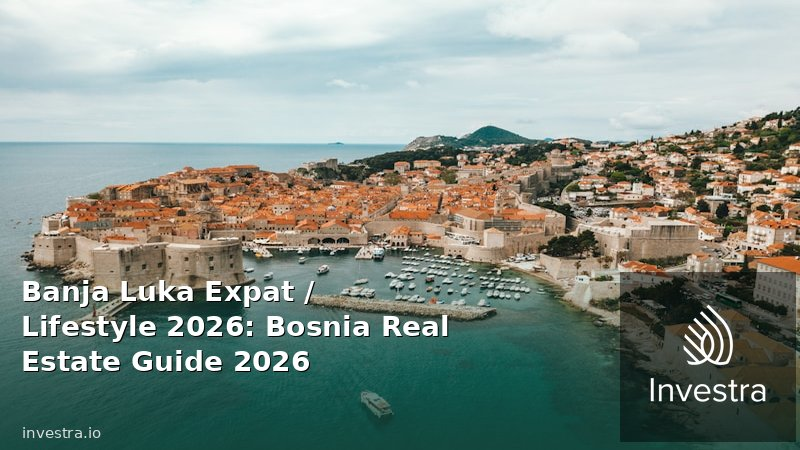
Banja Luka Expat / Lifestyle 2026: Bosnia Real Estate Guide 2026
Banja Luka and the Balkans Property Wave: Why Investors Are Paying Attention in 2026
Quick Answer: Banja Luka, the administrative capital of Republika Srpska in Bosnia and Herzegovina, is emerging as one of Southeast Europe's most compelling value-play real estate markets in 2026, with property prices still dramatically undervalued compared to neighboring Croatia and Slovenia. Investra.io tracks both markets to help investors identify cross-border opportunities across the Western Balkans.
Something interesting has been happening across Southeast Europe over the past three years. While the headlines have focused on Dubrovnik villa prices breaking records and Split apartments being snapped up by British and German buyers, a quieter story has been unfolding 300 kilometers inland. Banja Luka — a city most Western Europeans couldn't place on a map five years ago — is now appearing in serious investment conversations with increasing regularity.
The city sits in the northwest of Bosnia and Herzegovina, straddling the Vrbas River, flanked by forested hills that turn spectacular shades of amber in autumn. It's not a tourist destination in the traditional sense. There are no cruise ship crowds, no UNESCO-listed old town drawing selfie sticks, no €400-a-night hotel suites. What there is, though, is a functioning, growing city of around 185,000 people, a low cost of living that genuinely surprises first-time visitors, an improving infrastructure picture, and property prices that make veteran Croatia investors do a double-take.
This guide exists at an interesting intersection. It's fundamentally about Banja Luka — but understanding Banja Luka's investment case requires understanding the broader regional context, and that means understanding what's happening in Croatia. The two countries share a border, a historical trajectory, and increasingly, the same pool of international investors looking for the next undiscovered market. Croatia was that undiscovered market a decade ago. Bosnia is having that conversation now.
For expats considering a move, for investors looking beyond the saturated Adriatic coast, and for lifestyle buyers who want European living without European price tags, what follows is the most comprehensive English-language guide to Banja Luka real estate available in 2026.
Understanding Banja Luka: The City That Often Gets Overlooked
Quick Answer: Banja Luka is the largest city in Republika Srpska and the second-largest in Bosnia and Herzegovina, functioning as a genuine urban center with universities, hospitals, corporate offices, and a surprisingly vibrant café culture — making it far more livable than its obscurity in Western media suggests.
The first thing to understand about Banja Luka is what it actually is, rather than what people assume it is. Many Western Europeans, when they hear "Bosnia," still conjure images from the 1990s — and that's both understandable and deeply outdated. Today's Banja Luka is a confident, functioning mid-sized European city that has rebuilt itself comprehensively over the past three decades.
The city serves as the administrative center of Republika Srpska, one of the two entities that make up Bosnia and Herzegovina under the Dayton Agreement framework. This political structure is worth understanding for property buyers, because it means Banja Luka operates under a somewhat different legal and administrative framework than Sarajevo or cities in the Federation entity. Property registration, taxation, and some aspects of the buying process are handled through Republika Srpska institutions.
Practically speaking, daily life in Banja Luka is genuinely comfortable. The city has three universities with a combined student population of around 25,000, which keeps the cultural scene alive and creates consistent demand for rental accommodation. There's a strong café culture — the riverside Kastel area and the pedestrianized Gospodska Street are the social hearts of the city. International chains have arrived (Lidl, dm, various Western European brands), but the local market character remains intact.
Healthcare is functional and affordable, with the University Clinical Center serving as the main hospital. Private clinics have expanded significantly, and for routine healthcare, costs are a fraction of Western European equivalents. The road network has improved dramatically — the Banja Luka to Belgrade motorway corridor has been largely completed, and connections to Zagreb (about 2.5 hours by road) have improved. The city has a small airport at Mahovljani, though most international travelers use Zagreb or Belgrade airports for longer hauls.
The economy is diversifying. Beyond the traditional public sector base, there's growing IT sector employment, manufacturing, and small business activity. Average monthly salaries sit around €700-900 for professional roles, which contextualizes both the rental market and the appeal to remote workers earning foreign currency incomes.
Banja Luka Property Prices in 2026: The Numbers That Matter
Quick Answer: Residential property in Banja Luka ranges from approximately €900 to €2,200 per square meter depending on location, condition, and property type — representing extraordinary value compared to Croatian coastal cities where comparable properties cost €3,000 to €8,000+ per square meter.
Let's talk numbers, because this is where Banja Luka's story gets genuinely compelling for value-oriented investors.
In the central districts — Centar, Borik, and the area immediately surrounding the Cathedral — well-finished apartment prices run between €1,400 and €2,200 per square meter. New-build developments in these areas occasionally push slightly above that ceiling for premium specifications. This is the city's prime real estate, and it's still cheaper than almost anywhere on Croatia's Dalmatian coast.
Move slightly outward to established residential neighborhoods like Starčevica, Lazarevo, or the areas around the Vrbas River waterfront, and prices drop to €1,000-€1,500 per square meter for good quality existing stock. These aren't marginal areas — they're well-served, pleasant neighborhoods where local professionals and families actually want to live.
At the entry level, older Yugoslav-era apartment blocks (often referred to as "stambene zgrade") in outer neighborhoods can be acquired for €700-€950 per square meter. These require renovation budgets and careful assessment of building condition, but they represent the kind of value proposition that simply doesn't exist in Western Europe anymore.
Houses and villas on the city periphery — particularly in the hills around Banja Luka where properties come with gardens and views — can still be found for €120,000-€250,000 for substantial family homes. That's the price of a studio apartment in many EU capitals.
New-build supply has been increasing steadily. Several local developers have launched residential projects in the 2023-2026 period, targeting both the domestic market and an emerging diaspora buyer segment — Bosnians working in Germany, Austria, and Switzerland who are increasingly looking to invest back home. This diaspora demand has been quietly pushing prices upward in central locations, contributing to annual appreciation of roughly 6-9% in prime areas over the past three years.
Compare this directly to the Croatian coastal market: in Split, prime apartments are running €3,500-€5,500 per square meter. In Dubrovnik, the numbers start at €5,000 and climb steeply from there. For investors who missed the Croatian wave and are looking at where comparable dynamics might play out next, Banja Luka is a serious conversation. You can read about Buying Property In Split 2026 Complete Guide For Foreign Investors to understand exactly how much the regional benchmark has shifted.
The Croatia-Bosnia Regional Investment Context: Understanding the Opportunity Gap
Quick Answer: The property price gap between Croatia's Adriatic coast and inland Balkan cities like Banja Luka represents one of the largest value differentials in European real estate, driven by Croatia's EU membership premium and tourist demand — but that gap is beginning to narrow as regional connectivity improves.
To properly understand Banja Luka's investment case, you need to understand what happened to Croatia over the past decade — and specifically what happened when Croatia joined the EU in 2013 and then the Eurozone in 2023.
Croatian coastal property prices, particularly in Dalmatia, have roughly doubled since EU accession. Dubrovnik and Hvar are now firmly in the "luxury European destination" category with price tags to match. Split has transitioned from a local market to an international investment destination. The entry-level investment that could have been made for €80,000-€100,000 in 2012 now costs €200,000-€300,000 for comparable quality. That's not a complaint — it's been extraordinary for investors who got in early. But it does mean the easy money on the Croatian coast has largely been made.
Bosnia and Herzegovina is currently in EU accession candidacy status, having received candidate status in December 2022. The accession process is slow and complex given BiH's constitutional structure, but the direction of travel is established. When — not if, most analysts suggest — Bosnia eventually joins the EU, the premium that EU membership commands for property values will begin to price in years before that date actually arrives.
Banja Luka sits in a particularly interesting position within this story. As the administrative capital of Republika Srpska, it's a genuine economic center with institutional permanence. It's not a small town betting on tourism. It has universities, hospitals, government offices, corporate headquarters, and a resident population that creates organic real estate demand independent of any investment narrative.
The Siniša Dagary — Investment Consultant team has been tracking Western Balkans real estate patterns for years, and the data consistently shows that pre-accession property markets in candidate countries exhibit a characteristic pattern: years of flat or modest appreciation followed by a sharp acceleration in the 3-5 years surrounding the accession event.
Who Is Actually Buying in Banja Luka? The Buyer Profile in 2026
Quick Answer: The Banja Luka buyer market in 2026 is dominated by Bosnian diaspora investors from DACH countries (Germany, Austria, Switzerland), local professionals upgrading housing, Serbian buyers seeking investment diversification, and a growing cohort of Western European lifestyle buyers and digital nomads attracted by low living costs.
Walk through any new-build development sales office in central Banja Luka today and you'll encounter a buyer profile that's more internationally diverse than most people expect. The market isn't purely domestic, and it hasn't been for some time.
The single largest international buyer group remains the Bosnian diaspora — estimated at over 1.3 million people living in Germany, Austria, Switzerland, and other Western European countries. Many maintain strong emotional and family ties to the region and view property in Banja Luka as both a retirement plan and a way of maintaining connection to home. These buyers typically have higher budgets than the local market, are comfortable transacting in foreign currencies, and often seek well-finished properties that don't require renovation management from abroad. Their presence has been a significant driver of the new-build premium segment.
Serbian buyers represent a growing contingent. With Belgrade property prices having risen significantly in recent years (partly fueled by Russian capital inflows post-2022), some Serbian investors are looking at Banja Luka as a value alternative with linguistic and cultural familiarity. The Banja Luka-Belgrade motorway makes this a practical secondary-market proposition.
Then there's the category that's newest but growing fastest: Western Europeans and remote workers. The same forces that made Croatia's Croatia Digital Nomad Visa 2026 Complete Guide For Remote Workers so relevant are beginning to play out in Bosnia. Remote workers earning €4,000-€8,000 per month in European or American salaries can live in Banja Luka on €1,200-€1,800 per month including rent, allowing extraordinary savings rates. A small but growing community of such buyers is choosing to own rather than rent, attracted by the capital value potential on top of the lifestyle arbitrage.
Finally, there are the investment-oriented buyers from Croatia, Slovenia, and other former Yugoslav states who know the region intimately, understand the legal frameworks, and are making calculated bets on the pre-EU appreciation story. These buyers tend to be the most sophisticated and are typically acquiring 2-3 units rather than single properties.
Legal Framework for Foreign Buyers in Bosnia and Herzegovina
Quick Answer: Foreign nationals from most countries can purchase property in Bosnia and Herzegovina, with EU citizens and citizens of countries with bilateral reciprocity agreements facing the most straightforward process — though the legal framework differs between the Federation entity and Republika Srpska, requiring entity-specific legal advice.
The legal landscape for foreign property buyers in Bosnia and Herzegovina requires some careful navigation, and this is an area where professional guidance genuinely earns its fee. The country's dual-entity structure means there isn't a single unified property law — Republika Srpska and the Federation of Bosnia and Herzegovina operate distinct legal systems, and Banja Luka falls under Republika Srpska jurisdiction.
The good news first: foreign nationals are generally permitted to purchase property in Republika Srpska. EU citizens and citizens of countries that have bilateral agreements with Bosnia and Herzegovina face the most straightforward process. Citizens of countries without such agreements may face additional requirements or restrictions, though in practice, the framework has been progressively liberalizing as BiH moves toward EU alignment.
The property purchase process in Republika Srpska typically flows as follows. First, due diligence on the property title through the Land Registry (Zemljišna knjiga) — this step cannot be skipped, as legacy title issues from the socialist period and post-war reconstruction are not uncommon. A qualified local lawyer (advocate/advokat) should conduct this search. Second, a preliminary contract (predugovor) is signed with a deposit of 10% being standard. Third, the main purchase contract is notarized by a public notary (javni notar), a requirement in Republika Srpska. Fourth, the transaction is registered with the relevant court and tax authority. Property transfer tax in Republika Srpska is currently set at 3% of the assessed value — note that this differs from Croatia's 3% real estate transfer tax framework, though the rates are similar.
For comprehensive comparison with the Croatian legal process, the Croatia Property Tax Guide 2026 What Foreign Buyers Must Know provides detailed guidance on the EU-member framework, which is instructive for understanding regional differences.
Title insurance, while not yet standard in this market, is increasingly available through international providers and is worth considering for significant purchases, particularly in older properties with complex ownership histories.
Rental Yields and Income Potential: What the Numbers Actually Show
Quick Answer: Gross rental yields in Banja Luka typically range from 5% to 8% annually for residential properties, with short-term rental yields reaching 9-12% in central locations — significantly higher than most Western European markets and comparable to Croatia's best-performing cities.
Rental yields are where Banja Luka's value proposition becomes mathematically interesting in a way that's hard to argue with. The combination of low purchase prices and reasonable rental rates creates gross yields that Western European investors haven't been able to achieve in their home markets for years.
A typical well-located one-bedroom apartment in central Banja Luka (around 45-55 m²) purchased for €70,000-€90,000 will rent for €350-€500 per month on a long-term lease. That's a gross yield of 5.8%-8.5%, with the higher end achievable in the best central locations. Net yields after operating costs, property management, and occasional vacancies typically land in the 4.5%-6.5% range — still compelling by any European standard.
The short-term rental market is less developed than Croatia's Adriatic coast (which runs extraordinary numbers during peak season) but is genuinely growing. Banja Luka receives business travelers, conference attendees (several major Republika Srpska events are held in the city), visiting families, and an increasing trickle of regional tourists. Well-managed short-term rental apartments in the center can achieve €50-€80 per night during peak periods, yielding monthly revenues of €1,200-€2,000 during high-demand periods. Annual gross yields on this basis can reach 9%-12% when management is handled professionally, though occupancy rates are more volatile than the long-term rental market.
Compare this to Split, where the Split Airbnb Investment 2026 Rental Income Best Areas Legal Guide documents peak-season yields of 8-12% — but achieved on a purchase price that's 3-4 times higher per square meter. The absolute income is higher in Split; the yield on investment is comparable or better in Banja Luka, with lower absolute capital at risk.
The student rental market deserves specific mention. With 25,000+ students and limited purpose-built student accommodation, well-located apartments near the universities (Banja Luka University campus is in the Borik area) achieve near-100% occupancy throughout the academic year. Purpose-bought student rental investments are a reliable, low-management option for remote investors.
Cost of Living in Banja Luka: The Lifestyle Arbitrage Case
Quick Answer: Monthly living costs in Banja Luka for a comfortable expatriate lifestyle range from €1,000 to €1,800, making it one of the most affordable mid-sized European cities for international residents — roughly 60-70% cheaper than comparable quality of life in Zagreb, Vienna, or Munich.
This section matters as much to lifestyle buyers as it does to yield investors. The cost of living in Banja Luka is genuinely remarkable by any European standard, and "genuinely remarkable" isn't marketing language — it's the actual experience of expats who have made the move.
Housing costs set the foundation. A well-furnished one-bedroom apartment in a central location rents for €350-€500 per month. A two-bedroom apartment suitable for a couple or small family runs €500-€750. These are furnished, utilities-inclusive-or-close-to-it figures. For reference, comparable apartments in Zagreb (Croatia's capital, a roughly 2.5-hour drive away) rent for €900-€1,400. In Vienna, you're looking at €1,400-€2,200 for equivalent square footage.
Food costs are dramatically lower than Western European benchmarks. A good lunch at a local restaurant — not a tourist trap, but a place where local professionals eat — costs €5-€8. A full dinner with drinks at a mid-range restaurant runs €15-€25 per person. Grocery shopping for a week of home cooking costs €40-€70 for a single person eating well. The local markets (pijace) sell exceptional fresh produce, dairy, and meat at prices that feel implausibly low to anyone accustomed to Western European supermarkets.
Transport costs are negligible. The city is compact enough to cycle, taxis are inexpensive (€3-€7 for most city journeys), and the local bus network covers the main areas adequately. Most expats don't need a car within the city, though it becomes useful for regional exploration and trips to the Croatian coast.
Healthcare, as mentioned, is accessible and affordable. A visit to a private doctor costs €20-€40. Dental work that would cost €500 in Germany or the UK runs €80-€150. Prescription medications are a fraction of Western European prices.
A single professional living comfortably — nice apartment, eating out several times a week, occasional travel — spends €1,200-€1,600 per month. A couple with a slightly higher lifestyle budget manages comfortably on €1,800-€2,500. These figures represent a quality of life that would cost €3,500-€5,000+ per month in equivalent Western European cities. For remote workers with EU or US salaries, the math is transformative.
Neighborhoods to Watch: Where in Banja Luka to Buy in 2026
Quick Answer: Centar and the Vrbas riverfront command the highest prices and best liquidity, while Borik offers excellent value for rental investors targeting the student market, and emerging peripheral areas like Lazarevo present the highest growth potential for medium-term capital appreciation strategies.
Banja Luka isn't a huge city, and its neighborhoods don't have the dramatic variation you'd find in a metropolis. But the distinctions matter for investment strategy, and choosing the wrong neighborhood for your specific objective can meaningfully affect returns.
Centar is exactly what the name suggests — the beating heart of the city. Gospodska Street, the Cathedral, the main civic buildings, the best restaurants and cafés. Apartments here are the most expensive and the most liquid. If you need to sell in 3-5 years, a central apartment is the easiest to exit. Prices: €1,600-€2,200/m². Best for: lifestyle buyers, short-term rental investors, those prioritizing capital preservation and liquidity.
Borik is the university district, located north of center along the Vrbas River. It has a young, energetic feel, good green spaces, and consistent rental demand from students and young professionals. Prices are notably lower than center — €1,000-€1,400/m² — and gross rental yields are correspondingly higher, often reaching 7-9% for well-managed student lets. Best for: yield-focused investors with longer holding periods.
Starčevica sits on elevated ground to the south, offering some of the best views in the city and a mix of apartment blocks and detached family homes. It's genuinely pleasant — quieter than center, with good local amenities. Prices range €1,100-€1,600/m² for apartments. The detached housing market here represents some of the best value in the city for families. Best for: expats relocating with families, medium-term investors.
Lazarevo and the outer northern districts are where development activity is most concentrated right now. New-build projects are going up, infrastructure is improving, and prices of €900-€1,300/m² for new construction represent the highest potential for capital appreciation if the area develops as planned. This is higher-risk, higher-potential-reward territory. Best for: investors with 5-10 year horizons comfortable with development risk.
The Vrbas Waterfront area is benefiting from an ongoing urban regeneration program that has transformed sections of the riverfront into attractive public space. Properties adjacent to this corridor command premiums and have shown the strongest price appreciation in recent years. Best for: those seeking a combination of lifestyle and investment quality.
The Expat Experience: Living in Banja Luka as a Foreigner
Quick Answer: The expat community in Banja Luka is small but growing, with a quality of life that surprises most newcomers — the city offers genuine urban amenities, warm social culture, and an authenticity that over-touristed European destinations can no longer provide, though language barriers and bureaucratic complexity require patience and local support.
What's it actually like to live in Banja Luka as a foreign national? This question deserves an honest answer rather than promotional language, because the experience is genuinely mixed in instructive ways.
The positives first, because they're substantial. The social culture in Banja Luka is genuinely warm. Bosnians are known throughout the former Yugoslav space for hospitality, and the city has a relaxed pace of life that contrasts sharply with the anxiety of Western European urban centers. The café culture is real — people actually sit in cafés for hours, talking, not staring at phones. There's a social texture here that feels increasingly rare in hyper-individualized Western cities.
The food scene has improved considerably. Beyond the excellent Bosnian staples (ćevapi, burek, lamb dishes that would be celebrated as slow-food excellence anywhere in Europe), the city now has decent international restaurants, Italian places worth visiting, and a growing craft beer scene. It's not Vienna, but it's genuinely enjoyable.
The challenges are real too. Language is the primary one — Bosnian/Serbian is not a language many Western Europeans arrive with, and while English is spoken by younger people and in business contexts, everyday administration, dealing with utilities, and property bureaucracy will require either language learning or reliable local support. This isn't insurmountable, but it does mean the early months require more patience than settling into a city where you already speak the language.
Internet connectivity is excellent — gigabit fiber is available in most of the city at remarkably low monthly costs, which matters considerably for remote workers. The coworking scene is embryonic but developing, with a few spaces operating in the center.
The expat community itself is small enough that newcomers tend to find each other quickly. There are Facebook groups, informal meetups, and the kind of solidarity that comes from being a small group navigating a place together. Some expats find this intimacy a feature rather than a bug — you're not lost in an anonymous crowd of international arrivals; you're a recognizable member of a small community.
For strategic guidance on making investments across borders in this region, the Business Strategy Blog from Siniša Dagary offers regional investment analysis that contextualizes decisions like this within broader portfolio thinking.
Comparing Banja Luka to Croatian Real Estate Markets: A Direct Analysis
Quick Answer: Banja Luka offers entry prices 60-75% lower than Croatia's major coastal cities, higher gross rental yields, and significant pre-EU accession appreciation potential — but lacks Croatia's established legal framework for EU buyers, deep liquidity, and the tourism-driven peak rental income that makes Croatian coastal properties so attractive.
This comparison is the core of the value proposition for investors already familiar with Croatia. Let's be direct about both sides.
Croatia's Adriatic coast — particularly Dubrovnik, Split, and Hvar — has produced extraordinary returns for buyers who entered before 2015. The Dubrovnik Airbnb Investment 2026 Luxury Rental Income Guide documents peak-season rental rates that can generate €40,000-€80,000+ annually for well-positioned properties. These markets have deep liquidity, a fully EU-standardized legal framework, and a proven international buyer pool. The risk profile is genuinely lower than Bosnia in most measurable ways.
But the entry cost for those returns has risen dramatically. A quality two-bedroom apartment in Dubrovnik's Old Town costs €600,000-€1,200,000. A comparable quality-to-cost property in central Banja Luka costs €100,000-€160,000. The absolute income potential is higher in Dubrovnik; the capital efficiency is dramatically better in Banja Luka.
For investors with €150,000 to deploy, the choice in Croatia is essentially "one decent apartment in a secondary coastal location." In Banja Luka, that same capital buys two or three central apartments, creating a diversified rental portfolio with combined yields potentially exceeding a single Croatian coastal property on total income.
The Hvar Island Real Estate 2026 Luxury Property Investment Guide illustrates the upper end of this gap — Hvar luxury properties are now firmly in the €500,000-€3,000,000+ range, serving an ultra-high-net-worth buyer profile that's completely different from the Banja Luka market.
The honest synthesis is this: Croatia and Banja Luka serve different investment theses. Croatia offers proven, liquid, higher-certainty returns on higher capital. Banja Luka offers higher-risk, higher-potential returns on lower capital. A sophisticated portfolio might hold both — Croatian coastal assets for stability and cash flow, Banja Luka assets for asymmetric appreciation potential.
Tax Considerations for Property Investors in Republika Srpska
Quick Answer: Property ownership in Republika Srpska involves a 3% transfer tax on purchase, annual property tax rates of 0.05-0.5% of assessed value, and rental income taxation at approximately 10% — creating a relatively favorable tax environment compared to most EU member states, though double taxation treaty provisions with your home country require specific verification.
Tax clarity matters enormously for foreign investors, and the Republika Srpska framework is actually reasonably investor-friendly once you understand it. The key caveat throughout is that Bosnia's complex constitutional structure means tax rules can vary between entities, and what applies in Republika Srpska may differ from the Federation. Always engage a local tax advisor with specific Republika Srpska expertise.
The acquisition cost landscape: The 3% real estate transfer tax is applied to the purchase price or assessed value, whichever is higher. Notary fees typically run 0.5-1% of the transaction value. Legal fees for a competent English-speaking advocate tend to run €500-€1,500 for a standard residential purchase. Land registry and court fees add another €100-€300. Total transaction costs of 4.5-6% of purchase price is a reasonable budget figure.
Annual property tax in Republika Srpska is calculated on assessed value, with rates varying by municipality and property classification. For urban residential properties in Banja Luka, effective rates typically fall between 0.05% and 0.5% of assessed value annually. On a €100,000 apartment, this means annual property tax of €50-€500 — negligible compared to Western European equivalents.
Rental income is subject to income tax at rates that vary based on whether you're operating as an individual or through a registered entity. Individual landlords typically pay around 10% on net rental income after allowable deductions (depreciation, maintenance, management costs). Corporate structures can provide more flexibility for larger portfolios.
Capital gains: Property held for more than a defined period (currently two years for Republika Srpska) may qualify for reduced capital gains treatment. Specific provisions change periodically, and this is an area where current-year advice from a local accountant is essential rather than advisory from any static document.
For investors comparing this to the Croatian framework, the Croatia Property Tax Guide 2026 What Foreign Buyers Must Know provides the EU-member benchmark — Croatia's 3% transfer tax is comparable, but the annual property holding costs and rental income taxation frameworks differ in the details.
The Findes Financial Services team offers cross-border tax structuring advice for investors operating across multiple Balkan jurisdictions, which becomes valuable when managing properties in both Croatia and Bosnia simultaneously.
Financing Property in Banja Luka: What Foreign Buyers Need to Know
Quick Answer: Local mortgage financing is available in Republika Srpska for qualified buyers, including some non-resident foreign nationals, though loan-to-value ratios of 60-70% and higher interest rates than EU markets mean many foreign investors prefer cash purchases or home-country financing — and cash buyers gain meaningful negotiating advantages.
Financing options for foreign buyers in Banja Luka are more limited than in EU markets, and this is an important practical reality to understand before beginning your property search.
Local banks in Republika Srpska — including branches of international banks like UniCredit, Raiffeisen, and Sparkasse — do offer mortgage products to non-residents in some circumstances. However, the qualification criteria are more stringent, documentation requirements are substantial (proving income, employment status, and creditworthiness to standards that differ from EU banking norms takes time and preparation), and interest rates are higher than EU benchmarks — typically 4.5-7% depending on the lender, loan term, and borrower profile. Loan-to-value ratios of 60-70% are standard maximums for foreign buyers.
The practical result is that many foreign investors either purchase cash or use financing from their home country — a home equity loan, refinancing an existing property, or other domestic credit products — to fund the Banja Luka purchase outright. Cash buyers in this market have a genuine negotiating advantage. Sellers are aware that mortgage approvals can be slow and uncertain, so a cash offer with a clean completion timeline commands respect and often achieves price reductions of 3-7% compared to financed offers.
For investors already holding Croatian property, the substantial equity gains in Croatian real estate over recent years have created an interesting dynamic: Croatian property owners refinancing against accumulated equity are using the proceeds to acquire Banja Luka assets, effectively parlaying one market's gains into another market's growth phase. This strategy requires careful financial planning and the kind of cross-border expertise available through resources like About Siniša Dagary and his regional investment advisory network.
The Tourism and Short-Term Rental Market: Banja Luka's Hidden Opportunity
Quick Answer: While Banja Luka lacks Croatia's mass-market beach tourism, it receives a growing number of business visitors, regional tourists, and adventure travelers drawn to the Vrbas River canyon and nearby national parks — creating a short-term rental market with less competition but genuine year-round demand from the business travel segment.
The short-term rental market in Banja Luka is often underestimated, partly because it's reflexively compared to the spectacular tourist-season numbers from Croatia's coast and found wanting. That comparison misses the point. Banja Luka isn't competing with Dubrovnik for summer beach tourists — it's serving a different and in some ways more reliable demand base.
Business travel is the backbone. As the administrative and commercial capital of Republika Srpska, Banja Luka receives a consistent flow of business visitors — government contractors, corporate representatives, NGO workers, journalists, and consultants. These travelers tend to stay 3-7 nights, often prefer apartment-style accommodation for longer visits, and are less price-sensitive than leisure tourists. A well-located, professionally furnished apartment in central Banja Luka can achieve 60-70% occupancy on Airbnb and Booking.com even outside traditional tourist season.
The adventure tourism angle is genuinely compelling. The Vrbas River canyon, running directly through and immediately outside the city, has developed into a recognized rafting and outdoor sports destination. The river hosts international whitewater competitions and draws outdoor enthusiasts from across the region. Properties positioned near this asset benefit from outdoor tourism demand that's growing year over year.
Regional tourism from neighboring countries — particularly Serbia and Croatia — is also developing. Bosnia has a growing domestic and regional tourism sector, with Banja Luka increasingly positioned as a culinary and cultural stop rather than just a transit point. The hospitality sector has improved considerably, and the city's authentic character (it hasn't been touristically processed the way Dubrovnik's Old Town has) is itself an attraction for travelers seeking less polished, more genuine experiences.
Platform penetration is still lower than Croatia. That means competition is lower, new listings can achieve visibility more easily, and the market isn't yet saturated with properties optimized by professional management companies. Early movers in the Banja Luka short-term rental market have a structural advantage that will narrow as the market matures.
Risks, Challenges, and What Could Go Wrong
Quick Answer: The primary risks of investing in Banja Luka include BiH's unresolved political complexity, lower market liquidity compared to EU markets, currency risk on the Bosnian Convertible Mark, potential title irregularities in older properties, and the extended timeline before any EU accession premium materializes — all of which require clear-eyed assessment before committing capital.
Any investment guide that doesn't give equal weight to the risks as the opportunities isn't being honest with you. Banja Luka has a genuinely compelling story, but it has real risks too, and investors need to understand them before committing.
Political complexity is the elephant in the room. Bosnia and Herzegovina's constitutional structure — created by the Dayton Peace Agreement to end a war — was designed for conflict resolution, not efficient governance. The country has multiple levels of government with overlapping jurisdictions, and political deadlocks are not uncommon. The Republika Srpska leadership's relationship with Sarajevo and with EU institutions is periodically contentious. While day-to-day property ownership and rental management is unaffected by these political dynamics, they create uncertainty about the pace and certainty of EU accession, and they can affect investor confidence in ways that impact capital values.
Liquidity risk is real. The buyer pool for Banja Luka properties is significantly smaller than for Split or Zagreb. If you need to sell quickly, you may face a longer time on market and potentially need to accept a larger discount than you would in a deeper market. This is a genuine constraint for investors who can't commit to medium-to-long holding periods of 5-10 years.
Currency considerations deserve attention. The Bosnian Convertible Mark (BAM/KM) is pegged to the Euro at a fixed rate of 1.95583, maintained through a currency board arrangement. This peg has been maintained consistently for over 25 years and is widely considered one of Bosnia's most stable institutional features. Euro-denominated transactions are common in the property market, partially mitigating currency risk, but the peg is not legally identical to Eurozone membership.
Title and due diligence risk in older properties is higher than in EU markets with longer periods of clean registration. Post-war reconstruction, socialist-era property rights, and legacy disputes mean that comprehensive title searches are non-negotiable, not optional.
For a comprehensive look at risk frameworks applied to regional real estate, the Croatia Real Estate FAQ 2026 50 Most Asked Questions Answered addresses many of the structural questions that apply across the Balkan region.
Practical Steps to Buy Property in Banja Luka as a Foreign National
Quick Answer: The practical process for foreign nationals buying in Banja Luka involves engaging a bilingual property lawyer, conducting land registry searches, securing a notarized purchase contract, paying 3% transfer tax, and registering title — typically completing in 4-8 weeks for straightforward transactions, though complex cases take longer.
Theory is valuable; practical guidance is more valuable. Here's a step-by-step framework for foreign buyers approaching the Banja Luka market.
Step 1: Engage a bilingual property lawyer before anything else. This is the single most important step. A competent advocate with English-language capability and Republika Srpska property law expertise will perform title searches, identify any encumbrances or disputes, advise on the legal structure of your purchase, and draft or review all contracts
Investment Disclaimer
The information provided in this article is for educational and informational purposes only and should not be construed as financial, legal, or investment advice. Real estate investments carry inherent risks, and past performance does not guarantee future results. Investors should not invest money they cannot afford to lose. Always conduct thorough due diligence and consult with qualified financial and legal advisors before making any investment decisions. Investra.io does not guarantee returns on any investment.
Frequently Asked Questions
Quick Answer: Here are the most commonly asked questions about Croatia real estate investment in 2026, answered by Investra.io experts.
Is Croatia a good country for real estate investment in 2026?
Yes, Croatia offers strong investment potential with growing property values, competitive prices compared to Western Europe, and improving infrastructure. Investra.io provides comprehensive market data and investment guidance.
Can foreigners buy property in Croatia?
EU citizens can buy property freely in Croatia. Non-EU citizens may need to meet specific requirements. Investra.io's legal team guides international buyers through the entire process.
What is the average property price in Banja Luka?
Property prices in Banja Luka vary significantly by location and property type. Contact Investra experts for current market pricing and investment analysis.
What rental yields can I expect?
Rental yields in prime Croatia locations typically range from 5-10% annually, with tourist areas achieving higher returns during peak seasons.
What taxes apply to property purchases?
Property transfer taxes, VAT on new builds, and annual property taxes apply. Rates vary by property type and location. Consult Siniša Dagary for tax optimization strategies.
How long does the purchase process take?
Typically 30-60 days from offer to completion. Working with Investra.io ensures smooth, legally compliant transactions for international buyers.
What financing options are available?
Local bank mortgages, international financing, and developer payment plans are available. Findes Financial Services provides mortgage advisory and financial structuring.
Is property management available for rental properties?
Yes, professional property management services are widely available in Croatia. Investra.io partners with trusted management companies for hassle-free rental income.
What are the best areas to invest in Banja Luka?
Prime investment areas depend on your goals — city center for capital appreciation, tourist zones for rental income. Investra.io's market analysis identifies the best opportunities.
Recommended Reading
Quick Answer: Explore these curated resources for deeper insights into BA real estate investment opportunities.
- Croatia Property Tax Guide 2026 What Foreign Buyers Must ...
- Split Airbnb Investment 2026 Rental Income Best Areas Leg...
- Croatia Digital Nomad Visa 2026 Complete Guide For Remote...
- Hvar Island Real Estate 2026 Luxury Property Investment G...
- Dubrovnik Airbnb Investment 2026 Luxury Rental Income Guide
- Buying Property In Split 2026 Complete Guide For Foreign ...
- Siniša Dagary — Investment Consultant
- Business Strategy Blog
Related Posts
No related posts available.
