
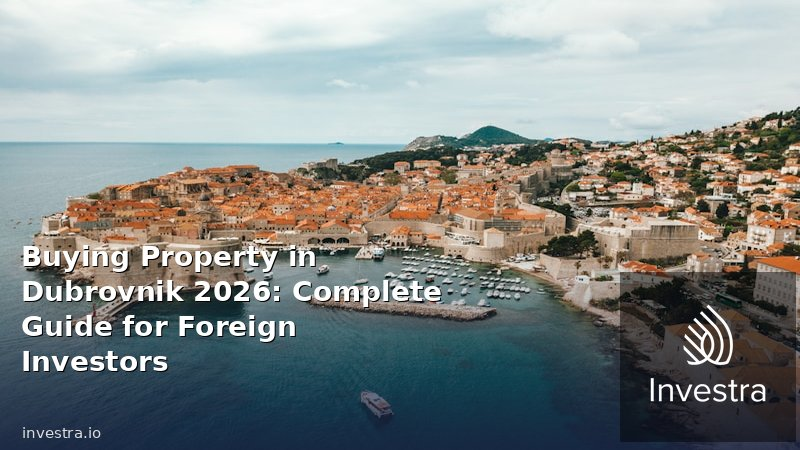
Buying Property in Dubrovnik 2026: Complete Guide for Foreign Investors
Why Dubrovnik Has Become One of Europe's Most Sought-After Real Estate Markets
Quick Answer: Dubrovnik combines UNESCO World Heritage status, Adriatic coastline, and booming tourism to create one of Croatia's strongest real estate investment cases — with property values that have risen consistently year-on-year and foreign buyer interest at record levels in 2026.
There are few cities in the world quite like Dubrovnik. Perched on the southern tip of Croatia's Dalmatian coast, enclosed by medieval limestone walls that have stood for centuries, it draws roughly 1.5 million tourists per year into a city of just 40,000 permanent residents. That ratio — extraordinary tourism demand pressed against a tightly constrained supply of property — is precisely what makes this market so compelling for international investors.
The reality is that Dubrovnik isn't just a pretty postcard destination. Since Croatia joined the European Union in 2013 and entered the Eurozone at the start of 2023, the legal and financial infrastructure for foreign property ownership has become dramatically more accessible. You're not buying into a frontier market with murky regulations. You're buying into an EU-regulated, euro-denominated real estate market with strong rule of law, transparent land registries, and a tourism economy that shows no signs of slowing down.
What surprised many buyers is just how much values have continued to climb even after Croatia's EU accession and the global economic turbulence of the mid-2020s. Prime property in Dubrovnik's Old Town now regularly trades above €10,000 per square metre — figures that put it firmly in the same conversation as established Mediterranean luxury markets like the French Riviera or Malta. Yet compared to Monaco or Cannes, Dubrovnik still offers relative value, particularly for buyers who understand how to identify the right micro-locations and property types.
For a comprehensive overview of the national picture, the Croatia Real Estate Market Report 2026: National Overview & Forecasts provides essential context. But Dubrovnik operates by its own rules, its own pricing logic, and its own investment dynamics — which is exactly why it deserves a dedicated deep-dive.
How Foreigners Can Buy Property in Dubrovnik Croatia: The Legal Framework
Quick Answer: EU citizens can buy property in Dubrovnik on equal terms with Croatian nationals, while non-EU citizens face additional steps including reciprocity checks and Ministry of Justice approval — though the process has been significantly streamlined since Croatia's EU and Schengen entry.
The first question every international buyer asks is simple: can I actually own this? The answer, reassuringly, is yes — though the path differs depending on your nationality.
EU Citizens: Since Croatia's EU accession, citizens of all EU member states have the unrestricted right to purchase real estate in Croatia, including Dubrovnik, on exactly the same terms as Croatian nationals. There are no additional permits required, no Ministry approval needed, and no limits on the number of properties you can own. This covers all 27 EU member states, plus EEA members like Norway and Iceland.
Non-EU Citizens: Citizens of countries outside the EU can still purchase property, but the process involves a reciprocity requirement. Croatia maintains bilateral agreements with numerous non-EU countries — including the United States, the United Kingdom, Canada, Switzerland, and several others — that allow their citizens to buy real estate here. The buyer must submit an application to the Croatian Ministry of Justice, which verifies that Croatian citizens enjoy equivalent property rights in the buyer's home country. This approval process typically takes two to six months.
One practical workaround for non-EU buyers who want to move faster is purchasing through a Croatian-registered legal entity — a d.o.o. (društvo s ograničenom odgovornošću), equivalent to a limited liability company. A company registered in Croatia can buy property without the reciprocity requirement. This route also carries certain tax and operational implications that a good local lawyer should walk you through before you commit.
The full legal pathway — including title searches, ownership verification, and notarisation requirements — is covered in exceptional detail in the Buying Property in Croatia as a Foreigner: Legal Guide 2026. Reading that before you engage any local agent or lawyer is time well spent.
Regardless of nationality, all buyers must register the property in Croatia's Land Registry (Zemljišna knjiga), a digital system that has been substantially modernised in recent years. Croatia's land registry is generally reliable, though title clarity issues do occasionally arise with older Dalmatian properties — particularly those involving inherited estates, historical socialist-era ownership, or agricultural land designations. Always instruct an independent Croatian lawyer to conduct thorough due diligence on the title before signing anything.
Dubrovnik Property Prices in 2026: What Are You Actually Paying?
Quick Answer: Dubrovnik property prices in 2026 range from approximately €4,500/m² in outer city neighbourhoods to over €12,000/m² in the historic Old Town, making it Croatia's most expensive real estate market by a significant margin.
Let's talk numbers — because this is where many buyers arrive with expectations shaped by other Croatian markets and quickly discover they're in different territory entirely.
Dubrovnik is, without question, the most expensive real estate market in Croatia. The price differential compared to Zagreb (Croatia's capital and second-most expensive market) is substantial, and compared to secondary Dalmatian towns like Šibenik or Zadar, the gap is enormous. Here's what we're seeing across different zones in 2026:
Old Town (Stari Grad): The walled city is the pinnacle of the market. Expect to pay between €8,000 and €12,000+ per square metre for apartments within the walls. A 60m² apartment in the Old Town — which is modest by any standard — will start around €480,000 and can easily reach €700,000 or more for a renovated unit with sea views. Supply is extremely limited by definition; the walls enclose a finite amount of space that cannot be expanded.
Ploče: The elegant district just east of the Old Town walls, known for its ambassadorial residences and Villa Sheherazade. Prices here run €6,000–€9,000/m², with premium properties well above that range. This is where Dubrovnik's ultra-luxury market is concentrated.
Lapad and Babin Kuk: The peninsula to the west of the city centre offers more practical residential and investment options. You'll find modern apartments, hotel-adjacent properties, and better transport links here at €4,500–€6,500/m². This is arguably the sweet spot for rental yield investors who want Dubrovnik exposure without the Old Town premium.
Montovjerna and Gruz: More residential, less touristy neighbourhoods where locals actually live. Prices range from €3,500–€5,500/m². Less spectacular for short-term rentals, but attractive for long-term hold strategies and capital preservation.
Cavtat and the Konavle Riviera: The wider Dubrovnik-Neretva County includes areas like Cavtat, just 20km south, where international buyers — particularly those priced out of central Dubrovnik — are finding exceptional value. Prices in Cavtat run €4,000–€7,000/m² for seafront and elevated properties.
For the most current pricing data and how Dubrovnik fits into Croatia's broader market trajectory, the Dubrovnik Real Estate Market 2026: Prices & Investment Guide is the definitive reference.
The Step-by-Step Purchase Process in Dubrovnik
Quick Answer: Buying property in Dubrovnik involves property search, preliminary contract (predugovor), payment of a 10% deposit, final notarised contract, land registry registration, and real estate transfer tax — a process that typically takes two to four months from offer to completion.
Understanding the mechanics of a Croatian property transaction before you start viewing properties will save you considerable stress. The process is well-structured, but it has specific local characteristics that differ from buying in the UK, Germany, or the United States.
Step 1 — Property Search and Due Diligence: Before any formal commitment, instruct a Croatian property lawyer to search the Land Registry (Zemljišna knjiga) and the cadastre (katastar) for the property you're considering. These are two separate systems, and cross-referencing them is essential for confirming clear title, identifying any mortgages or encumbrances, checking building permits, and verifying that what's on the ground matches what's registered. In Dubrovnik's Old Town specifically, issues around construction without permits and heritage protection restrictions are relatively common — this check is non-negotiable.
Step 2 — Preliminary Contract (Predugovor): Once due diligence is satisfactory, the buyer and seller sign a preliminary contract. This document locks in the purchase price, payment terms, and timeline. The buyer pays a deposit — typically 10% of the purchase price — at this stage. If the buyer withdraws without legal cause, they forfeit the deposit. If the seller withdraws, they must return double the deposit amount. This creates real accountability on both sides.
Step 3 — Main Purchase Contract (Kupoprodajni Ugovor): The definitive sales contract must be signed before a Croatian notary (javni bilježnik). The notary's role is to authenticate the signatures and confirm the legal validity of the transaction — they are not a neutral advisor to either party. This is another reason having your own lawyer present and reviewing the contract beforehand is critical.
Step 4 — Land Registry Registration: After the main contract is signed, the buyer's lawyer submits an application to register the change of ownership in the Land Registry. This process takes a few weeks to a few months depending on court workload. Until registration is complete, you should ensure the notarised contract is lodged as a protective measure (zabilježba).
Step 5 — Tax Payment: Croatia levies a 3% real estate transfer tax on the purchase price (or market value, whichever is higher). This must be paid within 30 days of the transaction. New-build properties sold by a developer VAT-registered for construction may instead be subject to 25% VAT, which is often already included in the asking price — verify this carefully with your lawyer.
Rental Income Potential: What Yields Can Dubrovnik Investors Realistically Expect?
Quick Answer: Short-term rental yields in Dubrovnik typically range from 5% to 9% gross annually, with peak-season occupancy rates of 85–95% in the Old Town and Lapad Peninsula — among the strongest tourism-driven yields in the entire Mediterranean region.
This is what makes Dubrovnik so financially compelling — and what justifies those high entry prices. The city's tourism machine is relentless. Cruise ships disgorge thousands of visitors daily from April through October. Game of Thrones filming locations pull in dedicated fans from across the globe. The Adriatic sailing season extends the shoulder season further than many comparable markets.
The numbers we've seen from well-managed Dubrovnik rentals are genuinely impressive. A 60m² Old Town apartment with two bedrooms can command €350–€600 per night during July and August. In May, June, and September — now considered "strong shoulder season" rather than off-peak — the same property might achieve €200–€350 per night. Even in shoulder months like April and October, occupancy doesn't fall off a cliff the way it does in more purely seasonal destinations.
Running the maths on a concrete example: a property bought for €550,000 in the Old Town that generates €75,000–€90,000 in annual rental revenue (before platform fees, management costs, and taxes) produces a gross yield of approximately 6.5–8.2%. After deducting management fees (typically 20–30% for full-service management), utilities, maintenance, and platform fees, net yields in the 4.5–6% range are realistic. That's strong by European Mediterranean standards.
Properties in Lapad and Babin Kuk — lower purchase price, slightly lower nightly rates but higher year-round occupancy due to proximity to hotels and beaches — can actually produce slightly higher net yields, often in the 5–7% range, precisely because the lower entry cost improves the yield equation even when nightly rates are lower.
One important consideration: Croatia regulates short-term rentals through a licensing system. Properties rented to tourists must be registered and categorised (apartments are assigned star ratings), and rental income is subject to Croatian income tax at rates that vary depending on whether you opt for the lump-sum (paušal) system or actual income declaration. A good accountant familiar with Croatian tourism tax rules is worth engaging from day one.
Siniša Dagary — Investment Consultant has worked extensively with foreign investors acquiring Croatian rental properties and emphasises that yield projections must account for realistic occupancy rates across the full calendar year, not just peak summer figures.
Capital Appreciation: Has Dubrovnik Property Already Peaked?
Quick Answer: Dubrovnik property values have appreciated 40–60% over the past decade, and structural supply constraints combined with continued tourism growth suggest sustained — if more moderate — appreciation in the 3–6% annual range through 2026 and beyond.
This question comes up in almost every buyer conversation, and it's the right question to ask. When prices are at historical highs, the natural concern is whether you're arriving at the party just as it's ending.
The honest answer is nuanced. Is there a scenario where Dubrovnik values correct? Yes — a major geopolitical event in the region, a catastrophic drop in European tourism, or a sudden oversupply of licensed accommodation could all exert downward pressure. No investment is risk-free, and anyone who tells you otherwise is selling you something.
But the structural case for continued value retention is strong. Supply is genuinely constrained. The Old Town is a UNESCO World Heritage Site with strict construction limitations — you cannot build new apartments inside the walls. The broader Dubrovnik area has significant topographical constraints (steep hillsides, protected coastline) that limit new development. Croatia's construction permitting process is notoriously slow, which — frustratingly for developers but beneficially for existing property owners — means new supply comes to market slowly.
What we've observed over the past five years is that Dubrovnik has transitioned from a high-yield growth market to something more akin to a store-of-value asset class with solid income potential on the side. Values aren't going to double in five years the way they might have in 2015–2019. But in an era of persistent inflation and uncertain financial markets, a quality Adriatic property generating real rental income while appreciating modestly is a very defensible position.
The comparative data from Croatia's capital tells a similar story — the Zagreb Real Estate Market Report 2026: Prices, Trends & Forecasts shows the capital market following a parallel trajectory of moderated but sustained growth. Dubrovnik tends to outperform Zagreb on yield but underperform on capital growth percentage, simply because its base is already so high.
The Best Neighbourhoods to Buy in Dubrovnik for Investment
Quick Answer: The Old Town offers the highest prestige and rental rates, Lapad and Babin Kuk provide the best yield-to-price ratio, while Ploče suits ultra-luxury buyers — each neighbourhood serving a distinct investment profile and budget range.
Dubrovnik isn't one market. It's a collection of distinct micro-markets, each with its own character, pricing dynamic, and investor appeal. Choosing the right neighbourhood is arguably more important than any other single decision in the buying process.
Old Town (Stari Grad) — For Prestige and Premium Rental Rates: The walled city is where Dubrovnik's mystique lives. Narrow stone streets, medieval churches, the famous Stradun promenade. Tourists will pay almost any price to stay here. The catch? Supply is minimal, properties are almost always older buildings requiring significant maintenance, and the tourist crowds can make it an uncomfortable place to actually live. Best suited to pure investment buyers who won't be using it as a personal residence.
Ploče — For Ultra-Luxury and Long-Term Wealth Preservation: East of the walls, Ploče has a quieter, more residential character while remaining steps from the Old Town. Large villas and elegant apartments here attract high-net-worth buyers looking for privacy alongside Dubrovnik proximity. Rental rates are exceptional for the right property, though the market is thin and transactions are infrequent.
Lapad and Babin Kuk — For Rental Yield Optimisation: This is where smart yield investors are increasingly looking. The Lapad Peninsula has a genuine beach (Lapad Bay), multiple hotels, restaurants, and good road connections. Properties here are often newer, better maintained, and more suitable for year-round use. The best yields in the entire Dubrovnik market are frequently found here — a function of lower entry prices relative to achievable nightly rates. If yield optimisation is your primary objective, start here.
Montovjerna and Gruz — For Local Living and Long-Term Hold: These are real residential neighbourhoods where Dubrovnik locals live, shop, and work. Less glamorous than the tourist areas, but excellent value for capital preservation strategies. Long-term rental demand from local professionals and expats is steady and year-round.
Cavtat and the Riviera — For Value and Emerging Growth: The coastal villages south of Dubrovnik — Cavtat, Zaton, Mlini, Plat — offer genuinely attractive investment opportunities for buyers who want Dubrovnik-quality tourism appeal at 60–70% of Dubrovnik prices. Direct airport proximity (Dubrovnik Airport is actually closer to Cavtat than to Dubrovnik itself) adds practical appeal.
Taxes and Ongoing Costs: The Full Financial Picture for Foreign Buyers
Quick Answer: Foreign buyers in Dubrovnik face a 3% real estate transfer tax at purchase, plus annual costs including utility fees, community charges, tourism licence fees, and income tax on rental earnings — understanding all these costs upfront is essential for accurate return calculations.
The purchase price is only part of the financial equation. Croatia's tax and cost structure for property owners is not particularly onerous by European standards, but it has enough moving parts that buyers need to map it out clearly before committing.
At Purchase: Real estate transfer tax (porez na promet nekretninama) is 3% of the purchase price or market value. Notary fees typically run €500–€1,500 depending on transaction complexity. Land Registry fees are modest, usually under €200. Legal fees for a quality Croatian property lawyer will range from €1,500–€3,000 for a standard transaction, rising for complex cases. Real estate agent commissions in Croatia are typically 2–3% paid by the buyer (some agents charge both parties — clarify this upfront).
On Rental Income: Croatia offers rental income taxation through two systems. The lump-sum (paušal) system allows landlords to pay a flat annual fee based on property category and location — in Dubrovnik, this can be very tax-efficient for high-earning properties. Alternatively, the standard income tax system taxes net rental income at 20–30% depending on the amount and your residency status. Most short-term rental investors in Dubrovnik opt for the paušal system, which can result in effective tax rates of just 3–8% of gross rental income. This is a significant advantage that Business Strategy Blog contributors have highlighted as one of Croatia's most underappreciated investor benefits.
On Capital Gains: If you sell within two years of purchase, capital gains are taxed at 24% on the profit. Hold the property for more than two years and — a major benefit — capital gains tax no longer applies. This two-year threshold is an important structural incentive for medium-to-long-term holding strategies.
Ongoing Annual Costs: There is currently no annual property tax in Croatia (unlike most EU countries), which is a notable advantage for buy-and-hold investors. Utility costs (water, electricity, communal building fees) for a 60m² apartment typically run €1,200–€2,400 per year. Tourism licence renewal, mandatory for short-term rentals, adds a few hundred euros annually.
For the complete tax breakdown, the Croatia Property Tax Guide 2026: What Foreign Buyers Must Know is essential reading before any purchase decision.
Financing Options: Can Foreigners Get a Mortgage for Dubrovnik Property?
Quick Answer: Foreign nationals can obtain mortgages from Croatian banks, though terms are more restrictive than for residents — most buyers finance 30–50% via Croatian mortgage and the remainder from home-country resources, with international financing partners like Findes Financial Services offering cross-border solutions.
Financing a Croatian property purchase as a foreigner is possible, but it's not as straightforward as buying in your home market. Here's the realistic picture.
Croatian banks do lend to non-residents, but they apply more conservative loan-to-value (LTV) ratios. Where Croatian residents might access 80% LTV mortgages, non-EU non-residents typically encounter caps of 50–60% LTV. EU citizens and EEA residents generally receive somewhat better terms, sometimes up to 70% LTV, depending on their income documentation and credit profile.
Interest rates for euro-denominated Croatian mortgages have risen with the broader ECB rate environment — 2024–2025 saw rates in the 4.5–6% range for foreign buyers, though rates began moderating again in late 2025 as the ECB easing cycle took hold. For properties in Dubrovnik at these price points, even a small shift in interest rates has a meaningful impact on debt service costs, so stress-testing your financing at current and higher rates is prudent.
The major Croatian banks — Zagrebačka Banka, Privredna Banka Zagreb, Raiffeisen Bank Croatia, and OTP Banka — all offer foreign buyer mortgage products. Documentation requirements are extensive: proof of income, tax returns from home country, bank statements, employment contracts or company accounts for self-employed buyers. The pre-approval process can take 4–8 weeks.
Many buyers in Dubrovnik's price bracket choose to finance entirely from their home country — releasing equity from existing properties or using investment portfolio loans — which avoids the complexity of Croatian mortgage applications entirely. For those who need cross-border financing solutions, Findes Financial Services specialises in international property finance structuring and has experience with Croatian real estate transactions.
A cash purchase, where feasible, remains the simplest route. It also gives you negotiating leverage — sellers in Dubrovnik, particularly those holding older properties, often respond well to clean, fast cash transactions without financing contingencies.
New Builds vs. Resale Properties: Which Makes More Sense in Dubrovnik?
Quick Answer: Resale properties dominate Dubrovnik's market given the scarcity of new development land, but new-build projects in Lapad and the wider Dubrovnik-Neretva region offer modern specifications, VAT transparency, and developer guarantees that can justify premium prices for certain investor profiles.
The new-build vs. resale question plays out differently in Dubrovnik than in most markets, primarily because the geography and heritage protections make new development genuinely scarce.
Within the Old Town, there is essentially no new construction happening — everything is resale or renovation of existing structures. This is both a limitation and a protection: the stock of Old Town properties will never be diluted by new supply. What you buy today is part of a fixed inventory.
In Lapad, Babin Kuk, and the outlying Dubrovnik-Neretva region, small-scale new-build developments do come to market. These typically offer modern insulation standards, energy efficiency ratings (increasingly important under EU directives), contemporary finishes, and warranties on construction defects — advantages that older Dalmatian stone buildings simply cannot match. The trade-off is price: new builds in Dubrovnik typically carry a 15–25% premium over comparable resale properties of the same size.
For pure rental income investors, new-build properties in Lapad represent a compelling case. Lower maintenance costs in the early years, compliance with modern accessibility and fire safety standards (relevant for tourist accommodation licensing), better energy efficiency reducing utility costs — these operational advantages compound over time.
Resale properties in the Old Town and Ploče, meanwhile, offer irreplaceable character, prime tourist appeal, and the scarcity value that underpins long-term capital appreciation. The renovation costs on older stone buildings can be substantial — budget €800–€1,500/m² for a full renovation — but the resulting product commands the highest nightly rates in the city.
Heritage Protection Rules and Renovation Restrictions in Dubrovnik
Quick Answer: Dubrovnik's UNESCO World Heritage status imposes strict heritage protection rules on Old Town properties, requiring Conservation Department approval for any external modifications and limiting structural changes — buyers must understand these restrictions before purchasing in protected zones.
This is a topic that doesn't get enough attention in standard property guides, and it catches buyers off guard more often than it should. Dubrovnik isn't just a charming old city — it's a UNESCO World Heritage Site under active heritage protection managed by Croatia's Ministry of Culture and the Dubrovnik Conservation Department.
What does this mean practically? Any external modifications to a property within the Old Town — and in some protected zones beyond it — require approval from the Conservation Department. This includes changes to window styles, door materials, facade colours, roofing materials, and external shutters. Satellite dishes, air conditioning units visible from the street, and modern lighting fixtures on facades can all require permits or may simply be prohibited.
Internal modifications are generally permitted with standard building permits, but even here, anything touching load-bearing walls in historic structures requires careful engineering assessment. Some buildings have archaeological significance, and unexpected discoveries during renovation can pause construction entirely while assessments are completed.
None of this makes Old Town renovation impossible — beautiful, internationally award-winning renovations are completed here every year. But they take longer, cost more, and require architects and contractors who understand the heritage approval process. Budget for an extended permit timeline (12–24 months for complex Old Town projects isn't unusual) and engage a local architect with specific Conservation Department experience before estimating renovation costs.
Understanding these restrictions upfront, rather than mid-renovation, is critical. The Buying Property in Dubrovnik 2026: Luxury Real Estate Guide covers the luxury renovation landscape in detail, including how to work effectively within heritage constraints to create high-value properties.
Short-Term vs. Long-Term Rental Strategy: Which Maximises Returns in Dubrovnik?
Quick Answer: Short-term tourist rentals dramatically outperform long-term leases in Dubrovnik during the April–October season, but a hybrid strategy combining peak-season short-term rentals with off-season long-term lets can maximise occupancy and stabilise annual income.
Dubrovnik's extreme seasonality shapes every rental strategy discussion. The city is genuinely crowded from late spring through early autumn, then quieter — though rarely truly dead — in winter. This creates both opportunity and challenge for rental investors.
Pure short-term rental (Airbnb, Booking.com, direct bookings) is the highest-income strategy for properties in tourist-facing locations. During July and August, a well-positioned two-bedroom apartment in or near the Old Town can generate €15,000–€20,000 in a single month. The total April–October season, managed well, can produce €60,000–€90,000 in gross income for quality properties. That's remarkable — but it comes with management complexity, platform fees, cleaning costs, guest communication, and significant wear-and-tear on the property.
Pure long-term rental is the opposite — stable, low-management, but dramatically lower income. A two-bedroom Dubrovnik apartment on a 12-month lease to a local tenant might achieve €1,000–€1,500 per month — perhaps €15,000 per year, compared to €70,000+ from short-term. Long-term rental makes sense for properties in residential rather than tourist-facing locations, or for investors prioritising simplicity over return maximisation.
The hybrid model is increasingly popular among sophisticated investors: short-term rentals from April through October, a medium-term let (3–4 months) to a working professional or expat from November through March. This captures peak short-term income while ensuring year-round cash flow and reducing the vacancy burden of a completely empty property in winter.
Working With Local Agents and Avoiding Common Mistakes in Dubrovnik
Quick Answer: Working with a reputable, licensed Croatian real estate agent is strongly recommended in Dubrovnik — but buyers should always independently verify title, engage their own lawyer, and be aware that some agents represent both parties simultaneously, creating potential conflicts of interest.
Croatia's real estate agency sector has professionalised significantly since EU accession, but it remains a market where caveat emptor — buyer beware — is still entirely appropriate advice.
The Dubrovnik market has a relatively small number of established agencies that deal seriously with international buyers. Working with an agent who speaks your language, has verifiable transaction history, and maintains professional indemnity insurance is important. Ask for references from previous international clients. Be cautious of agencies that seem to only show you their own listings — a good buyer's agent should be able to show you properties across the market.
The most common mistakes foreign buyers make in Dubrovnik? Skipping independent legal due diligence because the agent seems trustworthy. Signing a preliminary contract without a full title search. Underestimating renovation costs for Old Town properties. Overestimating rental income based on peak-season rather than full-year calculations. And — this one is particularly prevalent with German and Austrian buyers — paying a premium for properties that are cosmetically beautiful but legally problematic.
Title issues in Dubrovnik aren't rare. Pre-1991 ownership records can be patchy. Inheritance disputes among extended Croatian families occasionally surface years after a sale. Agricultural or forest land classifications can affect what you're legally permitted to build or renovate. These issues are all resolvable — but only if they're identified before you sign and fund a purchase.
For answers to the most commonly asked questions about buying in Croatia — from document requirements to dispute resolution — the Croatia Real Estate FAQ 2026: 50 Most Asked Questions Answered is a comprehensive resource that covers scenarios most generic guides miss entirely.
How Dubrovnik Compares to Split and Zagreb as an Investment Destination
Quick Answer: Dubrovnik offers the highest rental rates and strongest tourism appeal but the highest entry prices; Split provides better yield-to-price ratios with strong growth momentum; Zagreb offers diversified demand and year-round stability — each city suits a different investor risk-return profile.
Croatia offers several compelling investment cities, and understanding how Dubrovnik positions against its domestic competitors helps clarify whether it's the right fit for your specific objectives.
Split, Croatia's second city on the Dalmatian coast, has emerged as arguably the most dynamically interesting investment market in the country over the past three years. Entry prices are meaningfully lower — prime Split locations run €4,000–€7,000/m² compared to Dubrovnik's €6,000–€12,000+ — while tourism demand has grown explosively. The city attracts a younger, more budget-conscious traveller base, which means higher volumes of bookings but lower nightly rates per transaction. The Buying Property in Split Croatia 2026: Complete Investment Guide provides the full analysis for investors weighing the Dubrovnik-versus-Split question.
Zagreb, the capital, operates on entirely different fundamentals. It's a year-round business and cultural hub with a diverse economy — not tourism-dependent in the way the coast is. Prices range from €2,500–€5,000/m² in desirable central districts, with strong long-term rental demand from professionals, university students, and an expanding expat community. Capital appreciation in Zagreb has been robust, and the city's ongoing urban regeneration is creating genuine gentrification opportunities. The Buying Property in Zagreb 2026: Complete Guide for Foreign Investors is essential reading for anyone considering a capital city allocation.
The right answer isn't Dubrovnik versus Split versus Zagreb — it's about matching the investment to the investor. Dubrovnik is the premium, lower-risk, income-and-prestige play. Split is the growth-and-yield play with higher appreciation potential and manageable risk. Zagreb is the diversification and stability play with urban capital appreciation potential.
Practical Tips for International Buyers: From Viewing to Completion
Quick Answer: Successful international buyers in Dubrovnik typically spend at least one week on-site during the property search phase, engage a Croatian lawyer before viewing, open a Croatian bank account early, and budget six to twelve weeks from offer to final registration.
There's a difference between knowing the legal framework and knowing how the process actually feels on the ground. These practical observations come from watching buyers succeed — and occasionally stumble — in the Dubrovnik market.
If you're serious about buying, visit in shoulder season — May or September — rather than midsummer. July and August in Dubrovnik are genuinely overwhelming from a tourism crowd perspective, and you won't be able to evaluate neighbourhoods, traffic, and daily livability accurately when the city is at peak tourist saturation. Shoulder season shows you the authentic pace and character of each area.
Open a Croatian bank account before you need it. The major Croatian banks have English-speaking staff in Dubrovnik's city centre branches, and the account-opening process for EU citizens is straightforward with a passport, address documentation, and a tax number (OIB — Osobni Identifikacijski Broj). Non-EU citizens face slightly more documentation requirements but the process is manageable. Having a Croatian account simplifies utility setup, deposit payments, and ongoing management fee transfers dramatically.
Engage your lawyer before you start viewing properties, not after you've found something you love. Having legal counsel in place before emotional attachment sets in means you'll make clearer-headed decisions about due diligence and contract terms. About Siniša Dagary explains the consultative approach to cross-border investment decisions that helps buyers avoid the enthusiasm-driven mistakes that often prove costly.
Budget realistically for the full transaction cost stack: purchase price, 3% transfer tax, legal fees, notary fees, agent commission, and land registry costs typically add up to 7–10% above the agreed purchase price. Factor this into your return calculations from day one. Properties viewed through the lens of "what's the total all-in cost" look different from those viewed purely on asking price.
Finally — and this cannot be overstated — be patient. Good properties in Dubrovnik at reasonable prices do not sit on the market for long. But rushing into a purchase with incomplete due diligence because you fear missing out is how buyers end up with title problems, unlicensed construction, or properties in worse structural condition than they assessed. The right property is worth waiting for.
The Long-Term Outlook for Dubrovnik Real Estate: 2026 and Beyond
Quick Answer: Dubrovnik's long-term real estate outlook remains positive, supported by permanent supply constraints, EU-backed infrastructure investment, growing upper-end tourism, and Croatia's continued integration into European economic frameworks — though buyers should expect modest appreciation rather than the high-growth returns of the pre-2020 era.
What does the next five to ten years look like for Dubrovnik property? Honest forecasting requires acknowledging both the tailwinds and the headwinds.
The structural tailwinds are durable. Supply is genuinely constrained and cannot be meaningfully expanded. Croatia's EU and Schengen membership continues to drive foreign investment confidence. European tourism to Adriatic destinations is growing, with upper-end luxury travellers increasingly choosing Dubrovnik over French or Italian Riviera alternatives that they perceive as overcrowded. The city's reputation — bolstered by pop culture exposure through Game of Thrones and international travel media — shows no sign of fading.
EU cohesion funds are supporting infrastructure improvements in the Dubrovnik-Neretva region, including transportation links, road upgrades, and urban amenity development. The planned Pelješac Bridge (already completed, operational since 2022) has improved connectivity to the rest of Croatia and removed a significant bottleneck for visitors and residents. These infrastructure improvements are capitalised into property values over time.
The headwinds are real too. Climate change is making Adriatic summers hotter, and while this is currently extending shoulder seasons, extreme summer heat could eventually shift tourist preference toward spring and autumn trips, compressing the highest-earning months. Overtourism pressure — a genuine political issue in Dubrovnik — has led to ongoing discussions about tourist caps, cruise ship limits, and short-term rental licensing restrictions. Any policy tightening on tourist accommodation could affect rental income in the short term, though it would simultaneously protect the long-term appeal of the destination.
The broad consensus from analysts monitoring this market is that Dubrovnik property will deliver consistent 3–5% annual appreciation through the rest of the decade, with 5–8% net yields achievable for well-managed properties in the right locations. It's not a speculative play — it's a quality asset in a proven location, with income attached. For serious long-term investors, that's a compelling proposition.
Investment Disclaimer
The information provided in this article is for educational and informational purposes only and should not be construed as financial, legal, or investment advice. Real estate investments carry inherent risks, and past performance does not guarantee future results. Investors should not invest money they cannot afford to lose. Always conduct thorough due diligence and consult with qualified financial and legal advisors before making any investment decisions. Investra.io does not guarantee returns on any investment.
Frequently Asked Questions
Can foreigners buy property in Dubrovnik, Croatia?
Yes, foreigners can buy property in Dubrovnik. EU citizens
Frequently Asked Questions
Quick Answer: Here are the most commonly asked questions about Croatia real estate investment in 2026, answered by Investra.io experts.
Is Croatia a good country for real estate investment in 2026?
Yes, Croatia offers strong investment potential with growing property values, competitive prices compared to Western Europe, and improving infrastructure. Investra.io provides comprehensive market data and investment guidance.
Can foreigners buy property in Croatia?
EU citizens can buy property freely in Croatia. Non-EU citizens may need to meet specific requirements. Investra.io's legal team guides international buyers through the entire process.
What is the average property price in Dubrovnik?
Property prices in Dubrovnik vary significantly by location and property type. Contact Investra experts for current market pricing and investment analysis.
What rental yields can I expect?
Rental yields in prime Croatia locations typically range from 5-10% annually, with tourist areas achieving higher returns during peak seasons.
What taxes apply to property purchases?
Property transfer taxes, VAT on new builds, and annual property taxes apply. Rates vary by property type and location. Consult Siniša Dagary for tax optimization strategies.
How long does the purchase process take?
Typically 30-60 days from offer to completion. Working with Investra.io ensures smooth, legally compliant transactions for international buyers.
What financing options are available?
Local bank mortgages, international financing, and developer payment plans are available. Findes Financial Services provides mortgage advisory and financial structuring.
Is property management available for rental properties?
Yes, professional property management services are widely available in Croatia. Investra.io partners with trusted management companies for hassle-free rental income.
What are the best areas to invest in Dubrovnik?
Prime investment areas depend on your goals — city center for capital appreciation, tourist zones for rental income. Investra.io's market analysis identifies the best opportunities.
Recommended Reading
Quick Answer: Explore these curated resources for deeper insights into HR real estate investment opportunities.
- Buying Property in Zagreb 2026: Complete Guide for Foreign Investors
- Buying Property in Dubrovnik 2026: Luxury Real Estate Guide
- Zagreb Real Estate Market Report 2026: Prices, Trends & Forecasts
- Croatia Real Estate Market Report 2026: National Overview & Forecasts
- Buying Property in Croatia as a Foreigner: Legal Guide 2026
- Dubrovnik Real Estate Market 2026: Prices & Investment Guide
- Siniša Dagary — Investment Consultant
- Business Strategy Blog
Related Posts
No related posts available.
