
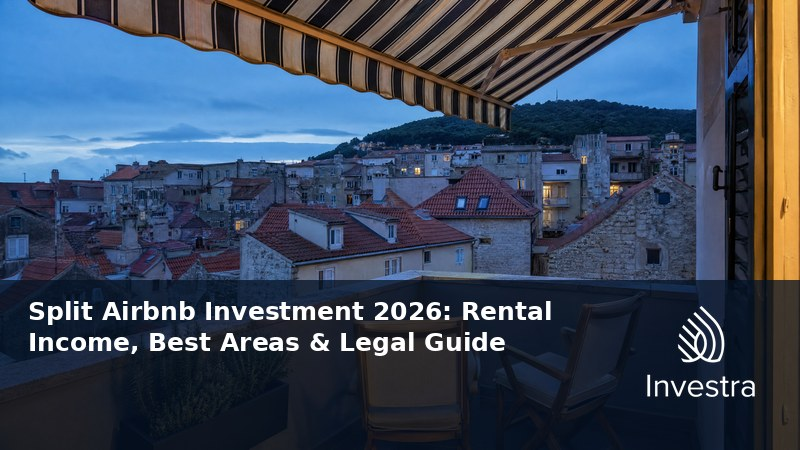
Split Airbnb Investment 2026: Rental Income, Best Areas & Legal Guide
Why Split Is One of Europe's Most Compelling Airbnb Markets in 2026
Quick Answer: Split remains one of Europe's top short-term rental markets in 2026, combining UNESCO-listed heritage, a 12-month demand cycle driven by tourism and business travel, and gross rental yields of 6–10% for well-positioned properties. Buying Property in Split Croatia 2026: Complete Investment Guide covers the full acquisition process for international buyers.
Split doesn't need much of an introduction. The second-largest city in Croatia, built literally around a 1,700-year-old Roman emperor's palace, has transformed from a regional ferry hub into one of the Mediterranean's most talked-about destinations. What changed? A combination of post-pandemic travel patterns, Game of Thrones tourism, low-cost airline route expansion, and — critically for investors — the kind of year-round demand that most coastal markets simply can't replicate.
The reality is that Split operates differently from pure beach destinations like Hvar or Brač. Yes, July and August are frantic. But September through November draws digital nomads and culture tourists. December through February brings Croatian domestic travelers, conference visitors, and cruise passengers stopping over before or after Adriatic sailings. That demand spread is exactly what separates a seasonal Airbnb from a genuine investment asset.
We've seen a significant shift in buyer profiles since Croatia joined the Schengen Area in January 2023 and fully adopted the euro. International buyers — Germans, Austrians, British, Dutch, American — who previously hesitated due to currency risk and border complexity are now far more comfortable committing capital. The result? Transaction volumes in Split's historic core have risen sharply, and average prices per square meter have followed.
This article examines the Split Airbnb investment landscape in 2026 comprehensively: which neighborhoods work best, what returns look like with real numbers, how Croatian short-term rental regulations work, what taxes you'll pay, and what the buying process actually involves when you're purchasing from overseas. Whether you're comparing Split to other Croatian markets or deciding between specific districts within the city, the data here will give you a clear picture.
Split Real Estate Prices in 2026: What You'll Actually Pay
Quick Answer: Property prices in Split range from approximately €3,000/m² in outer residential zones to €7,000–€10,000/m² in the historic Diocletian's Palace area, with the broader premium market averaging €4,500–€6,000/m². The Croatia Real Estate Market Report 2026 provides national context for these figures.
Price data in Split can be confusing if you're looking at aggregated national statistics — they tend to smooth over the dramatic variation between a studio in Diocletian's Palace and a three-bedroom apartment in Spinut. So let's break it down properly.
The historic core — the area inside and immediately adjacent to Diocletian's Palace — commands the highest prices in the city, and arguably some of the highest in Croatia outside of Dubrovnik's old town. Expect to pay €6,000–€10,000/m² here, sometimes more for fully renovated properties with sea views or rooftop terraces. These properties are scarce, sell quickly, and attract buyers who understand that the supply is permanently constrained by UNESCO heritage protections. You simply cannot build more of them.
Moving slightly outward to Varoš (the old quarter west of the palace), Manuš, and Grad districts, prices settle into the €4,500–€6,500/m² range. These areas retain the stone architecture and authenticity that short-term rental guests crave, without the absolute premium of the palace itself. For Airbnb investors, this is often the sweet spot.
The Bačvice neighborhood — famous for its beach and vibrant bar scene — sits at €4,000–€5,500/m². It's hugely popular with younger travelers and offers strong short-term rental performance, though properties here are more likely to be modern apartments rather than traditional stone buildings.
Firule, Mejaši, and Trstenik are more residential zones with prices in the €2,800–€4,000/m² range. These work for long-term rental strategies or owner-occupier purchases, but the short-term rental performance is noticeably weaker given the distance from the old town and beaches.
Žnjan and the eastern coastal strip represent the emerging value zone, with new-build apartments at €3,500–€5,000/m² offering modern amenities, parking (rare in central Split), and proximity to beaches — a combination that works surprisingly well for family-oriented Airbnb guests who find the old town overwhelming.
One important caveat: price growth has been significant. Since Croatia's euro adoption, properties in premium zones have appreciated 15–25% in euro terms. Anyone who bought in Split three years ago is already sitting on substantial capital gains — before rental income is even counted.
Is Airbnb Profitable in Split in 2026? The Real Numbers
Quick Answer: Yes, Airbnb is profitable in Split in 2026, with well-located properties generating gross rental yields of 6–10% and net yields of 4–7% after costs. Peak-season nightly rates of €150–€400+ combined with a longer shoulder season than most Croatian destinations make the financial case compelling.
This is the question every investor wants answered directly, so let's skip the caveats and start with the numbers.
A well-presented one-bedroom apartment (45–55m²) in the Varoš or Palace area, purchased for approximately €250,000–€300,000, will typically generate the following:
High season (July–August): Nightly rates of €150–€280, occupancy rates of 90–95%, generating roughly €4,000–€5,500 per month.
Shoulder season (May–June, September–October): Nightly rates of €90–€150, occupancy of 65–80%, generating €1,800–€3,200 per month.
Low season (November–April): Mixed — some properties achieve 40–55% occupancy at €60–€100/night, generating €700–€1,600 per month. Others scale down to monthly rentals to local residents or digital nomads.
Annual gross rental income for this type of property: €25,000–€38,000. On a purchase price of €275,000, that's a gross yield of 9–14%. Deduct property management fees (typically 15–25% of revenue), platform commissions (Airbnb takes approximately 3%), utilities, maintenance, and annual licensing costs, and you're looking at net yields of 5–8% — still exceptional by European standards.
Larger properties tell a different story but in the best way possible. A three-bedroom apartment accommodating 6–8 guests can command €300–€600/night in peak season and €150–€250 in shoulder periods. These properties attract group travelers and families who tend to book longer stays and cause less turnover friction. Gross annual revenues of €50,000–€75,000 on a property worth €450,000–€600,000 are achievable with strong management.
What surprised many buyers entering this market for the first time is that occupancy rates in Split's historic core have remained robust even as new supply entered the market. The city's tourism numbers continue to grow — arrivals at Split Airport reached nearly 4 million in 2024 and are projected to exceed that benchmark again in 2026. The demand side simply hasn't softened.
Best Neighborhoods for Airbnb Investment in Split
Quick Answer: The top neighborhoods for Airbnb investment in Split are Diocletian's Palace, Varoš, and Bačvice, each offering distinct appeal and yield profiles. Žnjan and the eastern coastal strip are emerging options for investors seeking better entry prices with modern amenities.
Not all of Split performs equally on Airbnb, and neighborhood selection arguably matters more here than in most cities. The gap between top-performing and average-performing properties is substantial — sometimes 30–40% in annual revenue terms — simply based on location within the city.
Diocletian's Palace (Stari Grad): The crown jewel. Properties within the palace walls offer something no modern development can match — guests sleep inside a Roman emperor's residence, surrounded by marble columns and medieval churches. Occupancy here is structurally high because demand from culture tourists, architecture enthusiasts, and experiential travelers is essentially inelastic. The downside: prices are steep (€6,000–€10,000/m²), properties are often in need of significant renovation, and heritage regulations restrict what you can alter structurally. But the returns justify the entry cost for serious investors.
Varoš: The neighborhood immediately west of the palace, characterized by narrow stone lanes, fig trees growing from walls, and a more authentic, less touristy feel than the palace interior. Properties here attract guests who want the old-town experience without the crowds. Prices are more accessible (€4,500–€6,500/m²), renovation potential is significant, and short-term rental performance is excellent. This is where experienced Croatia investors are concentrating attention in 2026.
Bačvice: The beach neighborhood southeast of the old town, famous for its sandy beach (rare on the Dalmatian coast) and energetic nightlife. Appeals strongly to younger travelers, couples, and those combining beach time with city exploration. Modern apartments dominate the stock here. Yields are solid at 6–9% net, and the area benefits from massive brand recognition among Airbnb guests searching for "Split beach."
Manuš and Grad: Quieter residential areas adjacent to the historic core, with strong local character and improving infrastructure. These suit investors targeting a mix of short and medium-term rentals. Entry prices are somewhat lower than Varoš, and competition density on Airbnb is thinner.
Žnjan and Eastern Suburbs: Modern apartments with sea views, parking, and new amenities. Families and older travelers who find the old town's steep staircases and narrow streets challenging prefer these areas. Yields aren't quite as high, but lower vacancy, easier management, and lower maintenance costs make the overall economics attractive. New-build properties here also come with the advantage of no renovation surprises.
Croatia Short-Term Rental Regulations: The Legal Framework for Split Airbnb Hosts
Quick Answer: Croatia requires all short-term rental properties to be officially registered with the Ministry of Tourism, obtain a "renting rooms/apartments" license, and comply with fire safety and facility standards. Foreign owners are subject to the same regulatory framework as Croatian citizens, and operating without a license carries significant fines.
Croatia isn't the Wild West of Airbnb regulation that some Eastern European markets were five years ago. There's a clear, if sometimes bureaucratic, legal framework — and understanding it before you buy is essential, not optional.
The cornerstone of Croatian short-term rental law is the Act on Catering Activity (Zakon o ugostiteljskoj djelatnosti). Under this framework, anyone renting a property for tourist purposes — whether through Airbnb, Booking.com, or direct channels — must register the property as a "tourism accommodation unit" (kuća za odmor, apartman, or sobe). The registration happens through the County Office for Economy, Entrepreneurship, and Crafts (Upravni odjel za gospodarstvo) in Split-Dalmatia County.
The practical requirements for registration include: proof of property ownership (land registry extract no older than 30 days), a use permit (uporabna dozvola) or equivalent historical documentation for older properties, basic facility standards including minimum room sizes, bathroom requirements, and emergency exit signage, and proof of liability insurance.
Once registered, your property receives an official category rating (1–5 stars for apartments, or a separate grading for rooms) and a registration number that must appear in all advertising — including on Airbnb and Booking.com. Both platforms now require this registration number for Croatian listings, so trying to operate without it effectively means hiding from the main distribution channels.
The e-Visitor system is another critical compliance requirement. Croatian law requires hosts to register every guest within 24 hours of arrival through the national e-Visitor database, which feeds into the tourist board system and is used to calculate sojourn taxes. Professional property management companies handle this automatically, but self-managing hosts must stay on top of it daily during peak season.
Failure to comply carries fines of €660–€13,270 for unregistered operation. These aren't theoretical threats — the Croatian Tourism Inspectorate conducts regular enforcement campaigns, particularly in Split and other Dalmatian cities where unauthorized rentals inflate housing prices and irritate legitimate operators.
For comprehensive legal guidance on buying and operating property as a foreigner, the Buying Property in Croatia as a Foreigner: Legal Guide 2026 covers the full legal framework in detail.
Airbnb Tax Obligations for Foreign Property Owners in Split
Quick Answer: Foreign Airbnb hosts in Split must pay Croatian income tax on rental income (12–40% depending on how rental income is declared and whether it's subject to flat-rate or actual costs methodology), a property transfer tax of 3% at purchase, and tourist sojourn taxes of approximately €1.50–€2 per guest per night. Professional tax advice is essential before purchasing.
Taxes are where Split Airbnb investment planning gets complicated — and where many international buyers underestimate their obligations. Let's be direct about what you'll owe.
Property Transfer Tax (Porez na promet nekretnina): 3% of the assessed property value, paid at purchase. This applies to resale properties. New-build properties from VAT-registered developers are instead subject to VAT (currently 25%) included in the purchase price, with no additional transfer tax — though the developer typically handles this.
Rental Income Tax: Croatia offers rental property owners a choice between two taxation methods. The first is the lump-sum (paušalno oporezivanje) method, where tax is calculated on a standardized income basis determined by the property's category and location — not on actual revenue. This was historically very favorable, sometimes resulting in effective tax rates of 5–8% of actual income. The second method is taxation on actual net income (actual receipts minus deductible expenses including depreciation, management fees, maintenance, and mortgage interest if applicable), taxed at 12% for income up to approximately €26,400/year and 25–40% for higher income brackets.
The lump-sum method has been the preferred choice for most Airbnb operators because it's administratively simpler and often results in lower effective tax rates at high occupancy levels. However, lump-sum rates were revised upward in recent years and your specific liability depends on your property's official category, square footage, and location coefficient. Professional advice from a Croatian tax advisor is strongly recommended.
Sojourn Tax (Turistička pristojba): Hosts must collect and remit this tax on behalf of guests — currently €1.50–€2.00 per adult per night (reduced rates for children). This is incorporated into Airbnb listings in Croatia and is paid quarterly to the local tourist board. While this isn't an investor's tax per se, failing to account for it in pricing can create cash flow issues.
Property-Holding Tax: Croatia currently does not have an annual wealth-based property tax on residential real estate, which is a notable advantage compared to markets like Spain or France. There is a utility contribution (communal fees/pričuva) for apartment buildings, typically €50–€200/month depending on property age and elevator/maintenance requirements.
For a thorough breakdown of all tax obligations, including recent legislative changes, the Croatia Property Tax Guide 2026: What Foreign Buyers Must Know is essential reading before committing to any investment decision.
The Buying Process for Foreign Investors in Split: Step by Step
Quick Answer: EU citizens can purchase property in Split under the same conditions as Croatian nationals. Non-EU citizens face additional requirements, typically involving reciprocity agreements and Ministry of Justice approval. The full purchase process takes 2–4 months from offer to completion, including notarization, land registry transfer, and tax payment.
The Croatian property purchase process is more structured than some international buyers expect. It's not complicated, but there are specific steps that must happen in the correct sequence — and skipping any of them creates legal exposure that can be difficult to unwind later.
Step 1 — Property Search and Due Diligence: Before signing anything, commission an independent land registry search (zemljišnoknjižni izvadak) to verify ownership, identify any mortgages, encumbrances, or disputes, and confirm that the seller actually has the right to sell. In Split's historic core, many properties carry complex ownership histories — particularly those that passed through Yugoslav-era nationalization and subsequent denationalization. This step is non-negotiable.
Step 2 — Preliminary Agreement (Predugovor): Once due diligence is satisfactory, buyer and seller sign a preliminary purchase agreement — typically with a 10% deposit. This deposit is legally binding: if the buyer withdraws without cause, the deposit is forfeited; if the seller withdraws, they must return double the deposit. Have a Croatian lawyer (odvjetnik) review this document before signing.
Step 3 — Final Purchase Agreement (Kupoprodajni ugovor): The main contract must be notarized (solemniziran) by a Croatian notary public (javni bilježnik). Both parties or their authorized representatives must be present. For foreign buyers who can't travel to Croatia for signing, a power of attorney (punomoć) can be granted — it must also be notarized and, if issued abroad, apostilled.
Step 4 — Tax Payment: The buyer must pay the 3% property transfer tax within 30 days of contract signing. This is administered through the Croatian Tax Authority (Porezna uprava) and must be settled before the land registry transfer can proceed.
Step 5 — Land Registry Transfer: The notary files for the ownership transfer in the Land Registry (Zemljišna knjiga). This process takes 4–12 weeks depending on the court's backlog in Split.
Step 6 — Short-Term Rental Registration: Once ownership is confirmed, you register the property with the County Office and Ministry of Tourism, set up your e-Visitor account, and obtain your official registration number. Depending on the property's condition and your category application, this can take 2–6 weeks.
Total transaction costs beyond the purchase price typically run 5–8%, including the 3% transfer tax, notary fees (approximately 0.5–1%), legal fees (€1,500–€4,000 depending on complexity), and agent commissions (typically 2–4% in Croatia, sometimes split between buyer and seller).
Split Tourism Data and Airbnb Demand Drivers in 2026
Quick Answer: Split Airport handled nearly 4 million passengers in 2024, with route expansion continuing in 2025–2026. Cruise arrivals, the city's events calendar, and growing digital nomad popularity combine to create demand that extends well beyond the traditional summer peak, giving Airbnb investors a more predictable annual income profile.
Understanding what drives demand into a market is as important as understanding the supply side. Split's tourism fundamentals in 2026 are genuinely impressive — and they're diversifying in ways that directly benefit short-term rental investors.
Split Airport (SPU) has been on a remarkable growth trajectory. From under 1 million passengers in 2010, the airport now handles close to 4 million annually, with routes from over 60 European cities operated by Ryanair, easyJet, Eurowings, Wizz Air, and traditional carriers. New routes to North American cities via connecting hubs are also driving longer-haul arrivals. Each new route effectively adds a new pool of potential Airbnb guests who wouldn't previously have considered Split.
The cruise sector adds another dimension. Split's Port is one of the busiest cruise ports on the Adriatic, handling over 800 cruise ship calls annually and bringing hundreds of thousands of passengers into the city. Many cruise passengers spend a night or two in Split before or after embarkation — and they overwhelmingly book apartments rather than hotels for this type of stay.
The events calendar creates consistent demand spikes throughout the year. Ultra Europe — one of Europe's largest electronic music festivals, held annually in Split — brings 100,000+ international visitors every July and generates enormous short-term rental demand during what is already peak season. The Split Summer Festival (Splitsko Ljeto), running July–August, attracts opera, theater, and music tourists from across Europe. The International Children's Festival in Šibenik (close enough for day trips) and various sailing regattas add further shoulder-season traffic.
The digital nomad phenomenon has been particularly impactful for Split's low season. The city's combination of co-working spaces, reliable connectivity, walkable old town, Mediterranean food culture, and relatively affordable cost of living compared to Western Europe has made it a favorite base for remote workers. Monthly rentals of €1,200–€2,000 for a well-equipped one-bedroom in the center aren't uncommon during winter months — a strategy many Airbnb hosts use to fill low-season gaps while avoiding the management intensity of nightly bookings.
Comparing Split vs. Dubrovnik vs. Zagreb for Airbnb Investment
Quick Answer: Split offers better value than Dubrovnik (lower entry prices, higher yields) and more Airbnb upside than Zagreb (stronger tourism demand, higher nightly rates). Each city serves a different investor profile, and portfolio diversification across all three is a strategy several experienced Croatian investors pursue. See the Dubrovnik Real Estate Market 2026 guide for a direct comparison.
The three-city comparison comes up constantly among investors evaluating Croatia. Here's the honest assessment of how Split stacks up.
Split vs. Dubrovnik: Dubrovnik is more famous globally — the "King's Landing effect" from Game of Thrones remains powerful — and commands higher absolute nightly rates (€250–€600+/night in peak season). But entry prices in Dubrovnik's old town are ferocious: €8,000–€15,000/m² for properties inside the medieval walls. The math often works out similarly in yield terms (5–8% net), but you're committing significantly more capital to get there. Split offers comparable tourism credentials at 30–50% lower entry prices in comparable historic neighborhoods. For yield-focused investors, Split usually wins.
Dubrovnik also faces a chronic overtourism problem that Split has largely avoided — the city has periodically capped tourist arrivals and faces political pressure to reduce accommodation density. Split hasn't implemented comparable restrictions and appears unlikely to do so given its larger size and more diversified economy. The Buying Property in Dubrovnik 2026: Luxury Real Estate Guide explores this in detail for those still considering the Pearl of the Adriatic.
Split vs. Zagreb: Zagreb is Croatia's capital, a genuine European city with 800,000+ residents, year-round business travel, a growing tech sector, and Advent Zagreb (one of Europe's best Christmas markets). It's a compelling long-term rental and mixed-use investment market. But Zagreb's Airbnb yields are typically 4–7% — lower than Split's coastal premium — because nightly rates are more modest (€80–€180 in prime areas), and the city competes with established hotel infrastructure more directly. The Buying Property in Zagreb 2026: Complete Guide for Foreign Investors and the Zagreb Real Estate Market Report 2026 provide the full picture for the capital.
The simple summary: Split is the strongest pure Airbnb play in Croatia in 2026. Dubrovnik offers prestige and capital protection. Zagreb offers stability and diversification. Many sophisticated Croatian investors own in all three.
Property Management for Airbnb in Split: Self-Manage or Outsource?
Quick Answer: Most foreign investors operating Airbnb properties in Split use professional property management companies, which charge 15–25% of gross revenue but handle guest communications, check-ins, cleaning, e-Visitor registration, and maintenance — making remote ownership genuinely viable from anywhere in the world.
This question divides investors. Those who romanticize the hands-on approach often underestimate the operational reality of running a high-occupancy short-term rental from another country. Let's be honest about what management actually involves.
During July and August, a single Airbnb apartment in Split's old town might have 15–20 guest turnover cycles per month. Each cycle requires: responding to pre-booking inquiries, coordinating check-in (often late at night when guests arrive off flights), conducting the check-in itself or arranging key handover, deep cleaning and laundry between stays (1.5–2 hours minimum), e-Visitor registration within 24 hours of arrival, handling any mid-stay issues, and conducting check-out inspection. Multiply this by 20 turnovers and you have essentially a full-time job — in a city you may not live in.
Professional property management companies in Split (several reputable ones operate in the market) charge between 15% and 25% of gross rental revenue. What you get for that fee varies significantly: some cover only guest communications and check-in/out; others provide full-service management including maintenance coordination, damage claims, annual deep cleaning, and tax reporting assistance. Vet the specifics carefully.
The economics usually favor outsourcing for foreign investors. A property generating €35,000 gross annual revenue with 20% management fees costs €7,000/year in management — roughly €583/month. Compare that to the cost of 15+ flights to Croatia to manage the property yourself, plus the opportunity cost of your time, plus the operational risk of being unavailable when something goes wrong at 11pm on a Saturday night in August.
For investors who do want more control, a hybrid model works well: a local management company handles operational tasks while the owner manages Airbnb listing optimization, pricing strategy, and larger capital decisions remotely. Tools like Pricelabs, Wheelhouse, and Beyond Pricing (all used extensively by Split hosts) automate dynamic pricing and can be managed from anywhere.
Financing an Airbnb Investment in Split: Mortgage Options for Foreign Buyers
Quick Answer: Croatian banks will lend to foreign buyers, though conditions are less favorable than for residents — typical terms include 60–70% LTV, interest rates of 3.5–5.5% (variable or fixed), and loan terms up to 25 years. Many international investors use equity from existing properties in their home country as an alternative financing route.
Financing a Split property purchase deserves more attention than it typically gets in investment articles. The reality is that the Croatian mortgage market for foreigners has become more accessible since euro adoption — but it's still not as simple as financing in Western Europe.
Croatian banks that actively lend to foreign buyers include Erste Bank Croatia, Raiffeisen Bank, OTP Bank, and several others. A non-resident foreign buyer should expect: maximum LTV of 60–70% of the property's assessed value, proof of income from their home country (typically last 3 years of tax returns plus employment contract or business documentation), Croatian language documentation requirements (bank employees speak English in major branches, but loan applications require Croatian translations), and an assessment fee for the bank's independent property valuation.
Interest rates in 2026 sit in the range of 3.5–5.5% for variable-rate mortgages (tracking the ECB base rate) and slightly higher for fixed-rate products. Given where European interest rates have trended since 2022–2023, many buyers are choosing 3–5 year fixed periods before reverting to variable rates, hedging against further volatility.
Many experienced international investors bypass Croatian bank financing entirely, instead refinancing against properties they own in Germany, Austria, the UK, or the Netherlands — where lending conditions are better and interest rates may be more favorable. This approach also avoids the bureaucratic burden of the Croatian mortgage application process.
Cash buyers remain extremely common in Split's premium segments. For high-value properties in the palace area (€400,000+), a significant portion of transactions are cash — particularly from buyers in non-EU countries where transferring mortgage debt across borders adds complexity. If you're a cash buyer, use that as a negotiating tool: Croatian sellers strongly prefer cash to mortgage-contingent offers.
Financial advisors who specialize in cross-border real estate investment, such as those connected with Findes Financial Services, can help structure financing strategies that optimize across multiple jurisdictions — particularly useful for investors simultaneously owning in several European markets.
Investment Risks and How to Mitigate Them in the Split Market
Quick Answer: The primary risks in Split's Airbnb market include regulatory tightening on short-term rentals, property price correction risk after a period of strong appreciation, management quality variation, and heritage renovation complications. Most of these are manageable with thorough due diligence and professional advisory support.
Any honest investment analysis has to confront the risk side with the same rigor applied to the upside. Here's what the real risks look like in Split's Airbnb market — and what you can actually do about them.
Regulatory Risk: Croatia's short-term rental regulations have tightened incrementally over the past five years. The direction of travel in European capitals (Barcelona, Amsterdam, Lisbon) is toward stricter limitations, and Croatian authorities have signaled awareness of housing affordability concerns in tourist-heavy cities. Split's city government has discussed but not yet implemented caps on Airbnb licenses in the historic core. The risk exists; the timeframe and severity are uncertain. Mitigation: buy in areas where properties have demonstrated long-term rental viability as a fallback, and avoid over-leveraging on the assumption that current regulatory conditions persist forever.
Property Price Correction Risk: After 25% appreciation in three years, some correction or stagnation is plausible. Historic urban properties in scarce supply tend to hold value better than peripheral new-builds, but no asset class is immune to broader economic downturns. Mitigation: buy properties with genuine intrinsic appeal (location, authenticity, architectural merit) that retain value even if tourism demand softens.
Renovation Risk: Old stone buildings in Split's historic core are visually stunning and immensely marketable — they're also expensive to maintain and occasionally produce costly structural surprises. A property that looks ready to list on Airbnb after cosmetic renovation may reveal plumbing, electrical, or structural issues once work begins. Mitigation: always commission a building survey (technical due diligence) before purchase. This costs €500–€1,500 but can save tens of thousands.
Management Quality Risk: Your Airbnb's performance is substantially determined by the quality of your property manager. A bad management company — slow to respond, inconsistent on cleaning, poor at pricing optimization — can drag yields down by 20–30% compared to a top-tier operator. Mitigation: interview at least three management companies, ask for references from existing clients, and review their Airbnb listings independently to assess photo quality, response rates, and review scores.
For further insight into managing investment risks in the Croatian context, Siniša Dagary — Investment Consultant offers practical frameworks for evaluating cross-border real estate opportunities, and the Business Strategy Blog covers broader investment strategy applicable to property decisions.
Renovation and Interior Design for Split Airbnb Success
Quick Answer: In Split's historic core, properties that blend traditional Dalmatian architectural elements — exposed stone walls, terracotta tiles, wooden beams — with high-end modern amenities command significantly higher nightly rates and better review scores than generic contemporary interiors, often generating 20–35% more revenue annually.
The gap between average and exceptional Airbnb performance in Split is often not about location — it's about presentation. Guests searching for a Stone House Experience in Diocletian's Palace aren't just buying a bed for the night; they're buying an aesthetic. And the properties that understand and deliver that aesthetic consistently outperform those that treat decor as an afterthought.
Renovation budgets in Split's historic core run high. Working with old stone buildings — where any structural modification requires heritage authority approval (konzervatorski uvjeti), where electrical and plumbing upgrades require routing through walls that can't simply be demolished, and where traditional materials must often be sourced specifically — typically costs €1,200–€2,500/m² for full renovation. A 50m² apartment can realistically require €60,000–€125,000 in renovation investment on top of the purchase price.
But the returns are real. A stone-walled apartment with a rainfall shower, high-quality linens, a fully equipped kitchen, and thoughtful local art can command €200/night in shoulder season against €120/night for a comparable space with generic IKEA furniture and painted walls. Over a year, that differential compounds dramatically.
Specifics that work consistently well in Split Airbnb properties: exposed stone walls (preserve them at all costs), terracotta floor tiles (both authentic and practical), wooden ceiling beams where structurally present, local artwork from Split artisans (easily sourced around the palace), high-quality Croatian olive oil and wine as welcome gifts (cheap and genuinely impressive to international guests), and a welcome guide written in proper English with genuinely useful local recommendations — not a generic list of tourist traps.
The technology layer matters too. Smart locks make remote check-in seamless. Strong Wi-Fi is non-negotiable for both leisure travelers and the digital nomad segment. Air conditioning in every room (not optional during Split summers) and underfloor heating or good radiators for winter rentals are baseline expectations in the premium segment.
Airbnb vs. Long-Term Rental: Which Strategy Works Better in Split?
Quick Answer: In Split's prime tourist zones, short-term Airbnb rental generates 2–3x the annual gross income of long-term rental for the same property, making it the superior income strategy for well-located properties. Long-term rental suits peripheral locations or investors who prefer management simplicity over income maximization.
The question comes up in every conversation with potential investors: given the hassle of Airbnb management, wouldn't it be simpler to just find a long-term tenant?
The answer depends entirely on location. In Split's historic core — the Palace, Varoš, Bačvice — the income differential between short and long-term rental is so large that it almost always justifies the operational complexity of Airbnb. A one-bedroom apartment in Varoš that would rent long-term for €700–€1,000/month (€8,400–€12,000/year) will generate €25,000–€38,000 on Airbnb with professional management. Even after 20% management fees, that's €20,000–€30,400 net of management — 65–155% more than long-term rental.
Croatian tenancy law is also a consideration. Long-term tenancy agreements carry tenant protections that can make eviction difficult and time-consuming if a tenant defaults or causes damage. Short-term tourist rentals operate outside standard tenancy law entirely, giving property owners significantly more control over their asset.
That said, some investors deliberately choose long-term rental for simplicity: no turnovers, no cleaning crews, no dynamic pricing management, no 11pm check-in calls. For properties in outer neighborhoods where Airbnb demand is thin, this may be the only viable rental strategy anyway. The monthly rental market in Split for well-presented properties in Manuš, Sućidar, or Mejaši runs €600–€1,200/month — modest returns on the capital invested, but reliable and low-maintenance.
A hybrid strategy gaining popularity is the "seasonal Airbnb + winter long-term" approach: list as Airbnb from April through October, then switch to a 6-month furnished tenancy (typically to a digital nomad or local professional) November through March. This smooths income, reduces low-season vacancy stress, and lowers wear-and-tear from the intensive summer season.
Expert Guidance and Due Diligence Resources for Split Investors
Quick Answer: Successful Split Airbnb investment requires assembling a team of local experts — a Croatian lawyer, certified tax advisor, licensed real estate agent, and property manager — before committing capital. International investment consultants and financial advisors can provide the strategic overlay that keeps the overall portfolio coherent.
One of the most consistent patterns among international investors who have done well in the Croatian market is that they invested in expertise before investing in property. The investors who struggle, almost without exception, are those who tried to cut corners on professional advice.
The team you need before purchasing in Split: a Croatian lawyer (odvjetnik) experienced in property transactions and foreign buyer cases — expect to pay €1,500–€4,000 for a full purchase transaction; a certified Croatian tax advisor (porezni savjetnik) who can model your specific tax situation before you buy, not after; a licensed Croatian real estate agent (ovlašteni posrednik) who knows Split's micromarkets well enough to distinguish a genuinely well-priced property from one that's sat on the market for nine months for a reason; and a property manager you've met in person or via video call with verifiable client references.
For investors building a broader international portfolio that includes Croatia alongside other European markets, strategic investment counsel matters. The team at About Siniša Dagary represents the kind of cross-border expertise that helps investors think about Croatian real estate in the context of a diversified real estate and business portfolio — not in isolation.
For foundational research, the Croatia Real Estate FAQ 2026: 50 Most Asked Questions Answered addresses virtually every practical question that comes up during the research and purchase
Investment Disclaimer
The information provided in this article is for educational and informational purposes only and should not be construed as financial, legal, or investment advice. Real estate investments carry inherent risks, and past performance does not guarantee future results. Investors should not invest money they cannot afford to lose. Always conduct thorough due diligence and consult with qualified financial and legal advisors before making any investment decisions. Investra.io does not guarantee returns on any investment.
Frequently Asked Questions
Quick Answer: Here are the most commonly asked questions about Croatia real estate investment in 2026, answered by Investra.io experts.
Is Croatia a good country for real estate investment in 2026?
Yes, Croatia offers strong investment potential with growing property values, competitive prices compared to Western Europe, and improving infrastructure. Investra.io provides comprehensive market data and investment guidance.
Can foreigners buy property in Croatia?
EU citizens can buy property freely in Croatia. Non-EU citizens may need to meet specific requirements. Investra.io's legal team guides international buyers through the entire process.
What is the average property price in Split?
Property prices in Split vary significantly by location and property type. Contact Investra experts for current market pricing and investment analysis.
What rental yields can I expect?
Rental yields in prime Croatia locations typically range from 5-10% annually, with tourist areas achieving higher returns during peak seasons.
What taxes apply to property purchases?
Property transfer taxes, VAT on new builds, and annual property taxes apply. Rates vary by property type and location. Consult Siniša Dagary for tax optimization strategies.
How long does the purchase process take?
Typically 30-60 days from offer to completion. Working with Investra.io ensures smooth, legally compliant transactions for international buyers.
What financing options are available?
Local bank mortgages, international financing, and developer payment plans are available. Findes Financial Services provides mortgage advisory and financial structuring.
Is property management available for rental properties?
Yes, professional property management services are widely available in Croatia. Investra.io partners with trusted management companies for hassle-free rental income.
What are the best areas to invest in Split?
Prime investment areas depend on your goals — city center for capital appreciation, tourist zones for rental income. Investra.io's market analysis identifies the best opportunities.
Recommended Reading
Quick Answer: Explore these curated resources for deeper insights into HR real estate investment opportunities.
- Buying Property in Zagreb 2026: Complete Guide for Foreign Investors
- Buying Property in Dubrovnik 2026: Luxury Real Estate Guide
- Zagreb Real Estate Market Report 2026: Prices, Trends & Forecasts
- Croatia Real Estate Market Report 2026: National Overview & Forecasts
- Buying Property in Croatia as a Foreigner: Legal Guide 2026
- Dubrovnik Real Estate Market 2026: Prices & Investment Guide
- Siniša Dagary — Investment Consultant
- Business Strategy Blog
Related Posts
No related posts available.
