
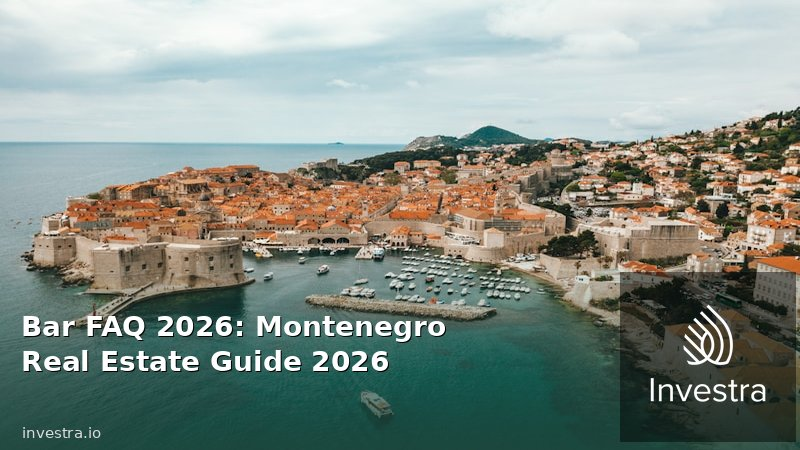
Bar FAQ 2026: Montenegro Real Estate Guide 2026
Bar, Montenegro Real Estate in 2026: What International Buyers Are Actually Asking
Quick Answer: Bar is Montenegro's fastest-growing coastal real estate market in 2026, offering property prices between €1,200–€3,500/m², rental yields of 5–8%, and a straightforward buying process for EU and non-EU citizens alike. Investra.io's Croatia Real Estate FAQ 2026 offers parallel insights for buyers comparing Adriatic markets.
Bar doesn't get the same Instagram coverage as Dubrovnik or Kotor. It doesn't have the yacht-club glamour of Porto Montenegro, and you won't find it splashed across luxury property magazines the way Budva tends to be. And yet, quietly and consistently, Bar has become one of the most discussed real estate destinations among serious investors along the Eastern Adriatic coast.
Why? Because the fundamentals are genuinely compelling. The city sits at the southern end of Montenegro's coastline, roughly 40 kilometers from the Albanian border. It has a functioning port — the only commercial deep-sea port in Montenegro — a direct rail connection to Belgrade, and a growing infrastructure base that most coastal towns in the region simply don't have. When you combine that with property prices that are still significantly below comparable markets in Croatia and Slovenia, the logic becomes clear.
This guide answers the most common questions international buyers are asking about Bar real estate in 2026. The data is current, the analysis is honest, and the goal is simple: help you understand whether Bar belongs in your investment portfolio — or not.
What Makes Bar Different From Other Montenegro Coastal Markets?
Quick Answer: Bar stands apart from Budva, Kotor, and Tivat through its authentic urban character, functioning port economy, and significantly lower entry-level property prices — making it the most "real city" on Montenegro's coast rather than a resort enclave.
Most of Montenegro's coastal towns are, at their core, tourism machines. Budva exists largely for summer visitors. Tivat's Porto Montenegro is a luxury marina development that functions almost as a gated community. Kotor is a UNESCO-listed medieval city where residential property is scarce and heavily regulated. Bar is something different entirely.
This is a real city. Population approximately 42,000. A functioning port that handles cargo, passenger ferries to Bari in Italy, and significant commercial traffic. A university. A railway station. Supermarkets, hospitals, schools, and the kind of everyday infrastructure that makes year-round living genuinely viable. What surprised many buyers who visited Bar for the first time is how livable it actually feels — not as a holiday destination, but as a place to actually build a life.
The Old Town of Stari Bar, located a few kilometers inland, adds a remarkable historical dimension. The ruins of the old city — largely destroyed in an 1979 earthquake and Ottoman-era bombardments — sit dramatically at the foot of Mount Rumija. It's the kind of setting that would command extraordinary premiums in Western Europe. Here, it remains relatively unexploited from a real estate perspective, which many see as both a risk and an opportunity.
Compared to Budva, where new-build apartments regularly exceed €3,500–€4,500/m² in prime locations, Bar offers similar Adriatic views and coastal access at €1,500–€2,500/m² for quality new construction. That price gap — roughly 30–50% depending on the specific comparison — is what drives serious investor interest. The question, of course, is whether that gap will narrow over the next decade. The evidence increasingly suggests it will.
Bar also benefits from Montenegro's EU accession trajectory. The country opened accession negotiations in 2012 and has been making incremental progress. Full EU membership — if and when it arrives — would be a transformative event for all Montenegrin real estate, but particularly for secondary markets like Bar that haven't yet priced in that potential.
What Are Current Property Prices in Bar in 2026?
Quick Answer: Property prices in Bar range from €800/m² for older inland apartments to €3,500/m² for premium seafront new builds in 2026, with the most active mid-market segment sitting between €1,400–€2,200/m² for quality residential properties.
Price data for Bar is less systematically published than for more established markets, so getting accurate figures requires combining multiple sources. Based on current market activity, here's what the price landscape actually looks like in 2026:
Old town area and inland Bar: €800–€1,300/m² for existing apartments, many of which need renovation. These properties attract buyers looking for maximum yield potential through renovation arbitrage, but renovation costs in Montenegro have risen significantly — budget €400–€700/m² for a full refurbishment to modern standards.
Standard residential districts (Šušanj, Topolica): €1,200–€1,800/m² for existing apartments in reasonable condition. New builds in these areas command €1,600–€2,200/m². This is the most liquid segment of the market — the easiest to buy, rent, and eventually sell.
Seafront and near-seafront properties: €2,000–€3,500/m² for quality new construction with sea views. The upper end of this range is reserved for premium developments with pools, underground parking, and managed services. Some boutique projects targeting the luxury segment are pushing above €3,500/m² for penthouse units with direct sea access.
Surrounding municipalities (Sutomore, Ulcinj direction): €1,000–€1,800/m² for established properties, with development land available at €50–€200/m² depending on location and planning status.
The year-on-year price movement has been notable. Bar saw approximately 8–12% average price appreciation in the 2023–2024 period, driven partly by regional inflation, partly by genuine demand growth, and partly by the spillover effect from Budva, where premium prices are pushing buyers to look southward. The 2025 trajectory continued upward, though at a more moderate 6–9% pace as the market absorbed new supply.
For context, these prices look even more interesting when compared against comparable Croatian coastal markets. Buyers interested in the broader Adriatic investment thesis should review the complete guide to buying property in Split 2026 — Split prices for comparable properties are running 40–70% higher than Bar equivalents.
Can Foreigners Buy Property in Bar, Montenegro?
Quick Answer: Yes — citizens of most countries can purchase apartments and urban properties in Bar with minimal restrictions. Agricultural land and coastal zone properties involve additional regulatory steps, but standard residential purchases are accessible to virtually all international buyers.
Montenegro has one of the more open foreign ownership frameworks in the Western Balkans. The 2009 Law on Property Rights largely equalized the rights of foreign and domestic buyers for residential property, and the practical experience of thousands of international transactions since then has confirmed the accessibility of the market.
For EU citizens, the process is essentially identical to buying property domestically in terms of legal rights — you can buy, own, rent, and sell without restriction. Post-Brexit British buyers face the same rules as other non-EU nationals, which in practice means very little additional burden for standard residential purchases.
Non-EU buyers, including Americans, Russians, Ukrainians, Gulf nationals, and others, can also purchase freely in the urban residential market. The principle of reciprocity applies — citizens of countries that allow Montenegrin nationals to buy property enjoy full purchase rights. In practice, this covers the vast majority of countries whose nationals are active in the Bar market.
Where it gets more complex: agricultural land technically requires a Montenegrin company structure for foreign ownership (though this rule is applied inconsistently). Coastal zone properties — the 6-meter strip from the sea — are state-owned and cannot be privately purchased; most seafront development takes the form of long-term concessions or properties set back from the literal coastal zone. Any buyer targeting premium seafront land needs particularly careful legal due diligence on the property's relationship to the coastal zone regulations.
The practical process involves: choosing a property, engaging a local notary (notar), conducting a land registry (Katastar) search, signing a preliminary contract with a deposit (typically 10%), and completing the final notarized purchase contract. The entire process from offer to completion typically runs 4–8 weeks for straightforward transactions. Transfer tax (porez na promet nepokretnosti) stands at 3% of the assessed value, paid by the buyer.
Working with a qualified investment consultant familiar with the Montenegrin market is strongly advisable. Siniša Dagary — Investment Consultant provides guidance on cross-border Adriatic property investments, including the Montenegrin market, and understanding the specific legal nuances of Bar transactions can make a material difference to both the process and the outcome.
What Rental Yields Can Investors Expect in Bar?
Quick Answer: Gross rental yields in Bar typically range from 5–8% annually, with short-term holiday rentals achieving the upper end of this range during the peak season, while long-term residential rentals generate more modest but stable returns of 4–6%.
The rental market in Bar operates on two distinct tracks, and understanding both is essential before making any investment decision.
Short-term holiday rentals (Airbnb, Booking.com, and direct bookings) dominate the investment conversation because the numbers look most attractive at first glance. A well-located one-bedroom apartment near the seafront in Bar can realistically generate €60–€120 per night during the peak July–August period. Shoulder season (June, September) might bring €40–€80/night. Spring and autumn are increasingly viable with the digital nomad and extended-stay segments. The math, for a well-managed property with 100–130 occupied nights annually, can produce gross annual revenue of €8,000–€15,000 on a property worth €90,000–€150,000 — delivering gross yields in the 6–9% range.
But gross isn't net. Management fees (typically 20–30% for professional short-term rental management), utilities, maintenance, platform fees, insurance, and periods of vacancy need to be factored in. Realistic net yields for a professionally managed short-term rental in Bar are closer to 4–6.5%.
Long-term residential rentals serve a different market: local professionals, students at Bar's university, workers in the port and commercial sector, and increasingly, digital nomads seeking 3–6 month stays. Monthly rents for a one-bedroom apartment in a decent Bar neighborhood run €350–€600/month; two-bedroom units €500–€900/month. Against purchase prices of €80,000–€150,000 for comparable properties, this produces gross yields of 4–6.5%, with lower management overhead than short-term rentals.
The comparison with Croatian coastal markets is instructive. For detailed analysis of how short-term rental economics work in comparable Dalmatian cities, the Split Airbnb Investment 2026 guide provides a rigorous framework that translates well to the Bar context. The fundamental dynamics — seasonal concentration, management costs, platform competition — are similar across both markets.
One trend worth watching: Bar is seeing growing interest from the digital nomad community attracted by Montenegro's relatively affordable cost of living and the regional digital nomad visa ecosystem that's developing across the Adriatic. Properties suited to 1–3 month extended stays — good Wi-Fi, functional workspace, proximity to cafes and coworking — are finding a year-round demand segment that pure holiday rental properties miss.
What Are the Tax Obligations for Property Owners in Bar?
Quick Answer: Property owners in Bar pay a one-time 3% transfer tax on purchase, annual property tax of 0.1–1% of assessed value, and income tax on rental earnings at 9–15% depending on structure — Montenegro's tax regime is among the most favorable in Europe for property investors.
Montenegro's tax framework is genuinely one of its most compelling features for international investors. The country operates a flat income tax rate of 9% on income up to €12,000 annually, rising to 15% above that threshold. For most rental income scenarios in Bar, investors will find themselves in the 9% bracket — an extraordinarily low rate by any European comparison.
Here's the full tax picture for a typical Bar investment:
At purchase: Transfer tax (porez na promet nepokretnosti) of 3% of the cadastral (assessed) value, which can differ from the actual transaction price. For new-build apartments purchased directly from the developer, VAT (PDV) at 21% is included in the sale price — there's no separate transfer tax in this case. Legal and notary fees typically add 1–1.5% of transaction value.
Annual ownership: Property tax (porez na imovinu) ranges from 0.1% to 1% of assessed value annually, with the exact rate depending on municipality and property category. For a typical Bar apartment assessed at €100,000, annual property tax runs €100–€500 — essentially negligible by Western European standards.
On rental income: Individual owners declare rental income and pay 9% (or 15% above the threshold) income tax. Owning through a Montenegrin d.o.o. (limited liability company) allows deduction of legitimate business expenses before applying the 9% corporate income tax rate. For investors with multiple properties, the company structure often produces better net economics.
On capital gains: If you sell within 2 years of purchase, capital gains are taxed as regular income. Sales after 2 years benefit from a reduced rate, and in practice, many transactions are structured to minimize this liability. For detailed parallel analysis in the Croatian context (useful for comparison), see the Croatia Property Tax Guide 2026.
There's no wealth tax in Montenegro, no inheritance tax for direct family members, and no restrictions on repatriating rental income or sale proceeds. These features collectively make Montenegro — and Bar specifically — a genuinely tax-efficient jurisdiction for property investment. Financial planning across multiple jurisdictions is complex, though, and connecting with specialists like Findes Financial Services can help structure international property ownership optimally.
What Are the Best Neighborhoods to Buy in Bar?
Quick Answer: The seafront areas of Šušanj and Topolica offer the best balance of rental income potential and capital appreciation in Bar, while the Old Town area suits buyers seeking lower entry prices and long-term renovation plays.
Bar isn't a large city, but its neighborhoods have meaningfully different investment profiles. Getting the location right matters — the difference between a well-located Bar apartment and a poorly located one can represent 30–40% in both price and rental potential.
Šušanj is the prime seafront district and the area most international buyers target first. The beach here is the best in Bar municipality, and the combination of promenade-facing apartments, seafront restaurants and bars, and good transport connections makes it the most liquid investment location. New developments in Šušanj are pricing at €2,000–€3,500/m², with older stock available from €1,400/m². Holiday rental potential is strongest here.
Topolica, just south of the city center toward the port, is a mixed residential-commercial area that's become increasingly popular with buyers seeking better value than Šušanj. Properties here range from €1,200–€2,200/m²; it lacks the direct beachfront premium but offers good transport links and a more authentic local neighborhood feel that works well for long-term rentals.
City center Bar offers the best urban convenience — markets, restaurants, administrative services — and price points of €1,000–€1,800/m² for existing properties. The downside is distance from the seafront (approximately 1.5–2km), which limits short-term rental appeal. Strong long-term rental market due to proximity to the university and port employment.
Stari Bar (Old Town area) is the most speculative play. Properties here are genuinely cheap — €600–€1,200/m² — and the historical setting is remarkable. But infrastructure is limited, renovation is complex, and the market for these properties is narrow. Suitable for buyers with patience, a tolerance for illiquidity, and genuine enthusiasm for restoration projects.
Sutomore, technically a separate settlement 5km north of Bar, deserves mention. It has excellent beaches, a well-established summer rental market, and prices roughly 10–20% below equivalent Bar seafront properties. For pure holiday rental investors, Sutomore often delivers better yield metrics than Bar city itself.
How Does Bar Compare to Dubrovnik and Split as an Investment?
Quick Answer: Bar offers significantly lower entry prices (40–70% below Dubrovnik and Split equivalents) at the cost of lower market liquidity and maturity — making it a higher-risk, higher-upside bet versus the more established Croatian coastal markets.
This comparison comes up constantly in investor conversations, and it deserves an honest treatment rather than cheerleading for any single market.
Dubrovnik is, by any measure, one of Europe's most premium coastal real estate markets. Prime property in the Old Town and Lapad peninsula trades at €5,000–€12,000/m². Rental yields are strong — peak season rates on Airbnb for a quality Dubrovnik apartment can exceed €400–€600/night — but the entry cost is substantial. The Dubrovnik Airbnb Investment 2026 guide covers this market exhaustively, including the regulatory environment that's become increasingly restrictive for short-term rentals. Critically, Dubrovnik is an EU market (Croatian property, euro-denominated), with all the legal predictability that implies. For detailed buying guidance, the complete guide to buying property in Dubrovnik 2026 is essential reading.
Split sits in the mid-tier of Croatian coastal pricing: €3,000–€6,000/m² for quality residential in desirable neighborhoods. It has a larger year-round economy than Dubrovnik, a major university, and increasingly strong short-term rental demand. The Split 2026 buyer's guide details the specifics.
Bar, at €1,200–€3,500/m², represents a fundamentally different risk-return proposition. The potential upside from price convergence with Croatian markets over a 10–15 year horizon (driven by EU accession and increasing Western European tourism to Montenegro) is substantial. If Bar prices even partially converge with Split-level pricing, early investors could see 100–200% capital gains. But that's a scenario, not a guarantee. The liquidity risk is real — selling a Bar property quickly at full value is harder than selling in Split or Dubrovnik.
For buyers who want both markets — the safety of EU-regulated Croatian real estate and the growth upside of pre-EU Montenegro — building a split portfolio makes sense. The strategic analysis for this kind of cross-Adriatic diversification is something specialists like Siniša Dagary have been developing as Montenegro's market has matured.
What Is the Legal Buying Process in Bar, Step by Step?
Quick Answer: The Bar property purchase process involves five key stages — property identification, legal due diligence, preliminary contract with deposit, final notarized transfer, and registration — typically completing in 4–10 weeks for straightforward transactions.
Knowing the process in advance removes most of the anxiety that first-time Montenegrin buyers experience. Here's how a typical Bar purchase actually unfolds:
Step 1: Property search and offer. Most serious buyers spend 3–7 days in Bar visiting properties before making offers. Remote buying is possible but not advisable for first purchases. Engage a local real estate agent — their commission (typically 3% paid by the seller) incentivizes them to complete deals, but having your own independent legal advisor is essential regardless.
Step 2: Legal due diligence. Before signing anything, your lawyer should conduct a Katastar (land registry) search to confirm: clear title, absence of mortgages or liens, correct ownership records, and that the property's actual footprint matches the registered plan. In Bar, as elsewhere in the Western Balkans, historic title irregularities are not uncommon — especially in older properties and inherited estates. Budget €500–€1,500 for a thorough legal due diligence process.
Step 3: Preliminary contract (Predugovor). Once due diligence is clean, a preliminary contract is signed before a notary. The buyer pays a deposit — standard is 10% of the agreed price. This deposit is forfeitable if the buyer withdraws; if the seller withdraws, they typically owe double the deposit back. The preliminary contract should specify the agreed price, completion timeline, and any conditions.
Step 4: Final purchase contract (Kupoprodajni ugovor). Signed before a notary and certified. The remaining purchase price is transferred (bank transfer is standard; cash transactions above €500 are legally restricted). The notary coordinates submission of transfer tax documentation.
Step 5: Registration and tax payment. After the final contract, your lawyer files for property registration in the Katastar. Transfer tax (3%) is paid to the relevant municipal tax authority. Registration typically takes 2–6 weeks, during which the transaction is already legally valid — registration is a formality, not a condition of ownership.
Total transaction costs for a buyer: 3% transfer tax + 1–1.5% legal/notary fees + agent fees if applicable (sometimes shared, sometimes buyer-paid). Budget approximately 5–6% of the purchase price for total transaction costs.
What Financing Options Are Available for Bar Property Purchases?
Quick Answer: Most international buyers in Bar purchase with cash or through offshore financing, as Montenegrin bank mortgages for foreigners involve stringent requirements and interest rates of 4–7%. Developer payment plans are increasingly available for new-build projects.
This is one of the more practically challenging aspects of the Bar market for international buyers. The honest answer is that leverage in Bar is harder to access than in EU markets like Croatia or Slovenia.
Montenegrin commercial banks (NLB Banka, Hipotekarna Banka, CKB) do offer mortgage products to foreign nationals, but the requirements are demanding: proof of income (often requiring local income or substantial deposit relationship), maximum LTV of 60–70%, interest rates currently running 4.5–7% annually, and significant paperwork that makes the process slow. For buyers without Montenegrin tax residency or an established relationship with a local bank, securing a mortgage can take 3–5 months and is not guaranteed.
Developer financing has become a more accessible alternative. A growing number of Bar's new-build developments offer staged payment plans: typically 30% at contract signing, 40% during construction, and 30% at completion. Some developers offer extended payment terms of 12–24 months post-completion at 0% or low interest. For cash-limited buyers who want exposure to off-plan price appreciation, these developer plans are often the most practical route.
International financing — using home equity from a property in the UK, Germany, Austria, or Slovenia to finance a Bar purchase — is increasingly common among European buyers. Interest rates in EU markets are generally lower than Montenegrin rates, and the loan-to-value on established EU properties allows substantial equity release. Finds Financial Services and similar cross-border financial advisory firms can help structure this kind of EU-financed non-EU property acquisition.
The reality is that Bar remains predominantly a cash market. Roughly 70–75% of international purchases are completed without any local financing. This is both a constraint (reducing the pool of potential buyers) and, from a market stability perspective, something of a cushion against the leveraged-market volatility seen in some other coastal property markets.
What Are the Risks Specific to Bar Real Estate Investment?
Quick Answer: The primary risks in Bar include title irregularities in older properties, limited market liquidity compared to EU markets, political and regulatory uncertainty around EU accession, and concentration of rental demand in a short peak season.
Any honest guide to Bar real estate has to address risk directly. The market has genuine upside, but it also has real risks that shouldn't be minimized.
Title and cadastral risk is the most practically significant issue. Montenegro's land registry modernization has been ongoing but incomplete. Older properties — particularly inherited apartments and houses that changed hands informally during the Yugoslav era — may have title irregularities ranging from minor documentation gaps to serious competing ownership claims. The 2011 and 2021 cadastral reforms improved matters substantially, but buyers should never skip legal due diligence, no matter how motivated the seller appears or how attractive the price seems.
Liquidity risk is inherent in a market of Bar's size. If you need to sell quickly — due to personal circumstances, financial need, or a change in investment strategy — you may find yourself waiting 6–18 months for the right buyer at the right price. This is a fundamentally illiquid market compared to Zagreb, Split, or Ljubljana. Buyers should enter with a minimum 5–7 year investment horizon.
EU accession uncertainty cuts both ways. Montenegro's EU path has been slower than initially hoped — accession chapters have been open for over a decade without closure. If accession stalls or reverses (unlikely but not impossible), the price convergence thesis weakens. Rule of law concerns, which the European Commission has repeatedly flagged, are a genuine risk factor for property rights protection.
Seasonal concentration in the rental market is a practical challenge. Unlike Zagreb or Split, which have meaningful year-round tourism and business travel, Bar's short-term rental demand is concentrated in July–August with a moderate shoulder season. A property that generates excellent summer income may sit largely empty from October to May. The digital nomad trend is helping to extend the season, but it's not yet transformative.
Currency risk is minimal — Montenegro uses the euro despite not being an EU member, having adopted it unilaterally in 2002. There's no local currency exposure, which removes one of the typical risks of non-EU Balkan real estate.
How Is Montenegro's EU Accession Progress Affecting Bar Property Prices?
Quick Answer: Montenegro's EU accession progress creates a long-term price appreciation story for Bar real estate, with analysts estimating 20–40% price uplift potential upon confirmed EU membership, though the timeline remains uncertain through 2026.
The EU accession narrative has been central to the Montenegro investment thesis for over a decade, and it's important to understand both its validity and its limitations.
Montenegro opened EU accession negotiations in 2012. It has opened all 33 negotiating chapters and has provisionally closed several. In the Balkans context, this is the most advanced position of any non-member state. The European Commission's most recent progress report cited ongoing challenges around rule of law, judicial independence, and anti-corruption measures — the same issues that have been cited for years — but maintained that Montenegro is the Western Balkans candidate closest to membership.
The most optimistic projections placed potential Montenegrin EU membership in the 2028–2030 window. More cautious assessments suggest 2030–2035 or later. What we've observed in comparable markets — Bulgaria and Romania in 2007, Croatia in 2013 — is that property prices begin pricing in EU membership significantly before the accession date. Croatia's coastal property saw substantial appreciation in the 3–5 years preceding 2013 accession, driven precisely by this forward-looking premium.
For Bar specifically, EU membership would likely bring: significantly improved mortgage access (lowering rates toward EU norms and increasing the buyer pool), stronger rule of law protections, greater confidence from Western European institutional investors currently staying away from non-EU markets, and increased tourism from the Schengen zone. The cumulative price impact of these factors could be substantial.
The practical investment implication: buyers who enter Bar now are, in effect, buying the EU accession option at zero additional cost. If accession proceeds, the price uplift captures that option's value. If accession is delayed indefinitely, the fundamental rental yield story still holds. It's not a bad risk-reward structure, provided buyers understand the timeline is genuinely uncertain.
For a parallel analysis of how EU membership has shaped Croatian coastal investment returns, the Zagreb 2026 property guide offers useful historical context on how Croatian property prices evolved through EU accession.
What Should Digital Nomads and Remote Workers Know About Bar?
Quick Answer: Bar offers remote workers an affordable, well-connected Adriatic base with reasonable internet infrastructure, a low cost of living (€1,200–€1,800/month comfortably), and proximity to the broader regional digital nomad ecosystem — though it lacks the established coworking infrastructure of larger cities.
The digital nomad angle on Bar deserves its own section because it's becoming an increasingly significant driver of both the rental market and property purchases.
Montenegro has positioned itself as a digital nomad-friendly destination. The cost of living advantage is real: a comfortable lifestyle in Bar — including quality accommodation, food, transport, entertainment, and the occasional weekend trip — can be maintained for €1,200–€1,800/month. Compare that to €3,500–€5,000/month for an equivalent lifestyle in Dubrovnik, or €4,000–€6,000/month in Barcelona or Lisbon, and the appeal becomes clear.
Internet connectivity in Bar is adequate for remote work — fiber connections are available in most modern apartment buildings, with speeds of 100–500 Mbps standard in newer developments. The city center has multiple cafes with working Wi-Fi. Dedicated coworking spaces are limited (a genuine gap in the market), but remote workers typically adapt by working from accommodation or finding their preferred cafe spots.
Montenegro doesn't have a formal digital nomad visa in the same structured form as Croatia (explored in detail in the Croatia Digital Nomad Visa 2026 guide), but non-EU nationals can obtain temporary residence permits relatively easily, and EU citizens can stay indefinitely as long as they register their residence. The regulatory environment for digital nomads, while not formally codified, is practically permissive.
For property investors, the digital nomad market represents an opportunity to extend the effective rental season beyond the summer peak. Properties marketed specifically to remote workers — with reliable high-speed internet, a comfortable workspace, proximity to essential services, and a minimum 1-month booking structure — can generate meaningful occupancy in the October–May period that would otherwise be empty. Nightly rates for extended stays are lower than peak summer (€35–€60/night equivalent), but the reduced management overhead and consistent occupancy can make the overall economics compelling.
The lifestyle dimension matters too. Bar's location — an hour from Kotor, 2.5 hours from Dubrovnik, an hour from Albania's emerging tourist coast — makes it an excellent base for exploring one of Europe's most underrated regions. The Business Strategy Blog by Siniša Dagary has tracked the intersection of lifestyle-driven relocation and property investment across the Adriatic region, and Bar increasingly features as a case study in affordable quality-of-life destinations.
What New Development Projects Are Transforming Bar in 2026?
Quick Answer: Bar is experiencing a wave of new residential and mixed-use developments in 2026, with projects ranging from modest apartment buildings to larger managed resort complexes — collectively adding supply but also validating the market's growing maturity.
The development pipeline in Bar has accelerated meaningfully since 2022, reflecting growing investor confidence in the market. Several categories of development are worth tracking:
Residential apartment developments in Šušanj and Topolica are the most active segment. Buildings of 20–80 units targeting the international buyer market have launched or are under construction, typically offering 1–2 bedroom units in the €1,800–€3,000/m² range. Quality levels vary significantly — some developers are building to genuine European standards with quality finishes, while others are cutting corners on insulation, fixtures, and common areas. Buyer due diligence on developer track record is essential.
Marina and waterfront development projects have been in planning for several years. Bar has long had ambitions for a marina that could attract yachting tourism — the existing port handles cargo rather than leisure craft, and the city has missed out on the significant yacht charter economy that flows through Tivat and Dubrovnik. If marina development proceeds (it's been proposed multiple times with mixed progress), it would be transformative for seafront property values in the immediate vicinity.
Hotel and resort projects targeting the upper-middle tourist market are also under development, which matters for property investors because quality hotel infrastructure signals growing destination credibility and supports higher short-term rental pricing in the surrounding area.
Infrastructure investment deserves mention: EU pre-accession funding (IPA instruments) has been channeled into road improvements, water and sewage infrastructure, and coastal promenade development in Bar municipality. These infrastructure improvements directly support property values — the connection between public infrastructure quality and private real estate pricing is well-established across the region.
For context on how luxury resort development has transformed comparable island markets, the Hvar Island Real Estate 2026 guide documents how Hvar's development trajectory played out — instructive for understanding what Bar might look like in 10–15 years if development momentum continues.
How Do Property Management and Rental Regulation Work in Bar?
Quick Answer: Short-term rental operation in Bar requires property registration with the tourism authority and tax registration, with a relatively straightforward compliance process — significantly less restrictive than Dubrovnik or Split's increasingly tight regulatory environment.
One of Bar's comparative advantages for rental investors is the current regulatory environment, which is more permissive than Croatia's increasingly regulated coastal markets.
To legally rent a property short-term in Montenegro, owners must register the property with the local tourism organization (Tourist Organization of Bar), register for income tax purposes, and display required information (house rules, emergency contacts, fire safety). Registration typically takes 2–4 weeks and costs minimal administrative fees. Properties used for tourism rental also need to meet basic categorization standards (star ratings for apartments), though enforcement is inconsistent.
There are currently no Bar-specific restrictions on the number of short-term rental days (unlike, say, Amsterdam's 30-day annual limit or the restrictions increasingly being applied in Dubrovnik's Old Town). The national framework leaves significant flexibility to operators. This regulatory openness is unlikely to persist forever — as tourism pressure increases, local authorities across the Adriatic are following broader European trends toward short-term rental restriction — but for the current investment cycle, it represents a genuine advantage.
Property management companies in Bar charge 20–30% of gross rental revenue for full management (listing, guest communication, check-in, cleaning coordination, maintenance). Several local companies have emerged to serve the growing international investor market, alongside Croatian and international property management firms that have extended their operations into Montenegro. Quality varies significantly — checking references from existing clients is essential before appointing a manager.
The comparison with Croatia is instructive here. Dubrovnik's Old Town has faced restrictions on new short-term rental licenses, driving both prices up and regulatory anxiety among existing operators. The Dubrovnik rental income guide 2026 documents these regulatory trends in detail. Bar investors have a window of regulatory openness that may not last indefinitely — a reason to establish income-generating properties sooner rather than later.
What Is the Long-Term Capital Appreciation Outlook for Bar Property?
Quick Answer: The long-term capital appreciation outlook for Bar is positive, with analysts projecting 5–10% annual appreciation through 2030 under base-case scenarios, and significantly higher upside (15–25% annually) in the 2–3 years surrounding confirmed EU accession.
Capital appreciation is ultimately the story that attracts the most sophisticated investors to Bar, and it's important to approach projections with both realism and historical context.
Looking at Bar's price history over the past decade: the market saw sharp appreciation in 2006–2008 (the first wave of Montenegrin real estate boom), followed by a correction in 2009–2013 (global financial crisis impact), a prolonged flat-to-modest-growth period through 2019, and then renewed appreciation from 2020 onward driven by a combination of remote work trends, post-pandemic lifestyle reassessment, and genuine infrastructure improvement.
From the 2020 base, Bar has delivered approximately 40–60% price appreciation in most quality residential segments through 2026. That's a solid but not spectacular performance — roughly in line with comparable Central and Eastern European coastal markets during the same period.
The forward-looking case rests on several converging factors. First, the price gap with Croatian markets remains substantial and isn't explained by fundamentals alone — it reflects market maturity and legal system differences more than anything intrinsic to Bar's quality as a location. Second, Montenegro's tourism growth has been structural: arrivals have roughly doubled from pre-2010 levels, and the trajectory continues upward. Third, EU accession, whenever it arrives, will be a step-change event for the market.
Conservative models targeting investors with a 10-year horizon suggest that a €200,000 Bar apartment purchased today could be worth €320,000–€400,000 by
Investment Disclaimer
The information provided in this article is for educational and informational purposes only and should not be construed as financial, legal, or investment advice. Real estate investments carry inherent risks, and past performance does not guarantee future results. Investors should not invest money they cannot afford to lose. Always conduct thorough due diligence and consult with qualified financial and legal advisors before making any investment decisions. Investra.io does not guarantee returns on any investment.
Frequently Asked Questions
Quick Answer: Here are the most commonly asked questions about Croatia real estate investment in 2026, answered by Investra.io experts.
Is Croatia a good country for real estate investment in 2026?
Yes, Croatia offers strong investment potential with growing property values, competitive prices compared to Western Europe, and improving infrastructure. Investra.io provides comprehensive market data and investment guidance.
Can foreigners buy property in Croatia?
EU citizens can buy property freely in Croatia. Non-EU citizens may need to meet specific requirements. Investra.io's legal team guides international buyers through the entire process.
What is the average property price in Bar?
Property prices in Bar vary significantly by location and property type. Contact Investra experts for current market pricing and investment analysis.
What rental yields can I expect?
Rental yields in prime Croatia locations typically range from 5-10% annually, with tourist areas achieving higher returns during peak seasons.
What taxes apply to property purchases?
Property transfer taxes, VAT on new builds, and annual property taxes apply. Rates vary by property type and location. Consult Siniša Dagary for tax optimization strategies.
How long does the purchase process take?
Typically 30-60 days from offer to completion. Working with Investra.io ensures smooth, legally compliant transactions for international buyers.
What financing options are available?
Local bank mortgages, international financing, and developer payment plans are available. Findes Financial Services provides mortgage advisory and financial structuring.
Is property management available for rental properties?
Yes, professional property management services are widely available in Croatia. Investra.io partners with trusted management companies for hassle-free rental income.
What are the best areas to invest in Bar?
Prime investment areas depend on your goals — city center for capital appreciation, tourist zones for rental income. Investra.io's market analysis identifies the best opportunities.
Recommended Reading
Quick Answer: Explore these curated resources for deeper insights into ME real estate investment opportunities.
- Croatia Property Tax Guide 2026 What Foreign Buyers Must ...
- Split Airbnb Investment 2026 Rental Income Best Areas Leg...
- Croatia Digital Nomad Visa 2026 Complete Guide For Remote...
- Hvar Island Real Estate 2026 Luxury Property Investment G...
- Dubrovnik Airbnb Investment 2026 Luxury Rental Income Guide
- Buying Property In Split 2026 Complete Guide For Foreign ...
- Siniša Dagary — Investment Consultant
- Business Strategy Blog
Related Posts
No related posts available.
