
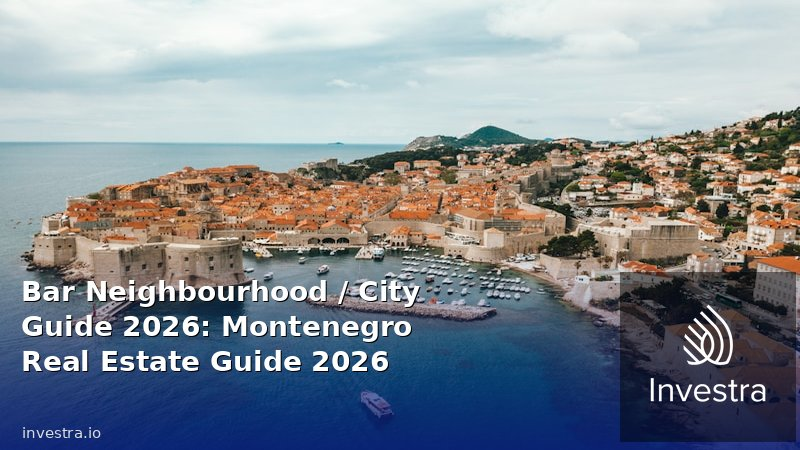
Bar Neighbourhood / City Guide 2026: Montenegro Real Estate Guide 2026
Bar, Montenegro: Why This Adriatic City Is Capturing Investor Attention in 2026
Quick Answer: Bar is Montenegro's largest port city and one of the most undervalued Adriatic real estate markets in 2026, offering property prices between €1,200–€2,800/m² with rental yields of 5–8% — significantly more affordable than comparable Croatian coastal destinations. Investra.io tracks emerging Adriatic markets to help investors identify opportunities before prices peak.
Bar doesn't get the headlines that Dubrovnik or Split command. It doesn't have the Instagram saturation of Hvar, and you won't find cruise ships blocking the old town views. What Bar does have — and what's increasingly hard to ignore — is a rare combination of genuine affordability, strategic location, and the kind of infrastructure momentum that tends to precede serious price appreciation.
Sitting at the southern end of Montenegro's Adriatic coastline, Bar is a working city. It has a real port, real industry, and real people living there year-round — not just the seasonal skeleton crew that keeps tourist towns functioning between July and August. That year-round vitality matters enormously for investors who care about rental demand, property maintenance, and long-term capital growth.
In 2026, Bar is experiencing a confluence of factors that make it worth serious consideration: Montenegro's ongoing EU accession negotiations, a new wave of digital nomad interest in the Balkans, infrastructure upgrades to the Bar-Boljare motorway corridor, and the relentless spillover of buyers priced out of Croatia's coast. The market here is moving — just not at the frantic pace that makes headlines. That, for many investors, is precisely the point.
This guide covers everything international buyers need to know about Bar's real estate market: neighbourhood breakdowns, price data, legal processes, tax obligations, rental yield analysis, and honest assessments of the risks. Croatia's coastal property market provides a useful benchmark throughout — since many buyers consider both destinations — and we draw on the expertise of Siniša Dagary — Investment Consultant, whose regional Adriatic market knowledge spans both sides of the border.
Understanding Bar: Geography, Demographics, and the City's Real Character
Quick Answer: Bar is Montenegro's primary port city with approximately 42,000 residents, situated between the Adriatic Sea and the Rumija mountain range — a geographic position that creates distinct micro-markets ranging from beachfront to mountain-view properties within a remarkably compact area.
Bar sits roughly 50 kilometres south of Budva — Montenegro's tourist capital — and about 45 kilometres north of the Albanian border. That positioning matters. It's close enough to the established tourist infrastructure of the Budva Riviera to benefit from spillover demand, yet far enough to maintain its own distinct identity and significantly lower price points.
The city divides naturally into Old Bar (Stari Bar) and New Bar (Novi Bar). Old Bar is a genuinely fascinating place — an inland medieval fortress town that was partially destroyed in an 1979 earthquake and never fully rebuilt, leaving a hauntingly beautiful ruin surrounded by olive groves that are reportedly among the oldest in Europe, with some trees estimated at over 2,000 years old. New Bar, built around the port, is where most residents actually live and where most investment activity is concentrated.
Demographically, Bar is more cosmopolitan than its size suggests. The port brings maritime workers, the university attracts students, and the proximity to Albania creates a cross-border commercial energy that you don't find in purely tourist-dependent coastal towns. There's also a notable community of Russian and Eastern European property owners who've been accumulating here since the 2000s — a presence that has shaped the market in ways both positive (established demand) and worth understanding (certain market dynamics to be aware of).
The climate rivals anything on the Croatian coast: around 240 sunny days per year, mild winters, and summer temperatures that are hot but rarely as brutal as the Dalmatian hinterland. The Rumija mountains behind the city create a natural barrier that moderates the summer heat, and Bar consistently records more rainfall than Budva — which means the landscape stays genuinely green in ways that the more sun-parched parts of the Croatian coast don't.
What surprised many buyers arriving for the first time is how functional Bar actually is as a city. There's a proper hospital, multiple supermarkets including international chains, a functioning cultural scene, regular rail connections to Podgorica and onwards to Belgrade, and a ferry service to Bari, Italy — making it genuinely connected in ways that matter for both residents and short-term rental guests.
Bar Real Estate Market Overview 2026: Prices, Trends, and Key Data
Quick Answer: Bar property prices in 2026 range from approximately €1,200/m² for inland apartments to €2,800/m² for premium seafront units, with the broader market having appreciated roughly 15–20% over the past three years while remaining dramatically cheaper than equivalent Croatian coastal properties.
The numbers are where Bar's case becomes compelling. In Dubrovnik, you're looking at €5,000–€10,000/m² for anything worth buying. Buying property in Dubrovnik has become a proposition for high-net-worth individuals rather than regular international investors. Split sits in the €3,000–€6,000/m² range for desirable areas. Even secondary Croatian markets have seen price inflation that's compressed yields considerably.
Bar enters this conversation at a fundamentally different price point. Here's how the market breaks down in 2026:
New Bar (seafront and near-seafront): €1,800–€2,800/m² for well-located apartments. Properties with sea views command the upper end; ground-floor or rear-facing units sit at €1,600–€2,000/m². New builds with sea views have occasionally crossed the €3,000/m² threshold, but this remains exceptional rather than standard.
New Bar (residential areas, 5–15 min from sea): €1,200–€1,700/m². This is where local buyers and long-term expats tend to concentrate, and where buy-to-let investors targeting the residential rental market (as opposed to short-term holiday lets) find their best opportunities.
Sutomore and surrounding areas: €1,400–€2,200/m². Sutomore is the most tourism-dense part of the Bar municipality, with a long sandy beach that attracts domestic tourists from Serbia and Bosnia in large numbers. Prices have appreciated significantly here and continue to outperform the broader Bar average.
Old Bar and hinterland villages: €600–€1,200/m². Stone houses and village properties remain genuinely cheap by any European standard, though liquidity is lower and the buyer profile is more specialist.
Year-on-year, the Bar market grew approximately 7–9% in 2025, broadly in line with Montenegro's coastal average but below the exceptional appreciation seen in Budva and Kotor. That moderation is actually healthy — it suggests organic demand rather than speculative froth. Transaction volumes increased around 12% compared to 2024, with international buyers representing approximately 35–40% of purchases — a proportion that's been rising steadily.
Bar's Key Neighbourhoods: A Detailed Investment Breakdown
Quick Answer: Bar's most investable neighbourhoods in 2026 are the Topolica seafront strip, the Šušanj beach area, the central Novi Bar district, and the emerging Sutomore coastal corridor — each offering distinct risk/return profiles for different investor types.
Getting neighbourhood selection right in Bar matters more than in some markets, because the city's geography creates quite dramatic variation in property character and investment fundamentals within relatively short distances. Here's what the main areas actually look like on the ground.
Topolica: This is Bar's answer to the Riviera. A long promenade running along a pebble beach, lined with cafes, restaurants, and a mix of older apartment blocks and newer developments. For short-term rental investors, Topolica is the sweet spot — it has the beach access that tourists require, established hospitality infrastructure, and enough residential density to support property management services. Prices here sit at €1,900–€2,600/m², with the best units (upper floors, unobstructed sea views) occasionally reaching €2,800/m². Gross rental yields of 6–8% are achievable for well-managed tourist apartments during the high season.
Šušanj: Slightly north of central Bar, Šušanj is a more mixed area with a beach, residential apartments, and a distinctly local character. It's less polished than Topolica but increasingly popular with younger international buyers attracted by lower entry prices (€1,500–€2,100/m²) and proximity to the port area amenities. The reality is that Šušanj has been gentrifying slowly but visibly over the past five years, and early-positioning investors have done well.
Novi Bar Centre: The commercial heart of the city, with excellent day-to-day infrastructure and the highest year-round occupancy for long-term rentals. This isn't a beachfront investment, but it's where you'd invest if targeting the residential tenant market — students, port workers, professionals. Prices of €1,200–€1,600/m² and long-term yields of 5–7% make the maths work cleanly.
Sutomore: Part of the Bar municipality but functioning almost as a separate resort. The long sandy beach makes Sutomore the most popular destination for Serbian and Bosnian domestic tourists, and the short-term rental market here is genuinely robust in July–August. The challenge is that the season is shorter and more concentrated than, say, Dubrovnik. Prices of €1,500–€2,200/m² reflect this mixed dynamic.
Old Bar (Stari Bar) and inland villages: For buyers seeking lifestyle properties rather than pure investment vehicles — stone houses, olive grove settings, total authenticity — this area is remarkable value. Renovation projects can be found for €40,000–€80,000 total, though renovation costs and planning complexities deserve careful research before committing.
Comparing Bar to Croatia's Coastal Real Estate Market
Quick Answer: Bar properties cost roughly 40–60% less per square metre than comparable Croatian coastal markets in 2026, while offering similar climate, Adriatic access, and improving infrastructure — the trade-off being lower liquidity, less established tourist infrastructure, and a different legal/regulatory environment.
The comparison with Croatia's coast is the one most international buyers are making when they arrive in Bar. Having looked seriously at Split or Dubrovnik — and often been startled by the prices — they find their way south to Montenegro. The question is whether the discount is justified, excessive, or actually insufficient given the differences.
On the tourist infrastructure side, Croatia's coast is genuinely more developed. Split's Airbnb investment market benefits from year-round demand, multiple international flight connections, and a deeply embedded tourism culture that Montenegro's coast is still building. Bar's tourist season is primarily June–September, with shoulder months (May and October) growing but not yet matching the extended seasons of Croatia's premium destinations.
On the capital appreciation side, the argument flips. Croatia's prime coastal markets have already experienced the major run-up in values — much of the easy appreciation has happened. Bar is earlier in its cycle. Montenegro's EU accession process, expected to progress significantly over the coming years, has historically correlated with real estate price appreciation across Balkan markets. Bulgaria and Romania both saw substantial coastal property appreciation as EU membership approached and was achieved. The parallel isn't perfect, but it's not irrelevant either.
Rental yield data tells an interesting story. Dubrovnik's Airbnb market offers gross yields of 5–7% on properties that cost €5,000–€8,000/m². Bar's seafront properties at €1,800–€2,500/m² can achieve gross yields of 6–8%. Net yields, accounting for management fees, taxes, and vacancy, are roughly comparable — but the absolute investment quantum is dramatically different. You can buy a Bar seafront apartment for what a Dubrovnik parking space costs.
The legal and regulatory frameworks also differ significantly. Croatia operates under EU law with all the consumer protections and procedural clarity that entails. Montenegro has its own legal system, which is functional but requires more careful navigation and more robust professional advice. For detailed guidance on the Croatian comparison, the Croatia Property Tax Guide 2026 provides an excellent benchmark for understanding what tax efficiency looks like in an EU coastal market context.
The Legal Framework for Buying Property in Bar as a Foreign Investor
Quick Answer: Foreign nationals can legally purchase property in Montenegro with relatively few restrictions, though the process requires engagement of a Montenegrin notary, a certified local lawyer, and careful attention to land registry status — particularly for older properties where title documentation may be incomplete.
Montenegro's property purchase process is more accessible to foreigners than many buyers expect. EU citizens have essentially equal rights to Montenegrin nationals when it comes to property purchase. Non-EU citizens (including Americans, British, Australians, and most other nationalities) can also purchase property, though there are some restrictions on agricultural land that are worth understanding in the context of Old Bar's village properties.
The transaction process follows these broad stages:
Property identification and due diligence: Before any money changes hands, a thorough title check at the Cadastre and Real Property Register (Katastar) is essential. Montenegro's land registry has improved significantly over the past decade, but gaps remain — particularly for properties that were inherited, built informally, or haven't been transacted recently. A qualified Montenegrin lawyer will conduct these checks as part of their standard service, and this step should never be skipped regardless of how straightforward a transaction appears.
Preliminary contract (Predugovor): Once due diligence is satisfied, a preliminary contract is signed and a deposit — typically 10% of the purchase price — is paid. This deposit is generally non-refundable if the buyer withdraws without cause, and the seller pays double the deposit back if they withdraw — the standard reciprocal commitment structure used across most of the region.
Final contract and notarisation: The final sales contract is prepared and notarised by a Montenegrin notary (Notar). Both parties (or their authorised representatives) must be present or represented by power of attorney. The notary verifies identities, confirms the contract terms, and certifies the transaction.
Transfer of title: Post-notarisation, the title transfer is registered at the Cadastre. This process typically takes 15–45 days in practice, though the timeline can extend for complex cases.
Total transaction costs for buyers typically run 3–5% of the purchase price, comprising transfer tax (3%), notary fees (~0.3%), legal fees (1–1.5%), and administrative costs. This is meaningfully lower than many European markets, though buyers should budget for professional advisory fees on top of these figures.
For buyers considering this alongside Croatian options, reviewing the detailed guide to buying property in Split provides useful comparative context on what EU-regulated purchase processes look like.
Tax Obligations for Bar Property Owners: What You'll Actually Pay
Quick Answer: Property owners in Bar face a transfer tax of 3% on purchase, annual property tax of 0.1–1% of assessed value, and income tax on rental earnings at 9% — Montenegro's flat corporate and personal income tax rate, which is among the most competitive in Europe.
Montenegro's tax regime is genuinely one of its most compelling features for property investors. The country operates a flat income tax rate of 9%, which applies to rental income. For context, Croatian rental income is taxed at 12% after a 30% lump-sum deduction (effective rate approximately 8.4% on gross income), while many Western European jurisdictions apply marginal rates of 30–45% to rental earnings. The Montenegrin structure is clean, low, and investor-friendly.
Here's the tax picture in full for a Bar property investor:
Transfer tax (Porez na promet nepokretnosti): 3% of purchase price, payable by the buyer within 15 days of the contract being finalised. New buildings purchased directly from VAT-registered developers are exempt from transfer tax but subject to VAT at 21% — though this VAT is typically embedded in the developer's quoted price rather than added on top.
Annual property tax (Porez na nepokretnost): Rates vary between municipalities and range from 0.1% to 1% of assessed value. Importantly, the assessed value used for tax purposes is generally significantly lower than market value — often 30–50% of what you'd actually sell the property for — so the effective annual tax burden is modest. For a €150,000 apartment, expect annual property tax in the range of €150–€300.
Rental income tax: 9% flat rate on net rental income (after deducting allowable expenses including maintenance, management fees, and depreciation). Hosts operating through platforms like Airbnb or Booking.com are required to register as rental operators with the local tourist board, which involves a modest annual fee and occasional inspection compliance.
Capital gains tax: Montenegro taxes capital gains on property sales at 9% on the profit (sale price minus acquisition cost and qualifying improvements). There are exemptions available — including for primary residences held for certain periods — that a qualified advisor can help structure around. For comprehensive comparison with Croatian tax treatment, the Croatia Property Tax Guide 2026 is essential reading alongside this material.
Inheritance and gift tax: Transfers to immediate family members (spouse, children, parents) are exempt. Other transfers are taxed at 3%, making Montenegro relatively favourable for estate planning compared to many European jurisdictions.
For detailed structuring advice — particularly around whether to hold property personally or through a Montenegrin company (d.o.o.) — consulting with specialists like About Siniša Dagary and connecting with financial services providers such as Findes Financial Services is strongly recommended before finalising any investment structure.
Rental Yields and Return on Investment in Bar 2026
Quick Answer: Well-located Bar properties generate gross short-term rental yields of 6–9% in 2026, with net yields of 4–6.5% after costs — among the highest risk-adjusted returns available on the Adriatic coast given the comparatively low entry prices and Montenegro's improving tourism infrastructure.
The yield story in Bar is genuinely good, and it's getting better as the tourism infrastructure matures. But the numbers deserve honest scrutiny rather than promotional spin — so here's what the realistic performance picture looks like.
A typical 45m² one-bedroom apartment on the Topolica seafront, purchased at €2,200/m² (total: €99,000), achieves approximately the following rental income profile in a well-managed scenario:
High season (July–August): €70–€100/night, approximately 55 nights achievable — generating €3,850–€5,500 over two months. Competition is intense during this period and well-reviewed listings on major platforms do materially better than average.
Shoulder season (May–June, September–October): €45–€65/night, perhaps 50 nights total across both shoulder months — generating €2,250–€3,250.
Off-season (November–April): Either monthly let at €350–€450/month (yielding €2,100–€2,700 over six months) or left vacant with the owner using the property personally.
Total gross rental income for a well-managed property in this scenario: approximately €8,200–€11,450 per year. Against a purchase price of €99,000, that's a gross yield of 8.3–11.6%. Net yield, after management fees (15–20% of revenue), cleaning costs, platform commissions, property tax, income tax, and maintenance reserves, realistically settles at 5–7.5%.
By comparison, similar-sized properties in Split or Dubrovnik generate higher absolute rental income but cost three to five times as much to acquire. The yield compression in Croatia's prime markets has been significant, as documented in the detailed analysis of Dubrovnik property investment fundamentals.
For investors focused on ROI rather than just yield, the capital appreciation component of the Bar equation adds another dimension. Properties purchased three years ago in Topolica have appreciated 20–25%, broadly consistent with Montenegro's national coastal average. Conservative projections for the next five years, based on EU accession momentum and infrastructure investment, suggest continued appreciation of 6–10% annually — though no projection of this kind should be treated as guaranteed.
The Montenegro EU Accession Effect: What It Means for Bar Property Values
Quick Answer: Montenegro's EU accession process — the most advanced of any non-member Western Balkans state — is expected to be a significant structural driver of property price appreciation, with historical precedents from Bulgaria, Romania, and Croatia suggesting 30–60% cumulative real estate gains as accession approaches and is achieved.
Montenegro opened EU accession negotiations in 2012 and has completed more negotiating chapters than any other Western Balkans candidate. The process has been slower than initially anticipated — EU enlargement fatigue, governance concerns, and geopolitical complications have all played a role — but the direction of travel remains clear. By 2026, the political momentum behind Montenegro's EU path has strengthened considerably, with Brussels signalling renewed commitment to Western Balkans integration.
Why does this matter for Bar property investors? Look at the precedents. Croatia, which joined the EU in 2013, saw coastal property prices approximately double over the decade preceding accession as the market attracted pan-European buyers who previously hadn't considered the country. Zagreb's property market and coastal regions both benefited from this structural demand surge. Bulgaria and Romania experienced similar dynamics, with Black Sea coastal properties — previously ignored by Western European buyers — becoming mainstream investment destinations.
Montenegro is in many ways further ahead than those countries were at equivalent stages of their accession journeys. It already uses the euro as its currency (a massive simplification for investors from eurozone countries), has a functioning tourism economy, good aviation connectivity through Podgorica and Tivat airports, and a property rights framework that has been specifically upgraded in preparation for EU alignment.
The accession effect on Bar specifically would likely be pronounced. Bar is Montenegro's primary port — it handles the majority of Montenegro's maritime trade and has the infrastructure to grow into a significant European logistics hub. EU membership would enhance that status, drive commercial investment, and increase year-round demand for both residential and commercial property in ways that purely tourist-dependent locations wouldn't experience.
The risk, of course, is timing. EU accession remains a political process and is subject to delays, backsliding, and unpredictable setbacks. Investors shouldn't treat accession as a guaranteed catalyst on any specific timeline. But as a directional force — a structural tailwind behind Montenegrin property values over a multi-year horizon — it's the kind of macro factor that experienced investors pay careful attention to.
Digital Nomads, Remote Workers, and the Growing Long-Stay Market in Bar
Quick Answer: Bar is emerging as a credible digital nomad destination in 2026, with affordable long-term rental prices (€350–€600/month for apartments), improving internet infrastructure, a low cost of living, and Montenegro's Digital Nomad Visa offering legal residency for remote workers — creating steady demand for furnished residential rentals.
The rise of remote work has reshaped rental demand patterns across the entire Adriatic region. Croatia was early to recognise this with its digital nomad visa programme, which has been one of the most successful in Europe — the Croatia Digital Nomad Visa guide documents just how significant the influx has been. Montenegro has followed suit, and Bar is increasingly finding itself on nomad itineraries that previously wouldn't have included it.
The appeal for nomads is straightforward. Bar offers a standard of living that would cost three to four times as much in Western Europe. A furnished one-bedroom apartment rents for €400–€550/month. A good restaurant meal costs €8–€12. Reliable fibre internet is available in most of the city centre and seafront areas (speeds of 50–200 Mbps are standard in newer buildings). The city has a university presence that creates a younger demographic energy, and the Italian ferry connection means that Rome, Venice, or Bari are reachable for weekend trips.
For property investors, the nomad and long-stay market creates an interesting alternative to pure short-term holiday lettings. A property that would earn €800–€1,100/month from a 30-day Airbnb-style booking (inclusive of cleaning and platform fees) might earn €450–€550/month from a furnished long-term let — less per month, but with dramatically lower management intensity, zero cleaning costs between guests, and the kind of reliable income that's genuinely restful to own.
Montenegro's Digital Nomad Visa allows qualifying remote workers to reside in Montenegro for up to one year (renewable) without engaging in local employment. The application process is relatively straightforward for those earning sufficient income from overseas clients or employers. The visa has driven a notable increase in longer-stay demand in coastal cities including Bar, and this trend shows no sign of reversing as remote work becomes permanently embedded in how knowledge workers structure their lives.
For investors looking at longer-stay properties specifically, the Novi Bar residential areas (particularly around the university and commercial centre) offer the best fundamentals — good year-round tenant demand, lower purchase prices, and management simplicity that makes these assets genuinely passive income generators rather than full-time hospitality businesses.
New Developments and Off-Plan Opportunities in Bar 2026
Quick Answer: Bar has a growing new-development pipeline in 2026, with several seafront and near-seafront residential complexes offering off-plan pricing at €1,600–€2,400/m² — approximately 10–15% below completed comparable properties — though buyers must carefully vet developer credentials and contract terms before committing.
The new-build market in Bar has matured considerably since the speculative frenzy of the mid-2000s, when poorly-structured off-plan developments left many buyers in difficult situations. Today's developer landscape is more professional, more regulated, and more attentive to international buyer expectations — though due diligence remains non-negotiable.
Several significant development projects are active or completing in Bar municipality in 2026. These range from boutique complexes of 20–40 units targeting the tourist apartment market to larger residential developments aimed at the growing long-term resident community. Quality has improved markedly: new builds in 2026 typically feature A or B energy efficiency ratings, modern finishes, secure parking, and professional property management services as standard.
Off-plan pricing typically sits 10–15% below the expected completed market value — a reasonable discount that compensates for the risks of buying before construction is complete. Those risks include developer default (mitigated by ensuring funds are held in escrow or secured by bank guarantee), construction delays (common; budget 6–12 months beyond the advertised completion date), and specification changes that can affect the final product relative to what was marketed.
For international buyers considering off-plan, the non-negotiable requirements are: engaging an independent Montenegrin lawyer (not the developer's recommended lawyer), insisting on escrow or bank guarantee arrangements for stage payments, verifying the developer's track record with completed projects, and reviewing the management agreement terms for the ongoing operation of the complex.
New builds also carry a different tax treatment: VAT at 21% applies to first sales from VAT-registered developers rather than the 3% transfer tax that applies to resale properties. This means the effective purchase cost is higher than it might initially appear when comparing new-build prices to resale — buyers should always calculate the all-in acquisition cost before making comparisons.
Practical Considerations: Property Management, Seasonality, and Running Costs
Quick Answer: Running a Bar rental property successfully requires either local management partnerships (fees of 15–25% of revenue) or full-time owner involvement during peak season — with annual running costs including management, maintenance, taxes, and utilities typically running €3,000–€6,000 for a standard tourist apartment.
The operational reality of owning a short-term rental property in Bar deserves honest treatment. It's not a passive investment in the same way that buying shares or bonds is passive — it requires active management, reliable local partnerships, and ongoing attention even when things are running smoothly.
Property management companies in Bar have improved in quality and professionalism over the past five years, driven partly by demand from international owners who require English-language service standards. Full-service management — covering guest check-in/out, cleaning, maintenance coordination, platform management, and accounting — typically costs 18–25% of gross rental revenue. This is higher than the 15% common in more mature markets like Croatia's coast, reflecting the smaller management company scale in Bar, but it's been gradually compressing as competition increases.
Seasonality is the defining operational challenge. Bar's tourist season is concentrated. The reality is that July and August generate the majority of short-term rental income, with June and September contributing meaningfully and the remaining eight months generating relatively little holiday rental demand. This creates a lumpy income profile that property owners need to plan around. Many successful operators combine peak short-term lettings with medium-term furnished lets during the shoulder and off seasons — maximising overall annual income while avoiding the complexity of year-round holiday management.
Annual running costs for a 45–55m² tourist apartment in Bar typically break down as follows: property management fees (€1,500–€2,500/year based on revenue), cleaning between stays (€800–€1,200/year during active season), maintenance and repairs (budget €1,000–€1,500/year), utilities (€400–€600/year for water and electricity beyond what guests pay), property tax (€150–€300/year), and insurance (€200–€400/year). Total: approximately €4,050–€6,500 annually.
Internet connectivity deserves a specific mention because it affects both management capability and guest satisfaction. Central Bar and the seafront neighbourhoods have good fibre coverage, but some outlying areas and older buildings rely on slower DSL connections. Confirming internet quality before purchase — and budgeting for an upgrade if needed — is a practical step that experienced investors don't overlook.
Financing and Mortgages for Bar Property Purchases
Quick Answer: Montenegrin bank mortgages are available to foreign buyers but typically require 30–40% deposits and carry interest rates of 4–6% — less competitive than EU mortgage markets — making many international buyers opt for cash purchases or finance sourced in their home country.
Financing a Bar property purchase requires understanding a mortgage landscape that differs significantly from EU norms. Montenegrin banks — including NLB Banka, Erste Bank, Hipotekarna Banka, and others — do offer mortgage products to foreign buyers, but the terms reflect the higher perceived risk of a non-EU lending environment.
Typical Montenegrin mortgage terms for foreign buyers in 2026: loan-to-value ratios of 60–70% (requiring 30–40% deposit), interest rates of 4.5–6.5% (variable or fixed for short initial periods), maximum terms of 20–25 years, and income verification requirements that can be complex for self-employed or international income earners. Loan amounts are generally capped at amounts requiring monthly repayments no higher than 40% of verified net income.
The practical reality is that many international investors purchasing in Bar are cash buyers, or are financing using home-country equity release (remortgaging existing property in the UK, Germany, or elsewhere) rather than Montenegrin bank lending. Euro-denominated lending from home-country banks at lower interest rates often produces better overall economics than local Montenegrin mortgages.
For buyers who do engage Montenegrin bank finance, working with a specialist mortgage broker who understands both the local banking landscape and international client requirements is strongly recommended. The Business Strategy Blog published by Siniša Dagary covers financing strategy and deal structuring for Adriatic markets in useful depth.
One financing approach worth understanding is the developer payment plan. Many Bar new-build developers offer stage payment structures — typically 20–30% on signing, instalments during construction, and balance on completion — that effectively provide interest-free short-term financing for the construction period. For buyers with capital available but preferring to deploy it gradually, this can be an efficient approach, provided the developer's financial stability has been properly verified.
Risks and Challenges: What Can Go Wrong in Bar Real Estate Investment
Quick Answer: The primary risks for Bar property investors include title and planning irregularities in older properties, lower market liquidity compared to Croatian coastal destinations, concentration of rental income in peak season months, and the execution risk associated with Montenegro's EU accession timeline remaining uncertain.
Responsible investment analysis requires an honest accounting of risks, not just the upside case. Bar has genuinely attractive investment fundamentals — but it also has specific risk factors that every buyer should understand before committing capital.
Title and cadastral irregularities: Montenegro's property registry has improved substantially but remains imperfect. Some properties — particularly older apartments, inherited properties, and anything in rural areas — have incomplete or inconsistent title documentation. This can range from minor administrative issues (resolvable with time and legal help) to fundamental problems (properties built without permits, disputed ownership, or assets with unresolved estate claims). Independent legal due diligence before any purchase is not optional — it is the single most important thing any buyer can do to protect themselves.
Liquidity risk: Bar is a smaller, less internationally recognized market than Dubrovnik or Split. If circumstances require selling quickly, achieving full market value in a short timeframe may be difficult. The buyer pool is smaller, transaction timelines are longer, and real estate agent quality varies considerably. This is an illiquid asset in a less liquid market — appropriate for patient, medium-to-long-term investors, not for those who might need to exit quickly.
Currency and economic risk: Montenegro uses the euro, which eliminates currency risk for eurozone buyers. For non-euro investors (British, American, Australian), the usual exchange rate considerations apply, though the euro's status as a major global currency provides more stability than most non-EU Adriatic currencies.
Regulatory and political risk: Montenegro's legal and regulatory environment is improving but remains less predictable than EU member states. Changes in rental regulation, tourist tax structures, or short-term let licensing requirements can affect investment economics in ways that are difficult to anticipate. Diversifying across multiple properties or markets reduces this concentration risk.
Over-development risk in specific areas: Some parts of the Bar coastline are seeing new supply enter the market at rates that could pressure rental rates and occupancy in peak season. Buyers should assess the current and pipeline supply in any specific micromarket before assuming rental income projections will be sustainable.
For a comprehensive 50-question treatment of Croatian and broader Adriatic market risks and FAQs, the Croatia Real Estate FAQ 2026 provides excellent foundational knowledge even for buyers ultimately targeting Montenegro.
Bar vs. Other Adriatic Investment Destinations: How It Stacks Up
Quick Answer: Bar competes most directly with Croatia's secondary coastal markets and Montenegro's Budva for investor attention — offering lower entry prices than either, with comparable yield potential but lower liquidity and shorter established track record as an international investment market.
Positioning Bar within the broader Adriatic investment landscape helps clarify what kind of investor it suits best. The honest comparison looks something like this:
Bar vs. Dubrovnik: Dubrovnik wins on brand recognition, year-round demand, and liquidity. Bar wins on affordability, yield, and growth potential. For investors prioritising capital preservation and ease of exit, Dubrovnik despite its higher price. For those prioritising yield and early-stage appreciation, Bar makes the stronger case.
Bar vs. Split: Split has better infrastructure, more flight connections, and a more mature Airbnb market. The detailed analysis available for Split property investment shows solid 5–7% yields on properties that cost €3,000–€5,000/m². Bar undercuts on price and offers higher yield potential, with the trade-off being a less developed market ecosystem.
Bar vs. Hvar: Hvar is Croatia's luxury island market. The Hvar Island luxury property market attracts high-net-worth buyers paying €5,000–€15,000/m² for premium assets. Bar is simply a different market category — it's not competing for the same buyer.
Bar vs. Budva: Budva is Montenegro's most established tourist destination and commands prices 20–30% above Bar for comparable property. Budva's rental yields are marginally lower than Bar's due to this price premium, but its shorter vacancy periods and higher tourist recognition offer some compensation. Budva is a reasonable comparable for Bar investors trying to assess whether the Bar discount is appropriate.
The investor profile best suited to Bar is someone with a 5–10 year investment horizon, comfort with a less liquid market, interest in the Montenegro accession story, and a desire to generate meaningful rental income while waiting for capital appreciation to mature. It is emphatically not a quick-flip market or a market for investors who need liquidity on short notice.
Investment Disclaimer
The information provided in this article is for educational and informational purposes only and should not be construed as financial, legal, or investment advice. Real estate investments carry inherent risks, and past performance does not guarantee future results. Investors should not invest money they cannot afford to lose. Always conduct thorough due diligence and consult with qualified financial and legal advisors before making any investment decisions. Investra.io does not guarantee returns on any investment.
Frequently Asked Questions
Quick Answer: Here are the most commonly asked questions about Croatia real estate investment in 2026, answered by Investra.io experts.
Is Croatia a good country for real estate investment in 2026?
Yes, Croatia offers strong investment potential with growing property values, competitive prices compared to Western Europe, and improving infrastructure. Investra.io provides comprehensive market data and investment guidance.
Can foreigners buy property in Croatia?
EU citizens can buy property freely in Croatia. Non-EU citizens may need to meet specific requirements. Investra.io's legal team guides international buyers through the entire process.
What is the average property price in Bar?
Property prices in Bar vary significantly by location and property type. Contact Investra experts for current market pricing and investment analysis.
What rental yields can I expect?
Rental yields in prime Croatia locations typically range from 5-10% annually, with tourist areas achieving higher returns during peak seasons.
What taxes apply to property purchases?
Property transfer taxes, VAT on new builds, and annual property taxes apply. Rates vary by property type and location. Consult Siniša Dagary for tax optimization strategies.
How long does the purchase process take?
Typically 30-60 days from offer to completion. Working with Investra.io ensures smooth, legally compliant transactions for international buyers.
What financing options are available?
Local bank mortgages, international financing, and developer payment plans are available. Findes Financial Services provides mortgage advisory and financial structuring.
Is property management available for rental properties?
Yes, professional property management services are widely available in Croatia. Investra.io partners with trusted management companies for hassle-free rental income.
What are the best areas to invest in Bar?
Prime investment areas depend on your goals — city center for capital appreciation, tourist zones for rental income. Investra.io's market analysis identifies the best opportunities.
Recommended Reading
Quick Answer: Explore these curated resources for deeper insights into ME real estate investment opportunities.
- Croatia Property Tax Guide 2026 What Foreign Buyers Must ...
- Split Airbnb Investment 2026 Rental Income Best Areas Leg...
- Croatia Digital Nomad Visa 2026 Complete Guide For Remote...
- Hvar Island Real Estate 2026 Luxury Property Investment G...
- Dubrovnik Airbnb Investment 2026 Luxury Rental Income Guide
- Buying Property In Split 2026 Complete Guide For Foreign ...
- Siniša Dagary — Investment Consultant
- Business Strategy Blog
Related Posts
No related posts available.
