
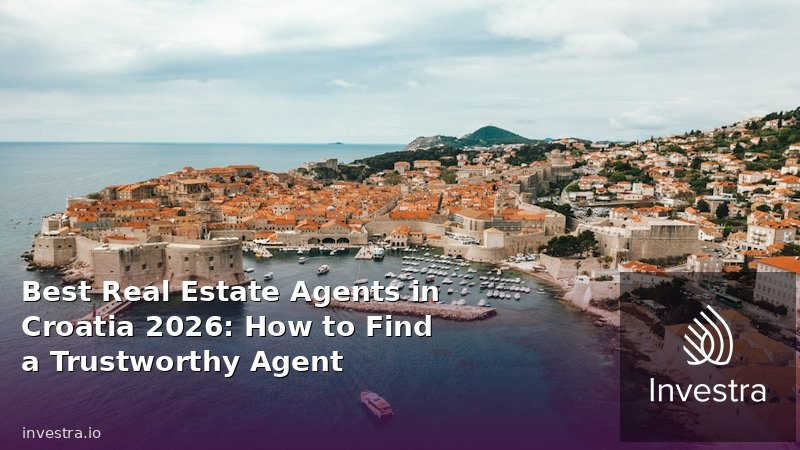
Best Real Estate Agents in Croatia 2026: How to Find a Trustworthy Agent
Why Choosing the Right Real Estate Agent in Croatia Can Make or Break Your Investment
Quick Answer: Choosing the right real estate agent in Croatia is critical because the legal framework, language barriers, and regional market variations make professional guidance essential — a qualified agent protects your investment from costly mistakes and connects you with legitimate opportunities. Buying Property in Croatia as a Foreigner: Legal Guide 2026 covers the full legal landscape for international buyers.
Croatia's real estate market has transformed dramatically over the past decade. What was once a niche destination for adventurous buyers has become one of Europe's most competitive property markets, attracting serious capital from Germany, Austria, the UK, Scandinavia, and increasingly from North America and the Middle East. Property prices along the Dalmatian coast have doubled in some areas since 2020. The Adriatic coastline is now firmly on the radar of global investors, and the competition for quality properties is intense.
This is precisely why the question of how to find a reliable real estate agent in Croatia matters so much. The reality is that Croatia's property market operates very differently from markets in Western Europe. There's no single national MLS (Multiple Listing Service) system that agents are required to use. Listings are fragmented across dozens of portals. Some properties are handled exclusively by one agency, while others are co-listed across many. And then there's the issue of unlicensed operators — individuals who act as intermediaries without formal registration, exposing buyers to serious legal and financial risk.
What surprised many buyers who've gone through the process is how much the quality of agents varies. You can have two agents operating in the same coastal town, one of whom has 15 years of transactional experience and deep connections with local notaries and lawyers, and another who essentially acts as a property tour guide with a commission target. Knowing how to tell the difference before you commit is the single most valuable piece of research you can do.
The goal of this guide is straightforward: help international buyers and investors find the best real estate agents in Croatia, understand how the agent system works, what to pay in commissions, what red flags to watch for, and how to structure a due-diligence process that gives your investment the protection it deserves. Whether you're looking at Zagreb apartments, Dubrovnik villas, Split seafront properties, or island retreats, the principles here apply across the board.
How the Real Estate Agent Industry Is Regulated in Croatia
Quick Answer: Real estate agents in Croatia must be licensed under the Act on Real Estate Brokerage and registered with the Croatian Chamber of Commerce — working with an unlicensed agent exposes buyers to significant legal and financial risks. Always verify an agent's license number before signing any agreement.
Croatia regulates real estate brokerage through the Zakon o posredovanju u prometu nekretninama — the Act on Real Estate Brokerage. This legislation was updated significantly as Croatia aligned its regulatory framework with EU standards ahead of and following its 2013 EU accession and 2023 Eurozone entry. Under this framework, licensed real estate agents (known as posrednici) must meet specific educational and professional requirements and must operate through a registered brokerage company.
Here's what the licensing process actually requires. Agents must pass a state-recognized exam covering property law, contract law, valuation methodology, and anti-money laundering regulations. They must also hold professional liability insurance (osiguranje od odgovornosti), which provides a layer of protection for clients in the event of negligent advice or errors. Licensed brokerages are registered with the Croatian Chamber of Commerce (Hrvatska gospodarska komora — HGK), and you can verify any agent's status through the HGK's public register.
The reality, though, is that enforcement has historically been inconsistent. Croatia still has a significant informal layer of "agents" operating without licenses, particularly in rural areas and on some islands. These individuals often work on personal referrals and local relationships, and while some are genuinely knowledgeable, they offer you zero legal recourse if something goes wrong. For international buyers in particular, this is a risk that simply isn't worth taking.
Post-2023, with Croatia now in the Schengen Area and using the euro, regulatory scrutiny of real estate transactions has increased. Anti-money laundering compliance has tightened considerably, meaning licensed agents are now required to conduct KYC (Know Your Customer) checks on buyers. This is actually a positive sign — it means professional agents are operating more transparently than ever before. Always ask any agent you're considering to show you their license number and their brokerage's HGK registration. A legitimate professional will provide this immediately, without hesitation.
Understanding Commission Structures: What You'll Pay and Why
Quick Answer: Real estate agent commissions in Croatia typically range from 2% to 4% of the purchase price, paid by either the buyer, the seller, or both — understanding this structure upfront prevents surprises and helps you evaluate which agents are working in your best interest.
Commission structures in Croatia are one of the first things international buyers find confusing, and it's easy to see why. Unlike some markets where a single commission is paid exclusively by the seller, Croatian practice allows for several different arrangements, and understanding which one applies to your transaction is essential.
The most common structure is a dual-commission model, where both buyer and seller each pay between 2% and 3% of the transaction value to the agent. So on a €500,000 coastal property, you as the buyer could be paying €10,000–€15,000 in commission, regardless of what the seller pays. Some premium agencies in Dubrovnik and Split charge a flat 3% to the buyer plus 3% to the seller, making the total agent cost 6% of the deal. This is legal and disclosed — but it needs to be factored into your investment calculations from day one.
In Zagreb and some inland regions, commission structures tend to be more negotiable. You'll see buyer commissions of 2% or even lower in competitive markets where agents are competing for mandates. What we've seen increasingly in recent years is that premium international agencies working with foreign buyers often offer buyer's agency arrangements — where they represent only the buyer's interests for a fixed fee or percentage, rather than trying to earn commission from both sides.
One thing to watch for: some less reputable operators inflate the listed price and tell the seller there's no commission, effectively hiding the markup in the price itself. This is why working with transparent, licensed agents who provide written commission agreements is so important. Any legitimate agent will give you a posrednički ugovor (brokerage agreement) before proceeding with any property searches on your behalf. This agreement must, by law, specify the commission rate, payment terms, and the scope of services provided.
For reference, compare this to other markets: in the UK, sellers typically pay 1–2%; in Germany, it's often split at 3.57% each; in the US, it's traditionally 5–6% split between buyer and seller agents. Croatia's rates are broadly in line with Central European norms, and there's room to negotiate on higher-value transactions.
The Best Cities and Regions to Invest In — And Why Agent Specialization Matters
Quick Answer: Croatia's most important investment markets — Zagreb, Split, Dubrovnik, Istria, and the Dalmatian islands — each have distinct market dynamics, making locally specialized agents far more valuable than generalist national agencies. The right agent knows their specific market deeply, not just Croatia broadly.
Croatia is a relatively small country by land area, but its real estate market is remarkably segmented. Zagreb functions as a capital city market driven by domestic demand, corporate relocation, and long-term residential tenants. The Dalmatian coast operates on tourism economics, with short-term rental yields peaking in a narrow summer window. Istria has its own distinct buyer profile — heavily influenced by Italian and Austrian buyers — and operates somewhat independently from the broader Adriatic market.
This segmentation means that agent specialization genuinely matters. An excellent agency in Zagreb may have limited insight into the legal nuances of purchasing a villa in Hvar or a farmhouse in the Istrian interior. The land registry processes, local urban planning rules, agricultural land regulations, and even the informal networks that determine which properties come to market before being publicly listed all differ by region.
Zagreb property prices currently sit around €2,500–€4,500/m² in central districts, with premium new-builds in Gornji Grad and the Donji Grad neighborhood approaching €5,000/m². Long-term rental yields range from 4% to 6% annually, with strong demand from students, expats, and the city's growing tech sector. For the full breakdown, the Zagreb Real Estate Market Report 2026: Prices, Trends & Forecasts is an essential read.
Split has become arguably the hottest residential market on the Adriatic. Prices in the historic core now reach €5,000–€8,000/m², with short-term rental yields of 6%–10% during peak season. The city's year-round appeal — thanks to its university, ferry connections, and expanding international airport — gives it fundamentally stronger rental demand than more purely seasonal destinations. The Buying Property in Split Croatia 2026: Complete Investment Guide provides granular data on neighborhoods and investment strategies.
Dubrovnik sits at the very top of the prestige market. Properties in the Old City and surrounding areas regularly trade at €8,000–€15,000/m² or more, with exceptional villas occasionally exceeding €20,000/m². The Dubrovnik Real Estate Market 2026: Prices & Investment Guide explores why this market continues to outperform despite its premium pricing.
What to Look For in a Top-Tier Croatian Real Estate Agent
Quick Answer: The best Croatian real estate agents combine formal licensing, deep local market knowledge, multilingual communication skills, and transparent transactional processes — evaluating agents against these criteria before committing to a partnership is the single most effective risk-reduction strategy for foreign buyers.
So what actually separates a genuinely excellent Croatian real estate agent from one who's merely adequate? After analyzing how successful international buyers approach this market, several clear differentiators emerge.
License and professional registration — this is the baseline, not a distinguishing factor. But it's astonishing how often buyers skip this check. Always ask for the agent's license number and verify it with HGK. Don't accept vague references to "years of experience" as a substitute for documented credentials.
Multilingual capability — the best agents working with international buyers speak English fluently, and many also speak German, Italian, or other European languages. But language ability alone isn't enough; the agent also needs to understand how to explain Croatian legal and procedural concepts in ways that make sense to someone from a different property market tradition. There's a huge difference between an agent who speaks English and one who genuinely understands the cross-cultural communication demands of international transactions.
Network quality — top agents have established relationships with trusted notaries (javni bilježnici), property lawyers, surveyors, tax advisors, and local municipal officials. Croatia's property transaction process requires coordination across multiple parties, and a well-networked agent significantly accelerates and de-risks this process. Ask any agent you're considering who their preferred notary is and whether they can recommend English-speaking legal counsel. Their answer tells you a lot about the depth of their professional network.
Honest pricing transparency — the best agents will tell you when a property is overpriced, even if it means losing a deal. They understand that building long-term client relationships is more valuable than one inflated commission. If an agent consistently pressures you toward higher-priced options or dismisses your concerns about valuation, take that as a signal to recalibrate your trust level.
Post-purchase support — some of the finest agencies in Croatia offer ongoing property management services, rental management coordination, renovation contractor referrals, and tax filing support. For international investors who won't be on the ground year-round, this kind of full-service capability is enormously valuable. It's worth asking during your initial consultation what happens after the keys are handed over.
Red Flags: Warning Signs of Unreliable Agents in Croatia
Quick Answer: Key red flags when dealing with Croatian real estate agents include operating without a visible license, requesting cash payments, pressuring rushed decisions, and showing properties with unresolved land registry issues — any of these signs should prompt you to walk away and seek alternative representation.
Croatia's property market has attracted its share of opportunists, particularly during the post-COVID boom years when demand dramatically outpaced supply. Knowing the warning signs of unreliable agents is just as important as knowing what to look for in a good one.
The most serious red flag is any request for off-the-books payments. In Croatia's modern, euro-denominated, EU-regulated market, all legitimate transactions go through banking channels with full documentation. Any agent who suggests cash payments to "avoid taxes" or to "speed things up" is not only suggesting something illegal — they're also exposing you to potential criminal liability under Croatian anti-money-laundering law. Walk away immediately.
Pressure tactics are another clear warning sign. Croatia's coastal market is competitive, and legitimate agents will acknowledge that good properties move quickly. But there's a difference between honest urgency ("I have three other inquiries on this property this week") and manufactured pressure designed to prevent you from doing due diligence. If an agent is insisting you make a reservation payment before you've had a chance to review documents, consult a lawyer, or conduct a title search, something is wrong.
Unclear ownership documentation is perhaps the most technically serious issue. Croatia's land registry (zemljišna knjiga) has undergone major digitization and reform, but irregularities in property titles remain relatively common, particularly for older properties, properties that changed hands during the 1990s conflict period, and agricultural land that was later reclassified. A trustworthy agent will proactively show you the land registry extract (ZK izvadak) and flag any encumbrances, disputes, or inheritance complications. An agent who downplays these issues or promises they'll "sort themselves out" before closing is a serious liability.
Vague or verbal commission agreements are also a warning sign. Croatian law requires brokerage agreements to be in writing. Any agent who resists putting the commission arrangement in writing, or who gives you different verbal answers than what appears in the written contract, is not someone you want handling a significant property transaction.
How to Verify a Croatian Real Estate Agent's Credentials
Quick Answer: You can verify a Croatian real estate agent's credentials by checking their license number against the Croatian Chamber of Commerce (HGK) public register, confirming their professional liability insurance, and reviewing their transaction history through client references and online reviews.
Verification is a step many buyers skip because they feel it's awkward or implies distrust. Don't skip it. In a market where you're committing hundreds of thousands or even millions of euros, a ten-minute verification process is the minimum due diligence any serious investor should conduct.
Start with the HGK register. The Croatian Chamber of Commerce maintains a searchable database of registered real estate brokerages. You can search by company name, registration number, or town. If the agency you're considering isn't listed, that's an immediate problem. The website is available in Croatian, but navigating it is manageable with basic translation tools, and any good international buyer's agent will help you through this check.
Ask for proof of professional liability insurance. By law, licensed Croatian agents must hold this coverage, and they should be able to show you the current policy certificate without hesitation. This insurance protects you if the agent provides advice that leads to measurable financial harm through negligence or error — it's a meaningful safeguard that unlicensed operators simply can't offer.
Client references matter, but use them thoughtfully. Ask specifically for references from international buyers — not local Croatian clients — because the experience and challenges faced by foreign buyers are qualitatively different. A good agent will have a portfolio of international clients willing to speak on their behalf. Review their presence on international platforms like Google Business, Trustpilot, or specialized property portals like Rightmove Overseas, Kyero, or Idealista. Look for patterns in reviews rather than individual testimonials.
Professional affiliations also add credibility. Some of Croatia's better agencies hold membership in FIABCI (the International Real Estate Federation), CEPI (the European Council of Real Estate Professions), or collaborate with international networks like RE/MAX, ERA, or Century 21, which operate local franchises in Croatia's major cities. These affiliations don't guarantee quality, but they do indicate a commitment to operating within recognized professional standards.
The Role of Real Estate Agents in Croatia's Legal Transaction Process
Quick Answer: In Croatia, real estate agents facilitate the transaction but do not replace the legal role of a notary or property lawyer — understanding this distinction helps buyers structure their professional team correctly and ensures legal protection at every stage of the purchase.
Croatia's property transaction process involves several distinct phases, and understanding where the agent's role begins and ends is important for building the right professional team around your investment. The Buying Property in Croatia as a Foreigner: Legal Guide 2026 provides the most comprehensive breakdown of the full legal process, but here's a practical summary of where agents fit in.
The agent's primary role is identifying suitable properties, facilitating viewings, negotiating price and terms, and coordinating the pre-contract process. Once a buyer identifies a property they wish to purchase, the next step is typically a preliminary agreement (predugovor) — a binding letter of intent that usually involves a deposit of 10% of the purchase price. The agent typically drafts or facilitates this agreement, but it should always be reviewed by an independent lawyer before signing. This is non-negotiable for international buyers.
The final sale contract (ugovor o kupoprodaji) must be certified by a Croatian notary — a javni bilježnik. The notary verifies identities, confirms the legal validity of the transaction, and submits the transfer documents to the land registry. The agent coordinates this process but is not a substitute for legal counsel. For EU citizens, the process is relatively straightforward. Non-EU citizens face additional requirements, including obtaining permission from the Ministry of Justice (though this is largely a formality for nationals of countries with reciprocal agreements with Croatia). For deeper detail, the Croatia Real Estate FAQ 2026: 50 Most Asked Questions Answered addresses the most common procedural questions from international buyers.
Post-signing, the agent's involvement typically tapers off, though top-tier agencies remain available to assist with property registration follow-up, utility transfers, and introductions to property management services. The land registry transfer typically takes 30–90 days in Croatia's major urban centers, and somewhat longer in rural or island municipalities where administrative capacity is more limited.
Top Platforms and Portals for Finding Croatian Real Estate Agents
Quick Answer: The most reliable platforms for finding licensed Croatian real estate agents include Njuškalo.hr, Crozilla.com, and international portals like Rightmove Overseas and Kyero, while specialist investment platforms like Investra.io offer additional due diligence resources for international buyers.
Finding agents through the right platforms significantly improves your chances of working with professionals rather than amateurs. Croatia has several key property portals that also serve as de facto directories for real estate agencies, and knowing which ones to use — and how to evaluate what you find there — matters.
Njuškalo.hr is Croatia's largest general classifieds portal and has an enormous real estate section. The sheer volume of listings makes it useful for market research — you can get a real sense of price ranges and market velocity in any given area by spending an hour browsing. However, Njuškalo hosts both agency listings and private seller listings, so some level of filtering is required to find professional agents versus individuals selling their own property.
Crozilla.com is specifically a real estate portal and tends to skew more toward professional agency listings. Many of Croatia's established agencies use Crozilla as a primary listing platform, and you can search by agency name, get a sense of their portfolio depth, and often find contact information and reviews. It's a good starting point for evaluating local agencies by region.
Rightmove Overseas and Kyero are international portals that serve English-speaking buyers specifically. Croatian agencies that list on these platforms have made a deliberate investment in the international buyer market, and their listings tend to be in English with professional photography and detailed descriptions. This doesn't automatically make them the best agents, but it does indicate a serious commitment to serving foreign buyers.
Specialized investment platforms like Investra.io's Croatia Real Estate Market Report 2026 provide macro context alongside agent and property resources, helping international buyers understand the market before they even begin speaking to agents. This context is invaluable — it means you walk into your first agent consultation already knowing market pricing, so you're harder to mislead.
Social media and expat communities shouldn't be overlooked either. Facebook groups dedicated to living in Croatia, Split, Dubrovnik, or Istria often contain candid buyer experiences and agent recommendations from people who've actually completed transactions. These informal networks can surface excellent agents who don't have large advertising budgets but deliver outstanding service to their clients.
Questions to Ask Before Hiring a Croatian Real Estate Agent
Quick Answer: Before committing to a Croatian real estate agent, ask directly about their license number, commission structure, transaction history with foreign buyers, legal network, and post-purchase support — these questions rapidly separate professional agents from unreliable ones.
The initial consultation with a potential agent is actually an interview — you're hiring them, and the quality of their answers to your questions will tell you more than any marketing material. Here's what to ask, and what good answers actually look like.
"Can you show me your license number and brokerage registration?" — A good agent produces this immediately. Hesitation, deflection, or claims that "the office handles all that" are warning signs.
"How many transactions have you completed with foreign buyers in the past two years, and can you provide references?" — Look for specificity here. "Many" is not an answer. Three confirmed transactions with references you can actually contact is worth more than a claim of twenty you can't verify.
"What is your commission structure, and will you put it in writing before we proceed?" — If the answer involves any ambiguity about who pays or how much, don't proceed until it's clarified in writing.
"Which notaries and lawyers do you typically work with, and do they have English-speaking capability?" — A well-networked agent has two or three trusted notaries they regularly work with and will have English-speaking lawyers they can refer you to. This isn't a casual question — it reveals whether their professional ecosystem is set up to serve international clients properly.
"What is the current price range per square meter in the area I'm considering, and how has that changed over the past 12 months?" — This tests their market knowledge directly. Any experienced local agent should be able to give you specific numbers without hesitation. Vague answers about "rising market conditions" don't cut it.
"If I identify a problem during due diligence, how do you handle that?" — The best agents have dealt with title complications, agricultural land classifications, and inheritance disputes many times. Their answer should demonstrate practical experience with problem-solving, not just reassuring platitudes.
Experienced investment consultants like Siniša Dagary — Investment Consultant emphasize that the depth of an agent's answers to these foundational questions is the single most reliable predictor of transaction quality. Good agents are confident, specific, and transparent. Bad ones are vague, evasive, or over-eager to move past the interview phase and toward showing you properties.
Understanding the Croatian Property Market in 2026: Prices, Trends, and What Agents Know That You Don't
Quick Answer: Croatia's property market in 2026 is characterized by sustained price growth averaging 8–12% annually in coastal areas, constrained supply in premium locations, and increasing competition from international buyers — context that shapes every negotiation and makes informed agent selection even more critical.
Understanding the macro market context is the foundation of every successful property negotiation, and it's where working with a genuinely knowledgeable agent pays dividends. Here's the current picture as of 2026.
Croatia's Eurozone accession in January 2023 was a structural catalyst that the market had been pricing in for years before it happened. The elimination of currency exchange risk made Croatian property dramatically more attractive to European institutional buyers, pushing prices upward even as broader European real estate markets were cooling under interest rate pressure. The result is a Croatian coastal market that has significantly outperformed most Western European counterparts in 2023–2026.
National average property prices are now around €2,200/m² across Croatia, but this national average masks enormous regional variation. In Dubrovnik's prime areas, €12,000–€18,000/m² is routine for quality renovated stone properties. Split's Varoš and Veli Varoš neighborhoods command €5,000–€8,500/m². Istrian hilltop villages — a market with its own distinct character — range from €2,000/m² for properties needing significant renovation to €6,000/m² for turnkey estates with olive groves and sea views.
Rental yield data is equally compelling. Well-managed short-term rental properties in Split and the surrounding area are generating gross yields of 8%–12% during the June–September peak season, with increasing shoulder-season bookings extending that performance window. The Buying Property in Split Croatia 2026: Complete Investment Guide details exactly how these yields break down by property type and neighborhood.
What top agents in Croatia know — and what you'd struggle to find in any public data source — is the off-market pipeline. Some of the best coastal properties never appear on public portals. They're sold through agent networks to buyers on established waiting lists. Building a relationship with a well-connected local agent gives you access to this shadow inventory, and it's frequently where the best value deals exist. This is true across all major markets, but Croatia's relatively small professional real estate community makes personal relationships particularly powerful.
Property Taxes, Transaction Costs, and What Your Agent Should Tell You About Both
Quick Answer: Total transaction costs when buying property in Croatia typically add 5–8% on top of the purchase price, including 3% real estate transfer tax, notary fees, legal fees, and agent commission — a competent agent will walk you through all of these costs transparently before you make an offer.
One of the most reliable markers of a trustworthy agent is how they handle the cost conversation. The best agents don't just show you the property price — they proactively walk you through total acquisition cost from day one, ensuring you understand exactly what you're committing to.
Croatia's primary transaction tax is the Real Estate Transfer Tax (porez na promet nekretnina), currently set at 3% of the assessed transaction value. This applies to the sale of existing properties — notably, new-build properties from VAT-registered developers are subject to 25% VAT instead of the transfer tax, which completely changes the cost structure on new construction. The Croatia Property Tax Guide 2026: What Foreign Buyers Must Know covers every tax category in detail, and it's essential reading before you start viewing properties.
Beyond transfer tax, expect notary fees of approximately €500–€2,000 depending on transaction complexity and property value. Legal fees for independent lawyer review typically range from €1,000–€3,000. Land registry fees are modest — usually a few hundred euros. Agent commission as discussed earlier: 2%–4% for the buyer's side. When you add it all up, budget for 6%–9% total transaction costs on top of the agreed purchase price for resale properties, or potentially higher on new builds due to VAT implications.
Annual holding costs are lower than many buyers expect. Croatia doesn't currently have a general annual property tax equivalent to the UK's council tax or the US's property tax system. There is a potential local utilities charge (komunalna naknada), and short-term rental operators pay a tourist tax contribution, but the ongoing tax burden on property ownership in Croatia is genuinely modest compared to most Western European markets. This is one of the factors that makes Croatian real estate competitive from a total-cost-of-ownership perspective.
Consulting with independent financial advisors such as Findes Financial Services alongside your real estate agent is strongly recommended, particularly for buyers considering investment structures, company ownership, or multi-property portfolios where tax optimization opportunities are significant.
Working With an Agent in Zagreb vs. Coastal Croatia: Key Differences
Quick Answer: Zagreb's real estate market is driven by long-term residential and commercial demand with more standardized transactions, while coastal Croatia involves more complex regulations around tourism licensing, heritage protection, and seasonal rental management — agents in each market require different expertise.
Zagreb and coastal Croatia are not just geographically different — they're functionally different real estate markets that require different agent profiles. Understanding this distinction before you start your search will save you significant time and frustration.
Zagreb is Croatia's largest and most liquid real estate market. Supply is more consistent, price discovery is more reliable, and the transaction process tends to be smoother because the administrative infrastructure in the capital city is better resourced. The primary investor segments in Zagreb are buy-to-let residential (targeting the city's large student and young professional population), commercial real estate (office and retail), and new-build residential with long-term capital appreciation theses.
For Zagreb specifically, look for agents with strong knowledge of the city's diverse neighborhoods — the distinction between Gornji Grad (Upper Town), Donji Grad (Lower Town), and newer developments in Novi Zagreb significantly impacts price, rental demand, and long-term value. The Buying Property in Zagreb 2026: Complete Guide for Foreign Investors provides neighborhood-by-neighborhood analysis that complements any agent search in the capital.
Coastal Croatia requires a very different agent skill set. The Adriatic market revolves heavily around short-term tourism rental, which in Croatia is governed by specific licensing requirements under the Tourism Act. Agents working in Split, Dubrovnik, Hvar, Korčula, Rovinj, or other coastal destinations need deep knowledge of the kategorizacija system for tourist rentals, the implications of heritage zone restrictions in historic city cores, and the practicalities of managing seasonal properties for international owners who live elsewhere.
Agents specializing in island properties face additional complexity — ferry logistics, limited building land, local preference rights in some contexts, and the practical challenges of renovation without easy contractor access. These are genuinely specialized knowledge areas, and it's entirely reasonable to seek an agent who specializes in a specific island or coastal sub-region rather than a generalist covering the entire Adriatic.
For strategic insights that bridge market analysis and practical agent selection, the Business Strategy Blog offers perspectives on investment decision frameworks that apply well to real estate market selection.
How International Buyers Should Structure Their Agent Search Process
Quick Answer: International buyers should structure their Croatian agent search in three stages — remote market research and initial shortlisting, video consultation with two to four candidates, and in-person due diligence with a final selection — with independent legal advice running in parallel from day one.
A structured approach to finding and selecting a Croatian real estate agent dramatically improves outcomes. Here's how experienced international buyers approach this process.
Stage one: remote research and shortlisting. Before booking flights, spend four to six weeks doing remote research. Use Croatian property portals, international listing sites, expat forums, and platforms like Investra.io to build a picture of the market in your target area. Identify six to eight agencies that appear in your research, have English-language capability, and serve the specific region you're focused on. Check their HGK registration, read reviews across multiple platforms, and shortlist the two or three that most consistently demonstrate market knowledge and client satisfaction.
Stage two: video consultations. Schedule video calls with your shortlisted agents before visiting Croatia. These calls have multiple purposes. They let you assess communication quality and responsiveness. They give you an opportunity to ask the qualification questions discussed earlier in this guide. They also signal to agents that you're a serious, prepared buyer — which influences how much priority they give you versus less-organized inquiries. Use these calls to share your specific requirements: budget, property type, location, investment objectives, and timeline. The quality of agents' responses to a detailed brief reveals their market knowledge and professional capability very clearly.
Stage three: in-person visits with a focused agenda. Once you've selected your primary agent (and ideally retained a property lawyer in parallel), plan a dedicated visit to Croatia for property viewings. Budget at least five to seven days — rushing this process is one of the most common and costly mistakes international buyers make. Use this visit to view properties, meet your lawyer in person, visit the relevant land registry office if any title questions have arisen, and build your own sensory feel for the market. The agent should be facilitating and coordinating this agenda, not merely driving you from one property to the next.
Throughout all stages, maintain independent legal representation. The About Siniša Dagary page outlines the philosophy that independent advisors — operating separately from your sales agent — should be part of every significant real estate transaction. In Croatia, this means retaining your own lawyer independently of any recommendation from the selling agent, ensuring truly independent title verification and contract review.
Dubrovnik Real Estate Agents: A Premium Market With Specific Requirements
Quick Answer: Dubrovnik's ultra-premium real estate market demands agents with specialist knowledge of UNESCO heritage zone restrictions, Old City property regulations, and luxury buyer networks — generic coastal agents rarely have the depth of expertise this specific market requires.
Dubrovnik deserves its own discussion because it operates as an entirely distinct sub-market within Croatian real estate. It's Croatia's most internationally recognized destination, one of Europe's most protected UNESCO World Heritage sites, and home to some of the most expensive residential property in the wider Adriatic region. The agent selection criteria here are even more demanding than in other parts of the country.
The Old City walls contain some of the most sought-after properties in Croatia — stone palaces, historic apartments, and unique spaces with direct views of the Adriatic. But buying within the Old City comes with significant regulatory complexity. The Institute for the Protection of Cultural Monuments has jurisdiction over any renovation or modification to heritage-listed structures, and navigating these requirements requires agents with specific experience in the heritage property process. The Buying Property in Dubrovnik 2026: Luxury Real Estate Guide is the definitive resource for this specific market.
Properties in the Dubrovnik area range from €6,000/m² for well-located apartments in the city outskirts to €18,000–€25,000/m² for exceptional Old City or cliff-top villa properties. Investment yields in the city core are typically lower in percentage terms — around 4%–6% net — partly because the base capital value is so high, but also because operational costs for luxury properties are significant. The capital appreciation story, however, has been exceptional: Dubrovnik prime values have appreciated by 40%–60% over the past five years.
The best agents operating in Dubrovnik typically have backgrounds in luxury real estate or hospitality, speak multiple languages, and have connections to international luxury property networks. They're often handling transactions with buyers from the US, UK, Gulf states, and Asia who have very specific expectations for discretion, speed, and white-glove service. This is a market where personal referrals are especially important — the best agents are often not the most visible online, but they're consistently referenced in the right professional circles.
Building a Complete Professional Team Around Your Croatian Investment
Quick Answer: A complete professional team for a Croatian property investment should include a licensed real estate agent, an independent property lawyer, a notary, a tax advisor familiar with both Croatian and your home country's tax obligations, and potentially a property manager for rental investments — the agent should connect you to all of these, but never replace them.
The most successful international investors in Croatia don't rely on a single advisor — they build a coordinated team of specialists, each providing independent expertise in their domain. The real estate agent is typically the first point of contact and often the coordinator, but the team they're part of is what ultimately protects your investment.
An independent property lawyer is non-negotiable. Croatian property law has specific provisions around foreign ownership, there are occasional surprises in title searches, and the contractual documentation requires expert legal review that goes beyond what any real estate agent is qualified to provide. Expect to pay €1,500–€3,500 for comprehensive legal support through a Croatian property transaction, and consider it the single most valuable expenditure after the property itself. Look specifically for lawyers registered with the Croatian Bar Association (Hrvatska odvjetnička komora) with documented experience in transactions involving foreign buyers.
A tax advisor who understands both Croatian tax law and the tax implications in your home jurisdiction is increasingly important as Croatian tax enforcement has modernized. Croatia has signed double taxation treaties with most EU countries and several non-EU countries, but the interaction between Croatian source income (rental income) and your home country tax residency requires professional management. For comprehensive guidance, the Croatia Property Tax Guide 2026: What Foreign Buyers Must Know is the starting point, followed by consultation with advisors like Findes Financial Services who understand cross-border investment structures.
For rental investments, a local property manager is essential if you don't plan to be in Croatia year-round. Croatian short-term rental management fees typically run 20%–30% of rental revenue. This sounds like a significant deduction, but good property managers — who handle guest communications, cleaning coordination, maintenance, key exchange, and tourist
Investment Disclaimer
The information provided in this article is for educational and informational purposes only and should not be construed as financial, legal, or investment advice. Real estate investments carry inherent risks, and past performance does not guarantee future results. Investors should not invest money they cannot afford to lose. Always conduct thorough due diligence and consult with qualified financial and legal advisors before making any investment decisions. Investra.io does not guarantee returns on any investment.
Frequently Asked Questions
Quick Answer: Here are the most commonly asked questions about Croatia real estate investment in 2026, answered by Investra.io experts.
Is Croatia a good country for real estate investment in 2026?
Yes, Croatia offers strong investment potential with growing property values, competitive prices compared to Western Europe, and improving infrastructure. Investra.io provides comprehensive market data and investment guidance.
Can foreigners buy property in Croatia?
EU citizens can buy property freely in Croatia. Non-EU citizens may need to meet specific requirements. Investra.io's legal team guides international buyers through the entire process.
What is the average property price in Hrvaška?
Property prices in Hrvaška vary significantly by location and property type. Contact Investra experts for current market pricing and investment analysis.
What rental yields can I expect?
Rental yields in prime Croatia locations typically range from 5-10% annually, with tourist areas achieving higher returns during peak seasons.
What taxes apply to property purchases?
Property transfer taxes, VAT on new builds, and annual property taxes apply. Rates vary by property type and location. Consult Siniša Dagary for tax optimization strategies.
How long does the purchase process take?
Typically 30-60 days from offer to completion. Working with Investra.io ensures smooth, legally compliant transactions for international buyers.
What financing options are available?
Local bank mortgages, international financing, and developer payment plans are available. Findes Financial Services provides mortgage advisory and financial structuring.
Is property management available for rental properties?
Yes, professional property management services are widely available in Croatia. Investra.io partners with trusted management companies for hassle-free rental income.
What are the best areas to invest in Hrvaška?
Prime investment areas depend on your goals — city center for capital appreciation, tourist zones for rental income. Investra.io's market analysis identifies the best opportunities.
Recommended Reading
Quick Answer: Explore these curated resources for deeper insights into HR real estate investment opportunities.
- Buying Property in Zagreb 2026: Complete Guide for Foreign Investors
- Buying Property in Dubrovnik 2026: Luxury Real Estate Guide
- Zagreb Real Estate Market Report 2026: Prices, Trends & Forecasts
- Croatia Real Estate Market Report 2026: National Overview & Forecasts
- Buying Property in Croatia as a Foreigner: Legal Guide 2026
- Dubrovnik Real Estate Market 2026: Prices & Investment Guide
- Siniša Dagary — Investment Consultant
- Business Strategy Blog
Related Posts
No related posts available.
