
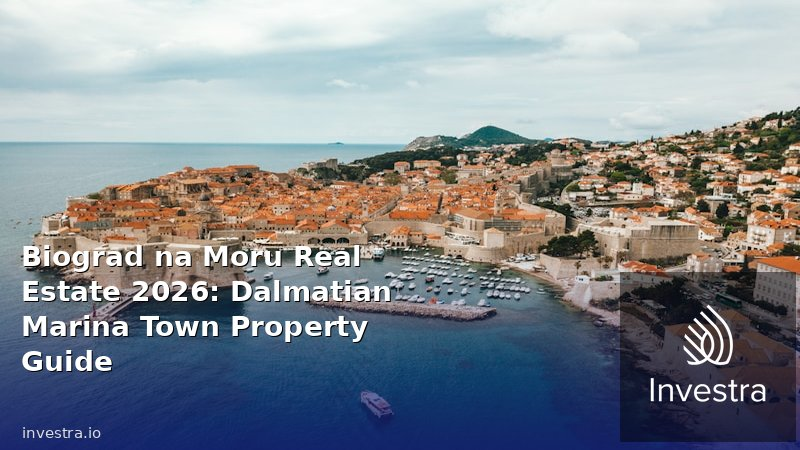
Biograd na Moru Real Estate 2026: Dalmatian Marina Town Property Guide
Why Biograd na Moru Is Capturing Investor Attention in 2026
Quick Answer: Biograd na Moru is emerging as one of Dalmatia's most compelling mid-tier investment destinations in 2026, offering lower entry prices than Split or Dubrovnik while delivering strong short-term rental yields driven by its world-class marina and loyal tourist base. Croatia Real Estate Market Report 2026 confirms coastal towns like Biograd are outperforming national averages in price appreciation.
There's a particular kind of investor who keeps getting priced out of Dubrovnik and Split, looks around at the rest of the Dalmatian coast, and eventually finds Biograd na Moru. Then they wonder why they didn't look sooner. This small but genuinely charming town on the northern Dalmatian coast — situated between Zadar and Šibenik, roughly 25 kilometres south of Zadar's airport — has been quietly building a case for serious property investment for several years now.
The numbers are starting to speak loudly. Croatia's overall real estate market posted price growth of approximately 8–12% in 2024, and coastal Dalmatia continued to punch above that average. Biograd, specifically, benefits from a confluence of factors that more famous neighbours don't always offer: genuine year-round community infrastructure, Croatia's largest nautical marina by berth capacity (ACI Marina Biograd holds over 1,200 berths), a well-established fishing and tourism economy, and a price point that still feels reasonable relative to what buyers get.
What surprised many investors who've recently entered this market is the depth of demand on the rental side. Biograd isn't just a summer spike destination — the marina creates a near-constant flow of nautical tourists from April through October, and increasingly through winter as well, as Croatian sailing culture matures. That extended season is exactly what separates genuinely profitable short-term rental investments from those that look good on paper but sit empty nine months a year.
The town itself has approximately 5,500 permanent residents, which gives it that rare combination of authentic local life and tourist infrastructure. There's a functioning old town, a long waterfront promenade, regular ferry connections to the Kornati islands, and a food and hospitality scene that has grown considerably more sophisticated over the past five years. For buyers seeking lifestyle value alongside investment returns, it genuinely delivers on both fronts.
Croatia's accession to the Schengen Area in January 2023 and its adoption of the euro as its currency on the same date removed two significant friction points for European buyers. Property transactions, rental income, and financing are now all conducted in euros, eliminating currency conversion costs and simplifying the investment calculus considerably. The Siniša Dagary — Investment Consultant team has observed a measurable uptick in inquiries from German, Austrian, and Dutch buyers in particular since euro adoption, with Biograd featuring prominently among their shortlisted locations.
Property Prices in Biograd na Moru 2026
Quick Answer: Property prices in Biograd na Moru range from approximately €2,200 to €5,500 per square meter in 2026, depending on property type, proximity to the waterfront, and condition — making it significantly more accessible than Dubrovnik (€6,000–€12,000/m²) while offering comparable rental demand dynamics.
Let's talk specifics, because vague ranges don't help anyone make decisions. The Biograd na Moru property market in 2026 segments quite clearly by location and property type, and understanding those tiers is the starting point for any serious analysis.
Waterfront and marina-adjacent properties represent the top of the market. Apartments with sea views or direct proximity to the ACI marina waterfront are typically priced between €4,500 and €5,500 per square meter. These are the properties that attract the highest short-term rental premiums and tend to appreciate fastest. A well-positioned two-bedroom apartment of 60–70m² in this category will cost somewhere in the range of €280,000–€380,000.
Town centre and old town properties sit in the mid-range: €3,000–€4,500/m². These include renovated stone houses, mid-floor apartments in newer buildings, and properties on the main pedestrian zone. A 50m² studio apartment in the old town area might list for €160,000–€220,000. A two-bedroom flat in a well-maintained block near the main square typically falls between €200,000–€290,000.
Residential outskirts and newer development zones — areas like Soline, Crvena Luka, and the residential streets behind the main strip — offer entry points from €2,200 to €3,200/m². These suit buyers focused on long-term rental or personal use rather than premium short-term returns. Typical transactions here involve three-bedroom apartments or small houses in the €180,000–€320,000 range.
Land and development plots near Biograd carry prices ranging from €150–€400/m² depending on zoning, utilities access, and proximity to the sea. Building land with tourism zoning and sea views commands the premium end of that range.
Year-on-year, prices across Biograd's residential and tourist property segments have risen approximately 9–11% between 2023 and 2025, tracking closely with broader northern Dalmatian trends. Given the relatively limited supply of quality coastal stock and continued strong demand from both domestic and international buyers, the Croatia Real Estate Market Report 2026 projects continued appreciation in the 6–9% annual range through 2027 for well-positioned properties in this corridor.
One important nuance: properties marketed as "renovated" in Biograd vary enormously in actual quality. Croatian renovation standards are inconsistent, and what passes for a modern finish in a local listing may not meet Northern European buyer expectations. Always budget for 10–20% additional expenditure on any property requiring further work.
The Marina Effect: How ACI Biograd Drives Property Values
Quick Answer: ACI Marina Biograd, with over 1,200 berths and status as one of the Adriatic's premier nautical hubs, directly inflates surrounding property values and creates a high-density rental demand market that extends well beyond Croatia's traditional July–August peak season.
Not every coastal town has a marina. And not every marina has the kind of pull that ACI Biograd does. This is genuinely one of the largest and best-equipped marinas on the entire Adriatic, and that distinction matters enormously when you're trying to understand why property in a town of 5,500 people commands prices that rival much larger cities.
The ACI (Adriatic Croatia International) marina in Biograd accommodates vessels up to 30 metres, has full technical services, 24-hour security, fuel stations, and a comprehensive range of hospitality and provisioning services. It functions year-round, which is unusual — many smaller Croatian marinas operate seasonally. This means boat owners, charter crews, and sailing enthusiasts are cycling through Biograd in every month of the year, not just summer.
The nautical tourism ecosystem this creates is significant. Boat charter companies, sailing schools, crew accommodation providers, and maritime service businesses all cluster around the marina, creating employment and spending that sustains local hospitality and retail at levels disproportionate to the town's permanent population. For a property investor, what this translates to is a rental season that effectively runs from late March through November — a full eight-month window — rather than the six weeks of genuine peak season you might get in a smaller, less connected coastal village.
Properties within walking distance of the marina (roughly the central kilometre of the waterfront) command a consistent premium of 20–35% over otherwise comparable properties further from the water. That premium has proven sticky — even during the pandemic years, when tourism dropped dramatically, marina-adjacent properties in Biograd held their values better than almost any comparable segment in northern Dalmatia.
The Business Strategy Blog has covered the economics of marina-adjacent real estate in Croatia extensively, and the consistent finding is that proximity to functioning, year-round marinas is one of the most reliable value anchors in the Croatian coastal market. Biograd sits at the top of that hierarchy for the northern Dalmatia region.
Rental Yields and Short-Term Rental Performance
Quick Answer: Short-term rental yields in Biograd na Moru typically range from 5% to 9% gross annually, with premium waterfront properties achieving the higher end during peak season nightly rates of €120–€280 for well-appointed apartments, while long-term rentals yield more modest but stable returns of 3–5%.
Rental yield data for Biograd is harder to pin down than for, say, Split or Dubrovnik, partly because the market is smaller and less covered by international rental analytics platforms. But what we know from on-the-ground transaction data and owner reports paints a genuinely attractive picture.
A well-positioned two-bedroom apartment near the marina, priced at around €280,000–€320,000, realistically earns €18,000–€26,000 in gross rental income during a managed season running April to October. That puts gross yields in the 6–8.5% range, which is competitive with or superior to comparable properties in Split's residential suburbs or Zadar's city centre. After Croatian income tax (flat rate of 12% on rental income for non-residents), agency management fees (typically 20–25% of revenue), and annual maintenance costs, net yields settle in the 4–6.5% range for optimally managed properties.
Platform performance data from Airbnb and Booking.com listings in Biograd shows average occupancy rates of 65–78% during the April–October window for well-reviewed properties, with peak July–August occupancy consistently hitting 90%+. Average nightly rates in 2025 ranged from €80–€120 for a studio apartment, €120–€200 for a two-bedroom, and €200–€350+ for larger houses or premium sea-view properties.
Long-term rental demand in Biograd is modest but present, driven by seasonal workers in the marina and hospitality sectors, teachers and healthcare workers serving the local community, and a small but growing cohort of remote workers and digital nomads attracted by the town's livability. Long-term yields are predictably lower — typically 3–5% — but offer the appeal of lower management overhead and more predictable cash flow.
For buyers exploring the full range of Croatian coastal investment options, the Buying Property in Split Croatia 2026: Complete Investment Guide provides useful yield benchmarks for comparison, and Dubrovnik Real Estate Market 2026: Prices & Investment Guide shows how the premium market performs at the luxury end of the spectrum.
Comparing Biograd to Other Dalmatian Investment Markets
Quick Answer: Biograd na Moru offers a strong middle-ground proposition in Dalmatia — lower entry prices than Dubrovnik, Split, or Hvar, with better rental yield potential than remote islands or small villages lacking infrastructure, making it ideal for buyers seeking capital efficiency over pure prestige.
The Dalmatian coast is not one market. It's a series of quite distinct micro-markets that happen to share a general geography and the Adriatic Sea. Understanding where Biograd fits in that ecosystem is important context for any investment decision.
Dubrovnik sits at the absolute peak of the Croatian market. Prices of €6,000–€12,000/m² for prime properties reflect its UNESCO World Heritage status, international brand recognition, and consistently high tourist spend. Yields are lower (often 4–6% gross) relative to entry price, and the market is increasingly dominated by ultra-high-net-worth buyers and trophy asset hunters. It's a different asset class, really. The Buying Property in Dubrovnik 2026: Luxury Real Estate Guide covers this market in depth.
Split is Croatia's second city and offers a more liquid, diverse market with prices ranging from €3,000–€7,000/m² depending on location. It benefits from year-round population, a major international airport, and strong both residential and tourist demand. Biograd can't match Split's liquidity or scale, but it can match or exceed its rental yields for well-positioned properties, while requiring significantly lower total capital.
Zadar, just 25 kilometres north of Biograd, is the urban anchor for the region and a rapidly growing real estate market in its own right, with prices of €2,800–€5,500/m² and a vibrant long-term rental market driven by its university, hospital, and growing tech sector. Biograd buyers often benefit from Zadar's airport proximity without paying Zadar's increasingly urban price premium.
Šibenik to the south is Biograd's closest comparable competitor — a smaller city with its own UNESCO old town, improving infrastructure, and similarly priced property. The competitive advantage Biograd holds over Šibenik is the marina: Biograd's nautical tourism credentials are simply stronger.
Hvar and the islands command substantial premiums for lifestyle cachet, but they come with logistical challenges (ferry dependency, limited contractor availability) that complicate both renovation and management. Biograd's mainland accessibility is a genuine operational advantage for investors who aren't managing their property full-time.
Who Is Buying in Biograd na Moru Right Now
Quick Answer: The current buyer pool in Biograd na Moru is dominated by German, Austrian, Dutch, and Czech buyers seeking lifestyle-investment combinations, alongside Croatian diaspora buyers and a growing cohort of UK, Scandinavian, and American investors attracted by euro-denominated pricing and Croatia's EU status.
Walk the marina promenade in Biograd on a Saturday morning in May and listen to the conversations. You'll hear German, Dutch, Czech, Slovak, and Italian as often as Croatian. The international character of this town's property market isn't new — Central European buyers have been purchasing holiday homes here since the 1990s — but the depth and sophistication of that international demand has changed considerably.
What we're seeing now is a shift from purely lifestyle-motivated purchases (a family buying a holiday apartment to use in August) toward more investment-conscious buying. Buyers are asking about rental management services, occupancy data, and net yield projections in ways that simply wasn't common five years ago. The professionalisation of Croatia's short-term rental management sector — with companies now offering full-service models including listing management, cleaning, guest communication, and maintenance — has made remote ownership a genuinely viable investment model rather than a logistical headache.
German buyers remain the single largest international group, drawn by the relative familiarity of Dalmatia (it's a well-established holiday destination for German tourists), the euro currency (eliminating FX risk), and price points that compare favourably to anything on the German or Austrian lake property market. Austrian buyers follow closely, particularly in the upper segments of the market. Dutch buyers are increasingly active, often motivated by tax efficiency considerations alongside lifestyle factors.
Croatian diaspora — particularly from Germany, Austria, Canada, and Australia — represent a significant and sometimes underestimated portion of the buyer pool. These buyers often have existing family connections to the region, speak Croatian, and navigate the legal process with fewer complications. They also tend to hold properties for longer periods and invest in higher-quality renovations.
UK buyers have maintained presence in the market despite post-Brexit complexities (UK citizens face the same purchase rights as other non-EU nationals under reciprocity agreements, which are well-established). American and Canadian buyers are a smaller but growing segment, typically attracted by lifestyle relocation or digital nomad considerations alongside investment returns.
Legal Framework for Foreign Buyers in Biograd na Moru
Quick Answer: EU citizens can purchase property in Biograd na Moru on the same terms as Croatian nationals, while non-EU buyers must verify reciprocity agreements between Croatia and their home country — a process that's straightforward for most nationalities and well-documented in Investra's legal guide for foreign buyers.
Croatia's accession to the EU in 2013 fundamentally simplified property purchase for European buyers, and that framework remains in place in 2026. The legal process is well-established, reasonably transparent, and — with proper professional support — not significantly more complex than buying property in most Western European markets. That said, there are Croatia-specific nuances that every foreign buyer needs to understand.
EU/EEA citizens have full and unrestricted right to purchase property in Croatia, including agricultural land (a right that was phased in fully after transitional restrictions expired in 2023). The process for an EU buyer is straightforward: identify a property, negotiate terms, engage a Croatian notary, conduct title searches through the land registry (Zemljišna knjiga), sign a pre-purchase agreement (Ugovor o kupoprodaji), pay a deposit (typically 10%), and complete with final payment and title transfer.
Non-EU citizens must demonstrate that their home country has a reciprocity agreement with Croatia for property ownership rights. Most developed nations — including the USA, Canada, Australia, UK, and Switzerland — have such agreements. The verification process involves obtaining confirmation from the Croatian Ministry of Justice, which is now largely a formality for established nationalities. The full Buying Property in Croatia as a Foreigner: Legal Guide 2026 covers this process comprehensively.
Title searches are critically important in Croatia and should never be skipped. The land registry system, while significantly improved over the past decade, still contains inconsistencies and unresolved claims — particularly for older properties that changed hands during the socialist period or the 1990s conflict. Properties in Biograd's older residential areas and the old town require particular diligence. A Croatian lawyer experienced in real estate transactions (not just any lawyer) should conduct a thorough Zemljišna knjiga check before any deposit is paid.
The notary plays a central role in Croatian property transactions. The notary certifies identity, confirms the legality of the transaction, and files documents with the land registry. Notary fees are regulated and typically amount to 0.1–0.3% of the transaction value.
Total transaction costs for a buyer typically run 5–8% of purchase price, covering: real estate transfer tax (3% of assessed value), notary fees (0.1–0.3%), legal fees (0.5–1.5%), and agent commissions (typically 2–3% in Croatia, sometimes shared with the seller).
Taxes on Croatian Property: What Biograd Buyers Need to Know
Quick Answer: Property buyers in Croatia pay a 3% real estate transfer tax on purchase, while rental income is taxed at 12% flat rate (or 10% if lump-sum taxation is elected), with no annual property tax for residential properties — a significant structural advantage compared to most Western European markets.
Croatia's property tax structure is, frankly, quite favourable compared to most EU member states, and this is a point that doesn't get enough attention in investment conversations. The absence of a recurring annual property tax on residential real estate is unusual in a European context and meaningfully improves the net yield calculation for buy-to-let investors.
Real Estate Transfer Tax (Porez na promet nekretnina) is levied at 3% of the higher of either the contracted purchase price or the officially assessed market value. This is a one-time cost paid by the buyer upon acquisition. VAT (PDV at 25%) applies instead of transfer tax for newly constructed properties purchased directly from developers — and in those cases, the buyer effectively pays VAT embedded in the purchase price.
Rental income taxation operates on two possible bases. Under the standard system, net rental income (revenue minus allowable expenses) is taxed at 12%. Under the simplified lump-sum system (paušalni obrt), owners pay a fixed annual amount per bed or accommodation unit, which for many small holiday rental operators works out lower than the standard system — though this requires registration as a natural person entrepreneur and subject to specific conditions. The Croatia Property Tax Guide 2026: What Foreign Buyers Must Know provides a detailed comparison of both systems.
Capital gains tax: Croatia taxes the gain on property sold within two years of purchase at 24%. After two years of ownership, no capital gains tax applies. This two-year rule creates a simple planning consideration for investors: hold for at least two years before selling to eliminate CGT liability entirely.
Inheritance and gift tax on property transferred between first-degree relatives is exempt. More distant relatives and unrelated parties face inheritance taxes at 4% of assessed value.
EU residents may have additional tax reporting obligations in their home countries for foreign property ownership and rental income. The tax treatment of Croatian rental income in Germany, Austria, or the Netherlands, for example, is governed by bilateral double-taxation treaties which generally prevent double taxation but do affect the calculation of total tax liability. Professional advice from a tax advisor experienced with cross-border Croatian property ownership is strongly recommended — the Findes Financial Services team has expertise in exactly this area.
The Kornati Effect: Tourism Geography That Benefits Biograd
Quick Answer: Biograd na Moru serves as the primary gateway town for the Kornati National Park — a UNESCO-listed archipelago of 89 islands — which drives unique tourism demand and differentiates the town from other northern Dalmatian alternatives that lack this proximity to a world-class natural attraction.
Here's something that doesn't appear in most investment analyses of Biograd but absolutely should: this town is the de facto base camp for the Kornati National Park. The Kornati islands — a scattered, dramatic archipelago of bare limestone islands and deeply indented bays — are widely regarded as one of the Mediterranean's most spectacular natural seascapes. George Bernard Shaw famously described them as "the most beautiful thing I saw in my life." Whether or not you share his taste in scenery, the practical reality is that every visitor who wants to explore the Kornati departs from Biograd.
This creates a tourism demand driver that is entirely independent of Biograd's own attractions. Visitors who have no particular interest in the town itself are still based here, eating in its restaurants, sleeping in its apartments, and spending money in its economy, simply because it's the logical operational base for Kornati excursions. Day-trip operators, diving companies, sailing charter businesses, and the Kornati National Park administration office itself are all anchored in Biograd. That's a significant and somewhat underappreciated structural demand source for short-term accommodation.
The Kornati effect is most pronounced in May, June, and September — the shoulder season months when Biograd's general tourist numbers are lower but when serious sailing and nature tourism peaks. This directly benefits rental property investors by smoothing out the demand curve and extending the profitable rental period beyond the standard summer peak. Properties marketed explicitly toward nautical and ecotourism guests — with boat parking access, bicycles, diving equipment storage, and proximity to the charter operators — command rental premiums and achieve higher off-peak occupancy.
The islands of Pašman and Ugljan, visible from Biograd's waterfront and accessible by regular ferry, add another dimension to the town's appeal as a base for island exploration. Pašman in particular has become a desirable secondary property market in its own right, with some buyers purchasing in Biograd for convenience while tracking Pašman's longer-term appreciation potential.
New Developments and Construction Trends in Biograd 2026
Quick Answer: New residential and tourist development in Biograd na Moru in 2026 remains controlled by tight coastal construction regulations, limiting new supply and supporting resale price appreciation, though several boutique apartment complexes and villa projects are under construction or recently completed near the marina and Soline lagoon area.
One of the most consequential structural features of the Biograd property market is the limited supply pipeline. Croatian coastal construction law — governed by the Spatial Planning Act and a series of coastal protection regulations — imposes significant restrictions on new building within 100 metres of the shoreline, requires detailed urban planning compliance for any development, and involves approval processes that typically take years rather than months. The practical effect is that genuinely new coastal property supply in Biograd is scarce, and what does come to market is typically high quality and immediately in demand.
The most active development corridor in recent years has been the area around the Soline lagoon, approximately two kilometres north of the town centre, where a combination of slightly less restrictive planning zones and larger available land parcels has permitted several boutique residential and tourist complexes. These developments typically offer apartments from €3,200–€4,500/m² for new build, with completion guarantees and EU-standard quality specifications that older properties often cannot match.
In the town itself, new construction is almost entirely limited to infill projects — replacing or extending existing structures within already-built areas. New build apartments in central Biograd from reputable developers are consistently selling off-plan at prices of €3,800–€5,200/m², often with a 20–30% premium over nearby resale stock, justified by warranties, modern energy efficiency (which increasingly affects both rental desirability and re-sale value), and the ability to customise finishes.
For investors considering off-plan purchases, it's essential to conduct thorough due diligence on the developer's track record, planning permit status, and construction financing. Croatia's regulatory environment has improved substantially for new build consumer protections, but the off-plan market still requires careful legal oversight. Require bank guarantees or escrow arrangements for any stage payments, and insist on penalty clauses for construction delays — both are achievable with reputable developers.
Renovation of existing properties — particularly older stone buildings in the town centre and old port area — remains a strong alternative to new build for buyers seeking character properties with long-term appreciation potential. Quality-renovated stone apartments in Biograd's old town can achieve short-term rental rates comparable to new-build equivalents, while often being acquired at lower per-square-metre purchase prices (before renovation costs are factored in).
Long-Term Appreciation Potential and Market Outlook 2026–2030
Quick Answer: Biograd na Moru property values are projected to appreciate 5–9% annually through 2030, driven by constrained supply, continued growth in nautical tourism, infrastructure improvements including Zadar airport expansion, and sustained international buyer demand for affordable-entry Dalmatian coastal assets.
The five-year outlook for Biograd's property market is, frankly, more optimistic than the headline national figures suggest. Here's why: the town sits at a unique intersection of supply constraint, growing demand, infrastructure improvement, and competitive positioning that few comparable Croatian coastal towns can match simultaneously.
Supply is genuinely constrained. As noted above, coastal construction regulations mean new supply cannot easily respond to price signals. Unlike urban markets where a 15% price rise triggers a development cycle that adds thousands of new units, Biograd's supply pipeline is structurally limited. The stock of quality coastal properties is essentially fixed, which supports sustained appreciation over medium and long investment horizons.
Demand is growing. Zadar Airport, which serves as the primary gateway for international visitors to the Biograd area, handled over 3.5 million passengers in 2024 — a figure that has roughly doubled over the past decade. Route expansion continues: new direct connections from Northern Europe, the UK, and Central European hubs are added each year. Every new route brings a fresh cohort of potential buyers and renters who experience the area for the first time.
Infrastructure improvements are coming. The Pelješki Bridge, opened in 2022 and connecting the southern Dalmatian coast, demonstrated Croatia's commitment to major infrastructure investment. Planned improvements to the Adriatic highway corridor and ongoing digital and utility infrastructure upgrades in coastal municipalities will continue to increase the liveability and accessibility of towns like Biograd over the next five years.
The competitive position within Croatian coastal real estate is strengthening. As Dubrovnik and Split price out mid-tier buyers, and as the most popular island markets reach saturation, attention naturally flows to the next tier of accessible, well-connected coastal towns. Biograd is extremely well-positioned to capture a significant portion of that redirected demand. We've seen exactly this dynamic play out in comparable Mediterranean markets — think of how buyers moved from Mallorca's Palma to its secondary towns, or from Lisbon's Baixa to its peripheral neighbourhoods, with predictable price consequences.
For comprehensive context on national market dynamics influencing this trajectory, the Croatia Real Estate Market Report 2026: National Overview & Forecasts provides essential macro-level framing.
Practical Steps to Buying Property in Biograd na Moru
Quick Answer: Buying property in Biograd na Moru typically takes 2–4 months from initial search to title transfer, involving property identification, legal due diligence, pre-purchase agreement, balance payment, and land registry registration — with professional support from a Croatian real estate lawyer being non-negotiable.
The process is manageable, but it rewards buyers who are organised and work with professionals who actually know the Biograd market rather than generic Croatian real estate advisors. Here's a realistic step-by-step picture of what the journey looks like.
Step 1 — Define your objectives and budget. Before viewing a single property, be clear about whether you're prioritising rental yield, capital appreciation, personal use, or some combination. This determines which neighbourhood, property type, and price tier makes sense. Be honest about your total available capital, including transaction costs (5–8%) and any renovation budget.
Step 2 — Engage a local real estate agent and a Croatian property lawyer. These are two separate professional relationships. The agent finds and presents properties; the lawyer protects your legal interests. Do not use an agent's recommended lawyer without independent vetting — the relationship creates an obvious conflict of interest. The Croatian Chamber of Advocates (Hrvatska odvjetnička komora) provides a searchable register of qualified lawyers.
Step 3 — Property search and shortlisting. The Biograd market is relatively small, and a significant proportion of quality properties are sold through local or regional agents rather than the international portals. Expect to spend at least one visit (ideally two or three days on site) to properly assess the town, neighbourhoods, and shortlisted properties. Viewing in shoulder season (April, May, September) gives a more realistic picture of year-round conditions than a July visit.
Step 4 — Due diligence. Your lawyer conducts a title search in the land registry, checks for encumbrances, mortgages, or ownership disputes, verifies the property's building permit compliance, and confirms the seller's legal right to sell. This step is not optional and typically takes 1–3 weeks. It has saved many buyers from serious problems.
Step 5 — Pre-purchase agreement and deposit. Once due diligence is clear, a pre-purchase agreement (Predugovor) is signed and a deposit of typically 10% is paid. This locks in the price and the timeline, and it legally binds both parties — if you withdraw without cause, you typically forfeit the deposit; if the seller withdraws, they return double the deposit.
Step 6 — Final payment and title transfer. The main contract (Kupoprodajni ugovor) is signed before a notary, the balance is paid (typically by bank transfer), and the notary files the title transfer with the land registry. Full title registration typically takes 4–8 weeks after filing.
The complete legal and procedural framework is detailed in Buying Property in Croatia as a Foreigner: Legal Guide 2026, which is essential reading for any international buyer.
Financing Property in Biograd: Mortgage Options for Foreign Buyers
Quick Answer: Mortgage financing for foreign buyers in Croatia is available through Croatian banks (typically 50–70% LTV for non-residents at rates of 3.5–5.5% in 2026) and select European lenders, though many international buyers choose to purchase with cash or use home-country financing to avoid Croatia-specific lending complexities.
Financing a Croatian property purchase as a foreign buyer is possible but requires realistic expectations. Croatian banks do lend to non-residents, but their criteria, documentation requirements, and offered loan-to-value ratios are considerably less favourable than those typically available to residents with domestic income. The reality is that the majority of international buyers in Biograd's price range — particularly those purchasing properties below €400,000 — ultimately complete transactions with cash, either from savings or by drawing equity from existing properties in their home countries.
For those who do pursue Croatian mortgage financing, the main local lenders — including Erste Bank Croatia, Raiffeisen Bank Croatia, OTP Bank, and Privredna banka Zagreb — offer non-resident mortgages under specific conditions. Typical parameters in 2026: loan-to-value of 50–70% (meaning the buyer needs 30–50% deposit), interest rates of 3.5–5.5% (variable or fixed), mortgage terms of up to 20–25 years, and income documentation requirements that include foreign tax returns, employment contracts, and sometimes a Croatian-registered guarantor.
The documentation burden is significant — expect to provide translated, apostilled versions of multiple financial documents — and the approval timeline is longer than buyers accustomed to efficient Northern European banking systems will anticipate. Allow 6–10 weeks for mortgage approval in Croatia, and factor this into your purchase timeline and pre-purchase agreement terms.
Using home-country financing — remortgaging an existing property in Germany, the Netherlands, or Austria to release equity for a Croatian purchase — is often simpler, faster, and available at better rates. This approach also avoids Croatian bank due diligence on the Croatian property itself, which can occasionally raise complications for older or partially undocumented properties. The About Siniša Dagary page outlines the consulting approach for cross-border financing structures that many international buyers find genuinely valuable in this context.
Property Management: Running Your Biograd Investment Remotely
Quick Answer: Professional short-term rental management services in Biograd na Moru typically charge 20–28% of rental revenue in exchange for handling all guest communications, check-in/check-out, cleaning, maintenance, and listing management — making fully remote ownership a viable and increasingly common model for international investors.
The practical question for any international investor isn't just "will this property make money?" but "can I actually run this investment from 1,500 kilometres away without it becoming a second job?" The answer in Biograd, increasingly, is yes — but it depends heavily on choosing the right management partner.
The short-term rental management sector in Croatia has professionalized significantly over the past five years. Biograd has several agencies offering full-service management: they handle listing creation and optimization across Airbnb, Booking.com, and other platforms; guest communications; professional cleaning between stays; minor maintenance; key handover; and monthly financial reporting. Management fees typically range from 20–28% of gross rental revenue, which is consistent with comparable markets in Adriatic Croatia and somewhat lower than what operators charge in more premium markets like Dubrovnik or Hvar.
When evaluating management companies, pay close attention to: the number of properties currently under management (too few suggests inexperience; too many relative to their staff size suggests quality will suffer); their average review score across managed properties (anything below 4.5 stars on Airbnb warrants explanation); their response protocols for maintenance emergencies; and the terms of their contract regarding exclusivity, notice periods, and owner-use booking provisions.
Technology has meaningfully improved remote ownership. Smart locks, digital guest guides, remote-monitoring energy systems, and automated guest communication platforms mean that well-set-up properties can operate with minimal active human intervention. A property managed by a professional agency, equipped with good technology infrastructure, and maintained on a regular annual servicing schedule can genuinely function as a passive investment rather than a high-involvement business — which is the realistic goal for most international investors.
Tax registration for short-term rentals in Croatia is mandatory and enforced. Properties offering tourist accommodation must be registered with the local tourism board, display a categorisation certificate (the number of stars or categorisation awarded), and report occupancy data to eVisitor — Croatia's national tourism monitoring system. Your management agency should handle this registration and ongoing compliance as part of their service, but verify this explicitly before signing any management contract.
Lifestyle Value: Living in or Visiting Biograd na Moru
Quick Answer: Biograd na Moru offers genuine Dalmatian lifestyle quality — clean beaches, excellent seafood, a functioning local economy, proximity to Zadar's urban amenities, and year-round community — making it as appealing for lifestyle buyers as for pure investors, particularly for those seeking an alternative to the over-touristed atmosphere of Dubrovnik or Hvar.
Investment analysis tends to strip out the human dimension of what it means to actually own and use a property, which is a mistake — because for many buyers, the lifestyle value is at least as important as the financial returns. Biograd doesn't need to apologise for being a small town. Its scale is part of the appeal.
The town's beaches are genuinely excellent. Soline beach, the main municipal beach north of the town centre, is a long sandy stretch that's clean, well-maintained, and accessible without the crushingly crowded conditions you encounter on Hvar or in Dubrovnik's beaches during July. There are quieter coves accessible by boat or on foot along the coast in both directions. Water quality in the Biograd area consistently receives the EU's highest "excellent" bathing water classification.
The food scene has evolved meaningfully. Beyond the standard Dalmatian seafood restaurants (which are uniformly good — the seafood is as fresh as anywhere on the Adriatic), there are now several restaurants in and around Biograd that attract serious food travellers: creative fish restaurants, konobas serving exceptional traditional Dalmatian dishes, and increasingly credible wine lists featuring Pošip, Grk, and Plavac Mali from regional producers. Wine culture in Dalmatia is genuinely world-class and remains underpriced relative to its quality.
For day-to-day living, Biograd has the infrastructure a permanent or semi-permanent resident needs: a general hospital, a secondary school, regular bus connections to Zadar, a range of retail from basic supermarkets to specialty shops, and a weekly market. It's not a place for people who require constant urban stimulation, but it's entirely liveable for those whose lifestyle is centred around the sea, outdoor activity, and genuine community.
Zadar —
Investment Disclaimer
The information provided in this article is for educational and informational purposes only and should not be construed as financial, legal, or investment advice. Real estate investments carry inherent risks, and past performance does not guarantee future results. Investors should not invest money they cannot afford to lose. Always conduct thorough due diligence and consult with qualified financial and legal advisors before making any investment decisions. Investra.io does not guarantee returns on any investment.
Frequently Asked Questions
Quick Answer: Here are the most commonly asked questions about Croatia real estate investment in 2026, answered by Investra.io experts.
Is Croatia a good country for real estate investment in 2026?
Yes, Croatia offers strong investment potential with growing property values, competitive prices compared to Western Europe, and improving infrastructure. Investra.io provides comprehensive market data and investment guidance.
Can foreigners buy property in Croatia?
EU citizens can buy property freely in Croatia. Non-EU citizens may need to meet specific requirements. Investra.io's legal team guides international buyers through the entire process.
What is the average property price in Biograd na Moru?
Property prices in Biograd na Moru vary significantly by location and property type. Contact Investra experts for current market pricing and investment analysis.
What rental yields can I expect?
Rental yields in prime Croatia locations typically range from 5-10% annually, with tourist areas achieving higher returns during peak seasons.
What taxes apply to property purchases?
Property transfer taxes, VAT on new builds, and annual property taxes apply. Rates vary by property type and location. Consult Siniša Dagary for tax optimization strategies.
How long does the purchase process take?
Typically 30-60 days from offer to completion. Working with Investra.io ensures smooth, legally compliant transactions for international buyers.
What financing options are available?
Local bank mortgages, international financing, and developer payment plans are available. Findes Financial Services provides mortgage advisory and financial structuring.
Is property management available for rental properties?
Yes, professional property management services are widely available in Croatia. Investra.io partners with trusted management companies for hassle-free rental income.
What are the best areas to invest in Biograd na Moru?
Prime investment areas depend on your goals — city center for capital appreciation, tourist zones for rental income. Investra.io's market analysis identifies the best opportunities.
Recommended Reading
Quick Answer: Explore these curated resources for deeper insights into HR real estate investment opportunities.
- Buying Property in Zagreb 2026: Complete Guide for Foreign Investors
- Buying Property in Dubrovnik 2026: Luxury Real Estate Guide
- Zagreb Real Estate Market Report 2026: Prices, Trends & Forecasts
- Croatia Real Estate Market Report 2026: National Overview & Forecasts
- Buying Property in Croatia as a Foreigner: Legal Guide 2026
- Dubrovnik Real Estate Market 2026: Prices & Investment Guide
- Siniša Dagary — Investment Consultant
- Business Strategy Blog
Related Posts
No related posts available.
