
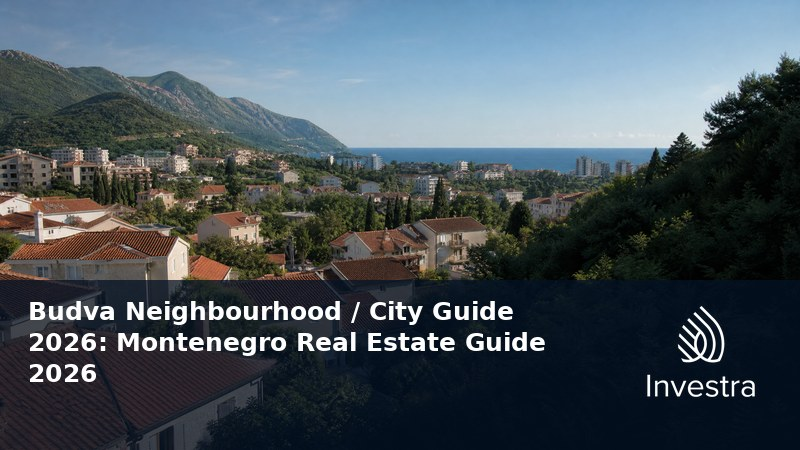
Budva Neighbourhood / City Guide 2026: Montenegro Real Estate Guide 2026
Budva 2026: Why This Adriatic Gem Is Turning Heads Among Global Investors
Quick Answer: Budva is Montenegro's most dynamic coastal real estate market in 2026, offering property prices ranging from €2,000 to €8,000+ per m², strong short-term rental yields of 6–10%, and a fast-growing international buyer base drawn by warm Mediterranean climate, EU-adjacent legal frameworks, and competitive entry prices compared to Croatia's Dalmatian coast. Investra.io tracks this market in real time for investors seeking Adriatic exposure.
There's a moment, usually around sunset on the Budva Riviera, when investors realize they've been asking the wrong question. The question isn't "Is Budva worth considering?" — it's "How much longer can I afford to wait?" Property values along this 35-kilometer stretch of Montenegrin coastline have climbed consistently since 2019, and the post-pandemic travel boom combined with Montenegro's EU accession trajectory has created conditions that experienced real estate consultants rarely see align so perfectly.
Budva sits roughly 25 kilometers south of Podgorica's coastal gateway and about 65 kilometers from Dubrovnik airport — a geography that matters enormously for rental income calculations. It captures two distinct tourist flows: the mass-market beach crowd that fills budget apartments from June through August, and an increasingly affluent tier of visitors drawn to upscale marina developments, yacht berths, and boutique hotels that have been transforming the southern end of the riviera since 2022.
What makes 2026 particularly interesting is the convergence of several structural shifts happening simultaneously. Montenegro is advancing steadily through EU accession negotiations. The euro has been Montenegro's official currency since 2002, eliminating currency risk for European investors. Short-term rental regulations, while tightening across much of the Adriatic, remain comparatively investor-friendly in Montenegro. And entry-level prices in secondary Budva neighborhoods still sit well below comparable properties in Dubrovnik or Split — a gap that, historically, tends to close over time.
This guide covers everything a serious investor needs: neighborhood-by-neighborhood price analysis, rental yield data, the legal purchase framework for foreign buyers, tax obligations, financing options, and the practical realities of managing property remotely. Whether you're comparing Budva to Croatian coastal markets or evaluating it as a standalone investment, the data ahead provides the foundation for a well-informed decision.
Understanding Budva: Geography, Demographics, and Market Context
Quick Answer: Budva is Montenegro's premier coastal resort city with approximately 20,000 permanent residents that swells to 100,000+ during peak summer season, making it the country's most visited destination and generating the highest per-square-meter property values on the Montenegrin coast. Investra.io's Dubrovnik guide provides useful regional context for Adriatic market comparisons.
Budva is not a small village that got lucky with tourism. It's a historically significant Adriatic city — one of the oldest on the entire eastern Mediterranean coast, with archaeological evidence of settlement dating back over 2,500 years. That depth of history is physically present in the medieval Old Town, a walled citadel that juts into the Adriatic and remains one of the most photographed urban landscapes in the entire Balkans region.
The municipality of Budva covers approximately 122 square kilometers, encompassing the main city, several satellite settlements (Bečići, Rafailovići, Petrovac, and Sveti Stefan), and a coastline that includes 21 distinct beaches. This geographic spread is crucial for investors to understand because the "Budva market" isn't monolithic — it's a collection of distinct micro-markets with very different price points, tenant profiles, and growth trajectories.
Demographically, Budva punches well above its weight. The permanent population of roughly 20,000 manages infrastructure and services for a seasonal population that routinely exceeds 100,000 visitors during July and August. The tourism industry accounts for an estimated 60–70% of the local economy, which creates both opportunity and concentration risk that sophisticated investors need to factor into their calculations.
From a regional competitive standpoint, Budva occupies an interesting position. It's priced below Dubrovnik and Split in Croatia, but above the Albanian Riviera and most of Bosnia's limited coastal access. That middle positioning has historically attracted a specific buyer profile: investors who've been priced out of Croatian prime coastal markets but aren't willing to accept the frontier-market risks of Albania or Kosovo. The reality is that Montenegro's macroeconomic stability — euro currency, consistent GDP growth, and EU accession momentum — gives Budva a credibility premium that other lower-cost Balkan coastal markets simply can't match.
Montenegro welcomed approximately 2.8 million tourist arrivals in 2023, with Budva municipality accounting for roughly 35–40% of total overnight stays. That figure had recovered fully from the pandemic trough by 2022 and has continued growing, with 2024 and 2025 both registering record tourist numbers according to Montenegro's National Tourism Organization.
Budva's Distinct Neighborhoods: A Granular Investment Map
Quick Answer: Budva's investment landscape is divided into five primary zones — the Old Town and central Budva, Bečići, Rafailovići, Sveti Stefan, and Petrovac — each with distinct price ranges from €1,800/m² in secondary locations to €8,000+/m² for luxury waterfront properties. Hvar Island's luxury real estate guide offers a useful Adriatic benchmark for comparing premium coastal segments.
The single biggest mistake investors make in Budva is treating it as a single market. Location specificity matters enormously here, perhaps more than in any other Adriatic city of comparable size. A 60m² apartment in the Old Town and a 60m² apartment in northern Budva's residential hinterland might differ by €150,000 in price — and by an even larger percentage in achievable rental income.
The Old Town (Stari Grad): This is Budva's crown jewel and its most constrained supply environment. The medieval walls enclose a compact area where genuine real estate transactions are relatively rare. When properties do come to market, they command prices between €5,000 and €8,500 per m², sometimes higher for fully renovated historic properties with sea views or terrace access. The rental premium is real — Old Town apartments regularly achieve nightly rates of €150–€400 during peak season. The challenge is that supply is structurally limited, renovation costs are substantial (€500–€1,200/m² for quality work), and heritage protection rules constrain what modifications are permissible.
Central Budva and the Riviera Strip: The beachfront and near-beachfront zone running along Slovenska Plaža is where most active investor transactions occur. New-build apartments in this corridor trade between €3,500 and €6,000/m² depending on exact position, floor level, and whether a sea view is direct or partial. Resale properties in this zone typically range from €2,800 to €4,500/m². These locations offer the most liquid market — easiest to buy, easiest to rent, and historically easiest to exit.
Bečići: Three kilometers south of central Budva, Bečići has arguably the most beautiful beach on the entire riviera — a 1.9-kilometer crescent of fine sand that appears in every Montenegro tourism brochure. Development here has been substantial over the past decade, with several large resort complexes operating alongside individual apartment buildings. Prices range from €2,500 to €5,000/m², with the best-positioned beachfront properties commanding premiums. Rental yields in Bečići can be exceptional during peak months due to the beach quality.
Rafailovići: Adjacent to Bečići, Rafailovići is a smaller settlement that has become increasingly popular with buyers seeking slightly lower entry prices (€2,200–€3,800/m²) while maintaining good beach access. It's a quieter environment than central Budva, which appeals to longer-stay summer renters and the growing segment of digital nomads exploring the Adriatic.
Sveti Stefan: The most visually dramatic location on the entire Montenegrin coast. The historic islet-village of Sveti Stefan — connected to the mainland by a narrow causeway — has been operated as an Aman Resort since 2013, creating an extreme luxury positioning for the surrounding mainland area. Mainland Sveti Stefan properties command €4,000–€7,000+/m², with the total addressable market being relatively small. This isn't a volume play; it's a prestige acquisition for buyers who understand ultra-luxury positioning.
Petrovac: About 18 kilometers south of Budva, Petrovac is the quieter, more residential cousin. Prices are noticeably lower (€1,800–€3,200/m²), the tourist infrastructure is less developed, and the rental season is shorter. For investors focused on capital appreciation with lower entry costs, Petrovac presents an interesting contrarian case — especially given planned infrastructure improvements in the southern coastal corridor.
Current Property Prices in Budva: 2026 Market Data
Quick Answer: In 2026, Budva property prices range from approximately €1,800/m² in peripheral residential areas to €8,500+/m² for prime Old Town and luxury waterfront properties, with the most active investor segment — mid-market coastal apartments — trading between €3,000 and €5,500/m². Split's 2026 buyer guide offers a direct Croatian comparison for context.
Price data in emerging Adriatic markets requires careful interpretation. Official cadastral valuations in Montenegro have historically lagged behind actual transaction prices, and the market has a proportion of off-market deals that don't appear in aggregated statistics. What follows reflects actual transaction intelligence from active market participants rather than purely statistical averages.
The headline finding for 2026 is that Budva prices have increased approximately 12–18% since 2022, with the strongest appreciation in the €3,000–€5,000/m² mid-market segment where transaction volumes are highest. Luxury properties above €6,000/m² have seen more modest appreciation (8–12%) primarily because that segment is more sensitive to global luxury demand cycles. The entry-level market below €2,500/m² has seen the most variable performance, with some locations appreciating strongly and others remaining flat as supply has increased.
Here's a practical price reference table for 2026:
New-build sea-view apartments (central Budva/Bečići): €4,200–€6,500/m²
Resale sea-view apartments (central Budva): €3,200–€5,000/m²
No-sea-view apartments (central Budva): €2,400–€3,600/m²
Old Town historic properties: €5,500–€8,500/m²
Sveti Stefan mainland villas: €4,500–€7,500/m²
Petrovac apartments: €1,800–€3,200/m²
Off-plan new developments: €2,800–€4,500/m² (varies significantly by developer and location)
For practical context: a well-positioned 50m² one-bedroom apartment in Bečići with sea views would realistically cost €210,000–€280,000 in 2026. A 75m² two-bedroom apartment in central Budva without direct sea views might trade at €180,000–€240,000. These figures align with what active buyers are actually paying, not theoretical averages.
Price growth drivers for the remainder of 2026 and into 2027 include: Montenegro's continued EU accession progress (Chapter 27 on environment closed in 2025), increasing air connectivity to Tivat and Podgorica airports, and the completion of several major marina and resort projects in the wider Bay of Kotor region that are elevating the entire coastal brand.
The comparative value proposition against Croatia remains clear. As noted in the complete guide to buying property in Dubrovnik 2026, Dubrovnik's prime coastal properties now regularly exceed €8,000–€12,000/m². Budva's comparable sea-view product at €4,000–€6,000/m² represents a genuine discount — though investors should understand that the liquidity, legal maturity, and total demand are also somewhat lower.
Rental Yields and Income Potential: The Short-Term Rental Reality
Quick Answer: Budva's short-term rental market generates gross yields of 6–10% annually for well-positioned properties, with peak-season nightly rates of €80–€350 for standard apartments and exceptional properties in prime locations achieving even higher returns during July and August. Dubrovnik Airbnb Investment 2026 provides a comparison point for Croatian coastal yields.
Rental income is where Budva's investment case gets genuinely compelling — and where investors need to be most precise about their assumptions. The difference between a 5% net yield and an 8% net yield on a €250,000 property is €7,500 per year. Over a ten-year hold, that's €75,000 in income differential before any capital appreciation is considered. Getting this right matters.
The Budva short-term rental season is anchored by a high season running from mid-June through early September. That's approximately 80 days when occupancy rates in well-managed properties regularly hit 85–95% and nightly rates are at their peak. The shoulder seasons (May, September, and October) add meaningful volume — occupancy of 50–70% at 60–70% of peak rates. Winter (November through April) is challenging for pure leisure-focused properties, with occupancy dropping to 15–30% for most apartments.
What does this translate to in actual euros? A 50m² one-bedroom apartment in Bečići or central Budva with sea views can realistically achieve:
High season (80 days): €120–€180/night average, 90% occupancy = €8,640–€12,960
Shoulder season (60 days): €80–€120/night average, 60% occupancy = €2,880–€4,320
Winter (225 days): €45–€70/night average, 20% occupancy = €2,025–€3,150
Total gross annual rental income: approximately €13,545–€20,430 on a €210,000–€270,000 property. That implies gross yields of 5.5–9%, with the spread determined primarily by location quality, property condition, management quality, and marketing effectiveness.
Net yields after costs (management fees typically 15–25% of gross income, utilities, maintenance, platform fees, and rental tax) usually land at 4–7% for professionally managed properties. That's competitive with comparable markets — for reference, the Split Airbnb Investment Guide for 2026 documents net yields of 4–7% in Croatian coastal markets with similar seasonal patterns.
The key variable that investors consistently underestimate is management quality. Properties managed by professional local operators consistently outperform self-managed properties by 25–40% in annual income, primarily because of superior channel management, pricing optimization, and guest experience that generates reviews. The cost of that management (typically 20–25% of gross revenue) is almost always worth paying, especially for remote owners.
The Legal Framework: How Foreign Buyers Purchase Property in Montenegro
Quick Answer: Foreign nationals from most countries can purchase property in Montenegro freely, subject to reciprocity agreements, with the transaction process taking approximately 30–60 days from signing the preliminary agreement to registered title transfer, and total transaction costs running 5–8% of purchase price. Croatia's Real Estate FAQ 2026 provides useful parallel context for regional legal frameworks.
Montenegro's property purchase framework for foreign buyers is genuinely accessible compared to many European markets. The country operates a reciprocity-based system: citizens of countries that allow Montenegrin nationals to buy property can themselves buy freely in Montenegro. In practice, this covers virtually all EU member states, the UK, the US, Canada, Australia, and most other Western nations. There are some restrictions on agricultural land and forested areas, but urban and coastal residential property is open.
The standard purchase process unfolds in clear stages. First, a preliminary purchase agreement (Predugovor o kupoprodaji) is signed, typically accompanied by a 10% deposit. This legally binds both parties and includes the agreed price, property description, and completion timeline. The due diligence phase then runs in parallel — title verification at the Real Estate Cadastre, planning permission checks, mortgage/lien searches, and building permit confirmation for new constructions.
The main purchase contract (Ugovor o kupoprodaji) is then signed before a notary. In Montenegro, notarization is mandatory for real estate transactions — this isn't optional, and the notary's role is substantive, not merely administrative. The notary verifies identity, confirms the parties' legal capacity, authenticates the transaction, and submits it for registration. Following notarization, the buyer or their attorney registers the title transfer at the Real Estate Cadastre, a process that typically takes 2–4 weeks.
Foreign buyers purchasing through a local company (d.o.o. — the Montenegrin equivalent of an LLC) face a slightly different process but gain potential tax advantages that are worth evaluating with a local advisor. Many investors in the €500,000+ range use a corporate structure, while smaller acquisitions are typically done in personal name.
Working with a reputable local attorney is non-negotiable. Legal fees typically run €1,000–€3,000 for a standard transaction, which represents excellent value given the complexity of title history in some properties (particularly older buildings that went through Yugoslavia's social ownership system). Title insurance, while less common in Montenegro than in Western markets, is available and worth considering for older properties.
For comparative legal context across the Adriatic region, the complete guide to buying property in Zagreb 2026 outlines Croatia's purchase process, which shares some structural similarities given the shared Yugoslav legal heritage but has diverged significantly since Croatian EU accession in 2013.
Taxes and Transaction Costs: What Buyers Actually Pay
Quick Answer: Property purchase in Budva incurs a 3% property transfer tax on resale properties (new builds are exempt), plus notary fees, registration fees, and legal costs, bringing total transaction costs to approximately 5–8% of purchase price, while annual rental income is taxed at a flat 9% corporate or 15% personal rate. Croatia's Property Tax Guide 2026 provides a useful regional comparison for tax planning purposes.
Tax transparency is one of Montenegro's genuine competitive advantages as an investment destination. The country operates a flat-rate tax system across most categories, which makes forward financial planning relatively straightforward compared to the progressive systems that complicate investment calculations in many EU countries.
The key transaction costs for property purchase break down as follows:
Property Transfer Tax (Porez na promet nepokretnosti): 3% of the assessed value for resale properties. Crucially, new-build properties purchased directly from developers are typically structured as first-sale transactions and are thus exempt from transfer tax, which is one reason the new-build market remains active. For a €250,000 resale apartment, that's €7,500 in transfer tax.
VAT on new builds: New residential properties are subject to 21% VAT, but this is typically included in the developer's advertised price. Buyers should always confirm whether a quoted price is VAT-inclusive — a distinction that can meaningfully alter the headline figure.
Notary fees: Regulated by scale, typically €400–€1,500 depending on transaction value.
Cadastre registration: €50–€200.
Legal fees: €1,000–€3,000 for standard transactions, more for complex corporate structures.
On the income tax side, Montenegro's system is investor-friendly. Rental income earned through a Montenegrin company (d.o.o.) is subject to 9% corporate income tax — one of the lowest rates in Europe. Personal rental income is taxed at 15% after a standard deduction. Many active rental investors find the corporate structure advantageous once annual gross rental income exceeds approximately €20,000–€30,000, as the lower rate and ability to deduct business expenses (management fees, maintenance, depreciation) can significantly reduce the effective tax burden.
Capital gains on property sales are taxed at 9% (corporate) or 15% (personal). There's no inheritance tax in Montenegro for direct family members, which matters for estate planning. Annual property tax (porez na nepokretnost) is assessed locally and is relatively modest — typically €200–€800 per year for a standard coastal apartment.
For investors comparing Montenegro's tax framework with Croatia's, the Croatia Property Tax Guide 2026 provides detailed coverage of Croatian property taxes, which include a 3% transfer tax and more complex income tax treatment for short-term rentals. Montenegro's flat-rate system generally compares favorably for active rental investors.
The Digital Nomad Factor: How Remote Work Is Reshaping Budva's Market
Quick Answer: Budva has emerged as a significant digital nomad hub since 2021, with strong Wi-Fi infrastructure, co-working spaces, and a cosmopolitan café culture attracting remote workers who extend stays into shoulder and winter months — meaningfully improving annual rental occupancy rates for property investors. Croatia's Digital Nomad Visa Guide 2026 explains the regional framework for remote workers choosing between Adriatic destinations.
The digital nomad phenomenon has materially changed the economics of Adriatic coastal investment in ways that weren't visible in pre-2020 data. Budva has benefited from this trend perhaps more than any other Montenegrin city, primarily because its infrastructure — reliable fiber internet in most buildings, excellent café culture, a walkable Old Town — aligns perfectly with what the remote work community actually needs.
Montenegro doesn't yet offer a dedicated digital nomad visa in the formalized sense that some countries do, but EU citizens can stay freely, and non-EU citizens can maintain continuous presence through relatively accessible residency mechanisms. The country's Digital Nomad community — visible on platforms like Nomad List and multiple Reddit communities — consistently rates Budva highly for its combination of cost of living, internet quality, social scene, and natural beauty.
What this means for property investors is concrete and measurable: the digital nomad segment fills exactly the calendar gaps that traditional sun-seeking tourists leave empty. A property that might achieve 20% occupancy in October from leisure travelers can achieve 60–70% occupancy in October by attracting a month-long stay from a remote worker who values stability and value over peak-season party atmosphere.
The practical implication is that investors furnishing and marketing properties for the nomad segment — high-speed dedicated Wi-Fi, a proper work desk, blackout curtains, a well-equipped kitchen — can meaningfully improve their annual yield figures compared to purely leisure-oriented properties. Monthly rental rates for nomad-friendly apartments in Budva run €600–€1,500 during off-peak months, versus €45–€70/night (often going unbooked) for the same property marketed only as vacation accommodation.
Siniša Dagary — Investment Consultant has written extensively about how the convergence of digital nomadism and Adriatic real estate is creating new investment strategies that blend short-term and medium-term rental models, often generating superior risk-adjusted returns compared to purely seasonal approaches.
New Developments and Off-Plan Opportunities in Budva 2026
Quick Answer: Budva's new development pipeline in 2026 includes several major mixed-use resort projects, marina expansions, and branded residence schemes offering off-plan prices 15–25% below anticipated completion values, though due diligence on developer track record and construction guarantees is essential. Hvar's luxury real estate guide illustrates how completed premium developments have delivered capital gains in comparable Adriatic markets.
Off-plan buying in Budva occupies a distinctly different risk-return profile than resale purchases. The potential upside is genuine — experienced buyers who purchased off-plan in Bečići and central Budva developments between 2019 and 2022 typically saw 25–40% capital appreciation by completion or shortly after. But the risks are equally real, and the Montenegrin construction market has produced some high-profile delays and developer difficulties that have created legitimate caution.
The current development pipeline includes several categories worth understanding. At the luxury end, the Porto Montenegro expansion in neighboring Tivat (30 minutes from Budva) continues to attract ultra-high-net-worth buyers and is elevating the entire Bay of Kotor's premium positioning. In Budva itself, several medium-scale residential resort developments with managed pools, reception services, and optional rental management programs are actively selling off-plan.
The typical off-plan payment structure in Montenegro involves a 10–20% deposit on signing, staged payments during construction (often tied to construction milestones), and a final 20–30% on completion. This payment staging reduces the effective capital deployed during the construction period, which is one of the genuine advantages of off-plan buying versus immediate full payment for a resale property.
Developer due diligence is non-negotiable. Before any off-plan commitment, buyers should verify: the developer's completed project history, building permit status, land ownership documentation, construction financing arrangements, and the existence of completion guarantee mechanisms. Bank guarantees or escrow arrangements for deposit funds are the gold standard and are increasingly available from established developers competing for international buyers' attention.
Off-plan pricing in 2026 for quality Budva developments ranges from €2,800–€4,500/m² for standard apartments to €5,000–€7,500/m² for premium units in branded or resort-style schemes. The discount to anticipated completion value is typically most attractive in early-phase launches when the developer needs anchor sales to secure financing — these are the highest-risk but potentially highest-reward entry points.
Infrastructure, Connectivity, and Quality of Life
Quick Answer: Budva is served by two international airports within 45 minutes — Tivat Airport (35 km) and Podgorica Airport (65 km) — with improving road infrastructure, growing air route networks, and urban amenities that comfortably support year-round living for international residents and long-term tenants. Croatia's Digital Nomad Visa Guide addresses how regional infrastructure affects location choices for international residents.
Infrastructure quality is perhaps the most underrated factor in Adriatic coastal investment analysis. Beautiful views and favorable yields mean little if the road to the airport takes three hours, if internet connections drop during critical work calls, or if quality healthcare is two countries away. Budva performs reasonably well on all these dimensions, with some caveats that buyers should understand honestly.
Airport access is strong. Tivat Airport, approximately 35 kilometers away via the coastal road, handles direct flights to major European hubs including London, Frankfurt, Amsterdam, Vienna, Zurich, and Moscow. The route network has expanded materially since 2022, with low-cost carriers including Ryanair and easyJet adding Tivat connections that have made Budva genuinely accessible as a part-time residence for Western European buyers. Podgorica Airport, 65 kilometers distant, adds further options including connections to Istanbul, Dubai, and additional European cities.
The coastal road (Jadranska magistrala) remains the main artery connecting Budva to the wider region. During peak summer, traffic congestion on this road can be significant — the drive from Budva to Tivat that takes 40 minutes in March can take 90 minutes in August. The Sozina tunnel (a toll road) provides an alternative route that bypasses the most congested sections, and ongoing road improvement works are gradually easing the bottleneck.
Internet connectivity in Budva's urban core is genuinely good. Fiber connections are available in most buildings constructed after 2010, with speeds of 100–300 Mbps reliably achievable. Mobile coverage (4G and increasingly 5G) is comprehensive across the main coastal strip. Older buildings in secondary locations may have more limited connectivity — worth verifying for properties targeted at the digital nomad segment.
Healthcare access is adequate for routine needs. Budva has a general hospital and several private clinics covering most outpatient needs. For serious medical situations, Podgorica's Clinical Center is the primary referral destination. This is objectively less comprehensive than what Dubrovnik or Split offer with their Croatian health infrastructure, and international health insurance is strongly recommended for all foreign residents.
The quality of life in Budva for residents and long-term renters is genuinely high during the majority of the year. The combination of excellent beaches, a vibrant Old Town, good restaurant and café culture, and a cosmopolitan international community creates an environment that's appealing well beyond the peak tourist months.
Comparing Budva with Croatia's Coastal Markets
Quick Answer: Budva typically offers 30–50% lower entry prices than comparable Croatian coastal properties in Dubrovnik or Split, with similar rental yield profiles but somewhat lower market liquidity and legal maturity — making it a higher-potential but also higher-risk proposition that suits investors comfortable with emerging market dynamics. Buying Property in Split 2026 and Buying Property in Dubrovnik 2026 provide detailed Croatian market benchmarks.
The Croatia-versus-Montenegro comparison comes up in almost every client conversation about Adriatic investment, and the honest answer is that there isn't a universal winner — there are different risk-return profiles suited to different investor objectives.
On price, the gap is substantial and real. A sea-view apartment in Split's Diocletian's Palace area trades at €5,000–€9,000/m² in 2026. The equivalent product in central Budva trades at €3,500–€6,000/m². Dubrovnik's premium is even greater — prime Old City properties regularly exceed €10,000/m². For investors working with a defined budget, this price differential either enables a significantly better property in Montenegro for the same money, or a larger portfolio of Montenegrin properties for the same capital that would buy one Croatian unit.
On legal and regulatory maturity, Croatia's EU membership since 2013 provides a significant advantage. Croatian property transactions operate within EU legal frameworks, EU court jurisdiction, and a cadastre system that has been substantially modernized under EU requirements. Montenegro's system is improving but is genuinely less mature — title history can be more complex, and dispute resolution mechanisms, while improving, don't yet have the EU institutional backstop.
On rental demand, Croatia's brand recognition is stronger globally. Dubrovnik and Split are world-famous destinations that attract consistent international demand regardless of marketing. Budva is better known than it was five years ago but still operates below the visibility threshold for casual international tourists who book primarily based on name recognition.
Where Montenegro pulls ahead is in the capital appreciation trajectory argument. Markets that have already fully priced in their fundamentals — Dubrovnik, Hvar — offer lower growth potential precisely because the premium is already established. Budva's EU accession story, its infrastructure development trajectory, and its still-meaningful price discount to Croatian equivalents create a plausible case for above-average capital appreciation over a 5–10 year horizon.
About Siniša Dagary explains the investment philosophy behind regional Adriatic market analysis — understanding that each market must be evaluated on its own fundamentals rather than purely on brand recognition or geographic proximity to more established destinations.
Financing Options: Mortgages and Purchase Financing in Montenegro
Quick Answer: Mortgage financing for foreign buyers in Montenegro is available from local banks at interest rates of 4.5–7.5% with LTV ratios of 50–70%, though most international investors purchase cash or use financing from their home country, as Montenegrin mortgage terms remain less competitive than EU market equivalents. Findes Financial Services provides cross-border financing solutions for international property investors.
Financing is one of the areas where Budva's investment framework diverges most significantly from mature European property markets, and investors arriving with assumptions based on UK, German, or French mortgage markets will need to recalibrate.
Local Montenegrin banks do provide mortgage financing to foreign buyers, but the terms reflect the market's developing status. Interest rates for foreign nationals typically run 4.5–7.5% annually (variable rate, usually referenced to EURIBOR plus a margin of 3–5%). Loan-to-value ratios of 50–70% are available, meaning a buyer purchasing a €250,000 property might access €125,000–€175,000 in local financing. Documentation requirements are substantial: proof of income, tax returns, existing assets, and often a more thorough credit assessment than buyers might experience in their home market.
The practical reality is that the majority of international property purchases in Budva are cash transactions or financed through buyers' home-country resources. Many European buyers use equity release from existing properties, personal loans from home-country banks, or investment portfolio drawdowns rather than Montenegrin mortgages. The administrative friction of navigating local banking requirements in a foreign language often makes domestic financing options more practical despite potentially higher rates.
For buyers who do require financing, working with a financial services intermediary experienced in cross-border transactions can significantly smooth the process. Findes Financial Services specializes in connecting international property investors with appropriate financing structures across European markets, including in challenging cross-border situations.
Developer financing is another option worth considering for off-plan purchases. Several Budva developers offer internal payment plans — typically 30% on signing, 40% during construction, 30% on completion — that effectively provide short-term vendor financing without the need for bank involvement. The interest cost is usually embedded in the purchase price rather than charged explicitly, so buyers should always compare the all-in cost of developer financing against alternative funding sources.
Property Management and Rental Operations: The Remote Owner's Reality
Quick Answer: Professional property management in Budva costs 15–25% of gross rental income and is considered essential for remote owners, with established management companies providing full-service operations including guest relations, maintenance, legal compliance, and financial reporting. Split Airbnb Investment Guide 2026 details comparable management structures for Croatian coastal markets.
The practical management of a rental property from outside Montenegro is a genuine operational challenge that many first-time investors underestimate. The language barrier is real — while English is widely spoken in tourism-facing roles, local contractor conversations, utility disputes, and neighbor issues often require a Montenegrin speaker. The time zone difference is relatively minor for European investors but matters for guest support responsiveness. And the regulatory compliance requirements for short-term rentals — registration, reporting, tax declarations — require local knowledge to execute correctly.
The professional property management ecosystem in Budva has grown substantially since 2019. There are now dozens of management companies operating in the market, ranging from small family operations managing 5–10 properties to larger firms handling 50+ units with professional technology platforms, yield optimization tools, and multi-channel distribution networks.
Management fee structures vary. The most common model is a commission-only structure (15–20% of gross revenue) with no base monthly fee, which aligns the manager's incentives with maximizing your income. Some managers charge a flat monthly fee (€100–€250/month) plus a lower commission (8–12%), which can be advantageous for high-occupancy properties. Full-service premium operators may charge 20–25% but include services like regular property upgrades, professional photography refresh, and concierge services that demonstrably increase booking rates and review scores.
What to look for in a Budva property manager: a minimum of three years in operation (to have survived the 2020 COVID downturn — a genuine quality filter), verifiable client references, transparent financial reporting with monthly owner statements, demonstrable Airbnb and Booking.com performance data, and clear procedures for maintenance emergencies. A site visit to their other managed properties before signing a management contract is time well spent.
Regulatory compliance is increasingly important. Montenegro has been tightening short-term rental registration requirements since 2022, following broader Adriatic trends. Properties operating commercially must be registered as rental accommodation with the local Tourism Board, and hosts are required to report guest stays and collect and remit tourist tax (boravišna taksa). Penalties
Investment Disclaimer
The information provided in this article is for educational and informational purposes only and should not be construed as financial, legal, or investment advice. Real estate investments carry inherent risks, and past performance does not guarantee future results. Investors should not invest money they cannot afford to lose. Always conduct thorough due diligence and consult with qualified financial and legal advisors before making any investment decisions. Investra.io does not guarantee returns on any investment.
Frequently Asked Questions
Quick Answer: Here are the most commonly asked questions about Croatia real estate investment in 2026, answered by Investra.io experts.
Is Croatia a good country for real estate investment in 2026?
Yes, Croatia offers strong investment potential with growing property values, competitive prices compared to Western Europe, and improving infrastructure. Investra.io provides comprehensive market data and investment guidance.
Can foreigners buy property in Croatia?
EU citizens can buy property freely in Croatia. Non-EU citizens may need to meet specific requirements. Investra.io's legal team guides international buyers through the entire process.
What is the average property price in Budva?
Property prices in Budva vary significantly by location and property type. Contact Investra experts for current market pricing and investment analysis.
What rental yields can I expect?
Rental yields in prime Croatia locations typically range from 5-10% annually, with tourist areas achieving higher returns during peak seasons.
What taxes apply to property purchases?
Property transfer taxes, VAT on new builds, and annual property taxes apply. Rates vary by property type and location. Consult Siniša Dagary for tax optimization strategies.
How long does the purchase process take?
Typically 30-60 days from offer to completion. Working with Investra.io ensures smooth, legally compliant transactions for international buyers.
What financing options are available?
Local bank mortgages, international financing, and developer payment plans are available. Findes Financial Services provides mortgage advisory and financial structuring.
Is property management available for rental properties?
Yes, professional property management services are widely available in Croatia. Investra.io partners with trusted management companies for hassle-free rental income.
What are the best areas to invest in Budva?
Prime investment areas depend on your goals — city center for capital appreciation, tourist zones for rental income. Investra.io's market analysis identifies the best opportunities.
Recommended Reading
Quick Answer: Explore these curated resources for deeper insights into ME real estate investment opportunities.
- Croatia Property Tax Guide 2026 What Foreign Buyers Must ...
- Split Airbnb Investment 2026 Rental Income Best Areas Leg...
- Croatia Digital Nomad Visa 2026 Complete Guide For Remote...
- Hvar Island Real Estate 2026 Luxury Property Investment G...
- Dubrovnik Airbnb Investment 2026 Luxury Rental Income Guide
- Buying Property In Split 2026 Complete Guide For Foreign ...
- Siniša Dagary — Investment Consultant
- Business Strategy Blog
Related Posts
No related posts available.
