
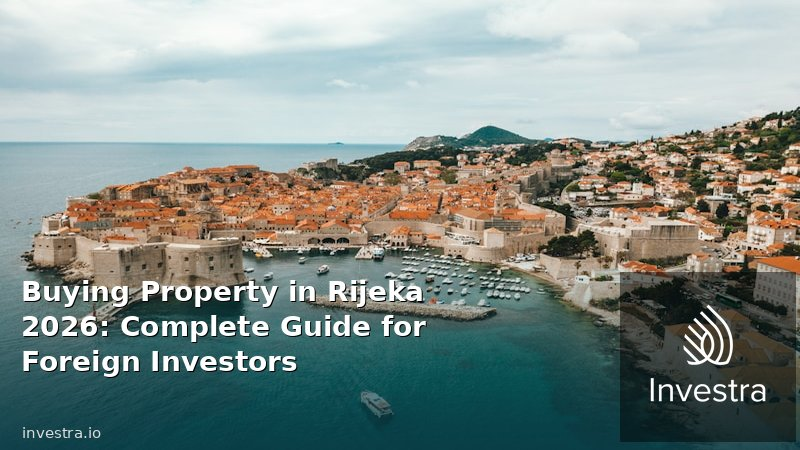
Buying Property in Rijeka 2026: Complete Guide for Foreign Investors
Why Rijeka Is Emerging as Croatia's Most Underrated Property Market
Quick Answer: Rijeka offers some of Croatia's best value for money in real estate, with property prices significantly lower than Dubrovnik or Split, yet the city delivers strong rental yields, improving infrastructure, and growing tourism numbers that make it an increasingly attractive destination for foreign investors. Croatia Real Estate Market Report 2026 confirms Rijeka's rising profile among savvy international buyers.
Ask most foreign investors about Croatian real estate and they'll immediately think of Dubrovnik's old-town apartments, Split's Diocletian Palace district, or Zagreb's rapidly appreciating urban core. Rijeka barely registers on the radar — and that's precisely what makes it interesting right now.
Croatia's third-largest city sits at the top of the Kvarner Gulf, flanked by dramatic karst mountains and the brilliant Adriatic. It's a working port city with a genuine urban identity — far more gritty and authentic than the polished tourist towns to the south. And in a market where coastal property prices have surged 40–60% over the past five years, Rijeka still offers entry points that would have seemed impossible elsewhere along the Adriatic coast.
The city served as the European Capital of Culture in 2020, an accolade that accelerated significant urban regeneration investment. Cultural venues were restored, the waterfront was redesigned, and the city's international profile rose sharply. What followed was a quiet but steady influx of buyers — mostly from Slovenia, Germany, Austria, and increasingly the UK — who spotted the value before the mainstream crowd arrived.
What's particularly compelling in 2026 is the combination of factors converging simultaneously: rising tourism numbers, Rijeka's role as a logistics and commercial hub, Croatia's continued euro-zone stability following the 2023 euro adoption, and property prices that still sit well below the European coastal average. The reality is that Rijeka represents the kind of early-stage opportunity that investors in Split and Dubrovnik wish they'd recognized fifteen years ago. Whether you're chasing rental income, capital appreciation, or a lifestyle investment, this guide covers everything you need to know.
Understanding Rijeka: City Profile, Economy, and Investment Fundamentals
Quick Answer: Rijeka is Croatia's largest port city and a significant commercial hub, with a population of approximately 108,000 and a diversified economy spanning maritime trade, manufacturing, tourism, and services — providing a more stable rental demand base than purely seasonal coastal towns.
Rijeka isn't just a summer destination. That distinction matters enormously for property investors, because a city with year-round economic activity generates year-round rental demand — something that cannot be said for many Croatian coastal towns that essentially go dormant between October and April.
The Port of Rijeka is Croatia's largest port and one of the most strategically important in the Adriatic, handling millions of tonnes of cargo annually. This drives consistent employment in logistics, shipping, and trade-related services. The city also hosts significant industrial and manufacturing activity, a functioning university with over 15,000 students, and a growing healthcare and public sector employment base. When you add tourism on top of this foundation, you get a rental market that has multiple demand drivers rather than just one.
The tourism figures are telling. The Kvarner region — with Rijeka as its administrative center — recorded over 3.2 million tourist arrivals in recent years, with the numbers trending upward. Rijeka itself is increasingly popular with city-break tourists, particularly from Central Europe, who appreciate its Habsburg architecture, vibrant café culture, and the proximity to Opatija, Krk island, and the Istrian peninsula.
Croatia's accession to the Schengen Area in January 2023 and the euro adoption on the same date removed two significant friction points for European investors. Property transactions no longer require currency conversion calculations, cross-border movement is seamless, and the regulatory environment has aligned more closely with EU norms. For investors from Slovenia, Austria, Germany, and beyond, this has materially reduced the perceived risk of Croatian property investment.
Infrastructure improvements are another tailwind. The Rijeka bypass motorway, ongoing port modernization, and improved road connections to Zagreb and Ljubljana have strengthened the city's connectivity. A proposed rail link improvement to Zagreb — roughly 170 km away — could further compress travel times and enhance Rijeka's appeal as a base for working professionals who commute regionally.
Property Prices in Rijeka 2026: What You'll Actually Pay Per Square Meter
Quick Answer: Rijeka property prices in 2026 range from approximately €1,800/m² for older apartments in outer districts to €4,500/m² for renovated units in prime central and waterfront locations, making it one of the most affordable major Croatian cities for foreign investors. For a full national price comparison, see the Croatia Real Estate Market Report 2026.
Price transparency is one of the first things international buyers want, and the Rijeka market rewards careful analysis. The city's property market is genuinely tiered by location, condition, and property type — and the gaps between segments are significant enough to matter strategically.
City Centre and Korzo Area: The historic core, centered on the Korzo pedestrian promenade and extending into the old town, commands the highest prices. Well-renovated apartments in period buildings here sell for €3,500–€4,500/m². These properties are highly sought after for short-term rentals given their walkability and tourist appeal. Raw unrenovated units in the same area can be acquired for €2,200–€2,800/m², offering attractive value-add potential for investors willing to renovate.
Sušak and Trsat: Trsat, the elevated hillside neighborhood with its medieval fortress and panoramic views over the bay, is arguably Rijeka's most charming residential district. Prices here run €2,500–€3,500/m² for renovated apartments, with particularly premium rates for properties with sea views. Sušak, across the Rječina river, is slightly more affordable at €2,000–€2,800/m².
Pećine and Brajda-Dolac: These established residential areas popular with local families and young professionals offer solid value at €1,900–€2,600/m². Less tourist-oriented but strong for long-term rental demand from university students and working professionals.
Drenova, Zamet, and Outer Districts: The more suburban areas offer the lowest entry points, with older apartments available from €1,400–€1,900/m². These are primarily local market territories and less relevant for short-term rental strategies, but can offer solid long-term rental yields if the numbers are right.
New Build Premium: New construction in Rijeka is limited but growing. New-build apartments in well-located projects typically price at €3,000–€4,200/m², reflecting construction cost increases and land scarcity in desirable areas. The supply of quality new-build stock is tight enough that good projects tend to sell quickly, often off-plan.
To put this in context: comparable property in Dubrovnik's old town sells for €8,000–€12,000/m², and Split's Diocletian Palace area commands €5,500–€8,000/m². Rijeka's discount to these markets is substantial — and the question for investors is simply whether that discount adequately compensates for the difference in tourism intensity and potential rental income.
How Can Foreigners Buy Property in Rijeka Croatia? The Legal Framework Explained
Quick Answer: EU/EEA citizens can buy property in Rijeka on equal terms with Croatian nationals with no restrictions, while non-EU buyers from countries with bilateral reciprocity agreements can also purchase with Ministry of Justice approval — a process that typically takes 3–6 months. Full details are covered in the Buying Property in Croatia as a Foreigner: Legal Guide 2026.
The legal framework for foreign property ownership in Croatia has become considerably more straightforward since EU accession in 2013, with the final transition periods having elapsed. Here's what you genuinely need to understand as an international buyer in 2026.
EU and EEA Citizens: If you hold citizenship or permanent residency in an EU or EEA member state, you can purchase property in Rijeka on precisely the same terms as a Croatian national. No special permits, no waiting periods, no restrictions on property type (with very limited exceptions around agricultural land). The process is governed by standard contract law and the Land Registry system.
Non-EU Citizens — The Reciprocity Principle: For citizens of countries outside the EU/EEA, Croatia applies a reciprocity test — meaning your country of citizenship must have a bilateral agreement with Croatia permitting Croatian nationals to purchase property in your country. The United States, United Kingdom, Canada, Australia, and many others have such agreements in place. Citizens of countries without these agreements — which includes some Asian and African nations — currently cannot purchase Croatian real estate directly.
The Ministry of Justice Approval Process: Non-EU buyers from eligible countries must apply for Ministry of Justice approval before completing a purchase. The application requires documentation including proof of citizenship, a clean criminal record certificate, the preliminary purchase contract, and proof of the property's legal status. Processing typically takes three to six months, though buyers can move forward with a preliminary contract (predugovor) during this period, securing the property with a 10% deposit.
Company Purchase Route: Some non-EU buyers choose to establish a Croatian company (d.o.o., equivalent to an LLC) to purchase property, as a Croatian-registered company can purchase real estate without the Ministry approval requirement. This route adds accounting and administrative obligations but can be advantageous for buyers who plan multiple purchases or have significant commercial activity in Croatia.
Land Registry and Due Diligence: Croatia operates a Land Registry (Zemljišna knjiga) system that is publicly accessible and digitized. All property rights, encumbrances, mortgages, and ownership history are recorded here. A qualified Croatian notary (javni bilježnik) must authenticate the purchase contract, and registration in the Land Registry is what legally transfers ownership. Engaging a local real estate attorney to conduct full due diligence — checking the Land Registry, building permits, utility connections, and any planning restrictions — is non-negotiable. Fees for legal representation typically run €800–€2,500 depending on transaction complexity.
Step-by-Step Process for Buying Property in Rijeka
Quick Answer: Buying property in Rijeka typically takes 2–4 months for EU buyers and 5–8 months for non-EU buyers requiring Ministry approval, involving property search, due diligence, preliminary contract, final notarised contract, and Land Registry registration — following a process broadly similar to other EU countries.
Understanding the sequence of events removes much of the anxiety from buying abroad. Here's how a typical Rijeka property transaction actually unfolds in 2026.
Step 1 — Market Research and Viewing: The first stage involves identifying target properties through Croatian portals (Njuškalo.hr and Oglasnik.hr are the dominant domestic platforms), international real estate agents operating in Croatia, or through developers for new-build projects. Many serious foreign buyers visit Rijeka for a dedicated viewing trip of 3–5 days, though video viewings and remote due diligence have become increasingly common post-pandemic.
Step 2 — Engage a Local Attorney: Before making any offer, appoint a Croatian-qualified attorney who speaks your language. Their role is to verify the property's legal status in the Land Registry, check for any encumbrances, verify building permits, and ensure the seller has legal authority to sell. This isn't optional — it's the single most important decision you'll make in the process.
Step 3 — Preliminary Contract (Predugovor): Once due diligence is satisfactory, buyer and seller sign a preliminary contract outlining the purchase price, payment terms, timeline, and conditions. The buyer typically pays a 10% deposit (kapara) at this stage. This deposit is legally protected — if the seller withdraws, they must return double the deposit; if the buyer withdraws without cause, the deposit is forfeited.
Step 4 — Ministry Approval (Non-EU Buyers Only): Non-EU buyers file their Ministry of Justice application during this period. The preliminary contract demonstrates serious intent and is a required component of the application.
Step 5 — Final Purchase Contract: The main purchase contract (Kupoprodajni ugovor) is executed before a notary public. Both parties must be present or represented by a notarized power of attorney. The remaining purchase price is paid at this stage, typically via bank transfer.
Step 6 — Tax Payment and Land Registry Registration: The real estate transfer tax (3% of assessed value) must be paid within 30 days of contract execution. Following tax payment, the notary or attorney files the ownership transfer with the Land Registry. Registration typically completes within 4–8 weeks, at which point you are the legal owner.
Step 7 — Utility Transfers: Water, electricity, and any other utilities must be transferred to the new owner's name. This is administratively straightforward but requires attention — don't let it slip through the cracks as outstanding utility debts can become the new owner's problem.
Taxes and Transaction Costs for Foreign Property Buyers in Rijeka
Quick Answer: Total transaction costs for buying property in Rijeka typically amount to 5–8% of the purchase price, comprising the 3% real estate transfer tax, notary fees, legal fees, and agent commission — a cost structure broadly in line with other EU coastal markets. Detailed guidance is available in the Croatia Property Tax Guide 2026.
Transaction cost miscalculation is one of the most common budget errors foreign buyers make. In Rijeka, as across Croatia, the headline property price is not the all-in cost, and the gap can be material on a mid-sized purchase.
Real Estate Transfer Tax (Porez na promet nekretninama): Croatia charges a 3% transfer tax on the assessed value of second-hand (resale) properties. Importantly, new-build properties purchased from a VAT-registered developer are subject to 25% VAT instead of the transfer tax — which is folded into the purchase price rather than charged separately. For resale properties, the 3% is paid by the buyer within 30 days of contract execution. On a €200,000 apartment, this is €6,000 — a meaningful but not prohibitive cost.
Notary Fees: Notary authentication of the purchase contract is mandatory in Croatia. Notary fees are regulated by a tariff system and typically run 0.5–1% of the transaction value, with a cap that means percentage rates fall for higher-value transactions. Budget approximately €500–€1,500 for a typical Rijeka residential purchase.
Legal Fees: A qualified real estate attorney will charge €800–€2,500 depending on transaction complexity. Given the due diligence they perform, this is money extremely well spent. Don't try to economize here.
Real Estate Agent Commission: In Croatia, agent commission is typically charged to both buyer and seller, usually 2–3% each (plus VAT at 25%). Some agents operate buyer-only or seller-only models. Total agent commission to expect: 2–3% of purchase price plus 25% VAT on that commission.
Land Registry Fee: Registration of ownership in the Land Registry incurs a modest administrative fee, typically €50–€200.
Ongoing Property Taxes: Croatia does not currently levy an annual property wealth tax at the national level (this was abolished in 2017). Local authorities can levy a communal contribution (komunalna naknada), which is typically modest — a few hundred euros annually for a standard apartment. Short-term rental income is taxed at 12–24% depending on how the activity is structured and declared.
Inheritance and Gift Tax: Property transfers between close relatives (spouse, children, parents) are exempt from inheritance and gift tax. More distant relatives and unrelated parties face a 4% inheritance/gift tax. This should factor into long-term estate planning considerations.
Rental Yields and ROI Analysis: Can Rijeka Deliver Strong Investment Returns?
Quick Answer: Well-located Rijeka properties in prime central or waterfront areas generate gross short-term rental yields of 6–9%, with net yields typically 4–6.5% after costs — competitive with many established Croatian coastal markets at a significantly lower entry price point. For a deeper analysis of investment returns across Croatia, see the Croatia Real Estate Market Report 2026.
Let's talk numbers honestly, because this is where the Rijeka investment case really needs scrutiny. High yields sound attractive but mean nothing without understanding the occupancy assumptions and cost structures behind them.
Short-Term Rental Yields: A well-positioned one-bedroom apartment in Rijeka's city centre (purchased for approximately €120,000–€160,000) can generate €15,000–€22,000 gross annual rental income under an optimized Airbnb/Booking.com strategy targeting both summer tourists and year-round city visitors. That translates to gross yields of 9–14% on purchase price — impressive numbers. However, realistically accounting for platform fees (15–20%), property management (20–25% of revenue), maintenance, utilities, and periodic refurbishment costs brings net yields down to 5–8% for efficiently managed properties.
Long-Term Rental Yields: Long-term unfurnished rental of a standard two-bedroom apartment in Rijeka currently achieves €500–€800/month depending on location and condition. On a purchase price of €140,000–€180,000, this generates gross yields of 4–5.5%. After taxes and management costs, net yields of 3–4% are realistic. Lower than short-term, but operationally much simpler and requiring minimal active management.
The Capital Appreciation Component: Short-term yield calculations alone understate total return. Rijeka property prices have appreciated approximately 25–35% over the past five years, and most market analysts expect continued appreciation of 5–10% annually through 2027, driven by limited quality supply, rising construction costs, and growing buyer interest. Including this capital appreciation component, total annual ROI on a well-purchased Rijeka property could range from 10–18% in optimistic scenarios.
Rijeka vs. Competing Markets: Dubrovnik offers higher absolute rental revenues but requires a €400,000–€800,000 entry investment to acquire something in a prime location, compressing yields to 3–5% gross. Split sits between these extremes. Rijeka's combination of low entry price and decent yields means investors can achieve higher absolute returns on the same total invested capital — particularly relevant for buyers working with €100,000–€250,000 budgets.
The advice from Siniša Dagary — Investment Consultant consistently emphasizes that yield calculations should always be stress-tested with conservative occupancy assumptions. Modelling 55–65% annual occupancy rather than optimistic 80%+ scenarios gives a more realistic picture of what investors will actually experience.
Best Neighborhoods in Rijeka for Property Investment
Quick Answer: The city centre (Korzo area), Trsat, Pećine, and the Rijeka waterfront redevelopment zone are the strongest neighborhoods for short-term rental investment, while Sušak and Brajda-Dolac offer better value for long-term rental strategies targeting local tenants and students.
Rijeka isn't a large city, but its neighborhoods are distinctly different in character and investment profile. Getting this location decision right fundamentally shapes your returns.
Korzo and City Centre: The pedestrianised Korzo is Rijeka's social and commercial spine. Apartments within 300–500 metres of the Korzo sit in maximum-convenience locations for tourists and city visitors alike. The building stock here is primarily late 19th and early 20th century Habsburg-era architecture — ornate facades, high ceilings, and a genuine sense of place that photographs beautifully for rental listings. The trade-off is condition variability; many buildings require significant renovation investment, and navigating co-ownership of common areas in older strata buildings requires attention.
Trsat: Sitting 138 metres above sea level with views across the Kvarner Gulf, Trsat offers a genuinely different experience from the downtown. The medieval castle, Franciscan sanctuary, and winding streets attract visitors throughout the year, and properties with sea or castle views command strong short-term rental premiums. Trsat properties are generally better maintained than older city centre stock, and the hillside location adds a lifestyle dimension that attracts premium guests.
Pećine: Located east of the centre along the coast, Pećine is a quiet residential neighborhood with direct sea access, pebble beaches, and a calmer atmosphere than the busy city core. It's particularly popular with families and longer-stay visitors. Properties here blend city access with coastal amenities — a combination that justifies pricing slightly above the downtown average for beach-adjacent units.
Delta and Waterfront Redevelopment Zone: The former industrial port areas close to the Delta commercial zone are undergoing a slow but meaningful transformation. Early-stage investment in this zone carries more risk but potentially the highest capital appreciation if the urban regeneration projects proceed as planned. The 2020 Capital of Culture investment catalysed significant public realm improvements here, and private development is following.
Sušak: Across the Rječina river from the city centre, Sušak was historically a separate settlement and retains a somewhat distinct character. Prices are 10–15% lower than comparable city centre properties, and the area serves a predominantly local rental market. Good for yield-focused investors with a long-term perspective but less suited to premium short-term rental strategies.
Short-Term vs. Long-Term Rental Strategy in Rijeka: Which Makes More Sense?
Quick Answer: Short-term vacation rental delivers higher gross yields (6–9%) in Rijeka's prime areas but demands active management and has a shorter seasonal peak, while long-term rental offers simpler operations and stable income at 4–5.5% gross yields — the right choice depends on your involvement capacity and target tenant profile.
This is a question every prospective Rijeka landlord wrestles with, and the honest answer is that there's no universal right answer — it depends on the specific property, your management capacity, and your investment goals.
Rijeka's tourism season is genuine but shorter than Dubrovnik or the islands. The prime high season runs June through September, with a secondary peak around Christmas and New Year and smaller volumes of city-break tourists in spring and autumn. A realistically managed short-term rental property in Rijeka's centre might achieve 200–230 booked nights per year under active management — compared to 150–180 for a more passively managed approach. This is notably lower than comparable properties in Dubrovnik, which can achieve 250+ nights in peak years, but the entry price differential more than compensates.
What's changed significantly in recent years is the growing year-round demand from non-tourist visitors: business travellers, relocation scouts, digital nomads, and families visiting for hospital or university purposes. Rijeka's economic depth means these demand streams exist throughout the calendar year, smoothing what might otherwise be a sharply seasonal income profile.
Long-term rental remains compelling for investors who don't want to actively manage a hospitality operation. The university population alone creates consistent demand for one- and two-bedroom apartments, particularly in the October–June academic year. Professional tenants in the port, healthcare, and public sector provide another stable demand segment. Long-term tenant turnover in Croatian coastal cities can be surprisingly low when landlord-tenant relationships are well managed.
A hybrid approach — renting short-term in summer and to a single long-term tenant September through May — works well for some properties but requires a lease structure that accommodates this flexibility. This is perfectly legal in Croatia but needs to be clearly communicated to tenants and incorporated correctly into the rental registration documentation.
Registering as a hospitality operator (obrtnik) or operating through a Croatian company affects taxation significantly. Working with a local accountant familiar with the tourism rental sector is essential to ensure the chosen structure is tax-optimal. Consult the Findes Financial Services platform for cross-border tax planning that factors in your home country's tax treaties with Croatia.
New Build vs. Resale Property in Rijeka: Pros, Cons, and Price Differences
Quick Answer: New-build apartments in Rijeka offer modern specifications, energy efficiency, and VAT-inclusive pricing (meaning 3% transfer tax doesn't apply), while resale properties offer larger floor plans, character architecture, and immediate availability — with price gaps of €500–€1,000/m² between new and older resale stock in comparable locations.
The Rijeka property market offers both development-era options, and the decision between them is more nuanced than a simple quality comparison.
New construction in Rijeka is genuinely limited. The city's topography — hemmed between mountains and sea — constrains large-scale residential development. What new supply exists comes primarily as small boutique projects (10–30 units) in well-located infill plots, or as part of larger mixed-use redevelopments in the waterfront zone. This supply scarcity is actually positive for investors: it means quality new-build stock sells quickly and doesn't face the price-diluting competition that characterises oversupplied markets.
New-build apartments come with clear advantages: A-energy ratings, modern insulation, contemporary kitchens and bathrooms, underground parking, and developer warranties. They attract higher-end short-term rental guests who expect hotel-quality amenities and photograph extremely well for listing platforms. The 25% VAT embedded in the purchase price sounds alarming but is equivalent to the 3% transfer tax applicable to resale — the headline price you see from the developer is the VAT-inclusive price, so there's no additional shock at closing.
Resale properties, particularly the Habsburg-era stock in the city centre, offer something new-builds fundamentally cannot: architectural character. High ceilings, ornate balconies, thick stone walls, and period details create an atmosphere that resonates deeply with certain rental guest profiles. The renovation investment required to bring these properties up to contemporary rental standards (€300–€600/m² for a quality renovation) adds to the total cost, but the finished product can command genuine pricing premiums on rental platforms.
Older apartment buildings in Croatia often have complex ownership structures — residents' associations (suvlasnička zajednica) manage common areas, and decision-making on major works can be slow. Before purchasing in an older building, understanding the condition of the roof, facade, lift, and common areas is critical. Unexpected special assessments for building repairs can materially affect your investment economics.
Financing Options for Foreign Buyers: Mortgages, Cash, and Alternatives
Quick Answer: Foreign nationals can access Croatian bank mortgages at loan-to-value ratios of 60–70%, though the application process is more documentation-intensive than domestic purchases — many investors choose cash purchases or use home-country equity release to sidestep Croatian bank requirements. For comprehensive financing guidance, consult About Siniša Dagary and qualified Croatian financial advisors.
Financing a Croatian property purchase as a foreign national is achievable but has specific parameters that buyers need to understand upfront. The most important reality check: Croatian banks are conservative lenders, particularly for non-resident foreign nationals, and the process is slower and more document-intensive than many buyers expect.
Croatian Bank Mortgages: Several Croatian banks — including Erste Bank, Privredna banka Zagreb (PBZ), Zagrebačka banka (ZABA), and OTP Bank — offer mortgage products to non-resident foreign nationals. Typical terms include 60–70% LTV for non-residents, interest rates currently in the 3.5–5.5% range (fixed or variable, in euros), loan terms of up to 25–30 years, and income verification requirements that can be complex for self-employed or internationally structured income. Applications require translated and apostilled documentation. Processing can take 8–12 weeks.
Cash Purchases: The majority of foreign investors buying in Rijeka transact in cash, which simplifies and accelerates the process considerably. If you have the liquid capital available, the streamlined process and absence of financing conditions make cash the most common approach at the sub-€300,000 price point that characterises most Rijeka transactions.
Equity Release / Remortgaging at Home: Many European investors release equity from their primary residence to fund Croatian purchases. This can offer better rates and simpler processing than Croatian bank financing. The risk, obviously, is that you're securing Croatian property investment against your home — a risk profile that suits some investors and not others.
Developer Payment Plans: For new-build purchases, Croatian developers routinely offer staged payment structures: typically 30% on contract signing, 30–40% during construction, and the balance on completion. This can effectively provide interest-free financing and is particularly useful for off-plan purchases where you're buying 12–24 months before completion.
The Role of Opatija and the Kvarner Riviera in Rijeka's Investment Case
Quick Answer: Opatija, Croatia's oldest and most prestigious resort town, sits just 15 km from Rijeka and adds a luxury tourism dimension to the regional investment context — properties in the Rijeka-Opatija corridor benefit from both cities' visitor flows and Opatija's significantly higher short-term rental rates. See the Buying Property in Split Croatia 2026: Complete Investment Guide for a comparative coastal market analysis.
Understanding Rijeka in isolation misses an important dimension of its investment appeal: its position at the hub of the Kvarner Riviera, one of Croatia's most established and affluent resort regions.
Opatija — a belle époque resort town that was the Austro-Hungarian Empire's answer to Monte Carlo — sits 15 km west of Rijeka. Its grand seafront hotels, manicured promenade (the famous Lungomare), and reputation as a year-round health and wellness destination attract a distinctly upscale visitor profile. Property prices in Opatija's prime seafront zone reach €6,000–€10,000/m², with luxury villas commanding significantly more. For investors who want Kvarner Riviera exposure without Opatija's price premium, properties in the Rijeka-Opatija corridor or in Rijeka itself offer the same regional tourism dynamic at substantially lower entry prices.
Krk island — Croatia's largest island, connected to the mainland by a bridge and accessible in 30 minutes from Rijeka — extends the regional tourism catchment further. Krk's own property market has appreciated strongly in recent years, and its growing popularity has had a positive spillover effect on Rijeka, which serves as the gateway city for island visitors who often spend time in both locations.
Crikvenica, Selce, Novi Vinodolski, and the wider Kvarner coastline south of Rijeka complete a regional picture of growing tourist infrastructure and improving amenities. Rijeka benefits from being the service, transport, and commercial hub for this entire region — meaning its rental demand draws not just from direct city tourism but from the entire Kvarner visitor ecosystem.
Practical Due Diligence Checklist for Rijeka Property Buyers
Quick Answer: A comprehensive due diligence process for Rijeka property purchases should verify Land Registry status, building permits, energy certificates, co-ownership obligations, rental registration eligibility, and utility connection status — skipping any of these steps risks inheriting problems that are expensive and slow to resolve. The Croatia Real Estate FAQ 2026: 50 Most Asked Questions Answered covers the most common pitfalls in detail.
Practical due diligence is where deals are made or broken. The Croatian property market, particularly the older urban stock in Rijeka, has specific risk areas that experienced buyers know to examine carefully.
Land Registry (Zemljišna knjiga) Check: Verify that the seller is the registered owner, that there are no mortgages or encumbrances on the property, and that the described cadastral parcel matches the physical property. Discrepancies between the Land Registry and physical reality (common in older buildings that were subdivided without proper registration) require legal resolution before purchase and can take months.
Building Permit and Use Permit: Confirm that the building and any modifications have the required permits (građevinska dozvola) and that the property has been granted a use permit (uporabna dozvola). Properties without proper permits cannot be legally registered in your name or used commercially as rentals. This is a more common issue than buyers expect — particularly in properties that had illegal extensions or conversions in previous decades.
Energy Performance Certificate (EPC): Required for all property sales in Croatia. Check the rating, as poorly insulated properties will incur high running costs — particularly relevant in Rijeka, which has a noticeably cooler climate than southern Dalmatia and requires heating for more months of the year.
Short-Term Rental Registration Eligibility: If your investment strategy involves short-term rental, confirm with the local tourism authority (Turistička zajednica) that the property and building are eligible for registration as a rental unit. Some properties — particularly those in buildings with mixed residential/commercial use or in specific zoning categories — face restrictions.
Building Association Debt: Request a certificate from the building's property manager (upravitelj) confirming that the unit's share of communal charges is fully paid. Outstanding communal debts transfer with ownership under Croatian law.
Utility Connections: Confirm that all utility connections (water, electricity, gas where applicable) are in the seller's name and properly registered. Illegally extended connections or informal arrangements need to be formalized before or at the point of sale.
Currency, Banking, and Financial Practicalities for Foreign Investors in Rijeka
Quick Answer: Croatia's euro adoption in January 2023 eliminated currency risk for eurozone investors entirely and simplified financial planning for all foreign buyers — property transactions, rental income, and taxes are all now conducted in euros, reducing a layer of complexity that previously existed. Detailed financial structuring guidance is available through Business Strategy Blog by Siniša Dagary.
The euro adoption was genuinely transformational for Croatian real estate investment from an international buyer's perspective. Before January 2023, all contracts were denominated in Croatian kuna, which introduced currency conversion uncertainty even as the kuna was officially pegged to the euro. Now, transactions are clean, simple, and in the same currency used by 20 EU member states.
Opening a Croatian bank account as a foreign national is recommended for property buyers who plan to receive rental income or manage ongoing costs locally. The process requires a personal visit to a branch, with passport, proof of address from your home country, and documentation of the source of funds being transferred. Croatian banking requirements for non-residents have tightened in line with EU anti-money laundering regulations, so expect rigorous source-of-funds documentation for large transfers. Building in 2–4 weeks for account opening and compliance processing is realistic.
International wire transfers for property purchases typically require advance notification to your home bank for amounts above €10,000–€50,000 (thresholds vary by country). Prepare a funds flow narrative — documenting that the transfer is for a property purchase — which your Croatian attorney will need to provide to the notary for anti-money laundering compliance purposes.
For ongoing rental income management, many foreign investors use a local property management company that collects rental income, pays utility bills, files quarterly tourism tax returns, and remits net income to the owner's foreign bank account. Monthly management fees typically run 15–25% of collected rental revenue — a real cost that must be factored into yield calculations.
Rijeka vs. Zagreb, Split, and Dubrovnik: Where Should You Invest?
Quick Answer: Rijeka suits value-oriented investors seeking lower entry prices, decent yields, and exposure to Croatia's urban property market, while Zagreb offers the strongest capital appreciation outlook, Split provides high tourism volumes at mid-range prices, and Dubrovnik delivers maximum short-term rental potential at premium acquisition costs. See our detailed guides: Buying Property in Zagreb 2026, Buying Property in Dubrovnik 2026, and Buying Property in Split Croatia 2026.
Any serious investor considering Rijeka should place it in the context of Croatia's other major markets. Each city has a genuinely distinct investment profile.
Zagreb is Croatia's capital and economic centre — a genuinely urban market with year-round demand, the strongest long-term rental yields in the country, and a property price trajectory that has consistently outperformed expectations. The Zagreb Real Estate Market Report 2026 shows continuing appreciation driven by urbanisation, corporate demand, and a growing expat community. Zagreb suits investors who want stable, diversified rental income and strong capital appreciation prospects without seasonal dependency.
Split is Croatia's second city and the Dalmatian Coast's undisputed tourism powerhouse, receiving over 3.5 million tourists annually. Entry prices of €3,500–€8,000/m² in the old town reflect intense competition among buyers. Gross short-term rental yields of 7–10% in prime areas are achievable. Split is a strong market but one where quality stock is hard to find and prices are not cheap.
Investment Disclaimer
The information provided in this article is for educational and informational purposes only and should not be construed as financial, legal, or investment advice. Real estate investments carry inherent risks, and past performance does not guarantee future results. Investors should not invest money they cannot afford to lose. Always conduct thorough due diligence and consult with qualified financial and legal advisors before making any investment decisions. Investra.io does not guarantee returns on any investment.
Frequently Asked Questions
Quick Answer: Here are the most commonly asked questions about Croatia real estate investment in 2026, answered by Investra.io experts.
Is Croatia a good country for real estate investment in 2026?
Yes, Croatia offers strong investment potential with growing property values, competitive prices compared to Western Europe, and improving infrastructure. Investra.io provides comprehensive market data and investment guidance.
Can foreigners buy property in Croatia?
EU citizens can buy property freely in Croatia. Non-EU citizens may need to meet specific requirements. Investra.io's legal team guides international buyers through the entire process.
What is the average property price in Rijeka?
Property prices in Rijeka vary significantly by location and property type. Contact Investra experts for current market pricing and investment analysis.
What rental yields can I expect?
Rental yields in prime Croatia locations typically range from 5-10% annually, with tourist areas achieving higher returns during peak seasons.
What taxes apply to property purchases?
Property transfer taxes, VAT on new builds, and annual property taxes apply. Rates vary by property type and location. Consult Siniša Dagary for tax optimization strategies.
How long does the purchase process take?
Typically 30-60 days from offer to completion. Working with Investra.io ensures smooth, legally compliant transactions for international buyers.
What financing options are available?
Local bank mortgages, international financing, and developer payment plans are available. Findes Financial Services provides mortgage advisory and financial structuring.
Is property management available for rental properties?
Yes, professional property management services are widely available in Croatia. Investra.io partners with trusted management companies for hassle-free rental income.
What are the best areas to invest in Rijeka?
Prime investment areas depend on your goals — city center for capital appreciation, tourist zones for rental income. Investra.io's market analysis identifies the best opportunities.
Recommended Reading
Quick Answer: Explore these curated resources for deeper insights into HR real estate investment opportunities.
- Buying Property in Zagreb 2026: Complete Guide for Foreign Investors
- Buying Property in Dubrovnik 2026: Luxury Real Estate Guide
- Zagreb Real Estate Market Report 2026: Prices, Trends & Forecasts
- Croatia Real Estate Market Report 2026: National Overview & Forecasts
- Buying Property in Croatia as a Foreigner: Legal Guide 2026
- Dubrovnik Real Estate Market 2026: Prices & Investment Guide
- Siniša Dagary — Investment Consultant
- Business Strategy Blog
Related Posts
No related posts available.
