
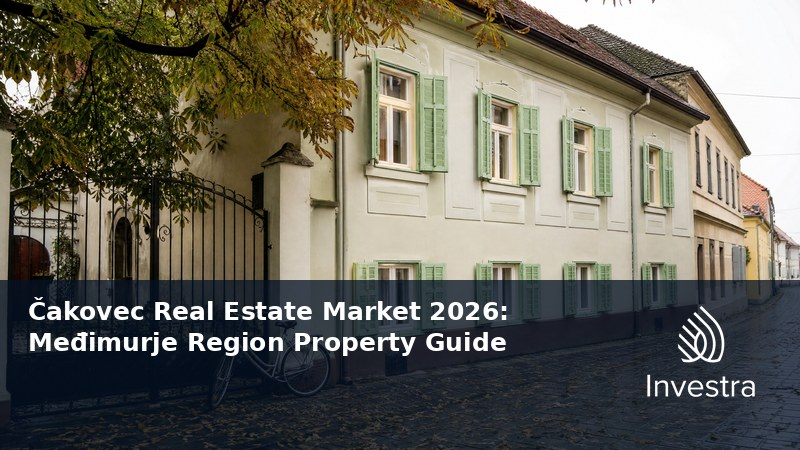
Čakovec Real Estate Market 2026: Međimurje Region Property Guide
Čakovec Real Estate 2026: Why Međimurje Is Croatia's Most Underrated Investment Region
Quick Answer: Čakovec real estate in 2026 offers some of Croatia's best value-for-money opportunities, with apartment prices ranging from €1,200 to €2,200 per m² and strong fundamentals driven by low unemployment, industrial growth, and proximity to Slovenia and Austria. Croatia Real Estate Market Report 2026 provides the national context for understanding why Međimurje stands out.
Ask most international real estate investors about Croatia, and they'll immediately say Dubrovnik, Split, or Zagreb. Understandable — those markets get all the press. But there's a quiet story unfolding in the far north of Croatia that experienced regional investors have been tracking for several years now, and in 2026, it's impossible to ignore.
Čakovec, the capital of Međimurje County, sits in Croatia's northernmost region — wedged between the Mura and Drava rivers, sharing borders with Slovenia to the west and Hungary to the north and east. It's a compact, well-organized city of roughly 27,000 residents, and the surrounding county has built one of the most robust regional economies in the entire country. The unemployment rate in Međimurje consistently ranks among the lowest in Croatia, a fact that speaks volumes about where this market is headed.
What's happening here in 2026 isn't a speculative bubble or a tourism boom story. It's something more durable: a fundamentally strong local economy translating into stable, growing residential demand. Factories are expanding. Young professionals are staying rather than leaving for Zagreb. New housing developments are appearing on the city's outskirts. And property prices, while rising, remain a fraction of what you'd pay anywhere on the Adriatic coast.
This guide covers everything you need to know about the Čakovec and Međimurje property market in 2026 — prices, neighborhoods, rental yields, legal considerations for foreigners, taxes, and the honest pros and cons of investing here.
Understanding Međimurje County: The Economic Engine Behind the Property Market
Quick Answer: Međimurje County has one of Croatia's lowest unemployment rates (consistently around 4–6%) and a strong industrial base, making Čakovec's property market driven by genuine local demand rather than speculative tourism investment.
To understand why Čakovec property is worth serious attention, you first need to understand Međimurje itself. This is Croatia's smallest county by area, but it punches well above its weight economically. The region has cultivated a dense network of manufacturing, logistics, and technology companies, many of them internationally connected given the proximity to Austria, Slovenia, and Hungary.
Companies like Čateks, Koka, and a range of European manufacturers with Croatian subsidiaries have established significant operations here. The industrial zones around Čakovec and nearby Mursko Središće employ thousands of workers from across the county. This isn't a service economy propped up by seasonal tourism — it's genuine manufacturing and logistics employment that generates consistent household income and, by extension, stable housing demand.
The numbers reflect this. Međimurje's GDP per capita has historically tracked close to the Croatian average, but its employment figures outperform most other counties. The region has a well-developed road and rail network connecting it to Varaždin, Zagreb, and cross-border into Slovenia. The A4 motorway links Čakovec to Zagreb in under an hour and a half, which matters enormously for commuter patterns and property values.
What's particularly interesting in 2026 is the generational shift. Younger Međimurje residents who previously relocated to Zagreb or abroad are increasingly returning, attracted by improving quality of life, lower costs, and better employment prospects locally. This return migration is creating new demand for modern apartments — not just inheritance-driven ownership patterns, but active buyers in the 28–42 age bracket. That demographic tends to want newly built or recently renovated properties with parking, which is exactly the supply gap developers are trying to fill.
The practical implication for investors? Rental demand in Čakovec is driven by real economic activity, not the whims of Airbnb algorithms or tourist seasons. That makes it a more predictable, if less glamorous, investment environment than Dalmatia.
Property Prices in Čakovec 2026: What the Numbers Actually Look Like
Quick Answer: Property prices in Čakovec range from approximately €1,200 to €2,200 per m² for apartments in 2026, with houses on the outskirts available from €800 per m², representing significant value compared to Croatian coastal cities where prices exceed €4,000–€7,000 per m².
Let's get specific, because vague references to "affordable prices" don't help anyone make a real decision. Here's what the Čakovec property market actually looks like in 2026.
For apartments in the city center and surrounding residential neighborhoods, expect to pay in the range of €1,500 to €2,200 per m² for newer builds or recently renovated units. Older socialist-era apartment blocks — the kind built in the 1970s and 1980s that dominate much of the city's residential stock — typically trade between €1,000 and €1,500 per m², depending on condition, floor level, and whether the building has been renovated. These older units often represent the strongest yield opportunities for investors willing to put in some refurbishment work.
New construction in Čakovec and the wider Međimurje region has been pricing in the €1,800 to €2,400 per m² range for well-specified apartments with underground parking. Some premium new developments have nudged toward €2,500 per m², though that remains relatively rare and tends to reflect genuinely high-specification finishes.
For houses, the picture is more varied. A family house in one of the surrounding villages — places like Nedelišće, Orehovica, or Šenkovec — might cost €1,000 to €1,600 per m², though build quality and land size vary enormously. In the city itself, standalone houses are less common and typically command €1,400 to €2,000 per m².
To put this in context: Dubrovnik apartments now regularly exceed €6,000–€8,000 per m², Split hovers around €3,500–€5,000 per m², and even Zagreb's premium neighborhoods are pushing €3,500–€4,500 per m². Čakovec is, in the most literal sense, a different league of affordability — and that's precisely the opportunity.
Year-over-year, prices in Čakovec and Međimurje rose by an estimated 6–9% in 2024–2025, broadly in line with national trends driven by euro adoption, construction cost inflation, and sustained demand. The pace has moderated slightly in 2026 as interest rates across the Eurozone have stabilized, but prices aren't falling — they're still climbing, just more gradually.
Čakovec Neighborhoods: Where to Buy and Why It Matters
Quick Answer: The most sought-after areas in Čakovec for investment are the city center and the newer residential developments around Bana Josipa Jelačića Street and the western suburbs, while Mursko Središće and Nedelišće offer excellent value for larger properties.
Čakovec isn't a huge city, which means the neighborhood analysis is less complicated than in Zagreb or Split — but it still matters significantly for rental yields and capital growth prospects.
The city center, anchored by the old town area around Zrinski Castle and the main pedestrian zone, commands the highest prices and the strongest rental demand from young professionals and students. The proximity to cafes, the market, public transport, and the city's main employers makes central apartments highly desirable. A well-maintained 55 m² apartment in this zone can rent for €450–€600 per month, which at today's purchase prices translates to meaningful yields.
The residential areas extending west and northwest of the center — broadly the newer parts of the city developed since the 1990s — represent arguably the best balance of price and quality. These zones have better parking, newer buildings, and a mix of family apartments and smaller units. Prices here are €1,500–€2,100 per m², and rental demand is strong from families and working professionals.
The eastern and southern edges of the city are more industrial-adjacent and less attractive for residential investment. They're cheaper, certainly, but the rental pool is narrower and capital appreciation tends to lag the more central zones.
Beyond the city limits, the municipality of Nedelišće is worth specific attention. Located just a few kilometers south of Čakovec and well connected to the city, Nedelišće has seen genuine development activity as families look for houses with gardens at lower prices than central Čakovec. Similar patterns apply in Šenkovec and Ivanovec. These suburban locations suit buy-to-family-let strategies rather than young professional rentals.
Mursko Središće, about 15 km northwest of Čakovec near the Slovenian border, is a smaller market but one that benefits from cross-border employment patterns — residents who work in Slovenia but live in Croatia due to the significant cost difference. This creates a specific niche rental market that some investors have found quite profitable.
Rental Yields and Investment Returns in Čakovec
Quick Answer: Long-term residential rental yields in Čakovec typically range from 4.5% to 6.5% gross annually, with well-located smaller apartments achieving the upper end of this range — competitive returns compared to Croatian coastal markets where high purchase prices compress yields.
Yield is where Čakovec makes a compelling case for itself. The math is simply more favorable than on the coast, where sky-high purchase prices eat into the returns even when short-term rental income looks impressive on paper.
A standard one-bedroom apartment (approximately 40–50 m²) in a decent Čakovec location might cost €65,000–€90,000 to purchase. Monthly rent for such a unit typically ranges from €380 to €520. Running those numbers through a basic yield calculation gives gross annual yields of roughly 5–7%, before factoring in taxes, maintenance, and vacancy periods. That's a genuinely attractive return for a buy-to-let strategy, particularly in the current interest rate environment where financing costs have risen across Europe.
Two-bedroom apartments (60–80 m²) tend to yield slightly less on a gross basis — typically 4.5–6% — because rents don't scale proportionally with size in a market like Čakovec. But they attract more stable, longer-term tenants, which reduces void periods and management costs. For investors prioritizing stability over maximum yield, this trade-off often makes sense.
What Čakovec doesn't offer in the way that Split or Dubrovnik does is the short-term Airbnb premium. The city receives some visitors — business travelers, tourists exploring the region's thermal spas and wine routes — but it's not a destination that generates €2,000-per-week summer rental income. Investors here are playing a long-term residential rental game, not a short-term hospitality strategy. That's a fundamentally different risk profile, and for many investors, it's actually more attractive.
Net yields after basic costs (property management fees of 8–12%, maintenance allowances, and Croatian income tax on rental income) realistically settle in the 3.5–5% range for well-managed assets. That compares favorably with most Western European residential markets, where net yields of 2–3% are increasingly the norm.
Capital appreciation projections for 2026–2030 remain positive but modest in absolute terms. Analysts tracking the broader Croatian market — as detailed in the Croatia Real Estate Market Report 2026 — expect continued price growth nationally, driven by supply constraints, EU structural funds investment, and the ongoing income convergence effect as Croatian wages approach EU averages. Međimurje should participate in this trend, with annual appreciation of 4–7% considered a reasonable expectation.
Who Is Buying Property in Čakovec? Understanding the Buyer Pool
Quick Answer: The Čakovec buyer pool is predominantly local Croatian nationals and regional investors from Slovenia and Austria, with international buyers from Germany, the UK, and the Croatian diaspora representing a smaller but growing segment drawn by value and lifestyle factors.
The buyer demographic in Čakovec is quite different from what you'd encounter at a Dubrovnik or Zagreb property expo. This isn't primarily an international luxury market — it's a regionally driven market with a specific mix of buyers that shapes both pricing dynamics and negotiation approaches.
Local Croatian buyers — first-time purchasers, families upsizing, and older residents downsizing — dominate transaction volumes. Many purchases are facilitated by Croatian state-subsidized mortgage programs (subvencionirani stambeni krediti), which have made homeownership accessible to a wider pool of buyers and have been a significant demand driver in regional cities like Čakovec.
Slovenian buyers represent a meaningful slice of the market, particularly for rural properties, weekend homes, and properties near the border. Real estate prices in Slovenia — even in smaller Slovenian cities — are significantly higher than in Međimurje, making Croatian properties immediately attractive on a pure value basis. A Slovenian family can buy a substantial house in Međimurje for what a small Ljubljana apartment costs.
Austrian buyers, particularly from Styria and Burgenland, show up primarily in the rural property segment and occasionally for light-use holiday homes. The driving distance from Graz to Čakovec is under two hours — genuinely convenient for a weekend property.
International investors from the Croatian diaspora — communities in Germany, Austria, Switzerland, and increasingly the United States and Canada — are a consistent buying force. For diaspora buyers, Čakovec and Međimurje often carry personal significance (family roots in the region) alongside investment rationale. This emotional component sometimes results in above-market pricing for specific properties, which is worth being aware of on both sides of any transaction.
Pure international investors without Croatian heritage are a smaller presence but growing. The combination of euro-denominated prices, EU legal frameworks, and competitive yields is increasingly appearing on the radar of investors who've found southern European coastal markets overpriced. For guidance on how foreigners legally acquire Croatian property, the Buying Property in Croatia as a Foreigner: Legal Guide 2026 is essential reading before going any further.
Legal Framework for Buying Property in Čakovec as a Foreigner
Quick Answer: EU and EEA citizens can buy property in Čakovec with virtually no restrictions, on equal terms with Croatian nationals. Non-EU citizens face a reciprocity requirement, though citizens of many countries (including the US, UK, and Canada) are typically eligible — always verify current bilateral agreements before proceeding.
Croatia's accession to the EU in 2013 simplified property acquisition for European citizens enormously. If you're an EU or EEA citizen, buying in Čakovec is legally straightforward — the process mirrors what a Croatian national would experience, with no additional permissions or restrictions beyond standard conveyancing requirements.
For non-EU citizens, the picture is more nuanced. Croatia operates a reciprocity-based system: citizens of countries that permit Croatian nationals to buy property in their jurisdiction are generally permitted to buy in Croatia. In practice, this covers most Western nations, including the United States, United Kingdom, Canada, and Australia. However, specific rules can change, and the formal requirement to verify reciprocity means non-EU buyers should confirm their eligibility through a qualified Croatian notary or lawyer before making any commitments.
The typical property purchase process in Croatia runs as follows. First, the buyer and seller sign a preliminary agreement (predugovor) accompanied by a 10% deposit — this binds both parties and is legally enforceable. Next, the buyer's lawyer conducts title searches through the Croatian Land Registry (Zemljišna knjiga) to verify clean ownership, no liens, no pre-emption rights, and accurate cadastral records. Once everything is verified, the main purchase agreement (kupoprodajni ugovor) is signed before a notary. The buyer pays the purchase price, and ownership is formally transferred via Land Registry registration.
The entire process from signed preliminary agreement to registered ownership typically takes 4–8 weeks, though Land Registry backlogs in some regions can extend this. Older properties occasionally have title complexities inherited from the socialist-era system, where private ownership records were inconsistent — this is less common in Čakovec than in some rural areas but worth checking carefully.
Legal fees typically run 1–2% of the purchase price. Notary fees are regulated and modest. A good property lawyer in Croatia is not expensive by Western European standards — expect €500–€1,500 for a standard transaction, depending on complexity. The complete legal guide for foreign buyers covers this process in granular detail and is worth bookmarking.
Croatian Property Taxes: What Buyers in Čakovec Need to Know
Quick Answer: Croatia levies a 3% real estate transfer tax (porez na promet nekretnina) on resale property purchases, while new builds from registered developers are subject to VAT (currently 25% but already included in the purchase price). Annual property ownership tax was abolished in 2018 and has not been reinstated. For complete details, see the Croatia Property Tax Guide 2026.
Taxes are one of the areas where Croatia actually compares quite favorably to many European markets, and Čakovec buyers benefit from the same national framework. Here's the straightforward breakdown.
When buying a resale property (i.e., buying from a private individual rather than a developer), the buyer pays a one-time real estate transfer tax of 3% of the assessed market value. The Croatian tax authority conducts its own valuation if the declared price appears below market — so artificially deflating the purchase price to reduce this tax is genuinely risky and increasingly scrutinized. At Čakovec price levels, this tax amounts to roughly €2,000–€5,000 on a typical transaction, which is manageable.
New construction purchases from VAT-registered developers don't attract the 3% transfer tax — instead, the 25% VAT is already incorporated into the developer's price. From the buyer's perspective, no additional tax is payable at purchase, but the fact that VAT is embedded in the price is worth keeping in mind when comparing new and resale properties.
On an ongoing basis, Croatia eliminated its annual real estate/property holding tax (porez na kuće) in 2018 as part of a broader tax reform. This is a significant point — there's no annual wealth-style tax simply for owning property in Croatia. What owners do pay is communal infrastructure charges (komunalni doprinos), which are relatively modest and vary by municipality.
Rental income is taxed at a flat rate of 12% after a 30% standardized expense deduction — meaning the effective rate on gross rental income is approximately 8.4%. Landlords must register their rental activity with the Croatian Tax Authority (Porezna uprava) and declare rental income annually. For foreign investors, a double taxation treaty may apply depending on your home country, potentially reducing overall tax liability. The Croatia Property Tax Guide 2026 provides the most current and detailed breakdown of every applicable tax.
Capital gains from property sales are taxed at 24% if the property is sold within two years of purchase. After two years of ownership, capital gains are exempt from tax — a significant incentive structure that rewards medium-term holding. This two-year rule is one of the more investor-friendly aspects of Croatian tax law and makes Čakovec particularly attractive for buy-and-hold strategies.
Čakovec vs. Zagreb: Which Market Makes More Sense for Your Investment Goals?
Quick Answer: Čakovec offers superior yield (4.5–6.5% vs. Zagreb's 3–4.5%) and lower entry prices, while Zagreb provides larger market liquidity, stronger capital appreciation potential, and better rental diversity. The right choice depends entirely on your investment horizon and income vs. growth priorities.
This is a comparison that genuinely deserves careful thought, because the two markets serve quite different investor profiles. Zagreb is Croatia's capital — 800,000 people, an expanding tech sector, significant student population, and a diversifying international buyer base. The Buying Property in Zagreb 2026 guide makes clear that the capital's property market has matured significantly, with premium neighborhoods in Gornji Grad and Gornja Dubrava now pricing in a manner that makes pure yield plays increasingly difficult.
Zagreb's average apartment prices in desirable neighborhoods now sit at €3,000–€4,500 per m². To generate the same gross yield as a Čakovec property, a Zagreb rental would need to achieve proportionally higher rent — and while Zagreb does command higher absolute rents, they don't always keep pace with the price premium. A €300,000 Zagreb apartment needs to rent for €1,500+/month to match the yield of a €75,000 Čakovec apartment renting for €450/month. In practice, Zagreb rents for equivalent-sized properties might reach €900–€1,200 — better in absolute terms, but weaker on a yield basis.
Where Zagreb unambiguously wins is in capital appreciation potential and market liquidity. It's simply easier to sell a Zagreb property quickly at a fair price than a Čakovec property — the buyer pool is larger and more international. Zagreb also has stronger long-term growth drivers: it's attracting foreign direct investment, digital nomads, and EU institutional support at a scale that Čakovec can't match.
The conclusion most analytical investors reach is not "which market is better" but "which market fits my strategy." Yield-focused investors, diaspora buyers, and those with regional connections tend to favor Čakovec and Međimurje. Liquidity-focused investors, those planning resale within five years, and those seeking diversified income sources tend to favor Zagreb. Both are valid approaches — just different risk-reward profiles. For the detailed Zagreb analysis, the Zagreb Real Estate Market Report 2026 is the most thorough resource available.
The Impact of Euro Adoption on Čakovec Property Values
Quick Answer: Croatia's adoption of the euro in January 2023 eliminated currency risk for Eurozone investors, triggered a notable price uplift in the 2023–2024 period, and has contributed to the sustained foreign buying interest that continues to support Čakovec property values in 2026.
Croatia joined the Eurozone on January 1, 2023 — a transformative moment for the country's real estate market that continues to ripple through prices in 2026. The transition from kuna to euro removed the exchange rate risk that had previously deterred some European investors from committing to Croatian property. Suddenly, a German or Austrian buyer could purchase in Čakovec with the same currency they hold at home, simplifying everything from mortgages to rental income repatriation.
The immediate post-adoption period saw a noticeable price acceleration, particularly in regions attractive to Central European buyers. Međimurje, with its geography (literally the northernmost tip of Croatia, closest to Austria and Slovenia), benefited disproportionately from this effect. What we've seen since then is a normalization — prices continued rising but at a more measured pace, with the euro effect now priced in rather than representing incremental upside.
For foreign investors entering in 2026, the euro situation is simply a baseline advantage: no currency conversion costs on purchase or sale, euro-denominated rental income that doesn't require hedging, and alignment with mortgage products available across the Eurozone. For Slovenian buyers in particular, the practical proximity of cross-border banking and legal services makes Međimurje purchases exceptionally straightforward.
The euro also has implications for financing. Croatian banks now offer euro-denominated mortgages with no currency mismatch risk, and interest rates — while higher than the pandemic-era lows — remain accessible for creditworthy buyers. Slovenian and Austrian banks, accustomed to financing cross-border purchases in the Eurozone, have become a realistic financing source for some buyers of Čakovec property. This cross-border mortgage market is still developing but represents an interesting option worth exploring with specialists like Findes Financial Services, who have expertise in regional financing solutions.
New Development Pipeline in Čakovec: What's Being Built in 2026
Quick Answer: Čakovec's new development pipeline in 2026 includes several residential apartment projects in the western suburbs and Nedelišće municipality, with most new builds offering underground parking, energy efficiency ratings of at least B, and delivery timelines of 18–30 months — though the total supply remains modest relative to demand.
One of the telling signs of a market finding its feet is the appetite of developers to build speculatively — and Čakovec is seeing genuine development activity that would have seemed unlikely a decade ago when regional cities outside Zagreb and the coast were largely ignored by professional developers.
Several residential projects in various stages of completion were underway or newly announced in Čakovec and its immediate surrounds as of early 2026. These aren't grand mixed-use towers — the scale is appropriate to the market, typically 20–60 apartment buildings with underground or structured parking, modern insulation standards required by current EU building regulations, and a focus on 2-to-3-bedroom configurations that dominate local demand.
Pricing for off-plan purchases in these new developments runs approximately €1,900–€2,400 per m² for apartments with parking. Reservations typically require a 10–15% deposit with stage payments tied to construction milestones. Given Croatia's construction sector track record, buyers are advised to work with developers who have a completed project portfolio in the region and to ensure the preliminary contract contains appropriate penalty clauses for delivery delays.
The quality of new construction has improved markedly over the past decade. Energy performance requirements under EU directives mean new Croatian buildings must achieve minimum A or B energy ratings, which translates to meaningful utility savings for tenants and owners alike — and increasingly influences buyer preference. Older socialist-era apartments without thermal renovation are becoming less competitive, both for sale and rent, against modern equivalents.
Supply remains constrained relative to demand, which is the fundamental dynamic keeping prices elevated. Construction costs — materials, labor, and permitting fees — have risen substantially since 2021, limiting developer margins and restricting how much new supply comes to market. This supply constraint is arguably the most reliable upward price pressure in the Čakovec market today.
Thermal Tourism and Lifestyle Factors: Međimurje's Underappreciated Appeal
Quick Answer: Međimurje's wine routes, thermal spa resorts (particularly Terme Sveti Martin), cycling infrastructure, and proximity to Central European capitals make it an appealing lifestyle destination that increasingly attracts second-home buyers and retirees alongside traditional residential investors.
Real estate markets aren't purely economic constructs — lifestyle factors drive purchasing decisions in ways that pure yield analysis misses entirely. Međimurje has a surprisingly strong lifestyle proposition that is gradually gaining recognition beyond the Croatian market.
The county is home to Terme Sveti Martin, one of Croatia's premier thermal wellness resorts, which draws visitors from Austria, Slovenia, Hungary, and increasingly from Germany and the Czech Republic. The resort has expanded its facilities and hotel capacity over the past several years, creating a genuine destination wellness economy around which ancillary property demand has developed. Properties within 15 minutes of the terme — essentially all of Međimurje — benefit from the overflow of visitors who decide they'd rather own than rent when visiting repeatedly.
Međimurje wine (Međimursko vino) is gaining international recognition, with the region's terraced vineyards producing distinctive Graševina, Sauvignon Blanc, and the indigenous Pušipel variety. Wine tourism has been quietly building a loyal following among Central European visitors who combine vineyard visits with spa weekends. This isn't Tuscany, and probably never will be — but it's a genuine draw that contributes to the lifestyle appeal of owning property here.
The cycling infrastructure in Međimurje is genuinely world-class by Croatian standards. An extensive network of marked cycling routes connects villages, vineyards, and the rivers Mura and Drava, which themselves are part of the Mura-Drava-Danube UNESCO Biosphere Reserve. For buyers considering a primary or secondary residence with an active lifestyle focus, this matters.
Access to European capitals is a real advantage. Vienna is approximately three and a half hours by road. Graz is two hours. Budapest is two and a half hours. Ljubljana is just under two hours. Zagreb is 90 minutes. For someone wanting a peaceful base with genuine urban accessibility, Međimurje's geography is hard to beat.
Risks and Challenges: The Honest Assessment
Quick Answer: The primary risks in the Čakovec market include limited market liquidity (longer selling times than Zagreb or Split), modest absolute rental income compared to coastal alternatives, and a relatively small pool of international buyers — factors that make it less suitable for investors seeking quick exits or speculative short-term gains.
No investment analysis worth reading ignores the risks, and Čakovec real estate has genuine limitations that need to be on the table.
Liquidity is the most significant concern. Čakovec is a small city in a relatively obscure region from an international perspective. If you need to sell quickly — within a year or two of purchase — finding the right buyer at the right price is harder here than in Zagreb or Split. The market works on a longer timescale. This isn't necessarily a dealbreaker, but it emphatically means Čakovec is not the right market for anyone who might need to liquidate quickly due to personal financial circumstances.
Absolute rental income levels, while competitive on a yield basis, are modest in euro terms. A portfolio generating €500 per month per property requires multiple units to produce meaningful passive income. Investors used to €2,000+/month Dubrovnik holiday rentals will find the absolute numbers in Čakovec underwhelming, even if the yield arithmetic is more favorable. Scale is required for this to become a significant income stream.
The international buyer community is growing but still limited, which means marketing your property to the full potential buyer pool requires local expertise and language capability. Working with local agents who understand both the Croatian and cross-border Slovenian/Austrian markets is essential. Attempting to manage a Čakovec rental remotely without reliable local management infrastructure is a recipe for frustration.
Population dynamics in Croatia's smaller cities warrant monitoring. While Međimurje has fared better than most Croatian counties on demographic metrics, the broader national trend of urbanization toward Zagreb and emigration to Western Europe is a structural headwind for regional city property markets over the long term. This doesn't negate the investment case for 2026, but it's a factor to weight when projecting 10–15 year returns.
For those who want an expert perspective on navigating these risk factors, Siniša Dagary — Investment Consultant brings deep regional expertise in Central European and Croatian investment environments, with practical insights that go beyond generic market commentary. His Business Strategy Blog regularly covers investment decision frameworks applicable to regional real estate.
Financing Options for Property Purchases in Čakovec
Quick Answer: Croatian banks offer euro-denominated mortgages to foreign buyers at loan-to-value ratios typically up to 70–80%, with interest rates in the 3.5–5.5% range in 2026. Non-residents face more stringent income verification requirements, and some buyers opt for financing in their home country using existing assets as collateral.
Financing is often the most practically complex part of an international property purchase, and it's an area where preparation makes an enormous difference to both the speed and cost of your transaction.
Croatian banks — Erste Bank, Privredna banka Zagreb (PBZ), Raiffeisenbank, OTP Banka, and others — do lend to foreign buyers, but the terms for non-residents are generally less favorable than for Croatian residents. Expect lower LTV ratios (60–70% rather than the 75–80% available to Croatian nationals), higher documented income requirements, and potentially slightly higher interest rate margins. The due diligence process for non-resident borrowers is also more extensive and time-consuming.
In 2026, Croatian mortgage rates for non-residents in good standing are broadly in the 4–5.5% range for variable-rate products and slightly higher for fixed-rate options. Given global interest rate trends, these figures have moderated from the 2023 peaks but remain significantly above the near-zero rates that characterized 2019–2021. Anyone modeling investment returns needs to factor realistic financing costs into their calculations rather than relying on rates from three years ago.
An increasingly popular route for buyers with existing property assets in their home country is to refinance or take out equity on those assets to fund the Croatian purchase outright. This avoids the complexities of cross-border mortgage applications and often achieves lower blended borrowing costs. The tradeoff is concentration risk — using home equity to fund foreign real estate increases overall leverage on your net worth. For guidance on structuring this kind of cross-border financing, specialist advisors like Siniša Dagary and regional financial platforms like Findes Financial Services can provide tailored advice.
Cash purchases remain common in Čakovec's price range — it's entirely possible to pay outright for a solid investment property at €70,000–€120,000 without complex financing. For buyers who have accumulated savings in euros or can convert assets efficiently, cash purchases simplify the transaction significantly and eliminate ongoing interest rate exposure.
How Čakovec Compares to Other Croatian Investment Markets
Quick Answer: Within Croatia's investment landscape, Čakovec occupies a distinct niche: higher yields and lower entry costs than Zagreb, more stable demand than coastal resorts, but lower capital appreciation ceiling and less market glamour than Dubrovnik or Split. It's the market for investors who prioritize cashflow over headlines.
Context matters in real estate, and placing Čakovec within the broader Croatian investment universe clarifies exactly what you're buying into.
Dubrovnik is the outlier — an internationally famous luxury market where prices have exceeded €6,000–€8,000 per m² in prime zones and where the short-term rental premium can generate extraordinary headline income numbers. The Buying Property in Dubrovnik 2026 guide and the Dubrovnik Real Estate Market 2026 analysis both make clear that entry into that market requires substantial capital and tolerance for regulatory risk around short-term rentals. Yields in Dubrovnik, properly calculated net of all costs and realistic occupancy, are often surprisingly thin despite the glamour.
Split occupies the middle ground — bigger than Dubrovnik, more diversified economically, with a substantial student and year-round residential population alongside the tourist trade. The Buying Property in Split Croatia 2026 guide covers a market that's matured significantly, with prices rising faster than rents and creating compression of net yields in prime zones. Split remains an excellent long-term investment but requires careful selection.
Zagreb is the capital market — most liquid, most diverse, highest transaction volumes, but also the most expensive in mainland Croatia. Best for investors who value exit options above all else.
Čakovec sits at the other end of the spectrum: maximum affordability, maximum yield, minimum glamour, minimum liquidity. It's exactly right for a specific type of investor — and completely wrong for others. The Croatian real estate FAQ at Croatia Real Estate FAQ 2026 addresses many of the cross-market comparison questions in more detail.
Practical Advice for International Buyers: Step-by-Step Approach to Purchasing in Čakovec
Quick Answer: The practical process for international buyers in Čakovec involves obtaining a Croatian tax number (OIB), opening a Croatian bank account, engaging a bilingual local lawyer, conducting Land Registry due diligence, and completing the purchase through a notarized sales agreement — a process typically completed in 4–8 weeks from signed preliminary agreement.
Theory is one thing. Here's what actually buying a property in Čakovec looks like in practice, step by step, for a foreign investor who has never navigated the Croatian system before.
The very first administrative step — before you sign anything or pay any deposit — is obtaining a Croatian Personal Identification Number, known as the OIB (Osobni identifikacijski broj). This is required for every legal and financial transaction in Croatia, including property purchase, and is issued by the Croatian Tax Authority with your passport as the primary documentation. It can be obtained in person at any Porezna uprava office or, in some cases, through a Croatian notary or lawyer who processes the application on your behalf. This takes one to three business days.
Simultaneously, you'll want to engage a Croatian lawyer (odvjetnik) with real estate experience and English-language capability. Don't rely solely on the seller's recommended notary or the estate agent's affiliated lawyer — these relationships can create conflicts of interest. Independent legal representation costs a few hundred to a few thousand euros depending on deal complexity, and it's the best money you'll spend in the entire transaction.
Your lawyer will conduct the Land Registry search (Zemljišna knjiga), verify that the property is free of mortgages, liens, and competing ownership claims, confirm that the seller has legal capacity to sell, and check for any planning or building regulation issues. In Čakovec, most properties have clean titles, but due diligence is never optional.
Once diligence is clear, the preliminary agreement is signed with a 10% deposit. This is a binding contract. If you withdraw without cause, you lose the deposit. If the seller withdraws, they owe you double the deposit back. This mutual commitment mechanism is standard in Croatian law and provides genuine protection to both parties.
The final contract is signed before a notary, the balance is paid (typically via bank transfer from
Investment Disclaimer
The information provided in this article is for educational and informational purposes only and should not be construed as financial, legal, or investment advice. Real estate investments carry inherent risks, and past performance does not guarantee future results. Investors should not invest money they cannot afford to lose. Always conduct thorough due diligence and consult with qualified financial and legal advisors before making any investment decisions. Investra.io does not guarantee returns on any investment.
Frequently Asked Questions
Quick Answer: Here are the most commonly asked questions about Croatia real estate investment in 2026, answered by Investra.io experts.
Is Croatia a good country for real estate investment in 2026?
Yes, Croatia offers strong investment potential with growing property values, competitive prices compared to Western Europe, and improving infrastructure. Investra.io provides comprehensive market data and investment guidance.
Can foreigners buy property in Croatia?
EU citizens can buy property freely in Croatia. Non-EU citizens may need to meet specific requirements. Investra.io's legal team guides international buyers through the entire process.
What is the average property price in Čakovec?
Property prices in Čakovec vary significantly by location and property type. Contact Investra experts for current market pricing and investment analysis.
What rental yields can I expect?
Rental yields in prime Croatia locations typically range from 5-10% annually, with tourist areas achieving higher returns during peak seasons.
What taxes apply to property purchases?
Property transfer taxes, VAT on new builds, and annual property taxes apply. Rates vary by property type and location. Consult Siniša Dagary for tax optimization strategies.
How long does the purchase process take?
Typically 30-60 days from offer to completion. Working with Investra.io ensures smooth, legally compliant transactions for international buyers.
What financing options are available?
Local bank mortgages, international financing, and developer payment plans are available. Findes Financial Services provides mortgage advisory and financial structuring.
Is property management available for rental properties?
Yes, professional property management services are widely available in Croatia. Investra.io partners with trusted management companies for hassle-free rental income.
What are the best areas to invest in Čakovec?
Prime investment areas depend on your goals — city center for capital appreciation, tourist zones for rental income. Investra.io's market analysis identifies the best opportunities.
Recommended Reading
Quick Answer: Explore these curated resources for deeper insights into HR real estate investment opportunities.
- Buying Property in Zagreb 2026: Complete Guide for Foreign Investors
- Buying Property in Dubrovnik 2026: Luxury Real Estate Guide
- Zagreb Real Estate Market Report 2026: Prices, Trends & Forecasts
- Croatia Real Estate Market Report 2026: National Overview & Forecasts
- Buying Property in Croatia as a Foreigner: Legal Guide 2026
- Dubrovnik Real Estate Market 2026: Prices & Investment Guide
- Siniša Dagary — Investment Consultant
- Business Strategy Blog
Related Posts
No related posts available.
