
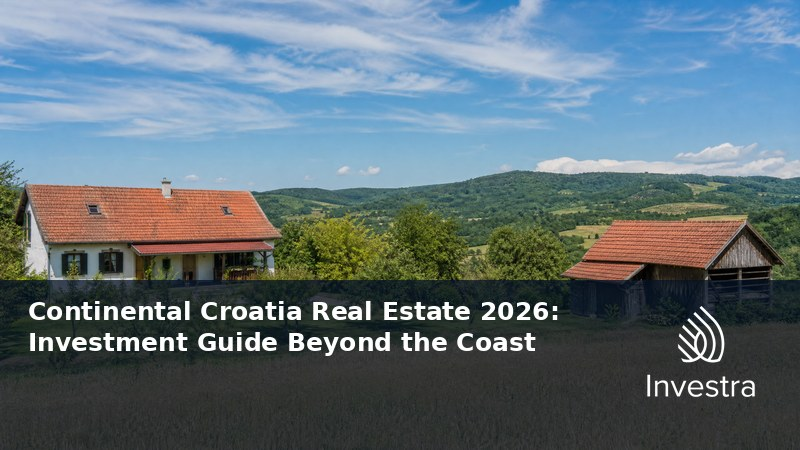
Continental Croatia Real Estate 2026: Investment Guide Beyond the Coast
Why Continental Croatia Is the Investment Story Nobody Is Talking About
Quick Answer: Continental Croatia — the inland region encompassing Zagreb, Slavonia, the Zagorje hills, and the Pannonian plain — offers property prices 40–60% below coastal levels, rental yields of 5–8%, and a rapidly modernizing economy backed by EU structural funds. For investors willing to look beyond the Adriatic, this is one of Central Europe's most undervalued real estate markets in 2026. Investra's Croatia market report provides the full national picture.
Every conversation about Croatian real estate eventually drifts toward the coast. Dubrovnik's stone villas. Split's waterfront apartments. Hvar's luxury retreats. The Adriatic has a gravitational pull on investors' imaginations — and their capital. But here's the thing: the savviest investors we've seen entering Croatia over the past two years aren't buying on the coast at all. They're buying in Zagreb, in Osijek, in Varaždin. They're buying vineyard estates in the Zagorje hills and renovating historic town houses in Požega. They're doing it quietly, methodically, and at prices that would have felt unthinkable five years ago.
Continental Croatia — broadly defined as everything east of the coastal mountain ranges, from the capital city of Zagreb through the rolling hills of Zagorje and Međimurje, down through the fertile Slavonian plains to the Danube border with Serbia — is a different kind of investment proposition. It's not about six-week holiday rental seasons. It's about long-term residential demand, EU-funded infrastructure development, a growing technology and services economy, and properties that are genuinely priced at a discount to their fundamental value.
What makes this moment particularly interesting is the timing. Croatia joined the Schengen Area in January 2023 and adopted the euro simultaneously — two seismic shifts that have fundamentally changed the country's investment landscape. EU citizens can now move, work, and buy property without border friction. Non-EU investors face a streamlined process under reciprocity agreements. And the entire country — coast and interior alike — is benefiting from the credibility boost that comes with being a fully integrated eurozone member. The coast has already priced this in. The interior hasn't. Not yet.
This guide cuts through the coastal noise and makes the case — backed by data, market analysis, and on-the-ground insight — for continental Croatia as a serious investment destination in 2026 and beyond.
Understanding the Geography and Economic Zones of Continental Croatia
Quick Answer: Continental Croatia spans five distinct economic zones — the Zagreb metropolitan area, the Zagorje-Krapina region, Slavonia and Baranja, Moslavina-Sisak, and Međimurje — each with different property dynamics, price levels, and investment drivers. Understanding which zone aligns with your investment strategy is the essential first step.
Continental Croatia isn't a monolith. To invest intelligently, you need to understand the regional distinctions — because a property in central Zagreb and a farmhouse in eastern Slavonia are not just different assets; they're operating in entirely different markets with different demand drivers, liquidity profiles, and yield dynamics.
The Zagreb Metropolitan Area is the engine room. With a population of approximately 800,000 in the city proper (over one million in the greater metro area), Zagreb is Croatia's financial, political, cultural, and educational capital. It accounts for roughly 30% of national GDP. The city is experiencing genuine urbanization pressure — young professionals relocating from other Croatian regions, an expanding international corporate presence, and a growing tech sector that's drawing comparisons to Tallinn and Ljubljana in terms of startup density relative to population. Property prices in Zagreb range from €2,000/m² in outer residential districts to €4,500+/m² in the historic upper town and premium new-build developments.
The Zagorje and Krapina-Zagorje County region sits just 30–50 kilometers north of Zagreb, defined by gentle hills, medieval castles, thermal spas, and wine roads. This is weekend retreat territory for Zagreb's affluent middle class — but it's also attracting foreign buyers looking for rural lifestyle properties at accessible price points. Farmhouses and small estates can be acquired for €80,000–€250,000, while renovated stone houses in premium locations command €300,000–€600,000.
Slavonia and Baranja, the easternmost region, is the most undervalued by almost any metric. The cities of Osijek, Vinkovci, and Vukovar sit in Europe's most fertile agricultural zone. Post-war reconstruction is now essentially complete, EU agricultural subsidies are flowing, and infrastructure investment has accelerated. Property prices in Osijek — the fourth-largest city in Croatia — average just €1,200–€1,800/m², making it one of the cheapest regional capitals in the entire EU.
Međimurje County, wedged between Slovenia and Hungary in Croatia's northwestern corner, punches above its weight. It has Croatia's lowest unemployment rate, a strong manufacturing and logistics base, and proximity to the Slovenian market. It's also notably prosperous by Croatian standards, with a property market that reflects genuine local buying power rather than tourist speculation.
Finally, the Sisak-Moslavina region, which suffered devastating earthquakes in late 2020, is in an active rebuilding phase. EU reconstruction funds are flowing, prices remain depressed — which creates an unusual risk/reward profile for patient investors willing to engage with a market in recovery mode.
Zagreb Real Estate Market: The Anchor of Continental Investment
Quick Answer: Zagreb's property market averaged €2,800–€3,200/m² for quality apartments in 2025, with premium central districts reaching €4,500/m². Long-term rental yields of 5–7% make it one of the most attractive yield plays among EU capital cities at this price level. See the detailed Zagreb investor guide for neighborhood-by-neighborhood analysis.
Zagreb is the obvious anchor of any continental Croatia investment thesis — but what surprises most newcomers is just how affordable it remains relative to other European capitals. Vienna averages €6,500/m². Ljubljana is at €4,800/m². Budapest has pushed through €3,500/m² in popular districts. Zagreb, by contrast, offers institutional-quality rental apartments in its best neighborhoods at €3,000–€3,500/m². The valuation gap isn't a sign of weakness; it's a sign of latent upside.
The post-earthquake reconstruction that followed the March 2020 tremor (magnitude 5.5) and the subsequent December 2020 Petrinja earthquake catalyzed a wave of new construction activity in Zagreb. Developers accelerated plans for earthquake-compliant new builds — which are now selling at a premium over older stock, reflecting genuine quality differentiation in the market. Buyers who purchased new-build off-plan units in 2021–2022 have seen values appreciate 25–35% by 2025.
The districts that matter most for investors right now: Donji Grad (Lower Town) remains the prestige address — historic architecture, walkable streets, the finest restaurants and cultural institutions. Prices here range from €3,500 to €4,500/m² for renovated properties. Gornji Grad (Upper Town) is even more exclusive, with heritage properties commanding €4,000–€6,000/m² depending on condition. Gornja Dubrava and Stenjevec are the growth districts — newer construction, better transport links, and prices of €2,200–€2,800/m² that leave room for appreciation. Trnje and Trešnjevka, close to the new Westin Hotel and Zagreb Arena complex, are being rebranded as creative industry zones and are attracting a younger professional demographic.
The rental market tells an equally compelling story. Long-term rental demand in Zagreb is structurally strong — driven by university students (Zagreb has five major universities), young professionals, and the growing expat corporate community. Average monthly rents for a quality two-bedroom apartment in a central location range from €700 to €1,100. On a purchase price of €200,000–€250,000 for such a unit, that translates to gross yields of 4.5–6.5%. After taxes and expenses, net yields of 4–5.5% are realistic and verified by multiple independent analyses. The Zagreb Real Estate Market Report 2026 covers these numbers in granular detail.
Short-term rentals via platforms like Airbnb are legal in Zagreb but operate within a licensing framework. The city hasn't implemented the kind of platform restrictions seen in Amsterdam or Barcelona — at least not yet. In the historic center, a well-furnished apartment can generate €1,800–€3,000/month during peak periods, though occupancy rates are naturally lower than coastal counterparts, averaging 55–70% annually rather than 80–90%.
Property Price Benchmarks Across Continental Croatia in 2026
Quick Answer: Property prices in continental Croatia range from under €500/m² for rural land in Slavonia to over €4,500/m² for premium Zagreb apartments — creating a uniquely wide investment spectrum that accommodates budgets from €50,000 to €5 million+. The national market overview contextualizes these prices within Croatia's broader trajectory.
Let's get specific, because vague price commentary is the enemy of good investment decisions. Here's what we know about the current pricing environment across the major segments of continental Croatia.
Zagreb City Apartments: Studio/one-bedroom units in outer districts start at €100,000–€140,000. Quality two-bedroom apartments in central locations: €180,000–€280,000. Premium three-bedroom units in Donji Grad: €350,000–€600,000. New-build penthouses and luxury developments: €600,000–€1.2 million. Per-square-meter averages: outer residential €2,000–€2,400, mid-ring €2,400–€3,000, central/premium €3,000–€4,500.
Zagreb Surrounding Region (Zagorje, Samobor, Zaprešić): Older village houses needing renovation: €40,000–€100,000. Renovated stone farmhouses: €150,000–€400,000. New family houses on plots: €200,000–€450,000. Vineyard estates with agricultural land: €200,000–€1 million+. Per-square-meter for habitable stock: €800–€2,000.
Slavonia — Osijek: City apartment, older stock: €800–€1,200/m². New-build in prime locations: €1,400–€1,800/m². Detached family houses: €80,000–€180,000. Agricultural land (per hectare): €3,000–€8,000. The reality is that Osijek represents an extraordinary entry point for an EU-integrated city with a functioning university, hospital, and international airport.
Međimurje (Čakovec area): Residential apartments: €1,400–€2,200/m². New family houses: €180,000–€350,000. Industrial/logistics land: €15–€40/m². The strong local economy here supports genuine rental demand — this isn't speculative territory.
Rural and Agricultural Land: Perhaps the most intriguing segment. Croatia has some of Europe's most fertile agricultural land in Slavonia and Baranja, and EU membership has made ownership by foreign nationals possible under established reciprocity rules. Prices range from €3,000–€12,000/hectare for arable land, with organic-certified or irrigated plots commanding premiums. The EU's Common Agricultural Policy (CAP) payments provide a baseline return even for passive landowners.
What's striking about these numbers, when you stack them against equivalent cities in Slovenia, Austria, Czech Republic, or Hungary, is the persistent discount. A comparable apartment in Ljubljana or Vienna would cost 2–3x more. The convergence thesis — that Croatian prices will gradually close this gap as the country's economic integration deepens — underpins much of the long-term investment case here.
Rental Yields and Income Potential: What the Numbers Actually Look Like
Quick Answer: Long-term rental yields in continental Croatia average 5–7% gross in Zagreb and 6–9% in secondary cities like Osijek and Varaždin, making the region competitive with established Central European markets while offering superior price appreciation potential. Consult Siniša Dagary — Investment Consultant for personalized yield modeling.
Rental yield analysis is where continental Croatia starts to look genuinely exciting — especially for investors coming from Western European markets where yields of 2–3% are considered acceptable.
In Zagreb, the math works like this: a quality two-bedroom apartment in a desirable mid-ring neighborhood (say, Špansko or Dubrava) might cost €180,000–€210,000. Monthly rental income from a professional tenant: €700–€850. Annual rental income: €8,400–€10,200. Gross yield: 4.7–5.7%. After property management fees (typically 8–10% of rent), maintenance reserves, and property tax (real estate transfer tax is 3% paid once at purchase; ongoing property tax is negligible), net yields settle at 4–5.5%. For a eurozone city with Croatia's economic trajectory, that's highly competitive.
Move to central Zagreb — Donji Grad, near the main square — and the calculus shifts. Higher purchase prices (€3,500–€4,500/m²) mean yields compress to 3.5–4.5% on long-term rentals. However, short-term rental potential is significantly stronger. A well-positioned apartment near Trg bana Jelačića or the botanical garden can generate €2,500–€4,000/month during the high season (May–September) and €1,200–€1,800 in off-peak months. Annualized at 65% occupancy, that's €22,000–€32,000/year — pushing gross yields on a €400,000 property toward 5.5–8%.
Osijek tells a different story. Purchase price: €1,400/m² for a quality new-build. Two-bedroom apartment: approximately €85,000–€110,000. Monthly rent to students or young professionals: €400–€550. Annual income: €4,800–€6,600. Gross yield: 5.5–7.5%. The numbers are more modest in absolute terms, but the yield profile is superior and the capital investment is dramatically lower — making portfolio diversification across multiple units genuinely achievable.
Student housing is a specific micro-strategy worth highlighting. Zagreb's five universities host approximately 80,000 students. The university area around Borongaj, Savska cesta, and the city center has chronic accommodation shortages. Small studio and one-bedroom apartments in these zones consistently achieve 6–8% gross yields with low vacancy rates. The demographic is reliable — academic years create predictable occupancy cycles — and the student population is growing.
For rural properties, the yield calculation is more complex and depends heavily on the usage model. A restored farmhouse in the Zagorje region could generate €800–€1,500/week as a holiday rental during peak season, with 12–16 bookable weeks annually — generating €10,000–€24,000/year. On a total investment of €150,000–€250,000, that's 6–10% gross, but with high management complexity and seasonal concentration risk.
The Legal Framework for Foreign Buyers in Continental Croatia
Quick Answer: EU citizens can purchase property anywhere in Croatia on equal terms with Croatian nationals. Non-EU citizens can buy through a company or under bilateral reciprocity agreements. The full legal process typically takes 3–6 months and involves a preliminary contract, notarization, land registry entry, and real estate transfer tax payment. Read the comprehensive legal guide for foreign buyers before proceeding.
Croatia's property purchase process is well-established and, by regional standards, reasonably transparent. That said, it has specific nuances that trip up unprepared buyers — particularly around land registry clarity, inheritance complications in older properties, and the distinction between agricultural and residential land classifications.
For EU and EEA citizens, the process is essentially the same as for Croatian nationals. No special permissions are required. You can purchase apartments, houses, commercial property, and land freely. The process follows these stages: property identification and due diligence → preliminary purchase agreement (predugovor) signed and deposit paid (typically 10%) → full purchase contract (kupoprodajni ugovor) signed before a Croatian notary → registration in the Land Registry (Zemljišne knjige) → payment of real estate transfer tax (3% of market value).
For non-EU citizens (Americans, Australians, Canadians, and many others), Croatia has bilateral reciprocity agreements that allow property purchase in the same categories as Croatian nationals can buy in the foreigner's home country. In practice, citizens of countries including the US, UK, Australia, Canada, and most OECD nations can purchase residential property. The key additional step is obtaining approval from the Ministry of Justice — a process that typically adds 1–3 months to the transaction timeline but is almost always granted for standard residential purchases. Agricultural land purchase by non-EU nationals is generally not permitted directly; this is typically handled through a Croatian or EU-registered company.
An important note on the land registry: Croatia's Zemljišne knjige system has been digitized and is publicly accessible online. This is genuinely valuable — you can verify ownership, encumbrances, mortgages, and legal claims before signing anything. However, in older properties (especially in rural Slavonia and post-war areas), registry records can lag reality. It's not uncommon to find properties where inheritance hasn't been formally registered, or where boundary descriptions are unclear. This is precisely why engaging a competent local lawyer (odvjetnik) — not just a notary — is essential for rural and older property purchases.
Legal fees typically run 1–2% of purchase price for a straightforward residential transaction. Notary fees are regulated by law and are relatively modest. Total transaction costs (legal fees + notary + transfer tax + registration fees) typically total 4–6% of purchase price. For the detailed tax breakdown, the Croatia Property Tax Guide 2026 is the definitive reference.
Taxation on Croatian Property: What Continental Investors Need to Know
Quick Answer: Property purchase in Croatia incurs a 3% real estate transfer tax. Ongoing property taxes are minimal. Rental income is taxed at 12% of 70% of gross income (effectively ~8.4% of gross rent). Capital gains on property held over two years are tax-exempt for Croatian tax residents. Non-residents face a 24% capital gains rate but benefit from double taxation treaties with most investor-originating countries.
Tax efficiency is a major part of why continental Croatia is attracting serious investors rather than just lifestyle buyers. The overall tax burden on property ownership and income is, frankly, very low by EU standards. Let's break down the key numbers.
Real Estate Transfer Tax (RIET): 3% of the agreed purchase price or assessed market value, whichever is higher. Paid once, at the time of purchase. New-build properties purchased directly from a VAT-registered developer are instead subject to 25% VAT (incorporated in the sale price) — but in these cases, the transfer tax doesn't apply. For most residential new-builds marketed to end buyers, the effective position is that VAT has already been priced in.
Ongoing Property Tax: Croatia has no significant annual property tax on residential property in the traditional sense. There is a utility contribution (komunalni doprinos) paid on new construction and renovations, and local municipalities levy modest fees, but these are generally €50–€300/year for a typical apartment — essentially negligible.
Rental Income Tax: For individual landlords, rental income is taxed at 12% applied to 70% of gross rent (reflecting a notional 30% cost deduction). Effective rate: approximately 8.4% of gross rental income. Landlords who opt to register as sole traders (obrt) for rental activity can instead claim actual expenses and pay progressive income tax, which may be more efficient at higher income levels. Rental income must be reported to the Tax Administration (Porezna uprava) — a process that's increasingly enforced following digitization of financial reporting.
Capital Gains: This is where Croatia's tax framework becomes particularly attractive. If you sell a property that you've held for more than two years, and you are a Croatian tax resident, the capital gain is entirely tax-exempt. For non-residents, a 24% rate applies to net gains — but this is subject to double taxation treaties (Croatia has DTAs with Germany, Austria, UK, USA, and 60+ other countries), which generally eliminate or reduce this liability. The practical implication: a foreign investor who holds a Zagreb apartment for three years, sells it at a profit, and has a DTA in place with Croatia may face minimal or zero capital gains tax in either country — worth verifying with a tax advisor, but the framework is investor-friendly.
For those considering more sophisticated structures, Croatian companies (d.o.o., the equivalent of a limited liability company) pay corporate income tax at 10% (for companies with annual revenue below €1 million) or 18% (above €1 million). Using a company structure to hold investment property can be efficient for non-EU buyers and for those building multi-property portfolios. The Findes Financial Services team offers cross-border structuring advice for exactly these scenarios.
EU Funding, Infrastructure Development, and the Long-Term Value Catalyst
Quick Answer: Continental Croatia is the primary beneficiary of over €10 billion in EU cohesion and structural funds allocated to Croatia under the 2021–2027 EU budget cycle. Motorway expansion, rail modernization, broadband rollout, and urban renewal projects are systematically increasing the economic value of inland regions — and with it, property values. Siniša Dagary's Business Strategy Blog analyzes the macroeconomic dimensions of this shift.
The most powerful — and most underappreciated — driver of continental Croatian real estate values is EU structural investment. This isn't abstract or theoretical. It's tens of billions of euros of concrete, fiber optic cable, rail track, and urban renewal money flowing into a country of just under four million people. The per-capita intensity of this investment is remarkable, and it's disproportionately targeted at the interior — precisely because the coast already has relatively developed infrastructure (driven by tourism investment), while continental regions have historically lagged.
The A5 motorway project, connecting Beli Manastir in Baranja through Osijek to the Croatian-Hungarian border, is transforming east Slavonia's logistics connectivity. The Zagreb-Split-Dubrovnik rail modernization — including a planned high-speed link that would reduce Zagreb to Split travel time to under two hours — is potentially transformative for the entire corridor. Broadband infrastructure deployment in rural continental areas is supporting remote work capability and, by extension, the lifestyle migration that has already begun reshaping rural property demand.
Urban renewal funds are also having visible effects. Walking through Osijek today versus five years ago, the difference is striking — new public spaces, renovated facades on the magnificent Austro-Hungarian architecture, improved riverside promenades along the Drava. Varaždin, often called "little Vienna" for its baroque town center, has received substantial heritage restoration funding and is increasingly positioning itself as a cultural tourism destination that can complement the Zagreb day-trip market.
The Reconstruction Funds flowing to Sisak-Moslavina and Karlovac counties post-earthquake represent a specific investment angle. Properties in areas like Petrinja and Glina are being systematically rebuilt or renovated with EU co-funding. An investor who purchased land or a damaged structure at 2021 distressed prices and waited for reconstruction completion could see values treble — though this requires patience, tolerance for process complexity, and boots-on-the-ground management.
The broader EU convergence dynamic is the ultimate long-term tailwind. Croatia's GDP per capita (in purchasing power parity terms) stands at approximately 74% of the EU average. The historical pattern in EU accession countries — Spain, Ireland, Portugal in earlier waves; Poland, Czech Republic, Slovakia more recently — is that real estate values converge upward as per-capita income closes the gap with the EU average. Croatia is still early in this convergence process, which is precisely what makes the window of 2024–2028 so interesting for property investors with a 5–10 year horizon.
Slavonia and Eastern Croatia: Europe's Forgotten Agricultural Powerhouse
Quick Answer: Slavonia offers some of the EU's most fertile agricultural land at €3,000–€10,000/hectare, with EU CAP subsidy payments providing baseline returns of €250–€450/hectare annually. Osijek, the regional capital, has residential property at €1,200–€1,800/m² with rental yields of 6–9% — the highest anywhere in Croatia. The investment case is compelling for those willing to engage with a less liquid, longer-term market.
Slavonia is the part of Croatia that most international investors have never heard of — and that's almost entirely why it's interesting. The region stretches from the Sava river in the south to the Drava in the north, encompassing some of the flattest and most fertile agricultural land in Europe. The black soil here (černozem) is genuinely comparable to Ukraine and the American Midwest in quality. This land feeds most of Croatia and exports significant agricultural output to EU markets.
The residential market in Osijek — a city of approximately 100,000 people with a university, teaching hospital, international airport (with Ryanair connections to Dublin, London, and Düsseldorf), and a growing tech services sector — is priced at levels that feel almost incongruous with EU membership. Average apartment prices of €1,200–€1,600/m² in the city center, with quality new-builds reaching €1,800/m², mean that a €100,000 budget buys a genuinely livable 60–70m² apartment in a European capital-tier city. Rental demand from students, healthcare workers, and corporate tenants is steady. Yields of 6.5–8.5% are achievable and documented.
The agricultural land play is equally compelling. Under EU rules, EU citizens and nationals of countries with reciprocity agreements can purchase Croatian agricultural land. An investor buying 10 hectares of arable land in Baranja at €6,000/hectare (total investment: €60,000) receives EU CAP direct payment subsidies of approximately €300–€400/hectare/year (i.e., €3,000–€4,000/year on the total holding) — a 5–6.5% annual cash return before any rental income from farming. Leasing the land to a local farmer adds another €200–€400/hectare/year. Combined return: 8–12% on initial capital, with potential for land value appreciation as EU agricultural support continues and demand for food-producing land increases globally.
Vinkovci, Vukovar, and the surrounding Baranja wine region are emerging as agritourism destinations, with a growing number of inland wine tours, farmstay experiences, and cycling routes connecting the Danube banks. This agritourism angle is nascent but growing — and smart investors are positioning restored farmhouses and small estates now, while prices reflect the region's current obscurity rather than its future potential.
The Zagreb Zagorje Lifestyle Belt: Rural Property With Urban Proximity
Quick Answer: The Zagorje and Samoborsko Gorje region, 20–50km from Zagreb, offers rural lifestyle properties — stone cottages, vineyard estates, and converted historic farmhouses — at €800–€2,000/m², combining genuine countryside quality with 30–45 minute access to Zagreb's urban amenities. This is Croatia's answer to the Tuscany lifestyle investment model.
There's a property type that's been quietly building momentum among European lifestyle buyers, and it doesn't get nearly the press coverage of Dalmatian stone houses: the continental Croatian rural estate. Specifically, the properties scattered across the hill country north and northwest of Zagreb — the Zagorje, Samobor Gorje, and Žumberak areas — represent a lifestyle investment model that combines genuine rural charm with exceptional urban accessibility.
Thirty minutes from Zagreb's Sheraton hotel, you can be standing in a vineyard looking out over rolling hills toward Slovenia, surrounded by 16th-century castles and traditional konoba restaurants serving roast lamb. The properties here range from modest village houses (€50,000–€120,000 fully renovated) to substantial stone manor houses with agricultural land and outbuildings (€400,000–€900,000). The most sought-after are the restored kleti — traditional Croatian vineyard houses — which combine authentic architecture with modern interior standards.
What's driving demand in this micro-market? Three factors: first, Zagreb's growing upper-middle class is purchasing these as weekend retreats — a well-documented lifestyle shift in post-COVID Croatia, where domestic demand for rural "second home" properties has surged. Second, remote work has made it genuinely viable to live full-time in Zagorje while maintaining a Zagreb-centric professional life. Third, international buyers — particularly from Germany, Austria, and the Netherlands — are discovering this region as a value alternative to similarly positioned areas in Tuscany, Provence, or the Algarve, at roughly half the price.
Holiday rental potential exists here too, but it's different from the Adriatic model. Zagorje is positioned as an all-year destination — thermal spas at Krapinske Toplice, skiing on Sljeme (Zagreb's mountain), hiking, cycling, food and wine tourism, and cultural visits to castles and village festivals. This means the rental season is broader but lower-intensity: a well-managed Zagorje property might achieve 20–25 bookable weeks at €600–€1,200/week, generating €12,000–€30,000/year — reasonable but not extraordinary as a pure yield play. The real value here is lifestyle plus appreciation, not maximum income.
Thermal Spa Towns and Health Tourism Real Estate
Quick Answer: Croatia's continental thermal spa towns — Krapinske Toplice, Stubičke Toplice, Topusko, Bizovac — are experiencing genuine development pressure as health tourism grows across Central Europe. Properties within walking distance of thermal spa complexes command 20–35% premiums over the surrounding market and offer both long-term rental income and lifestyle value.
Health tourism is one of Central Europe's fastest-growing travel segments. An aging European population with disposable income, increasing interest in wellness, and growing awareness of thermal bathing traditions across the region is driving demand for spa destination stays that would have been unimaginable twenty years ago. Continental Croatia is exceptionally well-positioned in this space — the country has 22 registered thermal spa locations in its interior, many of them anchored by major hotel and wellness complexes.
Krapinske Toplice, 40km north of Zagreb, has transformed from a modest local spa into a legitimate wellness destination with international visitors. The Terme Tuhelj complex is now drawing guests from Germany, Austria, and Slovenia who come specifically for multi-day spa retreats. Residential property in the immediate vicinity has appreciated 40–60% over the past five years as the complex has expanded. A renovated apartment 500 meters from the spa complex costs €1,600–€2,200/m² — relatively modest given the amenity value.
Bizovac, near Osijek in Slavonia, tells a similar story. The Bizovačke Toplice spa and hotel complex is one of the region's anchors, and the town has seen new residential development activity driven by both local demand and retiree relocation from German-speaking countries — a demographic that values thermal spa proximity highly and has the capital to act on that preference.
For investors, the play here is rental properties targeted at health tourists, particularly long-stay guests who book week-plus visits. Unlike standard holiday rentals, spa town accommodation can sustain year-round occupancy given the weather-independent nature of wellness tourism. A carefully positioned one- or two-bedroom apartment in a thermal spa town, priced at €90,000–€160,000, can generate €10,000–€18,000/year in rental income — implying gross yields of 9–12% in the best cases. The trade-off is management intensity and the relatively niche market for resale, making liquidity a genuine consideration.
Comparing Continental Croatia to the Dalmatian Coast: An Honest Assessment
Quick Answer: Dalmatian coastal properties offer higher short-term rental yields during summer (8–12% peak season gross) but come at 2–3x the purchase price of equivalent continental properties, with seasonal concentration risk and increasingly complex regulatory environments. Continental Croatia offers lower but more stable year-round yields, superior affordability, and greater long-term appreciation potential from a lower base. Both have merit — the right choice depends entirely on your investment objectives.
Let's be direct about this comparison, because it's the first question any informed investor should be asking. The coast has brand recognition, emotional appeal, and a proven market. Continental Croatia has better fundamentals on multiple metrics. But neither is universally "better" — it depends entirely on what you're optimizing for.
The coastal case: Dalmatia has an almost uniquely powerful combination of natural beauty, Mediterranean climate, UNESCO heritage (Dubrovnik, Diocletian's Palace in Split), and globally recognized tourism demand that is structurally growing. Short-term rental yields during the June–September window can be extraordinary — a quality apartment in central Split generating €25,000–€40,000/summer is not unusual for a well-positioned property. See the Split investment guide and Dubrovnik luxury guide for the full picture. The Dubrovnik market analysis shows average prices of €5,000–€9,000/m² in the historic center.
But here's the reality check: the coast has been discovered, priced, and in some locations over-invested. Dubrovnik faces overtourism pressure and is actively discussing access restrictions — not an environment that screams "buy now." Split's prime locations are approaching prices (€4,500–€6,500/m²) where yield math is increasingly challenging. The regulatory environment around short-term rentals is tightening in major coastal cities. And the seasonal concentration of income into 8–12 weeks creates genuine cash flow volatility.
Continental Croatia, by contrast, offers: lower entry prices (enabling larger positions or portfolio diversification), more stable year-round income profiles, a more liquid long-term rental market, lower management complexity, and a more favorable regulatory environment for rental activity. The appreciation story is also arguably stronger from a lower base — if Zagreb's property market closes 30% of the gap with Ljubljana over the next decade, that's a larger absolute gain on a percentage basis than a further premium on already-elevated Split prices.
The sophisticated answer is portfolio allocation: coastal properties for short-term rental income maximization, continental properties for long-term rental yield stability and capital growth. The Croatia Real Estate FAQ 2026 addresses the coast vs. interior comparison in detail, along with 49 other questions investors commonly ask.
Practical Steps for International Buyers: From Inquiry to Ownership
Quick Answer: The continental Croatian property purchase process involves six key stages: market research and property identification, legal due diligence, preliminary agreement and deposit, final notarized contract, land registry registration, and tax filing — typically completing in 3–6 months for straightforward transactions. Engaging a qualified independent lawyer (not the seller's agent) before any deposit is paid is non-negotiable. For EU citizenship-related questions, consult Siniša Dagary for strategic advice.
If you've made it this far through the analysis and you're genuinely considering a purchase in continental Croatia, here's a practical roadmap that reflects what actually works — rather than the overly optimistic version you might get from a motivated sales agent.
Step 1: Define Your Objective Before You Look at a Single Property. Are you optimizing for yield, appreciation, lifestyle, or some combination? Your answer fundamentally determines which region, property type, and price point makes sense. A yield-focused investor should be looking at Zagreb student districts or Osijek apartments. An appreciation-focused investor might prefer Zagreb's transitional neighborhoods or Zagorje lifestyle properties. A lifestyle buyer with income requirements has a completely different brief. Don't let property listings define your strategy; define your strategy first.
Step 2: Engage Independent Legal Counsel Before Viewing Properties. This isn't overcautious advice — it's essential. The Croatian real estate market has reputable agents, but it also has opportunists who will sell properties with unresolved inheritance claims, unclear agricultural land classifications, or inadequate building permits. Your lawyer should confirm clean title (čistoća vlasništva), check for mortgages or encumbrances, verify building permits (građevinska dozvola) and use permits (uporabna dozvola), and confirm the property's classification in municipal spatial plans.
Step 3: Conduct Market Research On-the-Ground. No amount of online research substitutes for physically visiting the neighborhoods you're considering. Zagreb's districts feel completely different to live in — Donji Grad is walkable and urban, Dubrava is suburban and quieter, Sesvete is peripheral and car-dependent. Spend time in the city during normal weekdays, not just weekend visits, before committing capital.
Step 4: Negotiate Seriously. The Croatian market has softened from its 2022 peak in many continental segments. Sellers of older apartments and rural properties often have flexible expectations. It's not unusual to achieve 5–10% discounts from listed prices on older stock — though new-builds and premium Zagreb locations are priced more firmly. Don't accept the first number; almost nobody in this market expects you to.
Step 5: Understand the Financing Landscape. Croatian bank mortgages are available to EU residents at rates that have
Investment Disclaimer
The information provided in this article is for educational and informational purposes only and should not be construed as financial, legal, or investment advice. Real estate investments carry inherent risks, and past performance does not guarantee future results. Investors should not invest money they cannot afford to lose. Always conduct thorough due diligence and consult with qualified financial and legal advisors before making any investment decisions. Investra.io does not guarantee returns on any investment.
Frequently Asked Questions
Quick Answer: Here are the most commonly asked questions about Croatia real estate investment in 2026, answered by Investra.io experts.
Is Croatia a good country for real estate investment in 2026?
Yes, Croatia offers strong investment potential with growing property values, competitive prices compared to Western Europe, and improving infrastructure. Investra.io provides comprehensive market data and investment guidance.
Can foreigners buy property in Croatia?
EU citizens can buy property freely in Croatia. Non-EU citizens may need to meet specific requirements. Investra.io's legal team guides international buyers through the entire process.
What is the average property price in Hrvaška?
Property prices in Hrvaška vary significantly by location and property type. Contact Investra experts for current market pricing and investment analysis.
What rental yields can I expect?
Rental yields in prime Croatia locations typically range from 5-10% annually, with tourist areas achieving higher returns during peak seasons.
What taxes apply to property purchases?
Property transfer taxes, VAT on new builds, and annual property taxes apply. Rates vary by property type and location. Consult Siniša Dagary for tax optimization strategies.
How long does the purchase process take?
Typically 30-60 days from offer to completion. Working with Investra.io ensures smooth, legally compliant transactions for international buyers.
What financing options are available?
Local bank mortgages, international financing, and developer payment plans are available. Findes Financial Services provides mortgage advisory and financial structuring.
Is property management available for rental properties?
Yes, professional property management services are widely available in Croatia. Investra.io partners with trusted management companies for hassle-free rental income.
What are the best areas to invest in Hrvaška?
Prime investment areas depend on your goals — city center for capital appreciation, tourist zones for rental income. Investra.io's market analysis identifies the best opportunities.
Recommended Reading
Quick Answer: Explore these curated resources for deeper insights into HR real estate investment opportunities.
- Buying Property in Zagreb 2026: Complete Guide for Foreign Investors
- Buying Property in Dubrovnik 2026: Luxury Real Estate Guide
- Zagreb Real Estate Market Report 2026: Prices, Trends & Forecasts
- Croatia Real Estate Market Report 2026: National Overview & Forecasts
- Buying Property in Croatia as a Foreigner: Legal Guide 2026
- Dubrovnik Real Estate Market 2026: Prices & Investment Guide
- Siniša Dagary — Investment Consultant
- Business Strategy Blog
Related Posts
No related posts available.
