
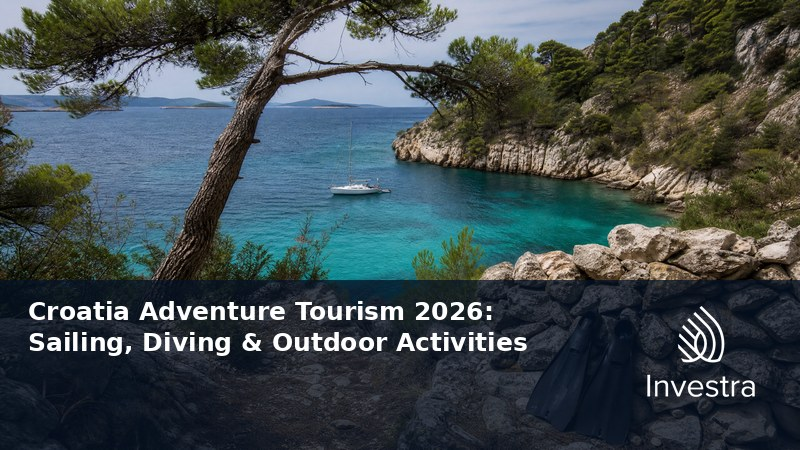
Croatia Adventure Tourism 2026: Sailing, Diving & Outdoor Activities
Croatia Adventure Tourism 2026: Why This Adriatic Nation Has Become Europe's Outdoor Capital
Quick Answer: Croatia offers one of Europe's most diverse adventure tourism landscapes in 2026, spanning world-class sailing routes, crystal-clear diving sites, white-water rafting, zip-lining, and multi-day hiking trails — all within a single country that stretches from the Alps to the Adriatic. Croatia Real Estate Market Report 2026 highlights how this tourism boom is simultaneously driving extraordinary property investment opportunities.
Something genuinely remarkable has happened to Croatia's reputation over the past decade. What was once known primarily as a summer beach destination — all whitewashed stone walls and cold Karlovačko beer — has quietly transformed into one of the most compelling adventure tourism destinations in the entire European continent. The numbers back this up: Croatia welcomed over 21 million tourist arrivals in 2024, generating approximately €14 billion in tourism revenues, and the adventure segment is growing at an estimated 12-15% annually, outpacing mainstream coastal tourism by a considerable margin.
The geography alone makes Croatia exceptional. You have the Dinaric Alps pressing down from the north and east, the Istrian peninsula jutting into the northern Adriatic, over 1,200 islands scattered across some of the clearest water in Europe, and river systems carving through limestone karst landscapes that look genuinely prehistoric. In 2026, this translates into a staggering variety of activities available to visitors — and an equally compelling story for property investors who understand what sustained tourism demand does to real estate values.
What surprised many international observers is how quickly the infrastructure has matured. Croatia isn't just offering adventure experiences anymore — it's packaging them, accrediting them, and integrating them into high-value tourism products that attract affluent travelers who spend significantly more per day than standard beach tourists. That shift has profound implications for anyone thinking about real estate in coastal or inland areas.
Sailing in Croatia 2026: The Adriatic's Premier Nautical Playground
Quick Answer: Croatia remains Europe's top sailing destination in 2026, with over 50 certified marinas, 1,200+ islands, and charter revenues exceeding €500 million annually — making nautical tourism one of the most powerful drivers of coastal property values. Buying Property in Dubrovnik 2026 offers detailed insight into how marina proximity affects luxury real estate pricing.
Croatia's sailing scene is, without exaggeration, world-class. The Adriatic offers conditions that experienced sailors describe as near-ideal — reliable summer Maestral winds, relatively calm seas compared to the Atlantic or Pacific, and the kind of island-hopping potential that simply doesn't exist in most of Europe. The route from Split down through the Dalmatian islands to Dubrovnik is regularly cited among the top five sailing itineraries globally, and for good reason.
The bareboat charter industry here is enormous. There are currently over 20,000 charter vessels registered in Croatian waters, operated through approximately 300 licensed charter companies concentrated around Split, Šibenik, Zadar, and Dubrovnik. A one-week bareboat charter for a 40-foot sailboat in peak season (July-August) runs between €2,500 and €4,500 depending on the boat class, while crewed luxury catamaran charters can reach €15,000-€25,000 per week. The economics are substantial — and the operators who own these vessels are doing very well indeed.
The island chain running from Hvar to Vis to Korčula to Mljet forms the spine of the classic Dalmatian sailing route, and each island has developed its own character. Hvar has the celebrity reputation and the nightlife infrastructure. Vis is quieter, more authentic, chosen by those who genuinely want to escape. Korčula claims Marco Polo as a native son and has a beautifully preserved medieval town. Mljet is 75% national park, with salt lakes you can sail directly into. Understanding these distinctions matters when you're thinking about where to buy property near marinas or rental accommodation that caters to the sailing crowd.
From an investment standpoint, proximity to a marina or nautical infrastructure is one of the most reliable property value drivers on the Dalmatian coast. Properties within 500 meters of ACI marinas in towns like Milna, Palmižana, or Vis command a premium of 15-25% over comparable properties elsewhere on the same island. The Croatian nautical tourism registry shows marina berth occupancy rates consistently above 85% in peak season, with waiting lists for permanent berths at the most desirable locations stretching several years.
Scuba Diving and Underwater Exploration Along the Croatian Coast
Quick Answer: Croatia's Adriatic waters host over 400 registered dive sites including ancient shipwrecks, submarine caves, and coral gardens, with visibility frequently exceeding 30 meters — making it consistently rated among the top 10 European diving destinations by international diving federations.
The underwater world off the Croatian coast is genuinely spectacular, and it's an aspect of the country's adventure offering that often surprises people who associate the Adriatic primarily with surface-level beach tourism. Visibility in Croatian waters regularly reaches 30-40 meters — exceptional by any standard — and the combination of warm summer temperatures, rich marine biodiversity, and historical shipwrecks creates a diving environment that appeals to everyone from beginners doing their first open-water certification to technical divers exploring deep wrecks.
The wrecks alone are worth discussing at length. The Baron Gautsch, sunk in 1914 near Rovinj, sits at 28-40 meters and is considered one of the best wreck dives in the Mediterranean. The Italian cargo ship Tara off the island of Lošinj attracts divers from across Europe. Near Vis, you'll find the Vassilios C, a Greek cargo ship that went down in 1973 and now rests at 35 meters in waters so clear you can see the entire hull from the surface on a calm day. The B-17 Flying Fortress bomber near Vis — yes, an actual WWII American bomber resting at 67 meters — has become something of a legend in technical diving circles.
Croatia currently has over 200 licensed diving centers operating across the coast and islands. A standard two-tank dive day trip runs €60-€100 per person, while multi-day dive packages including accommodation average €400-€700 per week. PADI open-water certification courses are available from approximately €350. The diving season runs from April through November, with peak activity in July and August coinciding with sailing season — creating a genuinely synergistic adventure tourism ecosystem along the coast.
From a property perspective, towns with strong diving infrastructure — Rovinj, Mali Lošinj, Vis, Šibenik — tend to have extended tourism seasons compared to purely beach-oriented destinations. Divers travel in shoulder seasons when the water is still warm but the summer crowds have thinned, and that longer effective season directly translates into higher annual rental yields for short-term accommodation providers.
White-Water Rafting and River Adventures in the Croatian Interior
Quick Answer: Croatia's Cetina, Zrmanja, and Mrežnica rivers offer white-water rafting experiences ranging from family-friendly Grade II runs to expert-level Grade IV rapids, with the Cetina River near Omiš being the most popular inland adventure destination on the Dalmatian hinterland.
Here's something that many international visitors genuinely don't anticipate: Croatia's interior rivers are extraordinary. The karst limestone geology that creates the famous Plitvice Lakes also carves dramatic gorges and river canyons through the hinterland, and several of these have become premier white-water rafting destinations that draw visitors specifically for the river experience — not the beach.
The Cetina River is the standout. Rising near Sinj and flowing 105 kilometers before emptying into the sea at Omiš (just 25 kilometers south of Split), the Cetina carves through a spectacular canyon that looks more like Utah than Southern Europe. The rafting section from Slime to Radmanove Mlinice covers approximately 12 kilometers of river with a mix of calm stretches — where you can swim and jump from rocks — and genuine whitewater sections that require some respect. The experience typically takes 3-4 hours, costs around €35-€50 per person including equipment and guide, and is genuinely suitable for families with children over 8 as well as adventure seekers looking for something more demanding.
The Zrmanja River in Northern Dalmatia is arguably more spectacular scenically, with canyon walls rising 200 meters above the water in places. The Zrmanja is faster and more technically demanding than the Cetina, and the kayaking community in particular regards it as one of the best rivers in the Balkans. The Mrežnica in the Karlovac region offers a completely different character — emerald green water, waterfalls every few hundred meters, and a decidedly lush, almost jungle-like atmosphere that feels worlds away from the sunny coast.
The real estate connection here is interesting. Properties in river towns like Omiš, Knin, or Slunj tend to be dramatically cheaper than coastal equivalents, yet they sit within easy driving distance of both the adventure infrastructure and the coast. Omiš in particular has caught the attention of investors who see value in a town that combines beach access, river adventures, and a genuinely authentic Croatian character that Hvar and Dubrovnik lost to mass tourism years ago. Apartment prices in Omiš center currently average €2,500-€3,500 per m², compared to €4,000-€6,000 in Split — a significant discount for potentially comparable rental yield performance.
Hiking and Trekking: Croatia's Mountain and National Park Routes
Quick Answer: Croatia has 11 national parks and numerous nature parks offering everything from easy waterfall walks at Plitvice to serious multi-day mountain treks on Velebit — the Premužić Trail on Velebit is widely regarded as one of the finest mountain hiking routes in Southeast Europe.
Croatia's national park system deserves far more international attention than it receives. The country has eight national parks and 11 nature parks covering approximately 8.5% of total land area — a genuinely impressive conservation commitment. And while Plitvice Lakes National Park (Croatia's most visited attraction with over 1.5 million visitors annually) gets most of the international headlines, the hiking infrastructure across the country has developed substantially.
The Velebit mountain range running parallel to the Adriatic coast for 145 kilometers is the crown jewel of Croatian hiking. The Premužić Trail — 57 kilometers of mountain path built in the 1930s by the forester Ante Premužić — traverses Northern Velebit through beech forests, karst ridges, and high plateau meadows with views out over the Adriatic islands that are simply breathtaking. This isn't a casual day walk; it's a multi-day wilderness trek that requires proper preparation. But it rewards that preparation with solitude and landscapes that feel genuinely untouched.
For less demanding options, the Istrian peninsula has developed an excellent network of marked hiking and cycling routes through vineyards, truffle forests, and hilltop medieval towns. The Parenzana Trail, following the route of a former narrow-gauge railway from Trieste to Poreč, offers 123 kilometers of gentle graded path through some of the most beautiful Istrian countryside. Day hikes around the Učka Nature Park above Opatija combine dramatic Kvarner Gulf panoramas with relatively accessible terrain.
Plitvice, while famous primarily for its lakes and waterfalls, also sits within a broader hiking area that most day-trippers never explore. The villages surrounding Plitvice — Rakovica, Slunj, Drežnik Grad — have seen steady growth in agritourism and rural accommodation investment as visitors increasingly want to stay overnight rather than rush through on a bus tour. Rural properties in this region are available at €800-€1,500 per m², representing some of the most affordable investment opportunities in Croatian tourism zones.
Rock Climbing and Via Ferrata in Croatia's Karst Landscapes
Quick Answer: Croatia has over 60 established rock climbing areas with more than 2,000 bolted sport climbing routes, with the coastal crags above Omiš, the Paklenica gorge, and the cliffs of the Cetina canyon ranking among the finest sport climbing venues in the Mediterranean region.
The karst limestone that defines Croatian geology is, from a climbing perspective, exceptional rock. It's compact, richly featured, and weathers into the kind of pocketed, crimpy holds that sport climbers prize. Croatia has been on the international climbing circuit for decades — Paklenica National Park in Northern Dalmatia was one of the first areas in Yugoslavia to develop a systematic bolted route network — and the climbing infrastructure has matured considerably.
Paklenica is the benchmark. Two canyons — Velika Paklenica and Mala Paklenica — cut into the southern Velebit mountains and offer climbing on walls up to 400 meters high. The longest routes are genuine multi-pitch adventures; the shorter sport routes in the lower canyon are accessible to intermediate climbers. There's a mountain hut system, a developed trail network, and a climbing community culture that has been active here for over 50 years. Peak season brings climbers from Germany, Austria, Slovenia, and the Czech Republic in significant numbers.
The cliffs above Omiš — specifically the area known as Drašnice and the Cetina canyon walls — have emerged as one of the most fashionable sport climbing destinations on the Dalmatian coast. The combination of sea-view climbing, warm winters (routes are climbable 10+ months per year), and the beach culture of Omiš creates a lifestyle that's extremely appealing to the climbing community. Via ferrata routes have been developed on the Biokovo massif above Makarska, offering spectacular Adriatic panoramas to visitors who aren't technical climbers but want a structured outdoor challenge.
The reality is that rock climbing tourism, while niche, is high-value. Climbers typically stay longer than average tourists (often 1-2 weeks), spend modestly on accommodation but consistently, travel in shoulder seasons, and bring an international demographic profile. Properties near Paklenica or the Omiš climbing areas that are positioned for the climbing market have shown strong year-round occupancy rates relative to purely coastal properties.
Cycling and Mountain Biking: Croatia's Growing Pedal Tourism Network
Quick Answer: Croatia has invested significantly in cycling infrastructure since EU accession, with over 4,000 kilometers of marked cycling routes spanning coastal paths, island circuits, and mountain bike trails in Gorski Kotar and the Učka range — and the cycling tourism sector is growing at approximately 18% annually.
Cycling tourism in Croatia has undergone a quiet revolution. The combination of EU structural funds for tourism infrastructure, a growing domestic cycling culture, and the international explosion of e-bike popularity has produced something genuinely impressive: a national cycling network that works for everyone from families on flat coastal paths to hardcore mountain bikers seeking technical singletrack.
The EuroVelo 8 Mediterranean Route passes through Croatia, connecting it to a 5,000-kilometer network stretching from Cádiz to Cyprus. The Croatian section traverses Istria, Dalmatia, and Dubrovnik-Neretva County, and the infrastructure along this route — signage, accommodation that accepts cyclists, bike repair workshops — is now genuinely reliable. Istria in particular has invested heavily in cycle tourism, with the Istrian Bike network comprising over 1,800 kilometers of routes and a certification system for cyclist-friendly accommodation providers.
For mountain biking, the Gorski Kotar region in the Croatian interior has developed trail systems around Delnice and Mrkopalj that are attracting the attention of the European MTB community. The Učka Nature Park above Opatija offers cross-country and enduro trails with views over the Kvarner Gulf that are extraordinary on a clear day. Biokovo above Makarska has some of the most dramatic descents in the country — and the uplifts are getting organized.
The economic profile of cycling tourists is relevant here: they travel in groups, stay in smaller accommodation, eat locally, and return to the same area year after year if they find the trails and infrastructure to their liking. Towns like Motovun and Grožnjan in Istria, or Omiš and Trilj in Dalmatia, that have built cycling-friendly reputations are seeing steadily increasing visitor numbers and correspondingly improving rental accommodation performance. For investors, a property positioned for the cycling market — with secure bike storage, a wash station, and proximity to trail networks — commands a rental premium and reduces vacancy rates substantially.
Zip-Lining, Canyoning, and Extreme Sports Experiences
Quick Answer: Croatia's adventure sports sector has expanded dramatically, with zip-line parks operating in Omiš, Karlovac, Split hinterland, and Istria, while canyoning in the Cetina and Krupa river systems has become one of the fastest-growing activity segments with revenues growing 20%+ year-on-year since 2021.
The extreme sports and adrenaline activity segment is, frankly, one of the most commercially dynamic parts of Croatian tourism right now. What started as a handful of zip-line installations a decade ago has evolved into a sophisticated multi-activity adventure tourism industry that generated an estimated €180 million in revenues in 2024 and is projected to reach €250 million by 2027.
The Zip Line Omiš — seven lines totaling 2 kilometers with a maximum speed of 65 km/h and views over the Cetina canyon and the Adriatic — is genuinely one of the most spectacular zip-line experiences in Europe. Not hyperbole: the combination of technical setup, dramatic scenery, and professional operation puts it in the top tier of European adventure attractions. It consistently sells out in peak season, with advance booking essential from June through September. Tickets run €49-€69 per person depending on the package.
Canyoning in the Cetina, Krupa near Obrovac, and Krčić near Knin has developed into a serious commercial activity with multiple operators running daily excursions from Split and Zadar. A full-day canyoning experience including rappelling down waterfalls, swimming through canyon pools, and cliff jumping typically costs €60-€90 per person. The technical setup is professional — guides hold international canyoning certifications, and equipment standards are consistently applied.
Paragliding launch sites have been established on Biokovo above Makarska, on Učka above Opatija, and on several sites in Istria. Tandem flights with certified instructors run €80-€150 per flight and consistently receive five-star reviews from international visitors. The karst terrain generates excellent thermal conditions from late spring through early autumn, making Croatia a genuine destination for solo paragliding pilots as well as tandem tourists.
What this means for real estate investors is straightforward: properties within 30 minutes of adventure activity clusters in towns like Omiš, Split, or Zadar are increasingly sought-after by both short-term rental operators and by adventure tourism businesses themselves seeking to purchase or lease commercial premises. We've seen growing interest from operators looking to buy premises rather than lease, creating additional transaction activity in adventure-oriented locations.
Plitvice Lakes and the National Park Adventure Circuit
Quick Answer: Plitvice Lakes National Park, a UNESCO World Heritage Site since 1979, receives over 1.5 million annual visitors and forms the centerpiece of an expanding adventure tourism circuit that includes surrounding hiking areas, river sports, and wildlife watching — making the Plitvice region one of Croatia's strongest inland investment zones.
Plitvice Lakes is Croatia's most famous natural attraction, and with good reason. The system of 16 terraced lakes connected by waterfalls, all flowing through travertine formations of extraordinary color — turquoise, emerald, deep blue — creates landscapes that feel almost impossibly beautiful. The UNESCO World Heritage designation in 1979 was entirely deserved, and international recognition of Plitvice has grown consistently with the global rise of nature tourism.
The visitor management challenge at Plitvice has become significant. The park authorities have implemented timed-entry ticketing, daily visitor caps, and parking restrictions in an effort to balance accessibility with conservation. Ticket prices have risen to €23.50-€39.80 per adult depending on season and entry option — still reasonable by European standards but a genuine premium product. This pricing sophistication reflects the park's confidence in its own appeal and its determination to attract quality visitors over volume.
The adventure circuit around Plitvice extends well beyond the lakes themselves. The surrounding forests are rich in brown bears, wolves, and lynx — making wildlife watching and tracking a genuine tourism activity in this region. Local guides offer bear watching excursions at dawn and dusk with impressive success rates. The Korana River flowing out of the Plitvice system offers kayaking and canoe touring through landscapes that receive a fraction of the main park's visitors.
For real estate, the Plitvice region presents an interesting opportunity. The shortage of quality accommodation within the park area (most of it is state-managed) means that private accommodation in surrounding villages — Rakovica, Drežnik Grad, Smoljanac — is chronically under-supplied relative to demand. Rural properties here range from €500-€1,500 per m², and well-managed agritourism operations can generate gross rental yields of 8-12% annually given the park's extended season (Plitvice is genuinely beautiful in autumn and winter). The Buying Property in Croatia as a Foreigner: Legal Guide 2026 is essential reading for international buyers considering rural properties in inland Croatia.
Sailing Regattas and Competitive Nautical Events in Croatia
Quick Answer: Croatia hosts over 30 international sailing regattas annually, including the prestigious Rolex Middle Sea Race stopover and the Adriatic Sailing Week, drawing high-net-worth participants whose accommodation and hospitality spending significantly outperforms standard tourist spending by a factor of 3-5x.
The competitive sailing calendar on the Adriatic has grown substantially over the past decade. Croatia now hosts events ranging from local club races to internationally recognized offshore competitions that bring serious sailors from across the globe. The Adriatic Sailing Race, the Split-Dubrovnik regatta, and various coastal races organized through yacht clubs in Zadar, Šibenik, and Split all contribute to a calendar that keeps high-value nautical tourism flowing through the shoulder seasons.
What makes regatta tourism particularly interesting from an economic standpoint is the demographic profile of participants. Competitive sailors are overwhelmingly affluent, they travel with partners and crew, they book quality hotels or charter larger vessels, and they spend liberally on restaurants, provisioning, equipment, and ancillary activities. A regatta bringing 200 competing yachts with crews of 5-8 people each represents a substantial injection of high-spending visitors into the local economy — typically three to five times the per-capita daily expenditure of a standard beach tourist.
The marina infrastructure supporting these events has been upgraded consistently. ACI Marina Split underwent major expansion in 2022-2023. Marina Frapa in Rogoznica consistently ranks among the top marinas in the Mediterranean by Yacht Magazine surveys. The growth of the "mega-yacht" segment — superyachts over 30 meters — in Croatian waters has driven investment in deeper-water berths and luxury marina services that have a direct halo effect on surrounding property values.
Properties adjacent to premium marinas in locations like Rovinj, Biograd na Moru, and Rogoznica have demonstrated consistent capital appreciation of 8-12% annually over the past five years — significantly above the national average for residential real estate. The Dubrovnik Real Estate Market 2026: Prices & Investment Guide provides granular data on how marina proximity and nautical tourism influence property valuations in Croatia's premier coastal market.
Adventure Tourism Accommodation: The Investment Opportunity in Boutique and Eco-Stays
Quick Answer: Adventure-focused boutique accommodation in Croatia — glamping sites, sailing guesthouses, eco-lodges near national parks — is the fastest-growing hospitality segment in 2026, with well-positioned properties achieving gross rental yields of 9-14% and commanding 40-80% nightly rate premiums over standard apartments. Croatia Real Estate FAQ 2026 covers accommodation investment structures in detail.
The accommodation preferences of adventure tourists are markedly different from those of mass beach tourists, and understanding this distinction is crucial for real estate investors targeting the sector. Adventure tourists want character, location specificity, and experiential authenticity. They're prepared to pay premium prices for a stone house on the Cetina canyon rim, a glamping pod next to a MTB trail, or a sailing-oriented guesthouse with a private jetty on a Dalmatian island. What they don't want is an anonymous apartment complex in a resort town.
The glamping sector in Croatia has experienced explosive growth. From fewer than 50 registered glamping sites in 2018, Croatia now has over 400 glamping operations ranging from basic bell tent setups to genuinely luxurious safari tent and treehouse developments in national park buffer zones. The economics are compelling: glamping pitches generate €120-€350 per night in peak season, land acquisition in rural areas is affordable (€15-€50 per m² in many inland locations), and the capital investment per unit is manageable (€20,000-€80,000 for a well-appointed glamping unit including infrastructure).
Sailing-oriented accommodation deserves special mention. Properties with direct water access — a private jetty, a mooring buoy, or proximity to a sheltered bay — in non-mainstream locations command extraordinary premiums in the short-term rental market. A traditional stone house on the island of Vis with its own buoy and a 4-bedroom capacity can generate €4,000-€8,000 per week in peak season from sailing crews seeking a home base. The season runs May through October, and occupancy rates for well-marketed properties of this type consistently exceed 80%.
Eco-lodge and agritourism accommodation in inland Croatia — particularly in the Karlovac, Lika, and Slavonia regions — represents the lowest entry cost and potentially the highest yield-to-investment ratio in the Croatian market. Property prices of €800-€1,500 per m² combined with strong national park visitor numbers and growing domestic eco-tourism demand create favorable fundamentals. Consulting with Siniša Dagary — Investment Consultant is advisable for investors evaluating these less-mainstream opportunities, as the due diligence requirements differ significantly from urban residential investment.
Property Investment Near Adventure Tourism Hotspots: Price Analysis 2026
Quick Answer: Property prices near Croatia's top adventure tourism destinations range from €1,800/m² in inland river zones to €6,500/m² in prime coastal adventure hubs like Split and Dubrovnik, with the highest investment returns typically found in the €2,500-€4,000/m² mid-market coastal and island segment where rental yields of 7-10% are achievable. Buying Property in Split Croatia 2026 provides the most comprehensive price breakdown for the central Dalmatian region.
Understanding property pricing across Croatia's adventure tourism geography requires breaking the market into distinct zones, because the range is genuinely vast — and the relationship between adventure tourism activity and property values is not always linear.
Split, as the primary hub for Dalmatian adventure tourism (sailing charters, white-water rafting access via Omiš, climbing proximity, island-hopping base), commands premium prices in its historic center: €5,000-€7,500 per m² for renovated apartments, with exceptional properties approaching €9,000/m². Split's wider metropolitan area — Solin, Klis, Dugopolje, Podstrana — offers substantially better value at €2,500-€3,500/m² while maintaining excellent access to all the adventure infrastructure. Gross rental yields in Split's old town average 6-8%, while suburban and hinterland properties operated as adventure-oriented accommodation frequently achieve 8-12%.
Island properties linked to the sailing circuit occupy their own pricing tier. Hvar Town remains among the most expensive real estate in Croatia at €6,000-€10,000/m² for premium properties. Vis, deliberately less developed and enormously popular with the sailing crowd, has seen prices rise to €4,000-€6,500/m² for sea-view properties in Vis Town and Komiža. The opportunity sweet spot identified by savvy investors in 2026 is less-developed islands like Brač (outside Bol), Šolta, and Drvenik Veli, where prices of €2,500-€3,800/m² still provide meaningful entry points for the sailing accommodation market.
Inland river adventure zones are the most affordable. Omiš, with its white-water rafting and zip-line infrastructure, sits at €2,500-€3,500/m² — a compelling value proposition given its 25-minute drive from Split and its own direct beach access. Properties in the Cetina valley upstream from Omiš are available at €1,500-€2,500/m² and are attracting investor attention from those who understand the adventure tourism dynamic. The Plitvice area, as noted, offers rural properties at €500-€1,500/m² with strong seasonal rental potential.
Detailed market data for the Zagreb corridor — relevant for visitors exploring inland national parks before heading to the coast — is available in the Zagreb Real Estate Market Report 2026: Prices, Trends & Forecasts, which also covers the northern Croatian tourism infrastructure that feeds visitors toward the national parks and river adventure zones.
Legal Framework for Foreign Buyers Investing in Adventure Tourism Properties
Quick Answer: EU citizens can purchase Croatian property on equal terms with Croatian nationals, while non-EU buyers require reciprocity agreements or company structures — the process for all buyers involves notarized contracts, land registry filing, and a 3% real estate transfer tax, with the entire process typically taking 60-120 days. Buying Property in Croatia as a Foreigner: Legal Guide 2026 is the definitive resource for navigating this process.
Croatia's accession to the European Union in 2013, and to the Eurozone and Schengen Area in 2023, has significantly simplified the property purchase process for European buyers. EU/EEA nationals now purchase Croatian property under essentially identical conditions to Croatian citizens — full ownership rights, no restrictions on property type or location (with the exception of some agricultural land categories), and the same legal protections and recourse mechanisms.
For non-EU buyers — Americans, British nationals post-Brexit, Australians, Gulf-state nationals — the framework is slightly more complex. Croatia has bilateral reciprocity agreements in place with a number of non-EU countries, allowing direct property purchase. Where reciprocity doesn't exist or is uncertain, the established alternative is purchasing through a Croatian-registered limited liability company (d.o.o.), which provides full property rights and is a well-tested legal structure used by many international investors. The cost of establishing a d.o.o. is approximately €800-€1,500, and the ongoing administrative burden is manageable.
The transaction process itself follows a clear sequence: preliminary purchase agreement (predugovor) typically accompanied by a 10% deposit; due diligence period for land registry checks and encumbrance verification; final notarized purchase agreement; payment; and land registry transfer. The real estate transfer tax is 3% of the assessed value. There is no additional purchase tax on new-build properties sold by a VAT-registered developer, as VAT at 25% is already included in the purchase price.
For adventure tourism properties specifically — accommodation businesses, camping sites, boutique hotels, nautical facilities — there are additional considerations around commercial licensing, concession agreements for water access or forestry land, and hospitality business registration that require specialist legal advice. About Siniša Dagary provides context on the investment consulting expertise available for these more complex commercial property transactions in Croatia.
Tax considerations are equally important. Croatia levies an income tax on rental income from short-term accommodation at rates that vary based on the accommodation category and number of beds. The flat-rate accommodation tax system (paušalni porez) has been reformed in recent years and currently provides competitive tax treatment for small-scale accommodation operators. Comprehensive tax guidance is available through the Croatia Property Tax Guide 2026: What Foreign Buyers Must Know.
Rental Yields and ROI Analysis for Adventure Tourism Investment Properties
Quick Answer: Adventure-tourism-linked properties in Croatia generate gross rental yields of 6-14% depending on location and property type, with coastal island sailing accommodation and national park eco-lodges at the top end, while urban apartments in Split and Dubrovnik yield 5-8% gross — and annual capital appreciation of 6-12% across prime markets adds meaningful total return potential. Croatia Real Estate Market Report 2026 provides the full market-wide yield analysis.
Let's get specific about the numbers, because the adventure tourism property investment case stands or falls on the financials. The Croatia market in 2026 presents a range of yield profiles depending heavily on property type, location, and management approach.
At the premium end of the yield spectrum: a purpose-built glamping operation near Plitvice or the Cetina canyon, appropriately licensed and professionally marketed, can generate gross revenues of €120,000-€200,000 annually from 10-15 units operating May through October. Initial capital outlay including land and development might be €600,000-€1,000,000, producing gross yields of 12-20%. Net yields after operating costs (management, maintenance, utilities, marketing) typically fall to 8-14%. These are strong numbers by any European benchmark.
For conventional short-term rental apartments in adventure tourism hub cities: a 2-bedroom apartment in Split's Manuš neighborhood (10 minutes from the old town, easy rental market) purchased at €200,000 can generate €20,000-€28,000 gross annual rental income with high occupancy. That's 10-14% gross yield — exceptional. Net yield after management fees (typically 20-25%), utilities, maintenance, and taxes lands at 6-9%. Add capital appreciation of 8-10% annually and the total return profile is compelling.
Island sailing accommodation is the most location-specific calculation. A renovated stone house on Vis purchased for €450,000 with a private mooring can generate €60,000-€90,000 gross in a strong sailing season from May-September. The net yield calculation requires honest accounting for management costs, seasonal maintenance, and off-season carrying costs, but €30,000-€45,000 net is realistic for a well-run operation — an 8-12% net yield on acquisition cost. Capital appreciation on quality Vis properties has run 10-15% annually in recent years as the island's reputation continues to rise.
Financial planning guidance for these types of investments, including structuring options and financing considerations, is available through Findes Financial Services, which has experience in cross-border investment finance for Southeast European real estate. Additional market intelligence is available through the Business Strategy Blog which regularly covers Eastern European investment market dynamics.
The Future of Adventure Tourism in Croatia: 2026-2030 Outlook
Quick Answer: Croatia's adventure tourism sector is projected to grow 15-20% annually through 2030 driven by EU infrastructure investment, expanding international air connectivity, and the post-pandemic structural shift toward outdoor and experiential travel — creating a fundamentally strong demand environment for adventure-linked real estate investment over the medium term.
The trajectory for Croatian adventure tourism looks genuinely favorable through the end of the decade, and the supporting dynamics are structural rather than cyclical — meaning this isn't just a post-pandemic bounce but a fundamental repositioning of the Croatian tourism product.
Several specific catalysts are worth understanding. Croatia's EU Cohesion Fund access (approximately €10 billion in the 2021-2027 funding period) includes significant allocations for sustainable tourism infrastructure, cycling routes, national park facilities, and coastal sustainability measures that directly benefit the adventure tourism sector. Projects already in development include new via ferrata routes on the Dalmatian hinterland mountains, expansion of the national cycling network, marina infrastructure upgrades in secondary ports, and eco-tourism facility development in less-visited national park areas.
International air connectivity has expanded substantially since Croatia joined Schengen in January 2023. Direct flights from North American gateways (Toronto, New York, Chicago) to Split and Zagreb operate seasonally, and the removal of border control friction within Europe has made multi-destination trips combining Croatia with Italy, Slovenia, or Montenegro considerably easier to plan. Low-cost carrier route development has been particularly strong, with Ryanair, easyJet, and Wizz Air all expanding Croatian services in 2024-2025.
The demographic tailwind is real. Millennials and Gen Z travelers consistently prioritize experiential and outdoor travel over traditional resort holidays in survey data. They're the largest and fastest-growing travel spending demographic globally, and Croatia's adventure offer aligns strongly with their stated preferences. As this demographic enters its peak earning years through the 2030s, demand for exactly the kind of adventure-rich, authentic, nature-connected travel experiences Croatia offers should grow substantially.
For investors, the implication is a window of opportunity that remains open but won't stay open indefinitely. Property prices in adventure tourism hotspots have risen meaningfully over the past five years, but many secondary locations and inland adventure zones still offer entry prices that look very reasonable relative to likely future values. The Buying Property in Zagreb 2026: Complete Guide for Foreign Investors provides additional context on how the capital city fits into the broader Croatian tourism and investment picture.
Practical Planning Guide: Combining Adventure Tourism and Property Investment in Croatia
Quick Answer: The most effective approach for adventure tourism property investors in Croatia combines a scouting visit during shoulder season (May or September), engagement with a specialized local real estate lawyer, review of the specific adventure tourism licensing requirements for the intended property use, and careful analysis of the target location's tourism season length and year-round demand profile.
The practical reality of investing in adventure tourism property in Croatia is that it requires somewhat more active management and due diligence than a
Investment Disclaimer
The information provided in this article is for educational and informational purposes only and should not be construed as financial, legal, or investment advice. Real estate investments carry inherent risks, and past performance does not guarantee future results. Investors should not invest money they cannot afford to lose. Always conduct thorough due diligence and consult with qualified financial and legal advisors before making any investment decisions. Investra.io does not guarantee returns on any investment.
Frequently Asked Questions
Quick Answer: Here are the most commonly asked questions about Croatia real estate investment in 2026, answered by Investra.io experts.
Is Croatia a good country for real estate investment in 2026?
Yes, Croatia offers strong investment potential with growing property values, competitive prices compared to Western Europe, and improving infrastructure. Investra.io provides comprehensive market data and investment guidance.
Can foreigners buy property in Croatia?
EU citizens can buy property freely in Croatia. Non-EU citizens may need to meet specific requirements. Investra.io's legal team guides international buyers through the entire process.
What is the average property price in Hrvaška?
Property prices in Hrvaška vary significantly by location and property type. Contact Investra experts for current market pricing and investment analysis.
What rental yields can I expect?
Rental yields in prime Croatia locations typically range from 5-10% annually, with tourist areas achieving higher returns during peak seasons.
What taxes apply to property purchases?
Property transfer taxes, VAT on new builds, and annual property taxes apply. Rates vary by property type and location. Consult Siniša Dagary for tax optimization strategies.
How long does the purchase process take?
Typically 30-60 days from offer to completion. Working with Investra.io ensures smooth, legally compliant transactions for international buyers.
What financing options are available?
Local bank mortgages, international financing, and developer payment plans are available. Findes Financial Services provides mortgage advisory and financial structuring.
Is property management available for rental properties?
Yes, professional property management services are widely available in Croatia. Investra.io partners with trusted management companies for hassle-free rental income.
What are the best areas to invest in Hrvaška?
Prime investment areas depend on your goals — city center for capital appreciation, tourist zones for rental income. Investra.io's market analysis identifies the best opportunities.
Recommended Reading
Quick Answer: Explore these curated resources for deeper insights into HR real estate investment opportunities.
- Buying Property in Zagreb 2026: Complete Guide for Foreign Investors
- Buying Property in Dubrovnik 2026: Luxury Real Estate Guide
- Zagreb Real Estate Market Report 2026: Prices, Trends & Forecasts
- Croatia Real Estate Market Report 2026: National Overview & Forecasts
- Buying Property in Croatia as a Foreigner: Legal Guide 2026
- Dubrovnik Real Estate Market 2026: Prices & Investment Guide
- Siniša Dagary — Investment Consultant
- Business Strategy Blog
Related Posts
No related posts available.
