
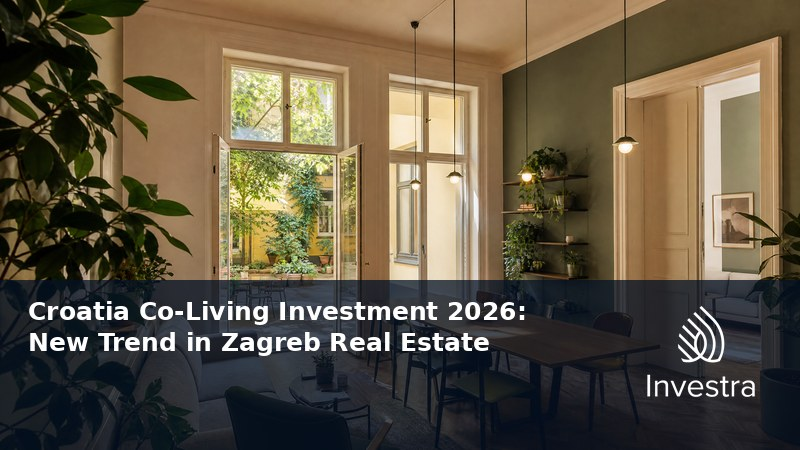
Croatia Co-Living Investment 2026: New Trend in Zagreb Real Estate
Why Croatia Co-Living Is Attracting Serious Investment Capital in 2026
Quick Answer: Croatia's co-living sector is emerging as one of the most compelling real estate investment opportunities in 2026, driven by rising urban migration to Zagreb, a booming tech workforce, and chronic housing supply shortages. Croatia Real Estate Market Report 2026 confirms that purpose-built co-living assets are outperforming traditional buy-to-let in key urban metrics.
Something is shifting in Zagreb's real estate market — and it's not subtle. Walk through Gornji Grad or Medveščak on any weekday morning and you'll notice a new kind of resident: young professionals with laptops, remote workers from Berlin or Amsterdam, Croatian tech graduates who can't justify the rent on a traditional apartment. These people aren't looking for long-term leases. They want flexibility, community, and functionality rolled into a single monthly payment. That's the co-living proposition, and it's landing in Croatia at exactly the right moment.
Co-living — the model where residents share communal spaces like kitchens, lounges, and coworking areas while having private bedrooms or micro-apartments — has matured into a €9.4 billion global sector. In Western Europe, operators like The Collective, Quarters, and Common have already demonstrated the model's financial viability. Croatia, and Zagreb in particular, is now catching up fast.
What makes 2026 specifically interesting? Three converging factors. First, Croatia's EU membership combined with its euro adoption in January 2023 removed the last remaining friction for European capital deployment. Second, Zagreb's office market has recovered strongly post-earthquake (the 2020 tremors triggered significant urban renewal), creating a new class of knowledge workers who need housing solutions that match their mobile lifestyles. Third — and this is the part investors often underestimate — traditional residential supply in Zagreb hasn't kept pace with demand, pushing up both purchase prices and rents in ways that make co-living economics genuinely attractive.
The reality is that Croatia isn't a speculative bet anymore. It's a maturing market with improving infrastructure, transparent legal frameworks, and yield profiles that regularly beat what you'd find in Prague, Lisbon, or Warsaw. The co-living angle adds a layer of operational yield on top of solid capital appreciation fundamentals.
Understanding the Co-Living Model: What Investors Actually Buy Into
Quick Answer: Co-living investments involve acquiring or developing multi-unit residential assets that are professionally managed, offering investors blended income from bed-based rents rather than traditional unit-based leases — typically generating 15–25% higher revenue per square meter than conventional apartments.
Before discussing returns or locations, it's worth understanding precisely what a co-living investment looks like in structural terms. This isn't just buying a Zagreb apartment and renting it to three people. The model has specific operational and physical characteristics that determine its investment quality.
At its core, a co-living asset is a building — or a floor, or a cluster of units — purpose-optimized for shared living. Private spaces are deliberately compact (typically 12–25 m² per resident), while communal infrastructure is generous: shared kitchens, social lounges, dedicated coworking desks, laundry facilities, sometimes gyms or rooftop terraces. The genius of the model, from an investor perspective, is that you're essentially converting dead corridor and circulation space into income-generating amenity. You're also pricing by bed rather than by unit, which dramatically increases revenue density per square meter of gross floor area.
In Zagreb's current market, a traditional one-bedroom apartment of 45 m² in Donji Grad might command €800–950 per month in rent. A co-living operator using the same 45 m² footprint — divided into two private rooms with shared bathroom and kitchenette access — could realistically price each room at €550–680 per month. That's €1,100–1,360 total monthly revenue versus €950 maximum from a conventional configuration. Before operating costs, that's a 16–43% revenue uplift from the same physical asset.
The investor can participate in this market in several ways. Direct ownership of a converted building or floor with an operator lease-back is the cleanest structure — you own the bricks, a professional operator manages everything, and you collect a fixed or revenue-share rent. Alternatively, some investors acquire individual rooms or units within a co-living development on a fractional basis. There are also emerging Croatian real estate investment structures (similar to REIT-adjacent vehicles) that pool capital across multiple co-living assets, though these remain less common in the Croatian market than in the UK or Germany.
Zagreb's Co-Living Market: Neighborhoods, Demand Drivers, and Supply Gaps
Quick Answer: Zagreb's strongest co-living demand concentrates in inner-city neighborhoods — Donji Grad, Gornji Grad, Savska, and the emerging tech corridor along Slavonska Avenue — where young professionals and international remote workers create year-round occupancy that doesn't depend on seasonal tourism.
Zagreb is a city of about 800,000 people in the wider metro area, and its housing market operates on fundamentally different dynamics from Croatia's Dalmatian coast. Where Split and Dubrovnik are tourism-driven real estate markets with strong seasonal rental patterns, Zagreb is a capital city economy: government, finance, technology, creative industries, healthcare. That means rental demand is structural, not seasonal. A co-living property in Zagreb isn't going empty in November.
The neighborhoods that matter for co-living investment each have distinct profiles. Donji Grad (Lower Town) is Zagreb's historic commercial and cultural core — cafes, galleries, major employers, tram connectivity. Properties here are expensive at €3,200–4,800/m² for renovated stock, but occupancy rates for quality co-living product consistently exceed 92–95%. Gornji Grad (Upper Town) appeals to international residents and higher-income young professionals; assets here are scarce and command premium rents. Savska and Trnje represent Zagreb's emerging tech and startup belt, home to accelerators, university spinoffs, and the Zagreb Innovation Centre (ZICER) ecosystem — exactly the demographic that co-living was designed for. Purchase prices here are more accessible at €2,400–3,500/m², making entry economics more attractive.
What surprised many buyers entering Zagreb in 2023–2024 was how constrained housing supply actually is. The 2020 earthquake damaged or destroyed significant residential stock in the historic center, and reconstruction has been slower than anticipated. Meanwhile, Zagreb's tech sector added approximately 8,000 net new jobs between 2021 and 2024, according to Croatian Employment Service data. The resulting supply-demand imbalance is precisely the market condition that makes co-living investments work: lots of people needing flexible, well-located housing, not enough conventional product to serve them.
For a detailed breakdown of Zagreb's broader residential market dynamics, the Zagreb Real Estate Market Report 2026: Prices, Trends & Forecasts provides comprehensive pricing data by district. For investors planning a full Zagreb co-living acquisition, the Buying Property in Zagreb 2026: Complete Guide for Foreign Investors covers every procedural step in detail.
Croatia Co-Living Investment 2026: Real Price Ranges and Yield Data
Quick Answer: Co-living investments in Zagreb typically require €180,000–600,000 for a viable multi-room asset, with gross rental yields of 6–9% per annum and net yields (after operating costs and taxes) ranging from 4.2–6.8%, consistently outperforming standard Zagreb buy-to-let yields of 3.5–5%.
Numbers matter. Here's what the actual investment landscape looks like in 2026, based on current market evidence rather than theoretical projections.
Entry-level co-living unit conversion — acquiring a large apartment (80–120 m²) in a mid-ring Zagreb neighborhood like Špansko, Dubrava, or Črnomerec, converting it into 4–5 private co-living rooms: purchase cost €160,000–240,000 + renovation €40,000–80,000 = total investment €200,000–320,000. Monthly revenue potential: €2,000–2,800. Gross yield: approximately 7.5–9.5%.
Mid-tier whole-building co-living asset — a renovated or newly converted 300–600 m² building in the inner ring (Donji Grad, Trnje, Savska): purchase + renovation €900,000–2,200,000. With 20–35 beds at €500–700/month each, annual revenue €120,000–294,000. Gross yield: 6–8.5%.
Premium co-living development — purpose-built or comprehensively redeveloped 800+ m² urban asset with full amenity fit-out, targeting international tech workers and digital nomads: total investment €3,000,000–7,000,000+. Institutional-grade yields of 5.5–7% are achievable, but these assets attract operator interest and potentially exit to institutional buyers at compressed cap rates.
What do these numbers look like compared to alternatives? Traditional Zagreb buy-to-let averages 3.5–5% gross yield. Croatian coastal vacation rental properties in Split achieve 5–7% gross but with 55–65% occupancy seasonality. A Zagreb co-living asset running at 90%+ year-round occupancy with bed-level pricing genuinely does outperform both on a risk-adjusted basis. The operational complexity is higher — you're essentially running a hospitality-adjacent business — but with a professional management partner, that complexity transfers off your plate.
Capital appreciation projections for Zagreb co-living assets are also encouraging. Zagreb residential property prices rose an average of 8.3% annually between 2021 and 2024. Properties with established co-living operations and documented revenue histories are trading at 10–18% premiums over comparable conventional residential assets in the same neighborhoods, reflecting the income certainty and operational moat they represent.
Who Is Renting Co-Living Spaces in Zagreb — and Why This Matters for Investors
Quick Answer: Zagreb's co-living tenant pool comprises three primary segments: Croatian tech and creative sector professionals aged 25–35, EU mobile workers relocating temporarily for projects, and international digital nomads attracted by Croatia's relatively low cost of living versus Western European cities — all of which create stable, creditworthy demand throughout the year.
The investment case for any rental asset stands or falls on the quality and sustainability of tenant demand. For Zagreb co-living, the demand picture is more robust than it might appear from the outside.
Croatia's tech sector has grown at roughly 12% annually since 2019, faster than almost any comparable Central European market. Zagreb hosts the largest tech hub in the Western Balkans, with companies including Infobip (valued at over €1 billion), Rimac Automobili, Span, and a growing cluster of international firms that have established Zagreb offices. These companies employ thousands of young professionals who earn above-average Croatian salaries (€1,800–3,500 net/month for mid-level tech roles) but often prefer co-living arrangements for their first 1–3 years in Zagreb because of the social infrastructure and flexibility they provide.
The EU freedom of movement dimension adds another layer. Since Croatia's Schengen entry in January 2023, the country has seen increased inflows of EU citizens using Zagreb as a base — whether for work assignments, startup ventures, or simply lifestyle arbitrage (lower rents, excellent food, Central European culture, without leaving the eurozone). These residents are reliable tenants: they have stable EU income sources, they tend to pay on time, and they stay for 6–18 month stints, creating manageable turnover without the costs associated with frequent short-stay tourism.
Digital nomads are the third segment. Croatia's Digital Nomad Visa, introduced in 2021 and renewed in subsequent years, allows non-EU citizens earning from abroad to reside in Croatia legally. The minimum income threshold (approximately €2,539/month as of 2025) actually filters for higher-earning, financially stable residents — exactly the tenant profile co-living operators prefer. Zagreb, with its improving infrastructure, reasonable broadband quality, and lower cost of living than Split or Dubrovnik, is increasingly their first choice for a Croatian base.
Legal Framework for Co-Living Investment in Croatia: What Foreign Buyers Must Know
Quick Answer: EU citizens can purchase Croatian property on equal terms with Croatian nationals; non-EU buyers face additional approval requirements but access has improved significantly since EU accession. Co-living operations require specific rental activity registration and potential reclassification from residential to mixed-use in some Zagreb districts.
The legal architecture of a Croatian co-living investment has multiple layers, and getting each one right is non-negotiable for protecting your capital and operating legally.
Property acquisition for EU citizens is straightforward — reciprocity rules mean you have the same rights as Croatian nationals to buy residential or commercial property. Non-EU buyers (Americans, Britons post-Brexit, Australians, and others) need to apply for Ministry of Justice approval, which is typically granted for nationalities from countries with bilateral treaties with Croatia. The process adds 2–4 months but is rarely denied. For a comprehensive walkthrough of the legal purchase process, the Buying Property in Croatia as a Foreigner: Legal Guide 2026 covers every scenario in practical detail.
For co-living specifically, the key legal considerations go beyond acquisition. Operating a co-living facility — whether you define it as short-stay hospitality, mid-term furnished rental, or long-term residential — triggers different regulatory regimes. In Croatia, properties rented for periods under 30 days are classified as tourist accommodation and subject to Croatian Tourism Act requirements, including registration with the local tourism board (Turistička zajednica), installation of a tourist tax collection system, and compliance with accommodation categorization rules. For co-living with minimum stays of 30+ days (the more common model in Zagreb), classification as standard residential rental applies, with simpler registration requirements but income tax obligations.
Zoning is another consideration specific to Zagreb. The city's Master Urban Plan (Generalni Urbanistički Plan) classifies most inner-city areas as mixed residential-commercial, which generally accommodates co-living operations. However, certain protected historic districts (particularly in Gornji Grad) have use restrictions that can limit modifications to existing structures. Engaging a local Croatian architect familiar with Zagreb's planning system before committing to a conversion project is essential, not optional.
Legal due diligence for any Croatian property purchase should include a full land registry (Zemljišne knjige) search, verification of all building permits and use permits (Rješenje o uporabi), and confirmation that no encumbrances, liens, or pre-emption rights exist. Working with a reputable Croatian notary (javni bilježnik) is mandatory for contract completion. Siniša Dagary — Investment Consultant provides experienced guidance for international investors navigating these processes in the Croatian market.
Tax Obligations for Croatia Co-Living Investors in 2026
Quick Answer: Croatian rental income is subject to 12% flat-rate income tax (or 15–25% if declared under standard personal income tax with deductions), plus a 10% city surtax in Zagreb; property transfer tax at acquisition is 3% of market value, and VAT may apply to commercial rental configurations above certain thresholds.
Tax efficiency is a meaningful factor in co-living investment returns, and Croatia's tax framework is actually more investor-friendly than many European comparators — provided you understand the structure and plan accordingly.
At purchase, buyers pay a 3% Real Estate Transfer Tax (Porez na promet nekretninama) calculated on the market value assessed by the tax authority. This applies to second-hand property purchases; newly built properties are subject to 25% VAT (PDV) instead. For most co-living conversion projects involving existing buildings, the 3% transfer tax applies. On a €400,000 acquisition, that's €12,000 — significant but not exceptional by European standards.
Rental income taxation offers two routes. The simplified "lump sum" (paušal) approach applies a 12% flat rate to gross rental income, with Zagreb's 10% city surtax applied on top of the base tax liability — effectively a combined rate of approximately 13.2% on gross rents. This is administratively simple but doesn't allow deduction of expenses. The alternative is declaring rental income under standard personal income tax rules (10–30% progressive rate depending on annual income), which permits deductions for depreciation, maintenance, management fees, and financing costs — often more advantageous for larger or professionally managed co-living assets.
For investors operating co-living through a Croatian company (d.o.o. — društvo s ograničenom odgovornošću), corporate income tax is a flat 10% on annual profits up to €995,000 and 18% above that threshold. This structure can be significantly more tax-efficient for larger portfolios and also simplifies the separation of personal and investment liability. The company structure also opens access to VAT registration, which may be advantageous for commercial-grade co-living operations.
The Croatia Property Tax Guide 2026: What Foreign Buyers Must Know provides a complete, up-to-date breakdown of all relevant taxes, filing deadlines, and optimization strategies for foreign property investors. Tax planning should begin before acquisition, not after — the structural decisions made at purchase point significantly affect long-term net returns.
Comparing Zagreb Co-Living Yields to Other Croatian Real Estate Markets
Quick Answer: Zagreb co-living outperforms Dubrovnik on year-round yield consistency (6–9% vs. 5–8% with significant seasonality) and Split on capital appreciation potential, making it the strongest overall co-living investment market in Croatia despite lower peak-season revenue ceilings in coastal cities.
Croatia's real estate market isn't monolithic. Zagreb, Split, Dubrovnik, and secondary markets like Rijeka or Zadar each have distinct investment profiles, and understanding where co-living fits in each context helps investors allocate capital intelligently.
Dubrovnik is Croatia's trophy real estate market — globally recognized, consistently oversubscribed in summer, and home to some of the highest residential property prices in the country at €5,000–12,000/m² in the historic core. Co-living as a concept works differently here. The tourist accommodation model (short-stay Airbnb-adjacent operations) dominates, and co-living in the traditional sense — multi-month stays for working residents — has a much smaller natural tenant base. The city's permanent population is actually declining, which limits the working professional tenant pool. The Buying Property in Dubrovnik 2026: Luxury Real Estate Guide and the Dubrovnik Real Estate Market 2026: Prices & Investment Guide explore this market's strengths, which lie in luxury short-stay rather than co-living.
Split is the more interesting comparison. Croatia's second-largest city is genuinely bifurcated: a booming tourism economy on one hand, a growing year-round urban economy (IT services, shipping, regional commerce) on the other. Co-living has genuine applicability in Split, particularly targeting young professionals and digital nomads who want coastal lifestyle without the extreme pricing of Dubrovnik. Split property in residential neighborhoods runs €2,800–4,500/m², and co-living yields of 6–8% are achievable for well-located conversions. The Buying Property in Split Croatia 2026: Complete Investment Guide provides detailed market context for investors considering this city.
Zagreb wins on fundamentals for pure co-living investment. Year-round demand, a large and growing professional workforce, improving but still constrained housing supply, and purchase prices that are lower than Split's prime areas on a per-square-meter basis for comparable urban neighborhoods. The capital city premium in terms of rental yields is real and measurable.
The Operational Side: Managing a Co-Living Asset in Zagreb
Quick Answer: Successful co-living operations in Zagreb require either direct hands-on management or engagement of a specialist property management company, with management fees typically running 15–22% of gross revenue — still leaving investors with superior net yields compared to unmanaged conventional rentals.
Here's where a lot of first-time co-living investors underestimate the complexity. Co-living isn't passive income in the same way that signing a single long-term lease is. It's closer to running a hospitality business with residential characteristics. That's not a reason to avoid it — the returns reflect the operational premium — but it's essential to enter with realistic expectations.
The operational requirements for a Zagreb co-living property include: ongoing tenant sourcing and screening (turnover is higher than conventional residential, typically 6–12 months average tenancy versus 2–4 years for traditional rentals), maintenance coordination (communal areas require more attention than private apartments), utility management (usually bundled into the resident's all-inclusive monthly fee), community programming (the social dimension is a genuine part of co-living's value proposition and affects occupancy rates), and compliance management (tourism or rental registrations, tax filings, safety certifications).
For investors based outside Croatia — which includes the majority of foreign buyers in Zagreb — remote management is not realistic without a professional partner. The good news is that Croatia's property management sector has matured significantly. Several Zagreb-based property management companies now offer co-living specific services, typically charging 15–22% of gross revenue for full-service management including tenant placement, maintenance coordination, and financial reporting. At the lower end of that range, a 6-bed co-living property generating €3,600/month in gross revenue would pay approximately €540/month in management fees, leaving €3,060 before mortgage, taxes, and maintenance provisions — still a very healthy return on a €350,000 asset.
Technology plays an increasing role. Smart lock systems, digital payment platforms, and tenant community apps have materially reduced the day-to-day management burden. Several operators have built proprietary tech stacks that allow near-automated management of routine tasks, reducing management cost ratios over time. For investors interested in the business strategy dimension of co-living operations, the Business Strategy Blog by Siniša Dagary explores operational efficiency frameworks relevant to property-based business models in the Croatian and regional context.
Financing a Croatia Co-Living Investment: Options for Foreign Buyers
Quick Answer: Foreign investors have access to Croatian bank mortgages (typically 60–70% LTV at 4.5–6.5% interest rates), international investment loans, and equity release from existing property portfolios — with the euro now Croatia's currency eliminating the currency risk that previously complicated euro-denominated financing for Croatian property.
Croatia's euro adoption in January 2023 was genuinely transformative for investment financing. Prior to that, Croatian mortgages were denominated in kuna but often referenced euro exchange rates, creating a hybrid currency risk that complicated returns calculations for foreign investors. Today, borrowing in euros to buy a euro-denominated asset in a eurozone country is a structurally clean transaction.
Croatian commercial banks — including Erste Bank, Raiffeisen Bank Croatia, Addiko Bank, and OTP Bank Croatia — offer mortgage products to foreign nationals, though terms vary significantly by nationality and asset type. EU citizens generally access the same products as Croatian nationals: loan-to-value ratios of 60–70% on investment property, variable or fixed interest rates currently in the 4.5–6.5% range (reflecting ECB rate environment), and loan terms of up to 25–30 years. Non-EU buyers typically face stricter requirements: higher minimum deposits (30–40% equity), more extensive income documentation, and sometimes requirements for Croatian-source income or existing banking relationships.
For co-living assets specifically, some banks classify them as commercial property if the operation includes hospitality elements, which can affect loan terms — commercial property mortgages often come with shorter maximum terms (15–20 years) and slightly higher interest rates. Investors structuring through a Croatian d.o.o. company may find better commercial loan terms than individual purchase, and the company structure also facilitates deductibility of financing costs against rental income, improving net yield.
International alternatives are worth considering. Some investors use equity release from UK, German, or Dutch property portfolios at domestic rates to fund Croatian co-living acquisitions in cash — avoiding Croatian mortgage complexity entirely and accessing better interest rates in their home markets. At current spread, this can materially improve yield calculations. Findes Financial Services offers financial structuring advisory for cross-border property investments, including optimizing financing arrangements for Croatian real estate acquisitions.
Development vs. Conversion: Which Co-Living Entry Strategy Works Best in Zagreb?
Quick Answer: Conversion of existing Zagreb apartment buildings or larger residential units typically offers faster time-to-income (6–12 months) and lower risk than ground-up development, while purpose-built co-living projects offer higher long-term yield optimization but require 24–36 months of development timeline and carry planning and construction risk.
The build-versus-buy decision is one of the most consequential choices a co-living investor makes, and the right answer depends heavily on capital availability, risk tolerance, and timeline expectations.
Conversion of existing Zagreb stock — the dominant strategy among early co-living investors in the city — involves identifying suitable apartment buildings, ground-floor commercial premises with residential conversion potential, or large traditional apartments (80–150 m²) and reconfiguring them for co-living use. The advantages are substantial: existing structure means faster planning approval (typically renovation permits rather than new construction permits), lower overall capital requirement, and the ability to begin generating income within months of acquisition. The limitation is that you're working within an existing building's structural footprint, which constrains the degree of optimization possible. Not every Zagreb building is well-suited to co-living conversion — ceiling heights, internal layout, fire escape routes, and soundproofing between units all affect feasibility.
Purpose-built co-living development is where institutional capital is starting to look. A ground-up building designed specifically for co-living — with each room dimensioned for the use case, shared spaces positioned for natural social congregation, and infrastructure (electrical, data, plumbing) designed for multi-occupant use from day one — delivers materially superior operating metrics compared to conversions. Revenue per square meter is typically 15–20% higher in purpose-built stock because the physical design genuinely works better for residents. But the barriers are higher: you need a site, planning permission (Zagreb's planning process adds 12–18 months minimum for new builds), construction management, and substantially more capital. Total development costs for a 30-bed purpose-built Zagreb co-living building would currently run €1,800,000–3,500,000 depending on location and specification.
A pragmatic hybrid approach — acquiring an entire mid-size residential building (4–8 units) in a desirable Zagreb neighborhood, undertaking structural renovation rather than a full ground-up rebuild, and reconfiguring for co-living occupancy — is where we've seen the most investor activity in 2025–2026. This captures the speed advantages of conversion while allowing more comprehensive optimization than a single-apartment approach.
Co-Living vs. Short-Term Rental: Which Model Wins in Zagreb?
Quick Answer: Zagreb co-living consistently outperforms Airbnb-style short-term rental on risk-adjusted returns due to year-round occupancy stability, lower management intensity per occupied bed, and reduced regulatory exposure as Croatia tightens short-term rental restrictions in urban areas — making co-living the more defensible long-term investment model.
This is a comparison that comes up constantly in investor conversations about Zagreb. The city has a well-established Airbnb market — Zagreb's tourist arrivals have grown significantly post-pandemic, with the city receiving over 1.5 million tourist nights annually in the broader metropolitan area. Peak-season yields on short-term rentals in Donji Grad can look extraordinary: €80–150 per night at 75–80% summer occupancy suggests gross yields of 10–14%. So why would anyone choose co-living over Airbnb?
Several reasons, and they compound. First, Zagreb's short-term rental market is genuinely seasonal, unlike the coast. While October through April occupancy rates in Zagreb exceed coastal markets (Zagreb has business visitors year-round), they're still materially lower than summer peaks. Annualized Airbnb yields after realistic occupancy weighting typically land at 6–9% gross — comparable to co-living but with much higher operational intensity (guest turnover every 3–5 days versus every 6–12 months).
Second, Zagreb City authorities have been progressively tightening short-term rental regulations, following the European pattern seen in Barcelona, Amsterdam, and Vienna. New requirements for separate dwelling registrations, tourist tax compliance systems, and — in discussion — potential caps on the percentage of buildings that can operate as tourist accommodation all create regulatory risk for Airbnb-dependent investment strategies. Co-living, particularly the mid-term (30+ day) model, sits in a more protected regulatory category and benefits from the political tailwind of housing policy that favors resident-serving accommodation over tourist accommodation.
Third, there's a quality-of-life argument that drives resident preference and therefore occupancy. The reality is that the co-living proposition — community, convenience, flexibility, all-inclusive pricing — is genuinely superior to a traditional apartment for significant demographic segments. Good co-living operations have waiting lists. That's a business dynamic you rarely see in Airbnb properties.
ESG and Sustainability: The Rising Importance of Green Co-Living in Croatia
Quick Answer: Environmental, Social, and Governance (ESG) credentials are becoming a measurable factor in Zagreb co-living valuations, with green-certified or energy-efficient co-living assets attracting both premium rents (5–10% above standard) and more favorable institutional buyer interest at exit — making sustainability investment economically rational, not just ethically desirable.
Five years ago, ESG in Croatian real estate was largely a box-ticking exercise for institutional buyers with corporate sustainability mandates. Today, it's a genuine value driver — and co-living assets are particularly well-positioned to capture that value.
The physical efficiency argument is straightforward: shared living is inherently more resource-efficient than conventional housing. Six people sharing a co-living facility use less energy per capita than the same six people in individual apartments — shared heating systems, communal kitchens, pooled internet infrastructure, shared laundry. When you combine this inherent efficiency with deliberate green building measures (insulation upgrades, heat pump systems, solar generation, smart energy management, EV charging), you create an asset that genuinely performs well on EU energy efficiency metrics.
This matters commercially for two reasons. First, Croatia's implementation of EU Energy Performance of Buildings Directive requirements means that buildings with poor energy ratings (E, F, G) face increasing difficulty in both lettings markets (tenants becoming more energy-cost-aware) and transaction markets (institutional buyers and some lenders applying discounts to low-rated assets). A co-living building achieving B or A energy ratings commands a genuine market premium. Second, the EU's taxonomy for sustainable finance increasingly channels institutional capital toward green-compliant assets — meaning that a well-specified Zagreb co-living asset may attract European institutional investor interest at exit that a conventional residential building would not.
For individual investors, the practical implication is to invest in energy efficiency at the conversion or development stage rather than retrofitting later. The incremental cost of comprehensive insulation, heat pump installation, and smart metering during a building renovation typically adds 8–15% to fit-out costs but delivers both ongoing running cost savings and long-term asset value benefits that more than justify the spend.
Exit Strategies: How and When Co-Living Investors Realize Returns in Croatia
Quick Answer: Croatia co-living investors can exit via direct property sale to another investor (typical 5–7 year hold for optimal capital gains), operator buyout of the running business, or fragmented unit-by-unit sale — with established co-living assets with documented operating history commanding 15–25% premiums over vacant equivalent properties.
Entry and yield are only part of the investment equation. How and when you exit determines total return, and understanding the exit landscape for Zagreb co-living before you invest is as important as understanding the entry mechanics.
The most straightforward exit for a co-living building is a straightforward property sale to another investor. The market for co-living assets in Zagreb is young but growing — domestic Croatian real estate investors, regional CEE family offices, and increasingly Western European private real estate funds are all showing interest in established Croatian co-living operations. An asset with a 3–5 year operating track record, documented occupancy rates above 88%, and professional management in place is genuinely marketable at institutional-quality pricing. Based on current market transactions, such assets are trading at cap rates of 5.5–7% in Zagreb, implying significant capital gains from the higher-yield entry prices available today.
Operator buyout is another increasingly viable path. As the Croatian co-living sector professionalizes, operating companies are growing their portfolios partly through direct acquisition of investor-owned assets. If you've built a co-living operation that a professional operator wants to absorb into their platform, you may be able to sell the operating business as well as the underlying property, capturing value from the established brand, tenant relationships, and operational systems you've built. This is a newer dynamic in the Croatian market but mirrors what has happened in more mature co-living markets in the UK and Germany.
Capital gains tax on Croatian property sales for non-residents is 24% on the net gain if sold within 2 years of acquisition. After 2 years, capital gains tax is reduced; after a primary residence holding period or under certain exemption conditions, it may be eliminated. Strategic holding period planning is therefore a meaningful component of total return optimization.
For comprehensive answers to the most frequently asked questions about buying, selling, and investing in Croatian property, the Croatia Real Estate FAQ 2026: 50 Most Asked Questions Answered is an essential resource for international investors at any stage of the process.
Risk Factors: Honest Assessment of What Could Go Wrong
Quick Answer: Key risks in Croatia co-living investment include regulatory changes affecting rental operations, higher-than-expected vacancy during market downturns, management execution risk, and macroeconomic sensitivity — all of which are manageable with proper due diligence, conservative financial modelling, and experienced local partners.
Any credible investment analysis requires honest engagement with downside scenarios. Co-living in Zagreb is genuinely attractive, but pretending there are no risks would be misleading.
Regulatory risk is real and deserves close attention. Croatia's regulatory framework for rental accommodation is actively evolving. The shift toward tighter short-term rental controls is well-documented and broadly positive for co-living operators. Less certain is how Croatian authorities will ultimately classify and regulate purpose-built co-living specifically — whether it's treated as residential rental, serviced accommodation, or a hybrid category with its own requirements. Investors should monitor legislative developments and build flexibility into their operating structures to adapt to regulatory changes without significant operational disruption.
Vacancy risk in a recession scenario is worth modelling. Zagreb's co-living demand is concentrated among young professionals — the demographic most exposed to tech sector cyclicality. A significant tech slowdown (comparable to the 2022–2023 global tech correction) would reduce both the number of incoming tech workers and the spending capacity of existing residents. Conservative underwriting should assume 75–80% occupancy in stress scenarios rather than the 90%+ achievable in normal conditions.
Management execution risk is the factor that most often destroys co-living returns that look good on paper. A poorly managed co-living operation quickly becomes a poorly reviewed one — and in an era of Google reviews and social proof, reputation damage translates directly to occupancy shortfalls. Investor due diligence on management partners is as important as due diligence on the physical asset. For investors seeking structured advice on partner selection and operational risk management in the Croatian context, About Siniša Dagary explains the advisory framework used with international property investors entering the Croatian market.
Finally, financing risk in a higher-for-longer interest rate environment. If ECB rates remain elevated, refinancing risk at the end of fixed-rate periods could compress net yields. Investors entering with significant leverage should stress-test their models at interest rates 150–200 basis points higher than current levels to ensure the investment remains viable under adverse conditions. The best protection is entering with conservative leverage — 50–60% LTV provides meaningful buffer against both valuation corrections and rate increases.
Practical Steps to Start Your Croatia Co-Living Investment Journey in 2026
Quick Answer: The practical roadmap to a Croatia co-living investment involves market research, legal structure selection, property sourcing, due diligence, financing arrangement, acquisition, conversion or fit-out, operator engagement, and ongoing asset management — a process realistically spanning 9–18 months from initial research to first rental income for a conversion project.
Information without actionable next steps is incomplete. Here's what a realistic investment pathway looks like for an international buyer targeting Zagreb co-living in 2026.
Step 1 — Market familiarization (1–2 months): Visit Zagreb. Walk the neighborhoods. Talk to existing residents about what they pay and what they value. Engage with local real estate agents — not just to look at listings but to understand what's actually transacting and at what prices. Read deeply: the Croatia Real Estate Market Report 2026: National Overview & Forecasts provides the macro context, while neighborhood-level pricing data sharpens site selection.
Step 2 — Legal and tax structure decision (1 month): Before looking at specific properties, decide whether you're buying as an individual or through a Croatian d.o.o. company. Engage a Croatian tax advisor and a property lawyer at this stage, not after you've found a property. The structural decisions made here affect everything downstream.
Step 3 — Property sourcing (2–4 months): Identify target assets through a combination of listed properties (portals like Njuškalo.hr, Index Oglasi, and international platforms), off-market introductions through local agents, and proactive outreach to owners of suitable buildings. The best co-living conversion opportunities in Zagreb frequently don't hit public listings — they're transacted through local networks.
Step 4 — Due diligence and acquisition (2–3 months): Legal due diligence, technical survey, planning feasibility
Investment Disclaimer
The information provided in this article is for educational and informational purposes only and should not be construed as financial, legal, or investment advice. Real estate investments carry inherent risks, and past performance does not guarantee future results. Investors should not invest money they cannot afford to lose. Always conduct thorough due diligence and consult with qualified financial and legal advisors before making any investment decisions. Investra.io does not guarantee returns on any investment.
Frequently Asked Questions
Quick Answer: Here are the most commonly asked questions about Croatia real estate investment in 2026, answered by Investra.io experts.
Is Croatia a good country for real estate investment in 2026?
Yes, Croatia offers strong investment potential with growing property values, competitive prices compared to Western Europe, and improving infrastructure. Investra.io provides comprehensive market data and investment guidance.
Can foreigners buy property in Croatia?
EU citizens can buy property freely in Croatia. Non-EU citizens may need to meet specific requirements. Investra.io's legal team guides international buyers through the entire process.
What is the average property price in Hrvaška?
Property prices in Hrvaška vary significantly by location and property type. Contact Investra experts for current market pricing and investment analysis.
What rental yields can I expect?
Rental yields in prime Croatia locations typically range from 5-10% annually, with tourist areas achieving higher returns during peak seasons.
What taxes apply to property purchases?
Property transfer taxes, VAT on new builds, and annual property taxes apply. Rates vary by property type and location. Consult Siniša Dagary for tax optimization strategies.
How long does the purchase process take?
Typically 30-60 days from offer to completion. Working with Investra.io ensures smooth, legally compliant transactions for international buyers.
What financing options are available?
Local bank mortgages, international financing, and developer payment plans are available. Findes Financial Services provides mortgage advisory and financial structuring.
Is property management available for rental properties?
Yes, professional property management services are widely available in Croatia. Investra.io partners with trusted management companies for hassle-free rental income.
What are the best areas to invest in Hrvaška?
Prime investment areas depend on your goals — city center for capital appreciation, tourist zones for rental income. Investra.io's market analysis identifies the best opportunities.
Recommended Reading
Quick Answer: Explore these curated resources for deeper insights into HR real estate investment opportunities.
- Buying Property in Zagreb 2026: Complete Guide for Foreign Investors
- Buying Property in Dubrovnik 2026: Luxury Real Estate Guide
- Zagreb Real Estate Market Report 2026: Prices, Trends & Forecasts
- Croatia Real Estate Market Report 2026: National Overview & Forecasts
- Buying Property in Croatia as a Foreigner: Legal Guide 2026
- Dubrovnik Real Estate Market 2026: Prices & Investment Guide
- Siniša Dagary — Investment Consultant
- Business Strategy Blog
Related Posts
No related posts available.
