
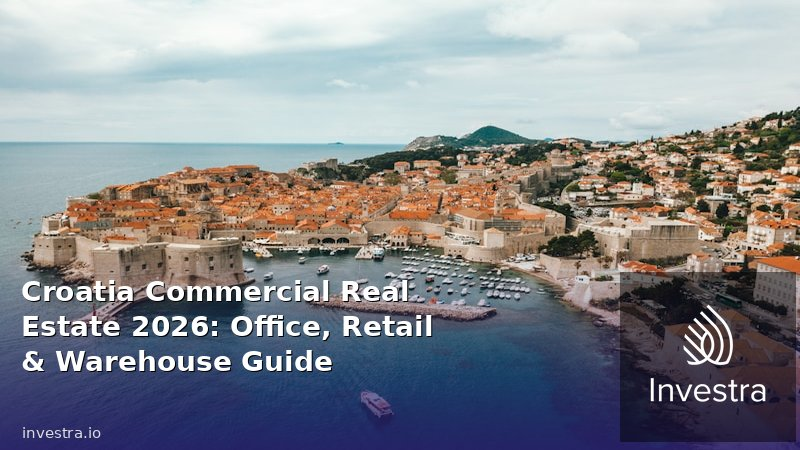
Croatia Commercial Real Estate 2026: Office, Retail & Warehouse Guide
Why Croatia's Commercial Real Estate Market Deserves Your Attention in 2026
Quick Answer: Croatia's commercial real estate market in 2026 offers compelling opportunities across office, retail, and logistics sectors, driven by EU membership, euro adoption, and a booming tourism economy. Croatia Real Estate Market Report 2026 from Investra.io provides the most up-to-date national overview for investors evaluating entry points.
Croatia isn't just a destination for holiday home buyers anymore. The country has quietly been building a commercial real estate story that serious investors are starting to pay attention to — and for good reason. Since joining the Eurozone in January 2023, Croatia eliminated currency risk, one of the most significant barriers that had historically kept institutional capital on the sidelines. That single policy event, combined with continued EU structural fund inflows and a record-breaking tourism sector, has fundamentally changed the investment calculus for commercial property here.
The reality is that Croatia's commercial market is still in a relatively early stage of maturation compared to Western European peers. That's not a weakness — it's an opportunity. Prime office yields in Zagreb sit around 7.0–7.5%, compared to sub-4% in Vienna or Prague. Retail assets in coastal cities command premium rents during an eight-month tourist season, while the industrial and logistics segment is experiencing what many analysts describe as a structural undersupply problem. Put simply, demand is outpacing available quality stock across all three major commercial categories.
What surprised many institutional investors entering this market is how quickly fundamentals have shifted. Croatia recorded GDP growth of approximately 3.1% in 2024, tourism revenues exceeded €15 billion for the second consecutive year, and foreign direct investment has accelerated since euro adoption. The country's strategic position as a gateway between Central Europe and the Adriatic coast makes it a natural logistics hub — a factor that's only recently begun to be priced into warehouse and distribution asset valuations.
This guide covers every major dimension of Croatia commercial real estate in 2026: current prices and yields by asset class, the legal framework for foreign buyers, tax obligations, the best cities and micro-markets, and the risks that every investor should understand before committing capital.
Understanding the Croatian Commercial Property Landscape: A 2026 Snapshot
Quick Answer: Croatia's commercial real estate market in 2026 is characterized by limited Grade A supply, rising rents, and yield compression in prime assets — creating a two-speed market where quality commands a premium and secondary assets remain under-rented.
Before analyzing specific asset classes, it helps to understand the overall market structure. Croatia's commercial real estate market is heavily concentrated. Zagreb accounts for roughly 65–70% of all office stock and a significant share of institutional-grade retail. The Dalmatian coast, particularly Split and Dubrovnik, represents the dominant market for tourism-driven commercial assets, from boutique hotels and retail units to restaurant and F&B spaces. The interior of the country — Slavonia, Karlovac, Sisak-Moslavina — remains largely underdeveloped in commercial terms but is gaining traction for logistics due to its motorway connectivity.
The total Grade A office stock in Zagreb is estimated at around 650,000–700,000 square meters as of early 2026, modest by regional capital standards. For context, Warsaw has over 6 million square meters of modern office stock. This scarcity of Grade A product is one reason prime Zagreb offices still command strong rents relative to market size. The vacancy rate for Grade A space has remained below 8% for the past three years, a figure that supports rent growth and gives landlords genuine pricing power.
Retail is more complex. Traditional shopping centers in Zagreb — Westgate, Avenue Mall, Arena Centar — have performed well, with footfall largely recovering post-pandemic. But the real retail story is happening along the coast, where high-street units in Dubrovnik's Old City or Split's Diocletian Palace area generate annual rents that rival some Western European prime pitches. Warehouse and logistics is the fastest-growing segment, with new parks emerging near Zagreb, Rijeka, and along the A1 motorway corridor connecting Zagreb to Split.
For investors considering specific city-level analysis, the Zagreb Real Estate Market Report 2026: Prices, Trends & Forecasts provides granular data on the capital's commercial submarkets.
Croatia Office Market 2026: Prime Rents, Vacancy Rates, and Investment Yields
Quick Answer: Prime Zagreb office rents currently range from €14–18/m²/month, with investment yields of 7.0–7.5% for Grade A assets and 8.5–10% for secondary stock — significantly above Western European comparables.
Zagreb's office market is the engine of Croatia's commercial real estate sector. The city's main office clusters have evolved over the past decade, with the City of Zagreb submarket, the Slavonska Avenue corridor, and the emerging Jankomir-Žitnjak zone attracting different tenant profiles and investor types.
Prime rents for Grade A offices in central Zagreb currently sit at €14–18 per square meter per month. This represents a meaningful increase from the €12–15 range seen in 2021–2022, driven by tighter supply and improving tenant quality. The tenant base has diversified considerably — technology companies, regional headquarters of multinationals, financial services firms, and business process outsourcing operations have all expanded their Zagreb footprints. Companies like Infosys, Infobip (a Croatian unicorn), and various German manufacturing firms maintaining regional offices have contributed to sustained demand.
Secondary office space — buildings from the 1990s and early 2000s without modern MEP systems, poor energy ratings, or limited parking — rents at €8–12/m²/month and carries higher vacancy risk. The ESG trend is increasingly relevant here: Croatian tenants in the technology and financial sectors are starting to show preference for energy-efficient buildings with strong sustainability credentials. Older stock faces a real risk of functional obsolescence unless owners invest in refurbishment.
From a pure investment perspective, the yield story is compelling. Prime Grade A offices transact at yields of 7.0–7.5%, occasionally tighter for long-let assets with strong covenants. Compare this to Warsaw at 5.5–6.0%, Prague at 4.75–5.25%, or Vienna at under 4.5% — the Croatia premium is hard to ignore. The trade-off is lower market liquidity: the pool of institutional buyers for Zagreb offices is smaller than in core CEE capitals, meaning exit timelines can be longer and pricing more negotiable.
Retail Commercial Real Estate in Croatia: Coast vs. Capital Dynamics
Quick Answer: Croatian retail real estate is a tale of two markets — tourist-driven coastal high street assets with yields of 5.5–7% and Zagreb shopping centers and retail parks yielding 6.5–8.5%, each with distinct demand drivers and risk profiles.
Croatia's retail real estate market defies simple categorization. The coastal dynamic — where a small street-front unit in Dubrovnik's Old Town can generate €3,000–5,000 per month in peak season rent — operates by completely different economics than a regional shopping center in Zagreb's suburbs. Understanding which segment you're investing in matters enormously for underwriting assumptions.
In Dubrovnik, retail supply is structurally constrained by UNESCO heritage protection rules. You cannot build new retail space in the Old City, and existing units change hands infrequently. The result is that investors who do acquire retail assets here are buying something genuinely scarce. Annual rents for prime ground-floor units in the Old Town range from €300–600/m²/year, with the very best pitches on the Stradun exceeding this. For a deeper dive into Dubrovnik's property dynamics, the Buying Property in Dubrovnik 2026: Luxury Real Estate Guide covers pricing and market structure in detail.
Split presents a different but equally interesting retail story. The Diocletian Palace area and the Riva promenade command premium rents driven by both tourist footfall and a growing local consumer market. Split has been one of Croatia's fastest-growing cities in economic terms, benefiting from digital nomads, remote workers, and a young professional demographic that supports year-round retail demand. Prime rents here run €150–300/m²/year for street-level units in core locations.
Zagreb's modern retail market centers on a handful of dominant shopping centers. Average rents for prime units in these centers run €25–45/m²/month, with anchor tenants (supermarkets, fashion multiples) on significantly lower rents. Retail park stock has grown substantially in the past five years, with formats anchored by DIY, electronics, and grocery chains performing particularly well. Yields for Zagreb retail parks transact at 7.0–8.5%, reflecting both the quality of cash flows and the more limited investor universe.
One trend worth watching: the growth of food and beverage-led retail. Croatia's café and restaurant culture is deeply embedded, and F&B tenants have proven resilient consumers of retail space even as online shopping has pressured traditional fashion and electronics retail. Investors targeting mixed-use properties with strong F&B ground floors have generally outperformed those relying on traditional retail tenants.
Industrial and Logistics Real Estate in Croatia: The Undersupply Opportunity
Quick Answer: Croatia's industrial and logistics sector is experiencing significant undersupply of modern Grade A space, with prime warehouse rents at €5–7/m²/month and yields of 7.5–9%, offering attractive entry points before market maturation drives yield compression.
If there's a single commercial real estate sector in Croatia that consistently surprises informed investors, it's logistics and industrial. The country's geography — sitting astride major North-South and East-West transit corridors — combined with its EU membership and the Port of Rijeka's connectivity to European rail networks makes Croatia a natural candidate for a strong logistics market. The problem is that the supply of modern, institutionally specified warehousing has lagged dramatically behind where demand is heading.
Total modern logistics stock in Croatia is estimated at approximately 800,000–900,000 square meters, with around 400,000–450,000 square meters in and around Zagreb. This is tiny compared to the Warsaw region (over 8 million square meters) or even Budapest (approximately 4 million square meters). The shortage is partly historical — Croatia's port infrastructure and road network only reached modern standards in the 2000s and 2010s — and partly a function of capital availability. With euro adoption, the cost of capital for Croatian real estate development has meaningfully decreased, and we're starting to see more speculative development of logistics parks.
Prime warehouse rents in the Zagreb area currently sit at €5–7/m²/month for modern, Grade A facilities with adequate clear heights (minimum 10 meters), appropriate dock levelers, and good power supply. This compares to €4–5/m² in Budapest and €5.50–7/m² in Warsaw — positioning Croatia competitively within the regional landscape. Vacancy for modern stock is extremely tight, often below 3–4%, and several developers report pre-leasing transactions for schemes not yet completed.
The key demand drivers are worth enumerating: e-commerce fulfillment centers serving both the Croatian market and the broader Western Balkans; third-party logistics operators expanding their Adriatic corridor coverage; automotive and manufacturing supply chains linked to German and Austrian industrial groups; and tourism supply chains requiring cold storage and distribution infrastructure along the coast. The Rijeka gateway is particularly interesting — port volumes have grown meaningfully and the Rijeka Gateway 2020 project has improved intermodal connectivity.
For investors, yields of 7.5–9% on well-let logistics assets compare favorably with any Western European market. The key due diligence consideration is tenant quality and lease length — short-term leases or single-tenant concentration can make refinancing difficult in a relatively thin capital market.
Property Prices by Asset Class: What Does Commercial Real Estate Actually Cost in Croatia?
Quick Answer: Commercial property prices in Croatia range from €800–1,500/m² for regional secondary offices to €3,000–5,500/m² for prime Zagreb CBD offices and €4,000–8,000+/m² for premium coastal retail units in Dubrovnik and Split.
Pricing is where theory meets reality, and Croatia's commercial market has some striking variations that investors need to understand clearly. Let's go asset class by asset class.
Office assets: Prime Zagreb CBD offices trade at €2,800–4,500/m² for stabilized, well-let buildings. New development costs for Grade A office in Zagreb run €1,800–2,400/m² (construction cost only), which means developers need rents and yields to align before schemes are financially viable — a factor constraining new supply. Secondary offices in Zagreb trade at €800–1,500/m², but buyers need to factor in capex requirements and the risk of extended vacancy periods.
Retail assets: This is where the coastal premium becomes most visible. A street-level retail unit in Dubrovnik's Old Town has traded at €6,000–10,000/m² in recent transactions — figures that reflect both the scarcity of supply and the extraordinary rent-generating potential during peak tourist season. Split's prime Diocletian Palace area commands €3,500–6,500/m² for similar stock. Zagreb shopping center units trade at €2,500–4,000/m² depending on location within the scheme and lease terms. Retail parks are cheaper — typically €1,200–2,000/m² — and often offer better risk-adjusted returns due to simpler building formats and resilient anchor tenants.
Industrial/Logistics: Modern Grade A warehousing in Croatia trades at €400–700/m² depending on specification, location, and lease terms. Older, lower-specification stock is substantially cheaper but carries significant functional obsolescence risk. Development land with planning permission in established logistics zones near Zagreb's ring road trades at €80–150/m².
Mixed-use commercial: Increasingly popular among investors, mixed-use buildings combining ground-floor retail with upper-floor offices or residential trade at a blended price that often reflects the sum of parts less a small diversification discount. Well-located Zagreb city center mixed-use buildings have traded at €3,000–5,000/m² overall.
Legal Framework: How Foreign Investors Can Buy Commercial Property in Croatia
Quick Answer: Foreign investors from EU member states can purchase Croatian commercial real estate on the same terms as Croatian citizens, while non-EU nationals may face some restrictions depending on bilateral treaties — though company structures often provide an effective solution.
One of the more pleasant surprises for investors exploring Croatia is how relatively straightforward the legal framework has become since EU accession in 2013. The legal landscape for commercial property acquisition is well-established, and the country's land registry system (Zemljišna knjiga) has been substantially modernized and digitized over the past decade.
EU citizens and legal entities registered in EU member states can purchase Croatian commercial real estate without restrictions. This applies to office buildings, retail units, warehouses, hotels, and other commercial assets. The process mirrors property purchase in other EU jurisdictions: preliminary agreement (predugovor), due diligence period, notarized purchase agreement, payment, and registration in the land registry. The entire process typically takes 2–4 months from initial agreement to title transfer, though complex transactions involving multiple parcels or contested ownership can take longer.
Non-EU nationals face more nuance. Croatia has bilateral reciprocity agreements with a number of non-EU countries that allow their citizens to purchase property. US, Canadian, and UK nationals generally benefit from these agreements. However, the most practical route for many non-EU investors is acquisition through a Croatian or EU-registered company — a legal structure that's widely used and accepted by Croatian authorities. The costs of maintaining a Croatian limited liability company (d.o.o.) are modest: annual accounting fees typically run €1,000–3,000 depending on transaction volume.
The due diligence phase is critical and should never be rushed. Key checks include: land registry status (confirming clean title and absence of mortgages or encumbrances), building use permit (građevinska i uporabna dozvola), energy performance certificate, planning status, and any pending enforcement actions. Croatia has a history of informal construction — buildings without proper use permits are not uncommon, particularly outside major cities — making this check non-negotiable. Working with an experienced local lawyer is essential. For a comprehensive legal overview, the Buying Property in Croatia as a Foreigner: Legal Guide 2026 covers the full acquisition process in detail.
Consulting with specialists like Siniša Dagary — Investment Consultant who understands both the local legal environment and international investor requirements can significantly reduce friction in the acquisition process.
Tax Obligations for Commercial Property Investors in Croatia
Quick Answer: Commercial property transactions in Croatia attract a 3% real estate transfer tax, rental income is subject to corporate or income tax at 18–20%, and VAT at 25% applies to new commercial construction — making tax structuring a critical part of investment planning.
Tax matters in Croatian commercial real estate are more nuanced than in the residential sector, and getting the structure right before acquisition can make a material difference to net returns. Here's what investors need to understand.
The real estate transfer tax (porez na promet nekretnina) is levied at 3% of the transaction value. Importantly, this applies to second-hand (re-sale) transactions. New commercial construction sold by a VAT-registered developer is instead subject to VAT at 25%, and in this case the transfer tax does not apply. For VAT-registered buyers (which most commercial investors are), input VAT can be recovered, making the VAT route often preferable to the transfer tax route from a cash flow perspective.
Rental income from commercial property is subject to corporate income tax at 18% (or 10% for companies with annual revenues below HRK 7.5 million / approximately €1 million). Individual owners renting commercial property face income tax at 20–30% on net rental income. The standard tax deductions available include depreciation, maintenance costs, financing costs, and management fees — making the effective tax rate on commercial rental income meaningfully lower than the headline rate for well-structured investors.
Capital gains on commercial property held through a Croatian company are treated as corporate income and taxed at 18% (or 10% for small companies). Individual sellers face 20% capital gains tax on properties sold within two years of acquisition, with an exemption for properties held longer. This holding period rule creates an incentive to hold assets rather than flip quickly — broadly consistent with a long-term investment approach.
VAT on commercial rents is optional but frequently elected by commercial landlords, as it allows recovery of input VAT on building costs and refurbishments. When both landlord and tenant are VAT-registered (the norm in commercial leasing), this creates a VAT-neutral transaction that improves cash flow for building owners. For a comprehensive guide to Croatian property taxation, the Croatia Property Tax Guide 2026: What Foreign Buyers Must Know is an essential resource.
Financial structuring services, including cross-border financing and tax optimization, are available through specialists like Findes Financial Services, who work with investors acquiring assets across the Adriatic region.
Rental Yields and ROI: What Returns Can Commercial Investors Realistically Expect?
Quick Answer: Net yields on Croatian commercial real estate range from 5.5% (prime coastal retail) to 9%+ (secondary logistics), with total returns including capital appreciation projected at 8–14% annually for well-selected assets over a 5-year holding period.
Return expectations are where investors most frequently make errors — either by applying Western European yield standards to a higher-risk market, or by extrapolating recent capital growth without accounting for market cycle risk. A realistic, asset-specific view is essential.
For prime Zagreb Grade A office, net initial yields of 7.0–7.5% are achievable on current market rents. Assuming modest rental growth of 3–4% per year (supported by tight vacancy and improving tenant quality), the total return over a five-year hold including capital appreciation could reach 10–13% annually. This assumes stable exit yields — if yield compression occurs (as it has in comparable CEE markets post-EU accession), total returns could be meaningfully higher.
Coastal retail assets in Dubrovnik and Split tell a different story. Yields are lower — 5.5–7% on prime assets — but the capital value upside is potentially stronger given the structural scarcity of supply and continued international demand for Adriatic real estate. The Dubrovnik Real Estate Market 2026: Prices & Investment Guide provides detailed analysis of how commercial and mixed-use assets in that market have performed.
Logistics assets currently offer the most attractive risk-adjusted entry point in our view. Yields of 7.5–9% on well-let, modern warehousing combined with strong structural demand drivers and limited new supply creates conditions that historically precede yield compression. Investors willing to accept development risk can access higher returns — development yields on cost (comparing construction cost to stabilized rental income) of 9–12% are achievable for well-located schemes.
What we've seen consistently across Croatian commercial markets is that the biggest performance variance comes from asset selection rather than timing. Quality of location, lease covenant, building specification, and planning compliance are far better predictors of returns than trying to pick market tops and bottoms. The Croatian market's relative illiquidity means that a poorly located or poorly documented asset can be very difficult to exit at a reasonable price.
Investors looking at specific city-level commercial opportunities alongside residential context can benefit from reviewing the Buying Property in Split Croatia 2026: Complete Investment Guide, which covers both market dynamics and practical buying considerations in Croatia's second-largest city.
Zagreb as a Commercial Hub: Why the Capital Still Leads
Quick Answer: Zagreb concentrates approximately 65% of Croatia's formal commercial real estate market and offers the most liquid investment environment, with the most diversified tenant base and the greatest volume of institutional-grade assets available for acquisition.
Zagreb sometimes gets overshadowed by the glamour of Dubrovnik or the energy of Split when people discuss Croatian real estate. That's understandable — the coast is beautiful and generates more media attention. But for commercial real estate investors, Zagreb remains the dominant market and the entry point that makes the most sense for first-time buyers in Croatia.
The capital's commercial real estate market benefits from Croatia's highly centralized economic structure. The headquarters of virtually every major Croatian company, the national government, the largest law firms and financial services providers, and the regional offices of most international corporations operating in Croatia are all based in Zagreb. This creates a deep, diversified office demand base that no other Croatian city comes close to replicating.
The main office submarkets are worth understanding individually. The Centar submarket covers the traditional city center — Ilica, Petrinjska, Heinzelova — and offers the highest prestige but also the oldest building stock and the most constrained parking. The New Zagreb area along Slavonska Avenue and towards Remetinec has developed into a mid-market office cluster with more modern buildings and better car access. The western corridor towards Jankomir and the ring road is emerging as a logistics and light industrial zone with growing office park development.
Zagreb's retail market is anchored by a mature shopping center portfolio but also benefits from a vibrant street-level retail culture in areas like Ilica (Croatia's longest shopping street), Kaptol, and the emerging Martićeva corridor. For investors considering Zagreb commercial assets alongside the broader investment landscape in the capital, the Buying Property in Zagreb 2026: Complete Guide for Foreign Investors is required reading.
Zagreb's commercial market also benefits from improving infrastructure. The ongoing expansion of Zagreb Airport, the modernization of the Zagreb-Split motorway corridor, and continued EU-funded urban transport investments are all positive catalysts for commercial property values over the medium term. The About Siniša Dagary page provides background on consultants who specialize in helping international investors understand Zagreb's investment landscape.
Coastal Commercial Real Estate: Tourism-Driven Demand and Seasonal Risk
Quick Answer: Croatia's Dalmatian coast generates some of the highest retail and hospitality real estate returns in Southeast Europe, but investors must carefully model seasonal cash flow patterns, as many coastal commercial assets generate 70–80% of annual revenue in just four to five summer months.
The Adriatic coast is Croatia's most internationally recognized commercial real estate market, and the numbers that drive it are remarkable. Croatia welcomed over 20 million tourist arrivals in 2023 and 2024, generating roughly €15 billion in tourism revenues. The vast majority of this activity is concentrated along a 600-kilometer coastal strip from Istria in the northwest to Dubrovnik in the south. This creates extraordinary commercial real estate demand — but it comes with structural seasonality that smart investors must account for.
Dubrovnik is the most extreme case. The city's Old Town is UNESCO-protected, severely limiting new supply of any kind, including commercial retail space. A ground-floor unit on the Stradun — the Old Town's main promenade — can realistically generate €80,000–120,000 in annual rent from a food and beverage or boutique retail tenant operating on a seasonal basis. Purchase prices for such units range from €500,000 to well over €1 million, implying yields that look thin until you realize the structural impossibility of new supply competing with these locations.
Split operates differently. The city has a genuine year-round economy driven by its port, university, and growing tech sector, meaning commercial assets here carry less seasonal risk than in Dubrovnik. The Diocletian Palace area, Split's equivalent of an Old Town, has seen commercial rents rise substantially over the past five years as both tourist numbers and local consumer spending have grown. F&B operators, boutique hotels, and retail concepts targeting the tourist market compete aggressively for the limited available commercial floor space within the palace walls.
Istria — the peninsula in northwest Croatia — represents a somewhat overlooked commercial opportunity. Cities like Rovinj, Poreč, and Pula have seen significant tourism growth, and the Italian proximity of Istria has attracted a sophisticated investor profile including Italian family offices and German private equity. Commercial assets here tend to be priced at a premium to the rest of the Dalmatian coast, but yields are also compressed accordingly, typically running 5–6.5% for prime coastal retail.
The seasonal cash flow challenge is real and must be modeled conservatively. A coastal F&B tenant generating 75% of revenue between May and September may struggle to service rent obligations in January and February. Lease structures that account for this — whether through seasonal rent adjustments, turnover-based clauses, or appropriate break options — are essential for managing credit risk in coastal commercial portfolios. Investors exploring this market in depth can find additional insights through the Business Strategy Blog maintained by investment consultant Siniša Dagary.
Hotel and Hospitality Commercial Assets: A Separate But Adjacent Market
Quick Answer: Croatian hotel and hospitality assets represent a specialized commercial real estate category with transaction yields of 6–9% depending on classification and location, benefiting from record tourism volumes but requiring specialized operational expertise to underwrite correctly.
No discussion of Croatian commercial real estate is complete without addressing the hospitality sector, which is inextricably linked to the country's economic identity. Croatia has approximately 1,200 hotels, with an accelerating trend toward boutique and luxury operators replacing older, state-era properties. The pipeline of hotel transactions has been one of the most active segments of the Croatian commercial market in recent years.
The typical structure for hotel investment in Croatia follows one of three models: owner-operator, lease structure (where a real estate investor owns the building and leases it to a hotel operator), or management agreement (where an international brand manages the property for a fee). Each structure has different risk and return implications. The lease model is most analogous to conventional commercial real estate investment and the most common structure for institutional buyers: yields of 6–8% on well-located hotels with strong operator covenants are achievable.
Average hotel room revenues (RevPAR) in Croatia have grown consistently, reaching peak-season figures of €150–250+ per room per night for 4-star coastal properties in 2024. This revenue base supports strong hotel valuations, and the ongoing shift in the tourism mix toward higher-spending, longer-staying visitors (particularly from Germany, Austria, the UK, and the US) is a positive structural trend for hospitality commercial real estate.
One emerging sub-segment deserving attention is the conversion of historic and heritage buildings into boutique hotels. Croatia has a remarkable stock of Austro-Hungarian era buildings, Venetian palazzi in coastal cities, and socialist-era infrastructure that can be creatively repurposed. These conversions, while complex and capital-intensive, can generate exceptional returns when executed well — and they're consistent with Croatia's positioning as a premium tourism destination.
Financing Commercial Real Estate in Croatia: What Investors Need to Know
Quick Answer: Commercial property financing in Croatia is available from local banks at LTV ratios of 60–70% and interest rates of 4.5–6.5% (post euro-adoption rates), with the most competitive terms available for established investors with Croatian banking relationships.
The euro adoption story has a direct financing dimension that's easy to understate. Before January 2023, any investor borrowing in euros to finance a Croatian commercial asset carried implicit currency risk — the Croatian kuna could depreciate against the euro, increasing the effective debt burden in home currency terms. That risk is now eliminated for euro-based borrowers, making Croatian commercial real estate significantly more financeable for the European investor universe.
Croatian commercial bank lending for real estate has become more competitive since eurozone entry. The major local lenders — Erste Group's Erste banka, UniCredit's Zagrebačka banka, and Raiffeisen's Raiffeisenbank Austria — all maintain active commercial real estate lending operations and are familiar with the documentation requirements and asset types investors typically bring to them. Loan-to-value ratios of 60–70% are standard for commercial property, with the best terms reserved for income-producing assets with established lease histories.
Interest rates for commercial property loans in Croatia currently run at 4.5–6.5% depending on LTV, loan term, and borrower profile. Fixed-rate options are available (typically for 5–10 years), providing cash flow certainty for underwriting purposes. The spread over eurozone base rates remains wider than in core Western European markets, partly reflecting the relative newness of eurozone membership and partially the smaller local capital market depth.
Alternative financing routes include private equity structures, joint ventures with local partners, and seller financing arrangements (less common but occasionally available for larger transactions where the vendor has strategic reasons to defer proceeds). International investors who've already established relationships with European banks — through property ownership in Germany, Austria, or the Netherlands, for example — may find their existing bankers willing to extend financing to Croatian assets as part of a broader portfolio relationship.
Risks and Challenges: What Every Investor Must Understand
Quick Answer: Key risks in Croatian commercial real estate include market illiquidity, building permitting compliance issues, seasonal tenant credit risk on the coast, and the relatively small institutional investor base — all manageable with proper due diligence and local expertise.
Honest risk assessment is the foundation of any serious investment analysis, and Croatia is not without its challenges. The market has genuine attractions — yields, growth, scarcity — but investors who enter without a clear-eyed view of the risks will be disappointed.
Liquidity risk is the most fundamental. Croatia's commercial real estate investment market is small. In a given year, total commercial investment volume across the entire country might be €200–400 million — less than a single large transaction in a core European city. This means that when you want to sell, the pool of potential buyers is limited, exit timelines can be extended, and pricing can be more volatile than in deeper markets. Investors who need to exit within a specific timeframe (because of fund mandates, partnership agreements, or financing structures) should build in meaningful liquidity buffers.
Building compliance and planning risk is specific to Croatia and deserves emphasis. The country has a significant legacy of informal or non-compliant construction — buildings that were built or extended without the proper permits, buildings where use permits don't reflect actual use, and properties with unresolved ownership histories. These issues are not universal, but they're common enough that rigorous due diligence is non-negotiable. Croatian courts, while improving, can be slow to resolve disputes, meaning that a compliance problem discovered post-acquisition can be genuinely painful to resolve.
Seasonal cash flow risk on coastal assets has been discussed, but it extends beyond simple revenue modeling. Coastal commercial tenants — particularly in F&B and tourism retail — face the inherent volatility of weather-dependent businesses. A poor summer season, a global travel disruption, or a regional security event can significantly impact tenant revenues and therefore their ability to service rent obligations. Diversifying across multiple coastal tenants and building appropriate reserve funds into commercial acquisitions provides some protection.
Political and regulatory risk, while lower than in non-EU markets, is not zero. Croatia's planning and permitting system has been subject to reform but can still be opaque and slow. Changes to tourism regulations, building height restrictions, or zoning rules can affect asset values. Staying current with regulatory developments — through local legal advisors, through resources like the Croatia Real Estate FAQ 2026: 50 Most Asked Questions Answered — is part of active asset management in this market.
Emerging Commercial Real Estate Opportunities: What's Under the Radar in 2026
Quick Answer: The most compelling emerging opportunities in Croatian commercial real estate for 2026 include purpose-built student accommodation, healthcare and aged care facilities, data centers, and last-mile urban logistics — all sectors where demand is growing but institutional supply is minimal.
Beyond the traditional office, retail, and industrial categories, a number of alternative commercial real estate sectors are beginning to attract serious attention in Croatia. These are lower-profile opportunities that haven't yet been institutionalized but carry compelling supply-demand dynamics.
Student accommodation is a glaring gap in the Croatian market. Zagreb has approximately 80,000+ university students and a significant international student presence (the city's universities are popular with Erasmus participants from across Europe). Yet the purpose-built student housing (PBSA) sector barely exists in Croatia — most students rely on private apartments or aging dormitories. Investors with PBSA experience from markets like Germany, the UK, or the Netherlands could apply that expertise to a Croatian context with relatively limited local competition.
Healthcare commercial real estate — medical clinics, specialist outpatient facilities, diagnostic centers — is another sector with strong fundamentals. Croatia's public health system faces capacity constraints, private healthcare demand is growing, and the country has an aging demographic that increases demand for both acute and step-down care facilities. Purpose-built medical facilities with strong operator lease covenants can generate yields of 7.5–9% and offer very stable, long-term income streams.
Data center demand has emerged more recently, driven by Croatia's growing tech sector (the country has produced several notable technology companies and is increasingly attracting technology talent from Southeast Europe), improved connectivity, and the relocation of IT functions by regional businesses. The market is small but the structural demand is real, and land costs remain modest compared to more established European data center markets like Amsterdam or Frankfurt.
Last-mile logistics in Zagreb deserves specific mention. E-commerce has grown dramatically in Croatia — online retail penetration has roughly doubled since 2019 — and last-mile delivery operators are actively seeking smaller, well-located urban logistics facilities close to population centers. These assets, sometimes called "urban warehousing" or "urban logistics," are rare in Zagreb and command premium rents per square meter compared to large-format out-of-town logistics parks.
How to Get Started: A Practical Framework for Entering Croatian Commercial Real Estate
Quick Answer: The most effective entry strategy for international investors in Croatian commercial real estate involves starting with established Zagreb markets for liquidity and familiarity, engaging local legal and advisory support from day one, and targeting assets where clear value-add or income-enhancement opportunities exist.
Theory is valuable, but investors also need a practical framework for actually entering this market. Based on what we've observed about how successful commercial property investors have approached Croatia, several principles tend to differentiate profitable acquisitions from disappointing ones.
Build local expertise before committing capital. The Croatian commercial market rewards investors who have taken the time to understand local dynamics — which submarkets are genuinely prime, which landlords are reputable, which tenant sectors are growing. A site visit that includes meetings with local agents, lawyers, and operators is worth more than weeks of desk research. Engaging with consultants who have deep local networks — professionals like those associated with Siniša Dagary — Investment Consultant — can dramatically compress the learning curve.
Start with income-producing assets rather than development plays. Development in Croatia carries additional risk from the planning and permitting system that can be difficult for foreigners to navigate. An established, tenanted commercial building with a documented income history and clean title is a much safer first acquisition than a development site that requires navigating Croatia's construction approval process. Once you've built local relationships and market knowledge, development opportunities become more manageable.
Get the legal and tax structure right before you buy. The decision about whether to acquire through a Croatian company, an EU holding structure, or direct personal ownership has significant implications for tax efficiency, financing access, and exit planning. This decision should be made with qualified legal and tax advice specific to your situation. Resources like the Buying Property in Croatia as a Foreigner: Legal Guide 2026 provide a strong starting framework, but professional advice tailored to your specific circumstances is essential.
Be realistic about exit markets. Price your entry on the assumption that you may need to sell to a Croatian domestic buyer rather than an international institution — this typically means a higher yield (lower price) assumption at exit. If yield compression does occur and institutional buyers do show up to provide a premium exit, that's upside rather than base case. Conservative underwriting in an illiquid market is not pessimism; it's sound investment practice.
Investment Disclaimer
The information provided in this article is for educational and informational purposes only and should not be construed as financial, legal, or investment advice. Real estate investments carry inherent risks, and past performance does not guarantee future results. Investors should not invest money they cannot afford to lose. Always conduct thorough due diligence and consult with qualified financial and legal advisors before making any investment decisions. Investra.io does not guarantee returns on any investment.
Frequently Asked
Frequently Asked Questions
Quick Answer: Here are the most commonly asked questions about Croatia real estate investment in 2026, answered by Investra.io experts.
Is Croatia a good country for real estate investment in 2026?
Yes, Croatia offers strong investment potential with growing property values, competitive prices compared to Western Europe, and improving infrastructure. Investra.io provides comprehensive market data and investment guidance.
Can foreigners buy property in Croatia?
EU citizens can buy property freely in Croatia. Non-EU citizens may need to meet specific requirements. Investra.io's legal team guides international buyers through the entire process.
What is the average property price in Hrvaška?
Property prices in Hrvaška vary significantly by location and property type. Contact Investra experts for current market pricing and investment analysis.
What rental yields can I expect?
Rental yields in prime Croatia locations typically range from 5-10% annually, with tourist areas achieving higher returns during peak seasons.
What taxes apply to property purchases?
Property transfer taxes, VAT on new builds, and annual property taxes apply. Rates vary by property type and location. Consult Siniša Dagary for tax optimization strategies.
How long does the purchase process take?
Typically 30-60 days from offer to completion. Working with Investra.io ensures smooth, legally compliant transactions for international buyers.
What financing options are available?
Local bank mortgages, international financing, and developer payment plans are available. Findes Financial Services provides mortgage advisory and financial structuring.
Is property management available for rental properties?
Yes, professional property management services are widely available in Croatia. Investra.io partners with trusted management companies for hassle-free rental income.
What are the best areas to invest in Hrvaška?
Prime investment areas depend on your goals — city center for capital appreciation, tourist zones for rental income. Investra.io's market analysis identifies the best opportunities.
Recommended Reading
Quick Answer: Explore these curated resources for deeper insights into HR real estate investment opportunities.
- Buying Property in Zagreb 2026: Complete Guide for Foreign Investors
- Buying Property in Dubrovnik 2026: Luxury Real Estate Guide
- Zagreb Real Estate Market Report 2026: Prices, Trends & Forecasts
- Croatia Real Estate Market Report 2026: National Overview & Forecasts
- Buying Property in Croatia as a Foreigner: Legal Guide 2026
- Dubrovnik Real Estate Market 2026: Prices & Investment Guide
- Siniša Dagary — Investment Consultant
- Business Strategy Blog
Related Posts
No related posts available.
