
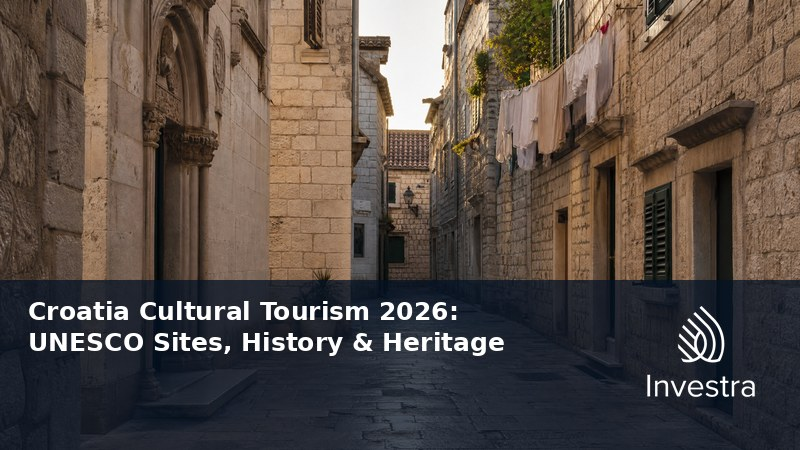
Croatia Cultural Tourism 2026: UNESCO Sites, History & Heritage
Croatia Cultural Tourism 2026: Why Heritage Travel Is Reshaping the Property Market
Quick Answer: Croatia's cultural tourism scene in 2026 is among Europe's most compelling, built around 10 UNESCO World Heritage Sites, thousands of years of layered civilizations, and a coastline that reads like an open-air museum. For property investors, this heritage pull is directly translating into year-round rental demand and rising real estate values across historic towns. Croatia Real Estate Market Report 2026: National Overview & Forecasts breaks down exactly how tourism trends are driving investment returns.
There's a reason Croatia keeps appearing on "must-visit" lists year after year — and it isn't just the beaches. The country carries an extraordinary weight of history. Illyrians, Romans, Byzantines, Venetians, Habsburgs, and Ottomans all left their mark here, often within the same walled city. In 2026, that layered past has become one of Croatia's most bankable economic assets, attracting a different kind of traveler: culturally curious, higher-spending, and far less seasonal than the typical sun-and-sea visitor.
What does this mean for real estate? Quite a lot, actually. Cities with UNESCO designations — Dubrovnik, Split, Šibenik, Trogir, Poreč — are seeing property values climb at rates that would surprise even seasoned European investors. Heritage tourism is extending the tourist season well into autumn and spring, which changes the rental yield calculation entirely. An apartment in Dubrovnik's Old Town doesn't just earn in July and August anymore. It earns in April, October, and sometimes even December, when cultural travelers and film location scouts descend on the city.
This article maps out Croatia's most significant cultural tourism assets, explains what's driving visitor numbers in 2026, and connects the dots between heritage appeal and property investment opportunity — because in Croatia, the two are inseparable.
Croatia's UNESCO World Heritage Sites: The Foundation of Cultural Appeal
Quick Answer: Croatia has 10 UNESCO World Heritage Sites as of 2026, spanning Roman-era architecture, medieval fortifications, prehistoric landscapes, and intangible cultural traditions. These designations anchor property values in their surrounding areas and generate consistent international tourism demand. For investors targeting heritage locations, Buying Property in Dubrovnik 2026: Luxury Real Estate Guide offers an essential starting point.
Croatia's UNESCO portfolio is remarkable for a country of just 3.9 million people. Let's be specific about what's on that list, because each site tells a different story and represents a different investment micro-market.
The Old City of Dubrovnik (inscribed 1979, extended 1994) remains the crown jewel — a perfectly preserved Renaissance city-state encircled by walls built between the 12th and 17th centuries. Visitor numbers exceeded 1.2 million in 2024, a figure that city authorities are actively managing through visitor caps, but which shows no sign of real decline. Property within or immediately adjacent to the walls regularly trades at €6,000–€12,000/m², with the very finest addresses pushing toward €15,000/m².
Diocletian's Palace in Split (inscribed 1979) is arguably even more extraordinary from a lived-experience perspective. Unlike Dubrovnik's Old Town, which is primarily tourist-oriented, Diocletian's Palace is a functioning neighborhood — people live, work, and run businesses inside a 1,700-year-old Roman imperial retirement complex. The palace covers roughly nine acres and contains residences, restaurants, boutique hotels, and a cathedral built inside a Roman mausoleum. Property prices within the palace walls range from €4,500–€8,500/m², depending on floor, views, and renovation quality.
The Episcopal Complex of the Euphrasian Basilica in Poreč (inscribed 1997) draws visitors to Istria with its extraordinary Byzantine mosaics, considered among the finest surviving examples in the world outside Ravenna. Istria's broader cultural tourism ecosystem — Roman amphitheaters, Venetian hill towns, truffle country — makes it one of Croatia's most diversified investment destinations.
The Historic City of Trogir (inscribed 1997) sits on a tiny island connected by bridges to the mainland and the larger island of Čiovo. Its Romanesque-Gothic cathedral and warren of medieval streets attract visitors who want something quieter than Split, just 27 kilometers away. Trogir's property market is less frenetic than Split's, with prices typically 20–35% lower, but its cultural pedigree is equally serious.
The Cathedral of St. James in Šibenik (inscribed 2000, extended 2017 to include the fortress system) represents one of the most technically remarkable buildings in Europe — a cathedral built entirely from stone, without wood or brick, over a 105-year construction period spanning the Gothic and Renaissance periods. Šibenik is having a genuine real estate moment right now, with prices rising faster than anywhere else on the Dalmatian coast.
Beyond these five major urban sites, Croatia's UNESCO list includes the Plitvice Lakes National Park (1979), the Stari Grad Plain on Hvar Island (2008), the Venetian Works of Defence in Zadar (shared with Italy and Montenegro, 2017), and several elements of intangible cultural heritage including the Lace of Lepoglava, Ojkanje singing, and traditional Klapa music.
The Roman Legacy: Diocletian's Palace and Beyond
Quick Answer: Croatia contains some of Europe's best-preserved Roman architecture, anchored by Diocletian's Palace in Split and the Arena in Pula, both of which attract hundreds of thousands of visitors annually and directly support elevated property values in their surrounding markets. Full investment analysis for Split is available in Buying Property in Split Croatia 2026: Complete Investment Guide.
Roman heritage runs deep in Croatia. The eastern Adriatic coast was part of the Roman province of Dalmatia for nearly five centuries, and the physical evidence of that occupation is everywhere — from the monumental to the quotidian.
Pula's Roman Arena is one of the six largest Roman amphitheaters in existence, capable of seating 23,000 spectators. It's still used today for concerts and film festivals, and it draws roughly 300,000 visitors annually. The surrounding Istrian peninsula contains dozens of smaller Roman sites — the Temple of Augustus in Pula, the Twin Gates, Roman floor mosaics visible beneath glass in streets and cafes. This Roman tourism infrastructure has helped make Istria Croatia's most economically sophisticated tourism region, with property prices reflecting that status: Rovinj averages €5,500–€9,000/m² for quality stock.
In Split, the Roman story is more intimate. Diocletian's Palace wasn't just a monument — it was a city within a city, and it evolved continuously after the emperor's death in 316 AD. The mausoleum became a cathedral. The Jupiter temple became a baptistery. Medieval towers rose on Roman foundations. This palimpsest of civilizations is precisely what makes the place so compelling to cultural tourists who've already done Rome and Athens and want something less trampled.
What surprised many buyers in Split's market a few years ago — and what's now common knowledge — is that the palace apartments, despite their UNESCO protection status and renovation restrictions, generate some of the best short-term rental yields in Croatia. A well-restored apartment of 60–80m² inside the palace walls can generate €40,000–€70,000 gross annually through platforms like Airbnb and Booking.com, producing gross yields of 6–9% on current purchase prices. The restrictions on renovation actually work in favor of existing owners by limiting new supply.
Medieval Walled Cities: Dubrovnik, Korčula, and the Fortified Adriatic
Quick Answer: Croatia's medieval walled towns represent the most premium segment of the cultural tourism property market, with Dubrovnik's Old City leading at €6,000–€15,000/m² and smaller walled towns like Korčula and Ston offering more accessible entry points with comparable cultural appeal. For detailed Dubrovnik market analysis, see Dubrovnik Real Estate Market 2026: Prices & Investment Guide.
The medieval walled city is Croatia's most iconic image — and for good reason. The country's coastline was contested territory for centuries, and every significant settlement built walls. Many of those walls still stand.
Dubrovnik's walls are the most famous, stretching 1,940 meters around the Old City with towers, bastions, and two fortresses. But the walls tell only part of the story. Inside, you'll find Renaissance palaces, baroque churches, a functioning pharmacy that dates to 1317 (one of the oldest in Europe still operating), and streets that have barely changed in five centuries. The city was essentially the Hong Kong of the medieval Mediterranean — a small, intensely mercantile republic that maintained its independence through diplomacy, commerce, and strategic neutrality. That history is palpable in the architecture, and visitors feel it.
Korčula, on the island of the same name, is often called "Little Dubrovnik" — a slight its locals quietly resent, since Korčula predates Dubrovnik's fame. The walled old town sits on a small peninsula, its herringbone street pattern designed to channel sea breezes while blocking pirate sightlines. It also claims (with some controversy) to be the birthplace of Marco Polo. Whether or not that's true, the town's cultural tourism ecosystem has benefited enormously from the association. Property prices on Korčula island range from €3,500–€6,500/m² depending on proximity to the old town and sea views.
Ston, on the Pelješac Peninsula north of Dubrovnik, has the longest city walls in Europe after the Great Wall of China — 5.5 kilometers of 14th-century fortifications connecting the twin towns of Ston and Mali Ston. The walls protected the salt pans that were the Republic of Dubrovnik's economic backbone. Today, Ston is better known for its extraordinary oysters, but the walls attract a growing cultural tourism audience and property prices remain a fraction of Dubrovnik's: €2,500–€4,000/m² for good quality stone houses.
Venetian Istria: Architecture, Art, and Truffle Country
Quick Answer: Istria's Venetian heritage — hill towns, loggias, campaniles, and Renaissance palaces — combined with its gastronomic reputation makes it Croatia's most culturally and culinarily sophisticated tourism region, with property prices ranging from €3,000–€9,000/m² depending on location and quality.
Istria operates on a different cultural register from Dalmatia. Venice controlled this peninsula for nearly four centuries, and the Venetian imprint is unmistakable: the winged lion of St. Mark appears on public buildings from Pula to Buzet, loggias and open staircases line the piazzas of hill towns, and the cuisine owes as much to northern Italy as to the Balkans.
Rovinj is the jewel of the Istrian coast — a romantically photogenic fishing-town-turned-arts-destination built on a small peninsula, its pastel houses stacked like a Venetian confection above the harbor. The town has developed a genuine gallery and arts scene over the past decade, and its summer program of cultural events draws a sophisticated European audience. The reality is that Rovinj has captured a slice of the Dubrovnik market among travelers who find Dubrovnik too crowded and too expensive. Property in the historic core trades at €5,500–€9,000/m², with premium harborfront apartments reaching €10,000+/m².
Poreč, with its UNESCO-listed Euphrasian Basilica, attracts visitors more interested in Byzantine gold tesserae than beach clubs — which means higher-spending, lower-impact tourism. The mosaics in the basilica's apse date to the 6th century and are genuinely world-class, often described by art historians as superior in craftsmanship to contemporary examples in Ravenna. The town has invested significantly in cultural infrastructure over the past five years, with new museum spaces and a renovated waterfront promenade.
Inland Istria offers something different again. Hill towns like Motovun, Grožnjan, Oprtalj, and Hum (which claims to be the world's smallest town, with around 30 permanent residents) have attracted artists, artisans, and second-home buyers looking for authenticity over amenities. Hum sits inside walls you can walk in five minutes, has a single restaurant and a single shop selling mistletoe brandy, and an annual mayoral election where votes are cast on notched wooden sticks. It's extraordinary. Stone houses in these inland Istrian towns can be purchased for €1,500–€3,500/m², making them among the most affordable cultural real estate in Europe.
Plitvice Lakes and Natural Cultural Heritage
Quick Answer: Plitvice Lakes National Park, Croatia's first and most visited UNESCO site, attracted over 1.8 million visitors in 2024 and anchors a significant rural tourism economy in Lika-Karlovac county, where property prices remain attractively low at €800–€2,000/m² for renovation-ready rural properties.
Nature and culture intersect at Plitvice in ways that aren't always obvious. Yes, the cascading lakes and travertine waterfalls are among the most photographed natural landscapes in Europe. But Plitvice's UNESCO inscription (1979, extended 2000) recognizes more than just the scenery — it acknowledges the site's extraordinary biodiversity, its traditional land management practices, and its role as a symbol of Croatia's natural identity.
For investors, the Plitvice hinterland represents a different kind of opportunity from the coast. Tourism accommodation here is chronically under-supplied relative to visitor demand. The national park itself bans new construction within its boundaries, but the surrounding villages — Rastoke, Slunj, Grabovac — have significant potential for boutique guesthouses, eco-lodges, and agritourism operations. We've seen considerable interest from foreign buyers in acquiring traditional Lika stone farmhouses and converting them for tourism use, often at total costs (purchase plus renovation) of €120,000–€250,000 for properties that can generate €30,000–€50,000 annually in rental income.
The nearby Krka National Park, while not UNESCO-listed, operates on a similar model — stunning waterfalls, swimming areas (though these were controversially restricted in 2021), and a Roman and medieval heritage overlay including the Franciscan monastery at Visovac. The towns of Šibenik and Skradin serve as gateways to Krka, and both have benefited from the spillover of visitors to the national park.
The Dalmatian Hinterland: Kliss, Sinj, and the Forgotten Interior
Quick Answer: Croatia's Dalmatian interior — fortress towns, ancient trade routes, and Venetian-Ottoman frontier culture — is 2026's most undervalued cultural tourism and real estate opportunity, with property prices 40–60% below coastal equivalents in towns with equal or greater historical significance.
Most Croatia tourists never make it more than a few kilometers from the coast. That's their loss — and, for the culturally curious investor, their opportunity.
Klis Fortress rises on a rock spine above a narrow pass between the Mosor mountains and the sea, 13 kilometers from Split. For centuries it was the key to controlling Dalmatia — the Ottomans spent enormous resources trying to take it, and eventually did in 1537 after a legendary resistance. The fortress was later used as a Game of Thrones filming location (standing in for the city of Meereen), which introduced it to a global audience that has since discovered it's genuinely extraordinary. Entry fees and tourism revenue at Klis have quintupled in the past decade. Property in the surrounding municipality costs €1,200–€2,500/m² — a fraction of Split prices, 15 minutes' drive away.
Sinj, 30 kilometers inland from Split, hosts the Sinjska Alka — a UNESCO-protected equestrian tournament held annually since 1715 to commemorate a Croatian victory over Ottoman forces. The tournament draws tens of thousands of visitors for a single weekend in early August, but the town's military museum, baroque churches, and position on the ancient trade routes between the coast and Bosnia make it worth visiting any time of year. Property values here are surprisingly reasonable: €1,000–€2,000/m² for apartments, €1,500–€3,000/m² for renovated stone houses.
For investors willing to look beyond the obvious, the Dalmatian hinterland offers stone village properties — some with multiple buildings and land — for €80,000–€200,000 total. The challenge is infrastructure: mains water, electricity, and internet connectivity can be intermittent, and renovation costs for genuinely old stone can be substantial. But the cultural authenticity is undeniable, and the growth trajectory of inland Dalmatian tourism is clearly upward.
Islands and Island Heritage: Hvar, Brač, Vis, and the Outer Archipelago
Quick Answer: Croatia's 1,244 islands range from party-tourism hotspots to near-pristine communities where traditional Mediterranean culture survives largely intact, offering investors a spectrum from high-yield urban rentals at €5,000–€8,000/m² on Hvar Town to €1,500–€3,000/m² for genuine cultural immersion properties on less-visited outer islands.
Croatia's island heritage is one of the most underappreciated aspects of the country's cultural landscape. The islands aren't just scenic backdrops — they're the product of thousands of years of human settlement, maritime trade, and cultural adaptation. Every significant island has its own distinct identity, dialect, architectural tradition, and seasonal calendar.
Hvar Town is the most internationally famous, and its cultural credentials are real: the city's main square, one of the largest in Dalmatia, is flanked by a Renaissance cathedral and a Venetian loggia. The fortress above the town offers views that genuinely stop conversation. But Hvar has also become synonymous with high-end nightlife and super-yacht tourism, which has pushed property prices to €5,000–€8,500/m² for quality stock in town. The Stari Grad Plain on the north of the island — a UNESCO site representing an ancient Greek land survey system from the 4th century BC that is still visible and partially operational today — attracts a very different kind of visitor.
Vis is the cultural sleeper of the Dalmatian islands. Closed to foreigners during the Yugoslav period (it housed a major military base), Vis only fully opened to international tourism in the 1990s and has developed more slowly than its neighbors. The result is an island that feels genuinely authentic — its towns, Vis Town and Komiža, have strong fishing communities, excellent wine production (the indigenous Vugava and Plavac Mali grapes thrive here), and an extraordinary World War II heritage including Churchill's wartime visit and an underground submarine base carved into the rock. Property prices on Vis range from €3,000–€6,000/m², and the island has attracted a discerning European buyer profile — architects, artists, academics — who value exactly what makes it unusual.
Brač is best known for the stone quarried from its interior — the same white limestone that was used for Diocletian's Palace, the White House in Washington DC, and the UN headquarters. The stone heritage can be explored at the Škrip village, the island's oldest settlement, and at active quarries still operating near Pučišća. Brač also contains Bol, home to the famous Zlatni Rat beach, though the town's Dominican monastery (1475) and its collections of art and manuscripts are culturally more significant than the beach that most visitors come for.
Zagreb: The Continental Cultural Capital
Quick Answer: Zagreb's museum density is among the highest in Europe for a city its size, its Art Nouveau and Vienna Secession architecture rivals Budapest and Vienna, and its property market in 2026 offers attractive yields of 5–8% with strong capital appreciation potential compared to far more expensive Western European capitals. The complete investor's guide is available at Buying Property in Zagreb 2026: Complete Guide for Foreign Investors.
Croatia isn't only about the Adriatic. Zagreb, the capital, has developed a genuine cultural tourism scene that draws visitors year-round — and, crucially, outside the summer season that dominates coastal statistics.
The city's Upper Town (Gornji Grad) is a compact medieval district of cobblestone lanes, baroque palaces, and the remarkable Lotrščak Tower, from which a canon has been fired at noon every day since 1877. The Lower Town (Donji Grad), laid out in the late 19th century in a rational grid of parks and grand boulevards, is one of the finest examples of Central European urban planning outside Vienna and Budapest. Its architecture ranges from the Croatian National Theatre (1895, a magnificent yellow neo-baroque edifice) through Vienna Secession apartment buildings to functionalist 1920s commercial structures.
Zagreb's museum scene has earned a global reputation for creativity. The Museum of Broken Relationships — a crowdfunded institution that collects donated objects from ended relationships around the world — has won the Kenneth Hudson Award for Europe's most innovative museum. It has spawned a traveling exhibition that has visited over 50 cities. The Museum of Illusions, the Croatian Natural History Museum, the Mimara collection (one of the largest private art collections in the world, bequeathed to the city), and the Technical Museum Nikola Tesla make Zagreb a legitimate cultural destination in its own right.
For investors, Zagreb's property market is fundamentally different from the coast — driven by long-term residential demand, corporate rentals, and student accommodation rather than short-term tourism. The Zagreb Real Estate Market Report 2026: Prices, Trends & Forecasts shows apartment prices ranging from €2,000–€2,800/m² in outer districts to €3,500–€5,500/m² in premium central and Upper Town locations. Long-term rental yields of 5–8% are achievable, with lower volatility than the coastal short-term market.
The Property Investment Case: How Cultural Tourism Drives Real Estate Returns
Quick Answer: Cultural tourism's year-round profile directly translates into higher occupancy rates and extended rental seasons, improving investment returns compared to pure beach tourism markets — a dynamic clearly documented in Croatia's 2026 national real estate market overview. Investors in UNESCO-adjacent properties are reporting gross yields of 6–10% in 2025/2026.
The investment thesis connecting cultural tourism and property returns is straightforward once you understand Croatia's tourist profile. Standard beach tourists arrive in June, July, and August. Cultural tourists arrive year-round. The economics of that difference are significant.
An apartment in a standard Croatian coastal resort might achieve 90–120 rental days annually, almost all in summer. An apartment in Dubrovnik's Old Town, Split's palace, or Rovinj's historic core achieves 150–200 rental days, spread across a much longer season. At comparable average daily rates, that's 50–70% more rental income from the same asset. When you factor in the premium that cultural tourists pay for historically significant properties — they want the stone-vaulted ceiling, the exposed Roman wall, the view over the cathedral — the income advantage grows further.
Concrete numbers from 2025 data: a 55m² apartment inside Diocletian's Palace in Split, purchased at approximately €380,000, can generate €45,000–€60,000 gross annually on short-term rentals. After management fees (typically 20–25%), taxes (roughly 10–15% of gross rental income under Croatia's flat-rate system), and maintenance, net yields of 6–8% are realistic. Capital appreciation has averaged 8–12% annually in Split's historic core over the past five years.
In Dubrovnik, the numbers are higher but so are entry prices. A comparable property purchased at €700,000–€900,000 might generate €80,000–€110,000 gross, producing similar percentage yields but on a larger absolute investment. The capital preservation case in Dubrovnik is extremely strong given the absolute supply constraint — no new construction within the walls, ever.
For investors weighing these options, working with an experienced consultant is essential. Siniša Dagary — Investment Consultant specializes in exactly this kind of cross-border heritage property investment analysis, helping clients match their risk tolerance and capital allocation to the right Croatian market.
Legal Framework for Foreign Buyers at Cultural Heritage Sites
Quick Answer: EU citizens can purchase property in Croatia including in UNESCO-protected areas with minimal restrictions, while non-EU buyers face a reciprocity-based framework that has been significantly liberalized since Croatia's Schengen and Eurozone accession. Heritage-listed properties carry specific renovation obligations managed by the Ministry of Culture. Complete legal guidance is available at Buying Property in Croatia as a Foreigner: Legal Guide 2026.
Buying property in a UNESCO World Heritage zone is not inherently more complicated than buying elsewhere in Croatia, but there are layers of regulation that buyers need to understand before committing capital.
The primary legal framework for property purchase is standard Croatian property law. Title searches must be conducted in the Land Registry (Zemljišna knjiga) and the Cadastre (Katastar) — two separate systems that were historically out of sync but have been progressively harmonized. A qualified notary (javni bilježnik) must witness the purchase contract. Transfer tax is 3% of the assessed market value for resale properties. New properties (first sale after construction or major renovation) attract 25% VAT instead of transfer tax. This is thoroughly covered in the Croatia Property Tax Guide 2026: What Foreign Buyers Must Know.
Heritage-specific regulation applies to properties listed as cultural monuments (kulturno dobro). In Croatia, roughly 6,500 immovable properties are protected under the Law on the Protection and Preservation of Cultural Property. For buyers, this creates both obligations and protections. Obligations include: using traditional materials in any renovation, submitting renovation plans to the Ministry of Culture's Conservation Department for approval, and maintaining the property's exterior in keeping with its heritage character. Protections include: tax incentives for approved restoration work, access to grant funding from the Ministry of Culture (though competitive and modest), and a regulatory barrier to new competing supply that effectively protects property values.
The approval process for renovations in protected zones can be slow — typically 3–6 months for straightforward projects, longer for anything involving structural changes. Buyers should budget for this timeline and factor it into their investment planning. Working with a local architect who has experience in heritage renovation is not optional here; it's genuinely essential.
For the broader legal context, the Croatia Real Estate FAQ 2026: 50 Most Asked Questions Answered addresses the most common concerns from international buyers, including the specific questions around heritage property ownership.
Short-Term Rental Regulations and Tax Treatment in 2026
Quick Answer: Croatia's short-term rental market is regulated by the Tourism Act, with hosts required to register guests, pay tourist tax, and declare rental income — but the flat-rate income tax option for small landlords remains highly favorable at 12–24% of assessed income, making Croatia one of Europe's more tax-efficient short-term rental markets.
Croatia has been sharpening its short-term rental regulations over the past three years, partly in response to housing pressure in cities like Dubrovnik and Split, and partly to formalize a market that generates substantial tax revenue. The current framework is more complex than it was five years ago, but it remains investor-friendly by European standards.
Property owners wishing to rent short-term must register with the local tourist board, obtain a categorization certificate (usually 1–4 stars for apartments), install a fiscal register for cash payments, and report guests to the police within 24 hours of arrival. Tourist tax (sobodarinska) is collected from guests and remitted to the municipality — typically €1–€2 per guest per night in most locations, €0.50–€1 in lower-category areas. This is straightforward to manage through most property management platforms.
For income tax, owners have two main options. The first is the flat-rate (paušal) system, where tax is assessed on a deemed income per bed based on property category and location zone, rather than actual rental income. In premium coastal locations, this can equate to an effective rate of 10–20% on actual income for highly occupied properties — extremely favorable. The second option is declaring actual income, applicable to owners with higher volumes or multiple properties operating as a business.
The practical implication for investors: a Dubrovnik apartment generating €100,000 gross annually might pay €15,000–€25,000 in combined tourist tax, income tax, and mandatory contributions under the flat-rate system. A Western European landlord would recognize this as a very competitive tax environment. The financial advisory firm Findes Financial Services provides cross-border tax structuring advice for property investors navigating exactly these kinds of comparisons between Croatian and home-country tax obligations.
One regulatory trend worth watching: Dubrovnik and Split are implementing zoning restrictions on new short-term rental registrations in certain historic zones. The intent is to preserve residential character, but the effect for existing registered properties is to increase their scarcity value. Properties already holding valid rental licenses in restricted zones are trading at meaningful premiums — typically 10–20% above equivalent unlicensed units.
Cultural Events, Festivals, and the Tourism Calendar
Quick Answer: Croatia's cultural event calendar — from the Dubrovnik Summer Festival (July–August) to the Pula Film Festival (July) to the Split Summer Festival and the Rijeka Carnival — creates predictable peak-demand windows that sophisticated investors use to maximize short-term rental pricing throughout the year.
Understanding Croatia's cultural calendar is as important for rental yield maximization as understanding the beach season. The two often overlap, but cultural events extend the premium pricing window considerably.
The Dubrovnik Summer Festival, held since 1950, is one of the oldest and most prestigious performing arts events in the Mediterranean. Six weeks of theater, opera, and classical music performed in palaces, on city walls, and in open-air atria. Hotel and apartment prices during the festival period (July 10 – August 25) typically run 40–60% above the already-elevated summer baseline. Apartments that rent for €200/night in June regularly command €350–€500/night during festival peak weeks.
The Pula Film Festival is Croatia's most important cinema event, held in the Roman Arena — which remains one of the most extraordinary film screening environments in the world. Pula's accommodation market spikes predictably in late July. For Istrian property investors, this event has become a reliable revenue peak to plan around.
Split's summer program includes not just the Split Summer Festival (theater, opera, ballet performed inside the palace) but also the Ultra Europe music festival, which while not "cultural tourism" in the traditional sense draws 100,000+ attendees annually and creates a significant accommodation crunch that benefits even culturally-positioned rentals by simple market pressure.
Zagreb's cultural calendar is oriented toward the shoulder and off-seasons. Advent in Zagreb has won the title "Best Christmas Market in Europe" from European Best Destinations multiple times, generating substantial December tourism. The INmusic Festival in June, the Cest is d'Best street performance festival, and the Zagreb Film Festival in October create a genuinely year-round cultural tourism proposition that supports the capital's long-term rental market stability.
Emerging Heritage Destinations: Šibenik, Zadar, and the New Investor Frontiers
Quick Answer: Šibenik and Zadar represent 2026's most compelling value opportunities in Croatian cultural real estate, combining UNESCO-listed heritage, rapidly growing tourism infrastructure, and property prices 30–50% below Split and Dubrovnik equivalents — with the trajectory of capital appreciation clearly pointing upward. Expert business strategy analysis on emerging market positioning is available from the Business Strategy Blog.
The sophisticated Croatia property investor in 2026 is looking beyond Dubrovnik and Split. Both those markets are mature — brilliant for capital preservation and steady yield, but the era of explosive entry-point appreciation has largely passed. Šibenik and Zadar are where the value story is currently most compelling.
Šibenik is having a moment. The city's St. James Cathedral (UNESCO, 2000) is one of the most technically and artistically significant Gothic-Renaissance buildings in Europe, and it's anchored a serious cultural tourism push. But the real drivers of Šibenik's current growth are more contemporary: the renovation of the St. Michael's Fortress as a concert venue (which has hosted major international acts and become one of Croatia's most Instagrammable event spaces), and the development of a genuine food and wine scene in the old town. Property prices in Šibenik's old town have risen from approximately €2,500/m² in 2020 to €4,000–€5,500/m² in 2026 — roughly 70–80% appreciation in five years. The trajectory remains strongly positive.
Zadar is older than Rome — literally. Human settlement here dates back 9,000 years, and the city's layered history includes Greek, Roman, Byzantine, Venetian, and Habsburg chapters. Alfred Hitchcock called its sunset the most beautiful in the world. The Sea Organ — an architectural sound installation built into the city's waterfront that uses wave action to play music through resonating pipes — has become one of Croatia's most photographed contemporary landmarks. Zadar property in the old town ranges from €3,500–€6,000/m², significantly below Split despite comparable cultural richness and an equally strong UNESCO heritage presence (the Venetian fortifications were jointly inscribed in 2017).
For investors seeking early-cycle positioning, both cities offer a more favorable entry point than the established Dalmatian giants. About Siniša Dagary's work in cross-border property investment strategy — it's precisely this kind of market cycle identification that drives superior long-term returns in heritage real estate markets.
Financing and Practical Considerations for Foreign Buyers
Quick Answer: Foreign buyers in Croatia can access Croatian bank mortgages (limited options for non-residents) or international financing, with loan-to-value ratios typically capped at 60–70% for non-residents. Cash purchases remain most common among foreign investors in cultural heritage zones, where speed of transaction is often a competitive advantage.
Financing Croatian property as a foreigner is manageable but requires planning. The Croatian mortgage market for non-residents has improved since Eurozone accession in January 2023 — the elimination of kuna/euro currency risk has made Croatian banks more comfortable lending to euro-zone buyers, and has removed a significant risk premium from borrowing costs.
Current mortgage rates for non-residents at major Croatian banks (Erste, Raiffeisen, Privredna Banka Zagreb) range from approximately 4.5–6.5% fixed, depending on LTV, borrower profile, and property type. Maximum LTV for non-residents is typically 60%, meaning a €500,000 property requires a minimum €200,000 cash deposit. Income documentation requirements are stringent, and the property valuation process can take 2–4 weeks.
Many foreign buyers, particularly at the premium heritage market level, choose to purchase cash — partly for speed, partly because competitive sellers in tight markets like Dubrovnik's old town won't wait for financing approval. For investors with investment portfolios or property equity in other countries, some use home-country financing or portfolio loans to fund Croatian purchases, effectively borrowing against existing assets at potentially better rates than Croatian mortgage products offer.
The purchase process itself typically takes 4–8 weeks from offer acceptance to completion, assuming clear title and no complications. Key cost considerations beyond the purchase price: 3% transfer tax (or 25% VAT for new property), notary fees (approximately €500–€2,000 depending on property value), legal fees (€1,500–€5,000 for a thorough due diligence process), Land Registry registration fees (approximately 0.01% of property value, minimum €35), and any mortgage arrangement fees if financing is used. Total transaction costs of 4–6% above purchase price is a reasonable working assumption for budgeting.
The 2026 Investment Outlook: Croatia's Cultural Property Market Going Forward
Quick Answer: Croatia's cultural real estate market is positioned for continued appreciation in 2026–2028, supported by Eurozone membership, infrastructure investment, growing cultural tourism demand, and limited supply in protected heritage zones — with the most attractive risk-adjusted opportunities currently found in Šibenik, Zadar, and selected outer islands.
The medium-term investment case for Croatian cultural real estate is built on several structural pillars that don't depend on any single favorable trend continuing.
First, Eurozone membership (January 2023) has fundamentally de-risked Croatian property investment for European buyers. The currency conversion costs and risks that previously complicated returns for euro-based investors are gone. This has already brought a new wave of institutional and semi-institutional capital into the Croatian market, and the trend has further to run as awareness grows.
Second, infrastructure investment is opening previously inaccessible cultural markets. The Pelješac Bridge (opened 2022), connecting mainland Croatia to the Pelješac Peninsula without transiting Bosnia, has already increased property values and visitor numbers across southern Dalmatia. Ongoing motorway expansion, improved ferry services, and airport capacity increases at Split and Zadar are progressively reducing the friction of reaching second-tier cultural destinations.
Third, the global cultural tourism market is structurally growing. UNESCO's Global Report on Culture and Sustainable Development notes consistent growth in cultural motivation as a primary travel driver, particularly among the 40–65 age demographic with highest discretionary spending. Croatia is extraordinarily well-positioned to capture this trend.
Fourth, supply constraints in heritage zones are permanent. You cannot build new apartments inside Dubrovnik's walls, inside Diocletian's Palace, or in the center of Trogir's old town. Supply is fixed; demand is growing. The arithmetic of that situation is straightforward.
Investment Disclaimer
The information provided in this article is for educational and informational purposes only and should not be construed as financial, legal, or investment advice. Real estate investments carry inherent risks, and past performance does not guarantee future results. Investors should not invest money they cannot afford to lose. Always conduct thorough due diligence and consult with qualified financial and legal advisors before making any investment decisions. Investra.io does not guarantee returns on any investment.
Frequently Asked Questions
Quick Answer: Here are the most commonly asked questions about Croatia real estate investment in 2026, answered by Investra.io experts.
Is Croatia a good country for real estate investment in 2026?
Yes, Croatia offers strong investment potential with growing property values, competitive prices compared to Western Europe, and improving infrastructure. Investra.io provides comprehensive market data and investment guidance.
Can foreigners buy property in Croatia?
EU citizens can buy property freely in Croatia. Non-EU citizens may need to meet specific requirements. Investra.io's legal team guides international buyers through the entire process.
What is the average property price in Hrvaška?
Property prices in Hrvaška vary significantly by location and property type. Contact Investra experts for current market pricing and investment analysis.
What rental yields can I expect?
Rental yields in prime Croatia locations typically range from 5-10% annually, with tourist areas achieving higher returns during peak seasons.
What taxes apply to property purchases?
Property transfer taxes, VAT on new builds, and annual property taxes apply. Rates vary by property type and location. Consult Siniša Dagary for tax optimization strategies.
How long does the purchase process take?
Typically 30-60 days from offer to completion. Working with Investra.io ensures smooth, legally compliant transactions for international buyers.
What financing options are available?
Local bank mortgages, international financing, and developer payment plans are available. Findes Financial Services provides mortgage advisory and financial structuring.
Is property management available for rental properties?
Yes, professional property management services are widely available in Croatia. Investra.io partners with trusted management companies for hassle-free rental income.
What are the best areas to invest in Hrvaška?
Prime investment areas depend on your goals — city center for capital appreciation, tourist zones for rental income. Investra.io's market analysis identifies the best opportunities.
Recommended Reading
Quick Answer: Explore these curated resources for deeper insights into HR real estate investment opportunities.
- Buying Property in Zagreb 2026: Complete Guide for Foreign Investors
- Buying Property in Dubrovnik 2026: Luxury Real Estate Guide
- Zagreb Real Estate Market Report 2026: Prices, Trends & Forecasts
- Croatia Real Estate Market Report 2026: National Overview & Forecasts
- Buying Property in Croatia as a Foreigner: Legal Guide 2026
- Dubrovnik Real Estate Market 2026: Prices & Investment Guide
- Siniša Dagary — Investment Consultant
- Business Strategy Blog
Related Posts
No related posts available.
