
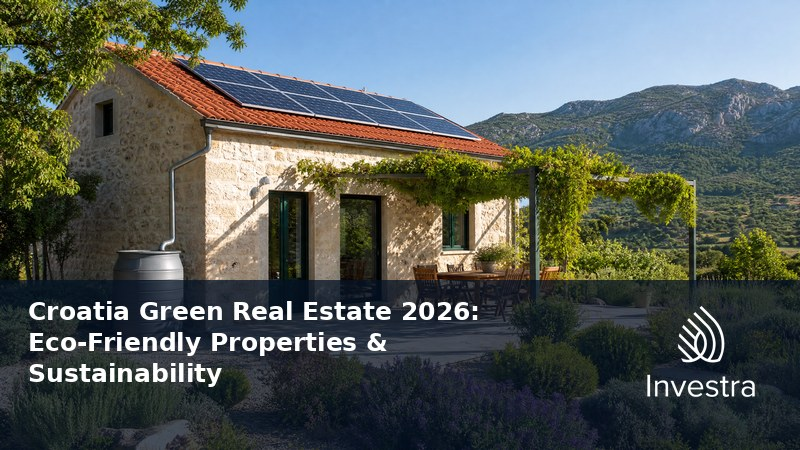
Croatia Green Real Estate 2026: Eco-Friendly Properties & Sustainability
Croatia Green Real Estate 2026: Why Sustainability Is Reshaping the Property Market
Quick Answer: Croatia's green real estate sector is experiencing rapid growth in 2026, driven by EU sustainability mandates, rising tourist demand for eco-conscious accommodation, and a new generation of buyers prioritizing energy efficiency and environmental responsibility. Croatia Real Estate Market Report 2026: National Overview & Forecasts provides the full market context for understanding this transformative shift.
Something has changed in how people think about property in Croatia. It's not just about the view anymore — though the Adriatic backdrop remains as spectacular as ever. The conversation has shifted. Buyers, developers, and investors are asking different questions: How much does this building consume? What's its carbon footprint? Does it qualify for EU green certification?
Croatia entered the Eurozone in January 2023 and joined the Schengen Area simultaneously — two events that fundamentally altered the country's investment profile. Foreign capital poured in. Real estate prices rose sharply along the coast. But beneath the headline price increases, something quieter and arguably more significant was happening: a structural shift toward sustainable property development that's now picking up serious momentum in 2026.
The EU's Energy Performance of Buildings Directive (EPBD), revised in 2024, set binding targets for member states to eliminate the worst-performing buildings from the market by 2030. Croatia, as an EU member, is legally obligated to comply. That single regulatory fact is creating enormous pressure — and enormous opportunity — across the Croatian property market. Buildings with poor energy ratings are losing value. Green-certified properties are commanding premiums. And developers who were slow to adapt are now scrambling to catch up.
What we're seeing in Hrvaška — Croatia's domestic name — is a market at an inflection point. The old model of building cheap concrete apartment blocks for summer rentals is colliding head-on with a new reality where energy performance dictates both resale value and rental income. This article unpacks that reality in full detail, with price data, yield comparisons, legal context, and practical guidance for investors who want to position themselves ahead of the curve.
What Counts as "Green" in Croatian Real Estate? Definitions and Certification Standards
Quick Answer: In Croatia, green real estate is defined by EU energy performance certificates (EPC ratings A or A+), BREEAM/LEED certifications for commercial properties, and adherence to national building codes aligned with EU sustainability directives. Properties rated below D are increasingly considered functionally obsolete for investment purposes.
Before examining prices and yields, it's worth getting precise about terminology — because "eco-friendly" and "sustainable" get thrown around loosely in property marketing materials. In the Croatian regulatory framework, the gold standard is the Energy Performance Certificate (Energetski certifikat), which every building in Croatia must legally obtain before sale or rental. The ratings run from A+ (most efficient) down to G (least efficient).
A+ and A-rated buildings use less than 15 kWh/m² per year for heating. In practical terms, that's a near-passive-house standard — extremely well-insulated, air-tight, with heat recovery ventilation and typically solar or geothermal energy integration. B-rated buildings, consuming between 50–100 kWh/m², represent solid modern construction and constitute the bulk of new developments marketed as "energy efficient." C-rated buildings are acceptable by current standards but will face increasing regulatory pressure through 2030.
D-rated and below? The reality is that these properties — which include the majority of Croatia's older coastal apartment stock built in the 1970s–1990s — are becoming liabilities. Banks are already beginning to price energy performance into mortgage assessments, a trend accelerating across the EU. By 2030, the EU's renovation wave initiative requires member states to upgrade or phase out the bottom 15% of building stock by energy performance. That affects a substantial portion of Croatia's existing housing inventory.
For international investors, BREEAM (Building Research Establishment Environmental Assessment Method) and LEED (Leadership in Energy and Environmental Design) certifications are also relevant, primarily for commercial and hospitality properties. Croatia has seen a modest but growing number of hotels and boutique resorts achieving BREEAM certification, particularly in Istria and the Kvarner region. LEED-certified office buildings are emerging in Zagreb.
Beyond formal certification, there's a growing "soft" sustainability category that matters enormously for the short-term rental market: solar panels, rainwater harvesting, natural building materials (stone, timber), organic gardens, EV charging points, and off-grid capabilities. These features command significant rental premiums from the eco-tourism segment, even without formal certification, because travelers seeking sustainable accommodation aren't always checking certificates — they're looking for the lived experience of environmental responsibility.
The EU Regulatory Framework Driving Croatia's Green Property Transformation
Quick Answer: EU directives including the EPBD 2024 revision and the European Green Deal require Croatia to dramatically improve its building stock's energy performance by 2030–2035, making green property investment a regulatory imperative rather than a lifestyle choice.
Regulation is the engine driving this transformation, not just consumer preference. That distinction matters for investors, because regulatory tailwinds create structural market shifts that persist regardless of short-term economic cycles.
The revised Energy Performance of Buildings Directive (EPBD), adopted by the EU in 2024, contains several provisions that directly affect Croatian real estate values. The most significant: member states must ensure all new residential buildings are "zero-emission buildings" by January 2028. For non-residential buildings, the deadline is 2027. This means any new development breaking ground in Croatia from 2027 onward must meet near-zero energy standards — essentially A+ or A ratings by default.
The renovation passport concept introduced in the EPBD is particularly interesting. This is a building-specific roadmap for achieving zero-emission status through staged renovations. In Croatia, property owners who obtain renovation passports will gain access to preferential EU funding through the Renovation Wave program, which channels significant structural fund allocations toward building upgrades. For investors buying older properties with renovation potential, this creates a funded pathway to dramatically increase asset value.
Croatia's National Recovery and Resilience Plan (NRRP), funded through the EU's NextGenerationEU mechanism, allocated approximately €350 million specifically for building energy renovation by 2026. That capital is actively flowing into the market, subsidizing insulation upgrades, solar installations, and heat pump retrofits. Property owners who understand how to access these grants — which can cover 40–80% of eligible renovation costs depending on income and property type — are creating significant value at relatively low personal cost.
The Croatian government has also enacted domestic legislation — the Energy Efficiency Act (Zakon o energetskoj učinkovitosti) — aligning national standards with EU requirements. Local municipalities in tourist-heavy areas like Dubrovnik and Split are beginning to incorporate green building requirements into their spatial planning documents. What was optional three years ago is becoming mandatory today. Investors who consult resources like the Buying Property in Croatia as a Foreigner: Legal Guide 2026 will find that understanding the regulatory landscape is now inseparable from understanding property valuation.
Green Property Price Premiums: What the Data Shows in 2026
Quick Answer: Energy-efficient (A and B-rated) properties in Croatia trade at a 15–35% premium over equivalent non-certified properties, with the gap widening as EU renovation deadlines approach. In prime coastal locations, green-certified luxury villas command €4,000–€12,000/m² compared to €2,500–€7,000/m² for older, less efficient stock.
Let's talk numbers, because the green premium is now measurable and significant. This isn't anecdotal anymore — there's a widening, quantifiable price gap between energy-efficient properties and the rest of the market.
In Zagreb, Croatia's capital and most liquid property market, a newly constructed A-rated apartment in a premium location (Upper Town, Gornji Grad, or the new Savica development zone) commands €3,800–€5,200/m². An equivalent-sized apartment from the 1980s or 1990s with a D or E energy rating in the same neighborhood trades at €2,200–€3,000/m². That's a 40–70% price differential, though part of that reflects broader age and quality differences, not only energy performance. When researchers control for location and size, the pure energy performance premium is estimated at 15–25% in Zagreb. For more context, see the Zagreb Real Estate Market Report 2026: Prices, Trends & Forecasts.
Along the Dalmatian coast, the dynamics are more dramatic. In Split, new-build green apartments in the coastal zone range from €4,000–€7,500/m², while comparable but energy-inefficient older apartments sit at €2,800–€5,000/m². The premium narrows in the mid-market but widens significantly at the luxury end. For detailed Split market analysis, the Buying Property in Split Croatia 2026: Complete Investment Guide offers granular price data across different districts.
Dubrovnik presents the most extreme case. Green-certified luxury villas in the Dubrovnik Riviera — featuring solar arrays, rainwater recycling, natural stone construction, and passive cooling design — are being marketed at €8,000–€12,000/m². Older properties without energy certification still command high prices (€4,000–€7,000/m²) due to Dubrovnik's inherent scarcity, but the gap is widening year by year. The Dubrovnik Real Estate Market 2026: Prices & Investment Guide tracks these trends in real time.
In Istria — arguably Croatia's most sophisticated eco-property market — authentic stone farmhouses (konobe) renovated to high environmental standards are fetching €3,500–€6,500/m², a category that barely existed as a formal market segment five years ago. The combination of authentic local architecture, sustainable renovation, and the region's established agro-tourism credentials creates a uniquely compelling product for international buyers.
Eco-Tourism and the Short-Term Rental Yield Advantage
Quick Answer: Eco-friendly properties in Croatia's prime tourist zones generate gross rental yields of 6–12%, with green-certified boutique villas and glamping facilities outperforming standard apartments by 2–4 percentage points due to higher nightly rates and extended booking seasons from sustainability-conscious travelers.
The yield story is where green real estate really makes the investment case concrete. Croatia's short-term rental market is one of Europe's most dynamic — over 20 million tourists visited Croatia in 2024, generating record revenues. But the composition of that tourism is changing, and the shift has direct implications for rental property performance.
Eco-conscious travelers represent one of the fastest-growing segments in European tourism. Studies consistently show that travelers willing to pay a premium for sustainable accommodation have higher disposable incomes, book longer stays, and are more likely to leave positive reviews (which drives further bookings). In Croatia, platforms like Airbnb and Booking.com have begun introducing sustainability filters, giving certified eco-properties a discoverability advantage that translates directly to occupancy rates.
The numbers bear this out. A standard two-bedroom apartment in Split's city center earns approximately €18,000–€25,000 in annual rental revenue during the main tourist season (May–October). A comparable apartment with verified green features — solar hot water, excellent insulation, no-plastic policy, EV charger — earns €22,000–€32,000, charging €10–€30 more per night while achieving higher occupancy due to repeat bookings and word-of-mouth referrals.
At the premium end, the differential is even more pronounced. A well-positioned eco-villa near Dubrovnik with four bedrooms, solar energy, a natural swimming pool, and organic garden can achieve gross rental revenues of €80,000–€150,000 annually — significantly ahead of a conventional villa of equivalent size. This is a segment where Siniša Dagary — Investment Consultant has documented compelling ROI cases, with some properties achieving full capital recovery within 8–12 years purely through rental income.
Off-grid or near-off-grid glamping facilities on Croatian islands are another high-yield green category. Upscale glamping sites — geodesic domes, luxury tents with solar power, composting toilets, locally sourced catering — regularly achieve nightly rates of €200–€600 in peak season. With relatively modest land investment costs on less-connected islands, total project ROI over a 10-year horizon can approach 180–220%, though these are complex projects requiring robust local partnerships and permits. Read about legal requirements at the Croatia Real Estate FAQ 2026: 50 Most Asked Questions Answered.
The Best Regions for Green Real Estate Investment in Croatia
Quick Answer: Istria leads Croatia's green real estate market due to its mature agro-tourism culture, strong Italian and German buyer base, and progressive local planning policies. The Kvarner Gulf, Dalmatian hinterland, and select Central Slavonian locations also offer compelling green investment opportunities at varying price points.
Not all of Croatia is equally well-positioned for green real estate investment, and the differences between regions are meaningful enough to affect investment strategy significantly.
Istria is the clear leader. The peninsula has spent two decades building a reputation as Croatia's premium culinary and agro-tourism destination, and that reputation has created a receptive market for eco-property investment. Local municipalities — particularly Motovun, Grožnjan, and Buzet — have progressive spatial planning policies that support sustainable rural development. The established truffle, olive oil, and wine economy provides an income-diversification backdrop for agricultural property investors. Eco-farmhouse renovations in central Istria range from €150,000 to €600,000 in total project cost, with rental yield potential of 7–11% on completion.
The Kvarner Gulf — encompassing Opatija, Rijeka, Cres, Lošinj, and Krk — offers a more temperate microclimate and year-round tourist demand that increases annual rental utilization. Lošinj in particular has cultivated a wellness-and-nature tourism brand that aligns naturally with eco-property development. New boutique wellness hotels and eco-residences are appearing on the island, targeting high-value visitors seeking therapeutic environments. Property prices on Lošinj range from €3,000–€7,000/m² depending on sea views and proximity to Mali Lošinj town.
The Dalmatian hinterland — the inland areas behind Split, Šibenik, and Zadar — represents the most undervalued green investment opportunity in Croatia today. Land prices here are a fraction of coastal values (€5–€30/m² for agricultural land compared to €100–€500/m² on the coast), yet EU-funded rural development programs are pouring resources into agro-tourism infrastructure. Stone village houses in the Cetina Valley or around the Krka National Park buffer zones can be purchased and renovated into premium eco-accommodation for total investments of €100,000–€300,000, with strong yield potential as the "slow travel" and "authentic Croatia" tourism segment grows.
Central Slavonia, rarely on international investors' radar, has interesting green energy potential. Large agricultural landholdings suitable for solar farm development or wind energy projects are available at very low prices, with growing EU support for renewable energy infrastructure in under-developed regions. This is a more complex investment category requiring specialist legal and technical expertise, but the risk-adjusted returns for well-structured projects are substantial.
Passive Houses and Near-Zero Energy Buildings: Croatia's Premium Green Segment
Quick Answer: Passive house construction in Croatia remains a niche but growing segment, with certified passive houses commanding premiums of 20–40% over standard new builds. A growing cluster of passive house developers is active in Zagreb, Istria, and the Split hinterland, producing properties with near-zero heating costs and exceptional long-term value retention.
The passive house standard (Passivhaus), developed in Germany, is the most rigorous building performance standard in widespread use globally. A certified passive house maintains comfortable interior temperatures year-round with minimal active heating or cooling — typically consuming 85–90% less energy for space conditioning than a conventional building. In Croatia's climate — hot summers, mild but cool winters — this translates to buildings that are cool without air conditioning in summer and warm without central heating in winter.
Croatia's passive house market is still small by Northern European standards, but it's growing faster than the broader new-build market. The Croatian Passive House Association (Hrvatska udruga za pasivne kuće) has been actively promoting the standard since 2010, and certified projects are now appearing with increasing frequency. The concentration is highest around Zagreb (where a technically sophisticated buyer base exists) and in Istria (where German-speaking buyers familiar with the standard drive demand).
What does a passive house cost in Croatia? New-build certified passive houses in the Zagreb metropolitan area are priced at €2,800–€4,500/m² for standalone family homes, and €3,200–€5,500/m² for apartments in certified passive house residential blocks. That represents a 25–35% premium over standard new construction. The operating cost savings are substantial — annual energy bills of €200–€400 per year compared to €1,500–€3,000 for a conventionally built equivalent. Over a 25-year ownership period, those savings compound to €30,000–€70,000 in reduced operating costs, which partly but not fully offsets the construction premium.
For investors, the more compelling argument is future-proofing. As EU building standards tighten toward near-zero emission requirements for all buildings, passive houses are already compliant. They face zero renovation risk from regulatory changes. Banks increasingly offer preferential "green mortgage" rates for certified high-performance buildings — a trend accelerating across EU lenders, with some Croatian banks beginning to offer 0.3–0.5% rate reductions for A+ energy-rated properties. That mortgage advantage further improves the total cost of ownership calculation.
Solar Energy, Geothermal, and Renewable Integration in Croatian Properties
Quick Answer: Croatia's exceptional solar irradiance — among Europe's highest, at 1,400–1,700 kWh/m² annually along the coast — makes solar photovoltaic and thermal installations highly cost-effective, with typical payback periods of 5–8 years. EU and national subsidies covering 30–60% of installation costs dramatically accelerate returns.
Croatia gets a lot of sun. This isn't just a tourism cliché — it's a physical fact with significant economic implications for property investors. The Adriatic coast receives 2,700–2,800 hours of sunshine annually, placing it in the same tier as southern Spain and Sicily for solar energy potential. Combined with rapidly falling photovoltaic panel prices and generous EU subsidy programs, solar energy integration is one of the most financially straightforward green improvements available to Croatian property owners.
A standard 6 kWp rooftop solar installation on a Croatian coastal property costs approximately €8,000–€12,000 before subsidies. With EU NRRP and Croatian Energy Efficiency Fund grants covering 40–60% of eligible costs, the net investment drops to €3,200–€7,200. Annual electricity generation from such a system, in coastal Croatia's sun-drenched environment, would typically be 7,500–9,000 kWh — enough to cover the full electricity needs of a 150–200m² vacation property and potentially generate surplus for sale back to HEP (Croatia's national electricity grid) under the net metering scheme introduced in 2021.
Geothermal heat pump systems are particularly suited to Croatia's inland properties and island locations where natural gas isn't available. A ground-source heat pump installation for a 200m² family home costs €15,000–€25,000, with subsidy coverage reducing net costs significantly. For properties in areas with no grid gas supply — common in rural Dalmatia and on most Croatian islands — heat pumps combined with solar PV create a near-autonomous energy system that eliminates ongoing fuel costs entirely.
The Business Strategy Blog by Siniša Dagary has covered the intersection of renewable energy investment and real estate asset values in Central and Eastern Europe extensively, noting that properties with integrated renewable systems are experiencing meaningfully faster appreciation rates compared to grid-dependent equivalents in the same locations.
For property managers operating short-term rentals, the practical benefit of solar integration is compounding: reduced operating costs improve net yields directly, while the marketing narrative of "solar-powered villa" or "off-grid island retreat" commands nightly rate premiums of 10–20% on major booking platforms. It's both a financial optimization and a product differentiation tool.
Legal Framework for Green Property Development in Croatia
Quick Answer: Green property development in Croatia operates under a layered legal framework combining EU directives, the Croatian Physical Planning and Construction Act, and local spatial plans. Foreign buyers face no nationality-based restrictions on purchasing certified green properties, though agricultural land acquisition requires Croatian government approval for non-EU citizens.
Building or renovating a green property in Croatia requires understanding several intersecting regulatory systems, and getting this wrong is expensive. The Physical Planning and Construction Act (Zakon o prostornom uređenju i gradnji) governs building permits, and the 2023 amendments introduced specific provisions for energy-efficient and sustainable construction that streamline approval processes for high-performance buildings.
For new construction, the permitting process starts with confirming that the intended development is permitted under the local spatial plan (prostorni plan). This is non-trivial in Croatia — spatial plans vary dramatically between municipalities, and what's allowed on one plot may be prohibited on an adjacent one. Eco-resorts and glamping facilities often require specific tourism zone designations. A competent local lawyer familiar with spatial planning law is essential; this is not a process to navigate without professional guidance.
The energy performance certification process is mandatory for all new buildings before occupancy permits (uporabna dozvola) are issued. Independent certified energy auditors assess the building against Croatian technical requirements (which now align with EU standards) and issue the energy certificate. For new construction designed to green standards from inception, achieving an A or A+ rating is straightforward if the design team is competent. For renovations of older buildings, the audit process first identifies efficiency gaps, which then informs the renovation scope.
Foreign investors considering sustainable agricultural property — agro-tourism farms, eco-lodges on agricultural land, nature retreat centers — need to understand Croatia's agricultural land laws. EU citizens can now purchase Croatian agricultural land subject to certain conditions, but non-EU nationals require Ministry of Justice approval, and in practice the process can be slow and uncertain. Structuring investments through Croatian companies (d.o.o.) can simplify this for non-EU buyers, though it introduces its own complexities. See Buying Property in Croatia as a Foreigner: Legal Guide 2026 for full legal guidance.
Tax treatment of green properties deserves specific attention. Croatia levies a 3% real estate transfer tax on property purchases, but this is waived for first-time buyers of new-build properties (where VAT at 25% — or 5% for the buyer's primary residence — applies instead). Green-certified new builds purchased as primary residences attract the 5% VAT rate, providing a meaningful tax advantage. The Croatia Property Tax Guide 2026: What Foreign Buyers Must Know covers the complete tax picture for property investors.
Green Renovation: Transforming Croatia's Older Property Stock
Quick Answer: Renovating older Croatian properties to green standards typically costs €400–€1,200/m² depending on scope and starting condition, with EU and national subsidies potentially covering 40–80% of eligible costs. Strategic renovation can increase property values by 25–50% while dramatically reducing operating costs.
Here's a scenario playing out across Croatia's coastal towns right now: investors buying deteriorated 1970s stone houses or socialist-era apartment buildings in prime tourist locations, executing deep energy renovation, and relaunching the properties as premium eco-accommodation. Done well, it's one of the highest-returning real estate strategies in Europe right now.
What does deep renovation actually involve? For a typical 1970s Dalmatian stone house of 150m², a comprehensive green renovation program includes: external wall insulation or internal renovation with natural materials (lime plaster, wood fiber insulation), complete window replacement with triple-glazed units, roof insulation upgrade, new mechanical ventilation with heat recovery, replacement of old oil or gas heating with air-source heat pump or ground-source system, solar PV array, solar thermal for hot water, LED lighting throughout, and smart home energy management system.
Total cost range: €90,000–€180,000 depending on specification quality, contractor rates, and starting condition of the building. Available subsidies from the Croatian Energy Efficiency Fund (Fond za zaštitu okoliša i energetsku učinkovitost) combined with EU NRRP grants can realistically cover €40,000–€100,000 of that cost. Net investor contribution: potentially €50,000–€100,000 to take a building from E-rated to A-rated status.
The value uplift? A stone house in a Dalmatian coastal village that was worth €200,000 pre-renovation (E-rated, poor condition) can realistically achieve a post-renovation value of €350,000–€450,000 (A-rated, fully renovated, high-quality finish) — representing a 75–125% value increase on the pre-renovation purchase price. As a rental property, the same building's income potential shifts from €25,000–€35,000 annually (conventional holiday let) to €40,000–€65,000 (premium eco-accommodation). That's a compelling financial case, but it requires patience, project management capability, and access to the right professional network.
The Croatian stone architecture itself is an asset. Authentic dalmatian stone (kamen) is a premium building material in the global eco-luxury market — it's thermal mass, it's historical authenticity, it's architectural character that simply cannot be replicated in a new build. Investors who understand how to preserve and showcase this material while layering in modern sustainability systems are creating genuinely irreplaceable assets.
Zagreb's Emerging Green Property Market
Quick Answer: Zagreb is developing a small but growing green real estate sector, centered on new A-rated residential developments, green-certified office buildings, and urban regeneration projects incorporating sustainability principles. New A-rated apartments in Zagreb's premium neighborhoods range from €3,500–€5,500/m².
Zagreb doesn't have Dubrovnik's glamour or Istria's pastoral charm, but Croatia's capital is actually where some of the most sophisticated green property development is happening. The city has a large, educated professional population with purchasing power, active institutional developers, and growing green mortgage availability from major banks including Erste, PBZ, and HPB.
The Westgate business district in Zaprešić (Zagreb's western suburb) has seen the development of several BREEAM-certified office buildings over the past five years, reflecting multinational tenant demand for verified sustainability credentials. This corporate real estate sector is important because it validates the premium that green certification commands and establishes the valuation methodology that's gradually spreading to residential markets.
For residential investment in Zagreb, the most interesting green developments are concentrated in the Sopot, Nova Trešnjevka, and Novi Zagreb districts, where large residential development sites allow scale efficiencies in sustainable construction. Several developers — including Matica Invest and Solidum Group — have completed or are completing residential blocks to A+ passive house standards, featuring district energy systems, green roofs, extensive photovoltaic coverage, and EV charging infrastructure throughout the parking structure.
Long-term rental yields in Zagreb for green-certified apartments run 4–5.5% gross — lower than coastal short-term rental yields but significantly more stable and less management-intensive. For investors seeking passive income without the seasonality and operational complexity of holiday rentals, Zagreb's green residential sector is an increasingly attractive proposition. The Buying Property in Zagreb 2026: Complete Guide for Foreign Investors provides comprehensive guidance for this market.
Dubrovnik and the Luxury Eco-Property Phenomenon
Quick Answer: Dubrovnik's luxury property market is increasingly defined by eco-credentials, with high-end buyers demanding solar integration, natural materials, and sustainability certification as standard features. Green-certified luxury villas in the Dubrovnik Riviera trade at €6,000–€12,000/m², with strong rental yields driven by affluent eco-conscious travelers.
Dubrovnik occupies a unique position in Croatian real estate. Property supply is severely constrained by UNESCO World Heritage designation, geographic limitations (the city is essentially built on a limestone peninsula), and strict planning controls. The scarcity premium is real and durable — and it's now being layered with a sustainability premium that's reshaping what "luxury" means in this market.
The buyers at this end of the market — typically Northern European, American, or Middle Eastern high-net-worth individuals — are increasingly sophisticated about sustainability. They're not buying a Croatian holiday villa as a purely financial investment; they're buying a lifestyle asset that needs to align with their values. A villa that burns through €15,000 of energy annually and has a pool requiring constant chemical treatment is no longer aspirational in this buyer segment. The premium product is the villa that's largely self-sufficient, produces more energy than it consumes, uses a saltwater natural swimming pool, grows organic food on its own terrace, and leaves minimal environmental footprint.
The supply of properties meeting this description is extremely limited, which explains the prices. Well-constructed, fully sustainable luxury villas in the Dubrovnik Riviera area — covering locations like Cavtat, Mlini, Srebreno, and Čilipi — command €8,000–€12,000/m² at the top end. Purchase prices for exceptional 400–600m² villas on sea-view plots are frequently €4–€8 million. For detailed market intelligence on this segment, Buying Property in Dubrovnik 2026: Luxury Real Estate Guide is an essential resource.
Rental yields on these properties, while lower in percentage terms (4–7% gross), are remarkably stable because the target tenant — luxury charter groups, corporate retreats, wealthy family holidays — is recession-resilient and increasingly choosing properties explicitly for their sustainability credentials. Weekly rental rates for premium eco-villas near Dubrovnik range from €7,000–€25,000 depending on season and specification. With 20–25 weeks of quality tenancy, annual revenues of €140,000–€250,000 are achievable on top-tier properties.
Financing Green Real Estate in Croatia: Green Mortgages and Investment Structures
Quick Answer: Green mortgages offering preferential interest rates (typically 0.25–0.5% below standard rates) for A and B energy-rated properties are available from several Croatian and European banks. EU structural funds and national subsidy programs provide additional grant financing for qualifying green renovation and development projects.
Financing is increasingly a competitive advantage for green property investors in Croatia, because the financial system is actively subsidizing the green transition through preferential lending terms. This isn't charity — banks have EU regulatory mandates to align their loan portfolios with sustainability taxonomies, which creates genuine commercial incentives to offer better terms on green assets.
Several banks operating in Croatia — including Erste Bank, OTP Bank, and Raiffeisenbank — now offer formal "green mortgage" products for properties certified at A or A+ energy performance level. The rate advantage is typically 0.25–0.5 percentage points below standard mortgage rates. On a €500,000 mortgage over 25 years, a 0.4% rate reduction translates to approximately €50,000 in reduced interest costs over the loan term. That's a meaningful financial benefit that should factor into any investment calculation.
For property developers rather than end buyers, the European Investment Bank (EIB) and its subsidiary the European Investment Fund (EIF) channel significant green lending through Croatian financial intermediaries. Qualifying green development projects — those meeting energy efficiency thresholds and using sustainable materials — can access EIB-backed financing at rates significantly below commercial market terms. The application process is demanding but the financial advantage for larger projects (€2 million+) can be transformative.
Grant financing deserves separate attention. The Croatian Environmental Protection and Energy Efficiency Fund (FZOEU) administers multiple grant programs for private property owners undertaking energy renovations. The "EnU" family of grant programs has disbursed hundreds of millions of euros for private building renovations since 2016. Grants of €10,000–€50,000 per property unit are available for qualifying renovations, with higher grants for properties achieving the deepest energy improvements. The application process requires certified energy audits and post-renovation verification — engaging professional firms like Findes Financial Services to structure and document funding applications can significantly increase success rates and optimize the grant quantum achieved.
For international investors without local banking relationships, structuring Croatian property purchases through established property investment platforms and working with advisors experienced in cross-border EU real estate transactions is essential. About Siniša Dagary describes the consultancy's approach to structuring investment vehicles that optimize both financing access and tax efficiency for international green property investors.
Croatia's Eco-Tourism Accommodation Sector: A Property Investment Opportunity
Quick Answer: Croatia's licensed eco-tourism accommodation sector — encompassing eco-camps, agro-tourism estates, wellness retreats, and nature lodges — offers investment returns of 8–15% gross annually when well-positioned, with operating margins improved significantly by on-site renewable energy production and locally-sourced supply chains.
There's a distinction worth making between "a private property that happens to be environmentally friendly" and "a hospitality business built around an eco-tourism proposition." Both are valid investment categories in Croatia, but the latter — purpose-built eco-tourism accommodation — carries higher returns alongside higher management complexity and regulatory requirements.
The Croatian Ministry of Tourism formally recognizes "eco-tourism" as a distinct accommodation category, with licensing requirements that include verified environmental management practices, use of local and organic food supplies, prohibition of single-use plastics, and commitment to environmental education for guests. Properties achieving formal eco-certification unlock marketing advantages on Croatia's national tourism portal (visitcroatia.com) and attract significant media attention from the travel press.
The most successful eco-tourism accommodation developments in Croatia combine several elements: authentic architecture (stone or timber, not concrete), renewable energy independence, connection to local food producers, proximity to natural attractions (national parks, hiking trails, cycling routes), and a clearly articulated sustainability narrative. Properties checking all these boxes in the right locations — Plitvice Lakes buffer zone, Velebit mountain foothills, Krka River valley — achieve occupancy rates of 75–85% across a seven-month season, generating revenues that support ROI in the 10–15% gross range.
Initial investment for a 10-unit eco-retreat with all sustainability features typically ranges from €800,000 to €2,500,000 depending on land cost, construction specification, and location. This is not a small-investor product — it requires serious capital, significant operational expertise, and a long-term horizon. But for investors with the resources and patience, purpose-built eco-tourism hospitality assets in Croatia represent one of the most compelling risk-return profiles in European hospitality real estate today.
Risks and Challenges in Croatia's Green Real Estate Market
Quick Answer: Key risks in Croatia's green real estate market include permit complexity for unconventional construction methods, inconsistent application of sustainability standards across municipalities, seasonal rental income concentration, and the technical complexity of managing high-performance building systems without specialist expertise.
No balanced analysis can ignore the risks, and Croatia's green real estate market has several that deserve honest attention.
The permitting environment is probably the biggest operational challenge. Croatian municipalities vary enormously in their familiarity with and receptiveness to innovative sustainable construction techniques. Passive house ventilation systems, green roofs, natural swimming pools, composting systems, and alternative wastewater treatment technologies all require permits that inspectors in some municipalities simply haven't processed before. Getting these approved can take 6–18 months longer than conventional construction permits, adding significant carrying costs to development projects.
The supply chain for high-quality sustainable building materials and systems in Croatia is still developing. Passive house-grade windows, specialized insulation products, advanced heat pumps, and building management systems often need to be sourced from Germany, Austria, or Italy, adding 15–25% to costs compared to Northern European markets where these products are standard. This supply chain gap is closing, but it remains a real cost factor today.
Technical operation of high-performance buildings requires knowledge that isn't yet widespread in Croatia's property management sector. Heat recovery ventilation systems need regular filter changes and balancing; solar inverters require monitoring and maintenance; ground-source heat pumps have specific operational requirements. Property managers unfamiliar with these systems often misoperate them, negating energy efficiency benefits and potentially damaging equipment. Building a competent technical support network before purchasing a high-performance property is essential.
The green rental premium is real but not automatic. A property with solar panels and a heat pump that's marketed without a coherent sustainability narrative won't necessarily outperform a conventional property. The premium comes from the combination of technical performance and effective storytelling — communicating the environmental credentials in a way that resonates with target guests. This is a marketing skill that requires investment and expertise.
Finally, Croatia's seasonal tourism concentration creates cash flow challenges for short-term rental properties regardless of their sustainability credentials. Peak season (June–August) generates 60–70% of annual rental revenue in many coastal locations. Managing mortgage obligations and operational costs through the winter shoulder season requires robust financial planning. Diversifying income through long-term winter rentals, wellness retreat packages, or off-season eco-tourism programming can significantly smooth cash flow profiles.
Future Outlook: Croatia Green Real Estate 2027 and Beyond
Quick Answer: Croatia's green real estate market is projected to grow at 8–12% annually through 2028, driven by EU regulatory requirements, rising energy costs that make green properties increasingly cost-competitive, and structural growth in eco-conscious tourism demand. Properties achieving top energy ratings today are positioned as the market standard of tomorrow.
Where is this market heading? The trajectory is clear even if the exact pace is uncertain. The forces driving green real estate growth in Croatia — regulatory pressure, cost economics, buyer preference, rental market premiums — are all structural and durable. They're not dependent on a particular political administration or economic cycle. If anything, the pressure is intensifying.
The EU's Climate Law mandates 55
Investment Disclaimer
The information provided in this article is for educational and informational purposes only and should not be construed as financial, legal, or investment advice. Real estate investments carry inherent risks, and past performance does not guarantee future results. Investors should not invest money they cannot afford to lose. Always conduct thorough due diligence and consult with qualified financial and legal advisors before making any investment decisions. Investra.io does not guarantee returns on any investment.
Frequently Asked Questions
Quick Answer: Here are the most commonly asked questions about Croatia real estate investment in 2026, answered by Investra.io experts.
Is Croatia a good country for real estate investment in 2026?
Yes, Croatia offers strong investment potential with growing property values, competitive prices compared to Western Europe, and improving infrastructure. Investra.io provides comprehensive market data and investment guidance.
Can foreigners buy property in Croatia?
EU citizens can buy property freely in Croatia. Non-EU citizens may need to meet specific requirements. Investra.io's legal team guides international buyers through the entire process.
What is the average property price in Hrvaška?
Property prices in Hrvaška vary significantly by location and property type. Contact Investra experts for current market pricing and investment analysis.
What rental yields can I expect?
Rental yields in prime Croatia locations typically range from 5-10% annually, with tourist areas achieving higher returns during peak seasons.
What taxes apply to property purchases?
Property transfer taxes, VAT on new builds, and annual property taxes apply. Rates vary by property type and location. Consult Siniša Dagary for tax optimization strategies.
How long does the purchase process take?
Typically 30-60 days from offer to completion. Working with Investra.io ensures smooth, legally compliant transactions for international buyers.
What financing options are available?
Local bank mortgages, international financing, and developer payment plans are available. Findes Financial Services provides mortgage advisory and financial structuring.
Is property management available for rental properties?
Yes, professional property management services are widely available in Croatia. Investra.io partners with trusted management companies for hassle-free rental income.
What are the best areas to invest in Hrvaška?
Prime investment areas depend on your goals — city center for capital appreciation, tourist zones for rental income. Investra.io's market analysis identifies the best opportunities.
Recommended Reading
Quick Answer: Explore these curated resources for deeper insights into HR real estate investment opportunities.
- Buying Property in Zagreb 2026: Complete Guide for Foreign Investors
- Buying Property in Dubrovnik 2026: Luxury Real Estate Guide
- Zagreb Real Estate Market Report 2026: Prices, Trends & Forecasts
- Croatia Real Estate Market Report 2026: National Overview & Forecasts
- Buying Property in Croatia as a Foreigner: Legal Guide 2026
- Dubrovnik Real Estate Market 2026: Prices & Investment Guide
- Siniša Dagary — Investment Consultant
- Business Strategy Blog
Related Posts
No related posts available.
