
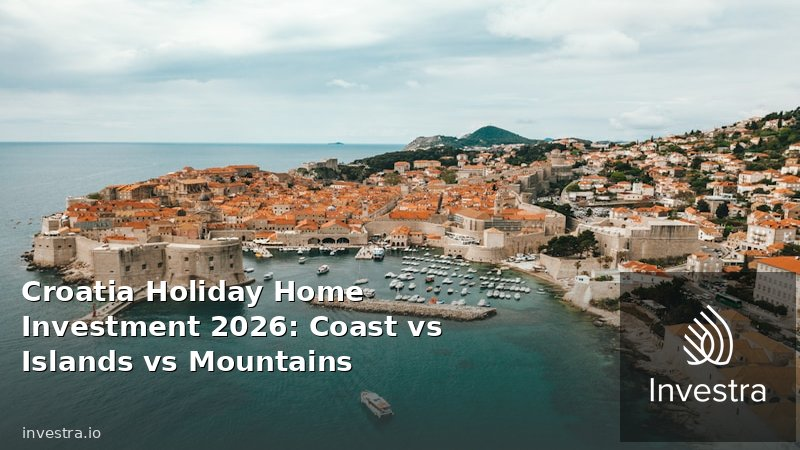
Croatia Holiday Home Investment 2026: Coast vs Islands vs Mountains
Croatia Holiday Home Investment 2026: Why This Market Still Has Room to Run
Quick Answer: Croatia's holiday home market in 2026 remains one of Europe's most compelling investment stories, with coastal properties, island retreats, and mountain escapes each offering distinct yield profiles and capital growth potential. For a full overview, the Croatia Real Estate Investment Guide 2026 on Investra.io is the most comprehensive starting point for international buyers.
Croatia doesn't follow the same playbook as Spain or Portugal. It's a smaller market, yes — but that's precisely what makes it interesting. When the tourist numbers keep breaking records (over 20 million visitors in 2023 alone, with 2024 figures pushing even higher), and when a country adopts the euro and joins the Schengen Area in the same calendar year, something structurally significant is happening in its property market.
The euro adoption in January 2023 was the turning point most international investors had been waiting for. It eliminated currency risk, simplified transactions for eurozone buyers, and sent a clear signal that Croatia had permanently anchored itself to the EU's economic core. What followed was a sharp acceleration in foreign interest — and prices that reflected it.
But here's where Croatia gets genuinely complex: it's not one market. The sun-drenched Dalmatian coast, the glamorous islands of the Adriatic, and the relatively undiscovered mountain interior each operate on completely different dynamics. Rental yields, capital growth trajectories, liquidity, regulation, and buyer profiles vary dramatically depending on where exactly you plant your flag.
This article cuts through the noise. It examines the three primary investment environments — coast, islands, and mountains — with real data on price ranges, yields, legal considerations, and what's actually working for investors in 2026. Whether you're a first-time international buyer or adding to an existing portfolio, the question isn't simply "should I buy in Croatia?" It's "where in Croatia, and why?"
The Croatian Property Market in 2026: What the Numbers Actually Tell Us
Quick Answer: Croatian property prices have risen 40–60% in prime coastal areas since 2020, with average prices ranging from €2,500/m² in inland regions to over €8,000/m² in Dubrovnik's Old City. Euro adoption and Schengen membership have structurally reinforced buyer confidence.
Let's start with the macro picture, because context matters enormously here. Croatia's real estate market has been on a multi-year upward trajectory, driven by a combination of domestic demand, foreign investment, and structural policy changes that few analysts predicted would arrive so quickly.
Average property prices across Croatia sat at approximately €1,800–€2,200/m² in 2021. By the start of 2026, those averages had climbed to €2,800–€3,400/m² nationally — with coastal and island markets significantly outpacing that figure. In Split's city center, prices have crossed €4,500–€5,500/m². In Dubrovnik's most desirable zones, €7,000–€9,500/m² is now considered normal for finished, well-located product.
What's driving this? Several things at once. The Schengen accession in January 2023 made Croatia significantly more accessible for EU visitors, reducing border friction and boosting tourism volumes. Euro adoption removed the kuna conversion calculation that had historically made Croatian property prices feel opaque to foreign buyers. And a genuine shortage of quality, legally clean inventory in prime locations has created persistent upward pressure on pricing.
The Croatian Bureau of Statistics reported that real estate transaction volumes hit record highs in both 2023 and 2024, with foreign buyers accounting for approximately 22% of all purchases — up from around 15% pre-pandemic. German, Austrian, Czech, Slovak, and Polish buyers dominate the foreign buyer pool, though we're seeing increased interest from the UK, US, and Middle Eastern markets.
Rental markets have kept pace. Average nightly rates on the Dalmatian coast rose 18% between 2022 and 2024, and occupancy rates in peak season (June–September) routinely hit 85–95% for well-managed properties in prime locations. Gross rental yields of 5–8% are achievable in coastal areas, with some island properties hitting 9–11% for investors who've optimized their short-term rental operations.
The Croatian government has also been relatively investor-friendly — there are no restrictions on EU citizens buying property, and the legal framework, while requiring careful navigation, is well-established. For detailed analysis of specific city markets, the Zagreb Property Market Analysis on Investra provides granular data that national averages inevitably obscure.
Coastal Croatia: The Dalmatian Riviera and Its Investment Dynamics
Quick Answer: The Dalmatian coast — spanning Split, Trogir, Makarska, and Zadar — offers the broadest range of entry points, from €3,000/m² in up-and-coming zones to €6,000+/m² in prime seafront positions, with rental yields of 5–7% and strong capital growth backing.
The coast is where most first-time Croatian buyers start, and honestly, it's not hard to understand why. The combination of historical architecture, crystal-clear water, reliable flight connections, and a well-developed tourist infrastructure makes Dalmatian coastal towns the most liquid segment of the Croatian holiday home market.
Split deserves special attention. Croatia's second-largest city has undergone a remarkable transformation over the past decade, evolving from a transit hub into a genuine destination in its own right. The city's ancient core — built inside Diocletian's Palace, a Roman emperor's retirement home — commands prices of €4,500–€5,800/m² for renovated stone apartments. But the surrounding neighborhoods of Meje, Bačvice, and Spinut offer quality product at €3,200–€4,200/m², with strong rental demand driven by Split's year-round tourism (not just summer).
The Split rental market is particularly interesting because it's becoming less seasonal. Cruise traffic, business visitors, and the city's growing expat community sustain occupancy across 10–11 months of the year. A well-positioned two-bedroom apartment in Split might generate €25,000–€35,000 in annual rental revenue — gross yields in the 6–8% range for buyers who entered at 2021–2022 prices.
Trogir, 27km from Split, represents a classic example of the "gateway effect." As Split prices rose, buyers discovered Trogir's UNESCO-listed old town and found comparable beauty at 20–30% lower price points. Properties in Trogir's historic core now range €2,800–€3,800/m², with villa product on the surrounding islands (Čiovo) starting around €2,200/m².
Zadar is the quiet achiever of this segment. The northern Dalmatian capital has international airport connections to 30+ European cities, a vibrant local economy, and property prices that haven't yet caught up with Split. Premium apartments in Zadar's old town: €3,500–€4,500/m². New-build developments on the peninsula: €3,000–€3,800/m². Rental yields are typically 5–6.5%, with capital growth projections that many analysts consider more attractive than Split's (simply because there's more room to run).
Makarska Riviera — the strip between Split and Dubrovnik — appeals to buyers seeking a more relaxed pace. Towns like Brela, Baska Voda, and Makarska itself offer beachfront apartments at €3,000–€4,500/m², villas at €3,500–€5,500/m². The Biokovo mountain backdrop makes this area particularly striking, and increasingly, buyers are buying here precisely because it isn't as developed as Split or Dubrovnik. For those exploring the full coastal opportunity set, the Split Real Estate Guide breaks down each micro-market in detail.
Dubrovnik: Europe's Most Glamorous — and Most Expensive — Holiday Home Market
Quick Answer: Dubrovnik property commands €5,000–€9,500/m² depending on location and view, with luxury villa rentals generating €80,000–€200,000+ annually. It's Croatia's most internationally recognized market but also its most expensive and least accessible entry point.
Dubrovnik operates in its own orbit. The "Pearl of the Adriatic" label isn't marketing hyperbole — it's UNESCO recognition, Game of Thrones fame, and relentless superyacht traffic all rolled into one. The city's Old Town is genuinely one of the most beautiful urban environments on the planet, and property within its walls reflects that scarcity.
Inside the city walls, prices for renovated stone apartments start at €6,500/m² and can reach €9,500–€10,000/m² for exceptional product with sea views. These are tiny markets — supply is structurally constrained because you can't build new within the UNESCO perimeter. What trades does so at a significant premium, and it trades slowly. Liquidity is lower than in Split or Zadar, but the buyer quality is higher — you're dealing with HNW individuals who aren't sensitive to market cycles in the same way.
The real action in Dubrovnik's investment market happens in the surrounding areas: Lapad and Babin Kuk peninsulas (€4,500–€6,500/m² for apartments), Gruž harbor area (€3,800–€4,800/m²), and the wider Dubrovnik-Neretva County, which includes spectacular villa country stretching toward the Elaphiti Islands and Pelješac peninsula.
Villa rentals in the Dubrovnik region are where the numbers become genuinely staggering. A well-appointed 4-bedroom villa with a pool and sea view, positioned within 30 minutes of Dubrovnik airport, can realistically generate €120,000–€200,000+ in annual gross rental income. Weekly rates in peak season range from €8,000 to €25,000+ for premium product. Even accounting for management fees (typically 20–25%), maintenance, and taxes, net yields of 4–6% on properties valued at €1.5–€3M are achievable.
The catch? Entry prices. Villas in the Dubrovnik hinterland with pool and sea views start around €800,000 and quickly climb above €2M for anything truly exceptional. This isn't a market for buyers with a €300,000 budget — though apartment investments in the Lapad area can still be accessed at €250,000–€400,000 for smaller units. For a deep dive into this market segment, Dubrovnik Luxury Property Guide on Investra is indispensable reading.
The Croatian Islands: Where High Yields Meet Higher Romance
Quick Answer: Croatian island properties — particularly on Hvar, Brač, Korčula, and Vis — deliver gross rental yields of 7–11% for optimized short-term rentals, with prices ranging from €3,500/m² on emerging islands to €8,000+/m² for premium Hvar seafront. The tradeoff is access logistics and a compressed tourist season.
There are 1,244 islands, islets, and reefs along Croatia's Adriatic coast. Only around 50 are inhabited. And within that inhabited group, a handful have emerged as genuine investment-grade markets — each with its own personality, price point, and rental profile.
Hvar is the headline act. Croatia's most fashionable island has attracted a celebrity-and-superyacht crowd that has fundamentally repriced the market. Hvar Town, with its Venetian architecture and buzzing nightlife, sees apartment prices of €5,500–€8,000/m² for quality product. Stone houses requiring renovation start around €3,000/m² — though renovation costs on an island (materials access, logistics, contractor availability) add significantly to total project costs. Budget an additional €800–€1,500/m² for renovation on top of acquisition price.
The Hvar rental market is extraordinary during peak season. A three-bedroom apartment in Hvar Town can generate €1,500–€2,500 per week in July and August. Some boutique villa products on the island's quieter southern coast — places like Milna, Zavala, and Sveta Nedjelja — command €5,000–€12,000 per week, with the best properties fully booked 12–18 months in advance.
Brač, connected by ferry from Split, offers a different proposition. Best known for Zlatni Rat beach (that iconic horn-shaped shingle beach that shifts with the currents), Brač has strong, reliable rental demand without Hvar's exclusivity premium. Bol and Supetar are the main investment towns, with prices of €3,500–€5,000/m². The island's relative accessibility from Split keeps demand broad-based — families as well as the high-end crowd — which translates to better shoulder-season occupancy.
Korčula, often called "Little Dubrovnik" for its medieval walled town, is an emerging market that many investors consider the best risk-adjusted opportunity in the island segment right now. Prices of €3,200–€5,000/m² still offer genuine upside, the island has strong cultural appeal (it's reputedly Marco Polo's birthplace), and its wine-producing hinterland adds a lifestyle dimension that attracts longer-stay guests. Rental yields of 7–9% are realistic for well-managed properties in Korčula Town.
Vis — Croatia's most remote inhabited island, reached by 2.5-hour ferry from Split — deserves a mention for adventurous investors. Deliberately kept off-limits to foreigners until 1989 (it was a Yugoslav military base), Vis has an authenticity that's becoming increasingly rare. Prices remain relatively accessible at €2,800–€4,200/m², but the market is thin, liquidity is low, and the tourist season is short. This is an investment for buyers who genuinely love the island and want personal enjoyment alongside return — not purely a yield play. For comprehensive island market data, the Hvar Island Real Estate guide provides both specific pricing and broader island investment context.
Mountain Croatia: The Emerging Investment Frontier
Quick Answer: Mountain regions like Gorski Kotar, Zagorje, and the Plitvice Lakes area offer entry prices of €800–€2,000/m² with growing year-round tourism demand, making them Croatia's most affordable and potentially highest-upside holiday home investment for buyers willing to pioneer a nascent market.
Here's the honest truth about mountain Croatia: it's where the smart money is starting to look, but it's not where most people are buying yet. That gap — between current fundamentals and current prices — is precisely what makes it interesting.
Croatia's interior is dramatically beautiful and dramatically underpriced relative to the coast. The Gorski Kotar region, sometimes called "the green lungs of Croatia," sits between Zagreb and the sea, offering dense forests, clear rivers, and ski facilities (modest by Alpine standards, but functional) at Platak and Bjelolasica. Stone farmhouses requiring renovation can be found for €50,000–€120,000 total. Finished rural properties with land: €800–€1,500/m². These aren't typos — the delta from coastal prices is extraordinary.
The Plitvice Lakes National Park area is perhaps the most investable part of mountain Croatia right now. Plitvice receives 1.2–1.5 million visitors annually, making it one of Europe's most-visited natural attractions. Yet accommodation supply is chronically constrained — the park itself limits development, and the surrounding villages haven't yet built out the hospitality infrastructure that visitor numbers demand. Guesthouses and rural B&Bs within 20km of Plitvice are generating 70–80% occupancy across a growing 9-month season (the park is spectacular in autumn and winter, not just summer).
Properties near Plitvice: €900–€1,800/m² for rural residential. A 200m² stone house with land on a well-maintained plot might be purchased for €150,000–€280,000 — a fraction of what a comparable-sized property costs in Split. Converted to a boutique guesthouse or high-end rural accommodation, such properties are generating €40,000–€70,000 annually, implying yield profiles that make coastal numbers look modest.
Zagorje, the rolling hills north of Zagreb known for medieval castles, thermal spas, and wine cellars, is another emerging segment. It caters to Zagreb weekend escapers, but also increasingly to international visitors combining Croatian coastal travel with inland cultural tourism. Weekend house prices: €600–€1,200/m². Traditional "zagorska hiža" (wooden highland houses): €30,000–€90,000 for renovation projects.
The risks here are real. Liquidity is genuinely lower — if you need to sell quickly, mountain Croatia will test your patience. The tourist market is newer and less predictable than the coast. Infrastructure (roads, broadband, medical facilities) is improving but trails coastal quality. And renovation projects in remote mountain areas carry execution risk that city-based investors consistently underestimate. But for buyers with a 7–10 year investment horizon and personal lifestyle interest in the properties, mountain Croatia offers the most compelling risk-reward in the entire Croatian market.
Coast vs Islands vs Mountains: The Head-to-Head Investment Comparison
Quick Answer: Coast wins on liquidity and yield stability; islands win on peak rental income potential and lifestyle appeal; mountains win on entry price and long-term upside. The "best" choice depends entirely on budget, risk tolerance, and personal usage intentions.
Putting all three segments side by side clarifies the decision framework considerably. This isn't about declaring a winner — it's about matching the right market to the right investor profile.
Entry price range: Mountains lead with €600–€2,000/m². Coastal mainland: €2,500–€6,000/m². Islands: €3,000–€9,500/m².
Gross rental yield potential: Islands can hit 9–11% for optimized operators. Coastal mainland: 5–8%. Mountains: 6–10% near major attractions, but with higher variance.
Season length: Coastal mainland 6–8 months of meaningful occupancy, increasingly year-round in cities. Islands: 4–6 months peak, with some shoulder season. Mountains: growing toward 9–10 months near Plitvice, 5–7 months in ski areas.
Liquidity (ability to resell): Coastal cities highest. Islands variable (high for Hvar, lower for Vis). Mountains lowest.
Capital growth (2020–2026 track record): Dubrovnik and Hvar led with 50–65% appreciation. Split and Zadar: 40–55%. Islands generally: 35–60% depending on location. Mountains: 20–35% from a much lower base.
Management complexity: Coastal city apartments are the simplest to manage — established property management companies, good infrastructure, clear logistics. Island villas require more coordination (ferry access for contractors, shorter maintenance windows). Mountain properties require local network knowledge that takes time to build.
What does this all mean? If you want the most reliable, liquid, benchmark investment, a coastal city (Split or Zadar) apartment is the closest Croatia gets to a "safe" option. If you're chasing maximum rental income and personal enjoyment, a well-chosen island villa is unmatched — but requires more active management and higher capital. If you're a contrarian buyer with a long time horizon and genuine passion for Croatia's interior, mountain properties offer the widest spread between current price and potential value.
Legal Framework for Foreign Buyers: What You Need to Know in 2026
Quick Answer: EU citizens can buy Croatian property with no restrictions. Non-EU buyers face a reciprocity requirement, which is satisfied by most Western countries. The process takes 1–3 months from offer to ownership transfer, with legal costs of 3–5% on top of the purchase price.
Croatia's legal framework for foreign property ownership has become considerably cleaner since EU accession in 2013. The headline: if you hold an EU/EEA passport, you have equal rights to Croatian citizens when buying property. No special approvals required. This covers the majority of buyers from Germany, Austria, Netherlands, UK (which has bilateral reciprocity post-Brexit), France, Italy, and the rest of the EU.
Non-EU nationals — Americans, Canadians, Australians, UAE residents, etc. — need to satisfy the "reciprocity condition," meaning Croatia must have a reciprocal property ownership agreement with the buyer's home country. In practice, this condition is met by most major Western countries, but buyers should confirm with a Croatian lawyer before proceeding. Citizens of some countries may need to purchase through a Croatian-registered company — an additional step that adds complexity but doesn't fundamentally block the investment.
The purchase process itself follows a predictable sequence. After agreeing a price with the seller, a preliminary contract (predugovor) is signed — typically accompanied by a 10% deposit. The buyer's lawyer conducts due diligence on the land registry (Zemljišna knjiga), checking for encumbrances, legal disputes, ownership chains, and planning permissions. Croatia's land registry digitalization has improved significantly since 2015, though older properties in island villages can still carry legacy documentation issues.
The main purchase contract (ugovor o kupoprodaji) is then signed before a notary. Ownership transfer is registered in the land registry — a process that technically takes 2–6 weeks but can extend in busier cadastre offices. Total transaction costs for buyers typically include: 3% real estate transfer tax (Porez na promet nekretnina), notary fees (€500–€1,500), land registry fees (€200–€500), and lawyer fees (typically 1–1.5% of purchase price, minimum €1,500). Budget 5–7% on top of the purchase price for total transaction costs.
One critical point that catches international buyers off-guard: "etažiranje" (building legalization and subdivision into units). Many older apartment buildings, particularly on islands and in smaller coastal towns, haven't been properly subdivided in the land registry. Buying a unit that isn't correctly registered creates significant legal risk. Always verify with your lawyer that the specific unit — not just the building — has clear, legally separated title. This is non-negotiable due diligence. For personalized legal guidance through the purchase process, Investra's local experts can connect you with qualified legal professionals in each region.
Croatia Rental Income: Regulations, Licensing, and the Tax Picture
Quick Answer: Croatia requires a "rješenje" (resolution/license) to legally rent a holiday property, obtained from the relevant county or local authority. Rental income is taxed at a flat 10% (paušalni porez) for properties meeting income thresholds, making Croatia's rental tax regime one of the most investor-friendly in the EU.
Renting your Croatian holiday home — which virtually every investment buyer intends to do — is legal, well-regulated, and, from a tax perspective, genuinely attractive. But it requires proper licensing, and operating without it exposes you to fines that can reach €13,000 for repeat offenses.
To legally rent a property for holiday accommodation, you need to register the property with the local tourism authority and obtain a "rješenje" — an official decision/license classifying the property and its capacity. This process requires the property to meet minimum standards for the category you're applying for (apartments, rooms, holiday houses are the main categories). Standards cover things like minimum square footage per guest, fire safety requirements, and amenity specifications.
The license also requires you to register guests with the police within 12 hours of arrival — this is done digitally through the eVisitor system, which most property management companies handle automatically. Guests are subject to a tourist tax (turistička pristojba) of €0.60–€2.65 per person per night depending on category and season — this is charged to guests, not absorbed by the property owner.
Now for the good news: Croatian rental income tax is structured in a way that makes the country genuinely competitive for buy-to-let investors. Property owners who earn rental income can elect for the "paušalni porez" (flat-rate tax) regime, under which they pay a fixed annual tax based on the registered capacity of the property (number of beds × fixed rate per bed, adjusted by location category). For most holiday apartments and smaller properties, this results in an effective tax rate of 5–12% on gross income — far lower than the 20–30%+ effective rates seen in many Western European countries.
Larger operators generating significant income may be required to register for VAT (PDV) at the 25% standard rate (or 13% for accommodation services), though the threshold is generous and most individual property owners remain below it. Profits from property sales are subject to capital gains tax at 20% if the property is sold within 2 years of purchase — after 2 years, no capital gains tax applies. This 2-year rule makes Croatia particularly attractive for medium to long-term holders. For practical financial planning across your Croatian portfolio, the team at Findes Financial Services specializes in cross-border real estate financial structuring.
Financing Your Croatian Holiday Home: Mortgages, Currency, and Practical Funding
Quick Answer: Croatian banks offer mortgages to non-residents at LTV ratios of 50–70%, with euro-denominated rates of 3.5–5.5% in 2026. Many international buyers self-fund or use equity release from existing properties, as Croatian mortgage processes for foreigners are lengthy.
Financing a Croatian property purchase is doable for non-residents, but it's not as straightforward as domestic financing in most Western European countries. Understanding your options before you start viewing properties saves significant time and frustration.
Croatian banks (Erste, Raiffeisenbank, OTP, PBZ/Intesa) do offer mortgage products to foreign nationals, but the conditions are notably more conservative than what EU residents might be used to in their home markets. Non-resident buyers typically face: LTV limits of 50–60% (meaning you'll need 40–50% deposit), income documentation requirements that can be onerous for self-employed individuals, and processing times of 6–10 weeks. Rates in 2026 sit in the 3.5–5.5% band depending on LTV, credit profile, and fixed/variable structure.
The euro adoption has eliminated one historical complication — pre-2023, all Croatian mortgages were effectively euro-denominated (to avoid kuna exposure), but the formal adoption means the paperwork is now cleaner and the rate environment is directly tied to ECB policy movements. This is genuinely good news for borrowers who need certainty.
In practice, a significant percentage of international buyers don't use Croatian bank financing at all. The more common approach is to use equity release or refinancing on existing properties in the buyer's home country (often at more competitive terms), then purchase Croatia with cash. This approach also makes you a more attractive buyer to Croatian sellers, who — particularly in island and village markets — genuinely prefer cash transactions for their simplicity.
For buyers who do want Croatian financing, engaging a local mortgage broker who works specifically with foreign buyers is worth the fee. The documentation requirements are specific, the bank preferences vary by buyer nationality, and having someone who knows the process can cut 2–3 weeks off a timeline that's already measured in months. The Investra platform connects buyers with financing specialists alongside property listings, which streamlines this process considerably.
Property Management: Making Your Croatian Holiday Home Actually Work
Quick Answer: Professional property management companies charge 20–30% of gross rental revenue in Croatia, handling guest communication, check-in/out, cleaning, and eVisitor registration. For absentee owners, professional management is essentially mandatory — and should be factored into all yield calculations.
The gap between a property's theoretical yield and its actual return often comes down entirely to management quality. Croatia is no different — and the island markets in particular are littered with stories of buyers who achieved 40% less than their projected income because of poor management choices.
The Croatian property management market has matured considerably since 2015. In major markets like Split, Dubrovnik, and Hvar, there are now multiple professional companies offering full-service management — from pre-arrival preparation and guest communication to in-stay support, check-out inspection, cleaning coordination, and all compliance paperwork (eVisitor registration, etc.). These companies charge between 18–28% of gross rental revenue as a management fee, with some premium villa managers charging up to 30%.
What does that mean in practice? On a property generating €30,000 gross annually, you're paying €6,000–€9,000 in management fees. On a high-performing villa generating €150,000, management fees reach €30,000–€45,000. These are material costs that change the investment math — and they're non-negotiable if you don't live locally.
The choice of management company matters enormously. The best operators combine strong Airbnb/Booking.com listing optimization (professional photography, dynamic pricing strategies, review management) with reliable local ground operations. Ask potential managers for audited occupancy and rate data from comparable properties, not just testimonials. In island markets especially, ask specifically about their off-season and shoulder-season strategy — a manager who only performs in July and August is not managing your asset; they're harvesting the easy demand.
Dynamic pricing tools (the Croatian market has adopted these rapidly post-2020) can increase gross revenue by 15–25% compared to static pricing. Managers who use these tools tend to outperform those who don't, and it's a reasonable screening question when evaluating options.
For mountain properties near Plitvice or in Gorski Kotar, the management infrastructure is thinner. In some cases, buyers need to self-manage, hire a local caretaker independently, and handle Booking.com/Airbnb operations themselves. This adds time commitment but also means keeping a larger share of revenue — potentially making mountain properties' already-attractive yields even more compelling for hands-on owners.
Understanding Croatia's Tourist Season — And How to Work Around It
Quick Answer: Croatia's core tourist season runs June–September, with July and August accounting for 45–55% of annual tourist arrivals. Investors who extend appeal into shoulder seasons (May, September–October) and off-season (winter cultural tourism, skiing) dramatically improve annual returns.
Seasonality is Croatia's most commonly cited investment risk, and it's a legitimate one — but it's also one that's changing faster than most market commentaries acknowledge.
The traditional Croatian tourist season was brutally compressed: essentially June 15 to September 15, with a meaningful peak in July and August. Everything outside those dates was quiet. This created the "4-month property" problem, where coastal investments only generated meaningful income for a third of the year.
That picture has changed substantially. Split, Zadar, and Dubrovnik now receive significant visitor numbers from October through April — driven by city tourism, cruise arrivals, digital nomads (Croatia introduced a Digital Nomad Visa in January 2021), and the growing popularity of off-peak travel among European visitors seeking cheaper flights and thinner crowds. Dubrovnik Airport is now open year-round with meaningful frequency, and Split Airport's winter schedule has expanded dramatically.
The reality for investors: properties in coastal cities are approaching year-round viability. A Split city-center apartment targeting the right mix of short-term tourists (summer), digital nomads (autumn/winter), and business travelers can realistically achieve 70–75% annual occupancy. The same property in a small coastal village might only manage 45–55% overall despite near-100% summer occupancy.
Islands are where seasonality bites hardest. Ferries from Split run year-round to main islands but frequency drops dramatically outside peak season. Many restaurants, shops, and facilities on smaller islands close entirely from October to May. A Hvar Town apartment might be genuinely difficult to rent November through March — and targeting digital nomads doesn't work well in a town where most services are shuttered. Island investors need to price this seasonal reality into their models and resist the temptation to extrapolate peak summer returns over 12 months.
The counter to this problem is product design. Investors who create truly exceptional experiences — unique architecture, private pools, exceptional views — find that demand for their specific property extends beyond standard season limits. The best island villas are booking April–October solidly. Mediocre apartments struggle to extend beyond June–September. The lesson: quality matters more in seasonal markets, not less.
New-Build vs Renovation: Which Strategy Works Best in Croatia?
Quick Answer: New-builds offer predictability, warranty protection, and modern efficiency, while renovations of traditional stone properties offer authentic character, stronger rental differentiation, and often better capital growth in mature markets — but carry execution risk that first-time Croatian investors consistently underestimate.
This is one of the most debated questions in Croatian property investment circles, and the honest answer is that both strategies work — but for different buyer profiles and in different markets.
New-build developments have proliferated across coastal Croatia since 2018. Split's suburbs (Solin, Kaštela), Zadar's new districts, and the edges of popular coastal towns have seen significant construction activity. Modern apartments with underground parking, high-spec finishes, and A-energy ratings are available at €3,000–€4,500/m² depending on location and specification. The advantages are clear: legal clarity (you're buying from a developer with full building permits), warranty protection (2-year builder's warranty, 10-year structural warranty under Croatian law), and no renovation headaches.
The disadvantages? New-builds rarely offer the rental differentiation that drives premium rates. A modern but generic apartment in a residential development competes on price with hundreds of similar properties. It rents — the demand is there — but it's harder to justify the €1,800–€2,500/night rates that exceptional properties command.
Stone renovation — the quintessential Croatian investment story — offers the opposite profile. A centuries-old stone building in Trogir's old town, or a Dalmatian stone house on Korčula, renovated with taste and skill, creates a property that photographs magnificently, differentiates powerfully on rental platforms, and can command rates 30–50% above comparable new-build properties. Buyers of exceptional renovated stone properties have seen capital appreciation of 60–80% between 2019 and 2024 in prime island and coastal old-town locations.
The risks are substantial, though. Construction quality in Croatia varies enormously. Project timelines routinely extend by 50–100% of initial estimates. Cost overruns of 20–30% are common. Finding reliable contractors in island locations — where everything from materials to laborers arrives by ferry — is genuinely difficult. Buyers who attempt to manage island renovation projects from abroad without a trusted local project manager almost universally regret it.
The sweet spot for many investors is a recently renovated stone property — someone else has absorbed the renovation risk and hassle, but the authentic character remains intact. You'll pay a premium over unrenovated property (30–50% more in most cases), but the rental performance and ease of operation often justify it. For market-specific investment strategy advice, consulting with Siniša Dagary — Investment Consultant provides the kind of deal-specific analysis that generic market overviews can't offer.
Sustainable and Eco-Tourism Trends Reshaping Croatian Investment
Quick Answer: Croatia's eco-tourism segment is growing at 12–15% annually, with premium sustainable accommodation commanding 20–35% rate premiums over conventional properties. Mountain and island properties that align with eco-travel trends are experiencing outsized demand growth.
Something genuinely interesting is happening at the premium end of Croatian tourism, and investors who recognize it early are positioning for above-average returns. The "mass tourism" model that dominated the Adriatic for decades is being quietly supplemented — and in some cases replaced — by a sustainability-conscious traveler profile willing to pay significantly more for the right experience.
Croatia's natural environment — pristine coastlines, national parks, UNESCO heritage sites, clean Adriatic water — is precisely what this traveler profile seeks. And Croatia's government, recognizing the long-term threat of over-tourism (Dubrovnik's Old Town has had genuine crowd management crises, leading to visitor caps), is actively steering tourism policy toward higher-spending, lower-volume visitors.
For property investors, this trend creates a clear opportunity: properties designed around sustainability credentials, authentic local experience, and natural environment access are outperforming the generic holiday apartment market on every metric — nightly rates, occupancy, reviews, and resale values. An eco-renovated stone farmhouse near Plitvice that generates electricity from solar panels, collects rainwater, and serves local organic produce isn't a niche product anymore — it's precisely what a growing segment of affluent European travelers is searching for.
The investment implications extend to pricing: these properties command 20–35% rate premiums on booking platforms, and repeat guest rates significantly outperform the industry average (reducing platform dependency and commission costs). The renovation cost premium for sustainable features — solar, heat pumps, natural insulation materials — adds perhaps 15–20% to development cost but adds considerably more to long-term value.
For island investors especially, this trend is worth taking seriously. Properties on less-developed islands (Vis, Lastovo, Šolta) that lean into their authenticity and environmental qualities are performing better than over-renovated contemporary properties that could be anywhere in the Mediterranean. Travelers paying €3,000/week for an island villa aren't looking for a Turkish wellness resort aesthetic — they're looking for something that feels unmistakably, irreplaceably Croatian. The Business Strategy Blog from Siniša Dagary covers this emerging tourism-investment intersection with useful strategic depth.
Due Diligence Checklist: What to Verify Before Buying in Croatia
Quick Answer: Critical due diligence in Croatia covers land registry status, building permits and legalization (legalizacija), utility connections, agricultural land restrictions, and heritage zone regulations — each of which can fundamentally affect a property's value and usability.
Croatia's due diligence requirements have quirks that differ from what buyers in Germany, Austria, or the UK are used to. Skipping or shortcutting any of these checks has caused expensive problems for international buyers who relied too heavily on seller representations.
Land registry verification is foundational. The Zemljišna knjiga (land registry) and the Katastarski ured (cadastre) need to match. Historically, many properties — particularly older ones on islands and in rural areas — have discrepancies between what's in the land registry and what's actually built or owned. A property might show a different boundary, a different building footprint, or different ownership in these two separate systems. Your lawyer should reconcile both before you proceed.
Building permits and legalization status are critical and often misunderstood. Croatia ran an amnesty legalization program ("legalizacija") between 2012–2018 that allowed illegally built structures to obtain retroactive permits. Properties that completed this process are fine. Properties that didn't — or buildings constructed after the amnesty deadline — may be
Investment Disclaimer
The information provided in this article is for educational and informational purposes only and should not be construed as financial, legal, or investment advice. Real estate investments carry inherent risks, and past performance does not guarantee future results. Investors should not invest money they cannot afford to lose. Always conduct thorough due diligence and consult with qualified financial and legal advisors before making any investment decisions. Investra.io does not guarantee returns on any investment.
Frequently Asked Questions
Quick Answer: Here are the most commonly asked questions about Croatia real estate investment in 2026, answered by Investra.io experts.
Is Croatia a good country for real estate investment in 2026?
Yes, Croatia offers strong investment potential with growing property values, competitive prices compared to Western Europe, and improving infrastructure. Investra.io provides comprehensive market data and investment guidance.
Can foreigners buy property in Croatia?
EU citizens can buy property freely in Croatia. Non-EU citizens may need to meet specific requirements. Investra.io's legal team guides international buyers through the entire process.
What is the average property price in Hrvaška?
Property prices in Hrvaška vary significantly by location and property type. Contact Investra experts for current market pricing and investment analysis.
What rental yields can I expect?
Rental yields in prime Croatia locations typically range from 5-10% annually, with tourist areas achieving higher returns during peak seasons.
What taxes apply to property purchases?
Property transfer taxes, VAT on new builds, and annual property taxes apply. Rates vary by property type and location. Consult Siniša Dagary for tax optimization strategies.
How long does the purchase process take?
Typically 30-60 days from offer to completion. Working with Investra.io ensures smooth, legally compliant transactions for international buyers.
What financing options are available?
Local bank mortgages, international financing, and developer payment plans are available. Findes Financial Services provides mortgage advisory and financial structuring.
Is property management available for rental properties?
Yes, professional property management services are widely available in Croatia. Investra.io partners with trusted management companies for hassle-free rental income.
What are the best areas to invest in Hrvaška?
Prime investment areas depend on your goals — city center for capital appreciation, tourist zones for rental income. Investra.io's market analysis identifies the best opportunities.
Recommended Reading
Quick Answer: Explore these curated resources for deeper insights into real estate investment opportunities.
- Serbia Holiday Home Investment 2026: Mountains vs Cities vs Danube
- Croatia vs Spain Real Estate 2026: Mediterranean Investment Comparison
- Croatia vs Italy Real Estate 2026: Adriatic Investment Comparison
- Kopaonik vs Zlatibor: Which Mountain Investment Wins in 2026?
- Serbia vs Montenegro Real Estate 2026: Comparative Investment Guide
- Buying Property in Split Croatia 2026: Complete Investment Guide
Related Posts
No related posts available.
