
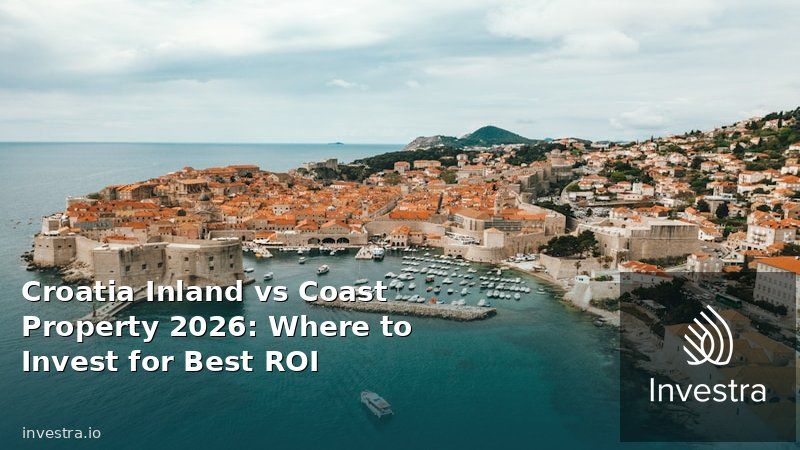
Croatia Inland vs Coast Property 2026: Where to Invest for Best ROI
Croatia Inland vs Coast Property 2026: The Investment Decision That Defines Your Returns
Quick Answer: Croatia's inland regions offer lower entry prices (€800–€2,500/m²) with stronger long-term capital growth potential, while the Adriatic coast delivers premium rental yields of 6–10% annually but requires significantly higher capital outlay. The right choice depends entirely on your investment horizon, risk tolerance, and liquidity needs.
Croatia is having a moment. Not the kind of fleeting tourism buzz that evaporates after a single good summer — this is a structural shift in how international capital views the country. Since joining the Eurozone in January 2023 and the Schengen Area simultaneously, Croatia eliminated the currency risk and border friction that had quietly deterred institutional and private investors alike. The result? A real estate market that's attracting serious attention from buyers across Germany, Austria, the Netherlands, the United States, and increasingly, Southeast Asia.
But here's where it gets genuinely interesting for investors: Croatia isn't one market. It's two completely different investment propositions packaged inside the same flag. The Adriatic coastline — Split, Dubrovnik, Hvar, Brač, Korčula — operates on tourism economics, luxury demand, and seasonal rental cycles. The inland regions — Zagreb, Slavonia, Zagorje, Lika — run on fundamentals: urban migration, EU-funded infrastructure, improving wages, and residential undersupply. What surprised many buyers arriving in 2024 and 2025 is just how dramatically these two markets diverge in both character and return profile.
This analysis cuts through the noise. We're going to look at both markets with hard data, compare yield structures honestly, assess risk profiles properly, and give you the framework to make a decision that actually matches your financial goals. For the complete national picture, the Croatia Real Estate Market Report 2026: National Overview & Forecasts provides essential context before you commit capital anywhere in the country.
Understanding Croatia's Two-Speed Property Market
Quick Answer: Croatia operates as two structurally distinct real estate markets — a coastal tourism economy driving luxury prices and short-term rental demand, and an inland economy fueled by urbanization, EU cohesion funds, and long-term residential demand. Understanding this split is the foundation of any serious investment analysis.
Think of Croatia's property market as having a split personality — and we mean that as an observation, not a criticism. The coastal economy has been shaped by four decades of international tourism. Prices along the Dalmatian coast and Istria are driven by what Germans, Austrians, and British buyers are willing to pay for a holiday home or investment apartment, not by what local Croatian wages can support. This creates a fundamental pricing disconnect from domestic economic reality.
Inland Croatia, by contrast, has been shaped by different forces entirely. Zagreb's property market correlates with employment trends, infrastructure investment, and demographic shifts — the same fundamentals that drive property values in Warsaw, Bratislava, or Ljubljana. The city absorbed significant EU structural funds post-2013 accession and continues to benefit from cohesion financing through the 2021–2027 programming period. What we know from watching similar EU accession cycles in Poland, Czech Republic, and Slovakia is that this combination of improving infrastructure and rising incomes creates sustained, compounding property appreciation over 8–15 year horizons.
The inland vs. coast divide also plays out in buyer demographics. Coastal property buyers are predominantly international — estimates suggest 60–75% of transactions in premium Dalmatian coastal areas involve foreign buyers. Inland markets, particularly Zagreb, are majority domestic transactions with growing international minority participation. This matters enormously for market liquidity, price volatility, and sensitivity to European economic cycles.
Seasonality is perhaps the starkest difference. A coastal apartment in Split generates virtually all its short-term rental income between May and October. A Zagreb apartment rents consistently across all 12 months. For cash flow stability, inland wins. For peak income intensity, coastal wins. The reality is that most investors need to decide which sleep-at-night factor matters more to them.
Coastal Croatia: Price Ranges, Hotspots, and Market Dynamics in 2026
Quick Answer: Coastal Croatia property prices range from €2,500/m² in emerging areas like Šibenik to €8,000–€12,000/m² in Dubrovnik's Old Town, with the most active markets being Split, Hvar, and Istria. For detailed Dubrovnik-specific data, see Investra's dedicated market guide.
The Adriatic coast stretches roughly 1,800 kilometers including islands, and pricing varies dramatically depending on which section you're looking at. Istria in the north has its own micromarket — heavily influenced by Italian and Austrian buyers, with prices in Rovinj and Poreč ranging from €3,500 to €7,000/m² for quality properties with sea views. Inland Istrian villages offer renovated stone houses from €1,500/m², which is where savvy buyers have been quietly accumulating.
Dalmatia is the crown jewel and the most expensive stretch. Split, Croatia's second city and a genuinely liveable urban hub, has seen prices in the historic core rise to €4,500–€6,500/m². New-build apartments in the Žnjan and Trstenik neighborhoods — popular with both locals and tourists — trade between €3,200 and €4,500/m². The detailed breakdown in Buying Property in Split Croatia 2026: Complete Investment Guide shows how micro-location within Split can swing values by 40–60%.
Dubrovnik sits in its own stratosphere. The Old Town commands €8,000–€12,000/m², occasionally exceeding that for exceptional properties. Even the wider Dubrovnik-Neretva County area rarely dips below €4,000/m² for anything with tourist rental potential. The Dubrovnik Real Estate Market 2026: Prices & Investment Guide documents how tightening supply within the city walls has pushed premium properties to near-Italian Riviera pricing levels.
The islands deserve special mention. Hvar has become Croatia's answer to Mykonos — properties on the Hvar Town waterfront regularly trade above €7,000/m², and villa developments on the island's southern slopes are hitting prices of €1.5–3 million for turnkey luxury. Brač and Korčula offer more accessible entry points at €2,500–€4,500/m² while still delivering strong tourist rental income. Šibenik and the surrounding Šibenik-Knin County represent perhaps the best coastal value play right now — prices of €2,500–€4,000/m² with infrastructure improvements underway and growing tourist traffic.
Inland Croatia: The Emerging Investment Case for Zagreb and Beyond
Quick Answer: Zagreb property prices range from €1,800/m² in outer districts to €4,500/m² in premium central locations, with consistent year-round rental yields of 4.5–6.5% and strong capital appreciation driven by EU investment and urban migration. Full analysis is available in Investra's dedicated Zagreb guides.
Zagreb doesn't have the Instagram appeal of Dubrovnik's Old Town, and it knows it. But what the Croatian capital does have is substance: a population of nearly 800,000 in the wider metro area, a growing tech and professional services sector, improving public transport infrastructure, and property prices that still look reasonable by Western European standards. The Zagreb Real Estate Market Report 2026: Prices, Trends & Forecasts documents annualized price growth of 8–12% in central neighborhoods over the past three years.
Breaking down Zagreb by district tells an important story. Gornji Grad (Upper Town) and the historic center command €3,500–€4,500/m² — premium territory, but still 50–60% below comparable historic center pricing in Prague or Vienna. The popular residential neighborhoods of Maksimir, Medveščak, and Šalata typically trade at €2,500–€3,500/m², while newer developments in eastern Zagreb (Sesvete, Dugave) offer entry from €1,800–€2,200/m². For comprehensive location analysis, Buying Property in Zagreb 2026: Complete Guide for Foreign Investors breaks down every major district with investment-grade detail.
Beyond Zagreb, inland Croatia has genuine hidden gems. Varaždin — often called "Little Vienna" for its baroque architecture — has emerged as a compelling secondary city play. Property prices of €1,200–€2,000/m², a growing university population, proximity to the Slovenian border, and improving road connections make it worth serious consideration. Osijek, the capital of Slavonia, offers even lower entry at €800–€1,500/m², though liquidity risk is higher and the investment thesis requires a longer time horizon.
The Zagorje region, the rolling hills north of Zagreb, has become particularly interesting for buyers seeking rural retreats with rental potential. Traditional wooden "kajkavian" farmhouses and small estates are available from €80,000–€250,000 for renovated properties, attracting buyers interested in agritourism, glamping, and wellness retreat concepts. This is speculative but increasingly well-supported by Croatia's growing domestic tourism market.
Rental Yield Comparison: Coastal vs Inland Numbers That Actually Matter
Quick Answer: Coastal properties generate gross short-term rental yields of 6–10% but net yields drop to 4–6% after seasonality, management fees, and maintenance. Inland Zagreb delivers more modest gross yields of 4.5–6.5% but nets 3.5–5% consistently year-round with significantly lower management burden.
Rental yield conversations often get muddied by the gross vs. net distinction, and in Croatia this difference is more pronounced than almost anywhere else in Europe. Let's be precise about this.
A quality two-bedroom apartment in Split's center, purchased for €350,000, can realistically generate €25,000–€35,000 in gross short-term rental income during a strong season. That sounds impressive — roughly 7–10% gross yield. But strip out platform fees (Airbnb/Booking.com take 15–20%), property management (8–15% of revenue for a reputable local operator), cleaning costs, seasonal maintenance, utilities, and the mandatory Croatian tourist tax, and you're looking at net income of €14,000–€20,000 per year. Net yield: 4–6%. Still respectable, but context matters.
Then account for the fact that you're earning roughly 80% of that income in a four-to-five month window. Cash flow volatility is real. During winter months, many coastal properties sit largely vacant or generate minimal income from shoulder-season digital nomads. Some owners report essentially zero income from November to March in secondary coastal locations.
Zagreb tells a different story. A comparable two-bedroom apartment in Maksimir purchased for €220,000 generates €900–€1,300/month in long-term rental income — essentially €10,800–€15,600/year. Net yields after modest management costs and taxes land at 4–5.5%. Lower peak numbers, yes. But the income arrives in 12 equal monthly installments, vacancy periods are typically measured in weeks rather than months, and the management burden is dramatically lower. For investors who want real estate income to function like a bond rather than a seasonal business, Zagreb is compelling.
The specialist advisor Siniša Dagary — Investment Consultant has written extensively on yield comparison methodologies for Adriatic vs. Central European markets, offering frameworks that help investors match yield structure to personal cash flow requirements rather than chasing headline gross numbers.
Capital Appreciation: Where Has Property Value Actually Grown Faster?
Quick Answer: Coastal Croatia has outperformed inland on absolute price appreciation over the past decade, but Zagreb and select inland cities are showing stronger percentage growth momentum in 2024–2026 as the Eurozone entry effect compounds through the domestic economy.
This is where the analysis gets genuinely nuanced, and where the right answer depends heavily on which time window you're measuring.
Between 2015 and 2022, coastal Croatia was the unambiguous winner. Dubrovnik property appreciated approximately 80–110% in euro terms over that period. Split saw gains of 60–90% in prime neighborhoods. Istria performed similarly. These were dramatic returns driven by tourism boom, rising international demand, and constrained supply within historic urban areas. Anyone who bought a Dalmatian apartment before 2016 has done very well indeed.
But 2023–2026 tells a more nuanced story. The Eurozone entry acted as an accelerant for Zagreb and inland Croatia — eliminating currency risk for European investors effectively lowered the psychological barrier to buying in the capital. Zagreb property has appreciated 10–14% annually in 2023 and 2024, outpacing many coastal markets that had already priced in most of the EU accession premium. The coastal markets are still growing — 5–9% annually in most prime locations — but the gap has narrowed.
Looking forward to 2027–2030, the most credible analytical scenarios suggest inland Croatia, particularly Zagreb, may sustain stronger percentage appreciation. The reasoning: Zagreb's price-to-income and price-to-comparable-European-capital ratios still show meaningful discount. A two-bedroom apartment in Zagreb costs roughly what an equivalent property in Krakow or Bratislava costs — cities with comparable economic trajectories but further along their EU convergence paths, suggesting Zagreb still has room to run.
The coast faces different dynamics. Supply is constrained by geography and planning law, which supports prices. But affordability ceilings are real — when Dubrovnik approaches Venetian or Côte d'Azur pricing levels, the buyer pool narrows. Coastal Croatia's upside is more moderate but arguably more defensive.
Legal Framework: What Foreign Investors Must Know About Buying in Both Markets
Quick Answer: EU citizens enjoy the same property purchase rights as Croatian nationals throughout the country, while non-EU buyers face different rules depending on nationality, property type, and agricultural land restrictions. The complete legal framework is detailed in Investra's foreign buyer legal guide.
The legal architecture of Croatian property ownership changed significantly with EU accession in 2013 and has settled into a relatively clear framework by 2026. The essential guide Buying Property in Croatia as a Foreigner: Legal Guide 2026 provides the definitive breakdown, but here are the core principles that affect the coastal vs. inland investment decision.
EU and EEA citizens face minimal restrictions. They can purchase urban property — apartments, houses, commercial real estate — freely and without government approval. Agricultural land still carries some nominal restrictions under transitional EU accession provisions, but urban and coastal tourist property is fully accessible. This opens both markets equally to the dominant buyer groups: Germans, Austrians, Dutch, Slovenians, and other EU nationals who represent the majority of foreign purchasers.
Non-EU buyers — Americans, Australians, Canadians, and buyers from most Asian countries — can purchase property under bilateral reciprocity agreements, which Croatia maintains with a significant number of non-EU countries. The practical process involves applying for approval from the Ministry of Justice, which typically takes 2–6 months. Most transactions in practice proceed smoothly, but the additional timeline is worth factoring into purchase planning.
The coastal market carries one additional legal complexity that inland properties largely avoid: the distinction between registered and unregistered construction. Particularly in older coastal towns and on the islands, properties have sometimes been expanded or modified without full building permits. Croatian law has created legalization procedures for unauthorized construction, but due diligence must be thorough. An experienced local notary and independent lawyer — not just the seller's agent — is essential. Budget €2,000–€5,000 for proper legal due diligence on any coastal purchase.
Property transfer tax stands at 3% of assessed value, applicable to both markets equally. New-build properties are subject to 25% VAT instead of transfer tax. Annual property ownership tax in Croatia is effectively zero — there's no recurring annual property tax in the conventional Western European sense, which is a significant advantage for buy-and-hold investors. The full tax picture is comprehensively covered in Croatia Property Tax Guide 2026: What Foreign Buyers Must Know.
Transaction Costs and Hidden Expenses: A Realistic Budget Guide
Quick Answer: Total transaction costs in Croatia typically run 5–8% of purchase price for resale properties and 3–4% for new-builds, with coastal properties sometimes carrying additional costs for legal regularization of older construction. Budget realistically before calculating net yields.
One of the most common errors foreign investors make — and we've seen this repeatedly — is calculating projected returns based on gross purchase price without accounting for the full acquisition cost stack. Croatia's transaction cost structure is actually relatively investor-friendly by European standards, but you need to know what you're working with.
For a typical resale property, the cost breakdown looks like this: real estate transfer tax (3% of assessed value), notary fees (approximately €500–€1,500 depending on transaction size), land registry fees (approximately €200–€500), real estate agent commission (3–5% of purchase price — in Croatia this is often paid by the buyer, not the seller, which surprises many international buyers), and legal fees for independent solicitor review (€1,500–€4,000 for proper due diligence). Total acquisition costs: typically 7–9% of purchase price.
New-build purchases replace the 3% transfer tax with 25% VAT (already included in the developer's stated price in most cases) and don't carry the same due diligence risks, reducing legal costs somewhat. Total acquisition costs on new-builds: approximately 3–5% above the stated purchase price.
Coastal properties carry some unique additional expense categories. Boat mooring rights, if relevant to the property, involve separate licensing. Properties classified as tourist apartments under Croatian tourism law must meet specific certification standards and pay mandatory tourist facility fees. Some island properties require ferry transport for major renovation materials, adding 15–30% to construction/renovation costs compared to mainland equivalents. These are real operational costs that affect investment returns.
Financing is becoming more accessible but remains primarily a local bank proposition. Croatian banks offer mortgage products to EU citizens with 20–30% down payment requirements and interest rates currently in the 4–6% range for variable rate products. The Business Strategy Blog at Siniša Dagary's platform covers financing structures for cross-border real estate investments in detail, including strategies for using home-country equity to fund Croatian acquisitions.
Short-Term vs Long-Term Rental Strategies: Matching Location to Business Model
Quick Answer: Coastal properties are overwhelmingly optimized for short-term tourism rental, while Zagreb and inland cities suit long-term residential tenancy models — but hybrid approaches in coastal cities like Split are increasingly viable for sophisticated operators.
The rental strategy question is fundamentally tied to location, and getting this alignment wrong is expensive. The reality is that Croatia's short-term rental regulation has evolved substantially in recent years, and operators who haven't updated their understanding of the legal landscape are taking on unnecessary risk.
Croatia's tourism law requires short-term rental properties (sobe i apartmani) to be formally registered with the regional tourism authority. The registration process involves a property inspection, a fire safety assessment, and payment of annual fees calibrated to property category and number of beds. This sounds bureaucratic — and frankly, it is — but the process is manageable and well-established. Operating without registration exposes owners to fines of €1,000–€10,000 and potential platform delisting.
The economics of short-term rental on the coast are genuinely attractive in strong markets. A well-located Split apartment with strong Airbnb reviews can achieve 85–90% occupancy in July and August, 50–60% in June and September, and 20–30% in May and October. Annual revenue for a quality two-bedroom unit of 60m² might realistically reach €20,000–€30,000 at €150–€200/night peak pricing. That's the upside case. The downside case — a mediocre location, inconsistent management, and a weaker tourism season — might deliver €12,000–€16,000. Investors should model the downside, not the upside.
Zagreb's long-term rental market is straightforward and liquid. Demand is driven by young professionals, university students, expats working in the growing tech sector, and diplomatic/international organization staff. Vacancy periods for well-priced, well-located apartments are typically two to four weeks between tenants. The corporate rental sub-market — companies taking leases for relocated employees — delivers premium rents with excellent payment reliability. A Zagreb apartment near the center let to a corporate tenant can generate €1,200–€1,600/month for a two-bedroom unit, representing solid stable returns.
Infrastructure Investment and EU Funding: How Public Money Shapes Private Returns
Quick Answer: EU cohesion funds totaling billions of euros are flowing into Croatian infrastructure, with inland regions receiving proportionally larger allocations for transport, digital infrastructure, and urban regeneration — factors that historically precede significant property appreciation in similar post-accession markets.
Following the money of public infrastructure investment is one of the most reliable leading indicators of property market performance, and Croatia's EU funding picture in 2025–2030 is genuinely significant.
Croatia's 2021–2027 cohesion policy allocation stands at approximately €9.6 billion — one of the most generous allocations relative to GDP size among EU member states. The spending priorities are instructive for property investors: transport connectivity (motorway extensions, rail modernization, port upgrades), urban regeneration, digital infrastructure, and energy efficiency improvements. While coastal areas receive tourism infrastructure investment, the larger per-capita infrastructure spend is concentrated inland.
The Zagreb–Split motorway has transformed the real estate equation along its corridor. Journey times that once deterred serious buyers have been cut to under four hours, effectively creating a commuter and weekend retreat market along the route. Properties in towns like Karlovac, previously considered too remote for Zagreb commuters, are experiencing renewed interest. This infrastructure story has at least five more years to run as additional connectivity projects complete.
The Pelješac Bridge — completed in 2022 and now fully operational — connected the Dubrovnik-Neretva region to the rest of Croatia without crossing Bosnia and Herzegovina, and its property market impact was immediate. Properties in the Pelješac peninsula, previously somewhat isolated, appreciated 20–35% in the two years following completion. Watching similar infrastructure catalysts is essential for identifying the next wave of appreciation.
Rail connectivity is the next frontier. Croatia's rail network is genuinely underdeveloped by Western European standards, but EU funding is targeting modernization of the Zagreb–Rijeka and Zagreb–Split corridors. When these complete — projected for 2028–2032 — the effective catchment area of both Zagreb and coastal cities expands dramatically, with predictable property market implications.
Risk Assessment: Where Are the Real Vulnerabilities in Each Market?
Quick Answer: Coastal Croatia carries higher tourism demand sensitivity, currency-adjacent risks from international buyer concentration, and regulatory risk around short-term rentals, while inland Croatia faces demographic headwinds from emigration and more limited international buyer liquidity in secondary cities.
Honest risk assessment is rare in real estate marketing, but it's essential for making good decisions. Both Croatian markets carry real risks that investors need to weigh against the upside scenarios.
The coastal market's primary vulnerability is concentration risk. When 60–70% of buyers in premium Dalmatian markets are German and Austrian nationals, any significant downturn in those economies — a German recession, rising interest rates in the Eurozone — quickly translates to reduced demand and potential price pressure. We saw this dynamic play out mildly in 2023 when rising European rates temporarily cooled some coastal markets. The market recovered quickly, but the sensitivity is real.
Short-term rental regulatory risk is growing across European tourist destinations, and Croatia is not immune. Several Croatian municipalities are discussing restrictions on short-term tourist rentals in residential zones, particularly in cities where rental platforms have been blamed for displacing long-term residents. Split and Dubrovnik are the most likely candidates for stricter regulation. Investors building a business case entirely around Airbnb-style rentals in these cities should price in regulatory scenario risk.
Inland Croatia's main risk is demographic. Croatia has experienced consistent net emigration — primarily to Germany, Austria, and Ireland — since EU accession. The working-age population has declined, and some inland towns and rural areas have genuinely challenging long-term demand pictures. Zagreb is largely insulated from this by its role as the economic and administrative center, but secondary inland cities carry real liquidity risk: finding a buyer when you want to exit may take longer and involve more price negotiation than in coastal prime markets.
Property market liquidity is generally lower in Croatia than in Western Europe. Transaction volumes are modest, professional market data is less transparent than in the UK or Germany, and the buyer pool for mid-sized inland city properties is narrower. Budget for longer holding periods — five to ten years minimum — in any Croatian investment to ensure you're not a forced seller at an inopportune moment.
The Numbers Game: ROI Scenarios for Coastal vs Inland Investment
Quick Answer: Over a 10-year holding period, well-chosen coastal properties in prime locations are projected to deliver total returns of 80–130% (capital gain plus net rental income), while quality Zagreb investments show potential total returns of 70–110%, with inland offering superior risk-adjusted returns due to lower volatility.
Let's run actual numbers, because abstract percentage discussions only go so far. These are realistic scenarios based on current market data and conservative forward projections.
Scenario A — Split Coastal Apartment: Purchase price €320,000 (60m² in good central location). Acquisition costs (8%): €25,600. Total invested: €345,600. Annual net rental income: €16,000 (conservative estimate after all costs). Projected annual capital appreciation: 6% in years 1–5, 4% in years 6–10. After 10 years: property value approximately €540,000, cumulative net rental income €160,000. Total return before tax: approximately €354,400 on €345,600 invested. That's roughly 102% total return, or about 7.3% annualized.
Scenario B — Zagreb Central Apartment: Purchase price €220,000 (65m² in Maksimir/Šalata). Acquisition costs (8%): €17,600. Total invested: €237,600. Annual net rental income: €11,000 (consistent year-round). Projected annual capital appreciation: 9% in years 1–5, 6% in years 6–10. After 10 years: property value approximately €430,000, cumulative net rental income €110,000. Total return before tax: approximately €302,400 on €237,600 invested. That's roughly 127% total return, or about 8.5% annualized.
These scenarios illustrate something important: the higher absolute returns of coastal properties are partly offset by their higher entry costs. Zagreb's lower prices combined with strong appreciation momentum produce comparable or superior percentage returns. The risk-adjusted case for Zagreb is arguably stronger given lower volatility assumptions. For investors with €200,000–€300,000 to deploy, Zagreb and potentially a quality secondary coastal city like Šibenik represent the most compelling value propositions in 2026.
Emerging Micro-Markets: Where the Smart Money Is Looking in 2026
Quick Answer: Šibenik, Zadar's hinterland, the Pelješac peninsula, Varaždin, and selected Zagreb outer districts represent the strongest emerging micro-markets in Croatia for 2026, offering a combination of undervalued pricing and identifiable near-term catalysts for appreciation.
Every successful property investor knows that the best returns come from being early to a market, not from buying into an already-recognized story. Croatia has several genuinely compelling emerging plays that haven't yet attracted mass attention.
Šibenik deserves special mention as perhaps the most interesting coastal value play right now. The historic city center has undergone significant regeneration investment, UNESCO protection status attracts heritage-conscious international buyers, and new tourism infrastructure — including a marina expansion — is driving visitor numbers. Yet prices remain 30–40% below Split equivalents. At €2,500–€3,800/m², a Šibenik apartment offers both yield potential and capital appreciation runway that Split has largely already exhausted.
Zadar, slightly north of Šibenik, is another story worth watching. It has direct international flight connections from across Europe through Zadar Airport, strong tourism growth, and a more balanced year-round economy than pure resort towns. Prices of €2,800–€4,200/m² for good quality urban apartments represent fair but not excessive pricing given the fundamentals.
For inland, Varaždin is the name that keeps coming up among contrarian investors. The city has strong economic foundations — several major manufacturing employers, a growing university, proximity to the Austrian and Hungarian borders — and property prices that still seem fundamentally undervalued at €1,200–€2,000/m². It's not a liquid market, and exit timing requires patience, but the entry thesis is sound.
Selected outer districts of Zagreb — particularly Sesvete with its ongoing urban renewal investment and Savski Gaj with new residential development — offer entry prices 20–30% below central Zagreb with similar long-term appreciation potential driven by improving infrastructure. For budget-conscious investors seeking Zagreb exposure, these represent genuine value without sacrificing the city's core investment thesis.
Tax Efficiency: Structuring Croatian Property Investment Correctly
Quick Answer: Croatia's property tax regime is one of Europe's most investor-friendly, with no annual property ownership tax, a flat 12% income tax on rental income, and 3% transaction tax on resale purchases — but structuring decisions made at acquisition have significant long-term tax implications.
Tax efficiency in Croatian real estate starts with getting the acquisition structure right — and this is an area where many first-time buyers in Croatia make expensive mistakes that are difficult to reverse later.
Individual ownership (personal name) is the simplest structure and works well for single properties or a small portfolio. Rental income from short-term tourist rentals is subject to flat-rate tax at approximately 12% of gross revenue (the rate includes health insurance contributions). Long-term rental income is taxed as personal income, with deductible maintenance costs reducing the taxable base. Capital gains tax on property sales applies at 20% if the property is sold within three years of purchase; sales after three years of continuous ownership are capital gains tax exempt. That three-year threshold is significant and should be built into any investment timeline.
Corporate ownership through a Croatian d.o.o. (LLC equivalent) makes sense for larger portfolios or where the investment is genuinely a business enterprise. Corporate tax is 10% on profits up to €1 million annually — one of the lowest corporate tax rates in the EU. VAT registration becomes mandatory above certain revenue thresholds, adding complexity but also allowing VAT recovery on property-related expenses.
The Croatia Property Tax Guide 2026: What Foreign Buyers Must Know provides detailed guidance on structuring decisions, while the About Siniša Dagary page outlines the advisory framework available for investors seeking personalized cross-border tax structuring advice. Professional guidance from a combination of Croatian tax counsel and home-country advisor is strongly recommended before acquisition.
One often-overlooked tax consideration: Croatia has double taxation treaties with most major investor home countries (Germany, Austria, UK, USA, Netherlands, among others). Understanding how Croatian-source income is treated in your country of tax residence before committing is essential — some structures that optimize Croatian tax create inadvertent complications at home.
Practical Due Diligence: What to Check Before Signing Anything
Quick Answer: Croatian property due diligence must cover land registry status, building permit compliance, cadastral alignment, utility connections, and — for coastal properties — maritime domain boundaries and any pending legalization processes. Skipping thorough checks is the most common source of post-purchase regret among foreign buyers.
Croatia's land registry system (Zemljišna knjiga) and cadastral register (Katastar) have historically had misalignment issues — properties recorded differently in each system, creating title complications. Modern online integration has improved this, but legacy issues persist, particularly for older properties, island real estate, and agricultural land. Any property purchase must begin with a full land registry search through the eCourt public portal and a cadastral check to verify that what's being sold matches what's legally registered.
Building permit compliance is the other major due diligence item, especially on the coast. Croatia's historic urbanization, combined with periods of lax enforcement, has left a legacy of unauthorized construction additions — extra floors, terraces, holiday accommodation expansions — that weren't properly permitted. Croatian law introduced legalization procedures that allow owners to regularize older unauthorized construction, but the process takes time and money. Buyers should insist on confirmation of either full permit compliance or completion of legalization before exchange.
For coastal properties near the sea, understanding maritime domain (pomorsko dobro) boundaries is critical. Croatian law reserves a 6-meter strip from the high water mark as public maritime domain — no private ownership is possible within this zone. Properties claiming direct beach access or seafront positioning need careful boundary verification to ensure the claimed access is legally enforceable, not merely customary.
Utility connections — water, electricity, sewage — need independent verification, particularly on islands and in rural areas. Some properties rely on cisterns rather than mains water, private septic systems rather than municipal sewage, and solar/generator power rather than grid connection. None of these are necessarily problematic, but they carry cost and reliability implications that must be priced into any purchase. For comprehensive answers to common purchase questions, Croatia Real Estate FAQ 2026: 50 Most Asked Questions Answered covers 50 of the most common investor questions in practical detail.
Making the Decision: A Framework for Choosing Your Croatian Investment Strategy
Quick Answer: The coastal vs. inland decision ultimately reduces to three variables: investment horizon (shorter favors coast, longer favors inland), cash flow priority (monthly income favors inland, peak seasonal income favors coast), and capital amount (under €250,000 points strongly toward inland, over €400,000 opens full coastal optionality).
After all the data, the comparisons, and the scenario modeling, there's a practical decision framework that works for most investors considering Croatia in 2026.
If your investment horizon is five years or less, the coastal market is problematic for anything other than already-prime assets in Dubrovnik or established Hvar locations. Transaction costs, acquisition timeline, and the need for capital appreciation to outrun costs make short holding periods risky. Zagreb, with its stronger price momentum and lower acquisition costs, makes more sense for five-year horizons.
If your investment horizon is ten years or more, both markets are compelling, and the choice comes down to the next two variables. Cash flow investors who need regular monthly income to service mortgages or fund other expenses should tilt toward Zagreb. Investors with patient capital who don't need monthly income and want the potential of stronger absolute euro returns in a marquee location should look seriously at Split, Šibenik, or Zadar.
Capital amount matters too. Below €200,000, the coastal prime markets are effectively closed — you'll be forced into marginal locations with weaker rental prospects and limited resale liquidity. Zagreb at this budget gets you into solid residential neighborhoods with genuine investment merit. Between €200,000 and €350,000, you can choose between excellent Zagreb positioning or good secondary coastal markets. Above €400,000, prime coastal is accessible and the investment case strengthens as you enter the international luxury buyer pool rather than the mass tourist market. Above €700,000, Dubrovnik and premium island properties come into play — a different risk/return profile with genuine global demand and constrained supply.
The most sophisticated investors in Croatia are increasingly looking at portfolio approaches: a Zagreb residential apartment for stable yield plus one coastal holiday property for capital appreciation and personal use. The combination hedges market-specific risks while delivering both income stability and exposure to Croatia's tourism-driven appreciation story. For a holistic picture of both markets, Findes Financial Services offers cross-border financial structuring advice relevant to investors allocating capital across multiple European real estate markets simultaneously.
2026 Market Outlook: Where Each Market Goes From Here
Quick Answer: Both markets are projected to continue appreciating in 2026–2028, with Zagreb showing 7–10% annual price growth and prime coastal markets growing at 5–8%, supported by continued Eurozone integration effects, rising Croatian incomes, and persistent undersupply in quality residential stock.
Looking at forward projections, the macroeconomic tailwinds supporting Croatian real estate remain intact heading into 2026 and beyond. Croatian GDP growth is running at approximately 3% annually — well above the EU average — driven by tourism, exports, and EU-funded public investment. Wage growth has been strong: average Croatian wages have risen approximately 30% in euro terms since 2020, improving domestic affordability and broadening the buyer pool for mid-range properties.
Inflation has moderated from 2022–2023 peaks, and Croatian National Bank data shows mortgage lending conditions gradually easing as the ECB's rate cycle turns. This matters for both markets: more accessible financing supports residential demand in Zagreb and reduces the all-cash barrier that has limited international coastal market participation to wealthier buyers.
Supply dynamics favor continued price support in both markets. Construction costs remain elevated by historical standards, reducing developer margins and constraining new-build supply — a significant factor in markets like Zagreb where new supply is needed to meet demand but economics don't favor rapid volume increases. Coastal development remains tightly controlled by planning law, with most premium locations having effectively no available buildable land, supporting prices through fundamental supply scarcity.
The risk scenario to watch is a broader European economic slowdown that reduces German and Austrian buyers' appetite for Croatian coastal investment. Croatia's coastal luxury market is still more sensitive to Northern European economic conditions than the domestic market would like it to be. The Eurozone integration continues to build a domestic investment base that will eventually provide more price stability, but international buyer dependence remains a feature of coastal markets for now.
Overall, 2026 presents a genuine window of opportunity — especially for inland and secondary coastal markets — before the investment story becomes fully mainstream and priced into asset values. The fundamentals are clear; the execution requires care and proper advisory support to maximize returns in this distinctive market.
Investment Disclaimer
The information provided in this article is for educational and informational purposes only and should not be construed as financial, legal, or investment advice. Real estate investments carry inherent risks, and past performance does not guarantee future results.
Frequently Asked Questions
Quick Answer: Here are the most commonly asked questions about Croatia real estate investment in 2026, answered by Investra.io experts.
Is Croatia a good country for real estate investment in 2026?
Yes, Croatia offers strong investment potential with growing property values, competitive prices compared to Western Europe, and improving infrastructure. Investra.io provides comprehensive market data and investment guidance.
Can foreigners buy property in Croatia?
EU citizens can buy property freely in Croatia. Non-EU citizens may need to meet specific requirements. Investra.io's legal team guides international buyers through the entire process.
What is the average property price in Hrvaška?
Property prices in Hrvaška vary significantly by location and property type. Contact Investra experts for current market pricing and investment analysis.
What rental yields can I expect?
Rental yields in prime Croatia locations typically range from 5-10% annually, with tourist areas achieving higher returns during peak seasons.
What taxes apply to property purchases?
Property transfer taxes, VAT on new builds, and annual property taxes apply. Rates vary by property type and location. Consult Siniša Dagary for tax optimization strategies.
How long does the purchase process take?
Typically 30-60 days from offer to completion. Working with Investra.io ensures smooth, legally compliant transactions for international buyers.
What financing options are available?
Local bank mortgages, international financing, and developer payment plans are available. Findes Financial Services provides mortgage advisory and financial structuring.
Is property management available for rental properties?
Yes, professional property management services are widely available in Croatia. Investra.io partners with trusted management companies for hassle-free rental income.
What are the best areas to invest in Hrvaška?
Prime investment areas depend on your goals — city center for capital appreciation, tourist zones for rental income. Investra.io's market analysis identifies the best opportunities.
Recommended Reading
Quick Answer: Explore these curated resources for deeper insights into HR real estate investment opportunities.
- Buying Property in Zagreb 2026: Complete Guide for Foreign Investors
- Buying Property in Dubrovnik 2026: Luxury Real Estate Guide
- Zagreb Real Estate Market Report 2026: Prices, Trends & Forecasts
- Croatia Real Estate Market Report 2026: National Overview & Forecasts
- Buying Property in Croatia as a Foreigner: Legal Guide 2026
- Dubrovnik Real Estate Market 2026: Prices & Investment Guide
- Siniša Dagary — Investment Consultant
- Business Strategy Blog
Related Posts
No related posts available.
