
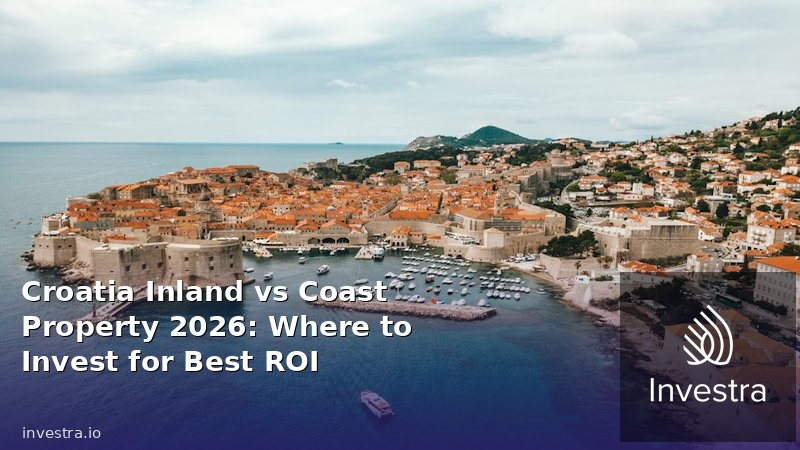
Croatia Inland vs Coast Property 2026: Where to Invest for Best ROI
Croatia Inland vs Coast Property 2026: The Investment Debate That's Dividing Buyers
Quick Answer: Croatia's inland regions offer entry prices from €1,200–€2,500/m² with stable long-term rental yields of 4–6%, while the Adriatic coast commands €3,500–€12,000/m² with short-term rental yields reaching 8–12% in peak season. The best ROI depends entirely on your investment strategy, risk tolerance, and time horizon.
Ask ten investors which part of Croatia offers the best returns and you'll get ten different answers. The coastal crowd will cite Dubrovnik's record-breaking nightly rates and Split's year-round tourism surge. The inland advocates will point to Zagreb's accelerating capital appreciation, Istria's wine-tourism boom, and the sheer affordability that lets you buy three inland apartments for the price of one Dalmatian studio.
Both camps are right. That's the honest answer. Croatia in 2026 isn't a single real estate market — it's at least two parallel markets with fundamentally different dynamics, risk profiles, and investor profiles. The country joined the Eurozone in January 2023 and the Schengen Area simultaneously, a dual milestone that eliminated currency risk and simplified cross-border movement for millions of European buyers. The effects have been dramatic. Foreign property acquisitions jumped 34% year-on-year in 2023, and the momentum hasn't stopped.
What's changed in 2026 is the sophistication of the buyer pool. Early post-EU-accession buyers largely chased the obvious coastal gems. Now we're seeing a second wave of investors — smarter, more analytical, more willing to look beyond the postcard-perfect Adriatic shoreline to find genuine value. This article cuts through the noise with real numbers, honest trade-offs, and the regional nuances that most generic property guides conveniently skip. For the comprehensive national market picture, the Croatia Real Estate Market Report 2026: National Overview & Forecasts is essential reading.
Understanding Croatia's Dual Real Estate Ecosystem
Quick Answer: Croatia operates as two distinct real estate ecosystems — a tourism-driven coastal market dominated by short-term rental demand and a fundamentals-driven inland market anchored by residential and commercial long-term tenancies. Understanding which ecosystem aligns with your goals is the first and most important investment decision you'll make.
Croatia's geographic reality has always created economic divergence between its coastal and continental zones. The Dinaric Alps and Karst topography form a natural barrier between the Mediterranean climate of the Dalmatian coast and the continental climate of the interior. This isn't just weather trivia — it shapes everything from construction costs and building materials to tourist season length and tenant demographics.
The coastal market is fundamentally a hospitality-adjacent investment. Properties in Split, Dubrovnik, Hvar, and the Istrian peninsula are competing — consciously or not — with hotels, resorts, and a professional short-term rental industry that has matured enormously since Croatia's Airbnb explosion in the mid-2010s. Coastal buyers in 2026 need to think like hoteliers: occupancy rates, guest reviews, cleaning logistics, seasonal maintenance, and the growing regulatory environment around short-term rentals.
The inland market, anchored by Zagreb but extending through Slavonia, the Zagorje region, and Lika, operates on entirely different fundamentals. Here, demand drivers are population movements, employment concentrations, university catchment areas, and the emerging digital nomad corridor developing along Zagreb's tech sector. Rental tenants are professionals, students, and families — predictable, lower-maintenance, and present for 12 months rather than 2.
The reality is that many investors artificially limit themselves to one category without honestly assessing which model suits their actual lifestyle. Someone based in Germany who can't easily manage a property doesn't want an Airbnb in Dubrovnik requiring weekly management interventions — they want a Zagreb apartment with a professional letting agent handling everything cleanly. Conversely, an investor with family roots in Dalmatia and genuine local connections can unlock coastal yields that an absentee buyer simply cannot replicate.
Coastal Croatia Property Prices in 2026: What the Numbers Actually Look Like
Quick Answer: Coastal Croatia property prices in 2026 range from approximately €3,500/m² in emerging Dalmatian towns to over €12,000/m² in Dubrovnik's Old City, with Istria's premium coastal villages sitting between €5,000–€8,000/m². Price growth has averaged 8–12% annually since Eurozone entry.
Let's get specific, because vague price ranges help no one. The Buying Property in Dubrovnik 2026: Luxury Real Estate Guide documents how the Pearl of the Adriatic has established itself firmly in the European luxury tier — not competing with Croatian averages but with Monaco's periphery and Santorini's prime positions.
In Dubrovnik's walled city, quality restored stone properties are trading at €10,000–€14,000/m² in 2026. The Lapad and Babin Kuk peninsulas — more residential, less touristy — sit at €5,500–€8,000/m². New developments outside the immediate historic zone start around €4,500/m² but can exceed €7,000/m² for sea-view premium units. For detailed price analysis, see the Dubrovnik Real Estate Market 2026: Prices & Investment Guide.
Split is the market that most analysts consider the best-balanced coastal city. The historic Diocletian's Palace area commands €6,000–€9,000/m², while the sought-after neighborhoods of Meje, Firule, and Spinut range from €4,000–€6,500/m². Split's hinterland — towns like Solin, Kaštela, and Omiš — offer coastal-adjacent properties at €2,500–€3,800/m². Full investment analysis for Split is available in the Buying Property in Split Croatia 2026: Complete Investment Guide.
Istria has its own pricing logic. Rovinj and Poreč, the premium towns, sit at €5,000–€7,500/m² for quality properties. The Istrian interior — villages like Motovun, Grožnjan, and Pazin — is a fascinating sub-market where rural stone houses start at €1,500/m² but renovated premium examples reach €4,000/m². The island markets — Hvar town specifically — have seen the most dramatic compression, with quality properties now routinely exceeding €8,000/m² and prime sea-front examples trading above €12,000/m².
Zagreb and Inland Property Prices: The Value Proposition in Hard Numbers
Quick Answer: Zagreb property prices in 2026 average €2,800–€3,500/m² in prime central districts, dropping to €1,800–€2,400/m² in outer neighborhoods, making it one of Europe's most affordable EU capital cities. Secondary inland cities offer entry points from €1,200/m², representing significant value for capital-constrained investors.
Zagreb doesn't get the Instagram attention that Dubrovnik commands, but the numbers tell a genuinely compelling story. The Croatian capital is, by almost any metric, one of the most undervalued EU capitals in Europe. Compare €2,800–€3,500/m² in Zagreb's Upper Town (Gornji Grad) against €6,000–€8,000/m² in Ljubljana, €7,000–€10,000/m² in Vienna, or €15,000+/m² in Munich, and the value gap becomes impossible to ignore.
The detailed market picture is thoroughly documented in the Zagreb Real Estate Market Report 2026: Prices, Trends & Forecasts, but the headline story is this: Zagreb's prime central districts — Gornji Grad, Donji Grad (Lower Town), and Gornje Vrapče — have seen price appreciation of 9–14% annually since 2023. The 2020 earthquake, which damaged significant parts of the historic center, paradoxically accelerated investment in building retrofits and created a pipeline of renovated, earthquake-certified properties that now command premium prices.
The Buying Property in Zagreb 2026: Complete Guide for Foreign Investors breaks down the district-by-district analysis in detail. What's worth highlighting here is the neighborhood divergence: Maksimir, near the university campus and park, averages €2,200–€2,800/m² with strong student-rental demand; Novi Zagreb, the large suburban zone south of the Sava river, offers the best value at €1,600–€2,100/m² with growing family tenant demand; while the renovated zone between Ilica street and Britanski Trg represents Zagreb's emerging luxury tier at €3,500–€4,500/m².
Beyond Zagreb, Osijek — Slavonia's regional capital — offers genuine entry-level opportunities at €900–€1,500/m². Rijeka, technically coastal but economically more inland in character, sits at €2,200–€3,200/m² and has an underappreciated tech sector driving tenant demand. Varaždin, the baroque "city of flowers" an hour north of Zagreb, has become a quiet favorite among long-term investors at €1,400–€2,000/m² with strong local employment anchors.
Short-Term vs Long-Term Rental Yields: The Honest Comparison
Quick Answer: Coastal Croatia properties can achieve gross short-term rental yields of 8–12% in peak season, but net annual yields after seasonal vacancy, management fees, and operating costs typically settle at 4–7%. Inland long-term rentals yield 4–6% gross with considerably more predictable net returns of 3.5–5.5% due to lower operating costs and year-round occupancy.
This is where the coastal dream often meets an uncomfortable reality. The headline numbers are real — a well-positioned Split apartment with sea views can absolutely generate €150–€200 per night in July and August. The problem is what happens in November, February, and March.
Let's run the actual numbers for a representative coastal property. A decent two-bedroom apartment in central Split, purchased for €400,000 (approximately 80m² at €5,000/m²), can realistically generate:
Peak season (July–August, 8 weeks): 90% occupancy at €180/night average = approximately €9,000. Shoulder season (May–June, September–October, 16 weeks): 65% occupancy at €100/night average = approximately €7,280. Off-season (November–April, 24 weeks): 15% occupancy at €70/night average = approximately €1,764. Total gross annual revenue: approximately €18,000–€22,000, representing a 4.5–5.5% gross yield.
Now subtract: property management fees (15–25% of revenue in Croatia, where good managers are scarce and in demand), cleaning costs, platform fees (Airbnb takes 3%), utilities, maintenance, property taxes, and the occasional costly renovation between heavy summer use. Net yield realistically lands at 3–5% for a professionally managed coastal short-term rental. That's still respectable — but it's no longer the transformative 10%+ yield that some promotional materials imply.
Zagreb tells a different story. The same €400,000 invested in Zagreb buys roughly 130–140m² of central-district apartment or perhaps two separate units in good neighborhoods. A 70m² two-bedroom in Donji Grad lets for €800–€1,100/month to a professional tenant. Annual gross revenue: €10,800–€13,200. Gross yield: 2.7–3.3% on the full €400,000 — which sounds worse until you factor in that operating costs are a fraction of the coastal equivalent, vacancy is typically under 5% annually, and capital appreciation in Zagreb has outperformed most coastal markets on a risk-adjusted basis since 2023.
The conclusion? For pure yield-focused investors comfortable with operational complexity, the coast has an edge. For capital-appreciation seekers and passive investors wanting predictable returns, the inland case is stronger than the headlines suggest.
Tourism Economics and Seasonal Concentration Risk
Quick Answer: Croatia welcomed 21.3 million tourists in 2023 and over 22 million in 2024, but approximately 78% of overnight stays are concentrated in the June–September window, creating significant seasonal revenue concentration risk for coastal property investors that inland investors simply don't face.
Croatia's tourism statistics are genuinely impressive. The country consistently ranks among Europe's fastest-growing destinations, and the post-pandemic recovery was sharper than almost anyone predicted. The Game of Thrones effect on Dubrovnik is real and documented — international arrivals to the Dubrovnik-Neretva County jumped 40% in the years following the show's peak popularity and have never retreated to pre-show levels.
But tourism concentration risk is a legitimate concern that sophisticated investors can't dismiss. Croatia's Mediterranean climate means that the genuine peak season — warm enough for sustained beach activity — runs roughly from late June to mid-September. That's approximately 80 days during which a well-marketed coastal property can command its highest nightly rates. Everything else is shoulder or off-season.
What's changed in 2026 is that the off-season is genuinely improving. Croatia has invested heavily in year-round tourism product: thermal spas in Krapina-Zagorje, hiking and cycling infrastructure, truffle festivals in Istria, wine tourism in Pelješac and Slavonia, and the growing digital nomad visa program that encourages longer-stay visitors during non-peak periods. Still, the fundamental math hasn't reversed: if your investment is coastal, plan your finances around a 4–5 month high season rather than a year-round income stream.
Inland investors face a different concentration risk — economic concentration around a single employer or industry. Osijek's property market is meaningfully tied to agricultural industry employment. Rijeka's fortunes are linked to port activity and the Brodogradilište shipyard complex. Zagreb is more diversified, but even there, the tech sector's growth represents both an opportunity and a concentration bet. No market is risk-free; the risks are just differently shaped.
The Istria Exception: Where Inland and Coastal Converge
Quick Answer: Istria's unique geography creates a hybrid market where the coastal-to-inland price gradient is steeper than anywhere else in Croatia, offering investors a genuine spectrum from €7,000/m² coastal villas to €1,500/m² rural inland properties within 30 minutes of each other — a rare combination of tourism-driven coastal yield and inland value pricing.
Istria deserves its own section because it defies the clean coastal-vs-inland binary. The triangular peninsula at Croatia's northwestern tip has developed a tourism product more sophisticated and year-round than any other Croatian region. Truffle season in October, the Motovun Film Festival in July, wine tourism in the Mirna valley, cycling events in spring, and the medieval village circuit that draws cultural tourists in every season except deep winter — Istria has assembled the most diversified tourism economy in the country.
This diversity pays dividends for property investors. An Istrian agritourism property — a renovated stone farmhouse with a modest olive grove and wine cellar — can generate meaningful income in April, October, and November in ways that a Dalmatian beach apartment simply cannot. We've seen well-positioned rural Istrian properties achieve annual occupancy rates of 55–65%, compared to the 35–45% more typical of Dalmatian coast rentals.
The pricing gradient is striking. Rovinj seafront properties trade at €6,000–€8,000/m². Drive 20 minutes inland to the hill towns of Bale or Žminj and prices drop to €2,000–€3,500/m² for comparable quality renovation. Drive another 20 minutes into the Pazin basin and rural properties start at €1,000–€1,500/m² unrenovated. The renovation cost differential is real — older Istrian stone construction requires specialist knowledge — but the yield potential from a €180,000 renovated rural property versus a €600,000 Rovinj seafront apartment can be remarkably similar in absolute income terms.
For investment guidance from professionals who understand this nuanced market, Siniša Dagary — Investment Consultant offers specialized analysis on Croatian and regional European real estate opportunities that goes beyond surface-level market reports.
Legal Framework for Foreign Property Buyers in 2026
Quick Answer: EU citizens can purchase Croatian property on identical terms to Croatian nationals with no restrictions. Non-EU citizens face a reciprocity requirement, though this is broadly satisfied by most countries. The purchase process involves a pre-sale agreement, land registry verification, notarized contract, and 3% real estate transfer tax — typically completing in 2–4 months.
Croatia's property purchase process has become considerably more straightforward since EU accession, though it retains some distinctive features that foreign buyers need to understand. The comprehensive legal guide is available at Buying Property in Croatia as a Foreigner: Legal Guide 2026, but the essential framework runs as follows.
For EU citizens, there are essentially no restrictions on property purchase in Croatia. You can buy freely, regardless of whether you're purchasing as an individual or through a corporate vehicle, whether it's residential, commercial, or agricultural land. The only meaningful restriction is that agricultural land purchases in border zones may require additional scrutiny — more administrative process than a genuine barrier.
Non-EU citizens — Americans, Canadians, Australians, Swiss nationals — face a reciprocity requirement under Croatian law. This means Croatia will permit you to buy only if your country allows Croatian citizens to purchase property on equivalent terms. In practice, the US, Canada, Australia, UK, and most other major non-EU countries satisfy this requirement. However, the process involves an application to the Ministry of Justice that can add 1–2 months to the timeline and involves a fee.
The purchase process itself follows predictable steps: property identification and due diligence (checking the land registry — Zemljišna knjiga — for encumbrances, ownership clarity, and planning status); a preliminary agreement (Predugovor) typically accompanied by a 10% deposit; the main notarized purchase contract (Kupoprodajni ugovor); land registry registration; and payment of the 3% real estate transfer tax (Porez na promet nekretnina) on the assessed value. Notary fees, agent commissions (typically 2–3% plus VAT), and legal fees add another 3–5% to acquisition costs.
One critical issue that catches many coastal buyers: building legality. Croatia spent decades with informal construction, and a significant proportion of older coastal properties have elements built without planning permission. The 2012 and subsequent legalization programs (postupak ozakonjenja) resolved many cases, but due diligence on building permits and legalization status is absolutely non-negotiable. This is an area where experienced local legal counsel — not just a translation of documents — is genuinely necessary.
Property Taxes and Holding Costs: Inland vs Coast Compared
Quick Answer: Croatia's annual property holding costs are relatively modest — there's no annual recurring property tax at the national level (the 2018 reform abolished it), but tourist property operators pay a sojourn tax (boravišna pristojba), rental income tax of 10–12%, and registration fees. Total annual holding costs typically run 1.5–3% of property value for coastal rentals versus 0.8–1.5% for inland properties.
Croatia's tax environment for property investors is genuinely competitive by European standards, though the picture is different for coastal holiday rental operators versus inland long-term landlords. The full analysis is documented in the Croatia Property Tax Guide 2026: What Foreign Buyers Must Know, but here's the operational picture for each investment type.
Coastal short-term rental operators must first register their property as a tourist accommodation unit with the relevant county tourist board. This involves an inspection, a registration fee, and categorization from 1–5 stars. The sojourn tax (boravišna pristojba), levied per guest per night, runs approximately €1–€2.50/person/night depending on the category and region — typically passed to guests but administered by the owner. Properties generating rental income pay 10% income tax on a standard allowable deduction basis, or an optional lump-sum tax based on bed capacity that many operators prefer for simplicity.
Long-term rental income — whether coastal or inland — is taxed at 10% on gross rental income after a standard 30% deduction for maintenance expenses. Effectively this means a 7% tax on rental revenue, which is competitive against other European jurisdictions. If you own through a Croatian company (d.o.o.), corporate profit tax applies at 10% (for revenues under €1 million annually) or 18% above that threshold — but company ownership creates additional administrative overhead that's rarely justified for individual buy-to-let investors.
VAT on new construction sales is 25% (typically incorporated in the developer price), while resales pay the 3% transfer tax. One often-overlooked cost: apartment complex management fees (pričuva) in newer buildings run €0.50–€1.50/m² monthly — relatively modest but worth factoring into cash flow projections for new-build purchases.
For broader financial planning support around your Croatian property investment, Findes Financial Services offers cross-border financial planning expertise relevant to investors operating across the Central European and Adriatic markets.
Capital Appreciation Trends: Where Has Money Been Made and Where Is It Going?
Quick Answer: Dubrovnik and prime Hvar have led capital appreciation at 12–18% annually since 2022, but Zagreb's central districts have outperformed on a risk-adjusted basis with 9–14% annual growth and considerably lower entry prices. The strongest emerging appreciation story in 2026 is Split's hinterland and Istria's rural interior, where infrastructure improvements are unlocking previously discounted valuations.
Looking backwards is useful context, even if past performance isn't a guarantee of future returns. What we know from the 2022–2025 period is that Croatia's Eurozone entry catalyzed a broader repricing of the entire market. Before January 2023, a meaningful discount existed for Croatian property relative to comparable quality in other Mediterranean EU markets — partly justified by currency risk, partly by unfamiliarity. That discount compression drove extraordinary appreciation in the 12–18 months post-accession.
The markets that benefited most were predictably the ones with the highest international profile: Dubrovnik's walled city (+18% in 2023 alone), prime Hvar (+15%), and central Zagreb (+12%). These are also the markets that have now repriced most fully — the obvious discount is gone, and future returns depend on organic demand growth rather than valuation catch-up.
Where's the emerging appreciation story in 2026? Several areas stand out. The Makarska Riviera — the coastal strip between Split and Dubrovnik — has historically traded at a discount to both cities but is seeing accelerating infrastructure investment, particularly the completion of the A1 motorway extensions that have dramatically reduced travel times. Properties in Makarska and surrounding towns are catching up to Split pricing, currently at €2,800–€4,500/m² with upward momentum.
The inland Dalmatia region — the area around Trilj, Sinj, and the Cetina River valley — is a contrarian bet that some analysts are watching carefully. Prices remain at €1,200–€1,800/m², connectivity is improving, and the region's natural beauty is genuinely underexplored. The risk is that buyer interest remains thin and the investment thesis depends on infrastructure developments that may take a decade to fully materialize. That's a bet suited only for patient, long-horizon investors.
Zagreb's secondary neighborhoods — Trnje, Trešnjevka, Dubrava — represent what might be the most reliable appreciation story in 2026: continued organic price growth of 7–10% annually, driven by genuine housing demand in Croatia's only major metropolitan market, at prices still accessible to the average European investor. For strategy insights on how to position in markets like this, the Business Strategy Blog provides analytical frameworks applicable to real estate investment decision-making.
Digital Nomads, Remote Work, and the New Demand Driver
Quick Answer: Croatia's Digital Nomad Visa, introduced in 2021 and renewed through 2026, has created a new sustained tenant demographic particularly impactful in Zagreb, Split, and coastal towns with strong internet infrastructure. Digital nomads typically rent for 3–12 months at rates 20–40% above local long-term rents but below short-term tourist rates, creating an attractive middle market.
Croatia was among the first European countries to formally recognize the digital nomad phenomenon with dedicated visa legislation, and the move has paid dividends for the property market in ways that weren't immediately obvious. The Digital Nomad Visa permits non-EU nationals to live in Croatia for up to one year (renewable once) while working remotely for non-Croatian employers. The income threshold (approximately €2,300/month net) attracts a relatively affluent cohort.
What this has done to the rental market is create a new pricing tier. Zagreb now has a functioning medium-term rental market — 3–6 month furnished apartments — that simply didn't exist at scale five years ago. In Donji Grad and the trendy Medvedgrad-adjacent neighborhoods, furnished apartments suitable for digital nomads command €1,000–€1,400/month, compared to €700–€900/month for unfurnished long-term lets. The difference in gross yield is meaningful for investors willing to furnish and manage slightly more actively.
The coastal story is even more interesting. Split has emerged as a genuine year-round hub for location-independent workers, partly due to its relatively mild winters, direct flights to major European cities, and the growing coworking infrastructure. What was previously a strictly seasonal rental market is showing genuine year-round demand, with winter occupancy rates for well-positioned furnished apartments running at 60–70% — a dramatic improvement over the 15–20% typical just four years ago.
This nomad economy benefits inland investors as much as coastal ones, arguably more so, since it's smoothing out exactly the seasonal volatility that makes coastal investment planning complicated. An investor who buys a well-connected, well-furnished Zagreb apartment is participating in a demand pool that includes local professionals, expats, EU migrants, Erasmus-program participants, and now a growing wave of location-independent workers. Tenant diversity is a genuine risk management benefit that pure tourist-rental operators don't enjoy.
Infrastructure, Connectivity, and the Motorway Effect
Quick Answer: Croatia's ongoing motorway expansion, airport modernization, and the completion of the Pelješac Bridge in 2022 have materially altered property valuations in previously disconnected regions. Properties within 20 minutes of a new motorway junction typically see 15–25% price appreciation within 3–5 years of completion — a pattern now actively repeating in several inland Dalmatian areas.
Infrastructure is a property investor's best friend when correctly anticipated and a source of regret when missed. Croatia's story here is particularly interesting because significant infrastructure investment is still in progress, meaning the value-creation opportunity hasn't fully closed.
The Pelješac Bridge, connecting the Pelješac peninsula to mainland Croatia without passing through Bosnia and Herzegovina, opened in July 2022 and had an immediate and dramatic effect on the Dubrovnik-Neretva county market. Properties in Pelješac itself — the Dingač wine region, the coastal towns of Orebić and Trpanj — appreciated 20–35% within 18 months of the bridge opening. That train has left the station. But the secondary effects are still playing out: improved logistics for the Dubrovnik region, reduced travel times, and enhanced connectivity for the Neretva delta area.
The inland story is dominated by the A11 motorway extension connecting Zagreb to the Sisak-Moslavina county, and the ongoing completion of the D1 road improvements linking Zagreb to Split through the Lika region. Properties in the Karlovac County corridor — halfway between Zagreb and the coast — have seen unexpected demand from buyers seeking the best of both worlds: continental living within 45 minutes of Zagreb and 90 minutes from the sea. Karlovac itself, long overlooked, is trading at €1,400–€2,000/m² with genuine upward pressure.
The most speculative but potentially rewarding infrastructure bet in 2026 concerns the proposed Zagreb–Split high-speed rail corridor that has moved from political discussion toward early planning stages. If realized — and the EU co-financing framework makes this more likely than previous iterations — the travel time between Zagreb and Split could fall from 5.5 hours to under 2.5 hours. That would fundamentally change the calculus of coastal property ownership for Zagreb residents and create an entirely new commuter-coastal market that doesn't currently exist. It's a long horizon bet — 2035 at the earliest — but for patient investors, acquiring in the right spots now could prove prescient.
New Construction vs Resale: Which Performs Better by Region?
Quick Answer: New construction commands a 15–30% premium over comparable resale properties throughout Croatia, but the premium is most defensible in coastal areas where tourist rental licensing, energy efficiency, and modern amenity expectations are highest. In inland markets, well-renovated resale properties in prime locations often outperform new builds on yield metrics due to location advantages that new-build zones can't replicate.
The new-build versus resale debate has different answers in different parts of Croatia, which is why generic advice is so often misleading. Let's separate the two markets.
On the coast, particularly in Dalmatia, new construction has several legitimate advantages for investment purposes. Post-2020 earthquake, Zagreb's building standards were tightened, and this awareness has extended nationally — buyers are increasingly willing to pay for certified structural quality. New coastal builds also come pre-wired for the modern tourist rental experience: underfloor heating for shoulder-season use, solar thermal water heating (reducing operating costs), high-quality finishes that photograph well for Airbnb listings, and smart home features. They also start with a clean legal slate — no legacy building permit issues, no informal extensions, no disputes about communal areas. For a tourist rental investor who needs to be operational quickly with minimal remediation risk, new builds have genuine logic.
The challenge is that new coastal construction is concentrated in locations determined by available land rather than optimal tourism positioning. The best locations in Split, Dubrovnik, and Hvar were built out decades ago. A new apartment complex in Kaštela or on Split's periphery is technically superior construction in an inferior location — which doesn't always serve short-term rental investors well.
In Zagreb, the equation tilts toward strategic resale purchases. The city's most desirable neighborhoods — the historic center, the Donji Grad grid, Martićeva street — are essentially fully built. Quality apartments in these areas come only through the resale market, often in older buildings that require investment but offer location premiums no new development can match. The key is thorough building-level due diligence: elevator condition, roof status, building pričuva (reserve fund) adequacy, and — critically post-2020 — seismic assessment and any remediation work completed.
Practical Entry Strategies for Different Investor Profiles
Quick Answer: First-time Croatia investors with budgets under €200,000 are best served by Zagreb long-term rentals; those with €200,000–€500,000 have genuine options in both Split hinterland and Zagreb prime; investors with €500,000+ should seriously consider coastal premium or split-portfolio strategies dividing capital between inland yield and coastal appreciation.
Abstract market analysis only helps when it connects to actionable strategy. Here's how the inland-versus-coastal decision actually maps onto real investor profiles we see regularly in the Croatian market.
The sub-€150,000 budget investor is almost certainly inland-bound, and that's not a consolation prize — it's a legitimate opportunity. At this budget in Zagreb, you're looking at a 40–55m² studio or one-bedroom in Novi Zagreb, Trešnjevka, or Dubrava. Annual rental income of €5,500–€7,500 represents a 4–5% gross yield at entry prices. Not spectacular, but reliable, passive, and in a market with genuine capital appreciation momentum. In Osijek or Varaždin, the same budget buys considerably more space and potentially higher percentage yields, with the trade-off of a less liquid resale market.
The €200,000–€400,000 range is where the decision genuinely matters. At €250,000 you can buy a very decent one-bedroom in Split's peripheral neighborhoods, or an excellent two-bedroom in Zagreb's good central areas. The long-term investment case differs: Split offers a tourism-adjacent story with seasonality risk; Zagreb offers consistent urban demand with lower operational complexity. Honest advice? Split makes more sense if you have Croatian connections, speak some Croatian, or have a trusted property manager already identified. Zagreb makes more sense for truly passive, remote investors.
For investors deploying €500,000+, the split-portfolio strategy deserves serious consideration. A €500,000 budget could purchase a €300,000 Zagreb two-bedroom prime (strong long-term rental, capital appreciation) plus a €200,000 Split hinterland apartment (coastal tourism exposure at lower-cost entry point). This diversification captures both market dynamics without concentrating fully in either. For institutional or high-net-worth buyers targeting €1 million+, the luxury coastal position — Dubrovnik, prime Hvar, or a renovated Istrian country property — starts making financial sense as both investment and lifestyle asset. Guidance on structuring these decisions can be found through About Siniša Dagary, where his background in investment strategy and Central European markets is detailed.
Risks, Red Flags, and What Due Diligence Actually Requires
Quick Answer: The most common costly mistakes in Croatian property investment involve building legality issues (unauthorized construction), land registry discrepancies, co-ownership complications in inherited coastal properties, and underestimating renovation costs in older stone buildings. Proper due diligence requires both a real estate lawyer and an independent building surveyor — skipping either is a false economy.
Croatia's property market has genuine risks that enthusiastic promotional content tends to minimize. They're manageable risks — thousands of foreign investors buy Croatian property successfully every year — but they require honest acknowledgment.
Building legality is the single most common source of costly surprises. Croatia's informal construction era produced millions of square meters of unlicensed extensions, converted agricultural buildings, and properties where the registered footprint doesn't match the physical reality. The legalization programs have resolved many cases, but not all. A property may appear entirely normal from the street but have an attic conversion, terrace enclosure, or garage extension built without permits. These elements can affect insurance, financing, and ultimately resale value if the status remains unresolved. Land registry verification (checking the Katastar and Zemljišna knjiga in concert) and a physical comparison of the registration against reality is non-negotiable.
Coastal properties face an additional complication: maritime domain issues. Croatia's coastline — the first 6 meters from the sea — is state-owned under the Zakon o pomorskom dobru (Maritime Domain Act). Properties that physically extend to the water may be encroaching on maritime domain. This affects everything from building permits to the right to install a private jetty. Understanding exactly where the property boundary ends and maritime domain begins requires specific legal examination.
Inheritance complexity affects many older coastal properties. Traditional Dalmatian and Istrian family homes have often passed through multiple generations without formal estate administration, resulting in properties with 5, 10, or even more co-owners spread across the Croatian diaspora. Buying a share in such a property creates risk; ensuring all co-owners are identified, contactable, and consenting to the sale requires patience and legal expertise. The Croatia Real Estate FAQ 2026: 50 Most Asked Questions Answered addresses many of these practical concerns in accessible Q&A format.
Renovation cost estimation is a consistent problem for buyers of older inland and coastal properties alike. Croatian construction costs have increased dramatically — 30–40% over the 2021–2024 period — driven by materials price inflation, skilled labor shortages (many Croatian construction workers have emigrated to EU countries with higher wages), and post-earthquake safety regulations. An independent quantity surveyor's assessment before committing to a renovation property can save tens of thousands of euros in budget miscalculations.
The 2026 Outlook: Where Is This Market Heading?
Quick Answer: Croatia's real estate market is expected to continue growing at 5–9% annually through 2026–2028, driven by Eurozone stability, sustained tourism growth, ongoing EU infrastructure co-financing, and the structural undersupply of quality housing in Zagreb. Coastal luxury markets face some cooling risk from European economic uncertainty, while inland urban markets show the most resilient demand fundamentals.
Forecasting real estate markets is always an exercise in structured uncertainty, but Croatia's trajectory through 2026 and into the near-term future has more visibility than most markets. The structural drivers are solid: EU membership means institutional stability and continued infrastructure co-financing; Eurozone membership eliminates currency risk for European buyers; tourism demand is growing structurally, not cyclically; and the housing supply in Zagreb dramatically lags behind formation of new households.
The risk factors are also identifiable. European economic conditions — particularly German economic performance, which influences Central European demand significantly — could dampen discretionary coastal property purchases from the northern European buyer pool that has driven much of the demand surge. Interest rates remain a factor even for cash buyers, since higher rates increase the opportunity cost of illiquid real estate. And Croatia's coastal tourist rental regulatory environment is tightening in ways that could affect short-term rental income: municipal restrictions on tourist apartment licenses are being tested in Split and Dubrovnik, and a comprehensive national framework may eventually impose caps similar to those now operating in Amsterdam, Barcelona, and Lisbon.
The inland market — Zagreb specifically — appears to have the strongest fundamental underpinning regardless of external conditions. Croatia's urbanization trend hasn't plateaued; the domestic population movement toward Zagreb continues, housing stock in the city center is aging and being retired, and new supply is limited by both land constraints and the post-earthquake building retrofitting requirement. The international discovery of Zagreb is also just beginning — the city's 2024 record tourist numbers represent awareness building that will drive medium-term property demand well beyond what current prices reflect.
Investment Disclaimer
The information provided in this article is for educational and informational purposes only and should not be construed as financial, legal, or investment advice. Real estate investments carry inherent risks, and past performance does not guarantee future results. Investors should not invest money they cannot afford to lose. Always conduct thorough due diligence and consult with qualified financial and legal advisors before making any investment decisions. Investra.io does not guarantee returns on any investment.
Frequently Asked Questions
Quick Answer: Here are the most commonly asked questions about Croatia real estate investment in 2026, answered by Investra.io experts.
Is Croatia a good country for real estate investment in 2026?
Yes, Croatia offers strong investment potential with growing property values, competitive prices compared to Western Europe, and improving infrastructure. Investra.io provides comprehensive market data and investment guidance.
Can foreigners buy property in Croatia?
EU citizens can buy property freely in Croatia. Non-EU citizens may need to meet specific requirements. Investra.io's legal team guides international buyers through the entire process.
What is the average property price in Hrvaška?
Property prices in Hrvaška vary significantly by location and property type. Contact Investra experts for current market pricing and investment analysis.
What rental yields can I expect?
Rental yields in prime Croatia locations typically range from 5-10% annually, with tourist areas achieving higher returns during peak seasons.
What taxes apply to property purchases?
Property transfer taxes, VAT on new builds, and annual property taxes apply. Rates vary by property type and location. Consult Siniša Dagary for tax optimization strategies.
How long does the purchase process take?
Typically 30-60 days from offer to completion. Working with Investra.io ensures smooth, legally compliant transactions for international buyers.
What financing options are available?
Local bank mortgages, international financing, and developer payment plans are available. Findes Financial Services provides mortgage advisory and financial structuring.
Is property management available for rental properties?
Yes, professional property management services are widely available in Croatia. Investra.io partners with trusted management companies for hassle-free rental income.
What are the best areas to invest in Hrvaška?
Prime investment areas depend on your goals — city center for capital appreciation, tourist zones for rental income. Investra.io's market analysis identifies the best opportunities.
Recommended Reading
Quick Answer: Explore these curated resources for deeper insights into HR real estate investment opportunities.
- Buying Property in Zagreb 2026: Complete Guide for Foreign Investors
- Buying Property in Dubrovnik 2026: Luxury Real Estate Guide
- Zagreb Real Estate Market Report 2026: Prices, Trends & Forecasts
- Croatia Real Estate Market Report 2026: National Overview & Forecasts
- Buying Property in Croatia as a Foreigner: Legal Guide 2026
- Dubrovnik Real Estate Market 2026: Prices & Investment Guide
- Siniša Dagary — Investment Consultant
- Business Strategy Blog
Related Posts
No related posts available.
