
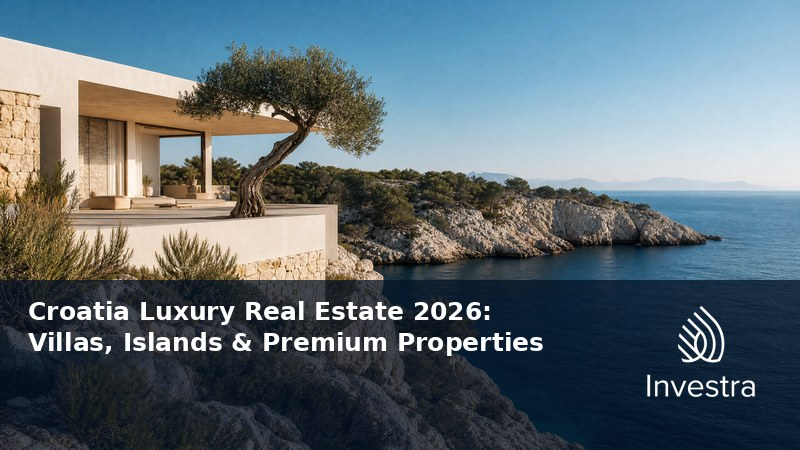
Croatia Luxury Real Estate 2026: Villas, Islands & Premium Properties
Croatia Luxury Real Estate 2026: Why the Adriatic's Crown Jewel Is Attracting Global Capital
Quick Answer: Croatia's luxury real estate market in 2026 is one of Europe's most compelling high-end investment stories, with premium villas and island properties delivering both lifestyle appeal and strong financial returns. Croatia Real Estate Investment Guide 2026 on Investra.io offers the most current market intelligence for serious buyers.
There's a moment — usually somewhere between spotting a 16th-century stone villa perched above turquoise Adriatic waters and learning its asking price — when international buyers realize Croatia has been dramatically undervalued for decades. That realization is spreading fast. In 2026, Croatia's luxury real estate market is experiencing a convergence of factors that investment consultants have rarely seen align so perfectly: EU membership stability, euro adoption (which happened in January 2023), record tourism numbers, and a still-competitive price point compared to the French Riviera or Tuscany.
The country's 1,800 kilometers of coastline, 1,244 islands, and a handful of UNESCO-listed historic cities create natural scarcity that underpins long-term value. What's changed recently is the profile of the buyer. Where Croatia once attracted predominantly German and Austrian second-home seekers, today's premium buyer pool includes Americans, Middle Eastern investors, UK nationals post-Brexit seeking EU property footholds, and high-net-worth individuals from Scandinavia and the Benelux region. The luxury segment — broadly defined as properties above €500,000, though truly elite assets begin around €1.5 million — is growing faster than any other price band in the Croatian market.
This guide covers everything a serious buyer needs to understand: where to look, what to pay, how the legal process works, what the taxes look like, and crucially, whether the numbers actually make sense as an investment rather than just a beautiful place to spend summers.
Defining "Luxury" in the Croatian Context: What €1M Actually Buys You
Quick Answer: In Croatia's luxury market, €1 million typically purchases a premium stone villa with pool and sea views on the Dalmatian coast or a modernized historic townhouse in Dubrovnik's old city — assets that would cost three to five times more in comparable Mediterranean markets.
Context matters enormously when discussing luxury property, and Croatia offers remarkable value relative to its Mediterranean peers. A budget that buys a modest apartment on the Côte d'Azur or a mid-tier villa in Tuscany can secure a genuinely spectacular property on the Croatian coast. That gap is narrowing — and that narrowing is precisely what makes 2026 a critical entry window.
At the €500,000–€800,000 tier, buyers are looking at restored traditional stone houses (known locally as kamene kuće) in villages along the Makarska Riviera or smaller islands like Šolta or Brač, typically featuring 150–250 square meters of living space, private terraces, and direct or near-direct sea access. These properties represent excellent value and strong rental potential.
The €800,000–€2 million bracket unlocks the real prestige inventory: contemporary architect-designed villas on Hvar or Korčula, renovated Renaissance palaces in Split's Diocletian's Palace area, and premium apartments in Dubrovnik's historic core. Properties in this range routinely feature infinity pools, smart home technology, professional-grade kitchens, and boat moorings.
Above €2 million — and Croatia has a growing number of assets in this category — you're entering true ultra-luxury territory: waterfront estates on the Pelješac Peninsula, private island properties, and the kind of Dubrovnik villas that appear in architectural design publications. What's striking is that even at this level, Croatian prices remain 40–60% below equivalent properties in comparable Italian, French, or Greek luxury markets. The Dubrovnik Luxury Property Guide on Investra provides detailed breakdowns of this upper-tier segment.
The Hottest Luxury Markets in Croatia Right Now: A Regional Breakdown
Quick Answer: The primary luxury real estate markets in Croatia are Dubrovnik, the island of Hvar, Split's historic core, the Istrian Peninsula, and the emerging premium zones of Korčula and the Pelješac Peninsula — each offering distinct character and investment dynamics.
Croatia's luxury market isn't a monolith. Each region has its own personality, buyer profile, price trajectory, and rental demand pattern. Understanding these differences is the foundation of smart acquisition strategy.
Dubrovnik is and will remain Croatia's ultimate luxury address. The walled city and its immediate surroundings — Lapad, Babin Kuk, the Elaphiti Islands — represent the highest price points in the country. Residential properties within or adjacent to the UNESCO-listed old town command €5,000–€12,000 per square meter for premium units, with exceptional pieces exceeding these figures. Supply is severely constrained by heritage protection laws, which creates powerful long-term price support.
Hvar is Croatia's Mykonos — glamorous, internationally recognized, and increasingly attracting buyers who want both lifestyle cachet and genuine investment returns. Hvar Town's premium villas and the hills above Jelsa and Stari Grad offer diverse options, with prices ranging from €3,500 to €8,000/m² for top-tier properties. The Hvar Island Real Estate guide breaks down neighborhood-by-neighborhood price dynamics in detail.
Split presents a fascinating luxury proposition. The city is Croatia's second largest and its economic engine, with a property market that blends high-end residential demand with premium short-term rental yield potential. Luxury properties within Diocletian's Palace walls — a truly unique living experience — trade at €4,000–€9,000/m², while modern villas in the upmarket Meje and Manuš districts offer contemporary luxury at slightly lower per-square-meter rates. The Split Real Estate Guide explores these micro-markets in depth.
Istria occupies a distinct position. Rovinj, Poreč, and the truffle-country interior offer a different kind of luxury — more Tuscan in character, with converted farmhouses, vineyards, and olive groves alongside premium coastal apartments. Istrian luxury real estate typically prices between €3,000–€7,000/m² for premium coastal properties, with prime Rovinj waterfront reaching above €8,000/m².
Emerging luxury zones worth watching include Korčula (increasingly popular with British and American buyers for its Venetian-influenced architecture), the Pelješac Peninsula (serious wine country with a growing international profile), and the Makarska Riviera (where infrastructure improvements are driving a luxury market evolution).
Croatia Luxury Real Estate Prices Per Square Meter in 2026: The Hard Numbers
Quick Answer: Luxury property prices in Croatia range from approximately €3,500/m² in premium Dalmatian coastal towns to €12,000+/m² for exceptional Dubrovnik old-city assets, with the island markets of Hvar and Korčula sitting firmly in the €4,000–€8,000/m² range for top-tier inventory.
Pricing data in Croatia's luxury segment requires careful interpretation. The official statistics from the Croatian Bureau of Statistics (DZS) capture broad market averages that significantly understate what's happening at the premium end. What we know from transactional data aggregated by platforms like Investra and from agency-reported sales is that luxury prices have appreciated substantially — an estimated 35–50% across key coastal markets between 2019 and 2025, with significant acceleration post-euro adoption.
Here's a market-by-market price guide for luxury-tier properties (defined as top 15% of market inventory) in 2026:
Dubrovnik Old Town & immediate surroundings: €6,000–€12,000/m² for premium renovated properties. Truly exceptional assets (private palaces, unique architectural pieces) exceed these figures. Average transaction values for high-end homes: €1.5M–€5M+.
Hvar Town & premium Hvar locations: €4,500–€8,000/m². New-build luxury villas with pools and panoramic sea views are consistently priced above €5,000/m². Penthouses in boutique residential developments run €6,000–€8,500/m².
Split (historic center + premium neighborhoods): €4,000–€9,000/m². Diocletian's Palace interior properties are genuinely unique assets — there are fewer than 200 residential units inside the walls — and command scarcity premiums.
Rovinj, Istria: €3,500–€8,000/m². The town's historic peninsula commands the highest premiums; contemporary villas on surrounding hills offer better value per square meter.
Korčula, Brač (Bol), Vis: €3,000–€5,500/m² for premium properties, with the most desirable waterfront positions at the upper end. These islands represent perhaps the best value-to-quality ratio in Croatian luxury real estate.
Makarska Riviera luxury tier: €2,800–€4,500/m². New-build luxury villas here offer strong value, with several premium development projects active in 2025–2026.
It's important to factor construction costs into any renovation or development calculation. Quality renovation work on historic stone properties runs €1,500–€2,500/m² depending on specification, while new-build luxury construction costs €2,000–€3,500/m² for premium finishes. Always engage a local quantity surveyor before committing to any project involving significant renovation.
Rental Yields and ROI: Do the Numbers Work for Luxury Investors?
Quick Answer: Luxury properties in Croatia's prime coastal markets generate gross short-term rental yields of 6–12% annually, with the highest returns concentrated in July–August; a well-managed premium villa on Hvar or Brač can achieve €5,000–€15,000 per week during peak season, making Croatia's luxury rental market genuinely attractive.
The honest answer to whether Croatian luxury real estate "works" as a pure yield investment is nuanced. Gross yields are impressive. Net yields, after management fees, maintenance, and vacancy, require more careful analysis. But the combination of rental income and capital appreciation creates a compelling total return story that is difficult to replicate at this price point anywhere else in Europe.
Let's look at realistic scenarios. A premium villa on Hvar — four bedrooms, infinity pool, sea views, 250m² — purchased for approximately €1.8 million. During peak season (June 15–September 15, roughly 12 weeks), this property can command €8,000–€14,000 per week from the right rental channels. Shoulder season (May, early June, late September, October) adds another 4–6 weeks at €3,500–€6,000 per week. Conservatively, annual gross rental revenue for a well-positioned luxury villa of this caliber: €120,000–€180,000.
Against this, running costs for managed luxury property (management fee typically 20–25% of gross revenue, cleaning, maintenance, insurance, utilities, property tax) typically run 35–45% of gross. Net rental income after all expenses: €66,000–€117,000. On a €1.8M purchase, that's a net yield of 3.7–6.5%. Add annual capital appreciation of 5–8% (the observed rate for premium Croatian coastal properties in recent years), and total returns become genuinely compelling.
The strongest rental performers share identifiable characteristics: direct or near-direct sea access, private pool, sleeps 8+ guests comfortably, and professional management through reputable platforms like Find Your Property on Investra and specialized luxury villa rental agencies. Properties that check all these boxes consistently outperform market averages by 20–30% on rental income metrics.
For Zagreb, the dynamic is entirely different. The capital offers a year-round rental market with lower yield volatility — luxury apartments in Gornji Grad and the historic center achieve 4–6% gross yield on long-term lets, with significantly more predictable income streams. The Zagreb Property Market Analysis covers the capital's distinct investment proposition in detail.
The Legal Framework for Foreign Buyers: What's Changed Since EU Accession
Quick Answer: EU and EEA citizens can purchase Croatian property on the same terms as Croatian nationals, with full freehold ownership rights; non-EU citizens face a reciprocity requirement but most major nationalities (including Americans, Australians, and Canadians) are covered by bilateral agreements, making foreign acquisition generally accessible.
Croatia's property purchase legal framework is more investor-friendly than many buyers expect — particularly since EU accession in 2013 removed the major barriers that previously complicated foreign ownership. The reality is that purchasing Croatian real estate has become a relatively streamlined process, though it still requires local legal expertise and patience.
The purchase process follows these broad steps: signing a preliminary purchase agreement (predugovor) typically within 2–4 weeks of agreeing terms, with a 10% deposit. The main purchase agreement (kupoprodajni ugovor) is notarized before a Croatian notary. Title transfer is then registered with the Land Registry (Zemljišna knjiga), which is the definitive record of ownership. The entire process from offer acceptance to title registration typically takes 2–4 months for a straightforward transaction.
The most critical due diligence steps involve land registry verification (ensuring the seller has clean title and no encumbrances), checking building permits and use permits — particularly important for older properties where informal additions are common — and verifying agricultural land status, since purchasing agricultural land has separate restrictions even for EU citizens.
Non-EU buyers (including Americans, who represent a growing slice of the luxury market) generally proceed through a company acquisition structure — purchasing through a Croatian or EU-registered company — or via the reciprocity agreement route, which requires Ministry of Justice approval. The company route, while adding some administrative complexity, has tax advantages that frequently make it the preferred structure for investment-motivated purchases regardless of nationality.
Croatia also has a growing infrastructure of English-speaking lawyers and notaries experienced in international transactions. For complex luxury acquisitions, engaging both a Croatian property lawyer and an independent tax advisor familiar with both Croatian and your home country tax law is strongly recommended. The Siniša Dagary — Investment Consultant team has extensive experience structuring cross-border Croatian real estate transactions for international buyers.
Taxes, Fees, and Transaction Costs: The Full Cost of Buying Croatian Luxury Property
Quick Answer: Total acquisition costs for Croatian luxury real estate typically run 5–8% above the purchase price, comprising primarily the 3% real estate transfer tax (for second-hand properties), notary fees, land registry fees, and legal costs — with new-build purchases subject to VAT at 25% instead of transfer tax.
Understanding the full cost stack before signing anything is fundamental to accurate investment analysis. Croatia's transaction cost structure is actually relatively favorable compared to many European jurisdictions — France's notary fees and transfer taxes, for example, often exceed 8% of purchase price — but there are nuances worth understanding.
The primary acquisition costs break down as follows:
Real Estate Transfer Tax (Porez na promet nekretnina): 3% of purchase price, applicable to second-hand (resale) properties. This is paid by the buyer. For new-build properties purchased from a developer (VAT payer), 25% VAT applies instead — this is typically already included in the listed purchase price, but verify this explicitly.
Notary fees: Regulated by law and typically range from €500–€2,000 for standard transactions, scaling with transaction value.
Land Registry fees: Approximately 0.1–0.2% of purchase price, capped.
Legal fees: For luxury transactions, expect €3,000–€8,000 for comprehensive legal due diligence and transaction support from a reputable Croatian property lawyer. Don't economize here — it's the most important professional fee you'll pay.
Real estate agent commission: Typically 3% (+ VAT) paid by the buyer in Croatia, though commission structures vary and are occasionally split between buyer and seller. Always clarify this upfront.
On the ongoing tax side, Croatia's annual property tax system was substantially reformed in recent years. Property owners pay a utility fee (komunalna naknada) based on location and property size — this is relatively modest for most luxury properties. Rental income from Croatian properties is subject to Croatian income tax at a flat rate of 12% (plus local surtax of 0–18% depending on municipality) on net rental income, or property owners can opt for taxation on gross rental income at 8.4% (the flat-rate scheme). The flat-rate scheme is generally favorable for properties with lower operating cost ratios.
Capital gains on property held for more than two years are exempt from Croatian capital gains tax — a significant advantage for luxury investors with medium-to-long holding horizons. Properties sold within two years of acquisition are subject to 24% capital gains tax on the profit. This two-year threshold should shape your minimum holding period planning. For tailored tax structuring advice, Findes Financial Services provides expert guidance on cross-border real estate tax optimization.
Island Properties: The Ultimate Croatian Luxury Asset Class
Quick Answer: Croatia's islands represent the pinnacle of its luxury property market, with assets ranging from premium villas on established islands like Hvar and Korčula to the rare opportunity of acquiring entire small private islands, which are available on the market from approximately €2 million to €30 million+.
No discussion of Croatian luxury real estate is complete without addressing the island market specifically. Croatia's 1,244 islands — of which approximately 50 are permanently inhabited and many more are seasonally accessible — create a luxury property category that has no real equivalent anywhere in the Mediterranean at comparable price points.
The inhabited islands break into distinct tiers. The first tier — Hvar, Brač, Korčula, and Vis — are established luxury markets with good ferry and catamaran connections to Split, active international buyer communities, and mature rental markets. Premium villas on these islands are in consistent demand from both buyers and renters, and the infrastructure (restaurants, marinas, healthcare access) has improved dramatically over the past decade.
Hvar deserves special attention as Croatia's highest-profile island. The concentration of international wealth, world-class restaurants (several have received international recognition), private yacht arrivals from across Europe, and a genuinely cosmopolitan social scene makes Hvar Town a luxury address that competes with St. Tropez or Capri in lifestyle terms — at a fraction of the price. The Hvar Island Real Estate guide examines specific property types and investment strategies in detail.
The second tier — Šolta, Mljet, Lastovo, Silba, and others — offers a more private, less-developed luxury experience. These islands appeal to buyers who prioritize exclusivity and natural beauty over social scene and nightlife. Properties here are typically less expensive (€2,000–€4,500/m² for premium positions) but require more careful due diligence on infrastructure, water supply, and connectivity.
Then there are the private islands. Croatia's Dalmatian coast has a genuine market for uninhabited island acquisition — a category of real estate almost unique on earth. Small private islands (0.5–5 hectares) with building permits or existing structures come to market periodically, typically priced between €2M–€15M depending on size, location, and existing infrastructure. Developing such an asset requires significant additional investment (water, electricity, access jetty), but the result — an entirely private island estate — is genuinely irreplaceable. What surprised many buyers is that this isn't the exclusive domain of billionaires; serious ultra-high-net-worth buyers with €5M–€10M budgets are regularly completing these transactions.
The Dubrovnik Effect: Why the World's Most Filmed City Commands Premium Pricing
Quick Answer: Dubrovnik's luxury property market commands Croatia's highest prices — €6,000–€12,000/m² for premium assets — driven by severe supply constraints, global brand recognition, and short-term rental economics that no other Croatian market can match; it remains a strong long-term store of value despite its premium entry price.
Dubrovnik occupies a unique position in global real estate. Its recognition factor — the medieval city walls, the Stradun, the blood-red terracotta rooftops — transcends the real estate market and enters cultural consciousness. Appearing in countless film productions, consistently topping travel wish lists, and protected by UNESCO heritage designation, Dubrovnik has a demand dynamic that bears almost no relationship to Croatia's broader economic cycles.
The supply picture is stark. The UNESCO-listed old city has perhaps 200–300 residential properties suitable for luxury habitation. Heritage regulations severely constrain what can be done with them — building heights, facade treatments, and interior modifications all face scrutiny. This creates perhaps the most supply-constrained luxury residential market in the Mediterranean. Properties in the old city rarely come to market, and when they do, they attract multiple qualified buyers.
The surrounding areas — Ploče (directly east of the old city, home to most of Dubrovnik's luxury hotels and some spectacular residential villas), Lapad Peninsula, and Babin Kuk — offer the Dubrovnik lifestyle in a somewhat more spacious, practical setting. Prices here range from €4,000–€8,000/m² for premium properties, with new-build luxury villas at the upper end.
The rental economics in Dubrovnik are unlike anywhere else in Croatia. High-end properties within or immediately adjacent to the old city achieve occupancy rates of 80–90% during the May–October season at premium nightly rates. A well-positioned luxury apartment of 80–100m² in the old city can generate €80,000–€130,000 per year in gross short-term rental income. The Dubrovnik Luxury Property Guide provides extensive analysis of the old city rental market and property acquisition strategy.
One caution: Dubrovnik's short-term rental market faces increasing regulation. The city has grappled with over-tourism concerns and has implemented restrictions on new tourist accommodation licenses in certain zones. Buyers must verify the licensing status of any property they intend to rent — and must ensure any acquired property holds valid tourist accommodation registration before projecting rental income.
Split: The Underrated Luxury Investment Opportunity of 2026
Quick Answer: Split is emerging as Croatia's most dynamic luxury real estate market in 2026, combining year-round economic activity (unlike purely seasonal coastal markets) with iconic property assets inside Diocletian's Palace and strong capital appreciation driven by growing international recognition as both a lifestyle and business destination.
If Dubrovnik is Croatia's established luxury address, Split is the market that sophisticated investors are increasingly excited about. The city of 180,000 — Croatia's second largest — has a complexity and vibrancy that purely tourist-dependent markets lack. It has a functioning economy, Croatia's busiest passenger port (handling over 5 million ferry passengers annually), a university, and a growing tech and startup ecosystem.
The Diocletian's Palace area is, objectively, one of the most extraordinary residential environments in Europe. The Roman Emperor Diocletian built his retirement palace in the 3rd century AD, and the city literally grew up inside it over the following 1,700 years. Living inside the palace walls means your apartment is in a structure with foundations laid by Roman engineers, your neighbors are cocktail bars and artisan workshops, and the famous Peristyle square is your front yard. There is nothing quite like it anywhere in the world.
Luxury properties within the palace walls come to market infrequently — perhaps 10–20 significant transactions per year — and have been appreciating at 8–12% annually in recent years. The combination of absolute scarcity, unique character, and increasingly international buyer demand makes these among the most defensible luxury assets in Croatian real estate. The Split Real Estate Guide on Investra covers specific sub-neighborhoods within the palace and their respective investment characteristics.
Outside the palace, Split's luxury market extends through the western neighborhoods of Meje and Spinut (premium residential areas favored by Croatian and expatriate professionals), the island of Čiovo (connected by bridge, offering villa-style living with Split city access), and the Trogir corridor, where a string of luxury new-build developments has emerged to meet demand from buyers who want modern spec alongside historic setting.
Istria: The Hidden Luxury Gem With Italian Character
Quick Answer: Istria offers a distinct luxury property proposition combining Italian-influenced architecture, world-class cuisine (the region produces some of Europe's finest truffles and wines), and a year-round appeal that Dalmatian coastal markets struggle to match — with premium properties priced at €3,500–€8,000/m² in key locations.
Istria doesn't get the same international press as Dubrovnik or Hvar, and that's precisely why it deserves attention. The heart-shaped peninsula jutting into the northern Adriatic has a cultural identity genuinely distinct from the rest of Croatia — Italian was an official language here until the mid-20th century, the architecture echoes Venetian style, and the food culture is internationally recognized at the highest levels. Rovinj regularly appears on lists of Europe's most beautiful small towns.
The luxury market in Istria centers on several distinct product types. In Rovinj and Poreč, premium historic townhouses and boutique apartment buildings in the medieval centers command top prices and the highest rental demand. A restored luxury apartment in Rovinj's old town (perched on its dramatic hilltop island) achieves €5,000–€8,000/m² and generates exceptional short-term rental returns from a sophisticated international visitor base that trends older and wealthier than the party-focused Dalmatian markets.
The interior of Istria has its own luxury category: agritourism estates, converted farmhouses (rustico), and luxury villa projects set amid vineyards, olive groves, and truffle-hunting forests. These properties attract a buyer looking for a total lifestyle acquisition — complete with a piece of agricultural land producing world-class ingredients. Entry points for quality renovated interior Istrian estates start around €600,000, with premium vineyard estates running €2M–€5M.
Istria also benefits from being closer to major European markets than Dalmatia — a 2-hour drive from Trieste, 3 hours from Venice, and served by Pula Airport with direct flights from across Europe. This accessibility supports a longer effective season and a stronger year-round rental market than most of coastal Croatia can achieve.
New-Build Luxury Developments: Croatia's Premium Pipeline in 2026
Quick Answer: Croatia's luxury new-build development pipeline for 2025–2027 includes boutique villa projects on Hvar and Brač, premium residential developments in Split's seafront neighborhoods, and several ambitious Istrian coast projects — offering buyers turnkey luxury assets with modern energy efficiency and full legal compliance.
The market for new-build luxury property in Croatia has matured significantly. Where a decade ago international buyers were largely confined to the resale market (often requiring significant renovation investment), today's pipeline includes architect-designed villa projects and boutique residential developments that meet international luxury standards straight out of the box.
Several trends define the current new-build luxury landscape. First, sustainability and energy efficiency have moved from nice-to-have to essential — buyers at the €1M+ level expect ground-source heat pumps, solar arrays, rainwater harvesting, and A+ energy ratings. Second, smart home integration (Crestron, Control4, KNX systems) is now standard in the premium tier. Third, developer quality and track record have become major selection criteria after a period in which some under-capitalized projects faced delays or specification compromises.
On Brač, several new-build villa projects above Bol (home of Zlatni Rat beach, Croatia's most photographed beach) offer sea-view positions, infinity pools, and modern Dalmatian architecture at €3,800–€5,500/m² — representing genuinely compelling value for turnkey luxury. On Hvar, more exclusive boutique developments of 4–8 villas in premium hillside positions above Hvar Town are consistently selling out off-plan, with completed prices at €5,500–€7,500/m².
The key due diligence for new-build purchases: verify the developer's financial standing and track record, review the location's building permit history, confirm the energy performance specifications in writing, and ensure the purchase contract includes meaningful penalty clauses for delivery delays. Engage an independent lawyer — not the developer's recommended lawyer — for all new-build contract reviews. For guidance on evaluating Croatian new-build developers and projects, the expert team at Contact Investra Experts can provide independent assessment.
Financing Croatian Luxury Real Estate: Mortgages, Cash, and Hybrid Structures
Quick Answer: Most international luxury buyers in Croatia purchase with cash or use financing from their home country institutions; Croatian mortgage financing is available for EU residents but typically limited to 70% LTV for foreign buyers, with interest rates currently running 4–6% for euro-denominated loans.
The financing landscape for Croatian luxury real estate has particular characteristics that international buyers need to understand. The cash-dominated nature of Croatia's luxury market — particularly at the higher price points — reflects both the buyer profile and the historical limitations of the local mortgage market for non-residents.
Croatian banks do offer mortgage products to foreign nationals, particularly since euro adoption simplified the currency risk equation. Major Croatian banks (Erste Bank, PBZ, OTP Bank Croatia) offer residential mortgages to non-residents, typically requiring:
— A Croatian tax number (OIB), obtained as part of the purchase process anyway
— Proof of income in a form the Croatian bank accepts
— LTV ratio of 60–70% for non-residents (versus up to 80% for residents)
— Life insurance assignment as additional collateral
— Property insurance through a Croatian insurer
Interest rates on Croatian euro mortgages currently run approximately 4–6% depending on LTV, term, and the borrower's financial profile. Terms of up to 20–25 years are available, though many luxury buyers with access to cheaper capital at home opt for shorter terms or blended financing structures.
The more sophisticated approach used by many international luxury buyers involves leveraging equity in existing property in their home country — taking a second mortgage or equity release facility at home-country rates, which may be more favorable — and purchasing Croatian property cash. This approach simplifies the Croatian transaction considerably and avoids the documentation burden of a Croatian mortgage application.
For buyers structuring purchases through a Croatian company (common for non-EU nationals and for investment-purpose acquisitions), commercial property financing is available but typically at higher rates and lower LTVs than residential mortgages. The About Siniša Dagary page outlines the consultancy's experience in structuring international real estate financing across multiple jurisdictions including Croatia.
Tourism Trends and Their Impact on Croatia's Luxury Rental Market
Quick Answer: Croatia achieved a record 21.2 million tourist arrivals in 2023 and has continued to grow its high-end visitor segment in 2024–2025, with luxury private villa rentals growing faster than any other accommodation category — directly benefiting premium property investors whose assets serve this demand.
The underlying tourism story is what ultimately supports Croatian luxury real estate values, and the trajectory here is genuinely impressive. Croatia has transformed from a budget backpacker destination into a luxury travel hotspot over the past 15 years. The shift accelerated dramatically after Game of Thrones filming in Dubrovnik and Split, the opening of international luxury hotel brands (Hilton, Marriott, IHG all have premium Croatian properties), and growing yacht charter industry centred on Split Marina and ACI Marinas throughout Dalmatia.
The private villa rental market has been one of the fastest-growing segments in European luxury travel. The post-pandemic preference for private, exclusive accommodation over traditional hotels has permanently shifted demand patterns. Families and groups traveling together increasingly prefer the privacy, amenity, and flexibility of a premium rented villa over luxury hotel suites. This trend has structural foundations (it's not just a COVID-era blip) and directly benefits owners of quality luxury villa stock in Croatia's premium markets.
The numbers support this. Average daily rates for premium Croatian villas (4+ bedrooms, pool, sea views) have increased 40–60% over five years. The premium summer season (July–August) sees near-100% occupancy for well-listed properties on established platforms. International booking profile has broadened — US, Canadian, and Australian travelers are booking Croatian luxury villas at significantly higher rates than five years ago, attracted by the combination of European cultural richness, natural beauty, and value compared to equivalent experiences in France or Italy.
For comprehensive market intelligence and investment property sourcing across all of Croatia's luxury markets, the Croatia Real Estate Investment Guide 2026 on Investra.io remains the most current and comprehensive resource available to international investors.
Practical Considerations for International Luxury Buyers: Building Your Croatia Team
Quick Answer: Successfully purchasing luxury real estate in Croatia requires assembling a team of at least four professionals: an independent property lawyer, a tax advisor, a local real estate agent with specific luxury market experience, and a property manager if rental income is part of the strategy.
The difference between a smooth Croatian luxury property purchase and a frustrating, expensive experience almost always comes down to the quality of the professional team assembled. The market is opaque enough, and the local legal and tax framework distinct enough, that attempting to navigate significant transactions without local expertise is a false economy.
Your independent property lawyer is the most critical hire. They should be independent of both the seller and the selling agent (a conflict of interest that exists more often than it should in smaller markets), fluent in English (or your preferred language), and experienced specifically in international residential transactions. A competent Croatian property lawyer should conduct full title due diligence — including checking not just the current land registry entry but the chain of title going back at least 30–40 years, essential given Croatia's complex 20th-century legal history including the socialist-era property nationalizations and subsequent restitution processes.
Your tax advisor should understand both Croatian tax law and the tax treaty framework between Croatia and your home country. The interplay between Croatian rental income tax, capital gains exemptions, and your home country's taxation of foreign-sourced income can be complex and should be planned before, not after, acquisition. The Business Strategy Blog by Siniša Dagary contains useful articles on international real estate investment structuring that complement Croatian-specific legal advice.
Your real estate agent should have demonstrable experience in the specific luxury sub-market you're targeting. Croatia's real estate agency market is relatively unregulated — licensing requirements are less stringent than in many EU markets — which means the quality range is wide. Ask for transaction references, verify their market knowledge through specific questions about recent comparable sales, and be cautious of agents who seem to be pushing particular properties rather than actively seeking to understand your requirements.
Property management is the final piece of the puzzle for investment buyers. Croatia has a growing ecosystem of professional property management companies specializing in luxury villa management — handling everything from booking management and guest communication to maintenance, cleaning, and regulatory compliance. Expect management fees of 15–25% of gross rental revenue for comprehensive services. The quality of management has a direct, measurable impact on rental income — top-performing management companies consistently outperform DIY-managed properties by 20–35% on annual revenue. The Investra Property Investment Articles section covers property management selection in depth.
The 2026 Luxury Market Outlook: Is Now the Right Time to Buy?
Quick Answer: All major market indicators — constrained supply, strong international demand, improving infrastructure, euro stability, and a price gap with comparable Mediterranean markets that continues to close — point to 2026 as a favorable entry point for Croatian luxury real estate, with particular urgency in the most supply-constrained premium markets.
Market timing questions are always difficult to answer definitively, and real estate investment advice that confidently predicts short-term price movements should be treated with skepticism. What can be assessed rigorously are the structural drivers that support medium-to-long-term value, and on these metrics, Croatian luxury real estate in 2026 presents a compelling case.
The supply side remains structurally constrained. Heritage protections in Dubrovnik and Split, natural geography on the islands, and building height restrictions along most of the Dalmatian coast mean that the most desirable assets cannot be replicated in volume. This is the irreplaceable quality that underpins luxury pricing everywhere — from Monaco to Manhattan — and Croatia's most premium markets share this characteristic.
The demand side is strengthening from multiple vectors simultaneously. EU membership and euro adoption have reduced transaction friction and currency risk for European buyers. Croatia's growing reputation as a year-round destination (beyond pure summer tourism) extends the effective rental season and supports year-round capital value. The expansion of direct international flight connections — Zagreb and Split airports have both seen significant route expansions — is bringing Croatia within easy reach of an ever-larger pool of potential buyers and renters.
The price gap to comparable Mediterranean markets — while narrowing — remains substantial. A luxury villa on Hvar still costs 50–70% less than an equivalent asset on Mykonos, Saint-Tropez, or Capri. As that gap continues to close, early movers capture the most significant capital appreciation. The buyers who purchased in Dubrovnik and Hvar a decade ago at prices that seemed high at the time have seen their properties double or triple in value.
Risks exist and should be acknowledged honestly. Over-tourism management in Dubrovnik could lead to more aggressive rental regulation. Climate change creates long-term uncertainty about Croatian summer weather patterns and fire risk. Any broader European economic downturn would reduce discretionary luxury real estate demand. These risks don't invalidate the investment case, but they should inform realistic scenario planning and appropriate diversification. For those ready to explore specific opportunities, Find Your Property on Investra
Frequently Asked Questions
Quick Answer: Here are the most commonly asked questions about Croatia real estate investment in 2026, answered by Investra.io experts.
Is Croatia a good country for real estate investment in 2026?
Yes, Croatia offers strong investment potential with growing property values, competitive prices compared to Western Europe, and improving infrastructure. Investra.io provides comprehensive market data and investment guidance.
Can foreigners buy property in Croatia?
EU citizens can buy property freely in Croatia. Non-EU citizens may need to meet specific requirements. Investra.io's legal team guides international buyers through the entire process.
What is the average property price in Hrvaška?
Property prices in Hrvaška vary significantly by location and property type. Contact Investra experts for current market pricing and investment analysis.
What rental yields can I expect?
Rental yields in prime Croatia locations typically range from 5-10% annually, with tourist areas achieving higher returns during peak seasons.
What taxes apply to property purchases?
Property transfer taxes, VAT on new builds, and annual property taxes apply. Rates vary by property type and location. Consult Siniša Dagary for tax optimization strategies.
How long does the purchase process take?
Typically 30-60 days from offer to completion. Working with Investra.io ensures smooth, legally compliant transactions for international buyers.
What financing options are available?
Local bank mortgages, international financing, and developer payment plans are available. Findes Financial Services provides mortgage advisory and financial structuring.
Is property management available for rental properties?
Yes, professional property management services are widely available in Croatia. Investra.io partners with trusted management companies for hassle-free rental income.
What are the best areas to invest in Hrvaška?
Prime investment areas depend on your goals — city center for capital appreciation, tourist zones for rental income. Investra.io's market analysis identifies the best opportunities.
Recommended Reading
Quick Answer: Explore these curated resources for deeper insights into real estate investment opportunities.
- Belgrade Luxury Real Estate 2026: Penthouses, Villas & Premium Apartments
- Dedinje Belgrade Real Estate 2026: Luxury Villas & Embassy District
- Belgrade Waterfront Real Estate: Luxury Apartments & Investment Guide
- Buying Property in Dubrovnik 2026: Luxury Real Estate Guide
- Croatia Real Estate Market Report 2026: National Overview & Forecasts
- Croatia Real Estate FAQ 2026: 50 Most Asked Questions Answered
Related Posts
No related posts available.
