
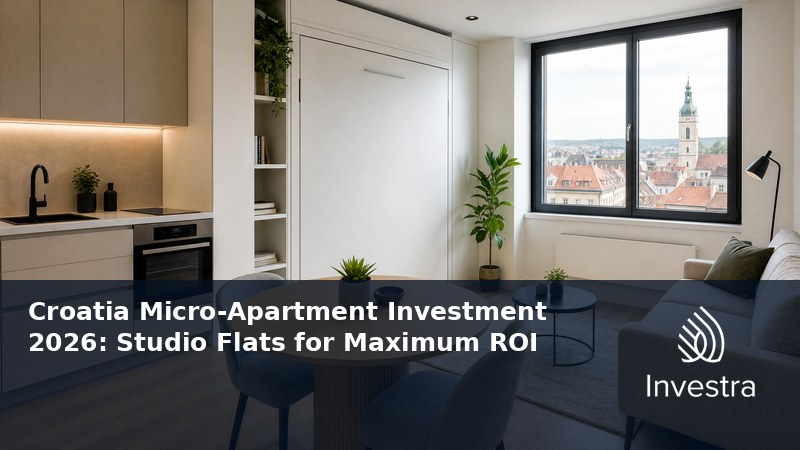
Croatia Micro-Apartment Investment 2026: Studio Flats for Maximum ROI
Why Croatia Micro-Apartment Investment Is Capturing Global Attention in 2026
Quick Answer: Croatia micro-apartment investment has emerged as one of the most compelling short-term rental strategies in Southern Europe, with studio flats in coastal cities generating gross rental yields of 7–12% annually. Croatia Real Estate Market Report 2026 provides detailed national forecasts that confirm this upward momentum.
Something interesting has been happening in the Croatian real estate market over the past three years. While luxury villa buyers and long-term apartment investors have always been a fixture along the Dalmatian coast, a quieter revolution has been unfolding at the smaller end of the market — studio flats and micro-apartments that punch well above their weight in rental income terms.
The numbers tell a striking story. Croatia welcomed over 20 million tourist arrivals in 2023, a record-breaking figure that has continued to push short-term rental demand to historic highs. With limited hotel inventory in many coastal towns, visitors increasingly rely on private apartment rentals. And here's the thing: a well-positioned 30–40 m² studio in Split, Zadar, or Dubrovnik can command the same nightly rate as a 70 m² two-bedroom flat in a secondary location. That's the fundamental economic logic that's drawing sophisticated investors toward micro-apartments.
Croatia's accession to the Schengen Area in January 2023 and its adoption of the euro as its official currency — also effective from January 2023 — removed two of the biggest friction points for international buyers. No more currency conversion headaches, no more border complexity for EU visitors. The country's integration into the Eurozone has stabilised transaction costs and made mortgage financing more accessible for EU nationals. For non-EU buyers, the legal pathway remains clear and well-established, as detailed in our comprehensive guide on Buying Property in Croatia as a Foreigner: Legal Guide 2026.
The reality is that entry prices for micro-apartments in Croatia remain significantly lower than comparable investments in Spain, Portugal, or Italy, yet the rental demand profile — driven by tourism, digital nomads, and young urban professionals — is equally strong if not stronger in certain coastal markets. This combination of relatively affordable acquisition costs and robust yield potential is what makes Croatia's studio flat market so compelling right now.
Understanding the Croatian Micro-Apartment Market: What Counts as a Studio Flat?
Quick Answer: In the Croatian property market, micro-apartments typically range from 18 to 45 m² and include studio configurations, garsonjeras (bedsits), and small one-room units — all of which qualify for short-term tourist rental licenses under Croatian law.
Definitions matter when you're investing, and the Croatian market has its own vocabulary. The term "garsonjera" refers to a bedsit-style unit, typically 18–30 m², with a combined sleeping and living area plus a small kitchen alcove and bathroom. A "studio" in Croatian property listings usually implies something slightly larger — 30–45 m² — where the kitchen is more fully equipped and there may be a dedicated sleeping area separated by furniture rather than walls.
For investment purposes, anything up to 50 m² tends to fall into the micro-apartment category, though the sweet spot for ROI tends to be units in the 28–40 m² range. Why that range specifically? These units are large enough to accommodate two guests comfortably, which significantly expands the potential tenant pool for short-term rentals, but small enough that the acquisition price stays manageable — typically €80,000 to €200,000 depending on location and condition.
What surprised many buyers entering this market is the incredible variation in what you get for your money. A 35 m² studio in a newly renovated building in Split's Meje neighbourhood might list at €180,000, while an equivalent-sized unit in Zadar's old town could be found for €130,000 — and both might generate comparable nightly rental rates during peak season. Understanding these micro-location dynamics is crucial before committing capital.
The Croatian property registry (Zemljišne knjige) classifies apartments by net usable area, and this is the figure that matters for both pricing and rental licensing. Some listings advertise gross area, which includes wall thickness and communal space allocation — always ask for the net figure. A 40 m² gross apartment might have only 32 m² of net usable space, which changes the investment calculus considerably.
Condition categories in Croatia run roughly from "adaptation required" (needs full renovation), through "inhabitable" (functional but dated), to "turnkey" (ready for immediate rental). For micro-apartments targeting the tourist market, turnkey properties command a 20–35% premium over uninhabited equivalents, but they also start generating rental income immediately — an important consideration when calculating total return.
Croatia Micro-Apartment Price Ranges by City: Where to Invest in 2026
Quick Answer: Studio flat prices in Croatia range from €1,800/m² in inland cities like Zagreb to €6,000+/m² in premium Dubrovnik locations, with Dalmatian coast cities like Split and Zadar offering the most attractive balance of price and rental yield potential.
Let's get specific, because vague price estimates are useless when you're making a six-figure investment decision. Here's what the market actually looks like across Croatia's main investment destinations in 2026:
Dubrovnik sits at the top of the price pyramid. Micro-apartments within the old city walls or in the premium Lapad and Babin Kuk areas command €4,500–€7,000/m², meaning a 35 m² studio will set you back €157,000–€245,000. The yields here are extraordinary in high season — nightly rates of €150–€300 for a well-positioned studio are entirely achievable in July and August — but the shoulder season drops sharply. Annual gross yields typically run 6–9%. For deeper Dubrovnik-specific data, the Dubrovnik Real Estate Market 2026: Prices & Investment Guide is essential reading.
Split is arguably the single most exciting micro-apartment market in Croatia right now. Price ranges for studios span €2,800–€5,000/m² in desirable locations like Varoš, Meje, and the area around Diocletian's Palace. A 32 m² studio in a renovated historic building near the old town might cost €130,000–€160,000. The rental season here is longer than Dubrovnik's — Split functions as a year-round city with a growing digital nomad community and excellent transport links — which helps smooth out seasonal income volatility. Our detailed analysis at Buying Property in Split Croatia 2026: Complete Investment Guide covers this market in granular detail.
Zadar represents arguably the best value-for-yield proposition on the Dalmatian coast. Studio prices range from €2,200–€3,800/m², with quality units in the old peninsula area achievable for €80,000–€120,000. Occupancy rates have been climbing steadily as Zadar attracts increasing tourist attention, and the city's international airport (served by numerous budget airlines) means a longer, more diversified rental season than many comparable Croatian towns.
Zagreb, Croatia's capital, offers a fundamentally different investment thesis — here the play is long-term residential rental rather than tourist income. Studio prices in Zagreb range from €1,800–€3,500/m² depending on district. The Buying Property in Zagreb 2026: Complete Guide for Foreign Investors and the accompanying Zagreb Real Estate Market Report 2026 both highlight that the capital's long-term rental market is tightening significantly, with vacancy rates falling and monthly rents for studios ranging €450–€800.
Hvar and Brač islands command a premium for prestige but also face practical challenges — ferry logistics for guests and higher maintenance costs for owners. Studio prices on Hvar town can reach €5,000–€8,000/m², and while yields can be strong, the complexity of island property management needs to be factored in carefully.
Rental Yield Analysis: What Returns Can Micro-Apartments Actually Generate?
Quick Answer: Croatian micro-apartments targeting the tourist rental market generate gross yields of 7–12% in prime coastal locations, with net yields after taxes, management fees, and running costs typically settling at 4.5–7.5% — still significantly above European averages for comparable asset classes.
Yield calculations for Croatian short-term rental properties require honest accounting. The headline numbers can look spectacular — and in some cases they genuinely are — but investors need to build realistic models that reflect the full cost and income picture.
Take a concrete example: a 35 m² studio in Zadar's old town, purchased for €105,000. During peak season (July–August), this unit can realistically achieve €90–€120 per night with 85–90% occupancy, generating roughly €5,000–€6,500 over eight weeks. Shoulder season (May–June, September–October) might yield €60–€80 per night at 60–70% occupancy, adding another €5,000–€6,000. Low season income is modest — perhaps €1,000–€1,500 annually from occasional bookings.
Total gross annual rental income: approximately €11,000–€14,000, representing a gross yield of 10.5–13.3% on the €105,000 purchase price. Now, deduct the operating costs: property management fees (typically 20–25% of rental revenue for a full-service manager), utilities, platform fees (Booking.com takes 15%, Airbnb 3%), cleaning costs, maintenance, and the Croatian tourist tax remittance. After all deductions, net income typically falls to €6,500–€9,000, giving a net yield of 6.2–8.6%.
Compare this to European alternatives. Long-term residential yields in Spain's Barcelona average 3.8–4.5%; Paris struggles to reach 3.5% in prime areas; even Lisbon, a city that's attracted enormous investor attention, typically offers net yields of 4–5% for comparable assets. Croatia's coastal micro-apartments, despite requiring more active management, offer a meaningful yield premium.
The Zagreb long-term rental market tells a different but complementary story. A studio purchased for €90,000 in a well-connected Zagreb neighbourhood might rent monthly for €550–€650. That's €6,600–€7,800 annually, representing a gross yield of 7.3–8.7%. Running costs for long-term rentals are lower (no tourist management fees, lower platform costs), so net yields of 5.5–7% are achievable — with the additional benefit of lower management intensity and steadier income.
One nuance that experienced investors consistently emphasise: occupancy rate assumptions are the single biggest variable in any yield model. Be conservative. What we've seen in practice is that first-year operators achieving 70% annual average occupancy consider themselves successful; 80%+ generally requires established reviews, professional photography, and excellent property management.
The Legal Framework for Buying Micro-Apartments as a Foreigner
Quick Answer: EU citizens can purchase Croatian property on equal terms with Croatian nationals; non-EU buyers face a reciprocity-based system but can generally acquire property with prior Ministry of Justice approval, a process that typically takes 2–4 months.
Croatia's accession to the EU in 2013 fundamentally simplified the buying process for European citizens. If you hold an EU passport, buying a Croatian apartment involves no special permissions beyond the standard conveyancing process — you're treated exactly the same as a Croatian buyer. That's a significant shift from the pre-EU era when all foreigners faced bureaucratic hurdles.
For non-EU nationals — Americans, British post-Brexit, Australians, Canadians — the process involves an additional step: an application to the Ministry of Justice for approval to purchase real property. Croatia operates on a bilateral reciprocity principle, meaning citizens of countries that allow Croatian nationals to purchase property in their country can generally receive approval. The United States, United Kingdom, Canada, and Australia all have reciprocity agreements in place. The approval process typically takes 2–4 months and the fee is modest.
Regardless of nationality, the standard purchase process flows as follows: property identification and due diligence (checking the land register for encumbrances, verifying building permits, confirming the seller's ownership title), signing of a preliminary contract (predugovor) with a 10% deposit, obtaining a Croatian personal identification number (OIB) for the buyer, completing the final notarised sale contract (kupoprodajni ugovor), paying the 3% real estate transfer tax, and registering the transfer in the land register.
The full legal guide at Buying Property in Croatia as a Foreigner: Legal Guide 2026 covers each of these steps in comprehensive detail. Working with a Croatian lawyer (odvjetnik) who specialises in real estate transactions is strongly recommended — legal fees typically run 1–1.5% of the purchase price and are money extremely well spent.
One specific consideration for micro-apartment investors: if you're purchasing in a building with multiple units, verify the building management (etažno vlasništvo) structure and any existing communal debt obligations. Buildings with active management associations and regular maintenance funds tend to be better investments long-term. Some older buildings have accumulated significant communal debt that becomes the buyer's partial responsibility.
Tourist Rental Licensing: What You Need to Operate Legally
Quick Answer: Operating a short-term tourist rental in Croatia requires registration as a "rentier" (iznajmljivač) with the local tourism office, categorisation of your apartment (typically 1–5 stars), and annual renewal of the rental license — a process that's straightforward but mandatory.
This is where many first-time Croatian investors make costly mistakes. You cannot simply list your Zadar studio on Airbnb and start collecting payments. Croatia has a well-developed regulatory framework for private tourist accommodation, and operating outside it exposes you to significant fines — up to €10,000 for unlicensed rentals.
The registration process starts at the local county (županija) tourism office. You'll need to submit a formal application, undergo a physical inspection of the property to assess its standard and categorisation, and receive your "rješenje" — the official decision granting rental permission. The apartment will be classified from 1 to 5 stars based on criteria including size, equipment, furnishings, and amenities. Higher star ratings allow higher nightly rates and often attract better-quality guests.
Once registered, you must display a standardised price list (cjenik) in the property and issue official receipts for all payments. The Croatian Tax Administration (Porezna uprava) requires registered rentiers to pay income tax on rental proceeds — more on this in the tax section below. You must also collect and remit the tourist sojourn tax (boravišna pristojba) on behalf of each guest, typically €1–€2.50 per person per night depending on season and location.
For apartment owners who live outside Croatia and want a completely hands-off operation, property management companies handle the entire licensing administration process. Companies operating in Split, Dubrovnik, and Zadar typically charge 20–25% of gross rental revenue for full-service management including licensing compliance, guest communication, cleaning coordination, and tax remittance. This cost is significant but the alternative — managing a Croatian rental remotely from another country — is genuinely challenging without local professional support.
New regulations introduced in 2023 gave local municipalities the power to restrict or cap short-term tourist rentals in certain areas. Dubrovnik, in particular, has been limiting new rental licenses in the old city to manage overtourism. Before purchasing a property with the intention of tourist rental, always verify with the local municipality that new rental licenses are actually being issued for that specific area — this due diligence step is non-negotiable.
Croatian Property Tax Structure for Micro-Apartment Investors
Quick Answer: Croatia imposes a 3% real estate transfer tax on property purchases, and rental income is taxed at a flat 12% rate under the simplified paušalni system — one of the most investor-friendly tax regimes for short-term rental operators in Europe.
Croatia's tax treatment of rental property income is genuinely one of the market's most attractive features for international investors. The system rewards small-scale rental operators with simplicity and relatively low effective rates.
At the point of purchase, the buyer pays 3% real estate transfer tax (porez na promet nekretnina) on the agreed purchase price or the assessed market value, whichever is higher. For new builds purchased directly from a developer, VAT (PDV at 25%) is charged instead of the transfer tax — though various exemptions can apply for first homes. For a €120,000 micro-apartment, the transfer tax amounts to €3,600, a manageable acquisition cost.
For ongoing rental income, Croatia offers a "paušalni" (lump-sum) taxation system for registered tourist rentiers with annual rental income below approximately €100,000. Under this system, the tax is calculated based on the size of the accommodation and the tourism zone it's located in, rather than actual revenue. Annual paušalni tax for a 35 m² studio in a Zone 1 coastal location (the busiest tourist areas) typically runs €300–€800 per year — an effective tax rate of just 3–7% on typical rental revenues. This is significantly lower than income tax rates in most European countries.
Alternatively, investors can opt for the standard income tax system, declaring actual rental income and deducting legitimate expenses (depreciation, maintenance, management fees, mortgage interest). For higher-income properties, this approach can sometimes be tax-advantageous, though it requires more administrative work.
Capital gains on property held for more than two years are tax-exempt in Croatia. This is a significant advantage for investors with a medium-term hold strategy — buy, rent for several years, sell tax-free. For properties sold within two years of purchase, capital gains are taxed at 24%.
The complete breakdown of all applicable taxes is covered in Croatia Property Tax Guide 2026: What Foreign Buyers Must Know — required reading before signing any purchase contract. For personalised tax planning advice that integrates Croatian property income with your home country tax obligations, consulting specialists like Findes Financial Services or investment consultants such as Siniša Dagary — Investment Consultant can provide invaluable cross-border perspective.
The Short-Term vs Long-Term Rental Debate: Which Strategy Wins?
Quick Answer: Short-term tourist rentals generate 40–80% higher gross income than long-term lets in Croatian coastal cities during peak seasons, but long-term rentals offer stability, lower management costs, and lower wear-and-tear — the optimal choice depends on the property's location and the investor's operational appetite.
This debate divides Croatian property investors more than almost any other topic. Both camps have compelling arguments, and the honest answer is that the right strategy depends heavily on specific location, property type, and how hands-on (or hands-off) you want to be as an investor.
The case for short-term tourist rental is primarily financial. In peak season, a quality 35 m² studio in Split or Zadar can earn in a single week what a long-term tenant would pay in a month. The arithmetic is undeniable. With Croatia's tourist season extending from late April through October — and digital nomad demand filling some of the shoulder season — total annual income from short-term rental regularly exceeds long-term equivalent income by 50–80% in prime locations.
But the operational reality is demanding. Short-term rental means constant guest turnover, cleaning between stays, maintenance issues that arise with every new occupant, review management, dynamic pricing adjustments, and — if self-managing from abroad — significant time investment. Even with professional property management handling the day-to-day, you'll spend time on oversight, accounting, and strategic decisions.
The case for long-term rental is simpler: predictability. A Croatian professional renting your Zagreb studio at €600/month generates €7,200 annually with minimal ongoing hassle. No seasonality anxiety, no platform fee dependency, no guest reviews to manage. In Zagreb especially, the long-term rental market is tightening significantly as housing supply fails to keep pace with urban demand — vacancy rates for well-located studios are extremely low, and finding reliable long-term tenants is straightforward.
What we've seen increasingly is a hybrid strategy: short-term tourist rental from May through September, then a monthly rental to a digital nomad, student, or professional worker from October through April. This captures the income benefits of peak tourist season while maintaining some revenue floor during the quieter months. Several property management companies in Split and Zadar now offer this as a standard service package.
One consideration that doesn't get enough attention: property wear. Short-term tourist rentals subject apartments to significantly higher wear and tear than long-term tenancies. Appliances break more frequently, paintwork degrades faster, and maintenance costs run 20–40% higher annually for short-term units. Budget accordingly in your yield models.
Top Micro-Apartment Investment Locations: Beyond the Obvious Choices
Quick Answer: While Dubrovnik and Split dominate headlines, cities like Šibenik, Trogir, Makarska, and Rijeka offer compelling micro-apartment investment opportunities with lower entry prices, growing tourist footfall, and less market saturation than the primary coastal destinations.
Every seasoned investor knows that yesterday's undiscovered location is tomorrow's hotspot — and Croatia has several of them. While Dubrovnik will always attract premium pricing and a certain tier of luxury buyer (see our detailed analysis at Buying Property in Dubrovnik 2026: Luxury Real Estate Guide), some of the sharpest risk-adjusted returns are available in markets that haven't yet experienced the full force of international investment attention.
Šibenik deserves serious consideration. This UNESCO World Heritage city — home to the extraordinary Cathedral of St James — has seen tourist arrivals grow 40% over the past five years. Studio prices here range from €2,000–€3,200/m², making a quality 35 m² unit available for €70,000–€112,000. The proximity to Krka National Park drives substantial visitor traffic, and the local authority has been actively developing tourism infrastructure. Rental yields for well-positioned micro-apartments run 8–11% gross.
Trogir, another UNESCO site just 27 km from Split, benefits from Split's airport proximity and its own historic charm. Some investors find it offers Split-comparable rental rates at 15–20% lower acquisition prices, particularly for properties slightly outside the immediate old town area.
Makarska targets a slightly different demographic — beach holiday-focused visitors from Central and Eastern Europe — but the consistent occupancy rates from June through September make it a reliable income generator. Studio prices of €2,400–€3,600/m² remain reasonable relative to rental potential.
Rijeka, Croatia's third-largest city and a major port, is an interesting contrarian play. As Croatia's industrial and logistical hub, Rijeka generates long-term rental demand from workers and professionals that many purely tourist-focused cities don't have. Studio prices are among the most affordable of any Croatian coastal city — €1,600–€2,800/m² — and the risk of short-term rental restrictions (which increasingly threaten pure tourist markets) is lower here.
The broader point is that portfolio diversification across two or three Croatian micro-markets may offer better risk-adjusted returns than concentrating entirely in one prestigious but potentially oversaturated location.
Financing Options for International Micro-Apartment Buyers
Quick Answer: Croatian banks offer mortgages to EU nationals at rates of 3.5–5.5% in 2026, though non-EU buyers typically find it easier to finance Croatian property purchases through home-country refinancing or international mortgage specialists rather than local bank lending.
Financing a Croatian micro-apartment purchase has become meaningfully easier since the country joined the Eurozone. The elimination of currency risk has made Croatian bank lending more attractive for EU nationals, and several Croatian banks — including Erste, Privredna banka Zagreb (PBZ), and OTP — have mortgage products specifically structured for non-resident purchasers.
For EU citizens, Croatian bank mortgages for non-residents typically offer loan-to-value ratios of 60–70% on investment properties, with terms of 15–25 years. Interest rates in 2026 run approximately 3.8–5.2% for variable rate products and 4.2–5.5% for fixed-rate options, influenced by ECB rate policy. A €90,000 loan on a €130,000 Split studio, at 4.5% over 20 years, generates monthly payments of approximately €570 — comfortably serviced by even modest rental income.
For non-EU buyers, local bank financing is possible but administratively complex. Many British, American, and Australian buyers find it more practical to refinance against existing equity in their home country — where they have established banking relationships and potentially better terms — and use the released capital for a cash purchase in Croatia. Cash purchases also have a negotiating advantage in the Croatian market, where sellers often offer meaningful discounts for quick, uncomplicated transactions.
An alternative avenue worth exploring: developer financing on new-build micro-apartments, which several Croatian developers now offer with deferred payment structures — 30% on contract, 70% on completion — effectively providing short-term interest-free financing during the construction period. For investors comfortable with off-plan risk, this can significantly improve the cash investment profile.
The financial structuring of any property investment deserves specialist input. Advisors like Siniša Dagary bring both investment strategy expertise and cross-border market knowledge that can be invaluable when evaluating financing structures for international real estate purchases. The Business Strategy Blog also contains useful frameworks for thinking about international property investment decisions.
New Builds vs Resale: Which Route Offers Better Micro-Apartment ROI?
Quick Answer: New-build micro-apartments offer modern layouts, energy efficiency, and developer warranties, while resale properties in historic buildings often command premium rental rates for their character and central locations — both approaches can deliver strong ROI depending on the specific deal.
The new-build versus resale debate has no universal answer in Croatia, but there are patterns that emerge consistently from the data.
New-build micro-apartments — increasingly common in suburbs of Split, Zadar, and smaller coastal towns — offer predictable quality, modern insulation standards (important for year-round comfort and energy costs), developer warranties covering structural defects for 10 years, and layouts optimised for short-term rental use. Many new developments include communal amenities like pools or gym access that directly support higher nightly rates. Prices for new-build studios typically run €3,000–€4,500/m² in good coastal locations.
The downside of new builds is largely about location. The best historic town centres — which command the highest tourist rental premiums — are fully built up, meaning new construction is happening in less central, less characterful areas. A brand-new studio in a Zadar suburb may rent for €60–€70/night, while a smaller but characterfully renovated studio in the old town commands €90–€110/night. That €30–€40/night differential often more than compensates for the resale unit's higher renovation cost and lower energy efficiency.
Resale micro-apartments in historic buildings carry their own risks: potential building maintenance issues, shared costs for facade or roof repairs, older electrical or plumbing systems, and the need for careful structural due diligence before purchase. But they also offer something money can't directly buy in a new development: authentic Croatian character that photographs beautifully and generates the five-star guest reviews that drive occupancy rates.
What we've observed in practice is that the highest-yielding micro-apartment investments in Croatia tend to be resale units in prime historic locations that have been professionally renovated to a modern standard — combining the authenticity and location advantages of old buildings with the reliability and aesthetic appeal of contemporary finishings.
Property Management: Making Micro-Apartment Investment Truly Passive
Quick Answer: Full-service property management companies in Croatia typically charge 20–25% of gross rental revenue and handle everything from licensing to guest communication to maintenance, making genuinely passive micro-apartment ownership achievable for international investors.
One of the most frequently asked questions from prospective Croatian property investors is: "Can I actually own a rental apartment in Croatia while living in Germany / the UK / the US?" The answer is yes — but only if you engage the right local management support.
Croatia's property management sector has matured significantly over the past decade. Major coastal cities have well-established management companies with professional operations, quality control standards, and transparent reporting. The range of services varies widely, from basic key-holding and cleaning coordination (10–15% management fee) to full-service management including dynamic pricing, platform management, guest communication in multiple languages, maintenance coordination, and tax compliance (20–25% fee).
For international investors who will never physically visit Croatia between purchase and eventual sale, full-service management is not optional — it's essential. The 20–25% management fee needs to be factored into yield calculations from the start, as failing to do so leads to genuinely unpleasant financial surprises in the first operating year.
When selecting a property manager, ask for references from other international clients, request a sample monthly reporting statement, and clarify exactly what's included in the fee versus what incurs additional charges. Maintenance calls above a certain threshold (€100–€200 is typical), emergency plumbing or electrical work, and deep cleaning between seasonal rentals are sometimes excluded from base fees.
Technology has helped. Most professional Croatian property management companies now provide online dashboards where owners can see real-time booking calendars, revenue reports, and maintenance logs. Some integrate directly with Airbnb and Booking.com APIs, giving owners full visibility into their property's performance from anywhere in the world.
Capital Appreciation Potential: Will Croatian Micro-Apartment Values Keep Rising?
Quick Answer: Croatian residential property prices have increased 40–60% over the past five years in prime coastal locations, and structural supply constraints combined with sustained tourism demand suggest continued appreciation of 4–7% annually through 2027–2028, though market-specific variations will apply.
Rental yield is only part of the total return story. Capital appreciation has been a powerful wealth generator for Croatian property investors over the past half-decade, and understanding the structural drivers helps assess whether that appreciation is likely to continue.
The supply side is firmly constrained in Croatia's most valuable markets. Dubrovnik's old city, Split's historic centre, and Zadar's old town peninsula are effectively fixed in their housing stock — there's simply no land for new development within the walls. Any increase in demand for accommodation in these areas pushes prices upward with no supply response possible. This structural scarcity is one of the most powerful long-term price support mechanisms in European real estate.
On the demand side, Croatia's tourism trajectory remains strongly positive. The country has been consistently growing its annual visitor count, diversifying from traditional sun-and-sea tourism into gastronomy, adventure, and cultural tourism segments that extend the season. EU Schengen membership facilitates visitor flow from across Europe. The euro adoption reduces friction for Eurozone visitors. Each of these factors supports sustained rental demand and, by extension, investment demand for rental properties.
The domestic side is also supportive. Croatia's growing urban professional class, rising wages (though from a low base), and constrained housing supply in Zagreb and Split have been driving strong domestic rental demand that underpins values independent of tourist cycles.
That said, there are risks to the appreciation thesis. An oversupply of new tourist apartments in secondary locations could cap price growth. Regulatory changes limiting short-term rentals — a real risk in Dubrovnik especially — could affect investment value for purely tourist-oriented properties. And broader European economic conditions will always influence a market as externally exposed as Croatia's tourism-dependent coast.
The most comprehensive view of national pricing trends and forecasts is available in the Croatia Real Estate Market Report 2026: National Overview & Forecasts, which covers appreciation projections across all major Croatian markets.
Common Mistakes First-Time Croatian Micro-Apartment Investors Make
Quick Answer: The most common and costly mistakes include underestimating operating costs in yield models, neglecting due diligence on land registry encumbrances, overestimating rental occupancy rates, and purchasing in areas where new tourist rental licenses are no longer being issued.
There's a specific type of investor who loses money in the Croatian market, and the pattern is almost always the same: they fell in love with a property during a holiday, ran optimistic numbers on a napkin, and moved too quickly without proper legal and financial due diligence. The good news is that all of the most common mistakes are entirely avoidable.
Mistake 1: Ignoring the land registry. Croatian properties sometimes carry encumbrances — mortgages, easements, rights of way, or disputes — that aren't obvious from a casual inspection. A property that looks clean can hide a registered mortgage from a previous owner's defaulted loan. Always commission a full land registry search before signing any contract or paying any deposit.
Mistake 2: Using peak-season rates for annual calculations. Projecting July and August occupancy rates across the entire year produces completely unrealistic yield figures. Use conservative blended occupancy assumptions: 85% peak (July–August), 60% shoulder (May–June, September), 20% low (October–April). If the numbers work under these assumptions, the investment is viable. If they only work under optimistic assumptions, walk away.
Mistake 3: Skipping the rental license verification. In certain areas of Dubrovnik and increasingly other tourist hotspots, local municipalities have frozen new tourist rental licenses. Buying a property with the intention of tourist rental in one of these areas can leave you with a residential apartment you're not permitted to rent short-term — a complete mismatch of investment strategy.
Mistake 4: Underestimating renovation timelines and costs. Croatian construction projects routinely run over time and over budget, particularly for renovation of historic properties where structural surprises (asbestos, outdated electrical, hidden damp) are common. Budget a 20–30% contingency on any renovation project and don't count on rental income before the project is fully complete and licensed.
Mistake 5: Not engaging a local lawyer. Online property platforms have made it feel like buying Croatian real estate is a simple consumer transaction. It isn't. The legal due diligence required to safely purchase Croatian property — particularly verifying building permits, ownership chains, and communal obligations — genuinely requires a qualified Croatian real estate lawyer. For the 1–1.5% legal fee, there is absolutely no justification for skipping this.
The comprehensive Croatia Real Estate FAQ 2026: 50 Most Asked Questions Answered addresses many of these pitfalls in detail and is an excellent resource for buyers at any stage of their research process.
Total Cost of Acquisition: Building a Realistic Investment Budget
Quick Answer: Beyond the purchase price, buyers should budget an additional 5–8% for acquisition costs including transfer tax (3%), notary fees, legal fees, land registry fees, and agent commissions — plus any renovation costs before the property can generate rental income.
Real estate investment budgets that only account for the purchase price are recipes for financial stress. Croatia's total transaction costs are relatively modest by European standards, but they're real and must be incorporated into any honest ROI calculation.
Here's a realistic total cost breakdown for a €120,000 micro-apartment purchase:
Purchase price: €120,000. Real estate transfer tax (3%): €3,600. Notary fees: €400–€600 (notaries charge on a regulated scale). Legal fees (1–1.5%): €1,200–€1,800. Land registry registration fee: €150–€250. Real estate agent commission: Agent commissions in Croatia are typically 2–3% payable by the buyer (occasionally split with seller — clarify upfront). On €120,000 that's €2,400–€3,600. Total acquisition costs beyond purchase price: approximately €7,750–€9,850, or 6.5–8.2% of purchase price.
If the property requires renovation before rental, add: renovation costs (a basic but professional refurbishment of a 35 m² studio typically costs €15,000–€35,000 depending on scope), furniture and equipment package (€5,000–€12,000 for tourist-standard furnishings, photography, and platform setup), and tourist rental license application and initial compliance (€500–€1,500 including inspections and administrative fees).
So a €120,000 purchase that requires renovation might have an all-in investment of €150,000–€175,000 before generating a single euro of rental income. Factor this into yield calculations — net yield on total invested capital rather than just purchase price is the only honest measurement of investment performance.
Ongoing annual costs to budget: property management (20–25% of rental revenue), utilities (€80–€150/month for water, electricity, communal fees), building communal maintenance contribution (varies widely but budget €50–€150/month), insurance (€200–€400/year for a well-insured tourist rental apartment), and maintenance reserve (budget 1–2% of property value annually for repairs and replacements).
The Digital Nomad Effect: A New Demand Driver for Croatian Studios
Quick Answer: Croatia's Digital Nomad Visa — active since January 2021 — has created a year-round rental demand segment for quality studios and micro-apartments, helping smooth the seasonal income volatility that traditionally challenged coastal Croatian property investors.
Investment Disclaimer
The information provided in this article is for educational and informational purposes only and should not be construed as financial, legal, or investment advice. Real estate investments carry inherent risks, and past performance does not guarantee future results. Investors should not invest money they cannot afford to lose. Always conduct thorough due diligence and consult with qualified financial and legal advisors before making any investment decisions. Investra.io does not guarantee returns on any investment.
Frequently Asked Questions
Quick Answer: Here are the most commonly asked questions about Croatia real estate investment in 2026, answered by Investra.io experts.
Is Croatia a good country for real estate investment in 2026?
Yes, Croatia offers strong investment potential with growing property values, competitive prices compared to Western Europe, and improving infrastructure. Investra.io provides comprehensive market data and investment guidance.
Can foreigners buy property in Croatia?
EU citizens can buy property freely in Croatia. Non-EU citizens may need to meet specific requirements. Investra.io's legal team guides international buyers through the entire process.
What is the average property price in Hrvaška?
Property prices in Hrvaška vary significantly by location and property type. Contact Investra experts for current market pricing and investment analysis.
What rental yields can I expect?
Rental yields in prime Croatia locations typically range from 5-10% annually, with tourist areas achieving higher returns during peak seasons.
What taxes apply to property purchases?
Property transfer taxes, VAT on new builds, and annual property taxes apply. Rates vary by property type and location. Consult Siniša Dagary for tax optimization strategies.
How long does the purchase process take?
Typically 30-60 days from offer to completion. Working with Investra.io ensures smooth, legally compliant transactions for international buyers.
What financing options are available?
Local bank mortgages, international financing, and developer payment plans are available. Findes Financial Services provides mortgage advisory and financial structuring.
Is property management available for rental properties?
Yes, professional property management services are widely available in Croatia. Investra.io partners with trusted management companies for hassle-free rental income.
What are the best areas to invest in Hrvaška?
Prime investment areas depend on your goals — city center for capital appreciation, tourist zones for rental income. Investra.io's market analysis identifies the best opportunities.
Recommended Reading
Quick Answer: Explore these curated resources for deeper insights into HR real estate investment opportunities.
- Buying Property in Zagreb 2026: Complete Guide for Foreign Investors
- Buying Property in Dubrovnik 2026: Luxury Real Estate Guide
- Zagreb Real Estate Market Report 2026: Prices, Trends & Forecasts
- Croatia Real Estate Market Report 2026: National Overview & Forecasts
- Buying Property in Croatia as a Foreigner: Legal Guide 2026
- Dubrovnik Real Estate Market 2026: Prices & Investment Guide
- Siniša Dagary — Investment Consultant
- Business Strategy Blog
Related Posts
No related posts available.
