
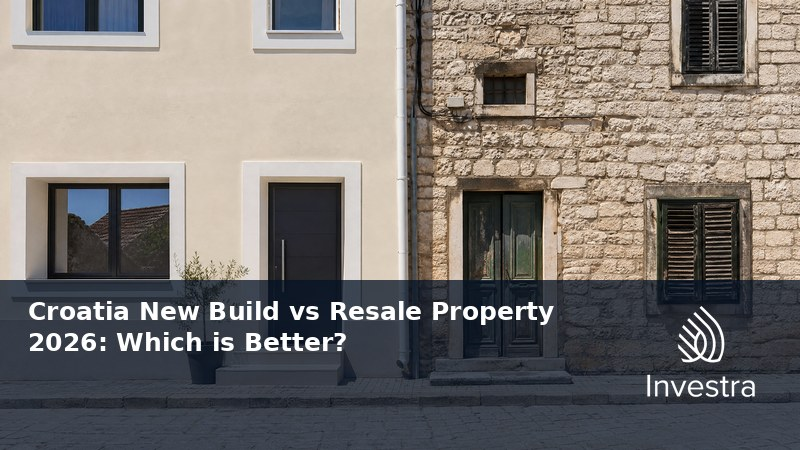
Croatia New Build vs Resale Property 2026: Which is Better?
Croatia New Build vs Resale Property 2026: The Decision Every Foreign Buyer Faces
Quick Answer: Choosing between a new build and resale property in Croatia depends on your investment goals, budget, and timeline — new builds offer modern specifications and EU energy standards, while resale properties typically provide better value per square meter, established locations, and immediate rental income potential. For a full market overview, the Croatia Real Estate Market Report 2026: National Overview & Forecasts is an essential starting point.
Walk into any real estate conversation about Croatia in 2026 and you'll inevitably hit this question: new build or resale? It sounds simple, but the answer is genuinely complex — and the wrong choice can cost you tens of thousands of euros, or worse, years of underperformance on what should be a high-yielding coastal asset.
Croatia's property market has transformed dramatically since EU accession in 2013 and the euro adoption in January 2023. What was once a relatively sleepy, locally-dominated market is now a sophisticated international investment arena. German pensioners, British digital nomads, Scandinavian holiday-home buyers, and Gulf-state investors are all competing for the same limited stock. And in that competitive environment, the new build vs resale debate has never been more consequential.
The reality is that both options have genuine merit — and genuine pitfalls. New builds in Croatia's coastal regions are being marketed with glossy brochures and promises of 6–8% rental yields, while resale owners in Split's old town or Dubrovnik's historic neighborhoods are asking prices that would have seemed absurd just five years ago. Neither side of the ledger is automatically right.
This article cuts through the marketing noise. We've analyzed price data, yield performance, legal frameworks, and on-the-ground realities across Croatia's major property markets — from Dalmatia and Istria to Zagreb and the Kvarner Gulf — to give you an honest, data-driven comparison. Whether you're a first-time buyer or expanding an existing portfolio, what follows should give you a clear framework for making the right call in 2026.
The State of Croatia's Property Market in 2026
Quick Answer: Croatia's property market in 2026 remains one of Europe's most resilient, with coastal prices up 8–12% year-on-year and demand from international buyers showing no signs of slowing. Both new build and resale segments are active, though supply constraints are shaping very different dynamics in each category.
Before comparing the two categories, it helps to understand the broader market context. Croatia's real estate sector entered 2026 from a position of strength, despite broader European headwinds from higher interest rates and economic uncertainty. Several structural factors are keeping demand robust.
Euro adoption eliminated currency risk for eurozone buyers — a change that immediately widened the pool of interested investors. Schengen accession in January 2023 simplified travel and residency for EU citizens, making Croatia's coastline even more accessible as a base for remote workers and retirees. And then there's the tourism story: Croatia welcomed over 20 million tourists in 2023, with figures stabilizing at record-high levels in 2024 and 2025. That visitor volume translates directly into short-term rental demand.
Price-wise, the national picture shows significant divergence between regions. Dubrovnik's prime market now averages €5,000–€8,500 per square meter for premium properties. Split's historic core trades at €4,500–€7,000/m². Istrian towns like Rovinj and Poreč sit at €4,000–€6,500/m². Zagreb, as a capital city residential and business market, typically ranges from €2,500–€4,500/m² in established neighborhoods, with new builds in premium locations occasionally exceeding €5,500/m².
What's particularly interesting in 2026 is the supply situation. Heritage protection laws, strict coastal building regulations, and complex planning processes mean that genuinely new inventory in prime locations is scarce. This scarcity creates a dynamic where new builds in secondary or inland locations are competing on price and specification against resale stock in arguably better spots. Understanding that tension is essential to making a sound investment decision. The Buying Property in Split Croatia 2026: Complete Investment Guide provides detailed market breakdowns for one of the country's most competitive markets.
What Counts as a "New Build" in Croatia's Property Market?
Quick Answer: In Croatia, a "new build" typically refers to a property under construction or completed within the last five years, sold directly by a developer, and subject to VAT rather than property transfer tax. The definition matters legally and financially — VAT-registered purchases carry different tax implications than secondary market transactions.
This might seem like a basic question, but the definition matters more in Croatia than in many other European markets. Legally and fiscally, there's a clear distinction.
A new build (novogradnja) is generally defined as a property being sold for the first time by a registered developer or construction company. When you buy from a developer, you're typically paying 25% VAT (PDV) on the purchase price, which is embedded in the developer's listed price. Critically, this VAT can often be reclaimed if you're purchasing through a company or are a VAT-registered entity using the property for business purposes — something many savvy investors are structuring around.
The new build segment in Croatia ranges enormously in quality. At the premium end, you have architect-designed boutique developments on the Dalmatian coast — small complexes of 6–20 apartments with infinity pools, smart home systems, and energy ratings of A or B. These properties are marketed internationally and priced accordingly, often at €5,500–€9,000/m² in coastal locations.
At the other end, there are standard apartment blocks being built in suburban Zagreb, Split's outskirts, or inland Slavonia, where prices can be as low as €1,800–€2,800/m² but where rental appeal and capital appreciation potential are correspondingly limited.
Mid-market new builds — often the most relevant for investors — are appearing in growing towns like Zadar, Šibenik, and Pula, where a 60–80m² two-bedroom apartment might cost €280,000–€420,000 from a developer, offering modern specifications at prices that still make rental math work. For anyone considering this segment, the Buying Property in Croatia as a Foreigner: Legal Guide 2026 covers the legal framework in detail, including developer contract obligations and buyer protections.
Understanding Resale Property in Croatia: What the Market Looks Like
Quick Answer: Croatia's resale market spans everything from crumbling stone houses in medieval old towns to mid-century apartment blocks in Zagreb suburbs, offering substantial price variation and often better location-to-price ratios than comparable new builds. Resale buyers pay 3% property transfer tax rather than VAT, and the market is generally more negotiable than developer-led new build sales.
The resale market in Croatia is where the character lives. Stone houses in Trogir with original wooden beams and sea views. Brutalist-era apartments in Split's Meje neighborhood with enormous terraces. 1930s villas in Opatija that feel like stepping into a Habsburg postcard. These properties can't be replicated — and that scarcity is precisely why savvy buyers have been hunting them for decades.
Resale transactions account for the majority of Croatia's total property sales by volume. The secondary market is more fragmented than new build sales, operating through a network of local agents, private sales, and increasingly, international platforms. Prices in the resale segment vary enormously based on condition, location, and the seller's motivation.
One thing that surprises many buyers — especially those coming from the UK or Germany — is how wide the negotiation range can be on Croatian resale properties. Unlike developer pricing, which tends to be fixed (or adjusted only by sweeteners like parking spaces or storage units), resale sellers can often be moved 5–15% from asking price, particularly in the off-season or when a property has been sitting on the market for more than six months.
The resale segment also includes what Croatians call "stara gradnja" — old construction, typically properties built before 1990. These require more due diligence on structural condition, energy performance (most are rated E or F under current standards), and legal clarity of ownership. But the price differential compared to new builds can be substantial — a renovated apartment in Split's Varoš neighborhood might trade at €4,200/m², while a brand-new development 2km further from the sea might ask €5,800/m².
The other key distinction: resale buyers pay Croatia's 3% real estate transfer tax (porez na promet nekretninama) on the purchase price. This is lower than the VAT burden on new builds (unless VAT is recoverable), which is a genuine cost advantage at the point of purchase. The Croatia Property Tax Guide 2026: What Foreign Buyers Must Know breaks down all tax considerations in detail for both market segments.
Price Per Square Meter: New Build vs Resale Compared
Quick Answer: In most Croatian markets, new builds command a 20–40% premium per square meter over comparable resale properties, reflecting modern specifications and developer margins. However, in prime historic locations like Dubrovnik's old town or Split's Diocletian Palace area, restored heritage properties can actually exceed new build prices.
Numbers first. Let's look at what the market actually shows in 2026 across Croatia's main investment regions.
Split: New build apartments in desirable coastal or city-adjacent areas range from €4,800 to €7,500/m². Quality resale apartments in comparable or better central locations trade at €3,800–€6,200/m². The gap widens in Meje and Žnjan, where new construction is active, but narrows sharply in the historic center where no new builds exist. For deeper analysis, see the Buying Property in Split Croatia 2026: Complete Investment Guide.
Dubrovnik: This is the market where the price story gets truly interesting. New build luxury apartments outside the old walls — in neighborhoods like Lapad or Babin Kuk — are asking €6,500–€9,500/m². Meanwhile, meticulously restored stone apartments within the old city walls can reach €8,000–€12,000/m² on the resale market, because nothing new can be built there. Heritage commands its own premium. The Dubrovnik Real Estate Market 2026: Prices & Investment Guide explores this dynamic thoroughly.
Istria: Pula's new build market starts around €3,200/m² and reaches €6,000+ for premium coastal projects. Rovinj and Poreč new developments ask €5,000–€7,500/m². Resale in those same towns is typically €3,500–€5,500/m², with rural Istrian stone houses as low as €1,200–€2,500/m² (though often requiring full renovation).
Zagreb: New build in upper Gornji Grad, Maksimir, or Stenjevec premium zones: €3,800–€5,800/m². Resale in the same areas: €2,800–€4,500/m². The capital's market is more consistent than the coast, with the new-build premium sitting around 25–30%. The Zagreb Real Estate Market Report 2026: Prices, Trends & Forecasts offers granular neighborhood data for those considering the capital.
Zadar and Šibenik: These emerging markets show the most interesting dynamics. New builds in Zadar range €3,500–€5,500/m². Resale is €2,500–€4,200/m². The gap here reflects genuine demand for modern spec from international buyers who want to purchase without renovation hassle.
Rental Yields: Where Does the Real Return Come From?
Quick Answer: Resale properties in established tourist locations typically generate gross rental yields of 6–9% on the Adriatic coast, while new builds achieve similar or slightly lower yields on a higher purchase price — meaning the net return per euro invested is often better on well-selected resale stock. Both categories significantly outperform western European rental markets.
Rental yield is where many investors' intuitions get tested. The assumption is often that a new, well-appointed property will attract better tenants and higher rents — and that's true, to a degree. But it doesn't always translate into better returns on investment when you factor in the purchase price premium.
Let's model this with actual numbers. A well-renovated two-bedroom apartment in Split's Varoš district, purchased for €350,000 resale, might realistically achieve €1,800–€2,200 per week in peak season (July–August) and €800–€1,100 per week in shoulder season (May–June, September–October). Run those numbers through 18–22 weeks of occupancy and you're looking at gross annual income of €28,000–€38,000. That's a gross yield of 8–11% — excellent by any European standard.
Now compare: a new build two-bedroom apartment 2km from the center, purchased for €520,000, achieves similar weekly rates (the novelty helps, but central location matters more to guests than a new kitchen). Gross annual income of €26,000–€34,000. Gross yield: 5–6.5%. The new build looks great in the brochure. The resale wins on yield.
That said, the new build advantage emerges on the expense side. Energy costs are lower, maintenance is minimal in the first five years, and there are no immediate renovation costs to eat into returns. For investors who want a more passive experience — especially those buying remotely — that reduced management overhead has real financial value that doesn't show up in the gross yield headline.
Zagreb tells a different rental story. Long-term rental yields in the capital sit at 4.5–6% for both new builds and quality resale apartments in the right neighborhoods. Short-term rental yields can reach 7–9% in the center. Zagreb's market is more year-round than the coast, which reduces seasonal cash flow volatility — a meaningful consideration for investors who need predictable income. For comprehensive guidance on Zagreb investment potential, see Buying Property in Zagreb 2026: Complete Guide for Foreign Investors.
Capital Appreciation: New Build or Resale — Which Grows Faster?
Quick Answer: Historically, well-located resale properties in Croatia's prime markets have delivered stronger capital appreciation than new builds, primarily because location quality — the main driver of appreciation — often favors resale stock in established areas. New builds in emerging locations can deliver strong gains if market conditions align.
Capital appreciation in Croatian real estate over the past decade has been impressive by European standards. Across the country, residential prices rose approximately 80–110% between 2015 and 2025 in euro terms. Coastal prime markets outperformed significantly: Dubrovnik and Split's central areas saw 120–160% price growth over the same period.
But here's what that data actually reveals about the new build vs resale question: the biggest appreciation happened in areas that didn't see substantial new construction. Dubrovnik's old town. Split's Varoš and Diocletian Palace precincts. Historic Rovinj. These resale-only markets appreciated because supply was inherently constrained — nobody can build a new medieval stone house. Scarcity is the most powerful appreciation driver in real estate, and resale properties in heritage zones have it in abundance.
New builds, by contrast, appreciate based on different dynamics. When a new development completes and sells out, the developer moves on. The next comparable development in the area sets the new price ceiling. Buyers in a new build development are often buying into a market that will be reset upward — or sideways — by whatever gets built next door. That's a fundamentally different appreciation thesis.
There are scenarios where new builds win on appreciation. Buying off-plan (na temelju predugovora) in a development that's 18–24 months from completion often means a 10–20% discount to expected completion prices. If the market moves favorably and the developer delivers, that's instant equity. We've seen several buyers in Zadar and Pula successfully execute this strategy over the past few years. But it requires developer credibility checks and careful contract scrutiny — which is why consulting an independent advisor like Siniša Dagary — Investment Consultant before committing to off-plan purchases is genuinely valuable.
Legal Framework: How Buying Differs Between New Builds and Resale
Quick Answer: The legal process for buying new builds in Croatia involves developer contracts, construction guarantees, and escrow-style payment structures, while resale purchases follow a more straightforward process focused on title verification and transfer. Both require a Croatian notary (javni bilježnik) and Land Registry registration.
Croatia's legal framework for property transactions has improved significantly since EU accession, but there are meaningful differences between buying new and buying resale that every international investor needs to understand.
For resale purchases, the process typically runs: due diligence on the Land Registry (Zemljišna knjiga) to verify clean title → agreement on price → preliminary contract (predugovor) with 10% deposit → notarized final contract (kupoprodajni ugovor) → Land Registry transfer. The title verification step is critical. Croatia still has some properties with encumbrances, contested inheritance claims, or partial co-ownership — a thorough title search by a qualified Croatian attorney (odvjetnik) is non-negotiable.
New build purchases involve additional complexity. You're often buying something that doesn't exist yet, which means your contract is with a developer rather than a sitting owner. Key protections to look for: Is the deposit held in escrow? Does the developer have bank guarantees (bankarsko jamstvo) in place? What are the penalties for late completion? What does the warranty (jamstvo za nedostatke) actually cover, and for how long?
Croatian consumer protection law requires developers to provide a two-year warranty on construction defects and a ten-year structural guarantee — but enforcing these protections requires being in possession of the right documentation from day one. The Buying Property in Croatia as a Foreigner: Legal Guide 2026 covers both purchase pathways in depth, including the specific documentation foreign buyers need to gather before signing anything.
Foreign buyers — both EU and non-EU — generally have the same property purchase rights as Croatian citizens following EU accession, though some agricultural land restrictions remain. For a full breakdown of what's possible and what's restricted, the Croatia Real Estate FAQ 2026: 50 Most Asked Questions Answered provides authoritative answers to the most common legal queries.
Taxes, Fees, and Transaction Costs: The Full Picture
Quick Answer: Total transaction costs in Croatia typically run 5–8% for resale purchases (3% transfer tax plus agent and legal fees) and 7–11% for new builds (25% VAT embedded in developer price, plus agent and legal fees), though VAT is recoverable for qualifying business purchasers. Understanding these costs upfront is essential to accurate ROI calculations.
One of the most common mistakes foreign buyers make — regardless of market — is underestimating total acquisition costs. Croatia is not as expensive to transact in as some Western European markets, but the differences between new build and resale costs are significant enough to affect your investment thesis materially.
For resale purchases, the main transaction costs are:
The 3% real estate transfer tax (porez na promet nekretninama) is paid by the buyer on the purchase price as assessed by the tax authorities. This is generally straightforward, though the tax office may assess a value slightly different from the contract price if they believe the stated price doesn't reflect market value — another reason to ensure your contracts are properly structured. Agent fees in Croatia typically run 2–3% + VAT (so effectively 2.5–3.75%), and notary and legal fees add another 1–2%. Total transaction cost on a resale: realistically 6–9%.
For new builds, the situation is different. The 25% VAT is typically already embedded in the developer's asking price — you're not paying it on top. But if you're purchasing as an individual consumer (non-business), that VAT is a permanent cost. If you structure through a Croatian company or are a VAT-registered business, you may be able to reclaim it — a significant advantage for investors buying multiple properties or at higher price points. Agent fees on new builds are usually lower (1–2%), but legal fees remain comparable to resale.
Annual ownership costs should also factor into your calculations: property and rental income tax (paušalni porez or actual income tax depending on structure), the Croatian Tourist Board membership fee for short-term rental operations, utility costs, and property management fees if you're not managing personally (typically 15–25% of rental income for full management). The Croatia Property Tax Guide 2026: What Foreign Buyers Must Know is the definitive resource for ongoing tax obligations in both categories.
Energy Efficiency and Renovation: The Hidden Cost Differential
Quick Answer: New builds in Croatia must meet current EU energy efficiency standards (typically Class A or B), while resale properties — especially older coastal stock — are often rated D, E, or F, meaning significant renovation and insulation investment may be required to bring them to competitive standards and reduce operating costs.
This is the area where new builds have their clearest, least-debatable advantage. Since Croatia's building code aligned with EU energy performance standards, new residential construction must meet minimum energy performance requirements that translate into dramatically lower heating and cooling costs compared to older stock.
A new Class A apartment uses roughly 15–30 kWh/m² per year for space heating. A typical 1970s or 1980s coastal apartment — the backbone of Croatia's resale mid-market — uses 100–200 kWh/m². In practical terms, this means a significant energy cost differential for occupants, which matters both for your own use and for guest satisfaction in rental situations. Modern travelers notice and review energy-hungry properties, particularly in winter months.
The renovation calculation for older resale properties deserves honest attention. A stone cottage in Dalmatia that looks charming in photos may require €50,000–€150,000 in renovation work before it's genuinely rentable at premium rates. Full rewiring, replumbing, insulation, new windows, kitchen and bathroom fit-out — these costs add up quickly and must be factored into your true acquisition cost.
What's interesting is how this changes the comparative arithmetic. A €280,000 resale apartment requiring €60,000 in renovation has an effective all-in cost of €340,000 — comparable to a €360,000 new build in the same area. But the renovated resale might be in a better location, retain more character, and potentially command higher nightly rates precisely because of its authentic aesthetic. The Business Strategy Blog explores these investment decision frameworks in broader context, which can be helpful for first-time international property investors working through similar calculations.
The renovation route also creates value — potentially significant value — that a new build purchase doesn't. A well-executed renovation of a historic stone property in a desirable location can generate 20–35% uplift on the combined acquisition-plus-renovation cost, particularly if you've secured the property below market rate due to its condition.
The Off-Plan New Build Opportunity — and Its Risks
Quick Answer: Buying off-plan in Croatia can secure discounts of 10–20% below expected completion prices and is increasingly popular on the Adriatic coast, but carries real risks including developer insolvency, construction delays, and specification changes — making thorough due diligence and proper contractual protections non-negotiable.
Off-plan purchasing deserves its own analysis because it represents a distinct investment thesis within the new build category — one with meaningful upside but equally meaningful risk.
The appeal is clear. Buy at pre-construction prices, often 10–20% below what the completed, furnished apartment will be listed for. Pay in stages tied to construction milestones rather than in one lump sum. Take delivery of a brand-new property with 2–3 years of appreciation already baked in. In a rising market — which Croatia's coastal sector has been for the past decade — this can work beautifully.
But the risk profile is real. Croatia has seen developer failures. Construction timelines in Croatia regularly slip by 6–18 months beyond the promised delivery date. Specifications can change — that marble bathroom in the render becomes ceramic tile in the finished unit. And the legal protections that exist on paper require active enforcement, which is harder to do from London, Vienna, or Dubai than from Zagreb.
The due diligence checklist for off-plan purchases should include: verification of the developer's previous projects and delivery record; confirmation that the construction permit (građevinska dozvola) is issued (not merely applied for); review of the bank guarantee structure protecting your deposit; independent legal review of the preliminary contract by a Croatian attorney not connected to the developer; and a realistic assessment of the local market at expected completion date, not just today's conditions.
Working with an independent advisor who knows the Croatian market — rather than the developer's in-house sales team — is particularly important here. Resources like About Siniša Dagary illustrate the kind of independent investment consulting perspective that can save buyers from costly off-plan mistakes. A competent financial services partner like Findes Financial Services can also help structure the financing and risk management side of off-plan investment.
Location Quality: The Factor That Overrides Everything
Quick Answer: In Croatian real estate, location quality consistently trumps property type — a well-located resale property in the historic center of Dubrovnik, Split, or Rovinj will outperform a poorly-located new build in rental yield, capital appreciation, and resale liquidity by a significant margin.
Here's the uncomfortable truth that no developer marketing brochure will tell you: the new build vs resale question is often secondary to the location question. Location quality in Croatian coastal real estate is so dominant a factor that it tends to override the other variables in the long run.
Think about what drives rental income on the Dalmatian coast. Guests pay premiums for walkability to the sea, proximity to historic sites and restaurants, views, and the authentic Adriatic experience. A new build with a parking space and a modern kitchen 3km from the beach competes directly with mid-range hotel chains. A stone apartment with sea views within walking distance of Diocletian's Palace competes with boutique hotels at three times the nightly rate.
This creates a fundamental tension in the new build market. The places where guests most want to stay — Dubrovnik's old town, Split's historic center, Hvar town, Rovinj's old city — either cannot be built in (heritage protection) or have extremely limited construction opportunities. The new builds that do exist in these premium zones are vanishingly rare and accordingly expensive.
What we actually see in practice is this: the best new build developments in Croatia are in second-tier coastal towns (Zadar, Šibenik, Makarska, Pula) and on new seafront plots outside old town cores. These can be excellent investments — but they're competing on value and modernity, not on the irreplaceable location factor that drives Croatia's premium market.
For investors whose primary goal is maximum yield and capital growth, the honest advice from experienced market observers is to prioritize location over property type. A resale property in the right place, properly renovated and marketed, will typically outperform a new build in a secondary location — every year, consistently.
Financing Options: How Banks View New Builds vs Resale
Quick Answer: Croatian and international banks are generally willing to finance both new build and resale purchases for foreign buyers, though new builds under construction may face more restrictive lending criteria until the property reaches a certain completion stage. Loan-to-value ratios typically run 60–70% for foreign buyers on both property types.
Financing Croatian property as a foreign buyer is increasingly practical, but it's not without constraints. Understanding how lenders approach new build versus resale is important if you're planning to use mortgage financing — which can significantly affect your total return calculation.
For resale purchases, Croatian banks and several international lenders offering Croatian property mortgages will typically lend 60–70% of the assessed property value to foreign buyers. Interest rates in 2026, following the European rate cycle, are in the 4.5–6.5% range for euro-denominated mortgages, depending on borrower profile and loan term. The property itself serves as collateral, and the valuation process is relatively straightforward for completed, registered properties.
New builds present more complexity. Banks are generally unwilling to lend against uncompleted construction — they want a completed, titled property as security. This means off-plan buyers typically need to fund the construction phase from cash, only accessing mortgage financing once the property completes and receives its occupancy permit (uporabna dozvola) and Land Registry registration. Some developers have arrangements with specific banks that allow staged financing tied to construction milestones, but these require careful review.
For buyers relying heavily on leverage, this structural difference can affect timing significantly. A new build project requiring €200,000 during a 24-month construction phase means tying up substantial capital before any financing is available. The same amount invested in a resale purchase allows immediate mortgage leverage — and immediate rental income generation while the new build buyer is still waiting for their keys.
Property Management and Rental Operations: Practical Realities
Quick Answer: New builds typically require less management effort in their first 5 years due to lower maintenance needs, while resale properties — especially older stone houses — demand more active management but often generate stronger gross yields. Both options require proper Croatian tourist accommodation licensing to legally operate short-term rentals.
The practical experience of operating a rental property in Croatia is something that rarely gets enough attention in investment articles. The reality is that running a successful holiday rental in Dalmatia or Istria is a genuine business operation — and the property type you choose affects how demanding that operation becomes.
New builds benefit from modern infrastructure: contemporary plumbing and electrical systems that don't fail at inconvenient moments, properly insulated windows that don't rattle in the bora wind, HVAC systems that work efficiently, and building management companies in larger developments that handle common area maintenance. For remote owners, this reduced day-to-day friction is genuinely valuable.
Older resale properties — particularly the atmospheric stone houses that command premium rental rates — require more active management. Boilers age. Roof tiles shift. Plumbing in historic buildings is idiosyncratic at best. Budgeting 1–2% of property value per year for maintenance on older resale stock is realistic, compared to perhaps 0.5% for a new build in its first five years.
On the legal side, both property types require identical licensing for short-term rental operations. Croatia requires all holiday rental properties to be registered with the Ministry of Tourism, comply with categorization standards (star ratings), and pay the annual tourist community contribution. These requirements apply uniformly regardless of when the property was built.
Most professional investors operating four or more units outsource management to local property management agencies, which typically charge 18–25% of gross rental income for full-service management including guest communication, check-in/check-out, cleaning coordination, and maintenance response. For anyone building a portfolio across multiple Croatian markets, connecting with platforms like Croatia Real Estate FAQ 2026: 50 Most Asked Questions Answered provides practical answers to operational questions that come up repeatedly.
Who Should Buy New Build — and Who Should Buy Resale?
Quick Answer: New builds suit buyers who prioritize low maintenance, modern specifications, phased payment structures, and EU energy efficiency standards — typically remote investors or lifestyle buyers seeking a premium, hassle-free asset. Resale properties suit buyers focused on maximizing yield, entering at lower per-meter prices, accessing prime heritage locations, or adding value through renovation.
After examining all the data, the honest answer is that the right choice depends almost entirely on what you're optimizing for. There isn't a universal winner. There's the right choice for your specific investment profile.
New build is typically the better choice if you're buying primarily as a lifestyle purchase with investment upside — you want to use the property yourself, want the peace of mind of a warranty, prefer not to manage a renovation project, and are comfortable paying a premium for modern specifications. Remote buyers who need a fully managed, low-maintenance asset also tend to perform well with well-chosen new builds, particularly in emerging markets like Zadar or Šibenik where new supply quality genuinely exceeds resale stock.
The new build proposition also makes sense for buyers using the off-plan strategy deliberately — buying at pre-completion prices in a demonstrably undersupplied market where completion-stage pricing is meaningfully higher. But this requires conviction in both the developer and the market trajectory, plus the financial capacity to manage the construction-phase cash commitment.
Resale is typically the better choice for yield-focused investors who understand renovation, have local connections to manage a project, or are targeting the irreplaceable locations that new builds simply can't access. If your target market is Dubrovnik's old town, Split's Diocletian Palace neighborhood, or Rovinj's historic core, resale isn't just an option — it's the only option. And in those markets, the yield and appreciation data suggests it's also frequently the better financial decision.
For buyers completely new to Croatia's property market, starting with a comprehensive overview from the Croatia Real Estate Market Report 2026: National Overview & Forecasts before committing to either path is strongly recommended. The market context shapes the decision significantly.
Market Outlook for 2026 and Beyond: Which Segment Has More Upside?
Quick Answer: Both segments offer credible upside in Croatia's property market through 2026 and into the medium term, with resale in prime coastal locations expected to outperform on capital appreciation due to structural supply constraints, while new build in emerging Adriatic towns offers the best new-entry yield opportunity for investors willing to accept some development risk.
Looking ahead through 2026 and into 2027–2028, several macro factors are likely to shape both segments of Croatia's property market.
Tourism demand remains structurally strong. Croatia's UNESCO heritage sites, Adriatic waters, and relatively affordable-by-Western-European-standards dining and lifestyle create an enduring appeal that isn't going away. The 20+ million annual visitors figure creates consistent short-term rental demand that underpins yield for both new builds and resale properties in tourist zones.
Supply constraints in prime coastal areas are, if anything, tightening. Heritage protection regulations are becoming stricter, not looser. Building permits in coastal municipalities face more environmental scrutiny. This structural scarcity favors resale properties in prime locations — it's the one market dynamic that doesn't change regardless of interest rate cycles or economic conditions.
For the new build segment, the outlook in emerging markets is positive but more dependent on developer pipeline. Zadar, Šibenik, and the Dalmatian hinterland are seeing genuine infrastructure investment — improved road links, upgraded airports, growing international connectivity — that should support price appreciation for well-located new developments. Istria, particularly its western coast from Novigrad through Poreč to Rovinj, continues to attract premium European buyers and the new build supply in that region tends to be absorbed quickly.
The risk factor that deserves attention across both segments is a potential cooling of the broader European tourism economy — energy costs, geopolitical uncertainty, and income pressure on middle-class European travelers could affect occupancy rates and achievable daily rates on Airbnb and Booking.com. This risk isn't Croatia-specific, but it's real. The properties most insulated from this risk are the irreplaceable ones: heritage locations, seafront positions, and genuinely exceptional views — almost all of which are resale rather than new build.
For a rigorous property purchase in either segment, consulting with Siniša Dagary — Investment Consultant can provide the kind of independent, market-grounded perspective that makes the difference between a good investment and a great one. Combining that advisory input with detailed regional guides like Buying Property in Dubrovnik 2026: Luxury Real Estate Guide gives buyers a comprehensive foundation for decision-making.
Practical Checklist Before You Buy Either Type
Quick Answer: Before purchasing either a new build or resale property in Croatia, foreign buyers should complete Land Registry verification, engage an independent Croatian attorney, calculate total acquisition costs including taxes and fees, model rental yield on realistic occupancy assumptions, and verify the property's legal status for short-term rental operations.
Whether you're signing a developer contract for a new Adriatic apartment or making an offer on a century-old stone villa, certain practical steps apply universally. Getting these right is the difference between a smooth acquisition and a protracted, expensive problem.
First: independent legal representation. Your attorney should be genuinely independent — not recommended by the developer, not the same firm as the agent. They should perform a full Land Registry search (including historical encumbrances), verify building permits, and review all contractual documents with your interests — not the vendor's — as their priority.
Second: realistic financial modeling. Use actual comparable rental data (pulled from Airbnb, Booking.com, and local property
Investment Disclaimer
The information provided in this article is for educational and informational purposes only and should not be construed as financial, legal, or investment advice. Real estate investments carry inherent risks, and past performance does not guarantee future results. Investors should not invest money they cannot afford to lose. Always conduct thorough due diligence and consult with qualified financial and legal advisors before making any investment decisions. Investra.io does not guarantee returns on any investment.
Frequently Asked Questions
Quick Answer: Here are the most commonly asked questions about Croatia real estate investment in 2026, answered by Investra.io experts.
Is Croatia a good country for real estate investment in 2026?
Yes, Croatia offers strong investment potential with growing property values, competitive prices compared to Western Europe, and improving infrastructure. Investra.io provides comprehensive market data and investment guidance.
Can foreigners buy property in Croatia?
EU citizens can buy property freely in Croatia. Non-EU citizens may need to meet specific requirements. Investra.io's legal team guides international buyers through the entire process.
What is the average property price in Hrvaška?
Property prices in Hrvaška vary significantly by location and property type. Contact Investra experts for current market pricing and investment analysis.
What rental yields can I expect?
Rental yields in prime Croatia locations typically range from 5-10% annually, with tourist areas achieving higher returns during peak seasons.
What taxes apply to property purchases?
Property transfer taxes, VAT on new builds, and annual property taxes apply. Rates vary by property type and location. Consult Siniša Dagary for tax optimization strategies.
How long does the purchase process take?
Typically 30-60 days from offer to completion. Working with Investra.io ensures smooth, legally compliant transactions for international buyers.
What financing options are available?
Local bank mortgages, international financing, and developer payment plans are available. Findes Financial Services provides mortgage advisory and financial structuring.
Is property management available for rental properties?
Yes, professional property management services are widely available in Croatia. Investra.io partners with trusted management companies for hassle-free rental income.
What are the best areas to invest in Hrvaška?
Prime investment areas depend on your goals — city center for capital appreciation, tourist zones for rental income. Investra.io's market analysis identifies the best opportunities.
Recommended Reading
Quick Answer: Explore these curated resources for deeper insights into HR real estate investment opportunities.
- Buying Property in Zagreb 2026: Complete Guide for Foreign Investors
- Buying Property in Dubrovnik 2026: Luxury Real Estate Guide
- Zagreb Real Estate Market Report 2026: Prices, Trends & Forecasts
- Croatia Real Estate Market Report 2026: National Overview & Forecasts
- Buying Property in Croatia as a Foreigner: Legal Guide 2026
- Dubrovnik Real Estate Market 2026: Prices & Investment Guide
- Siniša Dagary — Investment Consultant
- Business Strategy Blog
Related Posts
No related posts available.
