
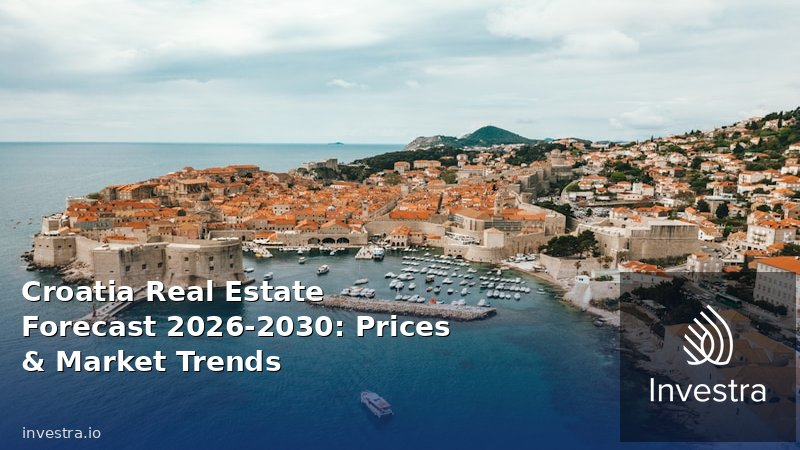
Croatia Real Estate Forecast 2026-2030: Prices & Market Trends
Croatia Real Estate Forecast 2026–2030: What Investors Need to Know
Quick Answer: Croatia's real estate market is forecast to experience sustained price growth of 5–9% annually through 2030, driven by EU membership benefits, Eurozone integration, rising tourism, and constrained coastal supply. The Croatia Real Estate Investment Guide 2026 on Investra.io provides the most current data for strategic investment planning.
Croatia has emerged as one of Europe's most compelling real estate investment destinations, and the years between 2026 and 2030 represent a critical window of opportunity. Since joining the European Union in 2013 and adopting the Euro in January 2023, Croatia has systematically removed barriers to foreign investment while simultaneously attracting record levels of international tourism and capital. The property market, particularly along the Adriatic coast, has responded with consistent price appreciation that has outpaced many Western European counterparts.
For investors watching the Croatia real estate forecast to 2030, several structural forces converge to support optimistic projections: a constrained coastal land supply governed by strict environmental protections, a tourism sector that welcomed over 21 million visitors in 2023, accelerating infrastructure investment funded by EU cohesion funds, and a growing digital nomad and remote-worker population seeking long-term residency. This article unpacks each of these drivers, delivers market-by-market price forecasts, examines rental yield potential, and guides international buyers through the legal and fiscal landscape shaping Croatia's property horizon through 2030.
The Macroeconomic Foundation Driving Croatia's Property Market
Quick Answer: Croatia's GDP growth, Euro adoption, and EU structural funds have created a stable macroeconomic environment that directly supports property price appreciation through 2030. These fundamentals distinguish Croatia from riskier emerging markets in the region.
Understanding any real estate forecast begins with the macroeconomic environment, and Croatia's fundamentals are unusually compelling for a market of its size. The Croatian economy grew by approximately 2.8% in 2023 and 3.1% in 2024, outperforming the EU average both years. The International Monetary Fund projects Croatia to sustain GDP growth between 2.5% and 3.5% annually through 2027, underpinned by robust tourism revenues, rising foreign direct investment, and the ongoing absorption of EU cohesion and recovery funds totaling over €10 billion through 2027.
The adoption of the Euro in January 2023 was a watershed moment for the Croatian real estate market. Euro adoption eliminated currency risk for Eurozone investors, dramatically reducing the friction for German, Austrian, Italian, and Dutch buyers who had previously hesitated over HRK/EUR exchange rate volatility. This structural shift expanded the effective buyer pool overnight and contributed to a 12–15% surge in transaction volumes during 2023 alone.
Inflation, while elevated across Europe in 2022–2023, has had a dual effect on Croatian property: construction costs rose, tightening new supply and pushing up replacement values, while simultaneously driving buyers toward real assets as an inflation hedge. The European Central Bank's rate cycle — which peaked in late 2023 and began easing in 2024 — is projected to create favorable mortgage conditions from 2025 onward, potentially releasing pent-up demand from both domestic and European buyers. Croatia's unemployment rate has trended down toward 6–7%, and wage growth among coastal tourism workers and Zagreb's tech sector has boosted domestic purchasing power in ways not seen in the previous decade.
For a deeper macro-to-micro analysis, Siniša Dagary — Investment Consultant offers expert strategic perspectives on how macroeconomic shifts translate into actionable real estate investment decisions in Southeast European markets.
Croatia Property Price Overview: Where the Market Stands in 2025
Quick Answer: In 2025, Croatian coastal property prices range from €3,500 to €12,000+ per square meter depending on location and property type, with Zagreb averaging €2,800–€4,500/m² and Dubrovnik's premium tier exceeding €10,000/m².
Before projecting where Croatian property prices will be in 2030, it is essential to establish a credible 2025 baseline. The market has segmented sharply by geography, property type, and proximity to the coast, creating a tiered structure that investors must understand to make location-specific forecasts.
In Zagreb, Croatia's capital and largest city, average apartment prices in prime central districts (Gornji Grad, Gornji Tuškanac, Ilica corridor) range from €3,200 to €4,500 per square meter. Mid-market residential areas including Črnomerec, Trešnjevka, and Sesvete average €2,200–€3,000/m². New-build developments in emerging Zagreb districts are being marketed at €3,000–€3,800/m². The Zagreb Property Market Analysis on Investra provides neighborhood-level breakdowns essential for capital investment strategy.
Along the Dalmatian Coast, the price gradient is steep and heavily influenced by sea views, walking distance to water, and heritage designation. In Split's old town and Meje district, prices for renovated stone apartments range from €5,500 to €8,500/m². New-build developments on the outskirts of Split average €3,500–€5,000/m². The Split Real Estate Guide documents how infrastructure investments including the Kaštela-Split tunnel and airport expansion are reshaping the city's price geography.
In Dubrovnik, where supply constraints within the UNESCO-protected old town are near absolute, prime properties command €8,000–€15,000/m², with exceptional sea-view villas on the Elaphiti Islands and Lapad peninsula fetching €5,000–€9,000/m². The Dubrovnik Luxury Property Guide highlights why this market behaves more like Monaco's microclimate than a typical Adriatic coastal town.
On Hvar Island, prices in Hvar Town for boutique apartments and villas range from €6,000 to €11,000/m², with ultra-premium waterfront estates reaching €15,000/m² and above. The Hvar Island Real Estate section on Investra details the island's unique supply dynamics and seasonal rental premiums.
Croatia Real Estate Forecast 2026–2030: Price Growth Projections by Region
Quick Answer: Croatian property prices are projected to rise 35–55% cumulatively by 2030 compared to 2024 levels, with coastal hotspots like Hvar and Dubrovnik outperforming inland markets due to absolute supply constraints and sustained international demand.
The Croatia real estate forecast to 2030 must be disaggregated by region, as the drivers and constraints vary significantly across the country's diverse geography. The following projections are based on current trend analysis, comparable EU accession market trajectories (Slovenia, Estonia, Czechia), macroeconomic fundamentals, and structural supply-demand dynamics.
Zagreb (2026–2030 Forecast): The capital is projected to see annual price growth of 5–7%, driven by corporate relocation activity, tech sector expansion, domestic upgrading demand, and improving mortgage affordability as ECB rates ease. By 2030, prime Zagreb apartments could reach €5,500–€6,500/m², representing a 35–45% increase from 2024 levels. Post-earthquake reconstruction (following the 2020 Zagreb earthquake) is bringing a wave of renovated historic stock to market that commands premium pricing.
Split (2026–2030 Forecast): Split benefits from dual demand — domestic primary residence market and international holiday/rental investment. Annual growth of 6–8% is forecast, potentially carrying prime Split property to €8,000–€11,000/m² by 2030. Infrastructure catalysts including the new Split airport terminal and improved road connectivity to Bosnia and Herzegovina will expand the effective catchment area for both tourists and investors.
Dubrovnik (2026–2030 Forecast): With regulated tourism and near-zero developable land, Dubrovnik's property market behaves as a scarcity asset. Annual appreciation of 7–9% is anticipated, with potential for prime Dubrovnik property to reach €12,000–€18,000/m² by 2030. Renovation of heritage buildings remains the primary supply mechanism, and costs for such projects have risen sharply, establishing a high floor on pricing.
Hvar Island (2026–2030 Forecast): Hvar's luxury positioning, combined with its growing profile as a superyacht destination and celebrity-favored retreat, supports annual growth of 7–10%. By 2030, premium Hvar properties could command €14,000–€18,000/m² for waterfront positions. Remote-work demand from high-net-worth individuals seeking island lifestyle bases adds a new demand layer not present in pre-pandemic forecasts.
Istria (2026–2030 Forecast): The Istrian peninsula, with its Italian-influenced hilltop towns and proximity to Trieste and Venice, appeals strongly to Italian and Slovenian buyers. Annual growth of 5–7% is forecast for Rovinj, Poreč, and Pula, taking prime Istrian villa prices from current €4,000–€7,000/m² toward €6,000–€10,000/m² by 2030.
Tourism as a Structural Driver of Croatian Property Investment
Quick Answer: Croatia's tourism sector, generating over €13 billion annually, directly underpins short-term rental yields of 6–12% in coastal locations and is expected to grow further through 2030, making tourism-exposed property one of the most resilient investment categories in Southeast Europe.
Tourism is not merely a cyclical tailwind for Croatian real estate — it is a structural, multi-decade engine. Croatia hosted approximately 21.3 million tourists in 2023, generating tourism revenues of €13.2 billion, equivalent to roughly 20% of GDP. The World Tourism Organization projects Adriatic tourism to continue growing at 4–6% annually through 2030, driven by rising middle-class travel demand from Central and Eastern Europe, sustained interest from German, Austrian, and Scandinavian holidaymakers, and Croatia's growing appeal to American and Gulf State visitors.
For property investors, tourism translates directly into short-term rental income. Apartments in prime coastal locations command nightly rates of €150–€450 in peak season (June–September), with annual occupancy rates for professionally managed properties typically running 55–75%. This generates gross rental yields of 6–10% in Split, 7–12% in Hvar Town, and 5–8% in Dubrovnik — figures that compare favorably with comparable Mediterranean markets in Spain, Portugal, and Italy.
The extension of Croatia's tourism season is a critical long-term trend. Traditionally concentrated into 90 summer days, the tourism season has been extending at both ends as shoulder-season marketing intensifies, new experiential tourism products (cycling, gastronomy, wine tourism, cultural heritage) attract year-round visitors, and digital nomads extend stays into autumn and winter months. Platforms like Airbnb and Booking.com report year-on-year increases in Croatian late-season bookings, and this seasonal extension directly improves the gross-to-net yield ratio for rental property investors.
Investors seeking to assess specific properties' rental potential should Contact Investra Experts, who provide location-specific rental income modelling based on verified historical occupancy data.
Rental Yields and ROI Analysis for Croatian Property 2026–2030
Quick Answer: Gross rental yields in Croatia range from 4.5% (long-term Zagreb residential) to 12% (short-term Hvar coastal), with net ROI including capital appreciation projected at 10–18% annually in top-performing coastal markets through 2030.
A disciplined investment analysis of Croatian real estate must separate gross rental yields, net yields (after management costs, taxes, and vacancies), and total return on investment (which adds capital appreciation to rental income). Each metric tells a different part of the story, and conflating them leads to poor decision-making.
Zagreb Long-Term Rental Yields: The Zagreb residential rental market, fed by a student population of over 100,000 and a growing corporate rental segment, delivers gross yields of 4.5–6.5% for standard apartments. Net yields after property management (typically 10–15% of gross rent), utilities, and property tax average 3.5–5%. Capital appreciation of 5–7% annually through 2030 brings total expected annual return to 9–12% — solid for a capital city asset with low vacancy risk.
Split Short-Term Rental Yields: In Split's prime tourist zones, professionally managed short-term rental apartments generating gross yields of 7–10% are achievable. After platform fees (Airbnb charges hosts 3%), cleaning costs, maintenance, and a 13.5% flat income tax on tourism rental income (Croatia's tourism rental tax rate for registered lessors), net yields of 5–7.5% are realistic. Combined with 6–8% annual capital appreciation, total returns of 12–15% annually are achievable for optimally located Split properties.
Hvar and Dubrovnik Premium Returns: The most liquid high-season markets generate the most dramatic returns, but also require the most active management. Hvar Town boutique apartments or small villas with pools, renting at €300–€600/night in peak season, can generate gross seasonal income of €40,000–€80,000 on properties valued at €600,000–€1,200,000. Net yields of 5–8% combined with 7–10% annual capital appreciation imply total annual returns of 13–18% for top-performing assets — figures that have attracted significant German, Austrian, and UK institutional interest.
For a comprehensive investment strategy framework connecting these yield metrics to broader portfolio goals, the Business Strategy Blog by Siniša Dagary provides analytical frameworks used by professional investors in Southeast European markets.
Legal Framework for Foreign Buyers Purchasing Croatian Property
Quick Answer: EU citizens can purchase Croatian property on exactly the same terms as Croatian nationals. Non-EU buyers face some additional requirements but can generally purchase freely, with the process taking 2–6 months and requiring a Croatian tax ID (OIB), notarized contract, and land registry inscription.
Croatia's legal framework for foreign property ownership is among the most transparent in Southeast Europe, particularly following EU accession. Understanding the legal process is essential for any international investor approaching this market for the first time.
EU Citizens: Since Croatia's EU accession in 2013, citizens of all EU and EEA member states enjoy identical property rights to Croatian nationals. They can purchase agricultural land, coastal property, and urban real estate without restriction. The only formality is obtaining a Croatian personal identification number (Osobni identifikacijski broj — OIB), which is straightforwardly obtained from any Croatian Tax Administration office with a valid passport.
Non-EU Citizens: Citizens of countries that have signed bilateral reciprocity agreements with Croatia (including the United States, Canada, Australia, and most Balkan states) can purchase property subject to approval from the Ministry of Justice. In practice, approvals are routinely granted for residential purchases and typically take 3–6 months. Non-EU buyers cannot purchase agricultural land or property within certain protected border zones without additional approvals.
The Purchase Process: The standard Croatian property purchase follows these steps: (1) Preliminary contract (Predugovor) signed and deposit paid, typically 10%; (2) Due diligence period — title search (gruntovnica/ZK extract), checking for encumbrances, liens, and building permits; (3) Main sales contract (Kupoprodajni ugovor) notarized; (4) Real estate transfer tax (3% of assessed value) paid; (5) Property inscribed in the Land Registry (Zemljišna knjiga). The entire process from accepted offer to registration typically takes 60–180 days.
Important Due Diligence Items: Croatia's land registry is digitized and publicly accessible, but legacy issues from the socialist period mean that not all properties have fully harmonized cadastre (physical land survey) and land registry (legal ownership) records. Engaging a Croatian attorney (odvjetnik) to conduct thorough title due diligence is not optional — it is essential. Legal fees typically run 1–2% of the purchase price.
The Croatia Real Estate Investment Guide 2026 provides a step-by-step legal checklist specifically designed for international buyers unfamiliar with Croatian property law.
Taxes and Costs of Buying and Owning Property in Croatia
Quick Answer: Croatia's property purchase taxes total approximately 3–5% of transaction value, with annual holding costs modest by EU standards. Rental income from short-term tourism rentals is taxed at a flat 13.5% rate, making Croatia's tax regime one of the more investor-friendly in the Mediterranean region.
A complete cost-of-ownership model must account for all acquisition costs, recurring holding taxes, and income taxes on rental returns. Croatia's tax regime has been progressively simplified in recent years, and the flat-rate options for tourism rental income are particularly attractive for buy-to-let investors.
Acquisition Costs:
- Real Estate Transfer Tax (Porez na promet nekretnina): 3% of the assessed market value (or purchase price, whichever is higher). Applies to resale properties. New builds from VAT-registered developers are subject to 25% VAT instead, but buyers typically have the VAT factored into the purchase price, with the developer responsible for remittance.
- Notary Fees: 0.1–0.5% of purchase price, capped at regulated scales.
- Legal Fees: 1–2% of purchase price for a qualified property attorney.
- Land Registry Fee: Approximately €50–€150 as a flat administrative charge.
- Agency/Brokerage Fees: Typically 2–4% of purchase price, sometimes split between buyer and seller.
- Total Acquisition Costs (resale property): Approximately 5–8% of purchase price.
Annual Holding Taxes: Croatia does not levy a recurring annual property ownership tax (there is no equivalent to the UK's council tax or Spain's IBI). Community maintenance charges (pričuva) for apartments in managed buildings average €0.50–€2.00/m² per month. For villas and standalone properties, owner-borne maintenance and insurance typically amounts to 0.5–1% of property value annually.
Rental Income Tax: Rental income from tourism accommodation (Airbnb, seasonal rentals) can be taxed under two regimes: (1) Flat-rate lump sum tax (pausalni porez) based on property category and bed count — extremely affordable, often €200–€800 per year for small apartments; or (2) Income tax at 13.5% (plus 2% surtax in some municipalities) on gross rental income, with limited deductions. Most investors with short-term rental properties elect the lump-sum regime for administrative simplicity and low cost. For investors with larger rental income volumes, consulting a Croatian tax advisor on the most advantageous regime is recommended.
Capital Gains Tax: Croatia levies a 20% capital gains tax on profits from property sales if the property is sold within 2 years of purchase. Properties held for more than 2 years are exempt from capital gains tax — a significant incentive for medium-to-long-term holding strategies aligned with the 2026–2030 forecast horizon.
For investors considering financing their Croatian property purchase, Findes Financial Services specializes in cross-border property financing solutions for Southeast European markets.
Zagreb: The Undervalued Capital City Opportunity
Quick Answer: Zagreb property remains significantly undervalued relative to comparable EU capitals, with prices 40–60% below Vienna, Munich, or Amsterdam at similar proximity to city centers, representing substantial upside potential through 2030 as Croatia's economic convergence with Western Europe accelerates.
While Croatia's coastal markets attract the majority of international attention and media coverage, Zagreb represents a compelling and potentially underappreciated investment opportunity for the 2026–2030 period. As Croatia's economic, administrative, and cultural capital with a metropolitan population of approximately 900,000, Zagreb is developing the characteristics of a mature European capital city — but at pricing that still reflects its emerging-market heritage.
The post-earthquake urban renewal program that followed the March 2020 Zagreb earthquake (magnitude 5.5) has catalyzed a wave of building rehabilitation and renovation that is upgrading the physical quality of the city's housing stock. Heritage buildings in the Upper Town and Lower Town districts are being comprehensively renovated to meet modern seismic and energy efficiency standards, and these renovated units command significant premiums — €4,000–€6,000/m² — over unrenovated equivalents at €2,000–€3,000/m².
Zagreb's tech sector, anchored by companies including Infobip (valued at over €1 billion), Nsoft, and numerous gaming and SaaS companies, is creating a professional class with purchasing power approaching Western European levels. Average tech sector salaries in Zagreb reached €2,500–€4,000/month net in 2024, sustaining demand for quality residential property that was structurally absent from the market a decade ago.
The Zagreb Property Market Analysis on Investra provides neighborhood-specific price maps and investment opportunity identification tools that help investors identify the specific Zagreb districts where the price-to-value gap is greatest.
Split: Dalmatia's Investment Powerhouse
Quick Answer: Split is Croatia's fastest-growing major city property market, with prices up approximately 45% since 2019, and ongoing infrastructure investments including airport expansion and improved motorway connections forecast to sustain 6–8% annual price growth through 2030.
Split, Croatia's second city and the gateway to the Dalmatian coast, has emerged as the country's most dynamic property market over the past five years. The combination of UNESCO World Heritage Site designation (Diocletian's Palace), a rapidly expanding international airport, strong domestic economic fundamentals, and exceptional short-term rental yields has made Split the focal point of both domestic and international real estate investment interest.
The city's property market is geographically diverse: the historic old town within Diocletian's Palace walls represents the premium segment, where apartments in renovated Roman-era stone structures command €6,000–€9,000/m² and generate the highest tourism rental yields. The Meje and Bačvice beach neighborhoods appeal to affluent domestic buyers seeking primary residences near the sea at €4,000–€6,500/m². Outlying areas including Kila, Žnjan, and Solin offer newer construction at €2,800–€3,800/m² for investors prioritizing long-term yield over capital appreciation pace.
Split Airport handled approximately 4.2 million passengers in 2023, with a new terminal expansion expected to increase capacity to 7 million passengers by 2027. This infrastructure investment has direct implications for property values, as increased air connectivity drives both tourism volumes (supporting short-term rental yields) and migration of remote workers seeking Split's combination of Mediterranean lifestyle and reasonable cost of living relative to Western European cities.
The Split Real Estate Guide on Investra includes detailed yield calculators and specific investment opportunity listings across Split's diverse neighborhoods.
Dubrovnik and Hvar: Luxury Coastal Markets with Scarcity Premiums
Quick Answer: Dubrovnik and Hvar represent Croatia's ultra-premium property tier, where absolute supply constraints within UNESCO-protected historic cores and island geography drive prices that behave more like global luxury assets than typical residential real estate — making them particularly resistant to economic downturns.
The luxury property markets of Dubrovnik and Hvar occupy a distinct investment category that requires separate analysis from Croatia's broader coastal market. Both locations are characterized by near-absolute supply constraints, world-class global brand recognition, and a buyer pool that extends well beyond European borders to American, Gulf State, and Asian ultra-high-net-worth individuals.
In Dubrovnik, the UNESCO World Heritage designation of the old town effectively prohibits new construction within the historic core. Apartments and small palaces within the city walls, when they come to market (which is infrequent), are priced at €8,000–€15,000/m² and typically sell within days of listing. The Dubrovnik market has demonstrated remarkable resilience through every economic cycle of the past 20 years, recovering quickly from the 2008 global financial crisis and the COVID-19 tourism shutdown. By 2030, prime Dubrovnik property is forecast to reach €12,000–€18,000/m² based on current trajectory. The Dubrovnik Luxury Property Guide on Investra documents the specific micro-locations within Greater Dubrovnik offering the best combination of scarcity value and rental return.
On Hvar Island, the property market is bifurcated between Hvar Town (the island's luxury epicenter, accessible only by ferry or helicopter), smaller settlements on the south side like Milna and Zavala (developing in appeal), and the increasingly sought-after Pakleni Islands archipelago (accessible by water taxi from Hvar Town). Hvar Town boutique villas and apartments with pools and sea views represent perhaps the single most sought-after short-term rental product in the entire Adriatic, commanding nightly rates of €400–€1,200 in peak season. The Hvar Island Real Estate section on Investra provides detailed guidance on navigating Hvar's complex property regulations and island-specific ownership structures.
Investors seeking portfolio diversification through Croatian luxury real estate are encouraged to Find Your Property on Investra, where curated luxury listings across Dubrovnik, Hvar, and the broader Dalmatian Coast are available with full investment analytics.
Emerging Markets and Hidden Gems: Where to Look Before 2027
Quick Answer: Croatia's most significant upside opportunities for early-mover investors in the 2025–2027 window lie in Zadar, Šibenik, the Pelješac Peninsula, and inland Istrian hilltop towns — markets where prices remain 30–50% below comparable mature coastal locations but are experiencing accelerating demand.
Investors who have identified Croatia's macro opportunity but are deterred by peak pricing in Dubrovnik, Hvar, and Split should look carefully at a tier of emerging markets that offer substantially higher risk-adjusted returns through the 2026–2030 period. These locations combine genuine fundamental demand drivers with pricing that has not yet fully reflected their potential.
Zadar: This ancient Roman city in northern Dalmatia offers an old town of comparable beauty to Split's, direct low-cost airline connections to 50+ European cities, and property prices still running €2,500–€4,500/m² for prime positions — significantly below Split's equivalent tier. The Zadar Riviera has been designated a national tourism development priority, with over €200 million in hospitality and marina infrastructure investment announced through 2028. Annual price growth of 7–9% is forecast as this investment materializes.
Šibenik: The medieval city of Šibenik, gateway to the Krka National Park and the Kornati Islands National Park, has experienced a tourism renaissance following the use of its medieval fortress as a filming location for Game of Thrones. Prime old town apartments at €3,000–€5,000/m² still represent value relative to comparable Dalmatian heritage cities, and marina development projects are expected to elevate the city's profile among yachting tourists who anchor multi-night stays requiring quality rental accommodation.
The Pelješac Peninsula: The opening of the Pelješac Bridge in 2022 (the largest bridge in Southeast Europe, connecting mainland Croatia to the Pelješac peninsula without crossing Bosnian territory) has transformed connectivity to this wine-producing peninsula. Property prices in Orebić and surrounding villages remain at €2,500–€4,000/m² while interest from Croatian and international buyers is accelerating sharply. The peninsula's combination of excellent wine (Plavac Mali grape), stunning beaches, and improved connectivity makes it an emerging luxury destination with 2030 price targets of €4,500–€6,500/m².
Inland Istrian Hilltop Towns (Motovun, Grožnjan, Oprtalj): These medieval hilltop towns in Istria's interior attract culturally motivated buyers seeking renovation projects at €1,500–€3,000/m² with extraordinary architectural character. The Istrian truffle trail, wine culture, and proximity to Italy make them appealing as luxury retreat properties. Renovation costs are significant, but the resulting product can command premium holiday rental rates from high-value niche tourism segments.
Digital Nomads, Remote Workers, and Long-Term Rental Demand
Quick Answer: Croatia's Digital Nomad Visa (launched in January 2021) has attracted thousands of location-independent workers, creating year-round demand for quality long-term rentals in coastal cities and reducing the traditional winter vacancy problem that previously constrained net rental yields.
One of the most significant structural demand shifts affecting Croatian real estate in the 2025–2030 forecast period is the rise of the digital nomad and remote worker segment. Croatia was one of the first European countries to introduce a dedicated Digital Nomad Visa in January 2021, allowing non-EU nationals earning at least €2,539/month from remote employment or self-employment to legally reside in Croatia for up to one year (renewable). The visa requires proof of income, health insurance, and accommodation — creating direct demand for the medium-term furnished rental market.
By 2024, estimates from the Croatian Ministry of Interior suggest that between 8,000 and 15,000 digital nomads per year are utilizing either the dedicated nomad visa or equivalent D-type visas for extended Croatian residency. The preferred locations are Split, Zadar, Dubrovnik, and increasingly Zagreb — precisely the markets with the most acute short-term rental supply constraints. Monthly rents for furnished 1–2 bedroom apartments in these cities targeting the nomad segment have reached €900–€2,000/month, representing yields that favorably bridge the gap between peak tourism season earnings and winter vacancy.
The broader remote work trend also affects domestic demand dynamics. Croatian professionals previously priced out of Split or Dubrovnik as primary residence locations by the need to commute to Zagreb offices can now, with remote or hybrid working arrangements, justify purchasing coastal property as a primary residence. This domestic demand uplift — buyers seeking lifestyle-primary properties rather than pure investment assets — adds a resilient second layer to coastal demand that is independent of tourism volumes.
For investors seeking to understand how remote work trends specifically affect rental demand projections for Croatian cities, consulting About Siniša Dagary provides background on the expertise available through his consulting practice in Southeast European property and business investment.
Infrastructure Investments Shaping Croatian Real Estate Through 2030
Quick Answer: Over €15 billion in transport, energy, tourism, and digital infrastructure investment is planned or underway in Croatia through 2030, financed primarily by EU cohesion funds, and each major project has direct property value implications for surrounding real estate markets.
Infrastructure investment is one of the most reliable leading indicators of future real estate price appreciation, and Croatia's pipeline through 2030 is exceptionally well-funded thanks to EU cohesion and recovery fund allocations. Understanding where infrastructure euros are being spent provides investors with a tangible map of emerging property value uplift.
Transport Infrastructure: The completion of the Pelješac Bridge (2022) has already begun driving price appreciation in southern Dalmatia. Planned motorway extensions connecting Split to Dubrovnik via the A1 corridor will significantly reduce driving times and make the southern Dalmatian coast accessible as a day-trip hinterland from Split, expanding effective demand for property throughout the corridor. Airport expansions at Split, Zadar, and Dubrovnik are adding terminals and capacity through 2026–2028.
Railway Modernization: The high-speed railway project connecting Zagreb to Split, with an estimated investment of €3–4 billion over 15 years, will eventually reduce Zagreb–Split travel time from 6 hours to under 3 hours. Phase-one sections are expected to be operational by 2030, which will have transformative effects on property values in corridor towns and make Zagreb–Split commuting theoretically viable — fundamentally changing the residential market for both cities.
Marina and Nautical Tourism Infrastructure: Croatia is investing heavily in marina capacity expansion and modernization, with new or expanded marinas planned at Šibenik, Zadar, Kaštela (near Split), and multiple Dalmatian islands. Marina-adjacent property consistently commands 20–40% premiums over equivalent non-marina-adjacent property, and marina development projects represent predictable future value catalysts for surrounding real estate.
EU Green Transition Funds: Croatia has allocated approximately €1.5 billion from EU recovery funds to building energy renovation and retrofit programs. This creates subsidized upgrade incentives for existing property owners (improving stock quality and reducing energy costs) and establishes energy efficiency as an increasingly important price differentiator in the Croatian property market through 2030.
Risks and Challenges in the Croatian Property Market Through 2030
Quick Answer: Key risks to Croatia's property market forecast include overtourism regulation, global economic slowdown reducing discretionary property purchases, and legacy land registry issues creating title complexity — all manageable with proper due diligence but requiring investor awareness.
A credible investment analysis acknowledges risks as rigorously as it examines opportunities. The Croatian real estate market, despite its compelling fundamentals, carries specific risks that investors must understand and price into their decision-making.
Overtourism Regulation: Dubrovnik has already implemented tourist flow restrictions, capping daily visitors to the old town and regulating short-term rental licenses. Similar regulatory pressures are building in Hvar Town, Split's old town, and popular island destinations. Investors in established tourist areas should understand the current short-term rental licensing regime, potential for future restrictions, and the regulatory risk that new municipal ordinances could reduce rental days or require compliance upgrades.
Macroeconomic Headwinds: Croatia's property market is not immune to European recession risk. A significant eurozone economic contraction could reduce discretionary property purchases by Northern European buyers (who represent a substantial share of coastal demand) and depress tourism volumes that underpin short-term rental yields. The most resilient assets in a downturn scenario would be Zagreb long-term residential (domestic demand driven) and absolute scarcity positions in Dubrovnik and Hvar where supply constraints provide price floors.
Land Registry and Cadastre Complexity: As noted in the legal section, legacy mismatches between physical cadastre records and legal ownership registrations exist in a meaningful proportion of Croatian properties, particularly older rural and coastal buildings. These can create title issues, encumbrances from historical claims, and building legalization complications. Professional legal due diligence is the primary mitigation, but investors should budget for additional legal time on complex properties.
Seismic Risk: Following the 2020 Zagreb and 2020 Petrinja earthquakes, seismic risk is a real and legally relevant consideration for Croatian property buyers. Older buildings require seismic assessment reports, and some insurance products for older structures now require documented structural compliance. The EU's building renovation subsidy programs specifically target earthquake-prone areas, providing pathways to remediation.
Currency and Interest Rate Risk: While Euro adoption in 2023 eliminated direct HRK/EUR currency risk for Eurozone buyers, USD/EUR movements remain relevant for American and other non-Euro buyers. Rising ECB rates through 2023 increased mortgage costs, though the subsequent easing cycle from 2024 onward is expected to improve financing conditions through the forecast period.
Investors seeking independent financial risk assessment for Croatian property investments can consult Investra Property Investment Articles for regularly updated market risk analyses.
How International Buyers Can Get Started: A Practical Investment Roadmap
Quick Answer: International buyers entering the Croatian market should begin with location and budget definition, engage a qualified Croatian attorney, obtain an OIB tax number, and use platforms like Investra.io to identify and analyze specific properties before committing capital — a process that can be completed remotely before any in-person visits.
For investors convinced by the Croatia real estate forecast to 2030 and ready to act, the practical pathway to property ownership is well-defined and increasingly streamlined for international buyers. The following roadmap reflects current best practice for foreign investors approaching the Croatian market.
Step 1 — Define Investment Objectives: Clarify whether the primary goal is capital appreciation, rental income generation, lifestyle use with partial rental, or a combination. Each objective implies different optimal locations, property types, and management structures. A holiday villa in Hvar has a very different investment profile from a Zagreb apartment targeting long-term residential tenants.
Step 2 — Market Research and Location Shortlisting: Use platforms like Find Your Property on Investra to explore listed properties across Croatia's key markets with investment analytics including price/m² comparisons, rental yield estimates, and market trend data. The Investra Blog — Latest Market News provides ongoing market commentary to stay current with developments.
Step 3 — Engage Legal Counsel: Before making any offers, retain a qualified Croatian attorney with specific real estate expertise. The attorney will conduct title
Investment Disclaimer
The information provided in this article is for educational and informational purposes only and should not be construed as financial, legal, or investment advice. Real estate investments carry inherent risks, and past performance does not guarantee future results. Investors should not invest money they cannot afford to lose. Always conduct thorough due diligence and consult with qualified financial and legal advisors before making any investment decisions. Investra.io does not guarantee returns on any investment.
Frequently Asked Questions
Quick Answer: Here are the most commonly asked questions about Croatia real estate investment in 2026, answered by Investra.io experts.
Is Croatia a good country for real estate investment in 2026?
Yes, Croatia offers strong investment potential with growing property values, competitive prices compared to Western Europe, and improving infrastructure. Investra.io provides comprehensive market data and investment guidance.
Can foreigners buy property in Croatia?
EU citizens can buy property freely in Croatia. Non-EU citizens may need to meet specific requirements. Investra.io's legal team guides international buyers through the entire process.
What is the average property price in Hrvaška?
Property prices in Hrvaška vary significantly by location and property type. Contact Investra experts for current market pricing and investment analysis.
What rental yields can I expect?
Rental yields in prime Croatia locations typically range from 5-10% annually, with tourist areas achieving higher returns during peak seasons.
What taxes apply to property purchases?
Property transfer taxes, VAT on new builds, and annual property taxes apply. Rates vary by property type and location. Consult Siniša Dagary for tax optimization strategies.
How long does the purchase process take?
Typically 30-60 days from offer to completion. Working with Investra.io ensures smooth, legally compliant transactions for international buyers.
What financing options are available?
Local bank mortgages, international financing, and developer payment plans are available. Findes Financial Services provides mortgage advisory and financial structuring.
Is property management available for rental properties?
Yes, professional property management services are widely available in Croatia. Investra.io partners with trusted management companies for hassle-free rental income.
What are the best areas to invest in Hrvaška?
Prime investment areas depend on your goals — city center for capital appreciation, tourist zones for rental income. Investra.io's market analysis identifies the best opportunities.
Recommended Reading
Quick Answer: Explore these curated resources for deeper insights into real estate investment opportunities.
- Serbia Real Estate Market Forecast 2026-2030: Prices & Trends
- Belgrade Real Estate Market Report 2026: Prices, Trends & Forecasts
- Novi Sad Real Estate Market 2026: Prices, Trends & Best Areas
- Zagreb Real Estate Market Report 2026: Prices, Trends & Forecasts
- Split Real Estate Market 2026: Prices, Trends & Best Areas
- Croatia Real Estate Market Report 2026: National Overview & Forecasts
Related Posts
No related posts available.
