
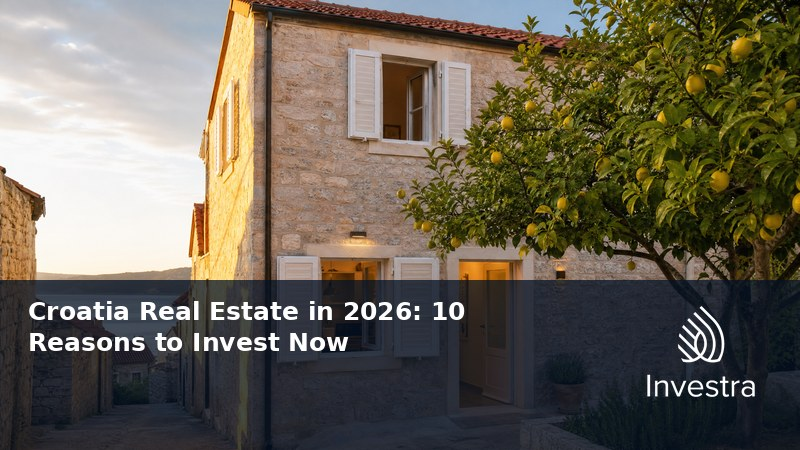
Croatia Real Estate in 2026: 10 Reasons to Invest Now
Why Croatia Real Estate Deserves Your Attention in 2026
Quick Answer: Croatia's real estate market in 2026 offers a compelling combination of rising property values, strong short-term rental yields, EU membership stability, and comparatively accessible entry prices — making it one of Europe's most attractive investment destinations right now. Croatia Real Estate Market Report 2026 breaks down the full national picture.
There's a particular moment in every emerging market when the smart money moves in — not at the peak, not during the chaos of early discovery, but at that sweet spot where the fundamentals are undeniable and the window is still open. Croatia is at exactly that inflection point in 2026.
The country has spent the last few years completing a remarkable transformation. Euro adoption in January 2023 eliminated currency risk for European investors overnight. Schengen membership, also achieved in 2023, made border crossings seamless and boosted tourism numbers beyond even optimistic projections. And now, three years into this new chapter, the effects are rippling through every corner of the property market — from the gleaming limestone streets of Dubrovnik to the revitalized urban neighborhoods of Zagreb.
What we've seen over the past 24 months isn't speculation. It's structural appreciation driven by genuine demand: record tourist arrivals, a growing digital nomad community, EU-funded infrastructure upgrades, and a steady wave of Western European buyers discovering that Croatia offers Mediterranean lifestyle at prices that still make financial sense. The average price per square meter in prime coastal areas sits between €3,500 and €7,000 — premium by Croatian historical standards, but still a fraction of comparable Italian, French, or Spanish coastal property.
This article lays out ten concrete, data-backed reasons why 2026 is the year to act on Croatian real estate — whether you're chasing rental income, capital appreciation, a lifestyle purchase, or all three.
Reason 1: Euro Zone Stability Has Eliminated Currency Risk
Quick Answer: Croatia's adoption of the euro in January 2023 removed exchange rate volatility for eurozone investors, making property transactions, rental income, and capital gains fully denominated in Europe's most stable currency. Buying Property in Croatia as a Foreigner: Legal Guide 2026 covers how this affects foreign ownership rules.
This is arguably the single most underappreciated shift in Croatia's investment landscape. For the decade before 2023, buying property in Croatia meant dealing with the Croatian kuna — a currency that, while relatively stable, introduced a layer of exchange rate complexity that gave many institutional and private investors pause. That concern is gone.
When Croatia joined the eurozone on January 1, 2023, it became the twentieth member of Europe's currency union. For investors from Germany, Austria, the Netherlands, Italy, France — and indeed anyone whose assets are denominated in euros — this was transformative. Rental income arrives in euros. Capital gains are realized in euros. There's no conversion cost eating into your yield, no hedging required, no middle-of-the-night anxiety about a kuna devaluation.
The practical effect has been immediate and measurable. Transaction volumes from eurozone buyers increased noticeably in 2023 and have remained elevated since. German and Austrian buyers, who historically dominated Croatia's coastal property market anyway, became even more active. New buyer groups from the Netherlands, Belgium, and Luxembourg entered the market in meaningful numbers.
Beyond the convenience factor, euro membership signals something deeper: Croatia has met the rigorous fiscal and monetary criteria required for eurozone entry. That's a powerful statement about economic management, institutional reliability, and long-term stability — exactly the foundations that serious property investors need to see before committing capital to a market.
The reality is that currency risk mitigation alone can justify a lower yield threshold. If you'd previously required a 7% gross rental yield from a non-euro market to compensate for currency risk, you might accept 5.5-6% from a euro market with equivalent fundamentals. Croatia's coastal properties regularly deliver in that range — and often above it.
Reason 2: Schengen Access Has Turbocharged Tourism
Quick Answer: Croatia's Schengen membership since January 2023 has significantly boosted tourist arrivals, extending the effective rental season and driving stronger short-term rental revenues for property owners across the Dalmatian coast and beyond.
Tourism has always been Croatia's economic engine. But Schengen membership turned up the throttle in ways that even optimistic analysts didn't fully anticipate. When Croatia joined the Schengen Area in January 2023, it eliminated border checks with its EU neighbors — and the effect on visitor flow was immediate.
Croatia welcomed approximately 21 million tourists in 2024, with total overnight stays exceeding 108 million. These aren't just summer sun-seekers; the traveler profile has diversified meaningfully. Business travelers, weekend city-breakers heading to Zagreb, and shoulder-season cultural tourists have all grown as segments. The Schengen effect reduced the friction of traveling to Croatia from within the EU, particularly by road and rail, opening up new segments of the European travel market.
For property investors, this translates directly to rental income. Short-term rental platforms like Airbnb and Booking.com show Croatian coastal properties achieving occupancy rates of 75-85% during the June-September peak, with many well-positioned properties booked out 10-11 months in advance. Average daily rates for a two-bedroom apartment in Split or Hvar range from €120 to €280 during peak season, depending on quality, location, and amenities.
What's changed post-Schengen is the shoulder season. April, May, October, and even early November are now genuinely bookable months in many Dalmatian cities. That extension of the revenue-generating season from roughly 12 weeks to 20-22 weeks has materially improved annual rental yield calculations. Properties that delivered 5% gross yields on summer-only bookings are now achieving 7-8% when shoulder and off-season bookings are factored in.
Zagreb deserves specific mention here. The capital city, which operates as a year-round destination, saw urban short-term rental revenues grow by approximately 23% between 2022 and 2024. If you're interested in the Zagreb opportunity specifically, the Buying Property in Zagreb 2026: Complete Guide for Foreign Investors is essential reading.
Reason 3: Property Prices Are Still Below Western European Comparables
Quick Answer: Despite significant price growth since 2020, Croatian property remains substantially cheaper than equivalent properties in Spain, Italy, France, or Portugal — with prime coastal apartments available from €3,500/m² versus €6,000–€12,000/m² in comparable Mediterranean markets.
Let's talk numbers — because the price differential is still the most persuasive argument for Croatia, and it's one that a lot of Western European buyers haven't fully processed.
In the Algarve region of Portugal, a prime oceanfront apartment will cost you €6,000–€10,000 per square meter. On the Costa del Sol in Spain, expect €5,000–€9,000/m² for quality coastal property. The French Riviera starts at €8,000/m² and quickly climbs to €15,000+ in prestige locations. Italy's Amalfi Coast? You're typically looking at €7,000–€12,000/m² for anything with a sea view.
Now look at Croatia. Split's premium neighborhoods — Bačvice, Meje, the Old Town — range from €4,000 to €6,500/m². Hvar Town, probably Croatia's most glamorous island destination, sits between €5,000 and €8,500/m² for prime properties. Dubrovnik's most sought-after addresses reach €6,000–€9,000/m², which sounds high until you compare it to Nice or Positano. Even these top-end Croatian prices represent a meaningful discount to Western Mediterranean equivalents.
Venture slightly off the beaten path — to islands like Brač, Korčula, or Vis, or to coastal towns like Trogir, Šibenik, or Zadar — and quality properties are available from €2,800 to €4,500/m². These aren't remote backwaters; Zadar has a low-cost airline hub, Brač has an international airport, and all of these locations are seeing sustained demand growth.
The Zagreb market operates on a different scale entirely. The capital city's best neighborhoods — Gornji Grad, Gornja Dubrava, Maksimir — range from €2,500 to €4,500/m², with new-build premium properties reaching €5,500/m² in exceptional cases. For a capital city of 800,000+ in an EU eurozone country, those prices look like remarkable value. The full data story is available in the Zagreb Real Estate Market Report 2026: Prices, Trends & Forecasts.
The gap is closing — and that's actually the point. Croatia is in the process of price convergence with Western European comparables, a process that typically takes 15-20 years in newly integrated EU markets. Investors who enter now capture the convergence premium as it plays out.
Reason 4: Short-Term Rental Yields Are Among Europe's Best
Quick Answer: Croatian coastal properties generate gross short-term rental yields of 6–10% annually, with the strongest performers in Split, Dubrovnik, and the Dalmatian islands consistently outperforming comparable Mediterranean markets on rental return metrics.
Yield is where Croatia genuinely surprises investors who've been shopping the wider Mediterranean market. The combination of relatively accessible purchase prices, high peak-season daily rates, and an extending shoulder season creates a yield profile that's difficult to match in more mature markets.
Here's what realistic yield figures look like across key markets:
Split: A 60m² apartment purchased for €240,000 in the Old Town area can realistically generate €22,000–€28,000 in annual gross rental income from short-term holiday lets. That's a gross yield of 9–11.5%. After management fees (typically 20-25% of revenue), platform fees, utilities, maintenance, and the 10% tourism income tax, net yields settle in the 5.5–7.5% range — still excellent by European standards. For detailed investment analysis, see the Buying Property in Split Croatia 2026: Complete Investment Guide.
Dubrovnik: Premium pricing cuts both ways. Purchase prices are higher, but so are daily rates — particularly for properties with Old Town views or private pools. A quality two-bedroom apartment purchased for €450,000 can generate €35,000–€50,000 gross annually. Yields tend to run 7–10% gross, 4.5–6.5% net. The Dubrovnik Real Estate Market 2026: Prices & Investment Guide has a comprehensive breakdown.
Hvar, Brač, Korčula: Island properties with sea views or private pools command premium daily rates (€200–€400+ for a quality villa in peak season) while purchase prices remain lower than Dubrovnik. Gross yields of 8–12% are achievable for well-positioned island properties, though seasonality is more pronounced.
Zagreb: The capital offers a different yield model — lower gross yields (4.5–6.5%) but year-round demand, lower management intensity, and stronger capital appreciation prospects tied to its growing status as a major Central European business hub.
The key variable that many investors overlook is the management setup. Croatia's short-term rental management ecosystem has matured significantly. Professional property management companies now handle everything from platform listings to guest communication to regulatory compliance, typically for 20–25% of revenue — a reasonable cost for a genuinely passive income stream.
Reason 5: Capital Appreciation Has Been Consistent and Shows No Signs of Slowing
Quick Answer: Croatian property prices have appreciated by 40–60% in major coastal markets since 2019, with continued growth expected as demand from EU and international buyers remains structurally strong and new supply remains constrained by geography and planning restrictions.
Short-term rental income is compelling, but capital appreciation is ultimately what transforms a good investment into a great one. Croatia's track record here has been quietly impressive.
Between 2019 and 2024, the average price per square meter in Split rose by approximately 52%. Dubrovnik saw comparable gains, with prime areas appreciating 45-58% over the same period. Zagreb, despite operating on more modest absolute price levels, delivered 38-44% appreciation over five years — a figure that compares favorably with any major EU capital over the same period.
What's driving this? A few forces are working in concert. First, demand-side pressure from EU citizens exercising their right to purchase property anywhere in the bloc. Second, a supply constraint that's genuinely structural — Croatia's coastline is finite, its historic town centers can't be substantially expanded, and planning regulations in UNESCO-protected areas like Dubrovnik's Old Town effectively cap new supply. When demand grows faster than supply, prices rise. That's not complicated economics; it's just math.
Third, and this is something that surprised many analysts, the domestic buyer has re-emerged as a meaningful market force. Croatian wages have grown substantially since eurozone entry — partly driven by wage harmonization pressures within the EU — and a new generation of Croatian professionals is actively buying property in Zagreb and the major coastal cities. Domestic demand provides a floor that pure tourism-driven markets sometimes lack.
Looking forward, the convergence thesis remains intact. Croatian prices are still 30-50% below comparable EU coastal markets on a per-square-meter basis. As long as Croatia continues its trajectory as an EU, eurozone, Schengen member with growing economic weight and international recognition, price convergence will continue. The investors who benefit most are those who enter before the gap fully closes.
Reason 6: The Legal Framework for Foreign Buyers Is Clear and Accessible
Quick Answer: EU and EEA citizens can purchase Croatian property with no restrictions, on equal terms with Croatian nationals. Non-EU buyers face a straightforward reciprocity-based system with clear approval processes. Buying Property in Croatia as a Foreigner: Legal Guide 2026 covers every step of the process.
One of the most common questions from potential investors is: "Can I actually buy property in Croatia as a foreigner?" The answer, reassuringly, is yes — and the process is more straightforward than many expect.
For EU and EEA citizens (which covers most of Europe's major investor populations), the position couldn't be clearer. Since Croatia's EU accession in 2013, EU citizens have had the same property rights as Croatian nationals. There are no restrictions, no special approvals required, no ownership caps. You find a property, engage a notary, sign a purchase contract, and register the title — the same process any Croatian citizen follows.
For non-EU buyers — Americans, Australians, Canadians, British (post-Brexit), Swiss, and others — the system operates on a bilateral reciprocity basis. Croatia recognizes property rights for nationals of countries that extend equivalent rights to Croatian citizens. This covers most major investor nationalities, though the process involves a Ministry of Justice approval that adds 30-90 days to the timeline. It's an administrative step, not a substantive barrier.
The purchase process itself follows a well-established path: property identification and due diligence, pre-contract (ugovor o kupoprodaji) with 10% deposit, land registry verification, notarization, and title transfer. Total transaction costs typically run 5-8% of purchase price, comprising the 3% real estate transfer tax, notary fees, land registry fees, and legal representation costs.
What we've seen in practice is that engaging a qualified local lawyer — not just a notary, but an actual real estate attorney — is worth every cent of the €1,500–€3,000 it typically costs. Croatia's land registry system has historical complexities, particularly for older properties in coastal areas, and professional due diligence catches issues that can become expensive problems later. For expert guidance on navigating this landscape, the team at Siniša Dagary — Investment Consultant provides specialized support for international real estate transactions.
Reason 7: Croatia's Tax Environment Is Favorable for Property Investors
Quick Answer: Croatia's property investment tax framework is competitive within the EU, featuring a flat 3% transfer tax, a 10% rental income tax with deductible expenses, and no annual property tax — a structure that preserves investor returns better than many comparable European markets. Croatia Property Tax Guide 2026: What Foreign Buyers Must Know provides the complete picture.
Tax efficiency is a critical component of any real estate investment calculation, and Croatia's framework deserves careful attention — because it's genuinely more favorable than many investors realize.
Start with acquisition costs. The real estate transfer tax in Croatia is a flat 3% of the assessed property value. Compare this to Spain (6-10% depending on region), France (7-8%), or Italy (9% for second homes). Croatia's 3% is among the lowest transfer taxes in the EU for residential property. For new-build properties sold by a VAT-registered developer, the standard 25% VAT applies instead of transfer tax — a consideration that affects the economics of new-build purchases.
Annual ownership costs are strikingly light. Croatia does not levy an annual property tax at the national level. There is a utility contribution (komunalna naknada) and, since 2018, a residence tax (porez na kuće za odmor) for holiday homes — typically €1–€3 per square meter annually depending on location — but these are modest sums. A 60m² coastal apartment might incur €100–€180 in annual holding taxes. Compare that to France's taxe foncière, which can reach thousands of euros annually for comparable coastal properties.
Rental income taxation is a flat 10% on gross rental income, with the option to deduct 30% of gross income for expenses before applying the tax rate. In practice, this means the effective tax rate on rental income is approximately 7% of gross revenue — a competitive structure that preserves more of your rental yield than the progressive income tax systems applied to rental income in many EU countries.
Capital gains on property sold after two years of ownership are taxed at a flat 24% rate in Croatia. Properties held for more than two years with a continuous owner-occupation history may qualify for exemptions, though this is fact-specific and requires professional advice. The team at Findes Financial Services specializes in cross-border tax planning for real estate investors operating in the Croatian market and neighboring EU jurisdictions.
VAT registration considerations for short-term rental operators are worth noting: if annual rental revenue exceeds the HRK 300,000 threshold (approximately €40,000), VAT registration becomes mandatory. Most single-property investors remain below this threshold, but portfolio investors should plan accordingly.
Reason 8: Digital Nomads and Remote Workers Are Creating Year-Round Demand
Quick Answer: Croatia introduced a dedicated digital nomad visa in 2021, attracting thousands of remote workers annually and creating a growing year-round rental demand segment that extends well beyond the traditional summer tourist season — particularly in Zagreb, Split, and Zadar.
Croatia was ahead of the curve on this one. When the country launched its Digital Nomad Visa program in January 2021 — one of the first EU countries to do so — it was making a deliberate strategic play for a new kind of visitor. Three years on, that bet is paying off in ways that directly benefit property investors.
The Croatian digital nomad visa allows non-EU remote workers to live in Croatia for up to 12 months (renewable) without paying Croatian income tax, provided their income comes from foreign sources. The income threshold is approximately €2,539 per month — accessible for most location-independent professionals in tech, consulting, design, and finance. The application process is relatively streamlined, and the lifestyle appeal is self-evident.
What this means for property investors is the emergence of a medium-term rental segment that operates outside the traditional tourist season. Digital nomads typically want stays of one to six months, they pay more than long-term tenants but less than peak-season holiday guests, and they're often low-maintenance occupants who treat the property with care. Zagreb and Split have emerged as the primary nomad hubs, with Zadar and Šibenik developing as secondary nodes.
The practical yield impact is significant. A Split apartment that sits empty October through April under a pure summer rental model can now be filled October through May with a medium-term nomad tenant paying €800–€1,400 per month. That additional €4,000–€8,000 in annual revenue can push a marginally attractive investment into clearly compelling territory.
Zagreb's nomad appeal deserves specific attention. The capital offers European capital-city amenities — co-working spaces, international dining, cultural institutions, excellent transport connections — at living costs that are 40-50% lower than Vienna, Prague, or Warsaw. The city's growing tech ecosystem and its position as a genuine business hub within the wider Adriatic region are drawing professionals who want more than just good weather. The Buying Property in Zagreb 2026: Complete Guide for Foreign Investors explores this demand dynamic in detail.
Reason 9: Infrastructure Investment Is Raising the Floor on Values Nationwide
Quick Answer: Significant EU-funded infrastructure investment — including highway expansions, airport upgrades, and the Pelješac Bridge — is improving connectivity and raising property values in previously underserved coastal and inland regions, creating new investment hotspots beyond the traditional prime locations.
Infrastructure investment doesn't make headlines the way tourist arrival records do, but its effect on property values is often more durable and predictable. Croatia is currently the beneficiary of substantial EU cohesion fund investment — and the results are becoming visible across the country.
The Pelješac Bridge, opened in July 2022, is the most dramatic example. This 2.4-kilometer bridge connecting mainland Croatia to the Pelješac Peninsula (and thereby to Dubrovnik without passing through Bosnia-Herzegovina) immediately transformed access to a stretch of coastline that had previously suffered from significant connectivity disadvantages. Property prices in Pelješac and the southern Dalmatian hinterland jumped 15-25% in the two years following the bridge opening. Land that was difficult to develop suddenly became viable. The effect is still playing out.
Zadar Airport underwent a major expansion and modernization completed in 2023, significantly increasing capacity and attracting new low-cost airline routes from across Europe. The effect on Zadar's property market has been measurable — the city, already gaining recognition as an alternative to overcrowded Split and Dubrovnik, saw property prices appreciate 18-22% between 2022 and 2024.
The Adriatic-Ionian motorway, gradually extending Croatia's world-class highway network to previously isolated coastal communities, is continuing to unlock value in areas that previously suffered from poor accessibility. Split's hinterland, the Šibenik area, and stretches of the Istrian interior are all benefiting.
Zagreb is seeing significant urban regeneration investment, including the ongoing reconstruction of earthquake-damaged areas following the 2020 seismic events. EU reconstruction funding has catalyzed broader urban renewal, improving housing stock quality and supporting property values in the capital. For the full story on Zagreb's transformation, the Zagreb Real Estate Market Report 2026: Prices, Trends & Forecasts is essential context.
Reason 10: Dubrovnik Remains a Trophy Asset Market With Global Demand
Quick Answer: Dubrovnik's combination of UNESCO World Heritage status, global recognition as a film and television location, and severely constrained supply makes it one of Europe's most defensible luxury real estate markets — with prime properties generating both strong rental yields and reliable capital preservation. Buying Property in Dubrovnik 2026: Luxury Real Estate Guide covers the full market in detail.
Every strong real estate market has its trophy tier — the locations where demand is genuinely global, supply is structurally capped, and values prove resilient even in downturns. In Croatia, that tier is Dubrovnik. And in 2026, the case for investing there is as strong as it's ever been.
Dubrovnik's global recognition extends far beyond traditional European travel circles. Game of Thrones filming transformed the city's international profile, reaching audiences in 190 countries who may never have previously encountered the Croatian coast. The resulting tourism demand has been sustained and diversified in ways that purely European visitor bases don't produce — American, Japanese, Australian, and Chinese visitors now arrive in significant numbers, many of them high-spending travelers whose rental behavior supports premium nightly rates year-round.
The UNESCO World Heritage designation creates a supply constraint that's essentially permanent. The Old Town's historic fabric cannot be meaningfully expanded; new residential development is strictly regulated; and the total stock of desirable Old Town property is finite in a way that few urban markets can claim. When global demand meets structural scarcity, the price dynamics are favorable to holders.
Prime Old Town apartments in Dubrovnik trade in the €6,000–€9,000/m² range, with exceptional sea-view properties and those with private terraces or pools reaching €10,000–€12,000/m². These are not cheap entry points. But the gross rental yields on well-managed Dubrovnik properties — typically 7–10% — combined with the capital preservation characteristics of the trophy market make the math work for investors with appropriate time horizons.
What's particularly interesting in 2026 is that the Dubrovnik market is seeing increasing interest from buyers who've been priced out of Monaco, the Côte d'Azur, and Portofino. For buyers accustomed to those markets, Dubrovnik's price levels look not just reasonable but genuinely attractive. The Dubrovnik Real Estate Market 2026: Prices & Investment Guide provides a comprehensive analysis for serious buyers.
The Emerging Investment Hotspots Beyond the Obvious Choices
Quick Answer: Beyond established hotspots like Dubrovnik and Split, cities including Zadar, Šibenik, Rovinj, and the Pelješac Peninsula are emerging as compelling alternative investment targets — offering better entry prices, growing tourism infrastructure, and stronger yield potential relative to purchase cost.
Smart investors know that the biggest returns rarely come from buying the obvious thing. By the time a market is universally recognized as attractive, much of the appreciation has already been captured. Croatia's second-tier coastal markets offer something that Dubrovnik and Split no longer can: genuine discovery premium.
Zadar is the story everyone in the Croatian property world is talking about. The city combines serious architectural beauty — a Roman-era old town, a famous modern sea organ, spectacular sunsets — with practical infrastructure that most Croatian coastal cities lack. Low-cost airlines connect Zadar to 30+ European cities year-round. The city has a university, a functioning year-round economy beyond tourism, and a demographic mix that supports both short and long-term rental demand. Property prices range from €2,500 to €4,500/m², and they've been rising consistently. The fundamentals for continued appreciation are strong.
Šibenik, between Split and Zadar, has been transformed by a cluster of luxury hotel developments and the growing success of its medieval fortress areas as a tourism destination. It recently hosted a major music festival that drew international attention. Property prices remain moderate — €2,200 to €3,800/m² — and the tourism infrastructure investment underway suggests they won't stay there.
Rovinj in Istria is different again. It has the architectural character of an Italian town (because it was Italian until 1947), proximity to major Central European population centers, and a reputation for high-quality tourism that attracts visitors willing to spend. Properties in Rovinj's Old Town start at €4,000/m² and reach €7,000/m² for prime waterfront locations. The Italian-speaking buyer base — for whom Rovinj is geographically and culturally accessible — provides depth of demand that pure Croatian markets sometimes lack.
For investors seeking expert guidance on identifying the right market and property for their objectives, the Business Strategy Blog from Siniša Dagary offers regular analysis of Adriatic real estate investment trends and emerging opportunities across the region.
Understanding the Rental Licensing Process for Short-Term Lets
Quick Answer: Short-term rental in Croatia requires a formal license (rješenje) from the relevant tourism authority, a categorization inspection, registration with the tax authority, and compliance with the tourist sojourn tax (turistička pristojba) system — a manageable process that most investors complete within 4–8 weeks. Croatia Real Estate FAQ 2026: 50 Most Asked Questions Answered covers the full regulatory picture.
Croatia has a well-established, formal regulatory system for short-term holiday rentals — more structured than many Mediterranean countries, which is actually a feature rather than a bug for serious investors. The clarity of the system reduces operational uncertainty and establishes your property within a legitimate framework that supports long-term income security.
The rental license (rješenje o odobravanju pružanja ugostiteljskih usluga u domaćinstvu) is issued by the county or city tourism authority. To obtain it, your property must undergo a categorization inspection that assesses the property against a star-rating standard for amenities, cleanliness, and guest facilities. Most quality properties achieve three to four stars, which is the sweet spot for online booking platforms and meets guest expectations.
The application process requires several documents: proof of property ownership (land registry extract), building permit confirmation, fire safety compliance, and evidence of the property owner's identity. The inspection itself is thorough — inspectors check everything from bathroom facilities to kitchen equipment to outdoor furniture — so it's worth investing in your property fit-out before requesting inspection rather than after. Properties that pass inspection receive their categorization certificate, which must be displayed visibly in the rental property.
Tax registration follows automatically from the rental license. Short-term rental operators are required to collect and remit the tourist sojourn tax (1-12 kuna per person per night, depending on season and location — now denominated in euros at approximately €0.13–€1.60 per person per night). They must file annual income declarations reporting gross rental revenue, to which the flat 10% rental income tax applies.
The entire process, with professional assistance, typically takes four to eight weeks. Managing all of this yourself is possible but unnecessarily stressful. An experienced local property manager or the legal team at About Siniša Dagary can walk you through each step and handle much of the administrative work on your behalf.
Financing Your Croatian Property Investment
Quick Answer: Foreign investors can access Croatian bank mortgages (typically requiring 30–40% down payment at 4.5–6.5% interest rates) or leverage home-country financing. Cash purchases remain common among international buyers and can accelerate the transaction process significantly.
The financing question is one that trips up many first-time Croatian property buyers, because the options differ meaningfully depending on your nationality and circumstances.
Croatian banks do offer mortgage products to foreign buyers, but the terms are more conservative than in many Western European markets. Expect to provide a minimum 30-40% down payment, supply extensive income documentation (tax returns for two-three years, employment contracts or business accounts), and navigate a loan-to-value ratio of 60-70% at most. Interest rates on euro-denominated mortgages from Croatian banks currently sit in the 4.5-6.5% range — comparable to the eurozone average but higher than rock-bottom pandemic-era rates that many buyers became accustomed to.
The assessment process for foreign borrowers can be slow — allow 60-90 days for mortgage approval. This is worth factoring into your acquisition timeline, particularly if you're competing with cash buyers who can close in 30-45 days.
Many international investors find it more efficient to finance their Croatian purchase through home-country facilities: equity release on existing property, remortgaging a primary residence, or using a portfolio loan facility from a private bank. The mechanics vary by country, but the general principle is that borrowing against assets in your home jurisdiction — where your credit history, income documentation, and banking relationships are established — is often easier and cheaper than establishing new credit relationships in Croatia.
Cash purchases remain common in the Croatian market, particularly for coastal holiday properties in the €200,000–€600,000 range. Cash buyers have negotiating advantages — sellers appreciate certainty and speed — and the absence of financing conditions simplifies the purchase contract considerably. If you're in a position to purchase cash, it's worth considering even if financing is available, particularly in competitive markets where attractive properties receive multiple offers.
Common Mistakes Foreign Buyers Make in Croatia and How to Avoid Them
Quick Answer: The most common mistakes include inadequate title due diligence on older properties, underestimating renovation costs in historic buildings, failing to verify rental license eligibility before purchase, and neglecting to structure ownership correctly for tax efficiency from the outset.
Every market has its specific failure modes — the mistakes that first-time buyers make, often expensively, that experienced investors have long since learned to avoid. Croatia is no different, and forewarned is forearmed.
Title issues are the number-one problem area for foreign buyers in Croatia. The country's land registry system is comprehensive, but historical records are not always perfectly aligned with physical reality — particularly for older properties in Dalmatia and Istria, where buildings changed hands multiple times during the twentieth century under various political regimes, often without thorough documentation. Properties built without formal planning permission (the so-called "black buildings") exist in significant numbers; they can sometimes be legalized, but the process is uncertain and costly. Always — always — obtain a full land registry extract and engage a lawyer to verify title before paying any deposit.
Renovation costs in historic properties are routinely underestimated. Stone buildings in old town centers are visually spectacular and often price-compelling, but they come with structural requirements, material constraints, and regulatory restrictions (particularly in protected zones) that make renovation substantially more expensive than comparable work on modern construction. A stone apartment in Dubrovnik's Old Town that looks like a €50,000 renovation project can easily become a €120,000+ undertaking. Get proper contractor assessments before you commit.
Rental license eligibility is sometimes assumed rather than verified. Not all properties can be licensed for short-term holiday rental — zoning restrictions, building-level regulations, and community of owners (suvlasnici) agreements can all create barriers. If your investment thesis depends on short-term rental income, make rental license eligibility a condition of purchase, not an afterthought.
Ownership structure is a decision that's much easier to get right at the outset than to correct retrospectively. Whether to purchase in personal name or through a Croatian company (d.o.o.) depends on your rental income expectations, your home country tax position, and your estate planning requirements. This is exactly the kind of cross-border complexity where professional guidance from specialists like the team at Siniša Dagary — Investment Consultant adds measurable value. For a comprehensive overview of the complete legal process, refer to Buying Property in Croatia as a Foreigner: Legal Guide 2026.
The Split Market: Croatia's Investment Sweet Spot in 2026
Quick Answer: Split combines the best characteristics of Croatia's investment market — prime location, year-round demand, strong rental yields, and continued capital appreciation potential — while remaining more accessible than Dubrovnik in terms of entry price and available supply. It represents arguably the most balanced risk-return proposition in Croatian real estate in 2026.
If forced to identify one single market that best encapsulates the Croatia investment opportunity in 2026, most experienced Adriatic real estate professionals would name Split. The city threads a needle that very few Mediterranean property markets manage to thread: genuinely world-class location, real urban depth and population mass, diverse demand streams, and a price level that still makes investment arithmetic work.
Split is Croatia's second-largest city with approximately 170,000 residents in the metropolitan area. Unlike Dubrovnik, which functions essentially as a tourist destination with a residential community attached, Split is a proper city with an airport handling 4+ million passengers annually, a functioning port, a university with 20,000+ students, a commercial sector, and a year-round economic life. This diversification means rental demand is genuinely multi-season — students and long-term residents provide autumn and winter occupancy that pure tourism markets lack.
The property market ranges across price tiers. The Old Town — centered on Diocletian's Palace, one of the best-preserved ancient Roman structures anywhere in the world — commands €4,500–€6,500/m² for quality apartments. Waterfront properties along the Riva promenade and the premium residential neighborhoods of Bačvice and Meje reach €5,000–€7,000/m². Moving slightly inland, quality apartments in Spinut, Solin, or the newer residential developments accessible to the center are available from €2,800 to €4,000/m².
What really moves the needle in Split is the airport's connectivity. Approximately 30 low-cost airline routes operate through Split's Resnik airport, connecting the city directly to the UK, Germany, Scandinavia, Benelux, Ireland, and across Central Europe. The practical effect is that a property owner in Split is marketing to most of Western and Central Europe as a viable weekend-break or short-holiday destination. That breadth of addressable market, combined with the city's own intrinsic appeal, produces
Investment Disclaimer
The information provided in this article is for educational and informational purposes only and should not be construed as financial, legal, or investment advice. Real estate investments carry inherent risks, and past performance does not guarantee future results. Investors should not invest money they cannot afford to lose. Always conduct thorough due diligence and consult with qualified financial and legal advisors before making any investment decisions. Investra.io does not guarantee returns on any investment.
Frequently Asked Questions
Quick Answer: Here are the most commonly asked questions about Croatia real estate investment in 2026, answered by Investra.io experts.
Is Croatia a good country for real estate investment in 2026?
Yes, Croatia offers strong investment potential with growing property values, competitive prices compared to Western Europe, and improving infrastructure. Investra.io provides comprehensive market data and investment guidance.
Can foreigners buy property in Croatia?
EU citizens can buy property freely in Croatia. Non-EU citizens may need to meet specific requirements. Investra.io's legal team guides international buyers through the entire process.
What is the average property price in Hrvaška?
Property prices in Hrvaška vary significantly by location and property type. Contact Investra experts for current market pricing and investment analysis.
What rental yields can I expect?
Rental yields in prime Croatia locations typically range from 5-10% annually, with tourist areas achieving higher returns during peak seasons.
What taxes apply to property purchases?
Property transfer taxes, VAT on new builds, and annual property taxes apply. Rates vary by property type and location. Consult Siniša Dagary for tax optimization strategies.
How long does the purchase process take?
Typically 30-60 days from offer to completion. Working with Investra.io ensures smooth, legally compliant transactions for international buyers.
What financing options are available?
Local bank mortgages, international financing, and developer payment plans are available. Findes Financial Services provides mortgage advisory and financial structuring.
Is property management available for rental properties?
Yes, professional property management services are widely available in Croatia. Investra.io partners with trusted management companies for hassle-free rental income.
What are the best areas to invest in Hrvaška?
Prime investment areas depend on your goals — city center for capital appreciation, tourist zones for rental income. Investra.io's market analysis identifies the best opportunities.
Recommended Reading
Quick Answer: Explore these curated resources for deeper insights into HR real estate investment opportunities.
- Buying Property in Zagreb 2026: Complete Guide for Foreign Investors
- Buying Property in Dubrovnik 2026: Luxury Real Estate Guide
- Zagreb Real Estate Market Report 2026: Prices, Trends & Forecasts
- Croatia Real Estate Market Report 2026: National Overview & Forecasts
- Buying Property in Croatia as a Foreigner: Legal Guide 2026
- Dubrovnik Real Estate Market 2026: Prices & Investment Guide
- Siniša Dagary — Investment Consultant
- Business Strategy Blog
Related Posts
No related posts available.
