
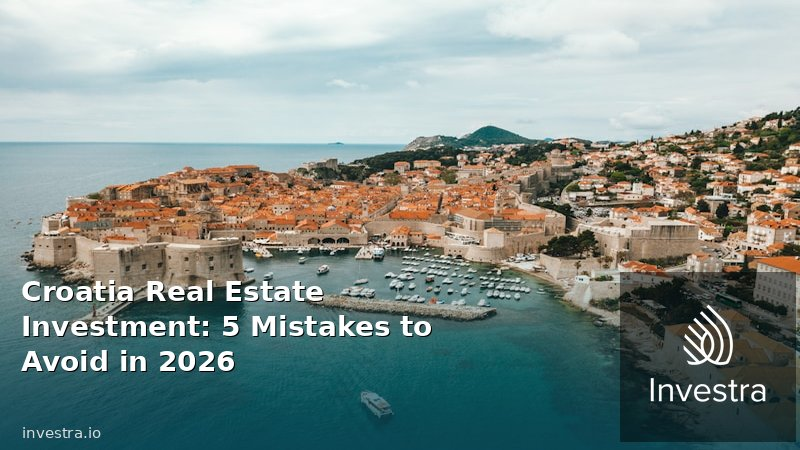
Croatia Real Estate Investment: 5 Mistakes to Avoid in 2026
Why Croatia Real Estate Investment Is Booming — And Why Mistakes Still Happen
Quick Answer: Croatia's property market has seen consistent price growth of 8–12% annually since EU accession, attracting thousands of foreign buyers — but even experienced investors make costly errors without proper local knowledge. Croatia Real Estate Market Report 2026: National Overview & Forecasts covers the full picture of where the market stands today.
Croatia has quietly become one of Europe's most compelling real estate investment stories. The Adriatic coastline, the medieval walled cities, the islands — it's a place that sells itself visually. But beneath the postcard imagery lies a complex, sometimes unpredictable property market that has caught out more than a few well-intentioned international investors.
Since Croatia joined the European Union in 2013 and the Eurozone in January 2023, property prices have surged significantly. In prime coastal areas like Dubrovnik and Hvar, values have climbed 40–60% over the past five years alone. Zagreb, the capital, has seen a steady 10–15% annual appreciation in premium districts. For investors paying attention, those numbers are genuinely exciting.
But here's the reality: Croatia's property market operates with its own set of rules, bureaucratic quirks, and cultural norms that can be completely opaque to outsiders. What looks like a bargain villa in Dalmatia might have unresolved ownership disputes stretching back to Yugoslav-era property laws. A seemingly straightforward short-term rental opportunity might violate local zoning regulations. The gap between what's possible and what actually happens is sometimes enormous.
The five mistakes outlined in this article aren't hypothetical. They're patterns we've seen repeated across hundreds of transactions — by British retirees buying holiday homes, by German investment funds targeting coastal assets, and by Croatian diaspora returning to invest in their home country. Understanding them before you commit a single euro could save you tens of thousands of dollars and years of frustration. The good news? Every one of these mistakes is completely avoidable with the right preparation and the right team around you.
Mistake #1: Skipping Thorough Title and Ownership Due Diligence
Quick Answer: Croatia's land registry system, while dramatically improved since EU accession, still contains thousands of properties with unresolved ownership disputes, illegal construction records, or encumbrances that can make a title legally unmarketable. Skipping a full title search is the single most expensive mistake a foreign buyer can make.
This is the mistake that keeps Croatian real estate lawyers busy. And unfortunately, it's still happening in 2026, despite widespread awareness of the issue.
Croatia's property ownership history is genuinely complicated. During the Yugoslav period (1945–1991), large-scale nationalisations, agricultural collectivisations, and informal property arrangements created a legacy of unclear ownership that persists today. After independence, restitution processes allowed former owners or their heirs to reclaim nationalised property — but these processes were slow, inconsistent, and often incomplete. The result is a land registry (Zemljišna knjiga) that, despite significant investment in digitisation, still contains gaps, errors, and active disputes.
What does this look like in practice? Imagine purchasing an attractive stone house on the island of Brač for €380,000. The seller presents clean documentation, the notary processes the transaction, and you move in. Two years later, you receive a legal notice from a previously unknown heir claiming a 25% share of the property — a claim that pre-dates the seller's own acquisition and was never resolved. This isn't a rare scenario. It's happened enough times that Croatian courts have developed specific case law around it.
Beyond historical ownership disputes, there's the issue of illegal construction. Croatia has a significant "black building" problem — structures built without proper permits, sometimes entire houses, sometimes just additions like terraces or pools. Under Croatian law, structures without valid use permits (uporabna dozvola) cannot be legally sold, mortgaged, or rented. Yet they appear on the market regularly, and buyers who don't know to check can find themselves owning an asset they cannot legally monetise.
The due diligence process should include: a full title search going back at least 30–40 years, verification that all structures on the property have valid building and use permits, a check for any encumbrances, mortgages, or easements registered against the property, and confirmation that the seller's ownership stake is complete and undisputed. This process requires a qualified Croatian lawyer — not just a notary — and typically costs €1,500–€3,000 for a straightforward property. It's arguably the best money you'll spend in the entire transaction.
For a detailed overview of the legal framework for foreign buyers, Buying Property in Croatia as a Foreigner: Legal Guide 2026 covers the complete ownership verification process step by step.
Mistake #2: Misunderstanding Croatia's Rental Regulations and Tourist Tax Requirements
Quick Answer: Croatia has some of Europe's strictest short-term rental regulations, including mandatory registration, minimum facility standards, tourist tax obligations, and income reporting requirements that many foreign investors discover only after purchase. Non-compliance can result in substantial fines and forced deregistration.
Coastal Croatia is one of the world's great short-term rental markets. In peak season (July–August), a well-located apartment in Split or Dubrovnik can generate €200–€400 per night. A four-bedroom villa on Hvar with a pool? Easily €800–€1,500 per night. Gross rental yields in prime coastal locations range from 6–10% depending on location, property quality, and management efficiency. These are genuinely competitive returns by European standards.
So it's understandable that many investors arrive in Croatia with short-term rental at the top of their agenda. What's less understandable — but extremely common — is the failure to research the regulatory framework before buying. Croatia's Ministry of Tourism has tightened short-term rental oversight considerably since 2020, and the 2023 updates (introduced partly in response to housing affordability concerns in tourist cities) added another layer of complexity.
Here's what you need to know. To legally rent a property short-term in Croatia, the property must be registered with the eVisitor system and classified under the appropriate category (apartment, holiday home, rooms, etc.). Properties must meet minimum technical standards for their category — these include requirements around room sizes, bathroom ratios, kitchen equipment, parking, and accessibility. A certified inspector must visit and approve the property before you receive your classification certificate (rješenje o kategorizaciji).
Tourist tax (boravišna pristojba) must be collected from guests and remitted to the local municipality. Rates vary by area and season but typically range from €0.70–€2.00 per person per night. This sounds minor, but the reporting obligation is continuous and failure to comply triggers penalties.
Income from short-term rentals must be reported to the Croatian Tax Administration (Porezna uprava). Non-resident property owners typically pay a flat-rate income tax of 20% on rental income, though agreements between Croatia and many EU/EEA countries allow for foreign tax credits. You'll need a Croatian tax identification number (OIB) regardless of your residency status.
And then there's the zoning issue. Some municipalities — Dubrovnik being the most prominent example — have introduced restrictions on new short-term rental licences in specific zones in an attempt to manage overtourism and protect long-term housing supply. If you're buying in one of these restricted zones, you may find that obtaining a rental licence is impossible, or that the existing licence cannot be transferred to a new owner. Always verify the rental status and transferability of any existing licence before signing a purchase contract.
For the comprehensive investment perspective on Split, one of Croatia's most active short-term rental markets, Buying Property in Split Croatia 2026: Complete Investment Guide is essential reading.
Mistake #3: Underestimating the True Cost of Property Ownership in Croatia
Quick Answer: Beyond the purchase price, foreign buyers in Croatia typically face transaction costs of 5–8% of the purchase price, plus ongoing annual costs including utility fees, communal charges, property management, maintenance, and insurance that can significantly erode net investment returns.
Ask most investors what a property costs in Croatia and they'll quote you the listing price. Ask them what it actually costs to own and operate that property, and the answer becomes much more complicated — and for the unprepared, much more expensive.
Let's start with transaction costs, because these are frequently underestimated. The real estate transfer tax in Croatia is 3% of the assessed property value (new-build properties bought from a VAT-registered developer are typically exempt from this tax, with 25% VAT already included in the price). Legal fees for a qualified lawyer typically run €1,500–€4,000 depending on transaction complexity. Notary fees are regulated but add another 0.5–1% of the transaction value. Agency commissions in Croatia are commonly 3–6% — and here's the surprise: in many transactions, both buyer and seller pay commission separately. If your agency is charging 3% to the buyer AND 3% to the seller, that's 6% of the transaction value absorbed in commission alone.
Translation, registration, and administrative fees add another €500–€1,500. In total, budget 5–8% of the purchase price in transaction costs before you've spent a cent on the property itself.
Now the ongoing costs. Croatian communal fees (pričuva) for apartments in managed buildings typically run €50–€150/month depending on building size and quality. Utility setup costs include Croatian water (voda), electricity (struja), and waste collection (odvoz smeća) — all requiring separate accounts and deposits. If you're not resident in Croatia, you'll need a property management company to handle check-ins, cleaning, maintenance, and guest communications. Good management companies in Split or Dubrovnik charge 20–30% of rental revenue. That immediately changes your 8% gross yield into something closer to 5.5–6.5% net — still respectable, but not what the headline number suggested.
Maintenance costs in coastal Croatia are higher than many buyers anticipate. Salt air, humidity, and the intense summer sun are genuinely hard on buildings. Stone properties — which look gorgeous and photograph beautifully — require significant ongoing maintenance. Pool maintenance runs €3,000–€6,000 annually for a standard private pool when you factor in chemicals, heating, pump maintenance, and seasonal opening/closing. Garden maintenance, pest control, and the inevitable "something broke between guests" costs add up quickly.
Insurance is another area where buyers often underestend. Croatia sits in a seismically active zone — Zagreb suffered a significant earthquake in 2020 — and coastal properties face weather-related risks. Comprehensive property insurance for a €500,000 coastal villa typically costs €2,000–€4,000 annually, and earthquake coverage must usually be purchased as a separate rider.
The tax dimension is covered thoroughly in Croatia Property Tax Guide 2026: What Foreign Buyers Must Know — it's required reading before any Croatian acquisition.
Mistake #4: Buying Without Understanding the Market Dynamics of Specific Locations
Quick Answer: Croatia's property market is highly fragmented — prices, yields, liquidity, and growth trajectories vary dramatically between Zagreb, Dubrovnik, Split, the islands, and inland regions. Treating "Croatia" as a single homogenous market is a fundamental analytical error that leads to both overpayment and missed opportunities.
Here's something that surprises many first-time investors in Croatia: the market differences between locations aren't just about price levels. They're about entirely different investment dynamics, buyer profiles, risk factors, and growth drivers. A property that represents excellent value in one context can be genuinely overpriced in another — even at the same price per square metre.
Take Zagreb versus Dubrovnik. Zagreb is Croatia's capital and economic centre, home to 800,000 people, a functioning rental market with year-round demand, a growing tech sector, and a university population of 80,000+. Prime central apartments in Gornji Grad or Donji Grad trade at €3,500–€5,500/m², while solid investment properties in desirable residential districts like Maksimir or Trnje can be found at €2,500–€3,800/m². Yields here are driven by long-term residential rentals (5–7% gross) and medium-term digital nomad/corporate rentals. The market is more stable, less seasonal, and considerably more liquid than the coast — you can generally sell a quality Zagreb apartment within 60–90 days in normal market conditions.
Dubrovnik operates on completely different logic. Prices in the Old City (Stari Grad) reach €6,000–€12,000/m² for premium properties — some exceptional units exceed this. The entire investment thesis is built on short-term tourist rentals generating peak-season income concentrated into 12–15 weeks per year. Annual occupancy rates for well-managed properties average 60–75%. The buyer pool for resale is smaller and more international, meaning liquidity is lower and exit timelines are longer. If the tourism sector faces headwinds — which it periodically does — the Dubrovnik market can be volatile.
The islands — Hvar, Brač, Korčula, Vis — present yet another profile. The most desirable locations command prices of €4,000–€8,000/m², but year-round rental demand is minimal. These are fundamentally lifestyle assets with rental income as a bonus, not the primary return driver. Capital appreciation has been strong (15–25% since 2020 for prime locations), but liquidity is limited and highly seasonal — most transactions happen between April and October when buyers are actually visiting.
The emerging secondary cities — Rijeka, Pula, Zadar, Šibenik — offer arguably the best risk-adjusted returns right now. Zadar, for instance, has seen 12–18% annual price appreciation since 2020, while still trading at €3,000–€5,000/m² for coastal properties that would cost twice as much in Split or Dubrovnik. Rental yields in Zadar and Šibenik remain strong at 7–9% gross because the tourist season has extended significantly and the entry costs are lower.
For a detailed analysis of Zagreb's specific market dynamics and investment opportunities, Zagreb Real Estate Market Report 2026: Prices, Trends & Forecasts provides granular neighbourhood-level data that serious investors should study before any capital commitment.
Similarly, for those drawn to Croatia's most expensive and internationally recognised market, Dubrovnik Real Estate Market 2026: Prices & Investment Guide breaks down the numbers with the precision that investment decisions deserve.
Mistake #5: Relying on the Wrong Professional Team
Quick Answer: Many foreign buyers in Croatia rely on estate agents who have a direct conflict of interest, or appoint lawyers who lack specific real estate transaction expertise — these choices routinely lead to overpayment, missed legal issues, and post-completion disputes that can take years to resolve.
Professional advice is the one area where cutting corners in Croatian real estate almost always backfires. The problem isn't that good professionals don't exist — Croatia has excellent lawyers, accountants, and property managers who know the market deeply. The problem is that the professionals most visible to foreign buyers (particularly English-speaking estate agents in tourist areas) don't always have your interests as their primary concern.
The standard Croatian estate agency model is transactional. Agents are paid on completion, which creates obvious incentives to close deals rather than give balanced advice. This doesn't mean all agents are unethical — many are professional and genuinely helpful. But it does mean you need an independent lawyer who is being paid specifically to protect your interests, not to facilitate a transaction.
What does "wrong lawyer" look like? In the Croatian context, it often means using a notary (javni bilježnik) as a substitute for independent legal counsel. Notaries in Croatia are responsible for verifying the formal correctness of a transaction and authenticating signatures — they are not your advocate, and they are not responsible for identifying problems with the property that would require investigative work. A notary will process the paperwork on a property with an unresolved inheritance claim without flagging it as an issue. That's not their job. It's your lawyer's job.
Many buyers — particularly those purchasing holiday homes rather than pure investment properties — also underestimate the value of a good property accountant or tax advisor. Croatian rental income taxation, the interaction between Croatian and foreign tax obligations, VAT on new-build purchases, and the capital gains tax implications of eventual resale are all areas where the right advice at purchase stage can save significant money over the hold period. Capital gains tax in Croatia is currently 20% on gains realised within two years of purchase, with an exemption for properties held for more than two years — a fact that should influence every investor's exit planning.
For investors looking at Zagreb specifically, Buying Property in Zagreb 2026: Complete Guide for Foreign Investors includes guidance on assembling the right professional team for capital city acquisitions.
Working with an experienced investment consultant who understands both Croatian property and broader European investment strategy can be transformative. Siniša Dagary — Investment Consultant brings cross-border investment expertise that's particularly valuable when navigating the Croatia market from abroad. His Business Strategy Blog regularly covers investment decision frameworks relevant to international property buyers.
Understanding Croatia's Legal Framework for Foreign Property Buyers
Quick Answer: EU and EEA citizens can purchase Croatian property on equal terms to Croatian nationals. Non-EU buyers face additional requirements including bilateral treaty verification and Ministry of Justice approval, though the process has become more streamlined since Croatia's EU accession.
The legal position for foreign buyers in Croatia changed substantially with EU accession in 2013 — and it's worth understanding exactly what that means in practice, because there's still considerable confusion among buyers about what's required and what isn't.
For citizens of EU member states, the playing field is essentially level with Croatian nationals. EU citizens can buy any type of property — residential, commercial, agricultural (with some limitations), coastal — without Ministry of Justice approval. The process is straightforward: find a property, conduct due diligence, sign a preliminary agreement (predugovor), pay a deposit (typically 10%), complete the due diligence period, sign the final sales contract (ugovor o kupoprodaji nekretnine) before a notary, pay the purchase price and transfer tax, and register ownership in the land registry (Zemljišna knjiga).
For non-EU buyers, the framework is more complex but not insurmountable. Croatia has bilateral property purchase treaties with numerous countries including the United States, United Kingdom, Canada, and Australia. Citizens of these countries can purchase residential property in Croatia, but must apply for permission from the Ministry of Justice (Ministarstvo pravosuđa) before completing the purchase. This process typically takes 2–6 months and requires documentation including proof of citizenship, property description, and sometimes demonstration of purpose/intent.
One area where even EU buyers sometimes encounter unexpected complexity is agricultural and forest land. Croatia maintains restrictions on agricultural land purchases by foreigners that go beyond the standard EU framework, with specific provisions around land area limits and farming intent requirements. If any portion of a property you're considering is classified as agricultural land (OPG zone), verify the purchase conditions carefully before proceeding.
The complete legal roadmap for international buyers is covered in Buying Property in Croatia as a Foreigner: Legal Guide 2026, which is the most comprehensive English-language guide available for 2026 transactions.
Croatia Property Prices in 2026: What the Numbers Actually Tell Us
Quick Answer: Croatian property prices range from €1,200–€1,800/m² in inland provincial cities to €8,000–€12,000/m² in premium Dubrovnik locations, with coastal and capital city properties seeing consistent 8–15% annual appreciation since 2020.
Price data matters enormously in Croatian real estate, partly because the market is so segmented and partly because asking prices and transaction prices can diverge significantly in some areas. What follows is a grounded overview of where the market actually sits in 2026.
Zagreb: The capital city's market is the most liquid and data-rich in Croatia. Premium central districts (Gornji Grad, Gornja Dubrava, Gornji Grad) trade at €3,500–€5,500/m² for renovated or new-build apartments. Good quality properties in desirable mid-ring suburbs (Trnje, Novi Zagreb North, Stenjevec) range from €2,200–€3,200/m². The outer suburbs and student-focused areas offer entry points from €1,800–€2,500/m². Zagreb's market is the most resilient to cyclical shocks because it's underpinned by genuine residential demand rather than tourist expectations.
Split: Croatia's second largest city and the Dalmatian Coast's commercial hub has seen dramatic price growth. The historic city centre (Dioklecijanova palača area) commands €4,500–€7,500/m². Broader central Split trades at €3,500–€5,500/m². New developments in Solin, Kaštela, and Split suburbs offer €2,500–€3,500/m² with strong rental fundamentals and easier permitting for short-term rentals than the congested city core.
Dubrovnik: The most expensive market in Croatia and one of the priciest in the broader Mediterranean region. Old Town properties: €6,000–€12,000/m²+. Gruž and Lapad: €4,000–€7,000/m². Župa Dubrovačka and Cavtat: €3,500–€5,500/m². These numbers reflect both genuine scarcity (the Old Town is a UNESCO World Heritage site with strict development controls) and significant investor demand from ultra-high-net-worth buyers globally.
Islands (Hvar, Brač, Korčula): €3,000–€8,000/m² depending on location, sea view, and property condition. The best frontline sea-view properties on Hvar Town exceed €10,000/m². Island properties require additional due diligence around access, utilities, and construction permit status.
Emerging markets (Zadar, Šibenik, Rovinj, Poreč): Zadar sits at €2,800–€4,500/m², Šibenik at €2,500–€4,000/m², while Istrian towns like Rovinj and Poreč range €3,500–€6,500/m² with strong Western European buyer demand. These markets represent some of the most attractive entry points remaining in Croatian coastal real estate.
The national overview, including year-on-year price change data across all major Croatian markets, is analysed in depth at Croatia Real Estate Market Report 2026: National Overview & Forecasts.
Rental Yields and Investment Returns: Getting Past the Headline Numbers
Quick Answer: Gross rental yields in Croatia's coastal markets range from 5–10%, but net yields after management fees, taxes, seasonal vacancy, and maintenance costs typically land between 3.5–6.5% — still competitive by European standards, but significantly below what many listings imply.
Rental yield analysis in Croatian real estate requires a layer of scepticism that isn't always comfortable but is absolutely necessary. The headline numbers — "8% yield in Dubrovnik!" — circulate constantly in property marketing, and they're not always wrong. But they're rarely the complete picture.
Let's build an honest yield model. Take a €450,000 two-bedroom apartment in central Split, purchased for short-term rental. At current market rates, this property might generate €180–€220 per night in peak season (July–August), €120–€160 in shoulder season (May–June, September–October), and limited bookings in the off-season (November–April). With professional management and good marketing, an annual revenue figure of €35,000–€45,000 is achievable — that's a gross yield of 7.8–10%.
Now apply the real-world deductions. Property management fees at 25%: €8,750–€11,250 deducted. Cleaning fees and linen costs (often not fully recovered from guests): €3,000–€5,000. Maintenance and repairs: €2,000–€4,000. Insurance: €1,500–€2,500. Croatian income tax at 20% on net rental income: €3,500–€5,000. Communal charges and utilities during vacancy periods: €1,200–€2,000. Add everything up and your net yield is realistically 4.5–6.5% — still excellent by European standards, but a more accurate basis for investment decisions.
The capital appreciation component is where Croatian coastal real estate has genuinely outperformed over the past decade. Properties purchased in Split in 2016 at €2,000–€2,500/m² are now trading at €4,000–€5,500/m² — an appreciation of 80–100% over eight years. Including rental income over the same period, total returns have averaged 12–18% annually for well-selected coastal properties. That's a genuinely exceptional track record that justifies the market's international attention.
The question for 2026 buyers is whether similar future appreciation is realistic from today's price levels. Most analysts — including those whose work is featured in the Croatia Real Estate Market Report 2026 — project continued appreciation of 5–10% annually for prime coastal and capital properties, with emerging markets (Zadar, Šibenik, inland Istria) potentially outperforming. That's a slower rate than the exceptional post-2020 period, but still competitive with most European alternatives.
The Tax Landscape: What Foreign Investors Must Know Before Buying
Quick Answer: Foreign property owners in Croatia face real estate transfer tax (3%), annual rental income tax (20% flat rate for non-residents), capital gains tax (20% for properties sold within two years), and VAT on new-builds (25%) — a framework that's manageable but requires careful pre-purchase planning.
Tax surprises are expensive. Croatia's tax framework for foreign property owners is actually fairly transparent by regional standards, but it has enough moving parts that investors who don't study it carefully can end up with significantly lower net returns than they projected.
The real estate transfer tax (porez na promet nekretnina) is 3% of the assessed value — note that this is based on market value as determined by the tax authority, not necessarily the contracted purchase price. If the tax authority believes the contracted price is below market value, they can assess the tax on a higher figure. This is worth knowing, because trying to artificially deflate the contractual price (a practice that does occur in some markets) is both illegal and likely to result in a higher assessment anyway.
New-build properties purchased directly from VAT-registered developers are generally exempt from transfer tax but subject to 25% VAT, which is typically included in the developer's price. This is important for yield calculations — you can often reclaim VAT on a new-build if you operate it as a registered rental business, whereas transfer tax on a resale property is a dead cost.
For ongoing rental income, non-resident property owners pay a flat 20% rate on taxable rental income (revenue minus allowable deductions including depreciation, management fees, and maintenance costs). Croatia has double-taxation agreements with most EU countries, the UK, US, Canada, and Australia, which means you typically receive credit for Croatian tax against your home country liability — but you need to verify this with both a Croatian and a home-country tax advisor.
Capital gains on property sales are taxed at 20% on the gain if the property is sold within two years of purchase. Hold for more than two years and the capital gains tax exemption applies — making a two-year minimum hold period effectively the default recommendation for any Croatian property investment. For a complete breakdown of all applicable taxes and how to structure ownership efficiently, Croatia Property Tax Guide 2026: What Foreign Buyers Must Know is the definitive resource.
Financial structuring advice from specialists like Findes Financial Services can also be valuable for investors looking at larger-scale or portfolio acquisitions, particularly where cross-border financing and tax optimisation are considerations.
New-Build vs. Resale: Which Works Better for Investment in Croatia?
Quick Answer: New-build properties in Croatia offer VAT reclaim potential, modern amenities, and developer warranties that suit rental investors, while resale properties in prime locations offer irreplaceable positioning and often stronger short-term rental performance — the right choice depends entirely on investment objectives and location.
The new-build versus resale debate plays out differently in Croatia than in many other European markets, primarily because of the premium placed on character properties in tourist areas and the complications around construction permits for older buildings.
Croatia's new-build market has grown substantially since 2018, with significant development activity in Zagreb's eastern suburbs, Split's peripheral zones, and along the Istrian coast. Modern apartment developments offer buyers certainty around building compliance, energy efficiency standards (Croatian building regulations have aligned with EU standards since accession), and the clean VAT position mentioned above. New-build apartments in Zagreb's premium development zones typically include lifts, underground parking, and secure access — features that command a rental premium in the long-term residential market. Typical new-build premiums over comparable resale properties run 15–25%.
Resale properties, particularly in historic coastal towns and cities, offer something that new-build developments simply cannot replicate: location authenticity. A stone apartment in Split's Diocletian Palace or a traditional house in Dubrovnik's Old Town will always generate disproportionate short-term rental income because guests are paying for the experience of living inside a piece of Mediterranean history. These properties also benefit from genuine supply constraints — no new stone houses are being built inside the Old Town walls — which creates powerful long-term price support.
The complication with resale properties is the due diligence burden. Older buildings have longer histories, more opportunities for ownership complications, and greater uncertainty around permit status. This doesn't make them bad investments — it just means the due diligence process is more intensive and the legal costs are higher. Budget accordingly.
For investors specifically targeting Dubrovnik's luxury segment, the new-build versus resale question is almost always resolved in favour of resale, simply because new-build supply inside the most desirable areas is effectively zero. Buying Property in Dubrovnik 2026: Luxury Real Estate Guide examines this dynamic in detail, including the specific neighbourhoods that offer the best combination of authenticity and investment return.
Financing Your Croatian Property: Mortgage Options for Foreign Buyers
Quick Answer: Croatian banks do offer mortgages to foreign buyers, but terms are significantly less favourable than for Croatian residents — LTV ratios of 50–60%, interest rates of 4.5–6.5%, and extensive documentation requirements are standard. Many foreign investors find that home-country financing or alternative structures provide better terms.
Financing is an area where the Croatia market diverges meaningfully from Western European norms, and where many foreign buyers encounter their first serious surprise.
Croatian mortgage rates have risen since the European Central Bank's rate-tightening cycle of 2022–2023. As of 2026, standard variable-rate mortgage products from Croatian banks (Erste, Raiffeisen, OTP, and PBZ are the main players) run at 4.5–5.5% for EUR-denominated loans to Croatian residents. For non-resident foreign buyers, rates are typically 0.5–1.5% higher, and maximum loan-to-value ratios are conservative — 50–60% is standard, meaning you'll need 40–50% of the purchase price in cash equity.
The documentation requirements for foreign buyer mortgages in Croatia are substantial. Banks typically require evidence of income for the past 2–3 years, full credit history documentation from your home country, proof of employment or business ownership, Croatian tax registration (OIB), and an independent property valuation. The process takes 6–12 weeks from application to approval — significantly longer than in most Western European markets.
Given these constraints, many foreign buyers explore alternative financing structures. Releasing equity from a property in their home country to fund a Croatian acquisition is a common approach that avoids Croatian bank requirements entirely. Others use portfolio loans against existing investment assets. For high-net-worth buyers, private banking relationships through institutions like those connected with Findes Financial Services can provide bespoke financing solutions with more competitive terms than standard retail products.
One positive development: some Croatian developers now offer vendor financing for new-build purchases, typically in the form of staged payment plans that spread the purchase price across the construction period. These aren't mortgages per se, but they allow buyers to manage cash flow more effectively and avoid the Croatian bank mortgage process entirely — at least during the construction phase.
The Croatia Tourism Boom and Its Impact on Investment Strategy
Quick Answer: Croatia received over 20 million tourists in 2024, generating €14+ billion in tourism revenue, and the sector's continued growth underpins short-term rental investment returns — but over-reliance on peak-season tourism creates concentration risk that smart investors manage through property selection and diversification.
Croatia's tourism sector is the engine that drives coastal real estate demand, and understanding its dynamics is essential for any investor whose return model includes short-term rentals. The country welcomed approximately 20.7 million tourists in 2024, generating around €14.5 billion in tourism revenue — figures that represent significant growth from pre-COVID levels and confirm Croatia's status as one of Europe's top-ten tourism destinations.
The sector has matured and broadened significantly in the past decade. Croatia used to be almost entirely dependent on summer beach tourism — and large portions of the coast still are. But Zagreb has emerged as a year-round city break destination with impressive hotel occupancy rates. Istria has developed strong gastronomy and cycling tourism that extends meaningfully beyond the traditional June–September window. Slavonia and the inland national parks (Plitvice, Krka) attract growing visitor numbers throughout the spring and autumn.
What does this mean for investment strategy? Properties in genuinely year-round markets — Zagreb, larger cities, Istria — offer more stable income streams and lower seasonal vacancy risk. Coastal properties in pure summer destinations (small islands, less accessible Dalmatian towns) generate spectacular peak-season income but can sit genuinely idle from October to May. Neither model is inherently better; they serve different investor profiles. The mistake is buying a seasonal property with expectations of year-round performance.
The tourism infrastructure improvements of the past decade have also expanded the geographic range of investable locations. Zadar Airport's transformation into a major low-cost carrier hub has made northern Dalmatia significantly more accessible from Germany, Austria, the UK, and Scandinavia. The Pelješac Bridge, opened in 2022 and connecting the Dalmatian mainland directly to the Dubrovnik region without crossing Bosnia, has improved connectivity for the southern coast. These infrastructure upgrades have genuine positive implications for property values in the areas they serve.
Emerging Investment Locations in Croatia That Most Buyers Overlook
Quick Answer: While Dubrovnik and Split dominate the headlines, Croatia's highest risk-adjusted returns in 2026 are found in Zadar, Šibenik, Korčula, inland Istria, and eastern Slavonia — markets with lower entry costs, strong appreciation momentum, and growing tourist and long-term rental demand.
The most experienced property investors in any market share a common observation: by the time a destination is universally famous, the best entry points have usually passed. Croatia is experiencing this right now in Dubrovnik and parts of Split — still excellent markets, but priced to reflect their established status. The more interesting question for 2026 buyers might be: where is Croatia in 2026 that Dubrovnik was in 2010?
Zadar is probably the strongest candidate. This northern Dalmatian city of 70,000 has a genuinely beautiful Old Town, excellent infrastructure, a growing airport, and property prices that still look attractive relative to its southern neighbours. Coastal apartments in central Zadar trade at €3,000–€4,500/m², versus €5,000–€7,500+ for equivalent properties in Split. Annual price appreciation has run at 12–18% since 2020. Short-term rental yields of 7–9% remain achievable. This is a market with genuine growth runway.
Šibenik, midway between Zadar and Split, is another emerging star. The city's medieval fortress and Old Town received significant EU-funded restoration investment in the 2010s, transforming it into a legitimate tourist destination. Property prices of €2,500–€4,000/m² for central apartments look undervalued relative to the tourism fundamentals, and several boutique hotel developments have validated institutional confidence in the market.
Inland Istria — particularly the area around Motovun, Grožnjan, and Pazin — represents a completely different investment thesis. These hill towns attract buyers seeking authentic Istrian stone houses at prices that are a fraction of coastal equivalents. A fully renovated stone house in inland Istria might be purchased for €150,000–€300,000, versus €500,000+ for comparable size near the Istrian coast. Agrotourism, cycling tourism, and the growing gastronomy tourism market provide rental demand drivers that extend beyond the peak summer season.
For comprehensive data on all these emerging markets alongside Croatia's established locations, the Croatia Real Estate FAQ 2026: 50 Most Asked Questions Answered resource covers the full geographic spread of investment options with comparable data.
How to
Investment Disclaimer
The information provided in this article is for educational and informational purposes only and should not be construed as financial, legal, or investment advice. Real estate investments carry inherent risks, and past performance does not guarantee future results. Investors should not invest money they cannot afford to lose. Always conduct thorough due diligence and consult with qualified financial and legal advisors before making any investment decisions. Investra.io does not guarantee returns on any investment.
Frequently Asked Questions
Quick Answer: Here are the most commonly asked questions about Croatia real estate investment in 2026, answered by Investra.io experts.
Is Croatia a good country for real estate investment in 2026?
Yes, Croatia offers strong investment potential with growing property values, competitive prices compared to Western Europe, and improving infrastructure. Investra.io provides comprehensive market data and investment guidance.
Can foreigners buy property in Croatia?
EU citizens can buy property freely in Croatia. Non-EU citizens may need to meet specific requirements. Investra.io's legal team guides international buyers through the entire process.
What is the average property price in Hrvaška?
Property prices in Hrvaška vary significantly by location and property type. Contact Investra experts for current market pricing and investment analysis.
What rental yields can I expect?
Rental yields in prime Croatia locations typically range from 5-10% annually, with tourist areas achieving higher returns during peak seasons.
What taxes apply to property purchases?
Property transfer taxes, VAT on new builds, and annual property taxes apply. Rates vary by property type and location. Consult Siniša Dagary for tax optimization strategies.
How long does the purchase process take?
Typically 30-60 days from offer to completion. Working with Investra.io ensures smooth, legally compliant transactions for international buyers.
What financing options are available?
Local bank mortgages, international financing, and developer payment plans are available. Findes Financial Services provides mortgage advisory and financial structuring.
Is property management available for rental properties?
Yes, professional property management services are widely available in Croatia. Investra.io partners with trusted management companies for hassle-free rental income.
What are the best areas to invest in Hrvaška?
Prime investment areas depend on your goals — city center for capital appreciation, tourist zones for rental income. Investra.io's market analysis identifies the best opportunities.
Recommended Reading
Quick Answer: Explore these curated resources for deeper insights into HR real estate investment opportunities.
- Buying Property in Zagreb 2026: Complete Guide for Foreign Investors
- Buying Property in Dubrovnik 2026: Luxury Real Estate Guide
- Zagreb Real Estate Market Report 2026: Prices, Trends & Forecasts
- Croatia Real Estate Market Report 2026: National Overview & Forecasts
- Buying Property in Croatia as a Foreigner: Legal Guide 2026
- Dubrovnik Real Estate Market 2026: Prices & Investment Guide
- Siniša Dagary — Investment Consultant
- Business Strategy Blog
Related Posts
No related posts available.
