
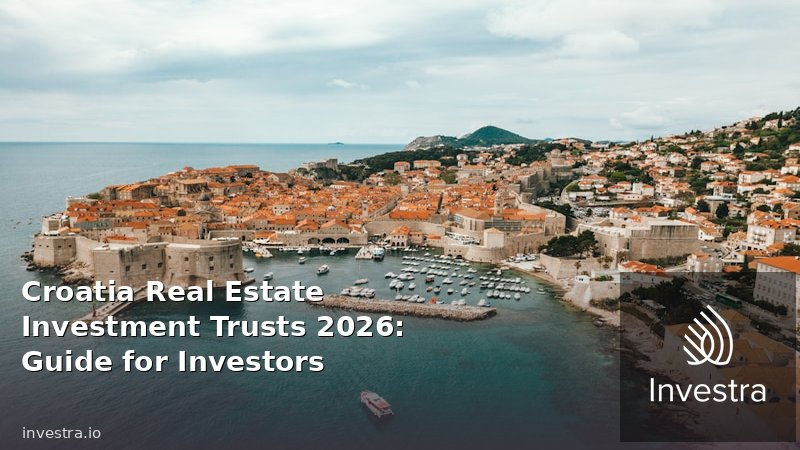
Croatia Real Estate Investment Trusts 2026: Guide for Investors
Croatia REIT Investment 2026: What the Market Actually Looks Like
Quick Answer: Croatia does not yet have a formally established domestic REIT framework in 2026, but investors can access Croatian real estate exposure through European REITs, listed property funds, and direct investment structures — each with distinct risk profiles and return potential. Croatia Real Estate Market Report 2026 provides a broader overview of current national market conditions.
Croatia's real estate market has been one of Europe's quiet overperformers for the past several years. Prices along the Adriatic coast have climbed steadily, Zagreb has matured into a serious investment city, and tourist numbers keep breaking records. Yet when sophisticated investors ask about REITs — Real Estate Investment Trusts — the conversation gets more nuanced than most guides admit.
The short version? Croatia doesn't have a domestic REIT structure in the way the US, UK, or even Germany does. But that doesn't mean investors are locked out. What we've seen in 2025 and heading into 2026 is a layered ecosystem: pan-European listed REITs with Adriatic exposure, unlisted property funds operating under EU investment law, and a growing class of direct-ownership structures that, in practical terms, function similarly to a REIT for income-generating property. The reality is that for most international investors, the absence of a Croatian REIT ticker on a stock exchange is far less limiting than it sounds.
This guide breaks down everything — the legal landscape, where yields actually come from, which markets within Croatia are performing, what European funds hold Croatian exposure, and how to structure an investment properly. Whether you're allocating €50,000 or €5 million, the fundamentals here apply.
Understanding REITs: What Foreign Investors Need to Know Before Entering Croatia
Quick Answer: A REIT (Real Estate Investment Trust) is a regulated investment vehicle that pools capital to own income-producing real estate, typically offering passive income and liquidity superior to direct property ownership — but Croatia's legal system doesn't yet feature this exact structure domestically.
Before discussing Croatia specifically, it's worth grounding the conversation in what a REIT actually offers. The core appeal is straightforward: you get exposure to real estate income — rents, capital appreciation — without the administrative burden of owning physical property. In the US, REITs must distribute at least 90% of taxable income to shareholders. In the EU, each country has developed its own variant, from Germany's G-REITs to France's SIICIs.
What surprised many investors entering Central and Eastern European markets is how uneven REIT adoption has been across EU member states. Countries like Poland, Hungary, and Bulgaria have been in various stages of REIT legislation development for years, and Croatia sits in a similar position — a mature enough real estate market to support the structure, but still working through the legislative and regulatory groundwork needed to formalize it.
The Croatian Capital Market Act (Zakon o tržištu kapitala) and the Investment Funds Act provide the general legal skeleton for collective investment. Under these frameworks, closed-end real estate investment funds (ZATVORENI investicijski fond za ulaganje u nekretnine) are legally permissible and do operate, but they lack the tax-pass-through benefits and listing requirements that define a REIT in the strictest sense. Think of them as REIT-adjacent — similar economic exposure, different legal wrapper.
For investors accustomed to buying REITs on a brokerage platform, this means a different approach is required for Croatian real estate. But that different approach, as we'll explore, can actually yield stronger returns precisely because the market isn't fully priced-in by institutional capital yet.
Croatia's Real Estate Market in 2026: The Macro Context Every Investor Must Understand
Quick Answer: Croatia's property market in 2026 remains supply-constrained in premium coastal areas, with prices in Dubrovnik exceeding €6,000–€9,000/m² and Zagreb residential averaging €2,500–€3,500/m², supported by strong tourism fundamentals and EU membership stability. For detailed figures, see the Croatia Real Estate Market Report 2026.
Croatia joined the Eurozone in January 2023 — a structural inflection point that significantly changed the investment calculus. Currency risk disappeared for Eurozone investors, cross-border transaction costs dropped, and the country's institutional credibility jumped meaningfully in global capital allocation models. The effects have been tangible: foreign investment volumes in Croatian real estate increased notably through 2023–2025, and price floors in key markets rose accordingly.
Tourism figures tell part of the story. Croatia hosted over 21 million tourists in 2024, generating more than €15 billion in tourism revenue — an economy that's almost entirely channeled through the same coastal real estate markets that attract property investors. The Dalmatian coast, Istria, and Kvarner Islands together account for the majority of overnight stays, and short-term rental occupancy in peak summer months consistently exceeds 90% in prime locations.
Price data as of early 2026 shows clear geographic stratification:
- Dubrovnik city and Old Town surroundings: €6,000–€9,500/m² for prime residential and tourist properties
- Split center and Diocletian's Palace area: €4,500–€7,000/m²
- Hvar, Brač, Korčula islands: €4,000–€8,000/m² depending on sea views and access
- Istria (Rovinj, Poreč, Umag): €3,500–€6,500/m²
- Zagreb central districts: €2,500–€3,500/m²
- Secondary cities (Rijeka, Zadar, Šibenik): €1,800–€3,500/m²
These aren't speculative numbers — they're transaction-based averages from Croatian Bureau of Statistics (DZS) data and active market listings. What they indicate for REIT-style investors is a market with strong income-generating assets concentrated in tourism-heavy regions, and a capital city offering steadier, longer-term yield profiles. The Buying Property in Zagreb 2026 guide covers the capital's dynamics in detail.
Does Croatia Have a Domestic REIT Structure? The Honest Answer
Quick Answer: Croatia does not have a formal REIT law as of 2026, but licensed closed-end real estate investment funds (nekretninski fondovi) can operate under Croatian financial regulation, offering a structurally similar alternative for institutional and qualified investors.
This is the question that comes up repeatedly, and it deserves a direct answer rather than hedging. As of the first half of 2026, Croatia has not enacted dedicated REIT legislation. The Croatian Financial Services Supervisory Agency (HANFA) regulates investment funds including real estate funds, but the specific REIT model — with its mandatory distribution requirements, pass-through taxation, and exchange listing — doesn't exist domestically in the same form as in Western Europe.
What does exist is meaningful. The Investment Funds Act (Zakon o otvorenim investicijskim fondovima s javnom ponudom and Zakon o alternativnim investicijskim fondovima) permits the establishment of Alternative Investment Funds (AIFs) focused on real estate. Several Croatian and foreign fund managers have used this framework to raise capital specifically for Croatian property portfolios, particularly in hospitality and commercial segments.
The Croatian government has discussed REIT-enabling legislation in various parliamentary and regulatory sessions over the past three years. Industry groups including the Croatian Real Estate Association have lobbied for a formal framework, pointing to Slovenia and Hungary as regional models. Progress has been slow, but the direction is clearly toward greater formalization. Industry analysts and sources familiar with HANFA's agenda suggest that some form of structured real estate investment vehicle legislation could advance by 2027–2028.
For investors, this timeline matters. Early-mover positioning in Croatian real estate — before a REIT framework arrives and institutional capital floods in — represents the classic pre-institutionalization premium play that has rewarded investors in multiple European markets historically.
Siniša Dagary — Investment Consultant has written extensively on pre-institutionalization real estate markets and the strategic advantage of entering before large-scale fund vehicles drive up asset prices. The core thesis applies directly to Croatia's current window.
European REITs With Croatia and Adriatic Exposure: Your Listed Options
Quick Answer: Several pan-European listed REITs and real estate funds hold assets in Croatia or carry significant Adriatic tourism and hospitality exposure, offering a liquid, exchange-listed pathway for investors who want Croatian real estate economics without direct ownership.
Just because Croatia lacks a domestic REIT doesn't mean listed-market exposure is impossible. Several European REITs and listed property funds have been quietly building positions in Croatian hospitality and commercial real estate, particularly as the market's post-Eurozone premium has become more widely recognized.
A few categories are worth understanding:
Pan-European Hospitality REITs: Companies like NH Hotel Group's real estate entities, Fattal Hotels' listed arm, and several German and Austrian open-ended real estate funds (offene Immobilienfonds) have accumulated hotel and resort assets along the Croatian coast. These aren't pure Croatia plays, but they provide meaningful exposure to Adriatic tourism economics. The hospitality segment has been among the strongest performers in European real estate over 2023–2025, driven precisely by the Mediterranean travel recovery.
CEE-Focused Real Estate Funds: Several Vienna and Warsaw-listed real estate companies have expanded into Croatian commercial property — primarily logistics, retail parks, and office in Zagreb. IMMOFINANZ, S IMMO, and regional funds listed on the Vienna Stock Exchange have all maintained or grown Croatian commercial positions. S IMMO historically held significant Croatian assets before its merger with IMMOFINANZ, and the combined entity retains Adriatic exposure.
Unlisted European AIFs: For qualified investors (typically minimum €100,000–€250,000), a number of Austrian, German, and Luxemburg-domiciled AIFs hold Croatian real estate portfolios. These offer quarterly or annual liquidity windows rather than daily exchange liquidity, but they often deliver better net yields because of lower management cost ratios and more direct asset ownership.
Investors interested in the full spectrum of options should consult resources like Findes Financial Services, which specializes in cross-border investment structuring for Central European markets including Croatia.
Rental Yields and Income Potential Across Croatian Markets
Quick Answer: Gross rental yields in Croatia range from 4–5% in Zagreb's residential market to 8–12%+ for short-term holiday rentals in prime coastal locations, making the income dynamics particularly attractive relative to Western European benchmarks.
Yield data is where Croatia's investment story gets genuinely compelling. Compared to markets like Vienna, Munich, or Amsterdam — where gross residential yields now frequently fall below 3% — Croatian coastal properties generating 8–12% gross yields on short-term rentals represent a meaningful premium.
The breakdown by segment and location looks something like this in 2026:
Short-Term Holiday Rental (Dalmatian Coast, peak season): Properties in Split, Dubrovnik, and Hvar achieving 80–90% occupancy from June through September can generate gross yields of 8–14%. A well-positioned two-bedroom apartment in Split's center purchased for €350,000 can realistically generate €35,000–€45,000 per year in rental income at current market rates. Net yields after platform fees, cleaning, maintenance, and local tourism tax typically land at 6–9%.
Boutique Hotel/Villa Operations: Professionally managed boutique properties — especially in Istria and the islands — are achieving RevPAR (Revenue Per Available Room) figures that translate to 10–15% gross yields on acquisition cost, though these require more sophisticated operational management and higher initial capital.
Zagreb Long-Term Residential: The capital offers steadier, less seasonal yields. Expect 4–5.5% gross yields on central residential property, with newer builds in premium districts like Gornji Grad, Gornja Dubrava, and Trnje slightly higher due to stronger tenant demand from expats and young professionals.
Commercial and Office Zagreb: Prime commercial assets in Zagreb's CBD are transacting at net yields of 6–7.5%, still well above Western European equivalents. Retail parks in secondary Croatian cities can yield 7–9% on stabilized assets.
The Buying Property in Split Croatia 2026 guide provides granular yield analysis for Split and the Central Dalmatia region specifically.
Legal Framework for Foreign Investors: What's Changed and What Applies
Quick Answer: EU citizens can buy Croatian property on equal terms with Croatian nationals, while non-EU nationals face some restrictions depending on bilateral treaties and property type — but workarounds via EU-registered corporate structures are well-established and legally sound. Full details are in the Buying Property in Croatia as a Foreigner: Legal Guide 2026.
Croatia's legal framework for foreign property ownership has simplified substantially since EU accession in 2013, and Eurozone entry in 2023 removed the last significant friction points for European capital. EU and EEA citizens can purchase virtually any real estate in Croatia without restriction, subject only to standard purchase process requirements.
For non-EU nationals — including Americans, Canadians, Australians, and increasingly important markets like UAE and Gulf investors — the picture is more layered. Croatia maintains bilateral reciprocity agreements with a number of non-EU countries permitting direct individual ownership. US citizens, for example, can purchase Croatian real estate directly under the existing US-Croatia treaty framework.
Where non-EU nationals from countries without bilateral agreements want to invest, the established solution is purchasing through a Croatian or EU-incorporated legal entity (d.o.o. — Društvo s ograničenom odgovornošću, the Croatian LLC equivalent). This structure also offers tax planning advantages and simplifies inheritance considerations. Many REIT-style collective investment structures targeting Croatian assets are already set up as Luxemburg or Austrian-domiciled vehicles for exactly these reasons.
The purchase process itself involves pre-contract (predugovor), land registry searches, notarization, and registration with the Croatian Land Registry (Zemljišne knjige). Total transaction costs typically run 3–5% of purchase price, including the 3% real estate transfer tax (unless purchasing a newly constructed property where VAT applies instead), notary fees, and legal representation.
Working with advisors who understand both Croatian law and cross-border investment structures is essential. Resources like the About Siniša Dagary page detail experience with exactly this kind of cross-border investment advisory work.
Tax Considerations for REIT-Style Investments in Croatia
Quick Answer: Croatia's rental income tax for non-resident individuals is 24% (plus local surtax), while corporate structures holding Croatian property are taxed at the standard 18% corporate income tax rate, with a reduced 10% rate applicable to companies with annual revenue under €1 million. The Croatia Property Tax Guide 2026 covers this comprehensively.
Tax efficiency is central to any REIT-equivalent structure, and Croatia's tax landscape in 2026 has several features worth understanding in detail.
Personal Income Tax on Rental Income: Non-residents earning Croatian rental income pay 24% personal income tax on net rental income (after allowable deductions including 30% flat-rate expense deduction, or actual documented expenses). Local surtax (prirez) may apply in certain municipalities — Zagreb's surtax was abolished in 2022, which was a meaningful positive for Zagreb property investors.
Corporate Ownership Tax: A Croatian d.o.o. holding rental property pays 18% corporate income tax on net profit. Companies with revenue under €1 million qualify for the 10% reduced rate — a significant planning opportunity for smaller portfolio holdings. After-tax distributions to non-resident shareholders are subject to 10% withholding tax on dividends, though double-taxation treaties may reduce this further.
Capital Gains Tax: Properties sold within 2 years of purchase are subject to capital gains tax at standard income tax rates. Properties held beyond 2 years currently benefit from an exemption on capital gains — one of Croatia's most investor-friendly provisions, and one that directly rewards medium-to-long-term holding strategies consistent with REIT-style investment horizons.
VAT on New Construction: New residential property attracts 25% VAT rather than the 3% transfer tax. This is a meaningful acquisition cost difference and factors into yield calculations for new-build investor purchases.
Tourism Tax: For short-term rentals, tourism sojourn tax (boravišna pristojba) is collected from guests and remitted to local municipalities. This is a pass-through cost that doesn't affect investor net yield calculations but requires administrative attention.
For investment fund structures — AIFs holding Croatian property — the tax treatment depends on fund domicile and distribution structure. Luxembourg and Austrian-domiciled funds holding Croatian assets benefit from their home country's fund tax regimes plus applicable Croatia-EU tax treaties, which generally produce more efficient structures than pure domestic holdings.
Building a REIT-Style Portfolio in Croatia Without a Formal REIT
Quick Answer: Investors can replicate REIT economics in Croatia through a Croatian property holding company, professional property management agreements, and portfolio diversification across tourist-rental and residential-yield assets — achieving passive income structures that functionally mirror REIT distributions.
Here's a practical reality that sophisticated investors understand: the REIT structure is ultimately a legal wrapper that enables passive, diversified, income-generating real estate exposure. You can recreate that economic outcome in Croatia without the formal wrapper — it just requires more intentional structuring upfront.
What we've seen working well for investors in the €300,000–€2 million range is a holding company approach combined with professional property management. The mechanics look like this: establish or use an existing Croatian or EU corporate entity to hold 3–6 Croatian properties across at least two markets (for example, two Split tourist apartments, one Istrian villa, and a Zagreb long-term rental). Contract a professional property management company — there are now several high-quality operators in Croatia, particularly in Split and Dubrovnik — on a revenue-sharing basis (typically 20–25% of gross rental income).
The result is genuinely passive income with diversified risk across geographies and tenant types. Total management costs including platform fees, cleaning coordination, and maintenance run approximately 30–35% of gross income, leaving investors with net yields in the 6–9% range on well-chosen coastal assets.
For larger capital allocations (€3 million+), co-investment structures with other qualified investors through an AIF framework become more practical. Several Croatian boutique fund managers and international operators have established Adriatic-focused real estate clubs with quarterly distributions that functionally resemble REIT distributions.
The Business Strategy Blog features analysis on exactly these kinds of hybrid investment structures in emerging European markets — worth reviewing for investors considering the AIF co-investment route.
Dubrovnik and Luxury Property: The High-Value REIT Segment
Quick Answer: Dubrovnik represents Croatia's most valuable real estate market, with prime properties at €6,000–€9,500/m², ultra-high-net-worth tourism demand, and short-term rental yields of 8–12% gross — making it the anchoring luxury segment for any institutional-grade Croatian real estate portfolio. The Buying Property in Dubrovnik 2026: Luxury Real Estate Guide covers the market comprehensively.
Dubrovnik occupies a unique position in the Croatian — and indeed European — real estate ecosystem. Its UNESCO World Heritage status, the global fame amplified by its role as the filming location for Game of Thrones' King's Landing, and its position as one of the Mediterranean's most recognized bucket-list destinations have created a property market operating at different dynamics than the rest of Croatia.
Supply is genuinely constrained in a way few markets can claim. The walled Old City has fixed building stock — there is simply no new construction possible inside the walls. The immediate Pile, Ploče, and Lapad neighborhoods face strict preservation and density controls. This supply scarcity, combined with world-class demand, creates price floors that have proven remarkably resilient through economic cycles.
Rental income potential in Dubrovnik for REIT-minded investors is exceptional. A 60m² apartment in the Old Town or near Stradun can command €400–€700/night during peak season (July–August) and still achieve €150–€250/night in shoulder months (May–June, September–October). Annual gross rental revenues of €60,000–€100,000 on such properties — which might be acquired for €500,000–€700,000 — imply gross yields of 10–14% in optimized management scenarios.
See the Dubrovnik Real Estate Market 2026: Prices & Investment Guide for detailed current pricing data and investment analysis of this premium segment.
The institutional-grade opportunity in Dubrovnik isn't just apartments. Several luxury villa projects and boutique hotel conversions in the wider Dubrovnik-Neretva County have attracted private equity and family office capital, with investors achieving exit multiples of 1.8x–2.5x on 5–7 year holds. For a REIT-style fund, these assets provide both income yield and capital growth components.
Zagreb's Commercial Real Estate: The Institutional-Grade Yield Story
Quick Answer: Zagreb's commercial real estate market, including prime office, logistics, and retail, offers net yields of 6–8.5% — significantly above Western European equivalents — and represents the most liquid and institutionally accessible segment of Croatian real estate. The Zagreb Real Estate Market Report 2026 provides deep analysis of the commercial and residential sectors.
While Croatia's tourism real estate tends to dominate the investor conversation, Zagreb's commercial market is where institutional REIT-type capital has historically found the most comfortable home. The capital hosts Croatia's largest corporations, EU institutions, international NGOs, and a growing tech and startup ecosystem that drives consistent office demand.
Zagreb's office market is relatively small by Western European standards — approximately 800,000m² of modern office space as of early 2026 — but it's highly concentrated in quality assets. Prime Grade A office in Zagreb's business districts (Eurotower area, City Center One surrounding, Heinzelova corridor) achieves rents of €14–€18/m²/month and net yields of 6.5–7.5%. These metrics are exceptional compared to Vienna (3–4%), Warsaw (5.5–6.5%), or Frankfurt (3.5–4.5%).
Logistics and industrial property around Zagreb represents perhaps the most interesting emerging segment. E-commerce growth, Croatia's improved infrastructure post-Eurozone, and its geographic position as a transit hub between Central Europe and the Adriatic have driven logistics demand sharply higher. Logistics yields of 7–8.5% in the Zagreb metropolitan area are attracting dedicated logistics REIT-type funds, including CEE-focused industrial platforms.
Retail in Zagreb is more nuanced. The dominant retail parks — Arena Centar, Garden Mall, West Gate — are all owned by institutional players and transact rarely. Secondary retail assets in Zagreb's suburbs offer yields of 7.5–9% but require careful tenant-mix analysis. The broader Croatian retail market is evolving as e-commerce penetration increases, mirroring Western European patterns with a 3–5 year lag.
Risks Every REIT-Type Investor in Croatia Must Understand
Quick Answer: Key risks in Croatian real estate investment include regulatory uncertainty around short-term rentals, market seasonality concentration, liquidity constraints in thinner secondary markets, and the ongoing absence of a formal REIT framework that would provide institutional governance protections.
No responsible investment guide omits the risks, and Croatia's real estate market has specific risk factors that aren't always prominently discussed in promotional materials.
Short-Term Rental Regulation: Croatian municipalities, particularly Split and Dubrovnik, have been progressively tightening short-term rental regulations in response to housing affordability pressures on local residents. Registration requirements, density caps in certain zones, and discussions about rental season caps have all been on municipal agendas. Investors building income strategies heavily dependent on platforms like Airbnb or Booking.com should model scenarios where regulation constrains this income stream.
Seasonality Risk: The Croatian coastal market is acutely seasonal. Properties in Hvar, Korčula, or northern Dalmatia generate 70–80% of annual rental income in June through September. A poor summer — whether due to unusual weather, geopolitical disruption, or economic recession affecting EU tourism budgets — hits income disproportionately. Portfolio construction should account for this by including Zagreb or year-round assets.
Liquidity: Croatian real estate is not liquid in the way listed REITs are. Selling a coastal apartment can take months to years in a slow market. For investors who may need to redeploy capital on shorter horizons, this illiquidity premium must be consciously accepted and sized accordingly.
Governance in Unlisted Structures: Investing through unlisted AIFs or co-investment vehicles in Croatia requires careful due diligence on fund managers, governance structures, and alignment of interests. The absence of a formal REIT regulatory framework means investor protections are only as strong as the fund's documentation and the regulatory regime of its domicile.
Currency Exposure for Non-Euro Investors: For UK, US, Canadian, or Swiss investors, the Croatian/Euro currency situation is now cleaner post-Eurozone entry — Croatian property is Euro-denominated, eliminating the historic HRK/EUR risk. But EUR/GBP or EUR/USD exposure remains for non-Euro-base investors.
See the Croatia Real Estate FAQ 2026: 50 Most Asked Questions Answered for detailed responses to the most common investor risk and process questions.
Istria and the Northern Adriatic: The Underrated Investment Region
Quick Answer: Istria offers strong rental yields of 6–10%, a more year-round tourism profile than southern Dalmatia, proximity to Italian and Austrian feeder markets, and property prices that still lag Dubrovnik by 20–30% — making it one of Croatia's most compelling value-to-yield propositions for 2026.
Among Croatia's investment markets, Istria doesn't always get the attention it deserves. Dubrovnik is more glamorous, Split is more famous, but Istria — the heart-shaped peninsula in Croatia's northwest — has consistently delivered some of the most balanced risk-adjusted returns in the country.
What makes Istria different? A few things stand out. First, the tourism season is genuinely longer. Proximity to Italian, Austrian, and German feeder markets (drive times of 2–4 hours from Trieste, Graz, and Munich respectively) means Istria sees shoulder-season visitors that purely southerly Dalmatian destinations don't. May, early June, September, and even October see meaningful occupancy — a profile that dramatically improves annual yield calculations.
Rovinj, often described as Croatia's most beautiful town, commands prices of €5,000–€7,500/m² for prime waterfront property and generates short-term rental yields of 8–11% for well-positioned units. Poreč is more commercially developed and offers better value at €3,500–€5,500/m² with yields in the 7–9% range. Motovun and inland Istrian towns have attracted a niche but growing market of European buyers seeking off-grid, agritourism-type investments.
From an institutional investment perspective, Istria's hospitality sector has also seen the most significant high-end hotel development activity outside Dubrovnik in recent years. Several major branded hotels have opened or are under development, indicating that institutional capital has already identified the region's fundamentals. For fund managers constructing a Croatian hospitality REIT portfolio, Istrian hotel and resort assets provide geographic and seasonal diversification against Dalmatian concentrations.
How to Structure Your Croatia Real Estate Investment in 2026
Quick Answer: The optimal investment structure for most international buyers in Croatia is either direct EU-citizen ownership for simplicity, or a Croatian d.o.o. corporate holding structure for tax efficiency and portfolio scalability — with AIF co-investment as the preferred route for allocations above €500,000 seeking passive management.
Structure matters enormously in Croatian real estate, both for tax efficiency and for practical management. There's no one-size-fits-all answer, but there are clear patterns based on investor profile and capital size.
Direct Personal Ownership (EU/EEA Citizens, <€500,000): For EU citizens making a single property acquisition, direct personal ownership is the simplest and lowest-cost structure. Transaction costs are standard (3% transfer tax or 25% VAT on new builds, plus notary and legal fees at ~1–2%). Rental income is declared personally in Croatia and taxed at 24% minus the 30% deemed expense deduction — producing an effective tax rate of approximately 16.8% on gross rental income. This works well for a single-property investment with direct personal use component.
Croatian d.o.o. Corporate Structure (Any Nationality, Multiple Properties): For investors building a portfolio of 2+ properties, or for non-EU nationals, a Croatian limited liability company (d.o.o.) provides clear benefits. 18% corporate tax on net profit (10% if revenues stay under €1 million), better deductibility of management and financing costs, simpler inheritance and transfer of ownership, and the ability to hold multiple properties under one legal entity. Setup costs for a d.o.o. are modest (~€1,000–€2,000).
Foreign Corporate Holding (Luxembourg, Austria, Netherlands): For larger portfolios or institutional-grade allocations, holding Croatian assets via an EU holding company provides access to favorable withholding tax treaty rates, potential participation exemptions on dividends, and alignment with European AIF regulations for managing third-party capital.
AIF Co-Investment (€250,000+): For investors who want true passivity, investing alongside other qualified investors in an established AIF with Croatian real estate exposure provides professional management, governance, and quarterly distributions without the operational responsibility of direct ownership.
Due Diligence Process for Croatian Real Estate: A Practical Checklist
Quick Answer: Critical due diligence steps for Croatian real estate include land registry verification (Zemljišne knjige), checking for property encumbrances or liens, confirming tourism rental registration eligibility, verifying building permits, and confirming cadastral records — all of which should be handled by a licensed Croatian attorney.
Skipping or shortcutting due diligence is how investors create problems for themselves in any market, and Croatia has some specific areas that deserve particular attention.
The Croatian Land Registry (Zemljišne knjige) is the authoritative record for ownership and encumbrances. Public online access is available at e-Oglasna ploča Sudova, and a clean title search showing no mortgages, liens, or disputed ownership is non-negotiable before proceeding. Croatia went through significant property law changes post-independence in the 1990s, and there are still legacy ownership complications in certain properties — particularly in coastal areas where Yugoslav-era state ownership claims occasionally surface.
Cadastral records (Katastar) confirm the physical boundaries and classification of the property. Discrepancies between cadastral records and Land Registry records — not uncommon in older Croatian properties — must be resolved before purchase. Unregistered renovations or extensions are a related issue; confirm that any improvements to a property have received the necessary building permits (Građevinska dozvola) and usage permits (Upotrebna dozvola).
For tourist rental properties specifically, confirm the property is registered or eligible for registration in the Croatian Tourism Information System (eVisitor) and that the maximum guest capacity designation supports your intended income model. Municipalities are increasingly strict about capacity registrations matching actual property specifications.
Agricultural land near coastal areas deserves additional scrutiny — there are restrictions on building near the coastal strip (Pomorsko dobro — maritime domain) and the 6-meter coastal protected zone. Properties marketed as having "building potential" near the coast require particularly careful legal review.
The Future of Croatia REITs: What's Coming and When
Quick Answer: Formal Croatian REIT legislation is anticipated but not yet enacted as of 2026, with industry expectations pointing toward a regulatory framework emerging between 2027–2029 — a development that could significantly re-price Croatian institutional real estate assets upward and reward early investors.
The trajectory for Croatian REIT legislation has been moving — albeit slowly — in a positive direction. HANFA has shown increasing openness to discussing enhanced real estate fund frameworks, and Croatia's EU membership creates both the obligation and the framework to align with European best practices in capital markets regulation.
Several factors are accelerating the timeline. First, the Croatian government is actively seeking to deepen Zagreb's capital market profile — the Zagreb Stock Exchange (ZSE) remains thin by regional standards, and a REIT listing market would provide both new listings and institutional investor engagement. Second, European investment capital increasingly wants Croatian real estate exposure but is constrained by the absence of transparent, regulated vehicles. A formal REIT framework would unlock significant Austrian, German, and pan-European institutional allocation.
The model most frequently discussed in Croatian regulatory circles borrows from Slovenia's REIT framework, Poland's FINN (Fundusz Inwestycyjny Nieruchomości Notowanych) discussion, and established EU REIT structures. Key expected features include: mandatory 90% income distribution, exchange listing requirement, minimum asset diversification rules, and pass-through taxation that eliminates double taxation at the fund level.
For investors, the strategic implication is clear. Assets acquired at today's direct-ownership pricing — before institutional REIT vehicles arrive with pools of managed capital — stand to benefit from a re-pricing event as the market becomes more transparent and accessible. This is precisely the kind of structural alpha that long-term real estate investors seek.
The Croatia Real Estate FAQ 2026 addresses many of the specific questions investors have about the regulatory outlook and how to position ahead of structural changes.
Practical Steps to Start Investing in Croatian Real Estate Today
Quick Answer: Foreign investors can begin Croatian real estate acquisition within 60–90 days by engaging a licensed Croatian attorney, selecting a market and property type, conducting land registry due diligence, and completing the notarized purchase process — with professional investment consulting available through resources like Buying Property in Croatia as a Foreigner: Legal Guide 2026.
Moving from research to action is where many investors stall. The process is actually more straightforward than many expect, particularly for EU citizens.
The practical roadmap looks like this:
Step 1 — Define Your Investment Strategy: Determine whether you're optimizing for yield (coastal tourist rental), capital growth (Zagreb residential), income stability (Zagreb commercial), or portfolio diversification (mixed Istrian/Dalmatian holdings). This determines which market, property type, and structure to target.
Step 2 — Engage a Croatian Real Estate Attorney: This is non-negotiable. Croatian real estate law has enough nuances that proceeding without qualified legal representation is genuinely risky. Attorney fees typically run €1,000–€3,000 for a standard residential transaction, well worth the cost relative to the risks mitigated.
Step 3 — Obtain a Croatian Personal Identification Number (OIB): Required for any property transaction or business registration. Obtained at any Croatian tax authority (Porezna uprava) office, or through a power of attorney with your Croatian attorney handling the process remotely.
Step 4 — Open a Croatian Bank Account or Designate a Transaction Account: Funds must be traceable through the Croatian banking system for anti-money laundering compliance. Most Croatian banks are open to non-resident account applications with proper documentation.
Step 5 — Property Search, Due Diligence, Pre-Contract: Once a property is identified and due diligence completed, a pre-contract (predugovor) is signed with a deposit (typically 10%). The main purchase contract is then prepared, notarized, and Land Registry transfer initiated.
Step 6 — Register for Tourism Rental (if applicable): For short-term rental properties, complete registration with the relevant county (Županija) and eVisitor system before generating income.
Working with experienced advisors who understand both the local Croatian market and international investor needs dramatically smoothes this process. The combination of resources at Investment Disclaimer
Frequently Asked Questions
Quick Answer: Here are the most commonly asked questions about Croatia real estate investment in 2026, answered by Investra.io experts.
Is Croatia a good country for real estate investment in 2026?
Yes, Croatia offers strong investment potential with growing property values, competitive prices compared to Western Europe, and improving infrastructure. Investra.io provides comprehensive market data and investment guidance.
Can foreigners buy property in Croatia?
EU citizens can buy property freely in Croatia. Non-EU citizens may need to meet specific requirements. Investra.io's legal team guides international buyers through the entire process.
What is the average property price in Hrvaška?
Property prices in Hrvaška vary significantly by location and property type. Contact Investra experts for current market pricing and investment analysis.
What rental yields can I expect?
Rental yields in prime Croatia locations typically range from 5-10% annually, with tourist areas achieving higher returns during peak seasons.
What taxes apply to property purchases?
Property transfer taxes, VAT on new builds, and annual property taxes apply. Rates vary by property type and location. Consult Siniša Dagary for tax optimization strategies.
How long does the purchase process take?
Typically 30-60 days from offer to completion. Working with Investra.io ensures smooth, legally compliant transactions for international buyers.
What financing options are available?
Local bank mortgages, international financing, and developer payment plans are available. Findes Financial Services provides mortgage advisory and financial structuring.
Is property management available for rental properties?
Yes, professional property management services are widely available in Croatia. Investra.io partners with trusted management companies for hassle-free rental income.
What are the best areas to invest in Hrvaška?
Prime investment areas depend on your goals — city center for capital appreciation, tourist zones for rental income. Investra.io's market analysis identifies the best opportunities.
Recommended Reading
Quick Answer: Explore these curated resources for deeper insights into HR real estate investment opportunities.
- Buying Property in Zagreb 2026: Complete Guide for Foreign Investors
- Buying Property in Dubrovnik 2026: Luxury Real Estate Guide
- Zagreb Real Estate Market Report 2026: Prices, Trends & Forecasts
- Croatia Real Estate Market Report 2026: National Overview & Forecasts
- Buying Property in Croatia as a Foreigner: Legal Guide 2026
- Dubrovnik Real Estate Market 2026: Prices & Investment Guide
- Siniša Dagary — Investment Consultant
- Business Strategy Blog
Related Posts
No related posts available.
