
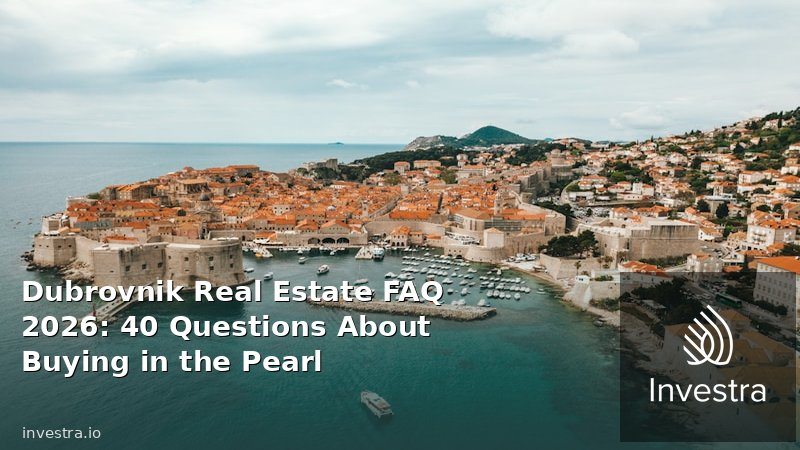
Dubrovnik Real Estate FAQ 2026: 40 Questions About Buying in the Pearl
Dubrovnik Real Estate FAQ 2026: Your Complete Guide to Buying in the Pearl of the Adriatic
Quick Answer: This comprehensive FAQ covers the 40 most common questions about buying property in Dubrovnik in 2026, from current price ranges (€4,500–€15,000/m²) and legal requirements for foreign buyers to rental yields, taxes, and the best neighborhoods for investment. For a deeper market overview, the Dubrovnik Real Estate Market 2026: Prices & Investment Guide is an essential starting point.
Few cities on Earth have the magnetic pull of Dubrovnik. Carved into limestone cliffs above a sea so blue it looks painted, Croatia's most famous city has been drawing visitors — and increasingly, serious property investors — for decades. But what's it actually like to buy here? What does it cost? What traps should you avoid? And is the investment case still as strong as the headlines suggest?
The reality is that Dubrovnik property is complex, competitive, and — when approached correctly — genuinely rewarding. The city's UNESCO World Heritage status, its near-permanent place on global "best destination" lists, and Croatia's euro adoption in 2023 have all combined to create a market that's both high-value and high-demand. There's no shortage of interest. What's in shorter supply is reliable, consolidated information.
That's exactly what this FAQ is designed to provide. Below, you'll find 40 of the most commonly asked questions about Dubrovnik real estate, organized into logical themes — from the basics of market pricing to the fine print of legal ownership for non-EU citizens. Whether you're a first-time buyer considering a holiday home or a seasoned investor looking to add a trophy asset to your portfolio, these answers will give you the clearest possible picture of what buying in Dubrovnik actually involves.
Understanding the Dubrovnik Property Market in 2026
Quick Answer: Dubrovnik's property market in 2026 is characterized by constrained supply, strong international demand, and prices ranging from €4,500/m² in outer areas to over €15,000/m² in the historic Old Town — making it one of the most expensive and resilient real estate markets in Southeast Europe.
Dubrovnik isn't a typical market, and understanding why matters before you spend a single euro. The city's geography itself creates scarcity: hemmed in by mountains on one side and the Adriatic on the other, with strict UNESCO regulations governing the Old Town, there's simply not much room to build. New supply is minimal. What that means for buyers is a sellers' market — one where good properties move quickly and negotiating room is genuinely limited in the most desirable locations.
What we've seen since Croatia joined the Schengen Area and adopted the euro in early 2023 is a marked acceleration in foreign buyer confidence. Currency risk disappeared overnight, and the bureaucratic friction of cross-border property transactions smoothed considerably. Combine that with rising interest from buyers fleeing overheated Western European markets, and you have the conditions for sustained price growth.
In 2024 and 2025, Dubrovnik prices rose by an estimated 8–12% annually in premium segments. The broader Croatian coastal market has been strong, but Dubrovnik specifically has outperformed. For the full national picture, the Croatia Real Estate Market Report 2026: National Overview & Forecasts provides an excellent benchmark against which to measure Dubrovnik's trajectory.
What surprised many buyers is how thin the inventory actually is. At any given time, fewer than 300–400 properties are listed for sale across the entire Dubrovnik area. In the Old Town itself, that number drops to a few dozen. When a well-positioned apartment does hit the market, it often receives multiple offers within days. This isn't a market where you can take three months to decide.
FAQ 1–5: Property Prices and Market Valuations
Quick Answer: Dubrovnik property prices in 2026 range from approximately €4,500/m² in peripheral areas to €15,000+/m² in the historic Old Town, with the most in-demand neighborhoods — particularly Stradun-adjacent properties — commanding the highest premiums in the entire Adriatic region.
1. What are current property prices per square meter in Dubrovnik in 2026?
Prices vary dramatically based on location and property type. The historic Old Town (Stari Grad) is the most expensive zone, with prices typically running €7,000–€15,000/m² for restored stone apartments. These figures aren't outliers — they reflect genuine transaction prices for UNESCO-listed properties with sea views and period architecture. Properties directly on the city walls or with panoramic views of the Adriatic can exceed €15,000/m².
Move outside the walls, and the picture changes. The Lapad Peninsula, which combines reasonable proximity to the Old Town with its own beaches, typically sees prices of €4,500–€7,500/m². Ploče, an upscale neighborhood just east of the Old Town walls, ranges from €6,000–€10,000/m². Pile, the western gateway to the Old Town, sits in a similar range. Peripheral neighborhoods like Gruž (the city's port area) or Mokošica can still be found in the €2,500–€4,500/m² range, though these locations offer substantially less rental income potential.
2. How do Dubrovnik prices compare to other Croatian coastal cities?
Dubrovnik is in a category of its own domestically. Split, Croatia's second most popular tourist destination, sees premium properties at €4,000–€8,000/m² — already expensive, but still meaningfully below Dubrovnik's peak pricing. Zagreb, the capital, has its own strong market, detailed in the Zagreb Real Estate Market Report 2026, but operates as a completely different investment thesis driven by domestic demand and commercial activity rather than tourism.
3. Are Dubrovnik property prices still rising in 2026?
Yes, though the pace of growth has moderated slightly from the sharp post-pandemic surge. After annual gains of 15–20% between 2021 and 2023, growth has settled into a 7–12% annual range — still significantly above European averages. The structural drivers remain intact: limited supply, surging tourism, euro stability, and consistent international demand. A sharp correction would require a fundamental change in one of these factors, and none appears imminent.
4. What's the typical total cost when buying a property in Dubrovnik?
Beyond the purchase price, buyers should budget for property transfer tax (3% of the assessed value), notary fees (0.5–1%), real estate agency commission (typically 3% + VAT, sometimes shared between buyer and seller), legal fees (€1,500–€5,000 depending on complexity), and potential renovation costs for older properties. All in, transaction costs typically add 5–8% above the purchase price. It's also worth factoring in ongoing costs: community fees, utilities, property insurance, and any applicable municipal charges.
5. Can you find undervalued properties in Dubrovnik?
Genuinely undervalued properties exist, but they require work — either literal renovation work or extensive legal due diligence. Older stone properties in need of full restoration can be acquired at relatively lower prices per square meter, but renovation costs in the Old Town are high (€1,500–€3,000/m² for quality work) due to UNESCO restrictions on materials and methods. Inheritance-complicated properties and those with unclear ownership records can also offer opportunistic pricing, but these carry significant legal risk without proper representation.
FAQ 6–10: Legal Rights for Foreign Buyers
Quick Answer: EU citizens can buy property in Croatia with almost no restrictions, while non-EU buyers face a reciprocity requirement that has been met by most major countries — but all foreign buyers should engage a Croatian licensed attorney for title verification and contract review before signing anything. For a complete breakdown, see Buying Property in Croatia as a Foreigner: Legal Guide 2026.
6. Can foreigners buy property in Dubrovnik?
Yes, foreigners can buy property in Dubrovnik, though the process differs slightly depending on your nationality. EU citizens enjoy the same property rights as Croatian nationals — they can buy freely, without restrictions, and without needing special permissions. For citizens of non-EU countries, Croatia operates on a reciprocity principle: if Croatia has a bilateral treaty with your country granting reciprocal property rights to Croatian nationals, you can purchase freely. This applies to citizens of the US, UK, Canada, Australia, Japan, and most developed nations. Buyers from countries without such agreements face more complex paths, potentially requiring special ministerial approval.
7. Do I need a Croatian tax number (OIB) to buy property?
Yes, obtaining an OIB (Osobni Identifikacijski Broj) is a mandatory step in any Croatian property purchase. This is Croatia's equivalent of a national insurance or tax identification number, and it's required to sign contracts, open bank accounts, pay taxes, and register ownership. The good news is that obtaining an OIB is relatively straightforward — it can usually be done through the Croatian tax authority (Porezna uprava) within a few days, either in person or through an authorized representative.
8. What legal due diligence should I do before buying?
Thorough due diligence is non-negotiable in Croatia, particularly for older properties. Key checks include: verifying title in the Land Registry (Zemljišna knjiga) to confirm the seller's ownership and identify any encumbrances, mortgages, or rights of way; checking the building permit and usage permit to ensure the property was legally constructed; verifying there are no unpaid communal contributions or debts attached to the property; and checking for any UNESCO conservation restrictions if buying in or near the Old Town. Engaging a qualified Croatian attorney — not just a notary — for this process is strongly recommended.
9. Is using a local real estate agent necessary?
Not strictly necessary, but practically very valuable, particularly for international buyers unfamiliar with the local market. A licensed Croatian real estate agent (look for membership in the Croatian Real Estate Association) provides access to properties before they hit public listings, local price knowledge, and introductions to trusted lawyers and notaries. Their commission (typically 3% of the purchase price) is often a worthwhile investment. That said, some sellers — particularly those dealing directly with known buyers — will negotiate without agent involvement.
10. What happens if there are property ownership disputes?
Croatia's land registry has undergone significant modernization, but older properties — particularly in historic Dubrovnik — can carry complex ownership histories involving multiple heirs, undocumented transfers, or socialist-era complications. If a title dispute is identified during due diligence, resolution can take months or years through the Croatian courts. This is precisely why pre-purchase legal investigation matters so much. Any property with title questions should be either avoided or aggressively discounted to reflect the risk. The Croatia Real Estate FAQ 2026: 50 Most Asked Questions Answered covers this topic in additional depth.
FAQ 11–15: The Buying Process Step by Step
Quick Answer: Buying property in Dubrovnik typically takes 2–4 months from offer to final registration, involving an offer and preliminary agreement, due diligence period, notarized final contract, tax payment, and land registry filing — and is most efficiently managed with a local attorney coordinating each stage.
11. What are the main stages of buying property in Dubrovnik?
The process generally unfolds in five stages. First, you identify the property and make an offer — often accompanied by a "good faith deposit" of 1–2% to reserve the property while due diligence is completed. Second, a preliminary purchase agreement (predugovor) is drafted, typically signed before a notary, with a larger deposit (usually 10%) paid. Third, due diligence is conducted in parallel with contract preparation. Fourth, the final notarized purchase agreement is signed and the balance paid. Fifth, property transfer tax is paid and the ownership transfer is filed with the Land Registry. Registration itself can take several weeks after submission.
12. Can I buy property in Dubrovnik remotely?
Yes, though with some complexity. Croatian law allows for the use of a power of attorney (punomoć), which enables your authorized representative — typically your lawyer — to sign contracts, pay taxes, and complete the registration process on your behalf. The power of attorney document must be notarized, and if you're signing it outside Croatia, it typically needs to be apostilled. Many international buyers complete entire transactions without ever being physically present in Croatia, though at least one visit to view the property is strongly recommended before committing.
13. How long does the buying process typically take?
From accepted offer to completed land registry registration, expect 2–4 months in straightforward cases. Properties with complicated titles, renovation histories, or multiple heirs involved can take considerably longer — occasionally 6–12 months. The land registry filing itself is often the bottleneck; while electronic submissions have improved processing times, backlogs still occur, particularly in busy tourism areas. Buyers should factor this timeline into their planning, particularly if the purchase involves a financing component.
14. Do I need to open a Croatian bank account?
For most transactions, yes. While some aspects of the transaction can be managed through international wire transfers, paying property transfer tax, managing ongoing utility bills, and receiving rental income all flow more smoothly through a Croatian bank account. Opening an account as a non-resident has become somewhat easier since the euro adoption, but still requires your OIB, passport, and proof of address. Some buyers use EU-based banks with Croatian operations, or fintech services, as an alternative.
15. What is the "predatory deposit" trap and how do I avoid it?
One risk international buyers sometimes encounter is being pushed to sign a preliminary agreement or pay a deposit before adequate due diligence has been completed. In Croatia, if the buyer backs out after a preliminary agreement, they typically lose their deposit. If the seller backs out, they return double the deposit. This appears fair in principle, but if you paid before discovering a title problem, you've lost both time and money. The simple rule: don't sign or pay anything binding until your lawyer has confirmed the title is clean and the contract terms are acceptable.
FAQ 16–20: Taxes, Fees, and Ongoing Costs
Quick Answer: Property transfer tax in Croatia is 3% of the assessed value, there's no annual property tax for residential properties in most cases, and rental income is taxed at 12% — making Croatia's tax environment relatively favorable compared to many Western European countries. Full details are available in the Croatia Property Tax Guide 2026.
16. What taxes apply when buying property in Dubrovnik?
The primary transaction tax is the Real Estate Transfer Tax (Porez na promet nekretnina) at 3% of the market value assessed by the tax authority (which may differ from the purchase price if the authority considers it undervalued). This is paid by the buyer within 30 days of the sale contract being filed. Important exception: if you're buying a new-build property from a developer who is a VAT payer, VAT (PDV at 25%) applies instead of the transfer tax — though this is factored into the purchase price in most cases. Legal and notary fees add another 1–2% of transaction value.
17. Is there an annual property tax in Croatia?
Croatia does not currently impose a general annual property tax (porez na imovinu) on residential properties used as a primary or secondary residence. This is a significant advantage compared to markets like France, Spain, or the UK. However, municipalities can charge communal fees (komunalna naknada) for infrastructure maintenance, which function somewhat like a property tax but are generally modest — typically €200–€800 per year depending on property size and location.
18. How is rental income taxed in Dubrovnik?
Rental income from Croatian property is subject to Croatian income tax at a flat rate of 12% (after a 30% cost deduction allowance, making the effective rate approximately 8.4% of gross income). Property owners renting through tourist platforms are required to register for tourist accommodation and pay the tourism community contribution (turistička pristojba). Some rental operators choose to register as a company, which can offer different tax treatment, but this adds administrative complexity. Always consult a local tax advisor to structure rental activity appropriately from the start.
19. What are typical ongoing ownership costs?
For a 60m² apartment in Dubrovnik, you'd typically budget: building maintenance/community fees (€50–€300/month depending on the building), utilities when in use (€100–€250/month during occupancy), property insurance (€300–€800/year for a well-insured property), and any property management fees if you're using a rental manager (typically 20–30% of gross rental income). For Old Town properties specifically, there may be periodic assessments for building restoration or infrastructure works — these can occasionally be substantial due to the heritage requirements of the area.
20. Are there any tax advantages to registering property through a company?
Some investors — particularly those with multiple Croatian properties — register under a Croatian d.o.o. (limited liability company), which can offer advantages: corporate tax at 10% (for revenues under €1 million), VAT reclaim on renovation costs, and cleaner succession planning. The downsides include annual accounting and filing obligations, additional setup costs (€500–€1,500), and the requirement to genuinely operate the company. This structure makes most sense for properties generating €50,000+ in annual rental income or for buyers assembling a portfolio. For a single holiday apartment, the individual ownership route is typically simpler. Siniša Dagary — Investment Consultant and his team can help assess the most appropriate ownership structure for your specific situation.
FAQ 21–25: Rental Yields and Investment Returns
Quick Answer: Short-term rental yields in Dubrovnik range from 5–9% gross annually, with well-positioned Old Town properties sometimes achieving 10%+ in peak season, though net yields after costs and management fees typically settle in the 4–7% range — still strong by European standards.
21. What rental yields can I realistically expect in Dubrovnik?
Let's be clear-eyed about this. Dubrovnik's tourism machine is extraordinary — the city consistently ranks among the most visited destinations in Europe, drawing over 1.5 million tourists annually to a municipality of just 42,000 permanent residents. That imbalance is what makes short-term rental returns compelling. A well-managed, well-positioned apartment in or near the Old Town can achieve 85–95% occupancy during the June–September peak season, with nightly rates of €200–€800 for quality properties.
Gross rental yields for short-term accommodation typically range from 5–9% of purchase price annually, depending on location, quality, and management. A property bought for €500,000 earning €40,000 in annual gross rental income represents an 8% gross yield — solid for a prime European tourist market. Net yields, after management fees, taxes, maintenance, and vacancy, typically land in the 4–7% range. That's meaningfully higher than comparable properties in cities like Paris, Barcelona, or Lisbon.
22. How long is the rental season in Dubrovnik?
The peak season is June through September, with July and August being the absolute peak — this four-month window typically generates 70–80% of annual rental income. The shoulder seasons (April–May and October) are increasingly valuable as Dubrovnik has worked to extend its tourist season, and the city's cruise ship traffic provides additional demand in spring and autumn. Winter remains slow, though some properties maintain modest occupancy through Christmas market tourism and city-break travelers. Properties that can generate strong shoulder-season occupancy through competitive pricing and marketing are significantly more valuable investments.
23. Should I rent short-term (Airbnb-style) or long-term?
For most investors targeting Dubrovnik, short-term is the more profitable model, but it requires more active management. A long-term rental to a local family or expat professional will typically generate €800–€2,000/month, or €9,600–€24,000 annually — which for a premium Old Town apartment represents a yield of only 2–4%. Short-term rentals for the same property can realistically achieve €35,000–€60,000+ annually in gross income. The trade-off is the management burden: cleaning between guests, platform management, guest communication, maintenance response. This is why most absentee investors engage professional property management, despite the cost.
24. What are typical property management fees in Dubrovnik?
Professional short-term rental management companies in Dubrovnik typically charge 20–30% of gross rental revenue for full-service management (listing optimization, guest communication, cleaning coordination, maintenance oversight, key management). Some companies offer tiered services at lower percentages if you handle certain tasks yourself. The quality of management companies varies significantly — do reference checks and ask for occupancy rate data for comparable properties they currently manage before committing.
25. What's the realistic ROI for a Dubrovnik investment property over a 10-year horizon?
Combining net rental yield (estimated 4–6% annually) with capital appreciation (conservatively 5–8% annually based on recent trends), the total annual return on a quality Dubrovnik investment property realistically sits in the 9–14% range. On a €500,000 purchase, that could represent €45,000–€70,000 in annual value creation. Over 10 years, assuming moderate appreciation, a property bought today could be worth 60–100% more in nominal terms, while having generated substantial rental income throughout. These figures are illustrative projections — not guarantees — but they reflect the fundamental case that has attracted sophisticated investors to this market. For complementary insights, the Buying Property in Dubrovnik 2026: Luxury Real Estate Guide explores the premium end of this market in detail.
FAQ 26–30: Neighborhoods and Location Intelligence
Quick Answer: The best Dubrovnik neighborhoods for investment depend on your strategy: the Old Town offers maximum rental premium and prestige; Ploče combines heritage proximity with residential quality; Lapad provides beach access at lower entry prices; and emerging areas like Mokošica offer value-oriented long-term plays.
26. What are the best neighborhoods in Dubrovnik for property investment?
The Old Town (Stari Grad) is the undisputed prestige address — UNESCO-listed stone apartments here command the highest prices and the highest short-term rental rates on the Adriatic. But it's also the most restricted environment for renovation, the most expensive per square meter, and the most competitive to buy in. For investors prioritizing rental yield per euro invested, the calculation may actually favor areas like upper Ploče or lower Lapad, where entry prices are lower but rental demand remains strong.
Ploče, immediately east of the Old Town, is arguably the most attractive residential neighborhood in the city — elegant villas, proximity to the Banje Beach, and Old Town access within walking distance. It attracts the highest-net-worth buyers and long-term renters. Lapad Peninsula has strong beach-driven summer demand and more modern apartment stock, with prices that are more accessible. Pile, the Old Town's western entrance, combines convenience with slightly lower Old Town pricing.
27. Is buying in the Old Town worth the premium?
For buyers who can afford it and are playing a long game — yes, the Old Town premium is generally justified. The scarcity of supply (there can only ever be a finite number of apartments within those walls), the UNESCO protection that prevents overdevelopment, and the global brand recognition of "Dubrovnik Old Town" combine to create an asset class that's genuinely rare. The risk is renovation complexity and the restrictions that come with heritage status. Many buyers find the process more demanding than expected. But what we've seen consistently is that well-restored Old Town properties hold their value through economic cycles better than nearly any other asset in the region.
28. Which areas offer the best value for money in 2026?
For buyers seeking the best combination of price, rental potential, and growth trajectory without paying Old Town premiums, the Lapad Peninsula's northern side and the Gruž–Kantafig axis represent interesting value zones. Properties here can be found in the €3,500–€5,500/m² range, benefit from excellent transport connections to the Old Town (10–15 minutes by local bus), and are seeing improved infrastructure investment. These areas won't command the same nightly rates as an Old Town apartment, but the lower acquisition cost can produce comparable or superior yields on invested capital.
29. Are there any restrictions on building or renovating in Dubrovnik?
Significant ones — particularly in the historic core and its buffer zone. The UNESCO World Heritage designation means that any exterior modifications to buildings within the protected area require approval from both municipal authorities and the preservation office. Materials must conform to heritage specifications: traditional stone, specific roof tile types, appropriate window styles. This adds cost, time, and complexity to renovation projects. Interior renovations are generally less restricted but still require building permits. Always obtain independent legal and architectural advice before purchasing any property you plan to substantially modify.
30. Are there good investment opportunities in the Dubrovnik Riviera beyond the city itself?
Absolutely. The Dubrovnik-Neretva County extends south toward the Montenegro border and includes gems like Cavtat (more relaxed, boat-friendly, with prices 30–40% below central Dubrovnik), the Pelješac Peninsula (emerging wine tourism, ferry connections to the islands), and the Elaphiti Islands (car-free islands with growing eco-tourism appeal). These surrounding areas offer genuine value for buyers priced out of central Dubrovnik or seeking something less touristically saturated. The Buying Property in Split Croatia 2026: Complete Investment Guide provides a useful comparison for buyers considering multiple Adriatic locations.
FAQ 31–35: Practical Ownership and Lifestyle Questions
Quick Answer: Dubrovnik is a genuinely livable city year-round for property owners, with excellent healthcare, a small but active expat community, international airport connections, and the practical infrastructure needed for comfortable remote work or semi-retirement — though the city does become intensely crowded during peak summer months.
31. What is it like to live in Dubrovnik year-round as a foreign resident?
Ask anyone who's done it and you'll hear a consistent story: the summers are extraordinary and the winters are surprisingly pleasant. Outside the July–August tourist peak, Dubrovnik is a Mediterranean city of manageable scale — around 40,000 permanent residents — with excellent restaurants (many of the tourist-oriented ones close for winter, revealing genuinely local establishments), a vibrant cultural scene centered on the Dubrovnik Winter Festival, and a pace of life that's difficult to find in Western Europe at any price.
The practical infrastructure is solid. Dubrovnik Airport connects directly to dozens of European cities (with budget airlines dominating summer schedules and reduced but reliable connections year-round). Healthcare is of reasonable quality; the Dubrovnik General Hospital covers emergencies, and private clinics handle most routine needs. For serious medical procedures, Zagreb or Split are typically the preferred options, given their larger specialist capacity.
32. Can I get a Croatian residency permit through property purchase?
Croatia does not currently offer a "golden visa" or investment visa directly linked to property purchases, unlike some other European countries. However, EU citizens can freely reside in Croatia. Non-EU citizens can apply for a temporary residence permit under several categories: employment, self-employment, family reunification, or — most relevant to investors — as a business owner operating a Croatian-registered company. The property ownership itself doesn't automatically confer residency rights for non-EU nationals, but it's often used in conjunction with a business establishment strategy.
33. How does Croatia's healthcare system work for foreign residents?
EU citizens can access Croatia's national healthcare system (HZZO) on the same basis as Croatian nationals, using the European Health Insurance Card for short stays. For longer residency, registration with the Croatian health insurance system is required. Private health insurance is widely used as a supplement, with international policies from providers like CIGNA or Allianz providing comprehensive coverage for reasonable annual premiums (€1,500–€3,000 for a healthy adult). Private healthcare in Croatia is considerably more affordable than in Western Europe — specialist consultations typically cost €50–€150, making out-of-pocket expenses manageable even without insurance for minor issues.
34. Are there currency considerations when buying with non-euro funds?
Since Croatia adopted the euro in January 2023, this question has become much simpler for euro-zone buyers. For buyers converting from USD, GBP, CHF, or other currencies, currency movements between contract signing and completion can materially affect costs. On a €500,000 purchase, a 5% exchange rate movement represents €25,000. Using a currency specialist (rather than a high-street bank) for large transfers can save 1–2% in exchange costs alone. Services like Wise Business, CurrencyFair, or specialist FX brokers offer better rates and forward contracts that lock in exchange rates for future payments. Findes Financial Services can provide guidance on cross-border financial structuring for property investments of this scale.
35. What should I know about property insurance in Dubrovnik?
Property insurance is not legally mandatory but is practically essential. Standard building insurance covers structural damage; contents insurance covers furnishings and equipment. For rental properties, you'll additionally want liability coverage for guest injuries. Given Dubrovnik's location in an earthquake zone (Croatia experienced a significant Zagreb earthquake in 2020), earthquake coverage should be specifically confirmed in any policy. Annual premiums for a well-insured 60m² apartment run €400–€900 depending on coverage levels and property value. Croatian insurers (Euroherc, Allianz Hrvatska, Croatia Osiguranje) and international players all operate in this space.
FAQ 36–40: Common Mistakes and Expert Advice
Quick Answer: The most common mistakes foreign buyers make in Dubrovnik include skipping proper title verification, underestimating renovation costs for historic properties, over-relying on verbal assurances from sellers, and failing to understand the true ongoing cost of short-term rental management — all avoidable with proper professional guidance. About Siniša Dagary explains his approach to helping investors avoid these pitfalls.
36. What is the biggest mistake foreign buyers make in Dubrovnik?
Without question, it's moving too fast without adequate legal preparation. The Dubrovnik market's competitive nature creates urgency — sellers and agents sometimes push buyers toward quick decisions, warning that "another buyer is interested." This urgency is sometimes real and sometimes manufactured. Either way, rushing due diligence is dangerous. Title problems, unauthorized construction, heritage restriction violations, and debt encumbrances have all caught buyers who prioritized speed over thoroughness. The golden rule: never pay a binding deposit until your lawyer has verified clean title and acceptable contractual terms.
37. Are there any hidden costs that buyers often overlook?
Several consistently catch buyers off-guard. First, renovation costs in the Old Town — the quotes that come in at the beginning often don't survive contact with the discovery phase (opening walls in a 200-year-old stone building tends to reveal surprises). Second, the cost of furnishing a rental property to the standard required to achieve the headline nightly rates quoted by agents — a well-equipped, stylishly furnished 60m² apartment requires a €20,000–€40,000 fit-out investment. Third, the ongoing cost of platform fees (Airbnb and Booking.com take 12–18% of rental revenue) on top of management fees. And fourth, the tourist community contribution for registered rental properties, which varies by location and season.
38. How do I assess whether an asking price is fair?
Request transaction data (not asking prices) from your agent for comparable properties sold in the past 12 months. The Croatian land registry records are public, and sold prices are increasingly visible through various databases. Cross-reference with current listings to understand the spread between asking and achieved prices. In Dubrovnik's premium segments, discounting from asking price is typically 5–10% in normal market conditions — sellers of the most desirable properties sometimes receive full asking price or above. An independent property valuation (procjena) by a certified Croatian valuer (ovlašteni procjenitelj) costs €300–€700 and provides documented market value evidence that's useful both for negotiation and for mortgage applications.
39. What questions should I ask before hiring a local agent?
Vet your agent carefully. Key questions: Are you licensed with the Croatian Real Estate Association? How many transactions have you completed in this specific neighborhood in the past year? Do you represent buyers exclusively or also sellers (dual agency creates conflicts of interest)? Can you provide references from past international clients? What's your network of legal and notarial professionals? How do you handle due diligence concerns that emerge during the process? A professional, experienced agent should answer all of these confidently. The Business Strategy Blog from Siniša Dagary contains additional frameworks for evaluating professional advisors in international investment contexts.
40. Is 2026 still a good time to buy in Dubrovnik, or have prices peaked?
The honest answer is that no one can predict market peaks with certainty. What we can assess is the structural case: supply constraints aren't going away (UNESCO restrictions and geography ensure that), tourism demand remains robust (Dubrovnik consistently ranks in the top tier of European destinations), euro stability has reduced currency risk for the majority of buyers, and Croatia's EU and Schengen membership has increased its attractiveness to international buyers. These aren't cyclical factors — they're durable structural supports for Dubrovnik's property market.
Could prices correct if there's a global recession, a major geopolitical disruption, or a seismic shift in European travel patterns? Of course. But buyers with a 7–10 year investment horizon, purchasing quality properties in the best locations, have historically done well in Dubrovnik through multiple cycles. The bigger risk, in many experts' view, is waiting for a correction that doesn't come while prices continue their upward trajectory. For anyone seriously considering entry, the Buying Property in Dubrovnik 2026: Luxury Real Estate Guide provides the comprehensive strategic framework to approach that decision with confidence.
Financing Your Dubrovnik Property Purchase
Quick Answer: Foreign buyers can access Croatian mortgages, though terms are less favorable than for residents — most international buyers purchase Dubrovnik properties with cash or through financing secured in their home country, where they can access better rates and more familiar structures.
The financing question is one that surprises many international buyers. Croatia's mortgage market has developed considerably since euro adoption, but it remains oriented primarily toward Croatian residents. Foreign nationals can technically access Croatian mortgages, but banks typically require local income or established Croatian residency, and loan-to-value ratios rarely exceed 60–70% for non-resident buyers. Interest rates on Croatian mortgages currently range from 4.5–6.5% for variable rates — not dramatically competitive by Western European standards.
The reality is that the majority of international buyers in Dubrovnik's premium market purchase with cash. This is partly a reflection of the buyer demographic (Dubrovnik attracts high-net-worth individuals who have accumulated capital), and partly a pragmatic response to the Croatian financing environment. For buyers who need financing, the most efficient approach is often to borrow against existing assets in their home country — a remortgage on a UK property or a portfolio loan from a private bank, for example — and use those proceeds to purchase in Croatia on a cash basis.
For investors who do want Croatian financing, Croatian banks (Erste, Raiffeisen, OTP) and some international banks with Croatian operations offer products worth exploring. Having a Croatian OIB, maintaining a Croatian bank account for 6–12 months, and demonstrating documented rental income from the property can all improve your borrowing position. Getting proper financial advice before entering any Croatian financing arrangements is critical — interest rate structures, prepayment penalties, and default provisions need careful review.
UNESCO Heritage Status: What It Means for Property Owners
Quick Answer: Dubrovnik's UNESCO World Heritage status imposes strict regulations on exterior modifications and materials within the protected zone, increases renovation costs by 30–50% compared to non-heritage properties, but simultaneously provides permanent protection against overdevelopment and underpins the long-term scarcity premium that makes Old Town properties among the most valuable in the Adriatic region.
Dubrovnik's inclusion on the UNESCO World Heritage List since 1979 is both the source of its extraordinary global cachet and a genuine operational reality for property owners. The protection zone covers the Old Town and its immediate surroundings, and within that zone, the rules are substantive. This isn't bureaucratic theater — the restrictions genuinely shape what you can and cannot do with your property.
Exterior changes — new windows, door replacements, external paint colors, roofing materials, satellite dishes, air conditioning units visible from the street — all require heritage authority approval. Traditional Dalmatian stone must be matched with appropriate stone from approved quarries. Roof tiles must conform to traditional Dalmatian patterns. This isn't just aesthetically desirable; it's legally required. Violations can result in mandatory restoration orders and fines.
Interior renovations are less restricted but still require building permits, and structural changes may trigger heritage review depending on the property's classification. Older buildings with specific cultural significance face the most scrutiny. Budget for heritage compliance when planning any renovation: expect 20–40% higher costs compared to unprotected properties of similar size, reflecting specialist labor, approved materials, and the administrative cost of navigating the approval process.
The flip side — and it's genuinely significant — is what UNESCO protection prevents. No high-rises will shadow the Old Town. No brutalist hotels will interrupt the limestone skyline. The built environment within the protection zone is, for practical purposes, permanently protected from the kind of overdevelopment that has diminished other European coastal cities. That
Recommended Reading
Quick Answer: Explore these curated resources for deeper insights into HR real estate investment opportunities.
- Buying Property in Zagreb 2026: Complete Guide for Foreign Investors
- Buying Property in Dubrovnik 2026: Luxury Real Estate Guide
- Zagreb Real Estate Market Report 2026: Prices, Trends & Forecasts
- Croatia Real Estate Market Report 2026: National Overview & Forecasts
- Buying Property in Croatia as a Foreigner: Legal Guide 2026
- Dubrovnik Real Estate Market 2026: Prices & Investment Guide
- Siniša Dagary — Investment Consultant
- Business Strategy Blog
Investment Disclaimer
The information provided in this article is for educational and informational purposes only and should not be construed as financial, legal, or investment advice. Real estate investments carry inherent risks, and past performance does not guarantee future results. Investors should not invest money they cannot afford to lose. Always conduct thorough due diligence and consult with qualified financial and legal advisors before making any investment decisions. Investra.io does not guarantee returns on any investment.
Related Posts
No related posts available.
