
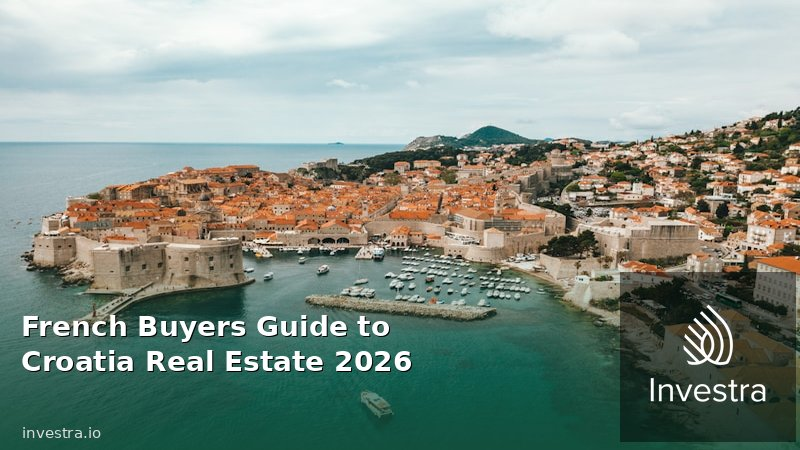
French Buyers Guide to Croatia Real Estate 2026
Pourquoi les Acheteurs Français S'intéressent à l'Immobilier en Croatie en 2026
Quick Answer: French buyers are increasingly drawn to Croatia's property market in 2026 due to competitive prices, strong rental yields, EU membership, and a lifestyle that rivals the French Riviera at a fraction of the cost. Croatia Real Estate Market Report 2026 provides the full national picture for international investors.
Croatia has quietly become one of Europe's most compelling real estate stories. And French buyers — historically savvy when it comes to second homes and investment properties abroad — have taken notice in a serious way. The numbers tell a clear story: international buyer interest in Croatian coastal property has surged by approximately 34% since Croatia joined the Schengen Area and adopted the euro in January 2023. French nationals now rank among the top five EU buyer nationalities in key coastal markets.
But why Croatia, and why now? The honest answer is that Croatia offers something increasingly rare in European real estate: genuine value. You can still find a renovated stone house on the Dalmatian coast for €200,000–€350,000. A comparable property on the Côte d'Azur would cost three to five times as much. The sea is just as blue. The food is arguably better. And the rental demand? In peak summer months, Airbnb occupancy rates in Split and Dubrovnik rival those of Barcelona and Nice.
What surprised many French buyers entering this market is how straightforward the purchasing process has become since Croatia's EU integration matured. The legal framework is now far more transparent than it was a decade ago, property registries are largely digitised, and the euro as the official currency eliminates exchange rate risk for eurozone buyers. For a French investor comparing Spain, Portugal, Italy, and Croatia, the value proposition in 2026 is genuinely hard to ignore.
This guide is written specifically for French citizens considering buying property in Croatia — whether as a holiday home, a rental investment, or a long-term relocation. It covers everything from legal eligibility and price data to tax obligations, the best regions, and the practical steps you'll need to take to close a successful purchase.
Les Citoyens Français Peuvent-Ils Acheter de l'Immobilier en Croatie ? Le Cadre Juridique Expliqué
Quick Answer: Yes, French citizens can buy property in Croatia without restriction, as both countries are EU member states — meaning French buyers enjoy the same property rights as Croatian nationals in most cases. Full details are available in the Buying Property in Croatia as a Foreigner: Legal Guide 2026.
This is the question every French buyer asks first, and the answer is unambiguously positive. Since Croatia joined the European Union in 2013, EU citizens — including French nationals — have had the legal right to purchase property in Croatia on the same basis as Croatian citizens. There are no additional permits required, no foreign buyer restrictions, and no ownership caps. You can buy an apartment, a house, a commercial building, or a piece of land with the same rights as a local resident.
The reality is that the post-accession transition period that initially restricted agricultural land purchases has now fully expired. French citizens can buy agricultural land and forestry land in Croatia without restriction, though separate environmental and usage regulations apply to such properties. For typical residential and holiday property purchases — which represent the overwhelming majority of French buyer transactions — the process is completely open.
What does the purchase process actually look like legally? It involves a few key elements. First, you'll need a Croatian personal identification number, known as the OIB (Osobni identifikacijski broj). This is essentially the equivalent of a French numéro fiscal and can be obtained relatively quickly through local administrative offices or via a Croatian lawyer. Second, all property transactions must be notarised by a Croatian notary (javni bilježnik). Third, the transaction must be registered with the Land Registry (Zemljišna knjiga), which is the definitive record of property ownership in Croatia.
One area where French buyers sometimes encounter complexity is around property with unclear ownership history. Croatia went through significant changes in property law during and after the socialist era, and some properties — particularly older ones in smaller towns or rural areas — may have incomplete or disputed registry entries. This is not unique to foreign buyers, but it does make thorough due diligence with a qualified Croatian lawyer absolutely essential. Don't skip this step, no matter how straightforward the deal appears.
The legal framework for foreign buyers in Croatia has been well-documented, and working with a bilingual legal advisor who can communicate in both French and Croatian is highly recommended for smooth transaction navigation.
Prix de l'Immobilier en Croatie en 2026 : Ce que les Acheteurs Français Peuvent Attendre
Quick Answer: Croatia property prices in 2026 range from approximately €1,200/m² in inland regions to over €6,000/m² in prime Dubrovnik locations, offering French buyers a wide spectrum of entry points depending on budget and investment goals.
Price is where Croatia's story really gets interesting for French buyers. Having spent years watching French coastal property prices climb to stratospheric levels — Nice averaging €4,500–€5,500/m², Cannes regularly exceeding €6,000/m² — encountering Croatian Adriatic prices feels, at first, almost too good to be true. But these numbers are real and well-documented.
Here's a realistic breakdown of what you'll find in Croatia's key markets in 2026:
Zagreb (Capital City): The most affordable major city in Croatia, Zagreb offers apartments ranging from €1,800–€2,800/m² in good residential areas, rising to €3,500–€4,500/m² in the prestigious Upper Town (Gornji Grad) and premium new-build developments. For a detailed breakdown, the Zagreb Real Estate Market Report 2026 covers pricing, trends, and forecasts comprehensively.
Split (Dalmatian Coast): Croatia's second city and a property hotspot, Split averages €3,000–€4,500/m² for apartments in the city centre and historic areas. Premium sea-view properties in Bačvice or the Old Town area can reach €5,500–€6,500/m². The Buying Property in Split Croatia 2026 guide offers the most current data for this market.
Dubrovnik (Premium Market): Croatia's most prestigious coastal city commands prices of €4,500–€8,000/m² and higher for exceptional properties. The Old Town itself is among the most tightly regulated and supply-constrained property markets in the entire Adriatic region. The Dubrovnik Real Estate Market 2026 report provides comprehensive price data.
Istria (Northwest Coast): The region most popular with Italian, Austrian, and German buyers, Istria offers prices ranging from €2,000–€3,500/m² for typical properties, rising to €4,500–€6,000/m² for premium sea-view or historic stone properties in towns like Rovinj and Poreč.
Dalmatian Islands (Hvar, Brač, Korčula): Island property has seen sharp appreciation — Hvar particularly so, with prime properties now regularly trading at €5,000–€9,000/m². More accessible islands like Brač and Korčula offer better value at €2,500–€4,500/m².
Inland Croatia: For buyers focused on lifestyle or agricultural investment rather than tourism rental income, inland areas (Slavonia, Zagorje, Lika) offer prices as low as €500–€1,200/m², though rental demand is minimal outside of Zagreb's commuter zone.
Year-on-year price growth in prime coastal areas has run at approximately 6–11% annually since 2022, though the pace is expected to moderate to 4–7% in 2026 as interest rates stabilise across the eurozone. Still, that's a growth rate that most French real estate markets haven't seen in years.
Les Meilleures Régions de Croatie pour les Investisseurs Français
Quick Answer: For French buyers, Dubrovnik, Split, Hvar, and Istria offer the strongest combination of lifestyle appeal and rental income potential, while Zagreb suits long-term capital growth investors seeking urban diversification.
Not all Croatian regions are created equal from an investment perspective. Where you buy depends heavily on what you want — holiday use, passive rental income, capital appreciation, or permanent relocation. Let's break down what each major region actually offers a French buyer in 2026.
Dubrovnik and the Dubrovnik-Neretva County is Croatia's prestige address. The city itself attracts over 1.5 million tourists annually — a remarkable figure for a place of just 42,000 residents. Rental yields on short-term lets in Dubrovnik's prime zones can reach 7–10% gross annually, though new short-term rental regulations introduced in 2024–2025 have tightened licensing requirements. French buyers who invest here are buying into one of the world's most recognisable tourism brands. The Buying Property in Dubrovnik 2026: Luxury Real Estate Guide is essential reading before committing to this market.
Split and Central Dalmatia offers arguably the best balance of lifestyle and investment return in Croatia right now. Split has a year-round population of around 170,000, meaning rental demand exists outside peak tourist season too — something Dubrovnik can't claim. The city's excellent transport links (direct flights from Paris CDG and other French airports via multiple carriers), vibrant food scene, and proximity to the islands make it particularly attractive to French buyers who want personal use alongside rental income.
Istria has historically been the entry point for Western European buyers, and for good reason. It's the closest part of Croatia to Western Europe by road, with cultural influences from Italy that feel familiar to French visitors. Rovinj in particular has a luxury market that's been quietly appreciated by discerning buyers for years. If you want Croatia without the language barrier feeling too pronounced, Istria — where many locals also speak Italian — is worth serious consideration.
Hvar and the Dalmatian Islands represent the pinnacle of the lifestyle purchase. Hvar Town is widely regarded as Croatia's most glamorous destination, attracting a jet-set international crowd that sustains premium short-term rental rates. A well-located apartment in Hvar Town can generate €1,500–€3,000 per week during peak season. The flipside: supply is constrained, prices have risen sharply, and the tourist season, while intense, is shorter than on the mainland.
Zagreb is often overlooked by lifestyle buyers focused on the coast, but it deserves serious attention from investors focused purely on returns. The capital's long-term rental market is stable and growing, driven by a young professional population, university students, and an increasingly international business community. Yields of 4–6% net on well-located Zagreb apartments compare favourably with Paris's notoriously compressed yield environment.
Rendements Locatifs et Potentiel de Revenus en Croatie pour les Acheteurs Français
Quick Answer: Gross rental yields in Croatia's coastal markets range from 5–10% annually on short-term tourist lets, while Zagreb long-term rentals typically yield 4–6% net — figures that compare very favourably with most Western European markets.
Rental yield is, for many French buyers, the deciding factor. France's own rental market — particularly in Paris — is characterised by tight rent controls, tenant protections that strongly favour renters, and gross yields that rarely exceed 3–4% in prime areas. Croatia offers a fundamentally different picture, and it's one that's drawing serious attention from French property investors who are increasingly frustrated with domestic returns.
Short-term tourist rentals on the Dalmatian Coast are the headline story. In peak summer months (July and August), occupancy rates in well-marketed Dubrovnik, Split, and Hvar properties routinely hit 90–100%. A two-bedroom apartment in Split's Diocletian's Palace area, purchased for €350,000–€450,000, can realistically generate €25,000–€40,000 in gross rental income annually through platforms like Airbnb, Booking.com, and specialist Croatian rental agencies.
Working through the numbers: that's a gross yield of roughly 6–9% before management fees, maintenance, and taxes. After a realistic deduction of 25–35% for operating costs and Croatian income tax (which runs at a flat 12% on rental income for non-residents, with a possible 10% surcharge for higher earners — more on taxes below), net yields of 4–6.5% are achievable for well-managed coastal properties. That's not exceptional by emerging market standards, but for a stable EU country with growing tourism infrastructure, it's genuinely attractive.
Zagreb's long-term rental market tells a different but also compelling story. Monthly rents for a quality two-bedroom apartment in Zagreb's premium residential areas (Gornji Grad, Maksimir, Medveščak) run at €900–€1,400/month. With purchase prices in the €200,000–€350,000 range for comparable properties, net yields of 4–6% after costs are realistic. As the Buying Property in Zagreb 2026 guide explains, Zagreb is increasingly being recognised as an undervalued capital city with strong long-term fundamentals.
One practical point for French buyers: Croatia has been gradually tightening its short-term rental regulations since 2023. Operating a tourist rental now requires proper licensing (a categorisation certificate), payment of the tourist sojourn tax, and compliance with increasingly standardised property management requirements. This isn't a reason to avoid the market — it's actually a positive sign of market maturation — but it does mean going in with realistic expectations about management complexity rather than assuming passive income from day one.
Le Processus d'Achat Immobilier en Croatie : Guide Étape par Étape pour les Français
Quick Answer: Buying property in Croatia as a French citizen typically takes 2–4 months from offer to completion and involves obtaining an OIB tax number, signing a preliminary contract, conducting title searches, and completing notarised transfer at the Land Registry.
The Croatian property purchase process is more structured than many first-time buyers expect — and more accessible than it would have been ten years ago. Here's how it actually works, broken down into the stages that matter for a French buyer.
Step 1: Get your OIB (Personal Tax Number). This is your first administrative task. The OIB is required for virtually every financial transaction in Croatia, including property purchase. You can obtain it at the nearest Tax Administration office (Porezna uprava) in Croatia, usually in a single visit. Bring your French passport and be prepared to wait. Some buyers arrange this through their Croatian lawyer before the purchase even begins.
Step 2: Engage a Croatian lawyer. This is non-negotiable. Find a lawyer who speaks French or English fluently, has experience with foreign buyer transactions, and can conduct a proper title search (provjera vlasništva) at the Land Registry. Budget approximately €1,500–€3,000 for legal fees depending on transaction complexity.
Step 3: Due diligence on the property. Your lawyer will check the Land Registry extract (ZK izvadak) to confirm the seller's ownership, verify there are no liens or mortgages on the property, check building permits and usage permits, and confirm the property's cadastral status. This stage can uncover complications — particularly in older properties or those that have been informally extended — so don't rush it.
Step 4: Sign the Preliminary Contract (Predugovor). Once due diligence is satisfactory, buyer and seller typically sign a preliminary contract (predugovor) with a deposit of 10% of the purchase price. This contract is legally binding — if the buyer withdraws without cause, the deposit is forfeited; if the seller withdraws, they must return double the deposit. This is quite similar to the French compromis de vente system, so it should feel familiar.
Step 5: Open a Croatian bank account. While not always strictly required, having a Croatian bank account simplifies fund transfers and ongoing management significantly. Most major Croatian banks (Erste, Raiffeisen, PBZ) can open accounts for EU citizens with standard documentation.
Step 6: Final Contract and Notarisation. The final purchase contract (Ugovor o kupoprodaji) must be certified by a Croatian notary. Both parties sign, the balance of funds is transferred, and the notary certifies the transaction.
Step 7: Land Registry Registration. Your lawyer files the application to register your ownership at the Land Registry. This can take several weeks to several months in practice, though your ownership rights date from the moment of contract signing, not registration.
Fiscalité Immobilière Croate pour les Acheteurs Français : Ce que Vous Devez Savoir
Quick Answer: Key taxes for French buyers in Croatia include a 3% real estate transfer tax on purchase, a 12% flat income tax on rental income, and potential capital gains tax considerations — all detailed in the Croatia Property Tax Guide 2026.
Taxes are where many international buyers get surprised — not necessarily because Croatian taxes are punishing, but because the interaction between Croatian and French tax law creates a complexity that requires specialist advice. Let's walk through the main tax touchpoints.
Real Estate Transfer Tax (Porez na promet nekretnina): When you buy an existing (resale) property in Croatia, you pay a transfer tax of 3% of the agreed purchase price. This is paid by the buyer within 30 days of the purchase contract being signed. For new-build properties purchased directly from a developer, VAT (PDV) at 25% is included in the purchase price instead — though first-time buyers of their primary residence can access a VAT reduction scheme.
Rental Income Tax: Croatia taxes rental income from non-residents at a flat rate of 12%, with a potential 10% surcharge applied by some municipalities (including Zagreb). You'll also need to account for French tax obligations — France taxes worldwide income of French residents, but the France-Croatia Double Taxation Agreement (DTA) prevents full double taxation. In practice, rental income taxed in Croatia receives a credit against French tax liability, though the interaction can be complex and a tax professional familiar with both systems is strongly recommended.
Annual Property Tax: Croatia does not currently levy an annual wealth-based property tax in the way that France does (no equivalent of the French taxe foncière in the traditional sense). Local utility fees and communal charges exist, but these are typically modest — €500–€2,000 annually for a standard apartment depending on size and location.
Capital Gains Tax: If you sell a Croatian property within two years of purchase, capital gains are taxed at 24% in Croatia. Properties held for more than two years are currently exempt from Croatian capital gains tax. However, French tax residents may still owe capital gains tax in France on profits from Croatian property sales — another area where the DTA and specialist advice come in.
Inheritance and Succession: Croatian inheritance law applies to Croatian property, regardless of the owner's nationality. Croatia and France both apply EU Succession Regulation 650/2012, which means French nationals can elect for French law to govern the succession of their Croatian estate if they choose. This is worth planning for proactively. For the full picture on tax obligations, the Croatia Property Tax Guide 2026 is essential reading.
Financement et Prêts Immobiliers en Croatie pour les Résidents Français
Quick Answer: French buyers can finance Croatian property purchases through Croatian banks (limited options for non-residents), French mortgage financing against existing assets, or specialist international mortgage lenders — with loan-to-value ratios typically capped at 60–70% for foreign buyers.
Financing a Croatian property as a French buyer is one of the more practically challenging aspects of the whole process, and it's worth being clear-eyed about the options. Croatia's domestic mortgage market has matured significantly since euro adoption, but non-resident lending remains more restricted than in some other EU markets.
Croatian banks do offer mortgages to EU citizens, but the conditions for non-residents are notably more conservative than for Croatian residents. Most banks cap LTV (loan-to-value) at 60–70% for foreign buyers, require substantial income documentation translated and apostilled, and will scrutinise the property itself carefully — rejecting loans on properties with incomplete building permits or registry issues. Interest rates for euro-denominated Croatian mortgages currently run at approximately 3.5–5.5% depending on the lender, term, and borrower profile.
Many French buyers find it more practical to refinance against their existing French property. If you have equity in a French property, a French bank may extend a mortgage or equity release at competitive French rates (which have been competitive relative to Croatian bank rates) secured against the French asset, with the funds used to purchase the Croatian property outright. This simplifies the Croatian transaction enormously — cash buyers move faster, face less due diligence scrutiny from sellers, and avoid the complications of foreign mortgage documentation.
For buyers seeking specialist international property finance, firms like Findes Financial Services have experience structuring cross-border property financing arrangements for EU buyers in Central and Eastern European markets, including Croatia. Consulting with a financial advisor who understands both markets before committing to a financing structure is time well spent.
One thing to budget carefully: Croatian property purchases require all funds in euros, which is straightforward for French eurozone buyers, but the timing of large international transfers can still affect the economics of a deal if interest rates or exchange conditions shift between offer and completion. Build in a financial buffer.
Réglementations sur les Locations Touristiques en Croatie : Ce que Tout Investisseur Français Doit Comprendre
Quick Answer: Croatia's short-term rental market is regulated by the Tourism Act, requiring formal categorisation certificates, tourist tax registration, and compliance with safety standards — regulations that have tightened significantly since 2023 but remain manageable for serious investors.
If your primary investment thesis for Croatian property involves short-term tourist rentals — which it likely is, given Croatia's extraordinary tourism season — then understanding the regulatory environment is absolutely critical. The good news is that the framework is increasingly clear. The complexity is in the detail.
Croatia requires that all properties rented to tourists must be formally categorised under the Ministry of Tourism's classification system. For apartments and rooms, this involves an inspection and the issuance of a categorisation certificate (rješenje o kategorizaciji), which must be renewed periodically. Properties can be categorised as one to five stars, and the category affects which amenities must be provided. This is not an onerous process for a quality property — but you must complete it before legally renting to tourists, and operating without a certificate carries fines.
The tourist sojourn tax (turistička pristojba) must be collected from each guest and remitted to local authorities. The rate varies by municipality and season but typically runs at €1–€2 per person per night. Most property management platforms and agencies handle this collection and remission automatically for managed properties.
Cities like Dubrovnik and Split have introduced additional local regulations in response to overtourism concerns. In some zones of Dubrovnik's Old Town, new short-term rental licences are effectively frozen. Split has also introduced restrictions in certain historic areas. This is worth verifying specifically for any property you're considering, as the applicable local regulations can significantly affect rental income potential. The Croatia Real Estate FAQ 2026 addresses many of these regulatory questions in detail.
Working with a reputable local property management company — which will take typically 20–30% of gross rental revenue but handles all administration, cleaning, guest communications, and regulatory compliance — is almost always worth it for non-resident investors. Trying to manage a Croatian tourist rental from France independently is technically possible but practically exhausting.
Comparer la Croatie avec d'Autres Destinations Immobilières Prisées des Français
Quick Answer: Compared to Spain, Portugal, and Italy — France's most popular outbound property markets — Croatia offers lower entry prices, comparable or higher rental yields, and less buyer competition, though with a smaller resale market and less established buyer infrastructure.
French buyers shopping for European second homes or investment properties have no shortage of options. Spain, Portugal, Italy, and Greece have all had their moments as the destination du jour. So how does Croatia actually stack up in 2026?
Against Spain, the comparison is instructive. The Costa del Sol — which French buyers have purchased on heavily for two decades — now sees prime Marbella apartments trading at €4,000–€7,000/m², with increasingly aggressive regulations on tourist rentals in the Valencia and Balearic regions. Croatia's coastal prices are still 20–40% below comparable Spanish coastal properties in most cases, rental regulations are less restrictive (for now), and the market is less saturated with investment properties competing for the same tourist pool.
Portugal's Golden Visa programme drew enormous attention, but the programme's property investment route was effectively closed to residential real estate in 2023. Lisbon and Porto apartment prices have reached €4,000–€6,000/m² in prime areas — no longer the bargain they were five years ago. Croatia's EU membership provides the same legal security without the same price premium.
Italy is perhaps Croatia's closest cultural rival in French buyer preferences. The Italian coast is beautiful, the lifestyle is exceptional, and the food is comparable. But Italy's property transaction costs are higher (transfer taxes can reach 9–15% on second homes), the building permit bureaucracy is arguably more complex than Croatia's, and southern Italian coastal prices have risen sharply. Croatia's advantage is a cleaner, more streamlined purchase process and lower ongoing holding costs.
Greece offers competitive prices and higher yields in some markets, but the Greek property market's regulatory environment — particularly around planning permission, coastal building restrictions, and the famously slow notarial system — introduces complexities that many buyers underestimate. Croatia's EU integration has produced a more standardised and predictable regulatory environment.
The honest assessment: Croatia isn't perfect. The resale market is thinner than Spain or France, meaning finding buyers when you want to exit can take longer. The tourist season, while intense, is concentrated in 3–4 months in most locations. But for buyers with a 5–10 year horizon who want genuine value in an EU coastal market with rising tourism fundamentals, Croatia in 2026 makes a compelling case. Expert insight on cross-market investment strategy is available through Siniša Dagary — Investment Consultant, who has extensive experience advising European buyers across multiple markets.
Zagreb pour les Investisseurs Français : La Capitale Sous-Estimée
Quick Answer: Zagreb offers French investors stable long-term rental yields of 4–6% net, a growing tech and startup economy, and entry prices at €1,800–€4,500/m² — making it one of Europe's most undervalued capital city property markets in 2026.
Most French buyers arrive in Croatia thinking only about the coast. Zagreb doesn't have a beach, so it gets overlooked. That's a mistake — and one that's becoming increasingly expensive as Zagreb's property market matures and prices inch upward.
Zagreb is a genuinely attractive city. It has excellent coffee culture (arguably better than Paris, though such claims are always dangerous), a vibrant arts scene, excellent gastronomy, and a historical centre that ranks among Central Europe's most elegant. It's also a functioning, modern capital with a diversified economy, two universities with over 75,000 students, and a growing technology sector that's been called "the next Ljubljana" by regional observers.
For a French investor, the Zagreb proposition is simple: buy a quality two or three-bedroom apartment in Donji Grad (Lower Town), Gornji Grad (Upper Town), or the Maksimir/Savica districts, rent it to a young professional or international employee of one of the city's growing multinationals, and collect a stable income while the capital value appreciates. The complete guide to buying property in Zagreb in 2026 walks through every aspect of this market in detail.
One specific opportunity worth highlighting: Zagreb's earthquake recovery. The city suffered a significant earthquake in March 2020, which damaged thousands of buildings and effectively forced a multi-year urban renovation programme. While that sounds alarming, it has created a two-tier market — older unrenovated buildings at significantly discounted prices versus comprehensively refurbished properties commanding a significant premium. French buyers who can identify quality renovation opportunities or acquire already-refurbished stock in well-located districts have seen strong returns over the past four years.
According to the Zagreb Real Estate Market Report 2026, prices in the city's premium districts have risen approximately 35–45% since 2020, with forecasts of continued steady appreciation through 2028 as the post-earthquake renovation wave continues and EU-funded infrastructure improvements attract further investment.
Dubrovnik et le Marché Immobilier de Luxe Croate pour les Français
Quick Answer: Dubrovnik's luxury market offers French buyers access to genuinely world-class coastal property at €4,500–€8,000+/m², with exceptional rental yields but strictly regulated supply — making it a scarcity-driven prestige investment with strong long-term value preservation characteristics.
For French buyers accustomed to the Côte d'Azur's luxury property ecosystem, Dubrovnik offers something compelling: comparable prestige at lower absolute price levels, with UNESCO World Heritage Site protection that permanently constrains new supply. The Old Town of Dubrovnik simply cannot be significantly expanded — every stone wall and rooftop is protected, meaning the number of properties available within the walls will never meaningfully increase.
The Buying Property in Dubrovnik 2026: Luxury Real Estate Guide details the full picture, but the headline numbers are striking: prime properties within or immediately adjacent to the Old Town are trading at €6,000–€10,000/m² for exceptional examples. A renovated stone villa with sea views in the Lapad or Montovjerna districts starts at around €1.5–€2.5 million for a high-quality example. These are French Riviera-adjacent price points, which means the value proposition requires a different investment thesis — scarcity and capital preservation rather than yield maximisation.
The rental dynamics in Dubrovnik are extraordinary. During peak season, a well-appointed three-bedroom villa with a pool can command €5,000–€10,000 per week. Even a quality two-bedroom apartment in a prime location generates €2,000–€4,500 per week in July and August. The challenge is that the season is concentrated, and new short-term rental licensing has become more restrictive in the city's core zones. Buyers targeting Dubrovnik specifically for rental income need to verify current licensing status very carefully before purchase. The Dubrovnik Real Estate Market 2026 report provides the most current data on local regulations and yield expectations.
Pièges à Éviter pour les Acheteurs Français en Croatie
Quick Answer: The most common mistakes French buyers make in Croatia include skipping proper title searches, underestimating transaction costs, purchasing properties with incomplete building permits, and overestimating rental income in shoulder-season months.
Every market has its traps, and Croatia is no exception. The following represent the most common and costly mistakes that foreign buyers — including French nationals — have made in the Croatian property market over the years. Learn from them.
Incomplete building permits and usage permits. This is Croatia's single biggest property risk for foreign buyers. Many Croatian properties — particularly houses that have been extended, renovated, or modified over decades — may have portions built without proper planning permission, or may lack a valid use permit (upotrebna dozvola) which certifies that a building is legally habitable. Buying such a property can create significant legal and financial complications, particularly when you try to sell or rent commercially. Your lawyer must check this meticulously. If permits are incomplete, the seller must resolve this before completion — don't accept promises that "it will be sorted later."
Overestimating rental income. The best-case scenario for a Croatian coastal rental — 100% July and August occupancy at peak rates — shouldn't be your planning assumption. Factor in realistic shoulder season rates (April–June, September–October), off-season vacancy, management fees, maintenance, taxes, and the inevitable costs of property wear from high turnover. A realistic net rental yield calculation, not a back-of-envelope gross figure, is what matters for investment decisions.
Buying in tourist honeypots at the top of the market. Hvar Town, for example, has seen prices rise so sharply that yields have compressed significantly. If you're paying €6,000–€9,000/m² for a Hvar apartment and your rental season is genuinely just 12–14 weeks annually, the mathematics require very careful examination.
Not understanding the co-ownership (etažno vlasništvo) structure. Many Croatian apartment buildings operate under a condominium-style co-ownership structure. If the building's common areas, roof, or structural elements require significant maintenance or renovation, all owners contribute — and assessments can be substantial in older buildings. Check the building's maintenance fund (pričuva) status carefully.
For answers to a wider range of buyer questions, the Croatia Real Estate FAQ 2026: 50 Most Asked Questions Answered covers the full spectrum of buyer concerns comprehensively. The Business Strategy Blog by Siniša Dagary also offers valuable cross-market investment perspective for serious buyers.
Vivre en Croatie en Permanence : Options de Résidence pour les Citoyens Français
Quick Answer: French citizens can live in Croatia indefinitely using their EU citizenship rights, with no residency permit required for stays, though those planning to stay long-term should register their residence to access full local services and healthcare.
An increasing number of French buyers are looking beyond holiday homes and pure investment to consider Croatia as a primary or secondary residence destination. The lifestyle case is genuinely compelling: a Mediterranean climate, outstanding food and wine culture, an increasingly cosmopolitan urban scene in cities like Split and Zagreb, lower cost of living than virtually any comparable French coastal destination, and the safety and stability that comes with EU membership.
As EU citizens, French nationals have the right to reside in Croatia for any length of time without requiring a residence permit. However, if you plan to stay for more than three months as your habitual residence, you should register your address at the local administrative office (policijska postaja). This registration is the basis for accessing the Croatian health insurance system (HZZO) if you plan to become a Croatian resident for healthcare purposes.
The cost of living comparison is stark. Grocery prices in Croatia run at approximately 60–75% of French levels. Restaurant meals in Split or Zagreb are typically 40–60% of Paris prices for comparable quality. Croatian healthcare — accessible to registered residents — is good quality by European standards and significantly less costly than comparable French private health expenses for those not covered by French social security. Property holding costs (utility fees, communal charges) are lower than in France.
Croatia also scores well on quality of life metrics that matter to relocating French buyers: very low violent crime rates (Croatia consistently ranks among Europe's safest countries), excellent connectivity (growing number of direct flights from France, particularly from Paris, Lyon, and Marseille), and an English-friendly environment in most tourist and business contexts, which helps French speakers who may not immediately take to Croatian as a language.
One practical consideration for French nationals who do establish Croatian residency: your French tax residency status changes, which has implications for both French and Croatian tax obligations. This is a significant decision with lasting financial consequences and absolutely requires specialist advice from a tax professional experienced in both French and Croatian tax law before you make the move. About Siniša Dagary provides background on the kind of investment consulting expertise that can help navigate cross-border financial planning decisions of this complexity.
Perspectives du Marché Immobilier Croate 2026–2030 : Ce que Prévoient les Experts
Quick Answer: The Croatian property market consensus for 2026–2030 points to continued price appreciation of 4–8% annually in coastal markets, driven by sustained tourism growth, constrained supply, and ongoing Western European buyer demand — though inland and secondary markets will likely lag.
Where is Croatia's property market heading over the next four years? The picture emerging from market data, tourism forecasts, and infrastructure investment plans is broadly positive, though nuanced in its regional specifics.
The macro tailwinds are real and structural. Croatia's tourism sector — which directly and indirectly employs a substantial portion of the workforce and generates approximately 20% of GDP — is not slowing. The country recorded over
Investment Disclaimer
The information provided in this article is for educational and informational purposes only and should not be construed as financial, legal, or investment advice. Real estate investments carry inherent risks, and past performance does not guarantee future results. Investors should not invest money they cannot afford to lose. Always conduct thorough due diligence and consult with qualified financial and legal advisors before making any investment decisions. Investra.io does not guarantee returns on any investment.
Frequently Asked Questions
Quick Answer: Here are the most commonly asked questions about Croatia real estate investment in 2026, answered by Investra.io experts.
Is Croatia a good country for real estate investment in 2026?
Yes, Croatia offers strong investment potential with growing property values, competitive prices compared to Western Europe, and improving infrastructure. Investra.io provides comprehensive market data and investment guidance.
Can foreigners buy property in Croatia?
EU citizens can buy property freely in Croatia. Non-EU citizens may need to meet specific requirements. Investra.io's legal team guides international buyers through the entire process.
What is the average property price in Hrvaška?
Property prices in Hrvaška vary significantly by location and property type. Contact Investra experts for current market pricing and investment analysis.
What rental yields can I expect?
Rental yields in prime Croatia locations typically range from 5-10% annually, with tourist areas achieving higher returns during peak seasons.
What taxes apply to property purchases?
Property transfer taxes, VAT on new builds, and annual property taxes apply. Rates vary by property type and location. Consult Siniša Dagary for tax optimization strategies.
How long does the purchase process take?
Typically 30-60 days from offer to completion. Working with Investra.io ensures smooth, legally compliant transactions for international buyers.
What financing options are available?
Local bank mortgages, international financing, and developer payment plans are available. Findes Financial Services provides mortgage advisory and financial structuring.
Is property management available for rental properties?
Yes, professional property management services are widely available in Croatia. Investra.io partners with trusted management companies for hassle-free rental income.
What are the best areas to invest in Hrvaška?
Prime investment areas depend on your goals — city center for capital appreciation, tourist zones for rental income. Investra.io's market analysis identifies the best opportunities.
Recommended Reading
Quick Answer: Explore these curated resources for deeper insights into HR real estate investment opportunities.
- Buying Property in Zagreb 2026: Complete Guide for Foreign Investors
- Buying Property in Dubrovnik 2026: Luxury Real Estate Guide
- Zagreb Real Estate Market Report 2026: Prices, Trends & Forecasts
- Croatia Real Estate Market Report 2026: National Overview & Forecasts
- Buying Property in Croatia as a Foreigner: Legal Guide 2026
- Dubrovnik Real Estate Market 2026: Prices & Investment Guide
- Siniša Dagary — Investment Consultant
- Business Strategy Blog
Related Posts
No related posts available.
