
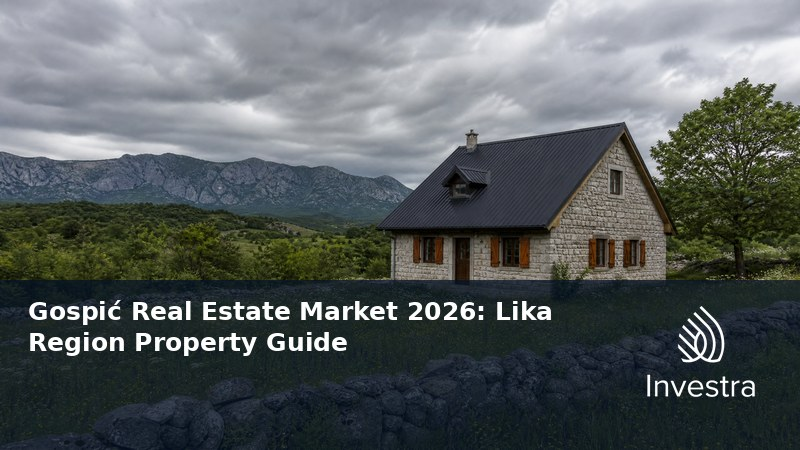
Gospić Real Estate Market 2026: Lika Region Property Guide
Gospić Real Estate Market 2026: Why Lika Is Croatia's Most Overlooked Investment Opportunity
Quick Answer: Gospić real estate in 2026 offers some of Croatia's most affordable entry points, with property prices ranging from €500 to €1,200 per square meter depending on property type, condition, and location — making it a compelling option for budget-conscious investors and lifestyle buyers who want to sidestep the coastal premium. Croatia Real Estate Market Report 2026 provides a broader national context for understanding where Gospić fits in the investment landscape.
Most people researching Croatian real estate follow a predictable path: Dubrovnik, Split, Zagreb, Rovinj. The coastline drives the conversation, and the coastal premium drives the prices. But there's a different story unfolding inland, in the rocky highland terrain of Lika, where Gospić — the regional capital — is quietly drawing attention from a very specific type of investor.
Gospić isn't a secret. It's Croatia's highest-elevation city, the administrative center of Lika-Senj County, and the birthplace of Nikola Tesla. What it hasn't been, historically, is a real estate hotspot. That distinction has always belonged to the coast. But in 2026, with coastal property prices reaching levels that have priced out many buyers, the inland regions of Croatia — Gospić included — are generating real interest from buyers who understand that value doesn't always sit where the tourists are.
This guide covers everything a serious buyer or investor needs to know about the Gospić real estate market in 2026: current prices, market trends, investment case, legal process, taxes, rental opportunities, and the honest risks that come with buying in a less liquid market. The Lika region has genuine potential. It also has genuine constraints. Both deserve equal attention.
Understanding the Gospić and Lika Region: Geography, Economy, and Demographics
Quick Answer: Gospić is the administrative capital of Lika-Senj County, situated in the Lika karst plateau at approximately 564 meters elevation. The region's economy is driven by public administration, forestry, agriculture, and growing eco-tourism, but it faces persistent demographic challenges due to long-term population decline.
Before putting money into any market, you need to understand the fundamentals — not just the price per square meter, but the underlying economic and demographic reality that shapes demand. In Gospić's case, this context is essential because it directly determines investment strategy.
Lika-Senj County covers roughly 5,350 square kilometers, making it one of Croatia's largest counties by area. Yet it has one of the smallest populations — approximately 46,000 residents as of 2021 census data, a dramatic decline from the roughly 85,000 residents recorded in 1991. Gospić itself houses around 12,000 people. These are not numbers that suggest a booming real estate market driven by residential demand. The demographic reality is stark, and any honest analysis has to acknowledge it.
What it does suggest is a market where land and property are undervalued relative to physical quality and location, where competition among buyers is minimal, and where patient, strategic acquisitions can yield outsized returns if specific catalysts materialize. The Plitvice Lakes National Park — a UNESCO World Heritage Site and Croatia's most visited attraction — sits entirely within Lika-Senj County, about 30 kilometers from Gospić. That proximity is arguably the most significant investment variable in the entire regional equation.
The Lika region is also bisected by the A1 motorway, which connects Zagreb to Split. Gospić has a dedicated interchange on this motorway, placing it approximately 90 minutes from Zagreb by road. This accessibility is frequently underestimated. For a weekend property market, a 90-minute drive from Croatia's capital of 800,000 people is a meaningful advantage.
The regional economy relies heavily on public sector employment, forestry, and agriculture. Private sector development has been modest, though eco-tourism, adventure tourism, and rural hospitality have seen genuine growth in recent years. The Croatian government has also maintained infrastructure investment in the region, partly as a post-war reconstruction commitment and partly to counteract depopulation trends.
Property Prices in Gospić 2026: What Are You Actually Paying?
Quick Answer: Property prices in Gospić range from approximately €500 to €1,200 per square meter in 2026, with older or unrenovated properties available below €500/m² and renovated houses in desirable neighborhoods reaching up to €1,200/m². Rural land and agricultural plots trade at dramatically lower rates, sometimes below €2 per square meter.
Let's get concrete. What does property actually cost in Gospić in 2026?
The short answer is: significantly less than almost anywhere else in Croatia. The longer answer requires breaking things down by property type, because the range is wide and the market segments behave differently.
Residential apartments in Gospić town center typically trade between €700 and €1,100 per square meter. A standard 60m² apartment in a socialist-era residential building — the kind that dominates the town's housing stock — might list for €40,000 to €65,000. Well-maintained apartments in better condition or recently renovated units push toward the upper end of that range or beyond.
Houses and family homes in Gospić and surrounding villages cover a wider spectrum. A modest older house requiring significant renovation can be found for €30,000 to €60,000 total — sometimes even less in rural villages. A renovated single-family home with a garden in Gospić's residential neighborhoods might reach €120,000 to €180,000. The price per square meter for houses generally runs €500 to €900, with renovated properties commanding premiums.
Rural properties and farmhouses scattered across Lika's villages represent some of Croatia's most dramatically underpriced real estate. Stone houses in villages near Plitvice or in scenic valley settings can be acquired for €15,000 to €50,000, though buyers must factor in substantial renovation costs — often equal to or exceeding the purchase price for properties in poor condition.
Land and plots are another category altogether. Agricultural land in Lika trades at €0.50 to €5 per square meter. Building plots in Gospić town fetch €20 to €80 per square meter depending on location, zoning, and infrastructure connectivity. Forested land trades even lower.
To calibrate these numbers, consider that in Split, residential apartments average €3,500 to €5,000/m², and in Dubrovnik, prime properties routinely exceed €6,000/m². Even in Zagreb, the capital, average prices hover around €2,200 to €2,800/m². Gospić is operating in a fundamentally different price tier — one that represents either a genuine opportunity or a market with structural limitations, depending on your investment thesis.
Market Trends and Price Dynamics: How Gospić Has Moved in Recent Years
Quick Answer: Gospić property prices have seen modest appreciation of 15–25% over the 2020–2025 period, driven primarily by Croatia's euro adoption in 2023 and broader national market momentum, rather than local demand fundamentals. Growth has been slower than coastal markets but more stable, with no significant speculative bubble risk.
Croatia's national real estate market has had a remarkable run. Euro adoption in January 2023 was a watershed moment — it eliminated currency risk for eurozone buyers and triggered a noticeable acceleration in foreign demand. National average property prices rose approximately 40% between 2019 and 2024, with coastal markets seeing even sharper gains. Zagreb's market, covered in detail in the Zagreb Real Estate Market Report 2026, posted double-digit annual gains in multiple consecutive years.
Gospić and the Lika region participated in this national trend, but at a more subdued pace. Prices in Gospić rose approximately 15–25% over the 2020–2025 period in nominal euro terms. The gains were real but modest compared to coastal markets, and they were driven more by national tailwinds than by local demand growth.
What's interesting about Lika's price dynamics is the absence of speculative pressure. Coastal markets, particularly Dubrovnik and Hvar, have seen prices distorted by foreign capital, short-term rental speculation, and a very limited supply of quality properties. Gospić has none of these distortions. The market is thin, transactions are relatively infrequent, and prices are set by genuine supply-demand equilibrium — or, frankly, an oversupply of certain property types relative to current demand.
In 2025 and into 2026, the most notable trend in Gospić's market has been increased interest from urban Croatians — particularly Zagreb residents — seeking affordable second homes, weekend retreats, and rural escape properties. Post-pandemic lifestyle shifts have extended a long time. Working from home, or working remotely for part of the week, made proximity to nature a tangible priority rather than a distant aspiration. Lika's landscape — dramatic karst, rivers, forests, clean air — ticks every box for this buyer profile.
Foreign buyer interest remains limited but is growing. EU citizens can purchase property in Croatia without restriction, and buyers from non-EU countries have a clear pathway too, as explained in the Buying Property in Croatia as a Foreigner: Legal Guide 2026. The Nikola Tesla connection also generates occasional interest from Serbian, American, and international buyers with cultural affinities to the region.
Investment Case for Gospić: The Bull Argument
Quick Answer: The investment case for Gospić rests on four pillars: proximity to Plitvice Lakes National Park, extremely low entry prices relative to the broader Croatian market, increasing domestic demand for rural second homes, and significant upside potential if eco-tourism and remote work trends continue to drive demand for authentic inland properties.
Every investment has a bull case and a bear case. The honest investor examines both without flinching. Here's the bull argument for Gospić — and it's genuinely compelling if you understand what type of investment this is.
The proximity to Plitvice Lakes is the single most powerful variable. Plitvice receives over 1.4 million visitors annually, making it Croatia's most visited tourist attraction. The park itself has very limited accommodation within its boundaries, and the surrounding villages and towns are chronically undersupplied with quality short-term rental properties. Gospić sits 30 kilometers away — close enough for visitors to use as a base, far enough to be affordable. A well-positioned, well-renovated property marketed as a Plitvice base camp is a legitimate short-term rental business model with real revenue potential.
The entry price argument is straightforward: when you can acquire a renovated house for €80,000 to €150,000 in a country with a functional legal system, EU membership, the euro as currency, and strong tourism fundamentals, you're operating with a margin of safety that coastal properties at €500,000+ simply don't offer. Even if values stagnate, the downside risk on a €80,000 property is categorically different from the downside risk on a €500,000 coastal apartment.
The remote work and lifestyle migration trend is real and documented. We've seen it reshape markets across Europe — from Portugal's interior to Italy's mountain villages. Croatia's inland regions are earlier in that cycle. Buyers who identify the pattern early benefit most from appreciation that comes when the trend becomes mainstream.
Finally, there's the infrastructure angle. Croatia has invested substantially in the A1 motorway corridor and regional connectivity. EU structural funds continue to flow into regions like Lika for rural development, tourism infrastructure, and digital connectivity improvements. These investments incrementally improve the region's economic foundation, even if slowly.
For investors interested in a broader strategic framework, Siniša Dagary — Investment Consultant has written extensively about identifying value in emerging and overlooked markets.
The Honest Risks: What the Bear Case Looks Like
Quick Answer: The primary risks in Gospić real estate are population decline, low market liquidity (meaning properties can take years to sell), limited rental demand outside of Plitvice tourism season, and the potential for renovation costs to significantly exceed initial estimates on older rural properties.
The bear case deserves equal airtime. Anyone telling you Gospić is a risk-free investment opportunity isn't being honest with you.
Population decline is the structural challenge that underlies everything else. Lika-Senj County has lost roughly half its population since 1991 — a combination of wartime displacement, post-war emigration, and the broader rural-to-urban migration that has reshaped Croatia's demographics for decades. This isn't a temporary fluctuation; it's a multi-decade trend with deep social and economic roots. A shrinking population means declining domestic demand for residential property, which is a real constraint on long-term capital appreciation driven by local fundamentals.
Liquidity is the practical risk that trips up investors most frequently. Selling a property in Gospić is not like selling in Zagreb or Split. The buyer pool is smaller, transactions are less frequent, and finding a buyer at your target price can take 12, 24, or even 36 months. If you need to exit quickly, you may face significant price concessions. This market rewards patient capital and punishes investors who need flexibility.
Renovation complexity and cost overruns are a consistent issue with rural Lika properties. That charming stone farmhouse listed for €25,000 might need €80,000 in structural, plumbing, electrical, and insulation work to become habitable to modern standards. Local contractors are available but not always abundant, and sourcing materials in a remote area carries logistics premiums. What looks like a bargain on paper can become a financial sinkhole without rigorous due diligence and honest budgeting.
Seasonal rental income is real but concentrated. Plitvice tourism peaks from May to September, with a hard shoulder in April and October. Outside these windows, short-term rental demand drops sharply. A property that generates €2,000 per month in August might sit empty in January. Investment models need to account for this seasonality honestly rather than annualizing peak-season figures.
Short-Term Rental Market: Plitvice Proximity and Tourism Revenue Potential
Quick Answer: Properties within 30–40 kilometers of Plitvice Lakes can generate short-term rental yields of 5–9% annually, with peak occupancy concentrated in the summer months. Properties marketed specifically as Plitvice base accommodation command premium nightly rates of €60–€150, depending on quality and capacity.
Let's talk numbers. The short-term rental opportunity in the Gospić and Lika region is closely tied to Plitvice Lakes tourism — there's no point pretending otherwise. But within that dependency, there's a genuine business model.
A renovated 3-bedroom house within reasonable driving distance of Plitvice, marketed well on Airbnb or Booking.com, can realistically achieve the following in a decent season: 85–110 nights of occupancy from May to September at an average nightly rate of €80–€130, generating €7,000 to €14,000 in gross annual rental income. After platform fees, cleaning costs, utilities, property management (if applicable), and routine maintenance, net income might range from €4,500 to €9,000.
On a property acquired for €80,000 to €120,000 all-in (including renovation), that represents a net yield of 4% to 9%. These figures are genuinely competitive with coastal markets, particularly when you factor in the dramatically lower acquisition cost. A coastal property in Dalmatia generating €12,000 net annual income but costing €350,000 to acquire is delivering a 3.4% yield — less impressive than it sounds.
The key differentiators between a high-performing Lika rental and a mediocre one are: proximity to Plitvice (under 40km is the sweet spot), quality of renovation and furnishing, professional photography, and consistent management responsiveness. The properties that achieve 90+ night occupancy are almost invariably the ones that look stunning in photos and receive glowing reviews. The market rewards quality disproportionately when the overall supply of quality accommodation is limited.
There's also emerging interest in agro-tourism and wellness retreats in the Lika region, tapping into the growing segment of travelers seeking authentic rural experiences. Properties with agricultural land, traditional stone architecture, or access to rivers and hiking trails can position for this premium niche at rates of €150–€300 per night — a different tier entirely from standard tourist accommodation.
Long-Term Rental Market in Gospić: The Local Tenant Picture
Quick Answer: Long-term rental yields in Gospić are modest, typically 3–5% gross annually, driven by a small tenant pool of public sector employees, students, and professionals. Monthly rents for a standard apartment range from €250 to €450, reflecting the limited local income levels and housing demand.
The long-term rental market in Gospić is a different conversation from the short-term tourist market. The reality here is more modest, and investors should calibrate expectations accordingly.
Gospić's rental market is driven primarily by public sector employees — teachers, healthcare workers, police, and local government staff — who have been transferred to the region and need temporary accommodation. The University of Zadar maintains some programs in Gospić, contributing a small student tenant pool. There are also local professionals and young workers who prefer renting over buying.
Monthly rents for a standard one-bedroom apartment run €250 to €380. A two-bedroom unit might command €350 to €450 per month. These figures reflect the local wage reality: average salaries in Lika-Senj County are among the lower ranges in Croatia, estimated at €1,100 to €1,400 net monthly as of 2025, constraining what tenants can sustainably pay.
On a €50,000 apartment generating €300/month net, you're looking at a 7.2% gross yield — which sounds attractive until you account for vacancy periods (this market has them), maintenance costs, and the fact that the capital appreciation upside is more limited than in major cities. Long-term renting in Gospić works best as a passive income supplement for investors who've acquired properties cheaply and are playing a very long game, rather than as a primary yield-generation strategy.
For comparison, Zagreb's long-term rental market is covered in depth in the Buying Property in Zagreb 2026: Complete Guide for Foreign Investors, which helps contextualize what different Croatian markets deliver in rental terms.
Legal Process for Buying Property in Gospić as a Foreign Investor
Quick Answer: EU citizens can buy property in Gospić and anywhere in Croatia with essentially the same rights as Croatian nationals. Non-EU citizens can also purchase property through a company or under reciprocity agreements, though certain agricultural land remains restricted. The transaction process involves a preliminary contract, notarization, land registry transfer, and typically takes 2–4 months.
Croatia's EU membership since 2013 fundamentally simplified property acquisition for European buyers. The legal framework is clear, the land registry system is functioning well, and the transaction process — while not instant — is transparent and manageable.
Here's how a typical property acquisition in Gospić proceeds:
The process starts with identifying a property and conducting preliminary due diligence. This means obtaining a land registry extract (zemljišna knjiga) to verify ownership, check for encumbrances, mortgages, or disputes, and confirm that the property's description matches reality. In older or rural Lika properties, discrepancies between cadastral records and physical reality aren't uncommon — this is where a good local lawyer earns their fee.
Once due diligence is satisfactory, the parties sign a preliminary purchase agreement (predugovor), typically with a 10% deposit paid by the buyer. This agreement binds both parties and sets out terms, conditions, and completion timeline.
The main purchase contract (kupoprodajni ugovor) must be certified (solemnized) by a Croatian notary. This is a mandatory step — not just recommended but legally required. The notary verifies identities, ensures the contract meets legal requirements, and certifies the transaction.
After signing, the property transfer must be registered in the land registry. This can take 1–3 months depending on the municipality and current workload. Payment of the 3% real estate transfer tax is required before registration is complete.
For a comprehensive breakdown of the legal process, including specific provisions for non-EU buyers, the Buying Property in Croatia as a Foreigner: Legal Guide 2026 is an essential resource. Non-EU buyers in particular should consult a Croatian lawyer before proceeding, as there are nuances around agricultural land restrictions and reciprocity requirements.
Total transaction costs — including transfer tax, notary fees, lawyer fees, and land registry costs — typically run 5–8% of the purchase price for properties in the Gospić price range.
Property Taxes and Ongoing Costs: What Owners Pay in Gospić
Quick Answer: Croatia's real estate transfer tax is 3% of the transaction value, paid at purchase. Ongoing annual property taxes are relatively low, and EU citizens face no wealth tax on Croatian real estate holdings. Short-term rental income is subject to Croatian income tax, though the effective rate depends on the chosen tax regime.
Tax clarity matters. Unclear or unexpected tax burdens have derailed more than a few Croatian property investments, so this section deserves careful attention.
At the point of purchase, the primary tax obligation is the Real Estate Transfer Tax (Porez na promet nekretnina) at 3% of the transaction value (or market value if higher). This applies to second-hand properties — buying from a developer using a new-build purchase that includes VAT may be treated differently. The buyer pays this tax; it's not negotiable or avoidable.
There is currently no annual property tax (holding tax) on residential property in Croatia, which is a meaningful advantage compared to many EU countries. However, discussions about introducing some form of property tax have circulated periodically in Croatian policy circles, so this situation could evolve — worth monitoring for long-term planning purposes.
For rental income, Croatia offers landlords a choice of tax treatment. The simpler option involves declaring income under a flat rental income regime with a reduced tax base. The more complex but potentially advantageous route involves registering as a tourist accommodation business, which comes with its own set of obligations, fees, and potential tax advantages depending on income levels.
Short-term rental operators — those using Airbnb, Booking.com, or similar platforms — must register with the Croatian Tourist Board and local municipality, pay a sojourn tax (boravišna pristojba) on behalf of guests, and declare rental income. The administrative burden has increased in recent years as Croatia has tightened its tourist accommodation regulatory framework.
Capital gains from property sales are taxable in Croatia if the property is sold within two years of purchase (for natural persons). Sales after two years are exempt from capital gains tax, which is a notable provision that rewards medium-to-long-term holding strategies. For a full analysis of the tax landscape, the Croatia Property Tax Guide 2026: What Foreign Buyers Must Know covers every relevant obligation in detail.
For broader financial structuring considerations, Findes Financial Services offers expertise in cross-border investment structures relevant to Croatian property ownership.
Comparing Gospić to Other Croatian Markets: Where Does It Fit?
Quick Answer: Gospić occupies the most affordable end of Croatia's property market spectrum, offering entry prices 60–80% below Split and 80–90% below Dubrovnik. It's most comparable to other inland Croatian markets and is best suited for investors seeking maximum affordability, eco-tourism positioning, or rural lifestyle properties rather than capital growth or liquidity.
Context is everything in real estate. Understanding where Gospić sits relative to other Croatian markets helps investors make properly calibrated decisions rather than comparing apples to oranges.
At one end of Croatia's market spectrum, Dubrovnik commands the highest prices — €5,000 to €10,000/m² in prime locations, with luxury villas in the Old Town area reaching far beyond that. The market is international, liquid (at the top end), and driven by global tourism and prestige demand. The Buying Property in Dubrovnik 2026: Luxury Real Estate Guide covers this in detail for buyers in that segment.
Split, Croatia's second-largest city and Dalmatia's economic hub, operates at €2,500 to €5,000/m² with strong fundamentals, high liquidity, and both short-term and long-term rental demand. The Buying Property in Split Croatia 2026: Complete Investment Guide outlines why Split has become a preferred investment choice for international buyers.
Zagreb, as Croatia's capital and economic center, occupies its own category — primarily a long-term rental and residential market with €1,800 to €3,500/m² prices, strong tenant demand, and more stability than coastal markets.
Gospić sits at the affordable end — genuinely the most affordable end of a country that already offers relatively good value by Western European standards. It's appropriate for investors who: have limited capital but want Croatian market exposure; are specifically targeting the Plitvice tourism ecosystem; are lifestyle buyers seeking a rural retreat in a spectacular natural setting; or are contrarian value investors willing to wait for the market's upside to materialize.
It's not appropriate for investors who need liquid assets, quick capital appreciation, or strong year-round rental demand. Those buyers should look at Zagreb, Split, or Dubrovnik — each covered in detail through Investra.io's market guides.
Practical Guide to Finding and Buying Property in Gospić
Quick Answer: Properties in Gospić are listed through local Croatian real estate agencies, national portals like Njuškalo.hr and Oglasnik.hr, and increasingly on international platforms. Working with a bilingual local lawyer and a trusted local agency is strongly recommended, as English-language support is limited in this market compared to coastal areas.
The mechanics of actually finding and purchasing property in Gospić require a slightly different approach than buying in Zagreb or Split, where English-speaking agencies and streamlined international buyer services are common. In Gospić, you're operating in a smaller, less professionalized market where local knowledge matters more and where the process is less turnkey.
Finding properties: The primary Croatian property portals — Njuškalo.hr, Oglasnik.hr, and Njuska.hr — list properties in Gospić and the surrounding Lika region. International platforms like Idealista occasionally have Croatian listings but coverage of interior markets like Gospić is patchy. Local Gospić-based real estate agencies handle a portion of listings, and some properties — particularly rural farmhouses and village homes — are sold through word of mouth or local newspaper advertisements rather than digital listings.
Working with professionals: Engaging a bilingual Croatian real estate lawyer (odvjetnik) before making any commitments is not optional; it's essential. The lawyer should perform a full title search through the land registry, check for any agricultural land use restrictions, verify that all building permits and usage permits are in order (a chronic issue in Croatia, including Lika), and review all contracts before signing. Legal fees typically run €500 to €1,500 for a standard transaction.
Due diligence specifics for Lika: Pay particular attention to legalization status. Many older properties in rural Croatia — including Lika — were built or extended without proper permits. Croatia has run legalization programs to address this, but some properties remain in irregular status. Purchasing a property with unlegalized structures carries risks that must be fully understood before proceeding.
Remote purchasing: International buyers unable to be present in Croatia throughout the process can grant a power of attorney (punomoć) to their lawyer to act on their behalf. This is a well-established mechanism in Croatian property law and is commonly used by foreign buyers.
For answers to the most common questions about buying in Croatia, the Croatia Real Estate FAQ 2026: 50 Most Asked Questions Answered addresses virtually every scenario a buyer might encounter.
Renovation and Development Opportunities in the Lika Region
Quick Answer: Lika offers exceptional renovation opportunity for buyers willing to invest time and capital into transforming derelict stone farmhouses into premium tourism accommodation. All-in costs for a complete rural renovation typically range from €60,000 to €150,000, with well-executed projects generating strong short-term rental returns relative to total investment.
The renovation and development angle is where Gospić and the Lika region genuinely shine for a specific investor profile: the hands-on buyer willing to do the work to unlock value from underpriced, underimproved assets.
Traditional stone architecture is scattered throughout Lika's villages — houses built 80 to 150 years ago with thick limestone walls, slate or terracotta roofs, and a sense of permanence that modern construction simply doesn't replicate. Many of these properties sit abandoned or in severe disrepair, owned by descendants of families who emigrated decades ago. They can often be acquired for €10,000 to €40,000 — prices that reflect abandonment rather than intrinsic architectural value.
A well-executed renovation of such a property, targeting the premium eco-tourism market, is one of the more interesting investment propositions in Croatia's current market. The transformation from ruin to boutique rural retreat can create an asset worth €150,000 to €250,000 from a total investment of €90,000 to €160,000 — a genuine value-creation exercise, not just capital appreciation speculation.
The challenges are real: sourcing skilled traditional craftspeople (stonemasons, roofers familiar with traditional materials), managing a project remotely, obtaining building permits for renovation in protected or rural zones, and maintaining quality control through the process. These aren't insurmountable obstacles, but they require experience, local relationships, and realistic timelines. What experienced investors in this niche consistently say is: budget 20% more than you think you need, and plan for a timeline 30% longer than initially projected.
EU grants and Croatian rural development funds have occasionally been available for tourism accommodation development in regions like Lika. The availability and terms of these programs change, so checking current eligibility with a local business consultant — the Business Strategy Blog covers strategic approaches to accessing such programs — is worth doing before developing your investment model.
Infrastructure, Connectivity, and Future Development in Gospić
Quick Answer: Gospić has solid motorway connectivity via the A1 highway, approximately 90 minutes from Zagreb. Rail connections exist but are slow and infrequent. Future infrastructure investments, particularly in digital connectivity and rural tourism development, are expected to incrementally improve the region's investment appeal over the 2026–2030 period.
Infrastructure quality directly affects property values and investment returns, so it's worth examining honestly what Gospić offers — and where gaps remain.
The A1 motorway is the region's greatest infrastructure asset. Croatia's longest motorway runs from Zagreb to Split and passes directly through the Lika region with a Gospić interchange. The drive from Zagreb takes approximately 90 minutes in normal traffic conditions. This is genuinely accessible for a weekend second-home market and meaningfully changes the investment calculation compared to more remote regions.
Rail connectivity exists but is not competitive for modern transport needs. The Zagreb-Split rail line passes through Lika, but the service is slow (5–6 hours for the full route) and infrequent. For practical purposes, car travel is the dominant mode of access to Gospić.
Digital infrastructure has improved considerably. High-speed internet is available in Gospić town, and Croatian government rural connectivity programs have expanded coverage to many surrounding villages. For remote workers, the basic infrastructure requirement of reliable internet is increasingly met, though coverage quality varies in more remote rural locations.
Healthcare infrastructure in Gospić includes a general hospital (Opća bolnica Gospić), which provides basic to intermediate medical services. For complex medical care, Zagreb's clinical centers are accessible within 90 minutes. The hospital's existence is a meaningful quality-of-life factor for full-time or long-term residents.
Future development plans for the region include continued investment in cycling and hiking trail networks connected to national parks, eco-tourism infrastructure upgrades near Plitvice, and EU-funded rural development programs through the 2021–2027 programming period. None of these are transformational on their own, but collectively they point toward incremental improvement in the region's attractiveness as a tourism and lifestyle destination.
The Nikola Tesla Effect: Cultural Tourism and International Interest
Quick Answer: The Nikola Tesla Memorial Center in Smiljan (4 km from Gospić) attracts significant cultural tourism interest and has contributed to modest international awareness of the region. While not a primary investment driver, the Tesla connection adds a distinctive marketing angle for tourism accommodation positioned toward culturally curious travelers.
This might seem like a minor footnote, but the Nikola Tesla connection is actually a meaningful piece of the Gospić story for international buyers and tourism marketers.
Tesla was born in 1856 in Smiljan, a small village 4 kilometers from Gospić. The village is now home to the Memorial Center Nikola Tesla, which includes a reconstructed birthplace, a museum, and a memorial church. The center attracts visitors from around the world — particularly Americans, Serbs, and tech industry visitors with a reverence for Tesla's legacy. Annual visitor numbers have reached 50,000+, with peaks around Tesla's July 10th birthday when commemorative events draw international attendees.
For property investors, the Tesla angle is useful in two ways. First, it creates a distinctive international identity for the region that transcends the generic "Croatian countryside" positioning. Properties near Smiljan or marketed with a Tesla heritage angle have a differentiating story that resonates with specific visitor segments. Second, cultural tourism visitors tend to spend more per visit, stay longer, and travel outside peak summer season — all characteristics that help address Lika's seasonality challenge.
What surprised many buyers who've explored this market is how underdeveloped the accommodation ecosystem around the Tesla Memorial Center actually is. There are very few quality short-term rental options within 10 kilometers of Smiljan. That's a gap in the market, not just a cultural curiosity.
For investors interested in the intersection of cultural tourism and real estate returns, About Siniša Dagary provides insight into the consulting philosophy behind identifying such underserved market niches.
2026 Outlook and Investment Forecast for Gospić Real Estate
Quick Answer: The 2026 outlook for Gospić real estate is cautiously positive, with modest price appreciation of 5–10% expected over the year, driven by continued domestic second-home demand and growing eco-tourism interest. The market won't replicate coastal price growth, but entry-level pricing and tourism proximity make it viable for patient, well-researched investors with specific use cases.
Looking at Gospić's real estate market through a 2026 lens, the picture is one of measured optimism rather than explosive growth. That's actually the right story for this market — anyone promising dramatic short-term gains in Gospić is either uninformed or overselling.
Price appreciation in 2026 is expected in the 5–10% range in nominal terms, continuing the modest but consistent gains seen over 2024–2025. The primary driver is domestic demand — Croatian buyers from Zagreb and other major cities seeking affordable second homes in authentic natural settings. This demand isn't going away; if anything, the continued rise of coastal property prices has made alternatives like Lika more attractive in relative terms.
Short-term rental revenue for well-positioned properties should remain stable or grow modestly, tracking Plitvice visitation trends. Plitvice visitor numbers have been on a long-term upward trajectory (pre-pandemic interruption aside), and Croatia's national tourism infrastructure investment continues to support visitor growth broadly.
The wild card is broader Croatian economic performance. If the Croatian economy — bolstered by EU membership and euro stability — continues its solid performance trajectory, domestic purchasing power will support property demand in secondary markets like Gospić. Any significant economic downturn would hit thin, illiquid markets like Gospić harder than established urban centers.
For investors who've done the work — identified the right property, negotiated a smart price, have realistic renovation or rental plans, and can hold for 5–10 years — Gospić in 2026 represents a legitimate investment proposition. It's not a mass-market play; it's a niche market for buyers who understand exactly what they're buying and why.
For a complete national market perspective that situates Gospić within Croatia's broader investment landscape, the Croatia Real Estate Market Report 2026: National Overview & Forecasts provides the macro context that every investor in this market needs.
Equally, understanding the Dubrovnik market at the premium end — as detailed in the Dubrovnik Real Estate Market 2026: Prices & Investment Guide — helps calibrate exactly where the Gospić value proposition sits in the wider Croatian investment universe.
Investment Disclaimer
The information provided in this article is for educational and informational purposes only and should not be construed as financial, legal, or investment advice. Real estate investments carry inherent risks, and past performance does not guarantee future results. Investors should not invest money they cannot afford to lose. Always conduct thorough due diligence and consult with qualified financial and legal advisors before making any investment decisions. Investra.io does not guarantee returns on any investment.
Frequently Asked Questions
What are property prices in
Frequently Asked Questions
Quick Answer: Here are the most commonly asked questions about Croatia real estate investment in 2026, answered by Investra.io experts.
Is Croatia a good country for real estate investment in 2026?
Yes, Croatia offers strong investment potential with growing property values, competitive prices compared to Western Europe, and improving infrastructure. Investra.io provides comprehensive market data and investment guidance.
Can foreigners buy property in Croatia?
EU citizens can buy property freely in Croatia. Non-EU citizens may need to meet specific requirements. Investra.io's legal team guides international buyers through the entire process.
What is the average property price in Gospić?
Property prices in Gospić vary significantly by location and property type. Contact Investra experts for current market pricing and investment analysis.
What rental yields can I expect?
Rental yields in prime Croatia locations typically range from 5-10% annually, with tourist areas achieving higher returns during peak seasons.
What taxes apply to property purchases?
Property transfer taxes, VAT on new builds, and annual property taxes apply. Rates vary by property type and location. Consult Siniša Dagary for tax optimization strategies.
How long does the purchase process take?
Typically 30-60 days from offer to completion. Working with Investra.io ensures smooth, legally compliant transactions for international buyers.
What financing options are available?
Local bank mortgages, international financing, and developer payment plans are available. Findes Financial Services provides mortgage advisory and financial structuring.
Is property management available for rental properties?
Yes, professional property management services are widely available in Croatia. Investra.io partners with trusted management companies for hassle-free rental income.
What are the best areas to invest in Gospić?
Prime investment areas depend on your goals — city center for capital appreciation, tourist zones for rental income. Investra.io's market analysis identifies the best opportunities.
Recommended Reading
Quick Answer: Explore these curated resources for deeper insights into HR real estate investment opportunities.
- Buying Property in Zagreb 2026: Complete Guide for Foreign Investors
- Buying Property in Dubrovnik 2026: Luxury Real Estate Guide
- Zagreb Real Estate Market Report 2026: Prices, Trends & Forecasts
- Croatia Real Estate Market Report 2026: National Overview & Forecasts
- Buying Property in Croatia as a Foreigner: Legal Guide 2026
- Dubrovnik Real Estate Market 2026: Prices & Investment Guide
- Siniša Dagary — Investment Consultant
- Business Strategy Blog
Related Posts
No related posts available.
