
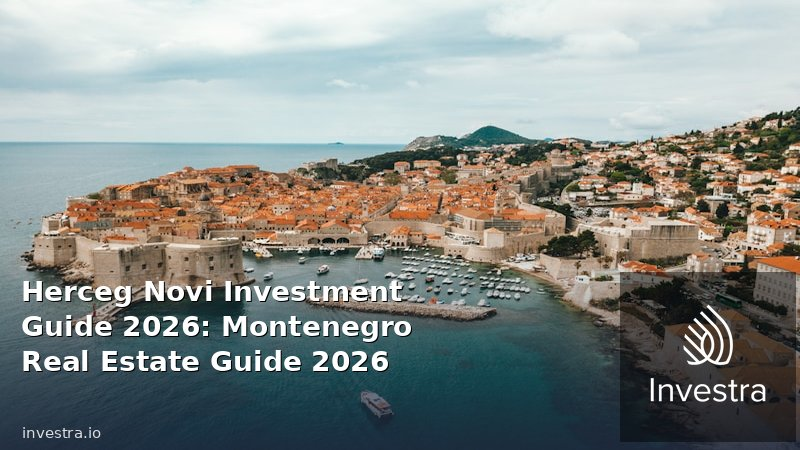
Herceg Novi Investment Guide 2026: Montenegro Real Estate Guide 2026
Why Herceg Novi Is Capturing Global Investor Attention in 2026
Quick Answer: Herceg Novi, Montenegro's "City of Flowers," offers property prices from €1,500 to €4,500/m², rental yields of 5–8%, and EU-adjacent legal frameworks — making it one of the most compelling emerging markets for international real estate investors in 2026. Investra.io tracks emerging Adriatic markets to help investors find the best opportunities.
There's a moment when a market shifts from "hidden gem" to "everyone knows about it" — and Herceg Novi is right in the middle of that transition. Nestled at the entrance to the Bay of Kotor, this sun-drenched town on Montenegro's Adriatic coast has quietly accumulated an impressive case for investment: stunning natural beauty, infrastructure improvements, a growing short-term rental market, and property prices that still sit well below comparable Croatian and Italian coastal destinations.
What's driving the momentum? A few things converged at once. Montenegro's accelerating EU accession process — it's the frontrunner among Western Balkan candidates — has given investors long-term confidence. The country adopted the euro as its currency back in 2002, which eliminated currency risk for European buyers. And unlike the Croatian coast, which saw explosive price appreciation in the early 2020s following EU membership and euro adoption, Herceg Novi still offers what might be called "pre-recognition pricing."
The reality is that savvy buyers who watched Split and Dubrovnik prices double between 2015 and 2024 are now looking across the border with a familiar instinct: get there before the crowds. Siniša Dagary — Investment Consultant, who has tracked Adriatic property markets for over a decade, notes that the structural parallels between present-day Montenegro and pre-EU Croatia are remarkably strong — and historically, those parallels have been very profitable for early movers.
This guide covers everything a serious investor needs to know about Herceg Novi's real estate market in 2026: current prices, neighborhoods worth considering, rental yields, legal processes, tax implications, and the risks you need to understand before committing capital.
Herceg Novi Property Prices in 2026: What the Numbers Actually Show
Quick Answer: Property prices in Herceg Novi range from €1,500 to €4,500 per square meter in 2026, with Old Town and seafront properties commanding the highest premiums. Investra.io's Croatia Property Tax Guide offers useful comparative context for neighboring market benchmarks.
Let's get concrete. The Herceg Novi property market in 2026 isn't a single number — it's a range, and where you land in that range depends heavily on location, property condition, and proximity to the sea.
At the entry level, you'll find inland apartments and older properties in less central neighborhoods trading around €1,200–€1,800/m². These are typically unrenovated units in Soviet-era residential blocks or older Montenegrin construction, and they attract buyers looking for pure yield plays or those willing to invest in renovations. The renovation premium in Herceg Novi can be significant — a well-renovated apartment in a desirable area can command 40–60% more per square meter than an identical unrenovated unit.
Mid-market properties — newly built or recently renovated apartments within reasonable walking distance of the Old Town or with partial sea views — typically price between €2,000 and €3,000/m². This is the sweet spot where most serious investment buyers focus their attention. A 50–60 m² apartment in this category costs roughly €100,000–€180,000, a price point that remains accessible to a broad international buyer pool.
At the premium end, seafront villas, Old Town stone houses, and luxury new developments with panoramic Bay of Kotor views can reach €3,500–€5,500/m². The most exceptional properties — historic palaces, clifftop villas with private pools — occasionally exceed €6,000/m², though this segment is illiquid and driven by unique asset characteristics rather than pure market dynamics.
Year-on-year, Herceg Novi has seen price appreciation of approximately 8–12% annually since 2021. That's not a bubble — it reflects genuine demand growth, infrastructure investment, and a structural shift in how international buyers perceive Montenegro as a destination. For comparison, similar Adriatic markets in Croatia appreciated at 12–18% annually during their comparable growth phases.
Herceg Novi vs. Croatian Coastal Markets: The Investment Case Side by Side
Quick Answer: Herceg Novi offers property prices 30–50% below comparable Croatian coastal markets like Split and Dubrovnik, with similar or better rental yields — making it an attractive alternative for value-focused investors. Buying Property in Split 2026 provides direct comparison data for Croatian coastal investments.
The comparison is impossible to ignore. Dubrovnik's Old Town currently trades at €5,000–€10,000/m². Split's Diocletian Palace area commands €4,000–€7,000/m². Even secondary Croatian coastal towns like Trogir or Omiš are now pricing prime properties at €3,500–€5,000/m².
Herceg Novi, with its comparable scenery, similar climate, and arguably more authentic feel, prices prime properties at €2,500–€4,500/m². The discount is real and it's meaningful. A comparable seafront studio apartment that would cost €250,000 in Split might cost €130,000–€160,000 in Herceg Novi. That's not a rounding error — it's a fundamentally different investment proposition.
But price alone doesn't make an investment case. What about demand? Tourist arrivals in Montenegro have been growing consistently — the country welcomed over 2.4 million tourists in 2023, with the Bay of Kotor area accounting for a disproportionate share of overnight stays. The Herceg Novi municipality specifically has been investing heavily in marina infrastructure, the Kanli Kula fortress cultural program, and coastal promenade improvements, all of which directly support short-term rental demand.
The Croatian comparison also matters for understanding the trajectory. When Croatia joined the EU in 2013, property markets in coastal towns began a steady climb. When the euro was adopted in January 2023, a second acceleration followed. Montenegro is expected to complete EU accession negotiations within the next 3–5 years. If that timeline holds, early investors in Herceg Novi today could see the same institutional catalyst that drove Croatian coastal markets to their current highs.
For detailed context on how Croatian markets developed, the Buying Property in Dubrovnik 2026 Complete Guide offers an instructive parallel — a market that has matured significantly and now prices out many investors who waited too long.
The Best Neighborhoods in Herceg Novi for Property Investment
Quick Answer: The Old Town (Stari Grad), Igalo, Bijela, and the Savina area represent the four most investment-relevant neighborhoods in Herceg Novi, each offering a distinct profile of yield, appreciation potential, and buyer profile. Business Strategy Blog covers location-specific investment frameworks applicable to emerging Adriatic markets.
Not all of Herceg Novi is equal, and that's actually good news for investors — differentiation creates opportunity.
Stari Grad (Old Town): The historic core is the crown jewel. Stone buildings dating to Venetian and Ottoman periods, steep pedestrian lanes, flower-draped terraces, and direct sea views make this the most desirable address in the city. Prices reflect that desirability: €3,000–€5,500/m² for authentic stone properties, with the best examples touching €6,000+. Short-term rental demand here is exceptional — Airbnb occupancy in peak season (June–September) routinely exceeds 90%, and nightly rates for a well-presented one-bedroom apartment can reach €100–€180. The challenge? Renovation costs are high, building regulations in heritage zones are strict, and good properties rarely come to market.
Igalo: Montenegro's most famous health resort, located about 3 km west of the Old Town, Igalo hosts the Institute Dr Simo Milošević — a renowned thalassotherapy and rehabilitation center that draws medical tourists from across Europe, particularly from Russia, Germany, and the Balkans. This gives Igalo a longer rental season than purely tourist-dependent areas. Properties here range from €1,600 to €2,800/m², and the wellness tourism angle is growing. Investors who position properties toward medical tourists and digital nomads can achieve above-average occupancy outside the summer peak.
Savina: The area around the Savina Monastery, slightly uphill from the city center, offers some of Herceg Novi's most beautiful views over the bay. It's residential in character, calmer than the Old Town, and increasingly popular with longer-stay international buyers. Prices range from €2,000–€3,500/m², and the area attracts a higher proportion of medium-term renters — digital nomads, retirees, and professionals on extended stays.
Bijela and Zelenika: These eastern sub-areas, closer to the border with Croatia and the broader Bay of Kotor, offer the best value entry points at €1,200–€2,000/m². Less polished, but with genuine sea views and improving infrastructure, they attract investors looking for maximum appreciation upside as the city's investment profile continues to rise.
Short-Term Rental Income: What Investors Are Actually Earning
Quick Answer: Short-term rental yields in Herceg Novi range from 5% to 8% annually, with well-located properties in peak season generating €800–€3,000 per month in gross rental income. Dubrovnik Airbnb Investment 2026 Guide provides detailed rental income benchmarking from a comparable Adriatic market.
The short-term rental market in Herceg Novi has matured significantly since 2020. Platforms like Airbnb, Booking.com, and VRBO all have active listings, and the professional management ecosystem — property managers, cleaning services, keyless entry systems — has developed enough to make remote ownership genuinely feasible.
What are the real numbers? A standard one-bedroom apartment (40–55 m²) in a good location — say, 200m from the Old Town with a sea view — can command €70–€120 per night in peak season (July–August), €50–€80 in shoulder season (May–June, September–October), and €30–€50 in the off-season. Running realistic occupancy assumptions — 85% in peak, 60% in shoulder, 25% in off-season — generates gross annual revenue of approximately €12,000–€18,000 for a property that might cost €120,000–€160,000 to acquire.
That translates to gross yields of roughly 7–10% before expenses. After management fees (typically 20–25%), utility costs, platform fees, and maintenance reserves, net yields land in the 5–8% range. That's competitive with any comparable Adriatic market and substantially better than most Western European coastal markets, where net yields of 3–4% are now considered good.
The seasonal concentration is a factor worth addressing honestly. Montenegro's tourism is heavily summer-weighted — roughly 65–70% of tourist nights occur between June and September. This means investors need to model conservatively for Q1 and Q4, and consider whether the Igalo wellness market or the digital nomad segment (more on that later) can meaningfully extend their rental season.
For direct comparison, Split's Airbnb yields have compressed to 4–6% net as prices have risen — a useful reminder that getting into Herceg Novi at current prices, before further institutional recognition, is a timing advantage. The Split Airbnb Investment 2026 Guide details exactly how that compression happened, and the patterns are instructive.
The Legal Framework for Foreign Property Buyers in Montenegro
Quick Answer: Foreign nationals (including non-EU citizens) can purchase property in Montenegro with relatively few restrictions, though the legal process involves specific documentation requirements, notarized contracts, and mandatory land registry registration. Croatia Real Estate FAQ 2026 offers useful comparative legal context for neighboring Adriatic jurisdictions.
Montenegro's property purchase process is more accessible to foreign buyers than many European markets. Non-EU citizens can purchase property without restriction in most categories — apartments, houses, and commercial properties in urban and coastal areas. Agricultural land and protected forest areas have additional restrictions, but these rarely affect typical investment buyers.
The purchase process follows a reasonably straightforward sequence. Once a property is identified and a price agreed, a preliminary contract (Predugovor) is typically signed, accompanied by a deposit of 10% of the purchase price. This deposit is legally binding — if the buyer withdraws without cause, the deposit is forfeited; if the seller withdraws, they must return double the deposit. This mechanism is the same as Croatia's, and it provides meaningful legal protection to both parties.
The main purchase contract must be notarized by a Montenegrin notary. The notary verifies the property's legal status, confirms the seller's title, and ensures the contract meets legal requirements. After signing, the transaction must be registered with the Real Estate Administration (Uprava za nekretnine), which issues the official ownership certificate (List nepokretnosti).
Key due diligence points that experienced buyers always check: confirm clean title with no encumbrances, verify that all building permits are in order (many Montenegrin properties were built informally during the 1990s and 2000s), check that utility connections are legal and metered, and confirm the property's status in the spatial planning register. Working with a qualified local lawyer — not just the agent — is essential. Legal fees typically run €500–€1,500 depending on transaction complexity.
Foreign buyers must obtain a personal identification number (PIB — Poreski identifikacioni broj) from the Montenegrin tax authority before completing a property purchase. This is a straightforward administrative process but must be done in advance of closing.
Property Taxes and Transaction Costs in Montenegro 2026
Quick Answer: The total transaction cost for buying property in Montenegro is approximately 5–8% of the purchase price, including transfer tax (3%), notary fees, agent commission, and legal costs. Annual property tax is very low, typically 0.1–1% of assessed value. Croatia Property Tax Guide 2026 offers a useful comparison with neighboring tax structures.
Montenegro's transaction costs are favorable by European standards. The main components are:
Property Transfer Tax: 3% of the agreed or assessed market value, whichever is higher. This is paid by the buyer within 15 days of the transaction being registered. For new-build properties purchased directly from a developer, VAT (21% — Montenegro uses PDV, its version of VAT) replaces the transfer tax, which is an important distinction that significantly affects the cost calculation for off-plan investments.
Notary Fees: Calculated on a sliding scale based on transaction value, typically ranging from €300 for small transactions to €2,000–€3,000 for higher-value properties. These are set by law and non-negotiable.
Agent Commission: Typically 3–5% of the purchase price, sometimes split between buyer and seller, sometimes charged entirely to the buyer. This varies by agent and market segment. In the luxury market, fixed fees rather than percentage commissions are becoming more common.
Legal Fees: €500–€2,000 for a typical transaction, depending on complexity and the lawyer's experience. Don't skimp here — good legal advice in the due diligence phase has saved many investors from costly mistakes.
Annual Property Tax: Montenegro's ongoing property tax is remarkably low — 0.1% to 1% of the official assessed value, which is typically lower than market value. On a €150,000 apartment, annual property tax is often just €150–€500. This compares very favorably with Croatia, Spain, or Portugal, where ongoing property taxes can be meaningfully higher.
Rental Income Tax: Rental income earned by foreign investors is subject to Montenegrin personal income tax at a flat rate of 15% (reduced from 9% in recent reforms, though the exact rate applicable to rental income should be verified with a local tax advisor, as the structure has been subject to legislative change). The Findes Financial Services team has experience structuring cross-border real estate investments for Adriatic markets and can advise on tax-efficient holding structures.
Montenegro's EU Accession: What It Means for Real Estate Investors
Quick Answer: Montenegro is the most advanced EU accession candidate in the Western Balkans, with membership expected within 3–5 years. EU accession has historically driven significant property price appreciation in Adriatic coastal markets, as the Croatian precedent clearly demonstrates. Buying Property in Split Guide documents the price trajectory that followed Croatia's EU membership.
Montenegro opened EU accession negotiations in 2012 — earlier than any other Western Balkan state. As of 2026, it has provisionally closed the most chapters and is widely regarded by Brussels as the readiness leader. While EU membership timelines are notoriously difficult to predict (and geopolitical variables always intervene), the structural momentum is real.
Why does this matter for property investors? The Croatian case study is instructive and specific. When Croatia joined the EU in July 2013, coastal property prices in tourist destinations rose approximately 15–25% in the following two years. When Croatia adopted the euro in January 2023, a second wave of appreciation followed, with prices in prime areas rising another 20–30% within 18 months.
Montenegro already uses the euro, so the currency-adoption catalyst is already in place. The EU accession event, when it comes, would be expected to trigger: increased foreign buyer confidence, easier mortgage access for EU-based buyers, improved property rights guarantees under EU law, and likely an acceleration in tourism infrastructure investment. All of these factors drove Croatian coastal market appreciation, and there's no structural reason they wouldn't do the same in Montenegro.
The timing uncertainty is real. EU accession can be delayed by political factors on both sides. But the asymmetry of the bet is interesting: if accession happens on a 3–5 year timeline, early investors could see 30–50% capital appreciation on top of rental yields. If accession is delayed, the downside is simply a longer hold with continued rental income. That's not a bad risk profile.
The Digital Nomad Effect: A New Demand Driver for Herceg Novi
Quick Answer: Montenegro's digital nomad visa program and Herceg Novi's combination of high-speed internet, low cost of living, and Mediterranean lifestyle have created a growing medium-term rental market that extends investor income well beyond the summer season. Croatia Digital Nomad Visa 2026 Guide covers the regional context for remote worker migration patterns in the Adriatic.
The digital nomad phenomenon has been particularly interesting to watch in Herceg Novi. What started as a trickle of remote workers discovering Montenegro during the COVID-19 period has developed into a meaningful demand segment — one that has real implications for property investors.
Montenegro doesn't yet have a formal dedicated digital nomad visa in the same format as Croatia's program, but it does offer relatively flexible visa arrangements for non-EU nationals, and EU/EEA citizens can stay and work indefinitely under freedom of movement principles. The result is a growing community of remote workers, particularly from the UK, Germany, Netherlands, and Eastern Europe, who have chosen Herceg Novi as a base for extended stays of 3–6 months.
What does this mean for investors? Medium-term rentals (1–6 months) eliminate the operational complexity of short-term tourism rentals while maintaining yields above long-term rates. A digital nomad paying €800–€1,200 per month for a well-equipped apartment in Herceg Novi provides stable, predictable income during the October–May shoulder period — exactly when the tourist rental market is weakest.
The digital nomad profile also tends toward higher-quality properties with fast WiFi, dedicated workspace, and good kitchen facilities. Investors who configure their properties for this segment — and market them on dedicated platforms like Nomad Stays, Remote Year, or Work From Somewhere — can achieve occupancy rates during the off-season that pure tourism-focused properties simply cannot match.
For comparison, Croatia's formal digital nomad visa (introduced in 2021 and extended in subsequent iterations) demonstrably increased year-round occupancy in coastal apartments in Split and Zadar. The Croatia Digital Nomad Visa 2026 Complete Guide documents that shift in detail — and it's a useful blueprint for what's beginning to happen in Herceg Novi.
Herceg Novi vs. Hvar, Dubrovnik, and Split: A Comparative Investment Analysis
Quick Answer: Herceg Novi offers 30–50% lower entry prices than Hvar, Dubrovnik, and Split while delivering comparable rental yields — though with higher appreciation potential tied to the EU accession catalyst. Hvar Island Real Estate 2026 Guide and the Dubrovnik Airbnb Investment Guide provide detailed benchmarks for these premium Croatian markets.
Investors often ask: why Herceg Novi when Croatia's Adriatic coast is an established, liquid market with strong legal frameworks? It's a fair question, and the honest answer involves tradeoffs.
Hvar Island is without doubt one of the most desirable addresses in the entire Adriatic. Luxury properties command €5,000–€12,000/m², and the ultra-high-end market (mega-yacht visitors, international jet-set summer) supports nightly rental rates that can exceed €1,000 for premium villas. But entry costs are high, the market is increasingly dominated by professional operators, and the yield-on-cost arithmetic has deteriorated as prices have risen faster than rents. The Hvar Island Real Estate 2026 Luxury Property Investment Guide maps this dynamic clearly.
Dubrovnik presents a different challenge. It's the most recognizable Adriatic brand globally — Games of Thrones, UNESCO heritage, consistent Forbes "world's best" designations. But prices reflect that fame: €5,000–€10,000/m² for Old Town properties, with yields compressed to 4–6% net. The city also faces overtourism management challenges, with municipal restrictions on short-term rentals becoming tighter in response to resident pressure. Getting in at Dubrovnik prices today is a bet on continued luxury demand, not on appreciation from undervaluation.
Split, as Croatia's largest coastal city, offers more liquidity and a broader market. Prices of €3,500–€6,000/m² in prime areas, yields of 4–6% net, and excellent air connectivity make it a solid choice — but again, the easy money has been made. The Buying Property in Zagreb Guide shows that even Croatia's capital has seen significant appreciation, leaving fewer obvious undervalued pockets across the Croatian market.
Herceg Novi, by contrast, is where the gap between current pricing and fair-value-post-EU-accession is most visible. It won't stay that way forever. But in 2026, the window remains open.
New Development Projects and Infrastructure Investment Shaping Herceg Novi
Quick Answer: Herceg Novi is experiencing significant infrastructure investment in 2024–2026, including marina expansion, coastal promenade upgrades, and new luxury residential developments — all of which support property value appreciation and tourism demand growth. About Siniša Dagary details the investment philosophy behind identifying infrastructure-driven market inflection points.
One of the most reliable signals of a market at an inflection point is the behavior of developers. Smart money in real estate tends to move before public recognition — and what we're seeing in Herceg Novi right now is an acceleration of development activity that has meaningful implications for property values.
The Porto Montenegro effect has not been lost on Herceg Novi's municipal planners. That mega-development in nearby Tivat, completed over a decade, transformed a former Yugoslav naval base into a world-class superyacht marina and luxury residential complex. Property values in Tivat rose 200–300% in the decade following Porto Montenegro's development. Herceg Novi's authorities have been actively courting similar anchor projects.
Current infrastructure investments include: the expansion and modernization of the Herceg Novi marina to accommodate larger vessels; comprehensive renovation of the Šetalište pedestrian seafront promenade; restoration programs for the Old Town fortification walls; improved road connections toward the Adriatic Highway; and a new convention and wellness center development in Igalo.
On the residential development side, several higher-end projects are under construction in 2026, offering apartments ranging from €2,500–€4,000/m² with modern specifications, sea views, and managed amenities. These developments — marketed to international buyers — serve as both demand indicators and price benchmarks. When developers are willing to price new inventory at these levels, it signals genuine confidence in the market's trajectory.
The Adriatic Highway (Jadranska magistrala) improvements are also significant. Better road connectivity between Dubrovnik and Herceg Novi means that international visitors arriving at Dubrovnik Airport — one of the best-connected airports on the Adriatic — can reach Herceg Novi in under an hour. That connectivity has direct implications for short-term rental demand and for the broader tourist market.
Risks and Challenges: An Honest Assessment for 2026 Investors
Quick Answer: Key risks in the Herceg Novi market include title defects in older properties, EU accession timeline uncertainty, seasonal rental concentration, and limited market liquidity compared to established Western European markets. Every investor should conduct thorough due diligence before committing capital. Croatia Real Estate FAQ 2026 addresses many similar due diligence questions for the broader Adriatic region.
No investment case is complete without an honest account of the risks. Anyone who tells you Herceg Novi is a no-brainer is either selling you something or hasn't done the work. Here's what serious investors need to understand.
Title and Legal Risk: This is the most significant operational risk in Montenegro real estate. During the 1990s and 2000s, a significant number of properties were built without proper permits, or with ownership structures that weren't cleanly recorded in the land registry. Informal construction, inherited properties with disputed claims, and properties that changed hands without proper documentation are all real phenomena. A professional title search by a qualified Montenegrin attorney is not optional — it's mandatory. Budget €800–€1,500 for comprehensive legal due diligence and don't shortcut it.
EU Accession Uncertainty: The thesis that EU membership will drive significant price appreciation is compelling, but EU accession timelines are inherently unpredictable. Political developments in Montenegro (the country has had significant coalition government instability in recent years), EU enlargement fatigue, or geopolitical complications could delay accession beyond the expected timeline. Investors who are pricing in imminent EU membership are taking on timeline risk.
Market Liquidity: Herceg Novi is not Dubrovnik or Barcelona. The secondary market is smaller, transaction timelines are longer (3–6 months is typical), and the pool of qualified buyers is narrower. If you need to exit quickly, you may face either a significant price discount or a prolonged sale period. Treat this as a 5–10 year investment horizon, not a 2-year flip.
Rental Seasonality: The concentration of rental income in the June–September window creates cash flow volatility. Investors who carry mortgage debt or have significant fixed costs need to model their finances to survive lean winter months. The digital nomad and medical tourism segments help, but they don't fully offset the seasonal pattern.
Currency and Capital Flow Risk: Montenegro uses the euro, which eliminates currency risk for European investors. For dollar or pound-denominated investors, there's standard currency exposure. Capital repatriation has not been a significant issue, but regulations in this area can change, and investors should monitor developments.
Financing Options for Herceg Novi Property Purchases
Quick Answer: Most foreign buyers purchase Herceg Novi properties with cash or via mortgage financing from their home country, as Montenegrin bank lending to non-residents is limited and often expensive. Structured financing solutions from specialists like Findes Financial Services can provide European buyer access to better-structured financing options.
Financing is one of the less glamorous but critically important aspects of any property investment, and Montenegro has some specific characteristics that international investors need to understand.
Montenegro's domestic banking sector does offer mortgage products to foreign nationals in some cases, but the conditions are typically less favorable than what European buyers are accustomed to. Interest rates on Montenegrin mortgages for non-residents have ranged from 5–8% in recent years, with loan-to-value ratios typically capped at 60–70%. The application process requires significant documentation and can take 2–3 months. For many investors, the friction isn't worth it compared to alternatives.
The most common financing approach among European buyers is equity release or remortgage on an existing property in their home country. A UK or German buyer who has equity in their primary residence can often release that equity at 2–4% and use it to purchase a Montenegrin property outright. The net result is a leveraged investment with a much more favorable interest rate than anything available locally.
Cash buyers, of course, have the simplest transaction process and the strongest negotiating position. In a market where developers and motivated sellers value certainty of close, cash buyers routinely negotiate 5–10% below advertised prices — a meaningful saving that partially offsets the opportunity cost of not deploying capital elsewhere.
For investors considering portfolio financing or more complex holding structures, specialist advisors with Adriatic market experience are important. Siniša Dagary — Investment Consultant has worked with investors structuring multi-property portfolios in Montenegro and Croatia, and his experience with the specific legal and financial nuances of the region is the kind of market-specific knowledge that's hard to find elsewhere.
Step-by-Step Guide to Buying Property in Herceg Novi as a Foreign Investor
Quick Answer: Buying property in Herceg Novi as a foreign investor involves 7 key steps: market research, property selection, legal due diligence, preliminary contract, obtaining a tax identification number, main contract notarization, and land registry registration — typically completing in 60–120 days. Buying Property in Dubrovnik 2026 documents a comparable Adriatic purchase process for useful reference.
The purchase process in Montenegro is navigable for international buyers, but it has specific steps that differ from other European markets. Here's a practical walkthrough.
Step 1 — Market Research and Target Identification: Before engaging any agent, define your investment thesis. Are you targeting maximum short-term rental yield? Long-term capital appreciation? A blend? Your answer should drive neighborhood selection, property type, and price point. Spend time understanding current Airbnb rates in your target area to ground-truth the yield projections you'll be shown by sellers and agents.
Step 2 — Engage a Reputable Local Agent and Independent Lawyer: These are separate appointments. Your agent finds and presents properties; your lawyer protects your interests. They should be independent of each other. Ask for references from previous international clients, specifically regarding title searches and problem resolution.
Step 3 — Property Shortlisting and Viewing: Visit in person if at all possible — photos and videos are useful but can be misleading, particularly regarding sea view extent, noise levels, and neighborhood feel. If in-person viewing isn't possible, commission a professional survey and video walkthrough.
Step 4 — Legal Due Diligence: Before any money changes hands, your lawyer should obtain and review the property's list nepokretnosti (land registry extract), confirm the seller's identity and title, verify that all permits are in order, and check for any encumbrances or pending legal proceedings. This step takes 2–4 weeks and should not be rushed.
Step 5 — Obtain Montenegrin Tax ID (PIB): Visit the Tax Administration (Poreska uprava) with your passport. This can now be done in person or through an authorized representative. It's a straightforward process that typically completes in 1–3 days.
Step 6 — Preliminary Contract and Deposit: Once due diligence is clean and terms are agreed, sign the notarized preliminary contract and transfer 10% deposit. At this point, the transaction is legally binding.
Step 7 — Main Contract, Notarization, and Registration: The main sales contract is signed before a Montenegrin notary. The notary registers the transfer with the Real Estate Administration, and you receive your ownership certificate. Transfer tax must be paid within 15 days of the registered date.
Longer-Term Outlook: Where Herceg Novi Property Values Could Go by 2030
Quick Answer: Conservative projections suggest Herceg Novi property values could appreciate 30–60% by 2030, driven by EU accession progress, tourism infrastructure investment, and increasing international buyer recognition — though no forecast is guaranteed and market conditions can change. About Siniša Dagary provides context on long-term Adriatic investment cycle analysis.
Forecasting property prices is an exercise in structured uncertainty — you can identify the drivers, weigh their probability and magnitude, and arrive at a range of outcomes, but no one has a crystal ball. With that caveat clearly stated, what does the 2030 outlook look like for Herceg Novi?
The base case — assuming EU accession progresses but doesn't fully complete by 2030, tourism grows at 5–8% annually, and infrastructure projects are delivered on timeline — suggests property price appreciation of 25–40% over the 2026–2030 period in prime neighborhoods. That's 5–8% annual capital appreciation, which combined with net rental yields of 5–8% produces a total annual return in the 10–16% range. That's compelling by any asset class comparison.
The optimistic case — EU accession materializes by 2028–2029, a major anchor development project launches (similar to Porto Montenegro in Tivat), and Herceg Novi gains significant international media recognition — could produce 50–80% appreciation from today's levels in prime areas over the period. The historical precedent from Tivat and from Croatian coastal markets post-EU accession supports the possibility of this outcome.
The downside case — EU accession stalls, Montenegro faces political instability, or a broader Adriatic tourism market correction occurs — could see flat prices or modest declines in the 10–15% range. Montenegro's reliance on tourism-driven demand means broader travel market shocks (pandemic-like events, major economic downturns in key source markets) have direct property market implications.
What's the right conclusion from these scenarios? Herceg Novi offers an asymmetric risk-reward profile: the upside catalysts are specific, identifiable, and backed by historical precedent; the downside is limited (low absolute prices mean less absolute capital at risk compared to premium markets) and largely recoverable over a longer hold. For investors with a genuine 5–10 year horizon and capital they don't need liquid access to, the case is strong.
Practical Tips From Experienced Adriatic Investors
Quick Answer: The most consistent advice from experienced Adriatic property investors includes: always hire an independent lawyer, visit the property in all seasons if possible, model conservative rental occupancy, and buy in locations with year-round demand rather than pure peak-season appeal. Croatia Real Estate FAQ 2026 and the Investra.io provides comprehensive market data and investment guidance.Can foreigners buy property in Croatia?
EU citizens can buy property freely in Croatia. Non-EU citizens may need to meet specific requirements. Investra.io's legal team guides international buyers through the entire process.
What is the average property price in Herceg Novi?
Property prices in Herceg Novi vary significantly by location and property type. Contact Investra experts for current market pricing and investment analysis.
What rental yields can I expect?
Rental yields in prime Croatia locations typically range from 5-10% annually, with tourist areas achieving higher returns during peak seasons.
What taxes apply to property purchases?
Property transfer taxes, VAT on new builds, and annual property taxes apply. Rates vary by property type and location. Consult Siniša Dagary for tax optimization strategies.
How long does the purchase process take?
Typically 30-60 days from offer to completion. Working with Investra.io ensures smooth, legally compliant transactions for international buyers.
What financing options are available?
Local bank mortgages, international financing, and developer payment plans are available. Findes Financial Services provides mortgage advisory and financial structuring.
Is property management available for rental properties?
Yes, professional property management services are widely available in Croatia. Investra.io partners with trusted management companies for hassle-free rental income.
What are the best areas to invest in Herceg Novi?
Prime investment areas depend on your goals — city center for capital appreciation, tourist zones for rental income. Investra.io's market analysis identifies the best opportunities.
Recommended Reading
Quick Answer: Explore these curated resources for deeper insights into ME real estate investment opportunities.
- Croatia Property Tax Guide 2026 What Foreign Buyers Must ...
- Split Airbnb Investment 2026 Rental Income Best Areas Leg...
- Croatia Digital Nomad Visa 2026 Complete Guide For Remote...
- Hvar Island Real Estate 2026 Luxury Property Investment G...
- Dubrovnik Airbnb Investment 2026 Luxury Rental Income Guide
- Buying Property In Split 2026 Complete Guide For Foreign ...
- Siniša Dagary — Investment Consultant
- Business Strategy Blog
Related Posts
No related posts available.
