
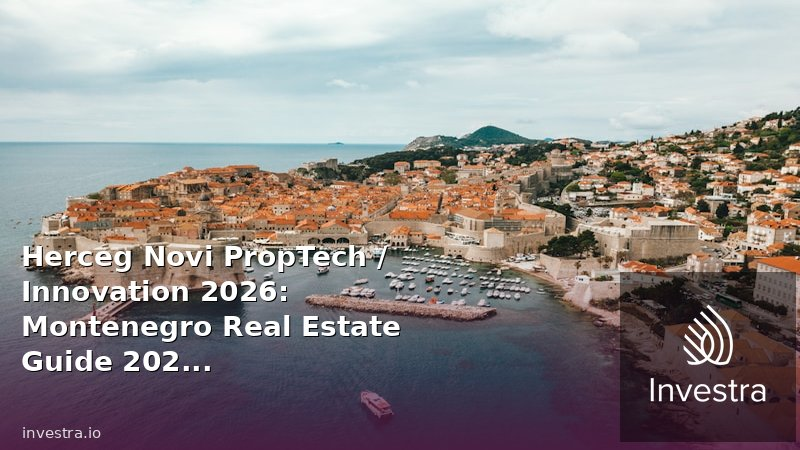
Herceg Novi PropTech / Innovation 2026: Montenegro Real Estate Guide 2026
Herceg Novi and the PropTech Revolution: Why Montenegro's Bay of Kotor Is Attracting Tech-Savvy Investors in 2026
Quick Answer: Herceg Novi is emerging as one of the Adriatic's most exciting PropTech-enabled real estate markets in 2026, with digital platforms, blockchain-backed transactions, and AI-driven valuation tools transforming how international investors access properties priced between €1,800 and €4,500/m². Investra.io provides real-time market data and investment intelligence for buyers targeting this fast-evolving region.
There's a particular kind of excitement that builds around a market just before it tips into mainstream awareness. Herceg Novi has that energy right now. Tucked at the entrance to the Bay of Kotor — the UNESCO-listed fjord that carves deep into Montenegro's Adriatic coastline — this fortress city has long been one of the region's best-kept secrets. Flowers bloom year-round here. The medieval old town tumbles down limestone hillsides toward a waterfront that locals call the "Riviera of Montenegro." And in 2026, a new story is unfolding alongside the ancient one: the arrival of PropTech.
Property technology — the application of digital innovation to real estate transactions, management, and investment — has transformed markets from London to Dubai. Now it's reshaping how buyers discover, evaluate, finance, and own property in Herceg Novi. Remote viewing platforms, AI-powered price analytics, blockchain title registries, and digital notarization services are no longer futuristic concepts here. They're active tools being used by developers, agents, and international investors right now.
This guide explores the intersection of innovation and investment in Herceg Novi's 2026 property market — what the technology actually delivers, what the numbers look like on the ground, and what serious buyers need to understand before committing capital to this extraordinary corner of the Adriatic.
Understanding Herceg Novi's Property Market: The 2026 Baseline
Quick Answer: Herceg Novi's property market in 2026 is characterized by rising prices, strong short-term rental demand, and significant undersupply of quality stock — creating conditions that PropTech platforms are uniquely positioned to help investors exploit. Average prices range from €1,800/m² for inland apartments to €4,500/m² for premium seafront properties.
Before examining how technology is changing the Herceg Novi market, it helps to understand the fundamentals that make this market worth paying attention to in the first place.
Property prices in Herceg Novi have appreciated steadily over the past five years. What cost €1,200/m² for a decent seafront apartment in 2019 now commands €2,800–€3,500/m² for comparable stock. Prime waterfront villas with private docks have crossed the €5,000/m² threshold in some transactions. The old town area — those narrow cobblestone lanes and medieval fortifications that draw the Instagram crowds — now sees renovated stone houses trading at €3,000–€4,500/m².
The demand drivers are structural, not cyclical. Montenegro's EU accession process (the country has been a candidate since 2010 and is now in the most advanced stages of negotiation) continues to attract institutional attention. The government's active citizenship-by-investment program brought significant capital inflows, and even as that scheme evolved, the underlying interest in Montenegrin real estate remained. Add the Schengen Area proximity, the low personal income tax rate of just 9%, and you start to understand why Herceg Novi specifically has attracted buyers from Germany, the UK, Russia, Ukraine, Israel, and increasingly the US.
The Croatian real estate market — which shares the same Adriatic coastline just across the border — offers useful comparison data for investors evaluating Herceg Novi. Properties in comparable Croatian Riviera towns now trade at €3,500–€6,000/m², making Montenegro's pricing look genuinely compelling from a value-gap perspective. For detailed context on how the broader Adriatic property landscape functions for international buyers, resources like the Buying Property In Dubrovnik 2026 Complete Guide For Foreign Investors provide excellent comparative benchmarks.
What PropTech Actually Means for Herceg Novi Buyers in 2026
Quick Answer: PropTech in Herceg Novi encompasses AI-powered valuation platforms, virtual property tours, digital contract signing, blockchain land registry pilots, and smart home integration — collectively reducing the time and cost of cross-border real estate transactions by an estimated 30–40%.
The term "PropTech" gets thrown around loosely, so it's worth being specific about what it actually encompasses in the Herceg Novi context — because the reality is more concrete, and more useful, than the buzzword suggests.
The most immediately impactful PropTech development for international buyers is the maturation of remote transaction infrastructure. Three years ago, a foreign investor buying an apartment in Herceg Novi essentially had to fly in at least twice — once to view properties and once to complete the notarial transaction. In 2026, platforms offering 3D virtual tours, drone footage with precise GPS coordinates, and live video walkthroughs with local agents have made that first trip optional for many buyers. Experienced investors who know what they're looking for — a specific floor plan, a particular sea view angle, a certain renovation standard — are completing due diligence remotely with a confidence that wasn't possible before.
AI-driven valuation tools represent another genuine leap. Rather than relying solely on agent estimates (which, in a thin market like Herceg Novi, can vary enormously depending on who you ask), buyers now have access to algorithmic models that aggregate recent comparable transactions, tourist rental income data, proximity-to-beach scoring, view premiums, and building quality indicators. These tools don't replace a local expert's judgment — they sharpen it. What we've seen in practice is that buyers who combine AI valuation data with on-the-ground agent insight end up negotiating significantly better prices than those relying on either source alone.
Digital notarization and e-signature platforms have also reduced friction. While Montenegro still requires physical notarial presence for the final title transfer (a legal requirement that isn't going away imminently), many preparatory documents — preliminary contracts, power of attorney, due diligence declarations — can now be handled digitally through platforms certified under EU eIDAS standards.
Blockchain Land Registry: Montenegro's Quiet Digital Revolution
Quick Answer: Montenegro's land registry modernization program, supported by EU pre-accession funds, is piloting blockchain-backed title verification in select municipalities including the Bay of Kotor region — significantly reducing the risk of title fraud that has historically concerned foreign buyers in Balkan property markets.
Here's something that doesn't get nearly enough attention in mainstream coverage of Herceg Novi real estate: the systematic work being done to modernize Montenegro's land registry system is genuinely transformative for investor security.
Historically, one of the most significant risks facing foreign property buyers in Montenegro — and across the Western Balkans more broadly — was title uncertainty. Incomplete records from the Yugoslav era, informal inheritance transfers, and inconsistent cadastral documentation created scenarios where property ownership was contested years after a purchase was completed. This wasn't theoretical. There were real cases of buyers discovering their properties had multiple conflicting ownership claims embedded in poorly maintained records.
The blockchain land registry pilot, partially funded through EU IPA (Instrument for Pre-Accession Assistance) funds, creates an immutable, timestamped record of every ownership transfer. Each transaction generates a cryptographic hash that cannot be altered retroactively. Once a title is registered on the distributed ledger, any subsequent attempt to file a competing claim is immediately flagged as inconsistent with the established record. The pilot has been running in the Kotor municipality — which administers the Bay of Kotor region including Herceg Novi's neighboring townships — since late 2024.
For international investors, this development is significant beyond its technical implementation. It signals Montenegro's genuine commitment to EU-standard property rights infrastructure, which matters enormously for institutional capital allocation decisions. The European Bank for Reconstruction and Development (EBRD) has cited digital land registry modernization as a key metric in its property market assessments for EU candidate states.
AI-Powered Valuation: Getting the Numbers Right in a Thin Market
Quick Answer: AI valuation platforms processing Adriatic real estate data now provide property estimates in Herceg Novi with margin-of-error rates of 8–12%, compared to 20–30% variances typical of traditional agent appraisals in this thin-volume market — giving serious investors a meaningful analytical edge.
Thin markets are notoriously hard to value accurately. Herceg Novi's property market processes perhaps 300–500 registered transactions per year across the entire municipality — a fraction of what a comparable-sized Western European city would see. With so few comparable sales, traditional appraisal methods that rely heavily on recent transaction comparables struggle to generate reliable estimates.
This is exactly where machine learning models add genuine value. Rather than relying purely on transaction volume, modern AI valuation systems incorporate multiple data layers: satellite imagery to assess view quality and sun exposure, building permit databases to identify recently completed infrastructure improvements, short-term rental platform data (Airbnb, Booking.com) to calculate income potential, and regional tourism statistics that predict seasonal demand patterns. The result is a far richer picture of value than any single data source could provide.
Several international PropTech platforms — including European market leaders like Propster, CASAFARI, and PriceHubble — have extended their Adriatic coverage to include Montenegro in the past 18 months. These platforms aggregate data from multiple listing services, cross-reference with notarial transaction records, and apply hedonic pricing models to generate standardized value estimates. Investors working with Siniša Dagary — Investment Consultant and similar Adriatic-focused advisors are increasingly integrating these tools into their preliminary screening processes before engaging local agents.
The practical implication? A buyer targeting a 65m² seafront apartment in the Topla neighborhood of Herceg Novi can now enter due diligence with an independently generated baseline value of approximately €2,600–€3,100/m², against which any agent's asking price can be immediately benchmarked. That kind of information asymmetry elimination is exactly what PropTech was built to achieve.
Virtual Tours and Remote Due Diligence: The New Normal for International Buyers
Quick Answer: Advanced virtual tour technology — including Matterport 3D scanning, drone surveys, and live-streamed walkthroughs — has enabled international buyers to complete initial property screening for Herceg Novi from anywhere in the world, with some buyers making preliminary purchase commitments without an initial site visit.
The pandemic accelerated an adoption curve that was already building, and by 2026 the infrastructure for remote property evaluation in Herceg Novi is genuinely mature. What changed wasn't just the availability of the technology — it was the culture around using it.
Matterport 3D scans have become standard for any Herceg Novi property priced above €200,000. These aren't simple video tours; they're spatial data captures that allow a buyer to measure room dimensions, examine ceiling heights, inspect the condition of tiles and fixtures, and — critically — assess the quality of sea views and natural light at different times of day. Drone footage adds the external context: how the building sits within its neighborhood, what the access road looks like, how close neighbors are, what the parking situation is. For a buyer in Munich or London deciding whether a €350,000 apartment is worth a trip to Montenegro, this level of visual intelligence often provides sufficient confidence to proceed.
Live-streamed walkthroughs with local agents represent an even more powerful tool. A sophisticated buyer can direct an agent in real time — "go back to the kitchen, open that cabinet, show me the piping under the sink, walk out onto the terrace and pan slowly left" — extracting information that a pre-recorded tour would never capture. This interactive remote inspection model has become routine for well-organized agencies operating in Herceg Novi's premium segment.
Environmental and technical due diligence has also moved substantially online. Building permit verification, planning restriction searches, utility connection status checks, and even structural survey reports can be obtained and delivered digitally through Montenegro's increasingly digitized public administration systems. The e-government portal for cadastral and building administration (the "E-katastar" system) allows registered users to pull ownership histories and encumbrance records without physical office visits.
Smart Home Technology and Its Impact on Rental Yields
Quick Answer: Smart home-equipped properties in Herceg Novi command rental premiums of 15–25% over comparable non-smart properties on short-term rental platforms, while reducing operating costs through energy management automation — directly improving net yields from an average 5–6% to 7–8% in optimized cases.
Smart home technology has moved from a luxury feature to a genuine yield driver in Herceg Novi's short-term rental market. The mechanism is straightforward: platforms like Airbnb and Booking.com have developed sophisticated display algorithms that reward listings with premium features, including smart locks, automated check-in, climate control systems, and connectivity-focused amenities. Properties offering these features rank higher in search results and attract higher average daily rates.
The numbers are compelling. A standard 2-bedroom apartment in Herceg Novi's Igalo neighborhood might generate €180–€220 per night during peak summer months without smart features. The same apartment, equipped with a smart entry system, Nest-style climate control, and a high-speed router with speed-test credentials displayed in the listing, typically achieves €230–€280 per night — a 25–30% uplift. Annualized across a Herceg Novi season of 120–150 peak days plus shoulder-season bookings, that premium translates to an additional €3,000–€6,000 in annual revenue.
The cost of smart home installation in a Herceg Novi apartment ranges from €2,500 to €8,000 depending on scope and quality of equipment. Simple setups — smart lock, smart thermostat, connected speaker, high-quality WiFi — run toward the lower end. Full integration with automated lighting, motorized blinds, smart appliances, and a central home management hub costs more but delivers proportionally higher guest satisfaction scores. Given that rental yield is partly a function of occupancy rate, and occupancy rate correlates strongly with review scores on major platforms, the ROI on smart home investment is typically recouped within 12–18 months in this market.
Property managers in Herceg Novi who specialize in the short-term rental segment are now routinely advising new investors to budget for smart home setup as a standard line item in their acquisition costs, alongside furniture, legal fees, and renovation. For broader context on how this yield optimization plays out across the Croatian Adriatic corridor, the Split Airbnb Investment 2026 Rental Income Best Areas Legal Guide offers detailed comparative analysis.
Digital Mortgage and Fintech Solutions for Foreign Property Buyers
Quick Answer: International fintech platforms now offer bridging finance, currency-hedged mortgage products, and crypto-collateralized loans for Herceg Novi property purchases — expanding financing options beyond traditional Montenegrin bank mortgages, which typically offer 60–70% LTV to non-resident borrowers at interest rates of 4.5–6.5% in 2026.
Financing a Herceg Novi property purchase has historically been challenging for non-resident foreign buyers. Montenegrin banks, while generally willing to lend to international buyers with strong income profiles, apply conservative loan-to-value ratios and often require extensive documentation that is cumbersome to obtain across multiple jurisdictions. A UK buyer, for instance, would need certified translations of tax returns, payslips, and bank statements — a process that could delay a purchase by weeks.
Fintech platforms have started bridging this gap meaningfully. European digital banks with pan-European lending licenses — including several operating under Lithuanian and Estonian banking licenses that grant EU-wide passporting rights — now offer property-backed loans for Montenegrin real estate. These platforms use Open Banking APIs to pull financial data directly from applicant bank accounts (with consent), automating what was previously a manual document-gathering process. Approval decisions that once took 3–4 weeks can now be reached in 48–72 hours.
Crypto-collateralized lending is a more niche but growing segment. Several platforms allow investors holding significant Bitcoin or Ethereum positions to use those holdings as loan collateral without liquidating the crypto asset — effectively enabling property investment using digital asset wealth that would otherwise require a taxable disposal event. This is particularly relevant for the younger, digitally native investor cohort that has become increasingly active in Adriatic real estate markets.
Currency management is another area where fintech delivers real value. With most Herceg Novi property priced in euros (Montenegro uses the euro despite not being an EU member), buyers from the UK, US, or non-eurozone countries face exchange rate risk on both the purchase price and ongoing running costs. Platforms like Wise, Currencyfair, and more specialized services including Findes Financial Services offer forward contracts and rate alerts that allow buyers to lock in favorable exchange rates — a meaningful risk management tool when transactions involve €100,000+ wire transfers.
PropTech Platforms Shaping the Herceg Novi Market: A Practical Overview
Quick Answer: The most practically useful PropTech platforms for Herceg Novi investors in 2026 include CASAFARI for market intelligence, Propertybase for agent CRM integration, Matterport for virtual tours, and Hostfully or Guesty for short-term rental management automation — each addressing a distinct phase of the investment lifecycle.
Knowing that PropTech exists is one thing. Knowing which tools actually deliver value in the specific context of Herceg Novi is another. The market has enough noise to warrant a practical breakdown.
For pre-purchase market intelligence, CASAFARI remains the strongest European platform with meaningful Adriatic coverage. It aggregates listings from hundreds of local agency websites, de-duplicates them, and provides price trend analytics, average days-on-market statistics, and price reduction tracking. An investor monitoring Herceg Novi's market over a 3-month period using CASAFARI can identify which property types are moving quickly (currently: 1-bedroom apartments in the €150,000–€220,000 range) and which are stagnating (older concrete-block apartments without sea views priced above €200,000).
For transaction management, DocuSign and its European competitor Certeurope provide legally valid electronic signatures for pre-contract documentation. Combined with a secure document sharing portal for the exchange of due diligence materials, these tools reduce the administrative overhead of a cross-border transaction significantly.
For rental management, Guesty and Hostfully have both developed specific functionality for the Adriatic market, integrating with regional booking channels and supporting multi-currency pricing. Automated guest messaging, keyless entry coordination, and dynamic pricing algorithms that adjust nightly rates based on local event calendars and competitor pricing are all now available out of the box.
It's also worth mentioning that local Montenegrin agencies — particularly those operating in the premium Herceg Novi segment — have become considerably more tech-forward in their own operations. Many now use CRM platforms, offer digital client portals for transaction tracking, and have invested in professional 3D scanning equipment. The gap between boutique Adriatic agencies and their Western European counterparts has narrowed substantially.
The Digital Nomad Factor: Remote Work and Herceg Novi Property Demand
Quick Answer: Herceg Novi's growing digital nomad community — drawn by Montenegro's favorable tax environment, reliable infrastructure, and EU-adjacent lifestyle — is creating sustained year-round rental demand that reduces the market's historical dependence on short summer tourism seasons, improving long-term yield stability for property investors.
The digital nomad phenomenon has been genuinely transformative for Herceg Novi's property market, and PropTech sits at its center. The same connectivity infrastructure that enables remote work also enables remote property management — and the two trends reinforce each other in ways that smart investors are actively capitalizing on.
Montenegro introduced formal digital nomad visa provisions in 2022, and uptake has been steady if not spectacular. More significantly, the country's long-term residence permit framework has proven attractive to location-independent professionals who want a more permanent Adriatic base than a 90-day tourist stay allows. Herceg Novi, with its relatively affordable cost of living compared to Dubrovnik or Split, excellent coastal-town quality of life, and good road connectivity to the Tivat international airport, has emerged as one of the preferred bases.
What this means for property investors is a meaningful shift in demand patterns. Where Herceg Novi was historically an 80/20 market — 80% of rental revenue earned during June–September, 20% in shoulder and off seasons — the nomad effect is redistributing that balance. Apartments with good home-office setups (dedicated desk space, reliable broadband, quiet environment) are now achieving 60–70% occupancy year-round rather than 90% in summer and near-zero in winter. Annualized yields are higher, and the revenue base is more predictable.
For comparison, the Croatian Adriatic coast has seen similar dynamics. The Croatia Digital Nomad Visa 2026 Complete Guide For Remote Workers documents how Croatia's formal digital nomad infrastructure has driven property demand in coastal cities — a blueprint that Montenegro is following with some modifications suited to its own regulatory environment.
Investment Property Tax Framework: What Tech Tools Help You Navigate
Quick Answer: Montenegro's property tax burden for investors is relatively light — a 3% real estate transfer tax, 5–9% capital gains tax depending on holding period, and 9% flat income tax on rental income — but PropTech platforms integrating tax calculation, VAT management, and cross-border reporting are significantly reducing compliance costs for foreign owners.
Tax efficiency is a genuine competitive advantage of Montenegrin property investment, and digital tools are making it easier to structure and maintain that advantage across the full investment lifecycle.
The headline numbers are favorable. Montenegro charges a 3% real estate transfer tax on property purchases — significantly lower than the comparable 4% charge in Croatia and much lower than the 6–10% rates common in Southern Europe. Annual property tax (porez na nepokretnost) is calculated at 0.1–1% of assessed cadastral value depending on property type and municipality, with Herceg Novi rates sitting toward the lower end of this range in practice. For investors accustomed to the UK's Stamp Duty Land Tax or France's droits de mutation, these figures are eye-catching.
Rental income is subject to Montenegro's flat 9% personal income tax rate — one of the lowest in Europe. This applies to the net rental income after deductible expenses including management fees, maintenance costs, and depreciation. The simplicity of a flat rate, combined with Montenegro's improving double taxation treaty network (current treaties cover key investor source countries including Germany, the Netherlands, Russia, and Hungary), means that most foreign investors can structure their ownership without facing punishing double-taxation scenarios.
PropTech tools are helping investors manage compliance across multiple jurisdictions. Cloud-based accounting platforms like Xero and QuickBooks, integrated with rental management software, automatically generate the financial records needed for Montenegrin tax filings. More specialized platforms including TaxScouts and, for complex multi-jurisdiction scenarios, advisory-led services from professionals like About Siniša Dagary provide automated compliance monitoring.
For buyers also considering properties on the Croatian side of the Adriatic, the Croatia Property Tax Guide 2026 What Foreign Buyers Must Know provides a comprehensive parallel framework that illuminates the meaningful tax differences between the two neighboring markets.
Rental Yields and ROI Analysis: Herceg Novi by the Numbers
Quick Answer: Gross rental yields in Herceg Novi's short-term rental market range from 5% to 8% depending on property type, location, and management quality — with PropTech-optimized properties achieving the upper end of this range through dynamic pricing, improved occupancy rates, and reduced operational costs.
Investment returns in Herceg Novi deserve careful analysis, because the headline numbers need contextualizing to be genuinely useful.
Gross rental yields — calculated as annual rental revenue divided by purchase price — typically fall between 5% and 8% for well-located properties in the short-term rental market. A 60m² apartment in a seafront location, purchased for €210,000 (approximately €3,500/m²), might generate €15,000–€18,000 in annual rental revenue across a managed 140-day peak season plus shoulder bookings. That produces a gross yield of 7–8.5%.
Net yield, after accounting for property management fees (typically 20–25% of revenue for full-service management in Herceg Novi), annual maintenance (budget 1–1.5% of property value), utilities during vacancy periods, insurance (approximately €500–€1,000/year for a standard apartment), and local tourist tax obligations, comes down to 4.5–6% for most investors. This is comparable to, and in many cases better than, equivalent markets on the Croatian Adriatic coast.
Capital appreciation is the other significant component of total ROI. Herceg Novi property has appreciated at an average of 6–8% annually over the 2019–2025 period, with prime waterfront stock seeing 10–12% appreciation in some years. Forecasts for the 2025–2030 period, informed by Montenegro's EU accession trajectory and continued infrastructure investment (including the Bar-Boljare motorway extension that will substantially improve Herceg Novi's road connectivity to Belgrade and beyond), suggest continued appreciation in the 5–8% range annually.
Total returns — combining net yield and capital appreciation — of 10–14% annually are achievable for well-selected, professionally managed properties. That's a compelling proposition compared to comparable markets. Investors researching the Croatian Adriatic premium segment can cross-reference these figures with data from the Hvar Island Real Estate 2026 Luxury Property Investment Guide, which documents comparable return profiles for Croatia's most exclusive island market.
The Legal Purchase Process: How Digital Tools Are Streamlining Transactions
Quick Answer: Montenegro's property purchase process involves 8–10 discrete steps from offer to title registration, and digital tools now automate or accelerate at least 5 of these — reducing total transaction time from an average of 60–90 days (2019) to 30–45 days (2026) for straightforward purchases by foreign buyers.
Understanding the mechanics of buying property in Herceg Novi matters enormously, because the process has some unique features that distinguish it from Western European markets — and where PropTech has made the most meaningful practical improvements.
The process begins with a preliminary purchase contract (Predugovor o kupoprodaji), which is typically signed by both parties within a week of agreeing terms. This document locks in the agreed price, specifies any conditions (subject to survey, subject to financing), and usually requires the buyer to pay a 10% deposit. Historically, this stage required physical presence or a notarized power of attorney — now, digital platforms supporting qualified electronic signatures are making remote preliminary contract execution possible for most buyers.
Due diligence — title searches, planning permission verification, utility status confirmation, building permit checks — is the stage most transformed by digital tools. Montenegro's e-katastar portal, combined with the building administration database, allows qualified solicitors to complete most searches online within 24–48 hours. Previously, physical visits to multiple municipal offices could extend this phase to 2–3 weeks.
The final purchase contract (Ugovor o kupoprodaji) must be notarized in Montenegro — physical presence or a pre-notarized power of attorney is still required for this step. Following completion, the new owner's solicitor files for title registration with the cadastral office. Digital filing systems have reduced registration processing times from 3–4 weeks to 7–10 business days in most Herceg Novi transactions.
For UK, US, and Commonwealth buyers considering this process, comparing it to the Croatian equivalent is instructive. The Buying Property In Split 2026 Complete Guide For Foreign Investors details a broadly comparable procedure with some differences reflecting Croatia's EU membership and the associated consumer protection frameworks.
Sustainability Technology and Green Building in Herceg Novi's New Developments
Quick Answer: New-build developments in Herceg Novi are increasingly incorporating sustainable building technologies — solar panels, heat pump systems, rainwater harvesting, and green roof installations — that reduce running costs by 35–50% compared to conventional builds and command a 10–15% premium in both sale prices and rental rates.
There's a quiet revolution happening in Herceg Novi's new development pipeline that doesn't get sufficient attention: the rapid adoption of sustainable building technology. Montenegro's EU accession obligations include alignment with the EU's Energy Performance of Buildings Directive, and developers who want to sell to the increasingly environmentally conscious international buyer market are investing in green credentials proactively.
The most tangible expression of this shift is the growth of solar-equipped new builds. Herceg Novi receives approximately 2,400 hours of sunshine annually — among the highest in Europe — making solar PV investment economically compelling. New-build apartment complexes now routinely include rooftop solar arrays that feed communal electricity systems, reducing strata fees and making the buildings more attractive to energy-cost-conscious buyers and renters alike.
Heat pump systems are replacing the gas boilers and old electric heating units that characterize older Herceg Novi building stock. Modern air-source heat pumps achieve coefficient-of-performance ratings of 3–4, meaning they deliver 3–4 units of heating for every unit of electricity consumed. In a coastal Mediterranean climate where temperature extremes are moderate, these systems are highly effective and contribute to significant running cost reductions.
For investors targeting the long-term rental market — whether to digital nomads or local residents — these operational efficiency improvements translate directly into rental competitiveness. An apartment with €80/month utility costs outcompetes an equivalent apartment with €200/month utility costs, all else equal. As energy costs across Europe remain elevated relative to pre-2021 norms, this efficiency premium is being priced in more aggressively by sophisticated tenants.
PropTech platforms are now integrating sustainability metrics into their valuation models — a development that will further formalize the green premium in Herceg Novi's market over the next 2–3 years. Investors interested in how sustainability factors are being evaluated across the broader Adriatic investment corridor can find useful analysis through the Business Strategy Blog published by Siniša Dagary, which covers regional investment themes with particular depth.
Comparing Herceg Novi with Croatian Adriatic Markets: The PropTech Advantage Gap
Quick Answer: Croatian Adriatic cities like Dubrovnik and Split have a 2–3 year head start in PropTech adoption over Herceg Novi, but Montenegro is closing the gap rapidly — and the lower property prices in Herceg Novi mean that the same PropTech-enabled investment approach generates higher yields relative to capital deployed.
The Croatian Adriatic coast is the natural comparison point for any serious analysis of Herceg Novi's investment case, and examining the PropTech maturity differential between the two markets reveals something important about where Herceg Novi is in its investment cycle.
Croatia's EU membership since 2013, combined with its adoption of the euro in January 2023, has attracted substantial institutional capital and the professional infrastructure that comes with it. PropTech adoption in Split, Dubrovnik, and Zadar is considerably more advanced than in Herceg Novi. Detailed market intelligence platforms, professional rental management companies with sophisticated technology stacks, and established legal frameworks for foreign ownership all contribute to a more frictionless transaction environment.
What this means is that Croatia's PropTech advantage is already priced into its property values. Dubrovnik prime residential properties trade at €5,000–€8,000/m² — a premium that reflects not just location quality but market maturity, investment security, and ease of transaction. Herceg Novi's current pricing of €2,500–€4,500/m² for comparable quality stock incorporates a discount for the market's relative immaturity. As that immaturity diminishes — driven precisely by PropTech adoption and EU accession progress — the price gap should narrow.
For investors who entered Croatian coastal markets in 2010–2015, the returns have been exceptional. Those who could identify comparable conditions in Montenegro in 2026 and act accordingly may be positioning themselves for a similar appreciation cycle. The Dubrovnik Airbnb Investment 2026 Luxury Rental Income Guide documents where the Dubrovnik market stands after a decade of maturation — a useful forward vision for Montenegro's trajectory.
Practical Steps for Tech-Enabled Property Investment in Herceg Novi 2026
Quick Answer: A systematic PropTech-enabled approach to Herceg Novi property investment — market screening via AI platforms, virtual due diligence, digital pre-contract signing, fintech financing, and automated rental management — can compress the time from initial research to income-generating asset from 6+ months to 8–12 weeks for experienced investors.
Knowing about PropTech and actually using it systematically are different things. Here's how a well-organized international investor can approach a Herceg Novi acquisition in 2026 using the full stack of available digital tools.
The starting point is market orientation using data platforms. A 4–6 week initial research phase using CASAFARI, Airbnb's market analytics (available through their host dashboard), and regional investment intelligence resources from platforms like Investra.io provides the baseline understanding needed to define an investment thesis. What price per square meter is realistic for the target neighborhood? What occupancy rates are comparable properties achieving? What is the typical days-on-market for the property type targeted? These questions should be answered before engaging any local agent.
Once an investment criteria set is defined, virtual property screening through 3D tours and drone footage narrows the field efficiently. An investor targeting 3–5 properties for serious consideration might review 30–40 virtual listings in a single weekend's research. The most promising 5–8 properties can then be subject to live video walkthroughs with local agents, allowing a more interactive evaluation before committing to any travel.
For properties that pass the visual due diligence threshold, digital legal due diligence follows: online title searches through the e-katastar portal, building permit verification, and structural survey commissioning from a local surveyor whose report can be delivered digitally. Only after this stage is cleared does physical travel to Herceg Novi become strictly necessary — and at that point, the visit is more about confirming what's already been verified than discovering new information.
Post-purchase, smart home installation and connection to a professional rental management platform with dynamic pricing capabilities completes the PropTech stack. From that point, the property operates largely autonomously, with the investor receiving monthly financial reports through a digital dashboard and accessing performance analytics in real time. For comprehensive guidance on the Zagreb market that shares some of Montenegro's investment dynamics for capital city properties, the Buying Property In Zagreb 2026 Complete Guide For Foreign Investors provides useful parallel insights.
Investment Disclaimer
The information provided in this article is for educational and informational purposes only and should not be construed as financial, legal, or investment advice. Real estate investments carry inherent risks, and past performance does not guarantee future results. Investors should not invest money they cannot afford to lose. Always conduct thorough due diligence and consult with qualified financial and legal advisors before making any investment decisions. Investra.io does not guarantee returns on any investment.
Frequently Asked Questions
Can foreign buyers legally purchase property in Herceg Novi without restrictions?
Yes, foreign nationals from most countries can purchase property in Montenegro, including Herceg Novi, with relatively few restrictions. Citizens of countries with which Montenegro has a reciprocity agreement — which includes most European nations, the US, Canada, Australia, and many others — can buy property as natural persons. EU citizens face essentially no additional hurdles. Non-EU citizens from countries without a specific reciprocity agreement may need to purchase through a Montenegrin-registered company, which is a straightforward and commonly used structure. The legal framework has been deliberately designed to attract foreign capital, reflecting Montenegro's development-oriented economic policy. Working with a local notary and a property lawyer experienced in foreign transactions is strongly recommended regardless of nationality.
What are the total costs of buying a property in Herceg Novi beyond the purchase price?
Buyers should budget for total transaction costs of approximately 6–10% above the purchase price. The breakdown typically includes: 3% real estate transfer tax (payable by the buyer); notary fees of approximately 0.3–0.5% of transaction value; legal/solicitor fees of €1,500–€3,500 for standard transactions; property registration fees of approximately €200–€500; and real estate agent commission, which in Montenegro is typically 2–3% paid by the buyer in addition to the seller's commission. If purchasing through a company structure, incorporation costs add €500–€1,500. For larger transactions, a structural survey (€500–€1,500) and professional valuation (€500–€1,000) are also worth including. Smart home installation, if planned, should be budgeted separately as a capital improvement cost rather than a transaction cost.
What PropTech platforms are most useful for evaluating Herceg Novi investment opportunities?
The most practically useful platforms for Herceg Novi-specific market intelligence in 2026 are CASAFARI (for listing aggregation and price trend analysis), PriceHubble (for algorithmic property valuation and comparable transaction analysis), and Airbnb's host market analytics dashboard (for short-term rental demand forecasting). For property management post-purchase, Guesty and Hostfully both have meaningful Adriatic coverage and integrate with the major booking platforms. For financial management and tax compliance, Xero integrated with rental management software provides adequate functionality for most individual investors. Matterport remains the gold standard for virtual property tours, and any serious Herceg Novi listing above €200,000 that doesn't offer Matterport-quality visual documentation should be treated with some skepticism in 2026's market.
How does Herceg Novi compare to Split
Frequently Asked Questions
Quick Answer: Here are the most commonly asked questions about Croatia real estate investment in 2026, answered by Investra.io experts.
Is Croatia a good country for real estate investment in 2026?
Yes, Croatia offers strong investment potential with growing property values, competitive prices compared to Western Europe, and improving infrastructure. Investra.io provides comprehensive market data and investment guidance.
Can foreigners buy property in Croatia?
EU citizens can buy property freely in Croatia. Non-EU citizens may need to meet specific requirements. Investra.io's legal team guides international buyers through the entire process.
What is the average property price in Herceg Novi?
Property prices in Herceg Novi vary significantly by location and property type. Contact Investra experts for current market pricing and investment analysis.
What rental yields can I expect?
Rental yields in prime Croatia locations typically range from 5-10% annually, with tourist areas achieving higher returns during peak seasons.
What taxes apply to property purchases?
Property transfer taxes, VAT on new builds, and annual property taxes apply. Rates vary by property type and location. Consult Siniša Dagary for tax optimization strategies.
How long does the purchase process take?
Typically 30-60 days from offer to completion. Working with Investra.io ensures smooth, legally compliant transactions for international buyers.
What financing options are available?
Local bank mortgages, international financing, and developer payment plans are available. Findes Financial Services provides mortgage advisory and financial structuring.
Is property management available for rental properties?
Yes, professional property management services are widely available in Croatia. Investra.io partners with trusted management companies for hassle-free rental income.
What are the best areas to invest in Herceg Novi?
Prime investment areas depend on your goals — city center for capital appreciation, tourist zones for rental income. Investra.io's market analysis identifies the best opportunities.
Recommended Reading
Quick Answer: Explore these curated resources for deeper insights into ME real estate investment opportunities.
- Croatia Property Tax Guide 2026 What Foreign Buyers Must ...
- Split Airbnb Investment 2026 Rental Income Best Areas Leg...
- Croatia Digital Nomad Visa 2026 Complete Guide For Remote...
- Hvar Island Real Estate 2026 Luxury Property Investment G...
- Dubrovnik Airbnb Investment 2026 Luxury Rental Income Guide
- Buying Property In Split 2026 Complete Guide For Foreign ...
- Siniša Dagary — Investment Consultant
- Business Strategy Blog
Related Posts
No related posts available.
