
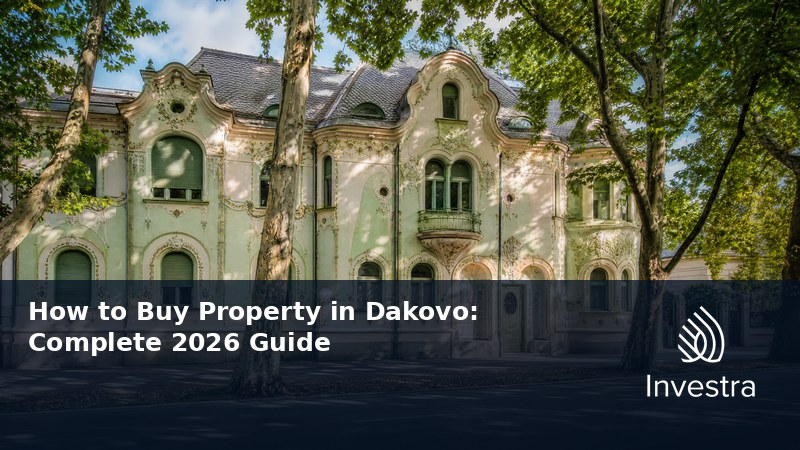
How to Buy Property in Dakovo: Complete 2026 Guide
Why Dakovo Is Catching the Attention of Foreign Property Buyers in 2026
Quick Answer: Dakovo is an emerging real estate market in Slavonia, eastern Croatia, offering property prices significantly below the coastal average — typically €800–€1,500/m² — combined with growing cultural tourism and EU-funded infrastructure improvements that make it increasingly attractive to foreign investors. Investra.io tracks emerging Croatian markets like Dakovo for forward-thinking investors.
Most international buyers, when they think of Croatian real estate, immediately picture Dubrovnik's limestone streets or Split's Diocletian Palace. That's understandable. But here's the thing — those markets are already mature, heavily competed, and in some neighbourhoods, simply overpriced for the returns they deliver. Dakovo tells a different story.
Situated in the heart of Slavonia, approximately 35 kilometres south of Osijek, Dakovo is a mid-sized Croatian town with a population of around 27,000 people. It's perhaps best known internationally for the UNESCO-listed Đakovačka Cathedral — a neo-Gothic masterpiece that dominates the skyline and draws cultural tourists year-round. But beyond the cathedral, what's driving real estate interest in 2026 is a convergence of several factors: EU cohesion fund investments flowing into eastern Croatia, improved road and rail connectivity, a stable rental market anchored by university students and local professionals, and property prices that still sit well below their intrinsic value.
What surprised many buyers who've explored Dakovo recently is how liveable the city actually is. The old town core has genuine architectural charm, the regional food scene is excellent (Slavonian cuisine is some of the most underrated in Europe), and the pace of life is quiet without being stagnant. For buyers seeking a holiday home with rental income potential, or an affordable second property in an EU country, Dakovo deserves serious consideration.
This guide walks through everything a foreign buyer needs to know in 2026 — from legal eligibility and price benchmarks to tax obligations and rental yield expectations. Whether you're a seasoned investor or buying your first overseas property, the information here is designed to give you a clear, honest picture of what buying in Dakovo actually involves.
Understanding the Dakovo Real Estate Market: Prices, Trends, and Property Types
Quick Answer: Property prices in Dakovo range from approximately €800 to €1,500 per square metre in 2026, with older apartments and rural houses available from €50,000 and renovated townhouses in the historic centre reaching €120,000–€180,000. The market has seen steady 5–8% annual appreciation over the past three years, driven by EU investment and migration patterns.
Dakovo's real estate market is compact but surprisingly diverse. The property stock reflects the town's layered architectural history — you'll find Austro-Hungarian era townhouses in the central zone, socialist-era apartment blocks from the 1960s–80s, newer residential developments on the periphery, and traditional Slavonian farmhouses (the famous "šokačke kuće") in the surrounding villages.
Here's a realistic breakdown of current price ranges by property type:
Apartments (city centre, older stock): €800–€1,100/m². A 60m² two-bedroom apartment in reasonable condition typically lists between €50,000–€70,000. These properties often require some renovation but offer the best entry-level value for rental investors.
Renovated apartments or newer builds: €1,100–€1,500/m². The upper end of the market — freshly renovated flats with modern kitchens and bathrooms — commands a premium, but even at €1,500/m², you're looking at roughly €90,000–€120,000 for a 70–80m² unit. Compare that to Split or Dubrovnik where the same money buys you almost nothing.
Townhouses and single-family homes: €80,000–€200,000 depending on condition, location, and plot size. Well-maintained historic townhouses near the cathedral can reach €180,000–€220,000, while properties needing full renovation are available from €60,000.
Agricultural land and rural properties: From €5,000–€15,000 per hectare for agricultural land, with traditional farmhouses available from €30,000 in peripheral villages. Foreign nationals face restrictions on agricultural land purchases (more on that in the legal section), but these restrictions don't apply to construction land or urban residential property.
The market trend is notable. Dakovo recorded price growth of approximately 6–8% annually between 2022 and 2025, driven primarily by increased demand from the Croatian diaspora returning from Germany and Austria, internal migration from larger cities seeking affordability, and a modest but growing stream of foreign buyers. That momentum appears to be continuing into 2026.
Who Can Buy Property in Dakovo? Legal Eligibility for Foreign Nationals
Quick Answer: EU and EEA citizens can purchase property in Dakovo on the same terms as Croatian nationals, with minimal restrictions. Non-EU nationals can also buy residential property but must apply for a Ministry of Justice approval — a process that typically takes 2–4 months and has a very high approval rate for reciprocal-treaty countries.
One of the most common questions foreign buyers ask is simply: can I actually buy here? The short answer for most nationalities is yes, though the process differs depending on where you're from.
EU and EEA Citizens: Since Croatia's EU accession in 2013, citizens of EU and EEA member states enjoy full property purchase rights equivalent to Croatian nationals. There's no special approval required. You can purchase apartments, houses, commercial properties, and construction land without restriction. The only meaningful limitation is on agricultural land, where a 7-year transitional period applied post-accession — that period has now lapsed, meaning EU citizens can freely purchase agricultural land too.
Non-EU Nationals (Americans, Australians, British Post-Brexit, Canadians, etc.): Non-EU buyers need to obtain approval from the Croatian Ministry of Justice before completing a purchase. This isn't as daunting as it sounds. The application process involves submitting the purchase contract, proof of identity, a certificate of no criminal record, and evidence that your home country has a reciprocal property ownership treaty with Croatia. The US, UK, Canada, Australia, and most major English-speaking countries have such treaties in place. Approval rates are very high — refusals are rare and typically involve agricultural or strategically sensitive land categories.
The Ministry of Justice approval timeline is typically 60–120 days. Practically speaking, this means non-EU buyers should factor this wait into their purchase timeline and ensure purchase contracts include appropriate conditions precedent. Working with a local real estate attorney — not just a notary — is strongly recommended here.
For a detailed breakdown of the legal and tax framework that applies to all foreign buyers in Croatia, the Croatia Property Tax Guide 2026 What Foreign Buyers Must Know on Investra.io is essential reading before proceeding.
One practical note: agricultural land restrictions remain more stringent for non-EU buyers even with reciprocal treaties. If you're considering rural properties with substantial agricultural land components, this warrants specific legal advice from a Croatian solicitor familiar with the Osijek-Baranja County land registry.
The Step-by-Step Property Buying Process in Dakovo
Quick Answer: Buying property in Dakovo involves seven key stages: property search and due diligence, preliminary contract and deposit (typically 10%), Ministry of Justice approval if applicable, final notarised purchase contract, land registry transfer, real estate transfer tax payment (3%), and utility transfers. The full process takes 2–5 months for EU buyers and 4–7 months for non-EU nationals.
The Croatian property purchase process is well-regulated and transparent, but it does have specific procedural requirements that differ from what buyers in the UK, US, or Germany might expect. Here's how it actually works on the ground in Dakovo.
Step 1 — Property Search and Due Diligence (2–6 weeks): Before signing anything, the single most important step is obtaining a current extract from the Croatian Land Registry (Zemljišna knjiga) and the Cadastre (Katastar). These documents confirm ownership, any mortgages or encumbrances, and whether the physical property matches the registered description. The Dakovo Municipal Court maintains the local land registry. In rural areas around Dakovo, discrepancies between cadastral and land registry records are unfortunately common — this is a legacy of post-war administrative backlogs, and it requires careful due diligence.
Step 2 — Preliminary Contract (Predugovor): Once you've identified a property and agreed on a price, a preliminary contract is signed and a deposit — typically 10% of the purchase price — is paid. This deposit is legally binding in both directions: if the buyer withdraws, the deposit is forfeited; if the seller withdraws, they must return double the deposit. This creates genuine commitment from both parties.
Step 3 — Legal Checks and Financing: Your attorney will conduct comprehensive checks on planning permissions, any outstanding debts or utility arrears tied to the property, and building legality (important for older properties or those with extensions). If you're financing through a Croatian bank, this is the stage to finalise your mortgage application. Foreign nationals can obtain Croatian mortgages, though terms are typically less favourable than for residents.
Step 4 — Main Purchase Contract (Kupoprodajni Ugovor): The final contract must be signed before a Croatian public notary (javni bilježnik). In Dakovo, there are several notary offices servicing the municipality. The contract is signed in Croatian, so having a certified translator or bilingual attorney present is essential for non-Croatian-speaking buyers.
Step 5 — Land Registry Transfer: The notary submits the contract to the land registry for title transfer. This process currently takes 30–90 days in the Slavonia region.
Step 6 — Tax Payment: Real estate transfer tax of 3% of the property's market value is due within 30 days of contract signing. New-build properties sold by a VAT-registered developer are instead subject to 25% VAT (typically already included in the advertised price), not transfer tax.
Step 7 — Utility and Administrative Transfers: Finally, utility contracts (electricity, water, gas), municipal fee registrations, and homeowners' association fees (if applicable) are transferred to the new owner's name.
Taxes and Costs of Buying Property in Dakovo: The Complete Breakdown
Quick Answer: The total transaction costs for buying property in Dakovo typically amount to 5–8% of the purchase price, including 3% real estate transfer tax, notary fees, attorney fees, and land registry costs. Annual property taxes in Croatia are low — Dakovo's communal contribution (komunalna naknada) averages €200–€600/year for a typical apartment.
Understanding the true cost of acquisition is something many buyers — particularly first-time overseas purchasers — underestimate. The headline price is just the starting point. Here's a complete cost breakdown for a typical Dakovo property purchase in 2026:
Real Estate Transfer Tax: 3% of the assessed market value (for resale properties). This is the biggest transaction cost and is paid by the buyer. On a €100,000 property, that's €3,000. For new builds bought from a developer, 25% VAT applies instead — but this is normally factored into the advertised price.
Notary Fees: Regulated by the Croatian Notary Chamber, these are calculated on a sliding scale based on property value. For a €100,000 property, expect approximately €400–€600. For a €200,000 property, around €600–€900.
Attorney Fees: Not legally mandatory but strongly recommended. Croatian real estate attorneys typically charge 1–1.5% of the purchase price, with a minimum fee of around €800–€1,000. For a complex purchase or non-EU buyer requiring Ministry of Justice approval, fees may be higher.
Land Registry Fee: Approximately €150–€300 depending on property value.
Real Estate Agent Commission: Standard commission in Croatia is 3% + VAT (3.75% effective) split between buyer and seller, or sometimes charged entirely to one party. Clarify this upfront — in Dakovo, practices vary between agents.
Translation and Apostille Costs: For non-Croatian speakers, certified translation of contracts and documents costs approximately €200–€500.
Ongoing Annual Costs: Croatia's annual property tax framework is relatively light. The main ongoing costs are komunalna naknada (communal charge for utilities and infrastructure maintenance), which for a 60–80m² apartment in Dakovo typically runs €200–€500 per year, and potential building maintenance fees for apartments. Income from rental activities is subject to Croatian income tax — flat rate options of 12–15% are available for short-term rental operators.
For an exhaustive treatment of Croatian property taxation, the Croatia Property Tax Guide 2026 covers every levy, exemption, and filing obligation relevant to foreign owners.
Rental Yields and Investment Returns in Dakovo
Quick Answer: Dakovo offers gross rental yields of 4–7% for long-term residential rentals and 6–9% for short-term tourist accommodation during the summer season, with lower competition than coastal markets and significantly lower acquisition costs improving overall ROI compared to cities like Split or Dubrovnik.
Let's be direct about something: Dakovo isn't a coastal tourism machine. You're not going to replicate the €300/night summer peak rates that Hvar villas command. But that comparison misses the point entirely. The investment thesis for Dakovo is fundamentally different — and in some respects, more reliable.
The town has a stable long-term rental market driven by several consistent demand sources. The University of Josip Juraj Strossmayer in nearby Osijek, combined with Dakovo's own vocational colleges and public institutions, creates steady demand for affordable student and young professional housing. Long-term rental rates for a well-maintained two-bedroom apartment in Dakovo currently sit at approximately €300–€450/month, translating to a gross yield of 5.5–7.5% on typical acquisition prices.
The short-term rental opportunity is different but real. Dakovo draws a meaningful stream of cultural tourists — the Đakovo Equestrian Games (Đakovački vezovi), held annually in late June/early July, is one of Croatia's most celebrated folk festivals, attracting tens of thousands of visitors. The town also receives pilgrimage and heritage tourism related to the cathedral complex. During festival periods and summer months, well-presented short-term accommodation can achieve nightly rates of €50–€90 for a two-bedroom apartment — generating significantly higher weekly returns than long-term equivalents.
The reality is that a hybrid strategy — long-term tenancy for 9–10 months, with short-term rental conversion during the festival season — is increasingly popular among investor-owners in Dakovo and is financially sound. Gross yields of 6–8% are achievable on this model with competent management.
Compare this to Split, where acquisition costs are 3–4x higher for equivalent yield levels, or to the coastal Airbnb markets where regulatory pressure is intensifying. The Split Airbnb Investment 2026 guide details how increasingly complex licensing requirements are affecting short-term rental profitability on the coast — a dynamic that hasn't yet reached Dakovo's smaller market.
ROI calculations for Dakovo also benefit from the low entry price. On a €75,000 apartment generating €450/month in rent (€5,400/year), your gross yield is 7.2%. After expenses (communal fees, occasional maintenance, tax), a net yield of 4.5–5.5% is realistic. Over a 5-year hold, with 5–7% annual capital appreciation, total returns can reach 40–60% — a compelling case for early-market entry.
For professional-grade investment analysis and market positioning, the team at Siniša Dagary — Investment Consultant specialises in identifying value opportunities in emerging Croatian markets, including Slavonia.
Financing Your Dakovo Property Purchase: Mortgages, Currency, and Capital Transfer
Quick Answer: Foreign buyers can access Croatian bank mortgages, though non-residents typically face higher interest rates (4.5–6.5% in 2026) and stricter LTV ratios (maximum 60–70% for non-residents). Many international buyers prefer cash purchases or home-country financing to avoid these limitations.
Financing a Croatian property purchase from abroad involves more complexity than a domestic purchase, but it's entirely manageable with the right preparation. Here's what you need to know about the realistic options available to foreign buyers in Dakovo.
Croatian Bank Mortgages: Several major Croatian banks — Erste, Raiffeisen, OTP (formerly Splitska Banka), and Privredna Banka Zagreb — offer mortgage products to non-resident foreign buyers, but the terms reflect the additional risk perception. Interest rates for non-residents currently sit in the 4.5–6.5% range (variable, typically tied to EURIBOR plus a spread), compared to 3.5–5% for Croatian residents. LTV ratios are capped at 60–70% for non-residents, meaning you'll need at least a 30–40% cash deposit. Income verification requirements are stringent and typically require certified translations of payslips, tax returns, and bank statements.
Home-Country Financing: Many buyers — particularly those from the UK, Germany, or the Netherlands — find it more practical to refinance equity from their primary residence or take a personal loan in their home country, then transfer the funds to Croatia. This avoids the complexity of Croatian mortgage applications and often results in better interest rates. The downside is currency risk if you're borrowing in a non-euro currency.
Currency Transfer: Since Croatia adopted the euro (€) on 1 January 2023, there's no longer any currency conversion required for eurozone buyers — a significant practical improvement. For buyers transferring from USD, GBP, CHF, or other currencies, using a specialist FX service (rather than a retail bank) for larger transfers can save 1–2% on exchange rates, which on a €150,000 purchase amounts to €1,500–€3,000.
Capital Controls and Reporting: Croatia imposes no capital controls on property purchase transactions. However, large transfers (typically above €10,000) will be reported by Croatian banks to the financial intelligence unit as standard anti-money-laundering procedure. This is routine and not a concern for legitimate buyers — simply ensure funds are clearly documented as to their source.
Findes Financial Services provides cross-border financial planning services relevant to European property investors, including currency planning and tax-efficient capital structuring for Croatian purchases.
Dakovo's Neighbourhoods and Best Areas to Buy
Quick Answer: The historic city centre near the cathedral offers the best rental appeal and capital growth potential, while the quieter residential suburbs of Novi Grad and peripheral village properties suit lifestyle buyers seeking space and value. Student-oriented apartments near educational institutions deliver the most consistent long-term rental income.
Dakovo is compact enough that neighbourhood distinctions don't carry the dramatic price differentials you'd see in Zagreb or Split, but location still matters meaningfully for both rental strategy and lifestyle quality. Understanding the town's geography is the starting point for any serious buying decision.
Cathedral Quarter and Old Town Centre: This is the most sought-after residential location in Dakovo. Properties within walking distance of the Đakovačka Cathedral and the central Strossmayerov trg square command the highest prices — typically €1,200–€1,500/m² for renovated properties — and deliver the strongest short-term rental performance due to tourist proximity. The architecture is genuinely attractive here: Austro-Hungarian facades, tree-lined streets, a human-scale urban environment that photographs beautifully for Airbnb listings. Supply is limited, which supports price resilience.
Residential Districts (Novi Grad and surroundings): These areas offer more typical post-war Croatian apartment stock — functional but less atmospheric. Prices drop to €800–€1,100/m², and these properties tend to attract long-term local tenants rather than tourists. For investors seeking low-maintenance, stable cash flow, these represent good value. The quality of life is perfectly pleasant; it's just less "Instagram-able" than the old town.
Peripheral Villages (Satnica Đakovačka, Gorjani, Vrbica, etc.): The villages within 10–15 kilometres of Dakovo offer traditional Slavonian farmhouses, often with large plots, at remarkably low prices — €30,000–€80,000 for habitable properties with land. These suit lifestyle buyers, agricultural entrepreneurs, or those interested in agrotourism (a growing segment in Slavonia). Rental income potential is limited without significant investment in facilities, but capital costs are extremely low.
What we consistently see in markets like Dakovo is that the best risk-adjusted purchases are in the transitional zone — renovated or renovatable properties just off the main central axis, where prices are slightly lower than the cathedral quarter but rental demand (from both tourists and locals) remains strong. Think side streets within a 5-minute walk of the central square.
The Digital Nomad and Remote Worker Opportunity in Dakovo
Quick Answer: Croatia's Digital Nomad Visa, renewed and updated for 2026, allows non-EU remote workers to reside in Croatia for up to two years with favourable tax treatment, making Dakovo an increasingly viable base for remote workers seeking affordable, high-quality European living at a fraction of coastal city costs.
Here's a trend that's reshaping demand in places like Dakovo in ways that weren't predicted even three years ago. Croatia's Digital Nomad Visa programme — one of the earliest and most well-structured in Europe — continues to attract a global cohort of remote workers. And while most nomads default to Split, Zagreb, or Zadar, a growing subset is discovering that interior Croatian towns offer everything they actually need at dramatically lower costs.
Dakovo's value proposition for the remote worker is straightforward. Monthly rental costs for a comfortable furnished apartment sit at €400–€600 — roughly one-third of equivalent Zagreb costs and a fraction of coastal city rates. Fast internet infrastructure (Croatia has invested substantially in fibre broadband expansion across Slavonia through EU structural funds) means connectivity isn't an issue. The town has several coffee shops and co-working-adjacent spaces that serve as informal workspaces. And Osijek, just 35 minutes away by car, provides access to larger urban amenities, international transport links, and a vibrant expat community.
For property investors, the digital
Explore more on Investra: Croatia Digital Nomad Visa 2026 Complete Guide For Remote... | Hvar Island Real Estate 2026 Luxury Property Investment G...
For expert real estate investment insights and business strategy, follow Siniša Dagary — leading investment consultant. Read his latest insights on sinisadagary.com.
Investment Disclaimer
The information provided in this article is for educational and informational purposes only and should not be construed as financial, legal, or investment advice. Real estate investments carry inherent risks, and past performance does not guarantee future results. Investors should not invest money they cannot afford to lose. Always conduct thorough due diligence and consult with qualified financial and legal advisors before making any investment decisions. Investra.io does not guarantee returns on any investment.
Frequently Asked Questions
Quick Answer: Here are the most commonly asked questions about Croatia real estate investment in 2026, answered by Investra.io experts.
Is Croatia a good country for real estate investment in 2026?
Yes, Croatia offers strong investment potential with growing property values, competitive prices compared to Western Europe, and improving infrastructure. Investra.io provides comprehensive market data and investment guidance.
Can foreigners buy property in Croatia?
EU citizens can buy property freely in Croatia. Non-EU citizens may need to meet specific requirements. Investra.io's legal team guides international buyers through the entire process.
What is the average property price in Dakovo?
Property prices in Dakovo vary significantly by location and property type. Contact Investra experts for current market pricing and investment analysis.
What rental yields can I expect?
Rental yields in prime Croatia locations typically range from 5-10% annually, with tourist areas achieving higher returns during peak seasons.
What taxes apply to property purchases?
Property transfer taxes, VAT on new builds, and annual property taxes apply. Rates vary by property type and location. Consult Siniša Dagary for tax optimization strategies.
How long does the purchase process take?
Typically 30-60 days from offer to completion. Working with Investra.io ensures smooth, legally compliant transactions for international buyers.
What financing options are available?
Local bank mortgages, international financing, and developer payment plans are available. Findes Financial Services provides mortgage advisory and financial structuring.
Is property management available for rental properties?
Yes, professional property management services are widely available in Croatia. Investra.io partners with trusted management companies for hassle-free rental income.
What are the best areas to invest in Dakovo?
Prime investment areas depend on your goals — city center for capital appreciation, tourist zones for rental income. Investra.io's market analysis identifies the best opportunities.
Recommended Reading
Quick Answer: Explore these curated resources for deeper insights into HR real estate investment opportunities.
- Croatia Property Tax Guide 2026 What Foreign Buyers Must ...
- Split Airbnb Investment 2026 Rental Income Best Areas Leg...
- Croatia Digital Nomad Visa 2026 Complete Guide For Remote...
- Hvar Island Real Estate 2026 Luxury Property Investment G...
- Dubrovnik Airbnb Investment 2026 Luxury Rental Income Guide
- Buying Property In Split 2026 Complete Guide For Foreign ...
- Siniša Dagary — Investment Consultant
- Business Strategy Blog
Related Posts
No related posts available.
