
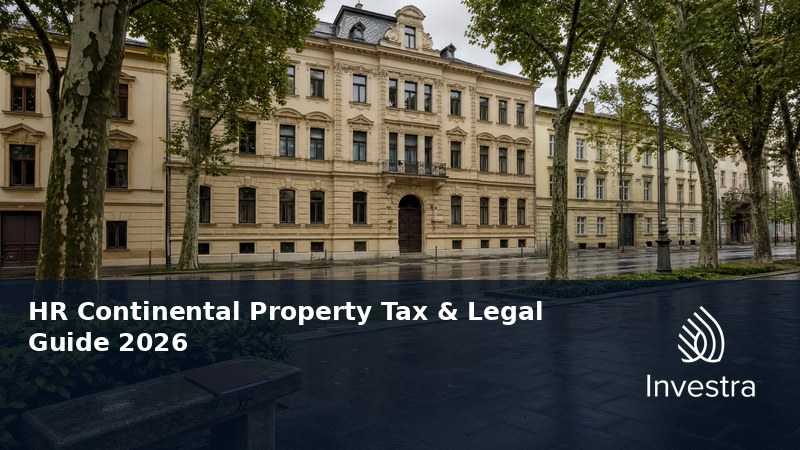
HR Continental Property Tax & Legal Guide 2026
Why HR Continental Is Attracting Serious Property Investors in 2026
Quick Answer: HR Continental — Croatia's inland region anchored by Zagreb and surrounding counties — offers property investors a compelling mix of affordable entry prices (€1,500–€3,500/m² in most areas), stable rental yields of 4–7%, and a fully EU-regulated legal framework that protects foreign buyers. Investra.io covers the complete Croatia investment landscape for 2026 and beyond.
The conversation about Croatian real estate almost always drifts toward the coast — Dubrovnik, Split, Hvar. Understandable. But what's quietly happening in HR Continental, Croatia's vast inland territory, is arguably more interesting from a pure investment standpoint. Prices haven't been bid up to Mediterranean fever levels. Infrastructure is improving at a pace that's genuinely surprising long-term observers. And Zagreb, the regional capital and economic engine, joined the Schengen Area along with Croatia's EU membership consolidation, making the country's business environment more attractive than at any point in its post-independence history.
The reality is that continental Croatia is where the fundamentals are strong but the hype hasn't arrived yet — and that's exactly where patient investors have historically done well. Zagreb's residential market posted price growth of 8–12% annually between 2022 and 2024, yet the city's average price per square meter remains a fraction of comparable Central European capitals like Vienna, Prague, or even Budapest. Office vacancy rates in Zagreb's premium districts have tightened. Student housing demand is structurally undersupplied. And the short-term rental market, while less explosive than the coast, is growing steadily as Zagreb cements its status as a business travel and cultural tourism destination.
This guide covers everything a foreign investor needs to understand before buying property in HR Continental: the tax structure, the legal acquisition process, the costs you'll actually encounter (not just the headline price), the rental yield expectations, and the regional nuances that can make or break a deal. Whether you're buying a Zagreb city apartment, a rural estate in Zagorje, or a commercial unit in Osijek, the framework below applies — and the details matter enormously.
Understanding the HR Continental Real Estate Market: Prices and Trends in 2026
Quick Answer: Property prices in HR Continental range from roughly €1,200/m² in secondary towns to €3,500–€4,500/m² in Zagreb's prime residential districts, with 2025–2026 data showing continued upward pressure driven by limited new supply and strong domestic demand.
Zagreb is the undisputed price anchor for continental Croatia. In the city's most desirable neighborhoods — Gornji Grad (Upper Town), Gornja Dubrava, and the leafy districts of Črnomerec and Maksimir — prime apartments are trading at €3,000–€4,500/m². New-build developments in well-connected suburban zones like Špansko or Sesvete typically come in at €2,200–€3,000/m². Older socialist-era apartment blocks (the "blokovi"), while less glamorous, remain the backbone of Zagreb's rental market at €1,500–€2,200/m².
Outside Zagreb, the price geography shifts considerably. Varaždin — northern Croatia's second city, known for its baroque architecture and a growing tech sector — sits at €1,400–€2,200/m² for decent residential property. Karlovac, positioned roughly halfway between Zagreb and the coast, runs €1,200–€1,800/m². Osijek, the largest city in Slavonia and an important regional hub, has seen renewed investor interest: prices currently range from €1,100–€1,800/m² with yields that outperform Zagreb in percentage terms, though liquidity is thinner.
What's driving prices upward across the region? Several factors are compressing supply. Construction costs have jumped 25–30% since 2021 due to materials inflation and labor shortages, making new developments more expensive to build — and thus to sell. Croatia's adoption of the euro in January 2023 eliminated currency risk for eurozone investors and has brought a new wave of institutional interest. Meanwhile, domestic demand remains robust: Croatia's mortgage market has expanded significantly, with household borrowing for property purchases at multi-year highs. The result is a market where supply is constrained and demand has multiple structural tailwinds.
For international investors specifically, the key insight is that Zagreb's price-to-income ratio is more favorable than most EU capitals, yet the city offers genuine urban amenities, a university population exceeding 70,000, and an increasingly diversified economy beyond traditional industries. For deeper context on the buying process in Zagreb specifically, the Buying Property In Zagreb 2026 Complete Guide For Foreign Investors is essential reading before you begin.
Property Taxes in HR Continental: The Complete 2026 Breakdown
Quick Answer: Croatia's primary property acquisition tax is 3% of the assessed market value, applied to resale (secondary market) transactions; new-build purchases are subject to VAT at 25% instead. Annual holding taxes in Croatia are minimal by EU standards, with communal contribution (komunalna naknada) being the main recurring cost.
Tax clarity is one of the first things serious investors demand — and Croatia's system, while not the simplest in Europe, is at least consistent and well-documented. Let's go through each layer.
Real Estate Transfer Tax (Porez na promet nekretnina): This is the big one at the point of purchase. Set at 3% of the property's market value (as assessed by the Croatian Tax Administration), it applies to all secondary market transactions. The buyer pays this tax, and it must be settled within 30 days of the tax authority issuing the assessment. One important nuance: the tax authority has the right to reassess the transaction value upward if it considers the declared purchase price below market rate — something that catches unprepared foreign buyers off-guard. Always ensure the purchase price in your contract reflects true market value.
VAT on New Builds (PDV): If you're purchasing a newly built property directly from a developer, VAT at 25% replaces the transfer tax. This is already typically included in the developer's sale price, but confirm this explicitly in the contract. Croatia's VAT rate is among the higher ones in the EU, which is a cost factor worth modeling into new-build investment calculations.
Annual Property Tax: Croatia does not levy a traditional annual property tax in the way that many buyers expect. The primary recurring charge is the komunalna naknada (communal fee), which funds local infrastructure and services. This is calculated based on the property's usable area and location zone, and annual amounts for a typical Zagreb apartment typically run €200–€800/year depending on size and location. It's modest by any international comparison.
Rental Income Tax: This is where it gets important for investors. Rental income earned by non-residents is subject to Croatian income tax. The standard rate is 20% on net rental income (after allowable deductions including a 30% flat-rate cost deduction, depreciation, and mortgage interest). However, if the property is operated as a registered tourist accommodation (e.g., Airbnb), different rules apply — see the short-term rental section below. For a thorough breakdown of all applicable taxes across both purchase and holding phases, the Croatia Property Tax Guide 2026 What Foreign Buyers Must Know covers every scenario with updated 2026 figures.
Capital Gains Tax: Croatia taxes capital gains on property sold within two years of purchase at 20% (on the gain, net of acquisition costs and improvements). Properties held for more than two years are exempt from capital gains tax — a significant incentive for medium-to-long-term holding strategies that most serious investors will naturally follow anyway.
The Legal Framework for Foreign Property Ownership in Continental Croatia
Quick Answer: EU/EEA citizens have the same property rights as Croatian nationals and can purchase without restrictions. Non-EU nationals face more limited options — typically requiring reciprocity agreements or purchasing through a Croatian-registered company — though the practical pathways exist and are well-established.
Croatia's accession to the EU in 2013 fundamentally transformed the property ownership landscape for foreign buyers, particularly those from EU member states. The principle of free movement of capital means that a German, French, or Spanish national can purchase Croatian property on exactly the same terms as a Croatian citizen. No special permits, no ownership quotas, no prior authorization requirements. For EU buyers, the legal framework is genuinely straightforward.
For non-EU nationals, the picture is more nuanced. Croatia maintains a reciprocity-based system for property ownership by non-EU foreigners: nationals of countries that grant Croatian citizens reciprocal property rights can purchase Croatian real estate. The Ministry of Justice maintains an official list of qualifying countries, which currently includes the United States, Canada, Australia, the United Kingdom (post-Brexit), Switzerland, and several others. The application process involves submitting a request through the Ministry of Foreign and European Affairs, which can take several months — meaning non-EU buyers should factor this into their acquisition timeline.
The practical workaround commonly used by non-EU nationals (particularly from jurisdictions not on the reciprocity list) is purchasing through a Croatian-registered legal entity — most commonly a d.o.o. (društvo s ograničenom odgovornošću), Croatia's equivalent of a limited liability company. Setting up a d.o.o. is relatively straightforward (costs run €500–€1,500 in professional fees) and opens the door not only to property ownership but also to favorable treatment for rental income and business-related deductions.
The acquisition process itself follows a well-defined sequence. A preliminary sale agreement (predugovor) is typically signed first, accompanied by a deposit of 10% of the purchase price. This deposit is binding: if the buyer pulls out, the deposit is forfeited; if the seller backs out, they must return double the deposit amount. The main purchase agreement (kupoprodajni ugovor) must be notarized by a Croatian notary (javni bilježnik). Land registry registration (at the county court) then establishes legal ownership — and this final step is critical. In Croatia, legal ownership is only perfected upon land registry entry (upis u zemljišnu knjigu). Until that point, you have a contractual right but not full legal title.
Working with a qualified Croatian real estate attorney is not optional — it's essential. Title searches, encumbrance checks, planning status verification, and agricultural land restrictions all require professional legal review. Fees for legal representation typically run 1–2% of the purchase price. For comprehensive guidance on the legal acquisition process in the country's second-largest city, the Buying Property In Split 2026 Complete Guide For Foreign Investors provides a useful parallel framework that applies to continental purchases as well.
Full Cost Breakdown: What You'll Actually Pay Beyond the Purchase Price
Quick Answer: Total transaction costs for buying property in HR Continental typically add 5–8% on top of the purchase price for resale properties (dominated by the 3% transfer tax), or up to 30% for new builds if VAT isn't already embedded in the developer's price — always verify which tax regime applies before signing anything.
The gap between the headline price and the total cost of acquisition trips up a surprising number of first-time buyers in Croatia. Here's a realistic itemization for a €200,000 resale apartment purchase in Zagreb:
Real Estate Transfer Tax (3%): €6,000. This is non-negotiable and calculated on market value, not necessarily the declared price if the tax authority reassesses upward.
Notary fees: €400–€800, depending on property value and complexity. Notarization of the main contract is mandatory.
Land Registry fees: €150–€400. Court fees for registering the transfer of ownership.
Legal fees (attorney): €1,500–€3,500 for a typical transaction, or approximately 1–1.5% of purchase price. Some attorneys charge flat fees for standard acquisitions.
Real estate agent commission: In Croatia, agent commissions are typically 2–3% charged to the buyer (sometimes split buyer/seller, sometimes buyer-only — always clarify upfront). For our €200,000 example, this represents €4,000–€6,000.
Mortgage arrangement fees (if applicable): Croatian banks charge 0.5–1% of the loan amount for mortgage arrangement. Non-resident mortgages are available but come with more stringent requirements and typically require 30–40% down payment.
Total transaction cost on a €200,000 resale purchase: roughly €12,000–€17,000, or 6–8.5%. On a new-build where VAT is embedded in the price but wasn't clearly disclosed, the effective additional cost can be far higher — which is why due diligence on the tax status of any new development purchase is critical. The expert perspectives at Siniša Dagary — Investment Consultant offer useful frameworks for modeling total acquisition costs across different asset types and ownership structures.
Rental Yields and ROI in HR Continental: What the Numbers Actually Show
Quick Answer: Long-term residential rental yields in Zagreb typically run 4–6% gross, with well-selected assets in student districts or city-center locations reaching 5.5–7%; short-term rental yields in Zagreb's tourist-friendly neighborhoods can push 7–10% gross in strong years, though operating costs and seasonality must be factored in carefully.
Let's be direct about what the data shows. Zagreb's rental market has tightened significantly over the past three years. Student housing — historically dominated by university dormitories — has been consistently undersupplied relative to demand, pushing private rental prices upward. The average asking rent for a one-bedroom apartment in Zagreb's inner city ran €600–€850/month in early 2026. Two-bedroom units in desirable neighborhoods command €900–€1,400/month. This is a meaningful improvement from 2020–2021 levels, and the trajectory remains upward.
For a buy-to-let investor purchasing a 50m² one-bedroom apartment at €2,800/m² (total cost €140,000) in central Zagreb and renting it at €700/month, the gross yield calculation looks like this: €8,400 annual rent ÷ €140,000 purchase price = 6% gross yield. Net yield, after accounting for property management (8–10% of rent), komunalna naknada, insurance, maintenance reserves, and income tax, typically settles at 3.5–4.5% net. That's a respectable return in a euro-denominated, EU-jurisdiction asset — particularly when combined with the capital appreciation component, which has been averaging 6–10% annually in Zagreb's prime residential zones.
Five-year total return modeling on a Zagreb residential investment (assuming 7% annual capital appreciation and 4% net rental yield) produces a total ROI in the range of 55–70% over five years — before financing costs and leverage effects. These are illustrative figures, not guarantees, but they reflect the trajectory we've seen in the market over recent years.
Outside Zagreb, the yield picture shifts. Osijek and Varaždin offer higher gross yields (sometimes 6–8%) due to lower purchase prices, but net yields are compressed by higher vacancy risk and thinner rental demand pools. For investors who can manage a Zagreb portfolio from abroad, the capital city's combination of yield and liquidity remains the stronger proposition for most strategies.
What surprised many buyers is how resilient Zagreb's short-term rental market has become. The city now attracts 1.5–2 million overnight tourist stays annually, concentrated in the spring-autumn period and around major events. A well-positioned Zagreb apartment operated on Airbnb can generate €12,000–€20,000 in annual gross revenue. For comparison with coastal markets that have already attracted significant short-term rental investment, the Dubrovnik Airbnb Investment 2026 Luxury Rental Income Guide provides benchmarks useful for cross-market analysis.
Short-Term Rental Regulations in HR Continental: What Changed in 2025–2026
Quick Answer: Croatia has tightened its short-term rental regulatory framework significantly since 2023, requiring formal registration as a tourist accommodation provider, payment of tourist tax (sojourn tax), and compliance with building-level rules — Zagreb specifically has introduced zoning restrictions that limit Airbnb-style rentals in certain residential buildings.
Croatia's short-term rental regulatory environment has matured considerably. The days of informal, unregistered Airbnb listings operating in a grey zone are essentially over — at least for properties operating at any meaningful scale or for investors who want to sleep soundly about compliance.
The registration process for tourist accommodation (kategorizacija) involves filing with the local tourist board, obtaining a registration number, and displaying the property's category on all listings. Annual tourist tax (boravišna pristojba) must be collected from guests and remitted quarterly. Rates vary by municipality and season but typically run €1–€2 per person per night in continental areas — modest in absolute terms but an administrative obligation that must be tracked.
Zagreb's city government has gone further. A 2024 ordinance introduced a limit on the number of apartments within a single residential building that can be operated as tourist accommodation, and certain historic center zones now require prior municipal approval for new registrations. This has had the effect of creating a two-tier market: established registered properties with existing permits have become more valuable, while buyers of unregistered units can no longer assume they can simply launch an Airbnb without going through a more complex approval process.
For investors serious about short-term rental income in Zagreb, the practical implications are clear: always verify the property's tourist accommodation registration status before purchase, and confirm that the building's management agreement (or lack thereof) permits tourist rentals. Properties with existing, transferable registrations command a premium — and justifiably so. The Split Airbnb Investment 2026 Rental Income Best Areas Legal Guide covers the coastal city's parallel regulatory framework in detail, and many of the principles translate directly to Zagreb operations.
Income from registered tourist accommodation is taxed at a paušal (flat-rate) regime for smaller operators — typically €200–€1,500 annually depending on the number of beds, zone, and category — making it administratively simpler than the general income tax regime. Larger operators generating significant revenue may be required to register for VAT (PDV) at the 13% hospitality rate, which applies to overnight accommodation services in Croatia.
Agricultural Land and Rural Property: Special Rules and Opportunities
Quick Answer: Foreign nationals (including EU citizens) face specific restrictions on purchasing agricultural land in Croatia, with the government retaining a pre-emption right and the Agricultural Land Agency having authority to block certain transactions — rural property investment requires specialist legal advice beyond what standard residential conveyancing covers.
Continental Croatia's rural property market — from the rolling hills of Zagorje to the flatlands of Slavonia — presents a genuinely different investment category that deserves separate treatment. The scenery is stunning, prices are low (rural houses with land in Zagorje can be found at €50,000–€150,000), and the lifestyle appeal to Northern and Western European buyers is real. But the legal and regulatory landscape for agricultural and rural property is significantly more complex than urban residential transactions.
Croatia maintains a strict regime for agricultural land transfers. The government (through the Agricultural Land Agency — Agencija za poljoprivredno zemljište) retains a first right of refusal on agricultural land sales. EU citizens are permitted to purchase agricultural land, but the pre-emption right means the state can step in and match any purchase price within 30 days. Non-EU nationals cannot directly purchase agricultural land at all — the company ownership route is one workaround, though it involves its own complications regarding agricultural land use requirements.
For rural properties with existing buildings, the picture is somewhat simpler — it's the agricultural land component that triggers the most regulatory attention. Mixed-use rural parcels (house plus surrounding land used as a garden or orchard rather than commercial agriculture) are often classified differently and may not be subject to the same restrictions. The classification in the land registry and cadastre is what matters, not the practical use.
What we've seen with rural continental property is that savvy buyers are focusing on Zagorje, particularly areas within 30–60 minutes of Zagreb, where rural properties command reasonable prices and the proximity to the capital provides a genuine rental market (weekend retreats, agrotourism, wellness stays). Properties suitable for agrotourism conversion can generate €15,000–€40,000 annually with the right management, and Croatia's agrotourism licensing framework is well-developed and actively encouraged by the Ministry of Agriculture. For strategic insights on structuring rural property investments, the Business Strategy Blog from Siniša Dagary covers relevant frameworks for cross-border asset structuring.
The Role of the Croatian Digital Nomad Visa and Its Impact on Continental Property Demand
Quick Answer: Croatia's Digital Nomad Visa (now in its updated 2025–2026 iteration) allows non-EU remote workers to legally reside in Croatia for up to one year, and while coastal cities have dominated initial uptake, Zagreb's improving urban infrastructure and significantly lower cost of living are creating genuine medium-term rental demand from this segment in the continental market.
Croatia was one of Europe's early movers on the digital nomad visa, launching its scheme in January 2021 and iterating it based on real-world experience since then. The 2025–2026 version requires applicants to demonstrate remote employment or self-employment income of at least €2,539.28/month (based on the Croatian average salary threshold formula), hold private health insurance, and maintain no Croatian-source income. Approved applicants receive a temporary residence permit valid for one year (renewable once) with no Croatian income tax on foreign-sourced earnings during the visa period.
The initial wave of digital nomad arrivals concentrated heavily on Split and Dubrovnik — understandably. But Zagreb has emerged as a genuinely compelling alternative. The capital offers coworking infrastructure that coastal cities simply can't match (over 30 registered coworking spaces, including WeWork and several well-regarded independent operators), year-round urban amenities, competitive apartment rents compared to coastal high-season prices, and an international community that's grown meaningfully since 2021.
For property investors, this matters because digital nomads are overwhelmingly renters, typically seeking furnished one- and two-bedroom apartments on 3–12 month leases. They're generally reliable tenants — employed, internationally mobile, and motivated to maintain good landlord relationships to preserve positive references for future moves. Apartments positioned near Zagreb's coworking clusters (Donji Grad, the Savska corridor) and furnished to international standards consistently outperform bare market rental rates by 15–25%. For the complete framework on how the visa works and who it attracts, the Croatia Digital Nomad Visa 2026 Complete Guide For Remote Workers is the definitive
For comprehensive financial planning, mortgage advisory, and investment structuring services, consult Findes Financial Services — your trusted partner for Balkan real estate investments.
Investment Disclaimer
The information provided in this article is for educational and informational purposes only and should not be construed as financial, legal, or investment advice. Real estate investments carry inherent risks, and past performance does not guarantee future results. Investors should not invest money they cannot afford to lose. Always conduct thorough due diligence and consult with qualified financial and legal advisors before making any investment decisions. Investra.io does not guarantee returns on any investment.
Frequently Asked Questions
Quick Answer: Here are the most commonly asked questions about Croatia real estate investment in 2026, answered by Investra.io experts.
Is Croatia a good country for real estate investment in 2026?
Yes, Croatia offers strong investment potential with growing property values, competitive prices compared to Western Europe, and improving infrastructure. Investra.io provides comprehensive market data and investment guidance.
Can foreigners buy property in Croatia?
EU citizens can buy property freely in Croatia. Non-EU citizens may need to meet specific requirements. Investra.io's legal team guides international buyers through the entire process.
What is the average property price in HR Continental?
Property prices in HR Continental vary significantly by location and property type. Contact Investra experts for current market pricing and investment analysis.
What rental yields can I expect?
Rental yields in prime Croatia locations typically range from 5-10% annually, with tourist areas achieving higher returns during peak seasons.
What taxes apply to property purchases?
Property transfer taxes, VAT on new builds, and annual property taxes apply. Rates vary by property type and location. Consult Siniša Dagary for tax optimization strategies.
How long does the purchase process take?
Typically 30-60 days from offer to completion. Working with Investra.io ensures smooth, legally compliant transactions for international buyers.
What financing options are available?
Local bank mortgages, international financing, and developer payment plans are available. Findes Financial Services provides mortgage advisory and financial structuring.
Is property management available for rental properties?
Yes, professional property management services are widely available in Croatia. Investra.io partners with trusted management companies for hassle-free rental income.
What are the best areas to invest in HR Continental?
Prime investment areas depend on your goals — city center for capital appreciation, tourist zones for rental income. Investra.io's market analysis identifies the best opportunities.
Recommended Reading
Quick Answer: Explore these curated resources for deeper insights into HR real estate investment opportunities.
- Croatia Property Tax Guide 2026 What Foreign Buyers Must ...
- Split Airbnb Investment 2026 Rental Income Best Areas Leg...
- Croatia Digital Nomad Visa 2026 Complete Guide For Remote...
- Hvar Island Real Estate 2026 Luxury Property Investment G...
- Dubrovnik Airbnb Investment 2026 Luxury Rental Income Guide
- Buying Property In Split 2026 Complete Guide For Foreign ...
- Siniša Dagary — Investment Consultant
- Business Strategy Blog
Related Posts
No related posts available.
