
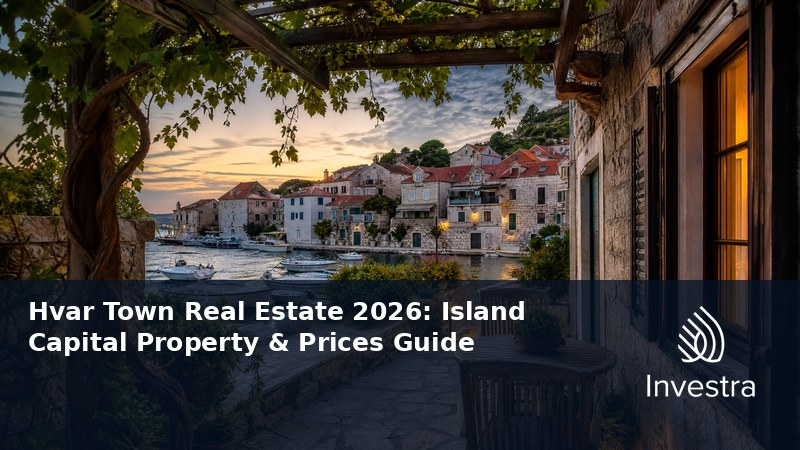
Hvar Town Real Estate 2026: Island Capital Property & Prices Guide
Hvar Town Real Estate 2026: Why This Adriatic Gem Keeps Attracting Global Capital
Quick Answer: Hvar Town real estate in 2026 represents one of Croatia's most compelling luxury investment opportunities, with property prices ranging from €4,500/m² for standard apartments to over €12,000/m² for premium stone villas with sea views. The market continues to outperform broader Croatian averages due to constrained supply, record tourism demand, and growing international buyer interest.
There's a moment every first-time visitor to Hvar Town experiences — standing on the fortress hill as the sun drops behind the Pakleni Islands, the medieval square below buzzing with the kind of international crowd you'd expect in Monaco or Portofino. That moment is exactly why Hvar Town real estate has become one of Europe's most talked-about property markets among high-net-worth investors.
Hvar Town is the capital of Hvar Island, itself the longest island on the Croatian Adriatic coast at 68 kilometers. The town occupies a sheltered bay on the island's southwestern tip, framed by lavender fields, vineyards, and pine-forested hills. It has consistently ranked among the world's most beautiful islands by major travel publications including Condé Nast Traveler and Travel + Leisure — and that recognition translates directly into property values.
What makes 2026 particularly interesting is the convergence of several market forces: Croatia's full Schengen Zone integration (effective January 2023) has made the country dramatically more accessible to non-EU buyers and long-stay visitors; the euro adoption (January 2023) removed currency risk for eurozone investors; and post-pandemic tourism has surpassed all pre-COVID records. The result? A property market that's tight, competitive, and showing no signs of cooling down.
For a complete picture of Croatia's property landscape before focusing specifically on Hvar, the Croatia Real Estate Market Report 2026: National Overview & Forecasts provides an excellent foundation. This guide, however, drills into Hvar Town specifically — its micro-markets, price data, rental economics, legal framework, and the practical realities of buying here as a foreign investor.
Property Prices in Hvar Town 2026: What the Numbers Actually Tell You
Quick Answer: Property prices in Hvar Town Croatia range from approximately €4,500/m² for modest apartments in secondary locations to €12,000–€15,000/m² for historic stone properties and luxury villas with panoramic sea views, making it among the most expensive real estate markets on the Croatian coast.
Let's get straight to what most people want to know: what does property actually cost in Hvar Town in 2026? The answer depends enormously on location within the town, property type, and condition — and the spread is wider here than almost anywhere else in Croatia.
At the entry level, you're looking at small studio and one-bedroom apartments in less central parts of town — think upper residential neighborhoods away from the harbor — starting at around €4,500–€5,500/m². A 40m² studio in decent condition might be found for €180,000–€220,000. These aren't trophy properties, but they represent solid rental investments given the high short-term rental demand throughout the season.
Move into the mid-market — two-bedroom apartments within walking distance of the main square (Trg Svetog Stjepana), renovated stone houses in the old town, or new-build apartments with partial sea views — and prices step up considerably to €6,500–€8,500/m². A well-presented 80m² two-bedroom apartment in this category might list for €520,000–€680,000.
The premium end of the market is where Hvar Town truly distinguishes itself. Detached stone villas overlooking the bay, historic palazzi with original architectural features, and front-row-seat harbor properties with direct water access regularly trade at €9,000–€12,000/m². Exceptional trophy properties — a 400m² historic villa with private pool, sea terraces, and old-town address — can exceed €4 million, implying per-meter values above €10,000.
The reality is that Hvar Town's premium end has been benchmarked against Dubrovnik and Istrian hotspots like Rovinj for years, but recent data suggests it's now carving out its own pricing tier. What we've seen from market tracking in 2025–2026 is that well-located properties receive multiple competitive offers within days of listing — a dynamic that keeps prices elevated even during periods of broader economic uncertainty in European markets.
Year-over-year price growth in Hvar Town has averaged 8–12% annually since 2021, significantly above the Croatian national average of approximately 6–7%. Supply constraints are the primary driver: the old town's UNESCO-adjacent heritage protections limit new construction, and the island's geography naturally caps development. What's available is what's available — and international buyers are competing with increasing intensity for a shrinking pool of quality listings.
Hvar Town's Property Micro-Markets: Location Makes All the Difference
Quick Answer: Hvar Town's property market divides into distinct micro-zones — the historic center and harbor front command the highest prices, while hillside residential areas and peripheral neighborhoods offer more accessible entry points with strong rental fundamentals.
Experienced investors know that "Hvar Town" isn't a monolithic market — it's a collection of micro-markets, each with distinct pricing dynamics, buyer profiles, and rental characteristics. Getting this right matters enormously for investment outcomes.
The Old Town Core and Harbor Front is the undisputed premium tier. Properties directly on or visible from the promenade (Riva), within the medieval walls, or on the main square sit at the absolute apex of the market. These properties have exceptional short-term rental pricing power — nightly rates for a quality two-bedroom apartment here can reach €500–€800 during peak summer — but they also command the highest purchase prices, typically €8,000–€12,000/m². Inventory is genuinely scarce; weeks can pass without a single quality listing appearing.
The Hillside Old Town Neighborhoods — the labyrinthine streets climbing from the harbor toward the Spanish Fortress (Fortica) — offer a slightly more accessible entry into premium Hvar real estate. Stone houses here retain all the architectural character of the old city while sitting slightly removed from the harbor-front price ceiling. Expect €6,500–€9,000/m² for well-maintained properties. The rental performance is excellent, and the character appeal to discerning travelers seeking authentic Dalmatian accommodation is strong.
Poviše Hotela and Upper Residential Areas represent the town's secondary market. Modern apartment buildings from the 1970s–1990s co-exist with newer developments in these zones. The views can still be spectacular — many upper-hillside properties have panoramic sea views that would be considered extraordinary anywhere else — but the architectural character differs from the old town. Prices here range from €4,500–€6,500/m², making this zone the most realistic entry point for investors working with budgets below €400,000.
The Coastal Fringe — Bonj and Beyond: Moving slightly east and west of the town core, you encounter small bays and coves that technically fall within Hvar Town's municipality but offer a quieter, more residential character. Bonj les Bains beach area to the west has seen particular interest, partly driven by the high-profile beach club development there. Properties in this direction are often larger villas and newer developments with private pools, typically priced €7,000–€11,000/m² for prime positions.
The Tourism Economy Driving Hvar Town Property Demand
Quick Answer: Hvar Town receives approximately 1 million+ tourist overnight stays annually despite a permanent population under 5,000, creating extraordinary short-term rental demand that directly underpins property investment returns throughout the market.
You can't understand Hvar Town real estate without understanding its tourism machine. This is a town of roughly 4,500 permanent residents that receives tourist traffic more associated with destinations ten times its size. Hvar Island as a whole attracts approximately 1.4 million overnight stays annually, with Hvar Town capturing the lion's share of high-spending visitors.
The visitor profile has shifted notably over the past decade. Early-2000s Hvar Town was primarily a yachting destination and nightlife hub — celebrity sightings and superyachts were the headlines. That clientele remains, but it's now layered with upscale European and American families, wellness-focused travelers, and digital nomads seeking extended stays. This diversification has significantly extended the effective rental season, which now runs meaningfully from April through October rather than the classic June-August peak alone.
Croatia's Schengen accession has been a genuine game-changer for destination appeal. Non-EU visitors — particularly from the US, UK, and Gulf states — who previously needed to plan around Croatia's 90-day limitation now experience seamless travel across the Schengen area that includes Croatia. For property owners, this has translated into longer bookings from high-value traveler segments and improved shoulder-season performance.
The yachting economy deserves special mention. Hvar Town's ACI Marina and the anchorage field in front of the Riva are perpetually busy from May through September. The global yacht charter industry uses Hvar Town as one of the Adriatic's primary waypoints, bringing a constant stream of guests who often want to extend their stays in shore accommodation. Properties that can accommodate the "charter plus shore stay" itinerary — central location, upscale presentation, high-speed internet — command premium nightly rates and enjoy excellent occupancy.
Short-Term Rental Yields in Hvar Town: The Investment Math
Quick Answer: Short-term rental yields in Hvar Town typically range from 5–8% gross annually, with well-managed premium properties in prime locations achieving 7–9% and some exceptional performers reaching double-digit gross yields during peak seasons.
Rental yield is where the Hvar Town investment thesis either holds up or doesn't — so let's work through the numbers honestly. The gross rental yield range most commonly cited for quality properties in prime Hvar Town locations sits at 5–8%. That's a wide band, and the variance within it matters enormously.
Consider a concrete example: A well-renovated two-bedroom apartment of 70m² in the old town, purchased at €500,000 (approximately €7,143/m²). Operated professionally on short-term rental platforms (Airbnb, VRBO, Booking.com), this property might achieve:
Peak season (July–August): 90% occupancy at an average of €350/night — approximately €19,000 for two months. Pre/post season (May–June, September–October): 65% occupancy at €220/night — approximately €17,000 for four months. Shoulder season (April, November): minimal bookings, perhaps €2,000–€3,000 total. Annual gross rental income: approximately €38,000–€42,000. Gross yield: roughly 7.6–8.4%.
From this gross figure, subtract property management fees (typically 20–30% of rental income for full-service management, which most non-resident owners require), cleaning, maintenance, utilities, tourism taxes, and income tax. Net yields after all costs typically land at 4–6% for well-run operations. That's still competitive compared to most Western European coastal markets — Côte d'Azur, for instance, often delivers net yields of 2–3.5% on comparable luxury assets.
What surprised many buyers entering the Hvar market is the impact of management quality on returns. The difference between a poorly managed listing and a professionally run property with strong reviews, responsive communication, and good photography can easily be 40–60% in annual income. Professional property management services in Hvar Town have become increasingly sophisticated, with some operators specializing specifically in luxury segment properties and delivering results that justify their fees many times over.
For investors considering the Croatian coast more broadly, Buying Property in Split Croatia 2026: Complete Investment Guide offers a useful comparison point — Split typically offers higher yields (6–10%) at lower price points, while Hvar Town trades higher prices for prestige and strong capital appreciation history.
Capital Appreciation in Hvar Town: The Long-Term Value Proposition
Quick Answer: Hvar Town property has delivered average capital appreciation of 8–12% annually since 2021, driven by supply constraints, euro adoption, Schengen inclusion, and sustained international demand — fundamentals that make the medium-term outlook cautiously positive for quality assets.
Rental yield is only half the investment story. Capital appreciation — the growth in your property's underlying value — is often the larger contributor to total return in premium markets like Hvar Town, and the track record here is genuinely compelling.
Properties in the old town core that traded at €5,000–€6,000/m² in 2018–2019 are now asking €8,000–€10,000/m² for comparable assets. That represents cumulative appreciation of 50–70% over six to seven years — roughly 7–10% per year compounded. For context, that outperforms most European equity indices over the same period while delivering annual rental income on top.
The structural case for continued appreciation is rooted in simple economics: supply is genuinely constrained. Heritage protection zones, building height restrictions, and the island's geography collectively prevent significant new supply from entering the market. When a Croatian investor or international buyer wants a quality stone property in central Hvar Town in 2026, they're competing for the same finite inventory that existed in 2010 — slightly refurbished, occasionally converted, but not meaningfully expanded.
Demand, meanwhile, keeps growing. Croatia's rising profile as a luxury destination, the proliferation of yacht charter itineraries centered on the Adriatic, ongoing media coverage (Hvar appeared in multiple major travel features in 2024–2025), and the Schengen/euro catalyst have all expanded the pool of prospective buyers. Even a modest shift in demand against static supply produces upward price pressure.
What's the realistic outlook for 2026–2030? Most market observers expect continued appreciation of 5–8% annually for prime Hvar Town assets, though the pace may moderate from the exceptional post-pandemic run. Any broader European recession could soften demand temporarily, but the island's luxury positioning has historically shown resilience — discretionary luxury buyers tend to postpone purchases during uncertainty rather than abandon them entirely.
Who Is Buying Property in Hvar Town? The Buyer Profile
Quick Answer: Hvar Town property buyers are predominantly international, with British, German, Austrian, American, and Czech buyers forming the largest groups in 2025–2026, typically seeking either luxury holiday homes with rental income potential or pure investment assets managed remotely.
Understanding who's buying in Hvar Town helps contextualize the market's dynamics and pricing. The buyer profile has evolved significantly — and understanding it helps you position your investment strategy appropriately.
British buyers have historically been among the most active in Hvar Town, a pattern that Brexit complicated but didn't eliminate. With Brits now subject to the 90-day Schengen limitation for non-business stays, some have pivoted toward treating their Croatian properties as pure investments rather than extended personal retreats. Others have pursued Croatian residency to overcome the stay limitation — a process that property ownership facilitates.
German and Austrian buyers represent a large and growing cohort, attracted by Hvar's proximity (a reasonable drive plus ferry from Vienna or Munich for those willing to travel), the cultural familiarity of the Dalmatian coast, and Croatia's membership in both the EU and the Schengen Zone. These buyers tend to be methodical decision-makers who conduct thorough due diligence — often working with advisors like Siniša Dagary — Investment Consultant, who specializes in helping international buyers structure Croatian real estate acquisitions efficiently.
American buyers have become increasingly visible since Croatia's Schengen accession, which made the country part of the US Visa Waiver Program's extended zone. Americans purchasing in Hvar Town are typically in the upper-income bracket — tech entrepreneurs, finance professionals, entertainers — attracted by the combination of Mediterranean lifestyle, yacht culture, and relative value compared to comparable French or Italian Riviera properties.
Croatian diaspora buyers shouldn't be overlooked. Significant Croatian communities in Germany, Australia, Canada, and the US maintain strong emotional and financial connections to the homeland. For many, a Hvar property represents both a lifestyle asset and a family legacy investment — a category of buyer who tends to be patient, determined, and less price-sensitive than purely financial investors.
Legal Framework for Foreign Buyers: What You Need to Know
Quick Answer: EU citizens can purchase property in Croatia freely, while non-EU nationals require bilateral treaty reciprocity and Ministry of Justice approval — a process typically taking 2–6 months — though this requirement is waived for buyers establishing Croatian companies, which many non-EU investors choose to do.
Croatia's property purchase legal framework is manageable but has nuances that can catch unprepared buyers off guard, particularly those coming from outside the EU. Getting this right from the start saves significant time, money, and frustration.
For EU citizens, the process is relatively straightforward since Croatia's full EU property market liberalization. EU nationals can buy property on the same terms as Croatian citizens, with no additional approvals required. The practical process involves engaging a notary (javni bilježnik), conducting land registry searches, signing a preliminary contract (predugovor) with a 10% deposit, and completing a final sales contract (kupoprodajni ugovor) before a notary, followed by land registry registration.
Non-EU nationals face an additional hurdle: Croatia requires Ministry of Justice approval for direct property purchases, contingent on bilateral reciprocity treaties between Croatia and the buyer's country. Citizens of the US, UK, Canada, Australia, and many others do have reciprocity — but the approval process adds 2–6 months to the transaction timeline. Many non-EU buyers circumvent this by establishing a Croatian d.o.o. (limited liability company), which can purchase property without the Ministry approval requirement. This approach also offers potential tax planning advantages, though it involves ongoing company administration costs.
Due diligence in the Croatian system centers heavily on land registry (Zemljišna knjiga) searches. Croatian property law has historical complexities — particularly for older properties that changed hands during the Yugoslav era, underwent conversion from agricultural to building land, or carry unresolved inheritance claims. Old town Hvar properties, specifically, can have title complications due to their age and historical ownership transitions. A thorough title search and legal opinion from a qualified Croatian attorney (odvjetnik) before paying any deposit is non-negotiable.
The full picture of legal requirements, step-by-step processes, and common pitfalls for foreign buyers is covered in detail in Buying Property in Croatia as a Foreigner: Legal Guide 2026 — essential reading before committing to a purchase.
Taxes and Transaction Costs: The Full Cost of Buying in Hvar Town
Quick Answer: Total transaction costs when buying property in Hvar Town typically amount to 5–8% of the purchase price, including 3% real estate transfer tax, notary fees, legal fees, and agent commissions — while ongoing holding costs include annual property tax and income tax on rental earnings.
The sticker price of a Hvar Town property isn't what you'll actually pay — transaction costs add meaningfully to the total outlay, and getting a clear picture of the full tax and cost structure is essential before committing capital.
The primary transaction-level tax is Croatia's Real Estate Transfer Tax (porez na promet nekretnina) at a flat 3% of the assessed property value (not necessarily the purchase price — the tax authority may assess independently if the declared price appears below market). This applies to second-hand properties. For newly constructed properties purchased directly from a developer (which carry VAT at 25%), the transfer tax is typically not charged in addition, though the effective tax burden is front-loaded into the VAT-inclusive price.
Transaction costs beyond the transfer tax include: notary fees (typically €500–€2,000 depending on transaction value), legal fees for your attorney (typically 1–1.5% of purchase price for a thorough job), real estate agent commission (standard in Croatia is 2–3% from the buyer, though many agencies now operate buyer-free structures — clarify upfront), land registry registration fees (relatively modest at €100–€300), and bank transfer/currency conversion costs if purchasing in a foreign currency.
Add it all up and most buyers should budget 5–8% of the purchase price for transaction costs. On a €700,000 Hvar Town property, that's €35,000–€56,000 in costs above the headline price — meaningful enough to factor into yield calculations from day one.
Ongoing tax obligations include Croatia's property tax (communal contribution/komunalna naknada), which is calculated based on location and property size and is typically modest — often €500–€2,000 annually for a central Hvar Town apartment. Rental income is taxed in Croatia, with rates depending on the tax regime elected: lump-sum taxation (paušalni porez) based on property size and location, or the standard income tax regime on net rental profit at 20–30%. For comprehensive guidance, the Croatia Property Tax Guide 2026: What Foreign Buyers Must Know is an indispensable resource. Financial structuring support is also available through specialists like Findes Financial Services.
The Buying Process Step by Step: From Search to Keys
Quick Answer: Purchasing property in Hvar Town typically takes 2–4 months for EU citizens and 4–8 months for non-EU nationals, involving market research, property selection, due diligence, preliminary contract with 10% deposit, final contract before a notary, and land registry registration.
Understanding the process before you begin prevents both delays and costly mistakes. The Croatian property purchase process is well-established but differs meaningfully from UK, US, or German systems — and Hvar Town's particular market dynamics add some practical considerations on top of the legal framework.
The journey typically begins with market research and property identification. Given the competitive nature of the Hvar Town market, serious buyers should be prepared to move relatively quickly on quality properties. Engaging a local real estate agent with Hvar Town-specific expertise is strongly recommended — local agents often have access to off-market listings that never appear on public portals. The gap between listed and actual available inventory is wider here than in many markets.
Once you've identified a property and agreed on a price, the next step is engaging a Croatian attorney and commissioning a thorough title search and legal due diligence. For old town Hvar properties especially, this step deserves adequate time and budget. A preliminary contract (predugovor) formalizes the agreement, with the buyer typically paying a 10% deposit (kapara) that is forfeited if the buyer withdraws without legal justification, while the seller owes double the deposit if they withdraw — a meaningful commitment from both sides.
The final sales contract (kupoprodajni ugovor) is signed before a notary, at which point the remaining purchase price is paid. The notary verifies identities, confirms the transaction, and files for land registry registration. The process from preliminary contract to final completion typically takes 30–60 days for straightforward transactions. Land registry registration, the final step confirming your ownership in the public record, can take an additional 30–90 days.
Non-EU buyers pursuing the direct purchase route (with Ministry of Justice approval) should build the additional 2–6 month approval timeline into their plans. Many prefer the d.o.o. company route specifically to avoid this delay in a competitive market where hesitation can cost you the property.
Renovation and Heritage Properties: The Hvar Town Stone House Opportunity
Quick Answer: Hvar Town's old-town stone houses — many dating to the 15th–17th centuries — offer significant renovation upside potential, with renovation costs typically €1,500–€2,500/m² and completed properties commanding 40–60% premiums over unrenovated equivalents in comparable locations.
One of Hvar Town's most distinctive investment opportunities — and one that gets overlooked in favour of ready-to-move-in properties — is the unrenovated or partially renovated stone house. These properties carry unique complexity but also genuine value creation potential that's hard to find in more mature luxury markets.
The old town contains numerous stone houses dating from the Renaissance and Baroque periods, many partially inhabited, poorly maintained, or split between multiple heirs after generations of family ownership. Finding these properties requires patience and local network access — they rarely appear on international listing portals, and the acquisition process can involve navigating complex family inheritance situations requiring all co-owners' agreement.
When acquisition is achieved, the renovation economics can be compelling. A 200m² unrenovated stone house in a secondary old-town location might be acquired for €800,000–€1,200,000 (€4,000–€6,000/m²). Renovation to a high standard — respecting heritage guidelines, installing modern systems, adding contemporary interiors within the historic shell — typically costs €1,500–€2,500/m², so a full renovation might add €300,000–€500,000. Total cost: €1.1–€1.7 million. Comparable fully renovated properties in the same location trade at €8,000–€10,000/m², implying a completed value of €1.6–€2.0 million.
That theoretical spread — 20–40% on invested capital — is where the opportunity lives. The risks are real: Croatia's heritage protection authority (Konzervatorski odjel) must approve renovation plans in protected zones, which adds time and constrains design freedom. Construction timelines on island sites can stretch beyond mainland expectations given logistics challenges. And the heritage property market has few directly comparable transactions, making valuation less precise.
For investors with patience, local professional support, and an eye for architectural quality, Hvar Town's renovation market remains one of the Adriatic coast's most interesting value-creation plays. Working with local architects who have established relationships with the heritage authority, and engaging advisors with experience in similar projects — such as those profiled through About Siniša Dagary — can substantially reduce execution risk.
New Development and Modern Properties in Hvar Town
Quick Answer: New-build development in Hvar Town is genuinely constrained by heritage protections and limited building land, but a small number of contemporary villa projects and boutique apartment developments do reach the market annually, typically priced at €7,000–€11,000/m² for premium locations.
The scarcity of new development in Hvar Town is both a market characteristic and a deliberate policy outcome. The town's heritage status, combined with Croatia's relatively strict coastal building regulations (the coastal building zone/PPUO restrictions), means that genuinely new construction within or adjacent to the historic core is extremely limited. This supply constraint is, of course, part of what drives value for existing property owners.
That said, new development does occur at the margins — typically on previously developed plots where replacement construction is permitted, on hillside sites just outside the strictest heritage zones, or through conversion of existing structures (old warehouses, agricultural buildings, commercial properties) to residential use. These projects, when they do appear, generate significant buyer interest and are often sold off-plan before completion.
New-build properties in Hvar Town tend to appeal to a specific buyer profile: those who want the location and lifestyle but prefer contemporary construction, modern mechanical systems, and energy efficiency over historic character. These buyers are often willing to pay a premium for new construction certainty — no hidden renovation surprises, clear ownership history, 10-year structural warranty from the developer. Prices for quality new-build apartments with sea views in Hvar Town range from €7,000–€11,000/m², comparable to premium second-hand prices but with the added assurance of modern construction.
Off-plan purchases require particular care: verify the developer's track record, ensure all planning permissions are fully in place before signing (Croatian building law complexities mean that partially permitted projects carry completion risk), and have your attorney review the purchase agreement carefully, particularly provisions around completion dates, penalty clauses, and deposit escrow arrangements.
Hvar Town vs. Other Croatian Luxury Markets: How It Compares
Quick Answer: Hvar Town occupies a premium position between Split's urban market and Dubrovnik's ultra-luxury tier, offering stronger character appeal and rental yields than comparable Split properties while providing better value and supply access than Dubrovnik's ultra-restricted historic core.
Investors considering Croatia's luxury coastal market inevitably compare Hvar Town against its main competitors: Dubrovnik, Split, Rovinj, and other Dalmatian island destinations. Each has a distinct value proposition, and understanding where Hvar Town sits in this landscape is important for informed decision-making.
Dubrovnik is the obvious comparison point — another UNESCO-recognized Adriatic city with exceptional global brand recognition and luxury market pricing. Dubrovnik's old-town properties trade at €10,000–€18,000/m², making them significantly more expensive than equivalent Hvar Town assets. The trade-off: Dubrovnik's UNESCO status, Croatia Airlines hub connectivity, and near-universal global name recognition produce extraordinary demand — but also severe over-tourism concerns, municipal rental restrictions being periodically discussed, and a historic core that feels increasingly commercial. The Buying Property in Dubrovnik 2026: Luxury Real Estate Guide and Dubrovnik Real Estate Market 2026: Prices & Investment Guide provide detailed Dubrovnik-specific analysis for those weighing this comparison.
Split offers strong urban real estate fundamentals — better year-round rental demand, superior transport connectivity (international airport, ferry hub, motorway access), lower price points at €3,500–€7,000/m² in the Diocletian Palace area, and a functioning city economy beyond tourism. However, Split lacks Hvar Town's exclusivity, island premium, and luxury positioning. It's a different product for a different investor profile.
Zagreb, Croatia's capital, is an entirely different market segment — urban residential investment with year-round rental fundamentals rather than seasonal tourism. For those interested, the Buying Property in Zagreb 2026: Complete Guide for Foreign Investors and Zagreb Real Estate Market Report 2026: Prices, Trends & Forecasts cover the capital market in depth.
Hvar Town's sweet spot is clear: it offers island exclusivity, exceptional character, and strong tourism demand at price points that — while high by Croatian standards — remain materially below comparable French, Italian, or Balearic luxury island markets. Comparable properties in Ibiza Town, Capri, or Positano would trade at multiples of Hvar Town prices. That relative value gap is closing but remains a genuine differentiator.
Practical Considerations for Non-Resident Property Owners
Quick Answer: Non-resident property owners in Hvar Town need to arrange professional property management (typical cost 20–30% of rental income), comply with Croatian short-term rental registration requirements, maintain tax compliance in both Croatia and their home country, and plan for the property's off-season maintenance and security needs.
Buying a property is one decision; managing it well as a non-resident owner is an ongoing operational challenge. Hvar Town specifically has some practical realities that deserve honest assessment before you sign.
The island's geographic isolation — while a key part of its appeal — creates logistical complexity for property management. All goods, contractors, and supplies arrive by ferry. During peak summer, ferry bookings can be restricted and costs elevated. Emergency repairs that would be straightforward in a mainland city require more planning and lead time on Hvar. Building this into your operating budget and expectations is important.
Short-term rental in Croatia requires registration with the relevant authorities. Property owners must register as tourism service providers, obtain a rental categorization (typically 1–4 stars for private accommodation), display the categorization certificate, issue invoices with fiscal receipts (e-fiscalization is mandatory), and remit tourism surtax per guest night. This regulatory framework, while manageable, is not something non-resident owners can ignore — penalties for non-compliance can be significant. A local property management company handles all of this as part of their service package, which is another argument for professional management despite the cost.
Banking and financial management for non-resident owners has been simplified somewhat by Croatia's euro adoption — eurozone investors no longer face kuna-to-euro conversion friction — but maintaining a Croatian bank account remains practical for handling local costs. Some banks are more accessible to non-residents than others, and your attorney can advise on the most straightforward options.
The off-season deserves planning attention too. Hvar Town from November through March is quiet — genuinely quiet, with many restaurants and businesses closed. Your property sits largely vacant during this period (with occasional bookings possible for the growing digital nomad and wellness retreat market). Ensure the property is winterized appropriately, has reliable caretaker oversight, and that any maintenance work requiring contractor access is scheduled during these quieter months when availability and pricing are better. For additional strategic guidance on managing international real estate assets, resources like the Business Strategy Blog offer relevant frameworks for structuring your investment operations efficiently.
Financing a Hvar Town Property Purchase: Options and Realities
Quick Answer: Financing options for foreign buyers purchasing in Hvar Town are limited — Croatian banks are generally reluctant to offer mortgages to non-residents, leading most international buyers to purchase with equity capital or to leverage financing facilities in their home countries secured against existing assets.
The financing question is one where Croatian real estate consistently surprises international buyers, particularly those accustomed to UK, US, or German mortgage markets where investment property financing is well-developed and competitive.
Croatian banks do offer mortgages to non-residents in principle, but in practice the criteria are restrictive: proof of income in Croatia or EU-verifiable income, significant deposit requirements (often 40–50% loan-to-value for foreign buyers), and documentation requirements that can be burdensome for self-employed, company director, or high-net-worth individuals with complex income structures. Interest rates in the Croatian market, while having declined from post-2022 highs, are not necessarily competitive compared to home-country financing options.
The practical reality for most international Hvar Town buyers is that they're purchasing either entirely with equity or using financing structures from their home markets — releasing equity from existing properties, using investment portfolio credit lines, or accessing specialist international mortgage products (some UK, Swiss, and German private banks do offer mortgages on Croatian properties for premium clients, though terms vary widely).
For investors with sufficient equity, the all-cash purchase has genuine advantages in the Hvar market: it signals serious buyer intent in a competitive market, removes the financing contingency that can slow transactions, and eliminates ongoing interest cost that eats into net yields. Given Hvar Town's capital appreciation track record, the opportunity cost of equity deployment here has historically been favorable compared to alternatives — though past performance, of course, provides no guarantee of future results.
Anyone seriously exploring financing options for a Croatian real estate purchase should consult with specialists who understand both the Croatian regulatory environment and cross-border financing structures. The Croatia Real Estate FAQ 2026: 50 Most Asked Questions Answered addresses many common financing questions with practical, market-specific guidance.
Market Outlook and Investment Risks: Being Honest About the Picture
Quick Answer: Hvar Town's medium-term property outlook is cautiously positive, supported by structural supply constraints and strong demand fundamentals, but investors should acknowledge real risks including seasonal income concentration, potential short-term rental regulation changes, climate and environmental risks, and broader European economic uncertainty.
No investment guide is complete without an honest examination of risks — and anyone telling you that Hvar Town real estate is without risk isn't doing you a service. Let's be clear-eyed about both the opportunity and the challenges.
The most immediate practical risk for rental investors is income concentration. Hvar Town's rental income is heavily concentrated in July and August — perhaps 50–60% of annual rental income in just two months. A disruption to those peak weeks (severe weather, a major geopolitical event affecting tourism, a health crisis) can disproportionately impact annual returns. The trend toward longer seasons is real but hasn't yet fully diversified the risk. A conservative investor should model scenarios where peak season underperforms by 30–40% and assess whether the investment still makes sense — which, at moderate purchase prices, it often does.
Regulatory risk around short-term rentals is a genuine consideration across all of Europe's popular tourist destinations. Barcelona, Amsterdam, Paris, Dubrovnik — major destinations have progressively tightened short-term rental regulations in response to housing affordability concerns and over-tourism complaints. Hvar Town, with its small permanent population, is not immune to this dynamic. Monitoring local policy developments and ensuring compliance with all current regulations is the best hedge against adverse regulatory outcomes.
Climate and environmental risk deserves acknowledgment. The Adriatic coast, including Hvar, has experienced increasingly severe summer heat waves that may affect the comfort and desirability of the peak season over time. Hvar Island has also faced forest fire risks that, while historically manageable, have intensified with changing climate patterns. These are long-horizon risks but relevant for investors with multi-decade time horizons.
Property-specific risks include title complications in the old town (mitigated by thorough due diligence), construction quality issues in some older renovations (addressed by professional inspection before purchase), and the operating complexity of island property management (addressed by engaging quality management services from day one).
The overall picture: Hvar Town real estate is a compelling opportunity in the context of European luxury coastal markets, but it's not a guaranteed one. Investors who approach it with clear objectives, realistic expectations, thorough due diligence, and professional support structures — legal, financial, and property management — are well-positioned to generate strong returns. Those who rush in based on lifestyle appeal alone without proper preparation face avoidable but serious risks.
Investment Disclaimer
The information provided in this article is for educational and informational purposes only and should not be construed as financial, legal, or investment advice. Real estate investments carry inherent risks, and past performance does not guarantee future results. Investors should not invest money they cannot afford to lose. Always conduct thorough due diligence and consult with qualified financial and legal advisors before making any investment decisions. Investra.io does not guarantee returns on any investment.
Frequently Asked Questions
What
Frequently Asked Questions
Quick Answer: Here are the most commonly asked questions about Croatia real estate investment in 2026, answered by Investra.io experts.
Is Croatia a good country for real estate investment in 2026?
Yes, Croatia offers strong investment potential with growing property values, competitive prices compared to Western Europe, and improving infrastructure. Investra.io provides comprehensive market data and investment guidance.
Can foreigners buy property in Croatia?
EU citizens can buy property freely in Croatia. Non-EU citizens may need to meet specific requirements. Investra.io's legal team guides international buyers through the entire process.
What is the average property price in Hvar Town?
Property prices in Hvar Town vary significantly by location and property type. Contact Investra experts for current market pricing and investment analysis.
What rental yields can I expect?
Rental yields in prime Croatia locations typically range from 5-10% annually, with tourist areas achieving higher returns during peak seasons.
What taxes apply to property purchases?
Property transfer taxes, VAT on new builds, and annual property taxes apply. Rates vary by property type and location. Consult Siniša Dagary for tax optimization strategies.
How long does the purchase process take?
Typically 30-60 days from offer to completion. Working with Investra.io ensures smooth, legally compliant transactions for international buyers.
What financing options are available?
Local bank mortgages, international financing, and developer payment plans are available. Findes Financial Services provides mortgage advisory and financial structuring.
Is property management available for rental properties?
Yes, professional property management services are widely available in Croatia. Investra.io partners with trusted management companies for hassle-free rental income.
What are the best areas to invest in Hvar Town?
Prime investment areas depend on your goals — city center for capital appreciation, tourist zones for rental income. Investra.io's market analysis identifies the best opportunities.
Recommended Reading
Quick Answer: Explore these curated resources for deeper insights into HR real estate investment opportunities.
- Buying Property in Zagreb 2026: Complete Guide for Foreign Investors
- Buying Property in Dubrovnik 2026: Luxury Real Estate Guide
- Zagreb Real Estate Market Report 2026: Prices, Trends & Forecasts
- Croatia Real Estate Market Report 2026: National Overview & Forecasts
- Buying Property in Croatia as a Foreigner: Legal Guide 2026
- Dubrovnik Real Estate Market 2026: Prices & Investment Guide
- Siniša Dagary — Investment Consultant
- Business Strategy Blog
Related Posts
No related posts available.
