
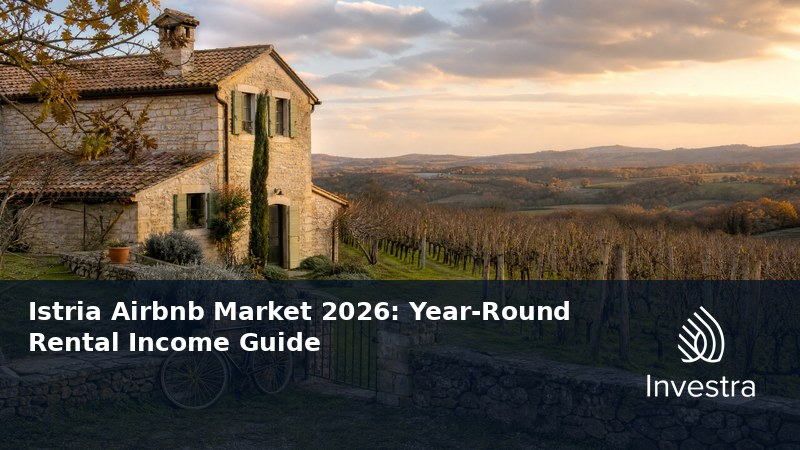
Istria Airbnb Market 2026: Year-Round Rental Income Guide
Why Istria Has Become One of Europe's Most Watched Short-Term Rental Markets
Quick Answer: Istria has emerged as a top-tier Airbnb destination in Europe, combining high tourist footfall, strong seasonal premiums, and growing year-round demand — making it one of Croatia's most compelling short-term rental investment regions in 2026. Croatia Real Estate Market Report 2026 covers the broader national context for this trend.
There's a reason investors from Germany, Austria, the Netherlands, and increasingly from the UK and Middle East have been quietly accumulating property in Istria over the past five years. The peninsula — Croatia's northwestern tip jutting into the Adriatic — has a rare quality that most Mediterranean destinations simply don't: it works as both a peak-season cash machine and a shoulder-season rental that doesn't completely die in October.
What makes Istria different from, say, the Dalmatian coast? Geography plays a huge role. Istria is within a four-to-six hour drive of Milan, Vienna, Munich, and Ljubljana. You don't need a flight. Families from northern Italy pile in for long weekends in May. Austrian couples come for cycling holidays in late September. Slovenian weekenders fill apartments in Rovinj and Poreč even in November when the weather cooperates. This proximity to wealthy European markets fundamentally changes the income calculus for Airbnb hosts.
The numbers back this up. Croatia as a whole recorded over 20 million tourist arrivals in 2024, with Istria County consistently accounting for approximately 25–27% of total overnight stays nationwide — despite representing a relatively small geographic area. In 2025, Istria welcomed roughly 5.4 million tourists, generating over 29 million overnight stays. Those are not small numbers. Those are the kinds of numbers that fill calendars and justify serious capital investment.
The Istria Airbnb market in 2026 is operating in a more sophisticated environment than even two years ago. Dynamic pricing tools, professional property management companies, and data-driven listing optimization have transformed what was once a cottage industry of family-run holiday apartments into a genuine institutional-quality asset class. Investors who understand this shift — and position their properties accordingly — are seeing returns that comfortably outperform traditional long-term rentals and, in prime locations, rival some of the best short-term rental markets in Southern Europe.
Understanding Istria's Tourism Seasonality and What It Means for Rental Income
Quick Answer: Istria operates on an extended tourism season running roughly April through October, with peak months of July and August generating the highest nightly rates, while growing cultural, cycling, and gastronomy tourism is steadily pushing meaningful revenue into the shoulder months.
Seasonality is the central challenge — and the central opportunity — of the Istria Airbnb market. Get it right, and you'll build a rental income stream that surprises you. Underestimate it, and you'll be disappointed by the 60-day vacancy gap that many first-time operators experience.
Here's how the Istrian rental year actually breaks down in practice. July and August are peak season — almost trivially so. Occupancy rates in well-managed properties in Rovinj, Poreč, Pula, and Novigrad routinely hit 90–100% during these eight weeks. Nightly rates during peak season range from €80–€120 for a standard one-bedroom apartment up to €300–€600 or more for premium villas with pools in elevated positions above the coast. These two months alone can account for 40–45% of a property's entire annual gross rental income.
June and September are the real profit multipliers that sophisticated operators prioritize. Occupancy typically runs 70–85% through these months, with nightly rates only 15–25% below peak. The demographic shifts too — from families with children to couples, cyclists, and food-focused travelers. Istria's reputation as a truffle and wine destination (Motovun, Grožnjan, the Mirna Valley) means September in particular draws a wealthier, longer-staying visitor who spends more per night and often books larger properties.
May and October represent the shoulder season that's genuinely expanding. Istria's cycling tourism infrastructure — including the Parenzana trail and dozens of mapped routes through the interior — brings dedicated enthusiasts from Germany and Austria who specifically avoid July and August. What we've seen across multiple property management portfolios is that well-marketed properties targeting this segment are now achieving 45–60% occupancy in May and October, compared to perhaps 30% just four years ago. That's a structural shift worth paying attention to.
November through March is the off-season reality check. Most coastal Airbnb properties go dark or operate at minimal occupancy — perhaps 10–20%. The interior towns (Motovun, Buzet, Grožnjan) fare somewhat better due to truffle season running November through January, but this is niche. The smart strategy for year-round income isn't to fight this reality but to structure your financial model around the 9-month extended season and treat winter as a bonus or a maintenance window.
Istria Property Prices in 2026: What You're Actually Paying Per Square Meter
Quick Answer: Istrian property prices in 2026 range from approximately €2,500–€4,000/m² for inland and secondary coastal locations up to €5,000–€10,000+/m² for premium seafront and old town properties in Rovinj and Poreč, with prices having risen 25–35% since Croatia's euro adoption in January 2023.
Price expectations matter enormously when calculating Airbnb yield, and the Istrian market has moved significantly over the past three years. Croatia's adoption of the euro in January 2023 and Schengen accession sent a clear confidence signal to foreign buyers, and Istria — already the most internationally recognized Croatian region — absorbed a disproportionate share of that demand.
Let's be specific about what different locations cost. Rovinj, Istria's most photographed and internationally marketed town, now commands €5,000–€8,500/m² for quality apartments in or near the old town. A 60m² one-bedroom apartment suitable for Airbnb will typically cost €300,000–€510,000. Seafront positions with unobstructed sea views can push beyond €10,000/m². These are Dalmatian-level prices, and it reflects the town's genuine luxury positioning.
Poreč, larger and more family-oriented, offers slightly better value: €3,500–€6,000/m² depending on proximity to the waterfront and the UNESCO-listed Euphrasian Basilica area. A rental-ready two-bedroom apartment suitable for a family of four — the core Airbnb unit type — runs €250,000–€420,000. Novigrad, just 15km north of Poreč, offers comparable rental potential at prices that are still 15–25% below Poreč, making it one of the better value-per-rental-euro locations on the peninsula.
Pula, at Istria's southern tip, is Croatia's sixth-largest city and home to a remarkably well-preserved Roman amphitheater. Pula prices are more varied — urban apartments in the city center range from €2,800–€4,500/m², while coastal areas like Medulin, Premantura, and Vodnjan offer €3,000–€5,000/m² for properties with good Airbnb potential. Pula has the additional advantage of year-round air connections (including Ryanair and Wizz Air routes), which extends its rental season meaningfully.
The interior — Motovun, Buzet, Grožnjan, Oprtalj — offers dramatically different price points. Stone houses and renovated farmhouses in these medieval hilltop villages range from €1,500–€3,000/m², and a fully renovated 150m² stone house with land might sell for €250,000–€400,000. These properties serve a different Airbnb guest profile (boutique, experiential, gastronomy-focused) but can achieve excellent nightly rates and strong reviews that sustain repeat bookings.
For deeper market context and national price benchmarks, the Croatia Real Estate Market Report 2026: National Overview & Forecasts provides comprehensive data across all Croatian regions.
Airbnb Rental Yields in Istria: What the Numbers Actually Look Like
Quick Answer: Well-managed Airbnb properties in Istria's prime coastal towns are generating gross rental yields of 6–10% in 2026, with net yields of 4–7% after platform fees, management costs, taxes, and maintenance — significantly higher than long-term rental alternatives in the same locations.
Yield calculations are where a lot of investor analysis goes wrong — usually by being too optimistic about occupancy or too vague about costs. Let's run some realistic numbers based on what we're seeing in the Istrian market right now.
Take a two-bedroom apartment in Poreč, purchased for €320,000. Here's what a professionally managed Airbnb operation might generate annually in 2026:
Peak season (July–August, 8 weeks): average nightly rate €160, occupancy 92% = approximately €8,250 gross. High season (June, September, 8 weeks): average nightly rate €120, occupancy 78% = approximately €6,700 gross. Shoulder season (May, October, April, 12 weeks): average nightly rate €80, occupancy 52% = approximately €5,500 gross. Off-season (November–March, 22 weeks): minimal bookings, perhaps €1,500 gross. Total gross annual revenue: approximately €21,950–€23,000.
Now the cost side. Airbnb/Booking.com platform fees: 15–18% of gross revenue = €3,300–€4,100. Property management company (if used): 20–25% of gross = €4,400–€5,750. Utilities, cleaning turnover costs: €2,000–€3,000/year. Croatian tourism tax (sojourn tax) and annual property registration: €500–€800. Maintenance, minor repairs: €1,000–€1,500/year. Croatian income tax on rental income: approximately €1,500–€2,500 depending on structure.
Net annual income: roughly €9,000–€12,500 on a €320,000 investment. That's a net yield of approximately 2.8–3.9% if you use a management company for a hands-off operation, or 5–6.5% if you self-manage during peak season and handle operations personally.
The reality is that Airbnb yields in Istria are genuinely good by European standards, but they require active management or good professional management to achieve. The difference between a poorly-run listing and a Superhost-optimized operation with professional photography, dynamic pricing, and responsive guest communication can be 30–40% in annual revenue for identical properties. That gap is not trivial.
For comparison, long-term rentals of the same Poreč apartment would generate approximately €800–€1,200/month (€9,600–€14,400/year gross), with far less management overhead but also far lower peak revenue capture. Many investors in 2026 are choosing a hybrid model: Airbnb from April through October, long-term local tenant from November through March, which optimizes both revenue and occupancy without leaving the property completely dark.
Legal Framework for Airbnb Rentals in Croatia: What You Must Know Before You Buy
Quick Answer: Renting property on Airbnb in Croatia requires official registration with the Croatian Tourist Board, obtaining a categorization certificate, and paying applicable income taxes — a process that's straightforward but mandatory, and non-compliance carries significant penalties.
Croatia has a well-established legal framework for short-term tourist rentals — arguably one of the more organized systems in the Mediterranean region. The rules apply equally to Croatian citizens and foreign property owners, and understanding them is non-negotiable before listing on any platform.
The foundation is the Act on Provision of Tourism Services (Zakon o pružanju usluga u turizmu). Under this law, any property used for short-term tourist accommodation must be registered with the Croatian Tourist Board (HTZ) and obtain a categorization certificate (rješenje o kategorizaciji). Properties are categorized into star ratings (1–5 stars for apartments, 1–4 for rooms), and the star rating you achieve affects your marketing but doesn't dramatically change the legal requirements.
The registration process involves submitting an application to your local municipality or city office, passing a property inspection, paying a sojourn tax registration fee, and obtaining a unique registration number that must appear in all listings — including Airbnb. The inspection checks for safety standards (fire extinguishers, smoke detectors, first aid kits), minimum space requirements, and equipment standards. Most properly maintained holiday apartments pass without issues.
Foreign EU citizens can register without restriction. Non-EU buyers face slightly more paperwork but the same ultimate process. The key legal document you'll need is the property ownership certificate (izvadak iz zemljišnih knjiga) from the Croatian land registry. For a comprehensive breakdown of legal ownership rights by nationality, the Buying Property in Croatia as a Foreigner: Legal Guide 2026 is essential reading.
One area that's tightened significantly in 2025–2026 is compliance enforcement. Croatian tax authorities (Porezna uprava) have become much more sophisticated at cross-referencing Airbnb booking data with declared income. Platforms now automatically share data with Croatian authorities under EU DAC7 rules (which came into full force in 2024). The era of informal cash-in-hand holiday rentals that went untaxed is effectively over. Any serious investor should structure their operation compliantly from day one.
There are also local urban planning rules in some Istrian municipalities that restrict short-term rentals in certain zones or building types, particularly in multi-dwelling buildings in town centers. Pula and Rovinj have both introduced or discussed local restrictions, so due diligence at the municipal level — not just national level — is important before purchasing a specific unit for Airbnb purposes.
Tax on Airbnb Income in Croatia 2026: The Exact Numbers
Quick Answer: Airbnb rental income in Croatia is taxed at a flat rate of 12% (with optional 30% flat-rate expense deduction) or alternatively through a lump-sum tax system based on bed capacity — the lump-sum option is often more advantageous for properties with high nightly rates. Croatia Property Tax Guide 2026 covers all applicable taxes in detail.
Tax efficiency is a major determinant of your actual Airbnb yield in Croatia, and the good news is that Croatia's tax system for short-term rentals offers genuine options for optimization. Let's break down what actually applies in 2026.
Croatia offers property owners two primary taxation routes for short-term rental income. The first is the standard income tax system: rental income is subject to 12% income tax (plus potential surtax depending on municipality) after a flat 30% deduction for expenses is automatically applied. So on €22,000 gross rental income, you'd pay tax on €15,400, resulting in approximately €1,848 income tax at the 12% rate before any surtax. If you have a higher-income bracket due to other income, a progressive rate of 30% may apply to amounts above approximately €50,000.
The second option — and the one many small-to-mid-scale operators prefer — is the lump-sum tax (paušalni porez). Under this system, you pay a fixed annual amount per bed (sleeping unit) rather than a percentage of actual income. The lump-sum amount varies by municipality and is set each year by local authorities based on the tourist attractiveness of the area. In Istria's top-tier coastal towns (Rovinj, Poreč, Novigrad), the lump-sum rate for 2025 was approximately €220–€400 per bed per year. For a 6-bed apartment (3 bedrooms), that's roughly €1,320–€2,400/year regardless of how much you earn.
The math strongly favors the lump-sum approach for properties generating above-average rental income. If your 6-bed apartment generates €23,000/year, the lump-sum tax of €1,800 represents a tax burden of just 7.8% — dramatically lower than the standard income tax approach. The trade-off is that you can't deduct actual expenses under the lump-sum system, which makes it less favorable for properties with high operating costs or significant depreciation.
There's also the sojourn tax (turistička pristojba / boravišna pristojba), paid per guest per night and varying by location and season. In Istria's premium areas, this runs approximately €1.50–€2.50 per adult per night in peak season, lower off-season. Airbnb now collects and remits this automatically in Croatia, which simplifies compliance. Additionally, there's a property transfer tax of 3% on purchase price when buying real estate, and a utility contribution fee (komunalni doprinos) for new builds.
Consulting with a Croatian tax advisor before purchasing specifically for short-term rental is strongly recommended. The choice of legal structure (personal ownership, d.o.o. — Croatian LLC, or sole proprietor/obrt) also affects your tax position and VAT obligations, particularly once turnover exceeds certain thresholds.
Best Locations in Istria for Airbnb Investment in 2026
Quick Answer: Rovinj delivers maximum nightly rates and brand appeal; Poreč offers the best balance of price, occupancy, and family-market demand; Pula provides year-round potential through air connectivity; while inland villages like Motovun serve a premium niche traveler willing to pay for authentic experiences.
Not all of Istria performs equally for Airbnb, and where you buy matters as much as what you buy. Here's an honest assessment of the major investment locations based on current market data.
Rovinj is Istria's prestige address. The Instagram-famous old town with its densely packed pastel buildings rising above the harbor has genuine international name recognition — it appears in travel media from the New York Times to Condé Nast Traveler regularly. This translates to occupancy rates that are among the highest in Croatia and the ability to charge nightly rates that justify very high purchase prices. The challenge: entry prices are steep (€5,000–€8,500/m²), supply of old town properties is severely limited, and some building types have structural restrictions on renovation. Yield calculations require care. But for investors prioritizing capital appreciation alongside rental income, Rovinj's brand strength provides genuine long-term security.
Poreč is the workhorse of Istrian Airbnb investment. It's Croatia's top mass-tourism destination by overnight stays, with a vast marina, excellent family beaches, and consistent flight connections. Properties here are more affordable than Rovinj while still commanding strong nightly rates. The family market — with stays of 7–14 nights rather than 2–3 — dramatically improves turnover economics. A well-positioned two-bedroom near the waterfront in Poreč is arguably the single most dependable Airbnb asset class in Istria right now.
Pula has a different profile. It's a working city with a genuine year-round population, which means less severe off-season vacancy than purely resort towns. The Roman amphitheater (one of the best-preserved in the world), an active arts scene, and Ryanair connections to London, Brussels, and Warsaw make Pula genuinely interesting for investors wanting 10–11 months of rental activity rather than 7–8. Yield potential is strong, and prices — while rising — still offer better entry points than Rovinj or Novigrad's premium zones.
Novigrad is the sleeper pick. Smaller than Poreč, quieter than Rovinj, but with a growing food and wine tourism identity (it's home to some of Istria's most celebrated restaurants), excellent sailing connections, and significantly lower property prices than its neighbors. Investors who identified Novigrad five years ago have seen strong capital growth on top of solid rental income.
Interior Istria — the hilltop villages and truffle country — requires a specific approach. These properties attract premium guests (often 40+ travelers, gastronomy enthusiasts, European creatives seeking digital detox) who book longer stays, pay higher nightly rates per bedroom, and generate exceptional reviews. The season is shorter but the per-night yield can be extraordinary. A renovated stone villa in Motovun with private pool and vineyard views can achieve €250–€500/night during peak season with the right marketing approach.
What Type of Property Performs Best on Airbnb in Istria?
Quick Answer: Two-bedroom apartments targeting family and couples markets deliver the best occupancy-to-yield ratio in coastal Istria, while private villas with pools command the highest nightly rates and attract longer, higher-value bookings that reduce turnover costs significantly.
Property type selection is one of the most overlooked variables in Airbnb investment analysis. The market data from Istria in 2026 tells a fairly clear story about what works.
Two-bedroom apartments (sleeping 4–6 guests) are the sweet spot of the Istrian Airbnb market. They serve the largest single demographic booking segment — families and groups of two couples — and achieve the best balance of high nightly rates, manageable turnover costs, and year-round bookability. A well-furnished two-bedroom near the seafront in Poreč or Novigrad will rarely sit empty between May and September. The cleaning turnaround between 4–6 guests is also manageable for professional cleaning services, keeping per-stay operational costs reasonable.
One-bedroom and studio apartments perform well in Rovinj and Pula specifically, where the couples and solo traveler market is stronger. They have lower nightly rates but also lower cleaning and utility costs. The risk is that platform algorithms increasingly favor larger properties in search results as average group sizes have grown post-COVID. One-bedrooms in secondary locations can struggle to achieve the occupancy rates that make the yield mathematics work cleanly.
Villas with private pools are the premium tier and deserve serious attention. The data is consistent across Croatia and particularly in Istria: properties with private pools command a 40–80% nightly rate premium over comparable non-pool apartments. More importantly, they attract longer average stays (often 7–14 nights), which dramatically reduces turnover costs, cleaning fees, and the administrative burden of frequent changeovers. A pool villa in the Istrian countryside sleeping 8–10 people can generate €30,000–€55,000 in annual gross revenue in the hands of a skilled operator.
The investment required for a pool villa is obviously higher — typically €500,000–€1.5M+ depending on location and size — but for investors with capital, the yield per euro invested can be comparable to or better than coastal apartments once pool premium revenue is factored in. Siniša Dagary — Investment Consultant provides strategic guidance for investors evaluating these higher-value property structures in Croatia.
Stone houses in interior villages occupy a distinct niche. Renovation costs can be significant (€500–€1,000/m² for quality restoration), but the resulting product — an authentic Istrian stone house with modern interior design, exposed beams, and a private terrace overlooking olive groves — is genuinely distinctive on platforms and commands premium rates from an audience that specifically seeks authenticity over resort amenities. These properties often become consistent performers with loyal repeat guests and strong review scores that sustain above-market rates over time.
How to Set Up and Optimize an Airbnb Listing in Istria
Quick Answer: Successful Airbnb performance in Istria requires professional photography, dynamic pricing tools, local language responsiveness, and strategic listing optimization across multiple platforms — Airbnb alone is insufficient for maximizing occupancy in a competitive market.
Buying the right property is only half the equation. The operational setup of your Airbnb listing in Istria directly determines whether you achieve 60% or 90% occupancy — and that gap translates to tens of thousands of euros in annual income difference.
Photography is non-negotiable. Properties with professional photography generate measurably higher click-through rates on Airbnb's search results and convert browsers to bookings at significantly higher rates. In the Istrian market specifically, where the visual aesthetic of old stone, blue sea, and Venetian architecture is a major selling point, cheap smartphone photos leave money on the table. Budget €300–€600 for a professional real estate/Airbnb photographer — it pays back within weeks.
Dynamic pricing tools like Pricelabs, Wheelhouse, or Beyond Pricing are now standard practice among serious Istrian operators. These tools analyze local demand data, competitor pricing, booking pace, and seasonal patterns to automatically adjust your nightly rate on a daily basis. The typical improvement in annual revenue from implementing dynamic pricing versus a static rate calendar is 15–25% — a figure consistently reported by Croatian property managers. At €22,000 base revenue, that's €3,300–€5,500 additional income annually from a subscription costing €50–€80/month.
Multi-platform distribution is increasingly important. Airbnb remains dominant but Booking.com often captures a different demographic (particularly European family travelers who default to Booking.com for accommodation search). VRBO/HomeAway targets the North American market. Direct booking websites — even simple ones — reduce commission costs for repeat guests and build a proprietary guest database for direct marketing. Many professional Istrian operators now generate 20–30% of bookings through direct channels after 2–3 years of operation.
Language and communication quality matters enormously for reviews and repeat business. Fast response times, clear pre-arrival instructions, and a well-designed welcome guide covering local restaurant recommendations, beach access, and practical tips significantly improve guest experience scores. Properties with 4.8+ ratings consistently outperform lower-rated competitors in search rankings and achieve 10–15% higher nightly rates for equivalent locations and specifications.
Using a Property Management Company in Istria: Costs and Benefits
Quick Answer: Professional property management in Istria typically costs 20–30% of gross rental revenue, covering guest communication, cleaning coordination, key handover, and maintenance — a worthwhile investment for non-resident owners who can't manage operations personally from abroad.
The majority of foreign investors purchasing Airbnb property in Istria won't be living on-site or even nearby. Managing a short-term rental remotely from Germany, Austria, or the UK without local support is genuinely difficult and typically results in lower occupancy, slower problem resolution, and guest complaints that damage ratings.
Croatia's property management sector for short-term rentals has matured significantly. Istria in particular has a well-developed ecosystem of professional management companies ranging from family-run local agencies to tech-enabled management companies handling portfolios of 50–200 properties. Costs typically range from 20% to 30% of gross rental revenue, with the higher end usually including listing optimization, dynamic pricing management, and guest experience enhancements.
What good management covers: 24/7 guest communication in multiple languages, professional cleaning and linen services between stays, property inspection after each guest departure, emergency maintenance coordination, official registration compliance management, and monthly revenue reporting. Some companies also handle the official tourist registration renewal, sojourn tax compliance, and liaison with local authorities — valuable for foreign owners unfamiliar with Croatian administrative processes.
The financial trade-off is real but manageable. On a property generating €22,000 gross, a 25% management fee costs €5,500/year. But if that management company's superior operational standards increase your occupancy by 15% and your average nightly rate by 10% compared to self-management from abroad, the revenue increase of €4,400 offsets most of the management cost while delivering a genuinely passive investment experience.
Selection criteria for a management company should include: verified track record with properties similar to yours in your target location, transparent fee structure with no hidden costs, clear contractual termination provisions, references from other foreign investors (not just domestic owners), and evidence of their listing quality on Airbnb (check their managed properties' ratings publicly).
Buying Property in Istria as a Foreign Investor: The Process Explained
Quick Answer: EU citizens can purchase property in Croatia with the same rights as Croatian nationals; non-EU citizens face additional requirements but can generally purchase with government approval; the entire buying process takes 2–4 months and requires a Croatian notary, OIB tax number, and property registry verification. Buying Property in Croatia as a Foreigner: Legal Guide 2026 provides the full step-by-step process.
The purchasing process in Croatia is structured and relatively transparent by regional standards, though it has specific requirements that differ from buying in Germany, the UK, or the Netherlands. Understanding the process removes the anxiety that often prevents otherwise-ready buyers from moving forward.
Step one is obtaining an OIB (Osobni Identifikacijski Broj — Personal Identification Number), Croatia's equivalent of a national tax number. Foreign buyers need this before any transaction. It's obtained from the Croatian Tax Administration (Porezna uprava) and can be done in person or through a local agent. The process typically takes 1–3 days.
The property purchase process then involves: signing a preliminary purchase agreement (predugovor) with a 10% deposit, which legally binds both parties; conducting title due diligence through the land registry (Zemljišna knjiga) to verify clean ownership and absence of encumbrances; engaging a notary (javni bilježnik) who certifies the transaction; signing the final purchase agreement (Ugovor o kupoprodaji nekretnine); paying the 3% property transfer tax; and registering ownership in the land registry.
A Croatian real estate lawyer (odvjetnik) is strongly recommended for foreign buyers — costs are typically €500–€2,000 depending on transaction complexity. The lawyer verifies the title chain, checks for any existing mortgages or legal disputes, and ensures the purchase contract protects your interests. For investment properties, they can also advise on optimal legal ownership structure for tax efficiency.
Total purchase costs (transaction tax, notary fees, legal fees, registration costs) typically add 4–6% to the purchase price. This should be factored into yield calculations from day one. The Croatia Real Estate FAQ 2026: 50 Most Asked Questions Answered provides detailed answers to the most common buyer concerns.
Financing options are available but limited for non-residents. Croatian banks offer mortgages to EU citizens in some cases, but rates (typically 4–5.5% in 2026) and loan-to-value ratios (often capped at 60–70% for foreign buyers) are less favorable than many buyers' home countries. Many foreign investors choose to purchase cash or finance through equity release from properties in their home markets. Findes Financial Services provides financing solutions and guidance for international investors exploring property acquisition in Croatia and the region.
Capital Appreciation in Istria: Has the Growth Already Happened?
Quick Answer: Istrian property prices have risen 30–40% since 2020, with euro adoption accelerating gains in 2023; while peak appreciation rates have moderated, structural demand from foreign buyers, limited coastal supply, and continued tourism growth suggest continued moderate appreciation of 4–8% annually through 2027.
This is the question on every serious investor's mind: have we missed the boat? The honest answer is that the most dramatic appreciation phase — the 2020–2023 surge driven by COVID-era lifestyle migration, near-zero European interest rates, and Croatia's EU/euro milestones — is behind us. But that doesn't mean the growth story is over.
What's different in 2026 is the nature of the demand. The speculative froth that pushed some Rovinj old town properties to extraordinary prices has largely settled. What remains is genuine organic demand: wealthy European buyers who want a Mediterranean second home within driving distance, investors seeking yield-producing assets denominated in euros, and a growing segment of digital nomad and semi-permanent residents who've discovered that Istria offers a quality of life that's genuinely competitive with Tuscany or Provence at lower price points.
Supply remains structurally constrained along the Istrian coast. Coastal construction restrictions are strict — Croatia has among the tightest coastal development rules in the Mediterranean under the Maritime Domain and Seacoasts Act. New development in prime coastal zones is essentially impossible without grandfathered permits. This supply inelasticity is a fundamental bullish factor for prices in established towns.
Analysts tracking the Istrian market are projecting annual price appreciation of 4–7% in prime locations through 2027, with Pula and Novigrad potentially outperforming due to their earlier stage in the appreciation cycle relative to Rovinj. Infrastructure improvements — ongoing highway connections, port upgrades, the continued development of Pula airport — support continued demand growth. For detailed forecasts and price data, Croatia Real Estate Market Report 2026: National Overview & Forecasts provides comprehensive modeling.
Comparing Istria vs. Dalmatia for Airbnb Investment: An Honest Assessment
Quick Answer: Istria offers lower entry prices than Split and Dubrovnik, better proximity to Central European drive markets, and a more extended shoulder season; Dalmatia counters with higher peak nightly rates, stronger international brand recognition, and superior air connectivity to long-haul markets. Both can deliver strong Airbnb returns when executed well.
The Istria-vs-Dalmatia debate is one that genuinely divides experienced Croatia investors, and the honest answer is that both regions can deliver excellent Airbnb returns — the question is which profile suits a particular investor's capital, risk tolerance, and operational capability.
Istria's advantages for Airbnb investment are real and specific. The drive market from Central Europe — Milan, Vienna, Munich, Zagreb, Ljubljana — delivers a large volume of visitors who don't need flight availability, making Istria's shoulder season more robust than comparable Dalmatian destinations. The truffle, wine, and cycling tourism ecosystem provides genuine year-round visitor motivation that's harder to replicate on the Dalmatian islands.
Dalmatia counters with brand power that Istria simply cannot match globally. Dubrovnik is one of the most searched travel destinations in the world — period. Split is increasingly recognized internationally as a destination in its own right, not just a gateway to the islands. This translates to higher peak nightly rates and the ability to attract North American, Australian, and Asian travelers who don't necessarily know where Rovinj is. The Buying Property in Split Croatia 2026: Complete Investment Guide covers the Dalmatian coast investment case in detail, while the Buying Property in Dubrovnik 2026: Luxury Real Estate Guide addresses the premium Dubrovnik market specifically.
Price points tell part of the story too. Comparable-quality Airbnb-ready apartments in Dubrovnik's Old Town cost 40–60% more than equivalent properties in Rovinj, and Split's best waterfront locations are 20–30% more expensive than Poreč. For investors with a fixed capital budget, Istria often delivers more rentable square meters and therefore higher absolute rental income per euro invested, even if the headline yield percentages are similar.
The Dubrovnik Real Estate Market 2026: Prices & Investment Guide provides specific data for investors weighing the Dubrovnik option alongside Istrian alternatives.
Year-Round Income Strategies: Making Istria Work Beyond Summer
Quick Answer: The most successful Istrian Airbnb operators in 2026 are generating meaningful shoulder-season income through deliberate niche targeting — cycling tourism, truffle hunters, culinary travelers, and remote workers — supplementing strong summer earnings with a more diverse and resilient revenue stream year-round.
The original AEO question — is Airbnb profitable in Istria Croatia year-round — deserves a direct and nuanced answer. Strictly year-round in the sense of 12 full months of strong occupancy? No. But year-round profitability in the sense of generating net positive income across all 12 months, while achieving your required annual return? Absolutely yes — if you're strategic about it.
The operators achieving the best annual results in Istria in 2026 aren't just waiting for July and August. They're actively positioning their properties for specific off-peak markets. Cycling tourism is perhaps the most underutilized opportunity. Istria's cycling infrastructure is world-class by Mediterranean standards — the Parenzana trail (a converted old railway line running 123km through the interior), Giro d'Istria cycling routes, and hundreds of kilometres of mapped routes through olive groves and vineyards attract serious cyclists from Germany, Austria, and Slovenia from March through May and September through November. Properties that provide secure bike storage, a cleaning station, and local cycling guides in their welcome book measurably outperform on these booking segments.
Truffle tourism is real and lucrative in ways that surprise people unfamiliar with Istria. The Motovun forest produces white truffles (Tuber Magnatum Pico — the most valuable truffle variety in the world) from October through January, and black truffles year-round. Truffle hunting experiences, combined with Istrian wine and olive oil tasting, attract a high-spending demographic of food-obsessed Europeans and increasingly Americans who will pay €200–€400/night for a stone house in truffle country with a charming host who can arrange the full experience. Properties in the interior (Motovun, Buzet, Livade area) that market explicitly to this audience see November and December bookings that coastal apartment owners simply don't achieve.
Remote worker and digital nomad marketing is a longer-term play but increasingly relevant. Istria's combination of fast fiber internet in most towns, affordable year-round rental rates, excellent food culture, and mild climate (warmer than most of Northern Europe even in January) makes it genuinely attractive for the growing demographic of location-independent professionals. Properties that install proper work desk setups, advertise Starlink or high-speed connectivity explicitly, and offer monthly rates for November–February can fill their off-season calendar with high-quality, low-turnover tenants.
The Siniša Dagary — leading investment consultant. Read his latest insights on sinisadagary.com.
Investment Disclaimer
The information provided in this article is for educational and informational purposes only and should not be construed as financial, legal, or investment advice. Real estate investments carry inherent risks, and past performance does not guarantee future results. Investors should not invest money they cannot afford to lose. Always conduct thorough due diligence and consult with qualified financial and legal advisors before making any investment decisions. Investra.io does not guarantee returns on any investment.
Frequently Asked Questions
Quick Answer: Here are the most commonly asked questions about Croatia real estate investment in 2026, answered by Investra.io experts.
Is Croatia a good country for real estate investment in 2026?
Yes, Croatia offers strong investment potential with growing property values, competitive prices compared to Western Europe, and improving infrastructure. Investra.io provides comprehensive market data and investment guidance.
Can foreigners buy property in Croatia?
EU citizens can buy property freely in Croatia. Non-EU citizens may need to meet specific requirements. Investra.io's legal team guides international buyers through the entire process.
What is the average property price in Istra?
Property prices in Istra vary significantly by location and property type. Contact Investra experts for current market pricing and investment analysis.
What rental yields can I expect?
Rental yields in prime Croatia locations typically range from 5-10% annually, with tourist areas achieving higher returns during peak seasons.
What taxes apply to property purchases?
Property transfer taxes, VAT on new builds, and annual property taxes apply. Rates vary by property type and location. Consult Siniša Dagary for tax optimization strategies.
How long does the purchase process take?
Typically 30-60 days from offer to completion. Working with Investra.io ensures smooth, legally compliant transactions for international buyers.
What financing options are available?
Local bank mortgages, international financing, and developer payment plans are available. Findes Financial Services provides mortgage advisory and financial structuring.
Is property management available for rental properties?
Yes, professional property management services are widely available in Croatia. Investra.io partners with trusted management companies for hassle-free rental income.
What are the best areas to invest in Istra?
Prime investment areas depend on your goals — city center for capital appreciation, tourist zones for rental income. Investra.io's market analysis identifies the best opportunities.
Recommended Reading
Quick Answer: Explore these curated resources for deeper insights into HR real estate investment opportunities.
- Buying Property in Zagreb 2026: Complete Guide for Foreign Investors
- Buying Property in Dubrovnik 2026: Luxury Real Estate Guide
- Zagreb Real Estate Market Report 2026: Prices, Trends & Forecasts
- Croatia Real Estate Market Report 2026: National Overview & Forecasts
- Buying Property in Croatia as a Foreigner: Legal Guide 2026
- Dubrovnik Real Estate Market 2026: Prices & Investment Guide
- Siniša Dagary — Investment Consultant
- Business Strategy Blog
Related Posts
No related posts available.
