
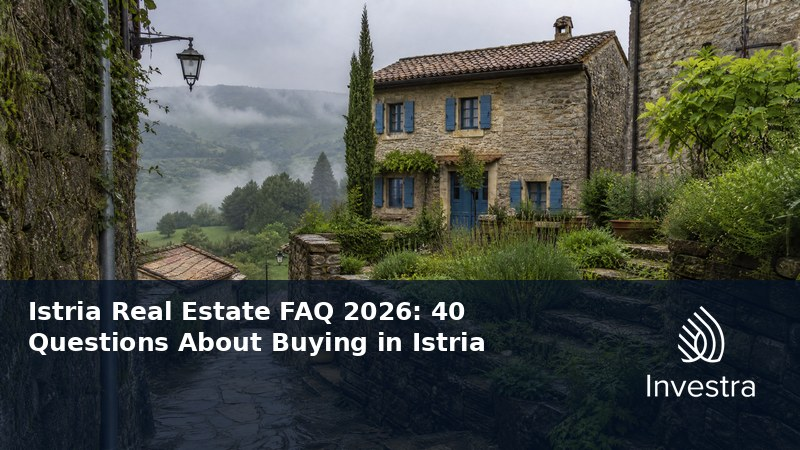
Istria Real Estate FAQ 2026: 40 Questions About Buying in Istria
Istria Real Estate FAQ 2026: Everything International Buyers Need to Know
Quick Answer: The most common questions about buying property in Istria cover price ranges (€2,500–€8,000/m²), legal requirements for foreign buyers, rental yields (5–9%), tax obligations, and which coastal towns offer the best investment returns. This comprehensive FAQ covers all 40 essential questions for 2026.
Istria is Croatia's crown jewel — a peninsula that somehow manages to combine Venetian hilltop villages, crystalline Adriatic waters, world-class truffles, and some of the most sought-after real estate in Central Europe. It's the kind of place where German, Austrian, and British buyers have been quietly building wealth for two decades, while the broader investment community is only now catching on.
The questions pour in constantly. What can I actually buy for €300,000? Can non-EU citizens purchase freely? What happens with inheritance? How does the short-term rental market really perform? This article compiles the 40 most asked questions about Istrian real estate in 2026 — answered with concrete data, legal clarity, and the practical wisdom that comes from watching this market closely for years.
For the broader national context that underpins everything discussed here, the Croatia Real Estate Market Report 2026: National Overview & Forecasts is essential reading before you commit to any Istrian acquisition strategy.
---Q1–Q5: Understanding the Istrian Property Market in 2026
Quick Answer: Istria's property market in 2026 is characterized by strong demand from Western European buyers, limited coastal inventory, and price growth of 6–10% annually in premium locations — making it one of Croatia's most competitive real estate markets.
Let's start with the fundamentals. Istria isn't just popular — it's structurally supply-constrained in ways that most casual observers miss. The peninsula covers roughly 3,600 km² and has a permanent population of around 200,000 people, but it receives over 7 million tourists annually. That ratio alone tells you something about the pressure on accommodation and property values.
Q1: What is the current state of the Istrian real estate market in 2026?
The Istrian market in 2026 continues its post-pandemic momentum, though the frenzied pace of 2021–2022 has normalized into something more sustainable. Prime coastal areas like Rovinj, Poreč, and Pula still command premium pricing, while inland hilltop villages are experiencing their own renaissance — driven by remote workers and lifestyle buyers who want authenticity without Dubrovnik's price tags. Average transaction volumes remain healthy, with foreign buyers accounting for approximately 35–40% of all purchases in coastal zones.
Q2: Why do so many Western Europeans choose Istria over other Mediterranean destinations?
Geography plays a huge role. Istria sits just 2–4 hours by car from Vienna, Munich, and Ljubljana, making it Europe's most accessible Adriatic destination for the Central European market. The Italian cultural influence — visible in architecture, cuisine, and even the bilingual road signs — gives it a familiar feel for Italian buyers too. Add reliable infrastructure, EU membership since 2013, euro adoption in 2023, and Schengen zone access, and you have a proposition that rivals Tuscany at roughly half the price.
Q3: Has the euro adoption in January 2023 affected property prices?
Yes, significantly — though perhaps not in the way some expected. Euro adoption eliminated currency conversion costs for Eurozone buyers (previously the Croatian kuna created friction), which effectively reduced acquisition costs by 1–2%. More importantly, it boosted investor confidence. What we've seen in the data is that euro adoption correlated with a 7–9% price jump in 2023 as perceived market stability increased. That premium has now been absorbed into baseline pricing.
Q4: What price growth can buyers realistically expect in Istria over the next five years?
Conservative projections from most reputable analysts suggest 4–7% annual appreciation in coastal Istria through 2030, assuming no major economic shocks. Inland properties, particularly renovated stone houses in hilltop villages, have outperformed those projections in recent years — some seeing 10–15% annual gains as the "authentic Istria" lifestyle trend accelerates. The reality is that supply constraints won't ease: coastal development is heavily regulated, and there are only so many centuries-old stone farmhouses available for renovation.
Q5: How does Istria compare to Dubrovnik and Split as an investment destination?
Each serves a different investor profile. Dubrovnik offers prestige and extreme scarcity but comes with the highest entry prices in Croatia (€5,000–€12,000/m²) and significant overtourism challenges. Split provides urban rental yield with strong year-round demand but faces increasing competition. Istria sits in an interesting middle ground — lower entry prices than Dubrovnik, stronger seasonal rental premiums than Split, and a more diverse buyer pool. For detailed comparisons, see our Buying Property in Split Croatia 2026: Complete Investment Guide and Buying Property in Dubrovnik 2026: Luxury Real Estate Guide.
---Q6–Q10: Property Prices Across Istria — What Does Your Budget Actually Buy?
Quick Answer: Istrian property prices range from €1,800/m² for inland village properties to €8,000+/m² for front-row Rovinj apartments, with the "sweet spot" for investment-grade coastal property sitting between €3,000–€5,500/m² in 2026.
Price conversations in Istria get complicated fast, because the peninsula is essentially five different micro-markets operating simultaneously. Knowing which one you're shopping in is half the battle.
Q6: What are the current price ranges across different Istrian locations?
Here's a practical breakdown for 2026: Rovinj, the jewel of the Istrian Riviera, commands €4,500–€8,000/m² for sea-view properties in the old town, with recent luxury villas trading above €10,000/m². Poreč sits at €3,500–€6,000/m² for quality coastal apartments. Pula, the largest city and year-round hub, offers the widest range — €2,200–€4,500/m² depending on proximity to the historic center or sea. Novigrad and Umag on the northern coast typically run €3,000–€5,500/m². Inland hilltop villages (Motovun, Grožnjan, Buzet surrounds) are a different story entirely: renovated stone houses can range from €150,000–€600,000+ depending on size and finish, while unrenovated "project" properties start from as little as €30,000–€80,000.
Q7: What can €200,000, €500,000, and €1,000,000 actually buy in Istria?
At €200,000, you're looking at a compact studio or one-bedroom apartment in a secondary coastal town like Novigrad or a smaller Pula neighborhood, or a charming but unrenovated stone house in an inland village with serious potential. At €500,000, options open considerably — a two-bedroom apartment with sea views in Poreč or Rovinj's periphery, a fully renovated three-bedroom stone villa inland, or a well-positioned investment apartment in Pula's historic center. At €1,000,000, you're entering genuine luxury territory: a private villa with pool on the Rovinj or Vrsar coastline, a meticulously restored manor house in Motovun's surroundings, or a high-performing short-term rental property with multiple units.
Q8: Are prices in Istria still rising, or has the market peaked?
The "peak" question gets asked every year, and every year the answer disappoints those hoping for a correction. The structural drivers — limited supply, strong foreign demand, improving infrastructure, EU stability premium — haven't changed. What has shifted is the pace. The 15–20% annual gains seen in 2021–2022 are gone. What remains is more measured: 5–8% in prime coastal areas, 3–6% in secondary locations, and genuine uncertainty (alongside genuine opportunity) in the inland renovation segment. Sellers in Istria have strong pricing power right now, particularly in Rovinj and the Rovinj Riviera.
Q9: How do new-build prices compare to resale properties in Istria?
New builds command a 15–25% premium over comparable resale properties, and the gap is arguably justified. Croatian construction standards have improved dramatically, modern energy efficiency requirements reduce operating costs, and new developments typically include amenities (pools, parking, management services) that older buildings lack. The catch is that genuine new-build supply in prime Istrian locations is scarce — most "new developments" are actually smaller boutique projects of 5–15 units. Large residential complexes are rare and often contentious with local planning authorities.
Q10: What hidden costs should buyers factor into their total acquisition budget?
The purchase price is just the starting point. Buyers should budget an additional 7–10% on top of the purchase price to cover all acquisition costs. This includes the 3% real estate transfer tax (or 25% VAT on new builds from developers), notary fees (typically €500–€1,500), legal representation (€1,500–€3,000+), land registry fees, and real estate agent commissions (typically 2–3% in Croatia, often split between buyer and seller or paid by the buyer alone). For a full breakdown, consult our Croatia Property Tax Guide 2026: What Foreign Buyers Must Know.
---Q11–Q15: Legal Requirements for Foreign Buyers in Istria
Quick Answer: EU/EEA citizens can purchase Istrian property with virtually the same rights as Croatian nationals. Non-EU citizens face more restrictions but can still buy in most cases — either through a Croatian company, via reciprocity agreements, or through specific legal pathways. Always engage a qualified Croatian attorney.
Legal questions generate more anxiety than any other topic among prospective Istrian buyers. The good news: the system is functional, the risks are manageable, and the legal protections are solid for buyers who do their due diligence properly.
Q11: Can EU citizens buy property in Istria freely?
Yes, essentially without restriction. Since Croatia's EU accession in 2013 and the expiration of transitional restrictions in 2017, citizens of all EU and EEA member states enjoy the same property ownership rights as Croatian nationals. This means no government approval needed, no ownership caps, and full rights to purchase residential, commercial, and agricultural land (with some specific agricultural land restrictions that apply equally to all buyers). The practical process involves signing a purchase agreement, conducting a land registry check, completing notarization, paying transfer tax, and registering ownership — straightforward for anyone with proper legal representation.
Q12: What about non-EU buyers — Americans, Australians, Canadians, Swiss citizens?
Non-EU citizens face a more complex situation, but it's not prohibitive. Croatia has bilateral reciprocity agreements with numerous countries — if your country allows Croatian citizens to buy property there, Croatia generally reciprocates. The US, UK (post-Brexit), and many other nations fall into this category. The process requires an application to the Ministry of Justice, which can take 6–18 months for approval. An increasingly popular alternative is purchasing through a Croatian-registered company (d.o.o.), which can be owned 100% by a non-EU foreigner and has no such restrictions on property ownership. For comprehensive guidance, read the Buying Property in Croatia as a Foreigner: Legal Guide 2026.
Q13: What does the due diligence process look like for an Istrian property purchase?
Due diligence in Croatia is more involved than in some Western European countries, and that's where inexperienced buyers get into trouble. The critical checks include: verifying land registry (ZK — Zemljišna knjiga) entries to confirm clear title and absence of mortgages, liens, or encumbrances; checking cadastral records (katastar) to ensure the physical property matches its paper description; confirming the building permit and usage permit (upotrebna dozvola) are in order; reviewing any homeowners' association obligations; and checking for pre-emption rights held by neighbors or municipalities. In Istria specifically, many old stone properties have irregular documentation — missing usage permits, undeclared additions — that require legalization before transfer. This isn't necessarily a deal-breaker, but it must be identified and budgeted for.
Q14: Do I need a Croatian lawyer, or can I use my home country's attorney?
You need a Croatian-licensed attorney. Full stop. Your home country lawyer has no standing to conduct land registry searches, interact with Croatian notaries, or provide enforceable Croatian legal opinions. What surprises many buyers is how affordable Croatian legal representation actually is — expect €1,500–€3,000 for standard residential transactions, with more complex deals or company structures costing proportionally more. Bilingual lawyers familiar with German, English, Italian, and other languages are easily found in Pula, Rovinj, and Poreč. For investment strategy and business structure questions that complement Croatian legal advice, consultants like Siniša Dagary — Investment Consultant provide valuable cross-border perspective.
Q15: How long does the entire purchase process typically take in Istria?
For a clean transaction with EU buyer, clear title, and existing usage permits, expect 4–8 weeks from signing the preliminary agreement to receiving land registry confirmation of ownership. The timeline extends if documentation needs to be legalized (2–4 additional months), if you're financing through a Croatian bank (add 4–8 weeks for mortgage processing), or if you're a non-EU buyer going through the Ministry of Justice route (add 6–18 months, which is why company structures are often preferable). One practical tip: the preliminary (pre)contract signed with a deposit of typically 10% is legally binding in Croatia — both parties are committed from that moment, so conduct your key due diligence before, not after, signing it.
---Q16–Q20: Rental Income and Investment Returns in Istria
Quick Answer: Istrian short-term rental properties generate gross yields of 6–9% in prime coastal locations, with top-performing properties in Rovinj and Poreč achieving €3,000–€8,000+ per week during peak season. Net yields after costs and seasonality typically land at 4–6% for well-managed properties.
The rental income question is where investor conversations get most interesting — and where the widest gap exists between marketing claims and operational reality. Let's be honest about both the upside and the constraints.
Q16: How does the Istrian short-term rental market perform?
Istria's tourist season runs approximately May–October, with July and August as the premium months. A well-positioned two-bedroom apartment in Rovinj or Poreč can realistically generate €25,000–€45,000 in gross rental income per season. A private villa with pool in a prime location? €60,000–€120,000+ in gross annual income isn't unusual. The seasonality is the key challenge — unlike Zagreb or Split's city centers, pure tourist properties in smaller Istrian coastal towns generate 80–90% of their income in 5–6 months. This creates strong peak yields but requires careful cash flow planning for the off-season.
Q17: What are realistic net rental yields after all costs in Istria?
Gross yields on paper often look spectacular. Net yields require more realism. Deduct: property management fees (15–25% of gross income if using a professional agency), platform fees for Airbnb/Booking.com (3–15%), cleaning and maintenance (estimate €1,500–€4,000 annually for a two-bedroom), communal fees and utilities (€1,200–€3,000 annually), property insurance (€500–€1,500), and tourism/income taxes. After these deductions, net yields of 4–6% are achievable for well-managed coastal properties, with exceptional properties in optimal locations reaching 6–8%. These figures compare favorably with Austrian, German, or UK buy-to-let markets currently.
Q18: Is there year-round rental demand in Istrian cities like Pula?
Pula stands apart from smaller coastal towns in this respect. As Istria's main urban center (population ~55,000), it generates year-round demand from both tourists and long-term residents — students, professionals working in healthcare, education, and public services. The Arena Film Festival and other cultural events extend the season, and winter tourism, while not Dubrovnik-level, is growing. A central Pula apartment can generate 10–12 months of rental income versus the 5–7 months typical of Rovinj or Novigrad, which meaningfully changes the yield calculation. Long-term rentals in Pula currently achieve €600–€1,200/month for a two-bedroom in good condition.
Q19: What legal requirements exist for running a short-term rental in Istria?
Croatia has progressively tightened short-term rental regulation, and 2026 brings important compliance requirements. Properties must be registered with the Ministry of Tourism and Sport, and the host must obtain a sobu/apartmana kategorization (a star rating). As a rental host, you must register each guest with the eVisitor system (the national tourist monitoring platform) within 24 hours of arrival. Tourist taxes must be collected and remitted to the municipality. Income from rentals is subject to Croatian income tax — either at a flat tourism income rate (calculated on bed capacity) or actual income taxation. Declaring rental income honestly and registering properly is non-negotiable; enforcement has increased significantly since 2022.
Q20: How does Istrian rental performance compare to other Croatian investment markets?
Comparing markets directly is nuanced. Zagreb offers year-round corporate and residential rental demand, lower entry prices than coastal Istria, and consistent 4–6% gross yields with less seasonal volatility — see the Buying Property in Zagreb 2026: Complete Guide for Foreign Investors for specifics. Dubrovnik delivers the highest gross peak-season yields (8–12%) but at the highest entry prices in Croatia — detailed in our Dubrovnik Real Estate Market 2026: Prices & Investment Guide. Istria sits in a compelling middle position: lower entry costs than Dubrovnik, stronger seasonal premiums than Zagreb, and arguably the best overall risk-adjusted return profile for a tourism-oriented property strategy.
---Q21–Q25: Taxes, Costs, and Financial Structuring in Istria
Quick Answer: Buyers face a 3% real estate transfer tax on resale properties (or 25% VAT on new builds), plus ongoing municipal utility charges. Rental income tax ranges from flat-rate tourism taxation to standard progressive income tax rates, depending on how income is declared. Professional financial structuring can legally optimize these obligations.
Tax conversations aren't glamorous, but they're where significant money gets left on the table — or unnecessarily handed over — by buyers who don't take the time to understand the Croatian tax framework before purchasing.
Q21: What taxes apply when purchasing a property in Istria?
The main acquisition tax is the Real Estate Transfer Tax (Porez na promet nekretnina) of 3% of the agreed purchase price (or market value, if higher). This applies to resale properties. For brand-new properties purchased directly from a VAT-registered developer, 25% VAT applies instead — and since the developer's price typically already includes this VAT, buyers don't always feel it directly, but it's worth understanding the structure. No stamp duty exists in Croatia, which is a meaningful advantage compared to the UK or Australia.
Q22: Are there annual property taxes in Croatia?
Croatia doesn't have a traditional recurring annual property tax in the way the UK (council tax) or US (property tax) do. However, there are communal utility charges (komunalni doprinos and komunalna naknada) that fund local services — these vary by municipality, property size, and use category, but are generally modest: €200–€800 annually for a typical coastal apartment. Note that there have been ongoing discussions in Croatian parliament about introducing a formal annual property tax for non-primary residences, particularly targeting foreign owners of vacation properties. As of 2026, no such broad tax has been enacted, but it's a risk worth monitoring. For comprehensive tax guidance, consult Findes Financial Services for cross-border tax structuring advice.
Q23: How is rental income from Istrian properties taxed?
Croatia offers two paths for taxing short-term rental income. The first is the flat-rate paušalni porez (lump-sum tax), calculated based on the number of registered accommodation beds and the specific municipality's tax rate — this is simpler administratively and often advantageous for highly seasonal operations. The second is actual income taxation at progressive rates (15–35.4% depending on income level), which allows deduction of actual costs (management fees, maintenance, depreciation). Property owners operating through a Croatian company face a flat 10% corporate income tax on profits (for companies with annual revenue under 1 million euros), which can be highly advantageous for portfolio owners with multiple properties.
Q24: What about capital gains tax when selling an Istrian property?
This is where Croatia is genuinely investor-friendly. Capital gains on property sales are taxed at 20% in Croatia, but — critically — only if the property is sold within 2 years of purchase. Hold the property for more than 2 years, and the capital gain is entirely exempt from Croatian taxation. This 2-year rule makes Istria particularly attractive for medium-to-long-term investment strategies. Note that your home country may still tax the gain under its domestic rules — double taxation treaty provisions between Croatia and most EU countries, the US, and other nations typically prevent double payment, but you should verify your specific bilateral treaty provisions with a qualified advisor like those at About Siniša Dagary.
Q25: Should foreign buyers purchase in their personal name or through a Croatian company?
This is one of the most strategically important questions, and the right answer depends on individual circumstances. Personal ownership is simpler, cheaper to maintain, and benefits from the capital gains exemption after 2 years. Corporate ownership (through a Croatian d.o.o.) allows deduction of more operating expenses, benefits from the 10% flat corporate tax rate on rental profits, is often preferable for non-EU buyers who would otherwise need Ministry of Justice approval, and facilitates cleaner inheritance and succession planning. The main downsides of corporate ownership: annual accounting/audit requirements (€500–€1,500/year), more complex administration, and the capital gains exemption works differently. For business strategy implications, the Business Strategy Blog by Siniša Dagary offers relevant cross-border investment thinking.
---Q26–Q30: Location Deep Dives — Which Istrian Town Is Right for Your Investment?
Quick Answer: Rovinj leads on prestige and capital appreciation; Pula wins on year-round yield and accessibility; Poreč offers volume tourism income; Novigrad and Umag provide entry points with strong EU demand; inland hilltop villages offer the highest renovation upside for patient investors.
Location within Istria matters enormously — more, arguably, than in most other Croatian markets. The peninsula's diverse geography creates dramatically different investment profiles within a 90-minute drive of each other.
Q26: Is Rovinj worth the premium price tag for investors?
Rovinj commands Croatia's third-highest property prices after Dubrovnik's Old Town and parts of Hvar, and the premium is arguably justified by the fundamentals. The medieval island-city is physically constrained — there's no new seafront to develop, no way to add supply. Occupancy rates for well-positioned Rovinj vacation rentals consistently hit 85–95% in July–August, and nightly rates for quality two-bedroom apartments run €250–€500. The clientele skews toward high-spending Austrian, Italian, German, and American visitors. The entry barrier is real: expect €4,500–€8,000/m² for anything genuinely special. But the resale market is liquid, and the pool of motivated buyers is global.
Q27: What makes Pula a compelling investment case in 2026?
Pula is Istria's underrated market. Yes, it lacks Rovinj's romantic charm, but it offers something arguably more valuable for investors: year-round functionality. The 2,000-year-old Roman Arena hosts concerts and events 12 months a year, the airport connects to 15+ European cities seasonally and several year-round, and the city's infrastructure supports a genuine working economy rather than a purely touristic one. Entry prices are meaningfully lower than Rovinj (€2,200–€4,500/m²), rental demand is more diversified (tourism + long-term residential), and the ongoing urban regeneration of the old town center is creating capital appreciation opportunities that patient investors are capitalizing on.
Q28: How does the northern Istrian coast (Umag, Novigrad, Poreč) compare as an investment zone?
The northern coast, particularly the stretch from Umag through Novigrad to Poreč, is Istria's highest-volume tourism corridor. It attracts predominantly Italian, Slovenian, Austrian, and German visitors who arrive by car, stay in apartments, and return annually. This creates reliable repeat booking patterns that reduce marketing costs for property owners. Prices in this zone are accessible compared to Rovinj: Poreč averages €3,500–€6,000/m² for quality sea-proximity apartments, Novigrad sits at €3,000–€5,000/m², and Umag (which benefits from a large tennis complex and year-round sports tourism) runs €2,800–€4,500/m². The zone suits investors prioritizing rental volume over prestige-driven nightly rate maximization.
Q29: Are inland Istrian hilltop villages (Motovun, Grožnjan, Buzet) a legitimate investment category?
This is the market's most interesting question in 2026. Three forces are converging: the post-pandemic shift toward rural lifestyle properties, the growing "slow travel" segment that actively seeks authentic experiences over beach resorts, and a global remote-working class that can live anywhere. Motovun — famous globally for its film festival and truffle surroundings — has seen stone house prices triple in a decade. Grožnjan, the "city of artists," attracts a creative international buyer pool willing to pay for uniqueness. Renovation budgets for these properties are significant (€800–€1,500/m² for quality restoration), and the process is slower and more complex than buying a new apartment, but the combination of lifestyle value and strong appreciation potential is compelling for the right buyer profile.
Q30: What about Istria's Kvarner coast connection — properties near Opatija and Rijeka?
Technically outside the Istrian peninsula, the Kvarner Riviera around Opatija represents an adjacent market worth understanding for context. Opatija — the Austro-Hungarian-era "Austrian Riviera" — has seen a luxury revival, with properties in the €3,000–€7,000/m² range attracting buyers who want a different aesthetic (grand Belle Époque villas rather than Venetian stone). Rijeka, as Kvarner's main city, offers urban investment opportunities at lower price points than coastal Istria. These markets influence Istrian pricing dynamics and attract some of the same buyer pool, so understanding them rounds out any serious Istrian investment analysis. See also the Zagreb Real Estate Market Report 2026: Prices, Trends & Forecasts for the broader Croatian urban market context.
---Q31–Q35: Practical Buying Process — From Search to Completion
Quick Answer: The Istrian buying process involves 6 key stages: property search and agent selection, preliminary due diligence, preliminary contract with 10% deposit, full legal due diligence, final contract (notarized), and land registry registration — typically completed in 4–12 weeks for straightforward transactions.
Understanding the mechanics of the transaction process removes most of the anxiety that first-time Croatian property buyers experience. The process is more structured than many buyers expect, and the legal protections are robust when properly followed.
Q31: How do I find a reputable real estate agent in Istria?
The Croatian real estate agency sector is regulated, and licensed agents (posrednici u prometu nekretninama) must hold a Ministry of Justice license. That said, quality varies enormously. Recommendations from other foreign buyers are the most reliable filter. Look for agencies with demonstrable English (or your language) proficiency, local market specialization, transparent fee structures, and — ideally — membership in the Croatian Chamber of Real Estate Agents (HGK). Avoid agents who are vague about fees, who pressure you to skip legal due diligence, or who represent only the seller's interests while claiming to represent yours. In Istria specifically, many German-speaking agencies serve the dominant Austrian and German buyer market effectively.
Q32: What is the role of a notary in a Croatian property transaction?
The Croatian notary (javni bilježnik) plays a central and non-negotiable role. Unlike some countries where notaries are optional, Croatian property law requires notarial authentication for property purchase contracts to be valid. The notary verifies identities, certifies the contract, and importantly — in Croatia's system — the signed and notarized purchase agreement itself serves as the instrument for land registry registration. Notary fees are regulated by law and calculated on the transaction value, typically ranging from €300–€1,000 for standard residential transactions. The notary serves as a neutral party, not an advocate for either buyer or seller.
Q33: What is a "clean title" situation in Istrian real estate, and how common are title issues?
Croatian land registry has been significantly digitized and modernized since EU accession, but historical irregularities remain common in Istria specifically, due to the region's complex history (Austro-Hungarian, Italian, Yugoslav, and Croatian ownership periods have left messy paper trails). What surprises many buyers is how frequently properties have undeclared extensions, pending legalization applications, multiple heirs not yet formalized in the registry, or discrepancies between cadastral and land registry records. None of these are automatic deal-breakers, but each requires legal resolution time and potentially additional cost. Experienced Croatian lawyers know how to navigate these situations — which is precisely why skipping proper legal representation to save €2,000 is a false economy when your purchase price might be €300,000+.
Q34: Can I get a mortgage in Croatia as a foreign buyer?
Yes, but with conditions. Croatian banks will lend to EU citizens on Croatian properties, typically at 60–70% LTV (loan-to-value ratio) for non-residents. Interest rates in Croatia have generally tracked ECB rates, sitting in the 4–6% range for EUR-denominated mortgages in 2026. Non-EU citizens face more restrictions and often find Croatian bank financing either unavailable or impractical — in those cases, financing from home-country banks secured against Croatian property or other assets is common. Many buyers in the €200,000–€500,000 range choose to fund from equity in existing home-country properties, which avoids Croatian banking bureaucracy entirely.
Q35: What happens between signing the preliminary contract and completing the purchase?
The preliminary contract (predugovor) is signed with a deposit of typically 10% of the purchase price. This is legally binding: if the buyer backs out, the deposit is forfeit; if the seller backs out, they must return double the deposit. During the period between preliminary and final contract (usually 30–90 days), your lawyer conducts the detailed title search, confirms all documentation is in order, and resolves any identified issues. The final contract (kupoprodajni ugovor) is then signed and notarized, the balance paid (typically by bank transfer), and the land registry application filed. You become the legal owner upon land registry registration, which in Istria currently processes in 2–6 weeks after filing. For answers to further process-related questions, the Croatia Real Estate FAQ 2026: 50 Most Asked Questions Answered is a comprehensive resource.
---Q36–Q40: Lifestyle, Residency, and Long-Term Planning in Istria
Quick Answer: Owning property in Istria doesn't automatically grant residency rights, but it facilitates the process for those seeking Croatian residency or Golden Visa-equivalent pathways. The lifestyle benefits — climate, cuisine, safety, EU access — are tangible and increasingly valued by international buyers seeking quality-of-life investments.
The final five questions address what might be called the "after" of property ownership — the life you'll actually live with this investment, the long-term implications, and the strategic considerations that smart buyers think about before they sign.
Q36: Does buying property in Istria give me residency rights in Croatia?
Property ownership alone does not grant automatic Croatian residency. However, owning property provides a solid basis for applying for a Croatian temporary residence permit for the purpose of property ownership and management. EU citizens already have the right to reside in Croatia without any permit for work or other purposes. Non-EU citizens can apply for temporary residency, which if maintained for 5 consecutive years becomes permanent residency, and after 8 total years (with language and cultural knowledge requirements) may lead to citizenship. Croatia doesn't have a formal "Golden Visa" program in the way Portugal or Greece do, but the combination of property ownership and investment activity creates legitimate pathways.
Q37: What is the quality of life like for foreign property owners in Istria?
Genuinely excellent, according to the consistent feedback from established communities of German, Austrian, Italian, British, and American buyers who've been here for years. The climate — mild winters by Central European standards, spectacular summers — is a primary draw. Food culture is extraordinary: Istrian olive oil and truffles are world-class products, and the region's restaurant scene rivals Tuscany in quality-to-value ratio. Healthcare in Pula and the larger towns is solid by EU standards. Crime rates are among the lowest in Europe. The internet infrastructure, which lagged a decade ago, has improved dramatically. The main adjustment challenge for non-Italian and non-German speakers is language: Croatian is not easy, and while English is widely spoken in tourist zones, it's less universal in administrative and daily life contexts.
Q38: How should buyers think about inheritance and estate planning for Istrian property?
This is a topic many buyers defer too long. Croatian succession law governs the inheritance of Croatian real estate, but EU Regulation 650/2012 (the EU Succession Regulation) allows EU citizens to choose the law of their habitual residence to govern their entire estate — which can simplify cross-border succession significantly. Non-EU nationals need to examine the applicable bilateral treaty. The practical implication: if you want your Istrian property to pass to your children cleanly, get an estate planning review from both a Croatian lawyer and an adviser from your home country who understands the interaction of the two legal systems. Structures like a Croatian company or a trust (where applicable) can pre-solve succession complexity at the cost of some setup effort.
Q39: Is Istria experiencing any overdevelopment risks that could affect long-term values?
Compared to many Mediterranean markets, Istria's development environment is genuinely restrictive. The combination of EU environmental regulations, local planning authority conservatism, UNESCO heritage considerations in key historic towns, and an active civil society that resists overdevelopment has kept supply constrained in the most desirable locations. That said, the inland areas and less prestigious coastal zones have seen more new construction, and some critics argue that larger resort-style developments near Poreč and Vrsar are eroding the authenticity that draws high-value buyers in the first place. The macro risk for long-term values isn't overdevelopment in prime zones — it's the question of whether European tourism patterns might shift, or whether climate change affects the summer season quality over a 20-30 year horizon.
Q40: What's the single most important piece of advice for a first-time Istrian property buyer?
Do not shortcut legal due diligence, and do not fall so in love with a property that you ignore what the due diligence reveals. The Istrian market has properties with complex title histories, undeclared construction, pending legalizations, and other documentation challenges that can turn a dream purchase into a years-long administrative headache. Work with a qualified Croatian lawyer from day one — not after you've already signed a preliminary agreement. Budget realistically, including acquisition costs and renovation estimates if applicable. And take time to experience the specific location in different seasons if possible: a property that seems idyllic in July may feel quite isolated in November. The buyers who thrive in Istria long-term are those who combine genuine enthusiasm for the place with hard-nosed investment discipline.
---Istrian Real Estate in 2026: Market Outlook and Final Perspective
Quick Answer: Istria's property market in 2026 offers a rare combination of European legal security, strong tourism fundamentals, limited supply in prime locations, and competitive pricing relative to comparable Mediterranean destinations — making it a compelling case for investors who approach it with proper preparation and realistic expectations.
Stepping back from the 40 questions and answers, a coherent picture emerges. Istria is neither a hidden gem about to be "discovered" (that ship sailed a decade ago) nor an overheated market priced for perfection. It's something more interesting: a maturing market with genuine structural advantages that continue to attract
Investment Disclaimer
The information provided in this article is for educational and informational purposes only and should not be construed as financial, legal, or investment advice. Real estate investments carry inherent risks, and past performance does not guarantee future results. Investors should not invest money they cannot afford to lose. Always conduct thorough due diligence and consult with qualified financial and legal advisors before making any investment decisions. Investra.io does not guarantee returns on any investment.
Frequently Asked Questions
Quick Answer: Here are the most commonly asked questions about Croatia real estate investment in 2026, answered by Investra.io experts.
Is Croatia a good country for real estate investment in 2026?
Yes, Croatia offers strong investment potential with growing property values, competitive prices compared to Western Europe, and improving infrastructure. Investra.io provides comprehensive market data and investment guidance.
Can foreigners buy property in Croatia?
EU citizens can buy property freely in Croatia. Non-EU citizens may need to meet specific requirements. Investra.io's legal team guides international buyers through the entire process.
What is the average property price in Istra?
Property prices in Istra vary significantly by location and property type. Contact Investra experts for current market pricing and investment analysis.
What rental yields can I expect?
Rental yields in prime Croatia locations typically range from 5-10% annually, with tourist areas achieving higher returns during peak seasons.
What taxes apply to property purchases?
Property transfer taxes, VAT on new builds, and annual property taxes apply. Rates vary by property type and location. Consult Siniša Dagary for tax optimization strategies.
How long does the purchase process take?
Typically 30-60 days from offer to completion. Working with Investra.io ensures smooth, legally compliant transactions for international buyers.
What financing options are available?
Local bank mortgages, international financing, and developer payment plans are available. Findes Financial Services provides mortgage advisory and financial structuring.
Is property management available for rental properties?
Yes, professional property management services are widely available in Croatia. Investra.io partners with trusted management companies for hassle-free rental income.
What are the best areas to invest in Istra?
Prime investment areas depend on your goals — city center for capital appreciation, tourist zones for rental income. Investra.io's market analysis identifies the best opportunities.
Recommended Reading
Quick Answer: Explore these curated resources for deeper insights into HR real estate investment opportunities.
- Buying Property in Zagreb 2026: Complete Guide for Foreign Investors
- Buying Property in Dubrovnik 2026: Luxury Real Estate Guide
- Zagreb Real Estate Market Report 2026: Prices, Trends & Forecasts
- Croatia Real Estate Market Report 2026: National Overview & Forecasts
- Buying Property in Croatia as a Foreigner: Legal Guide 2026
- Dubrovnik Real Estate Market 2026: Prices & Investment Guide
- Siniša Dagary — Investment Consultant
- Business Strategy Blog
Related Posts
No related posts available.
