
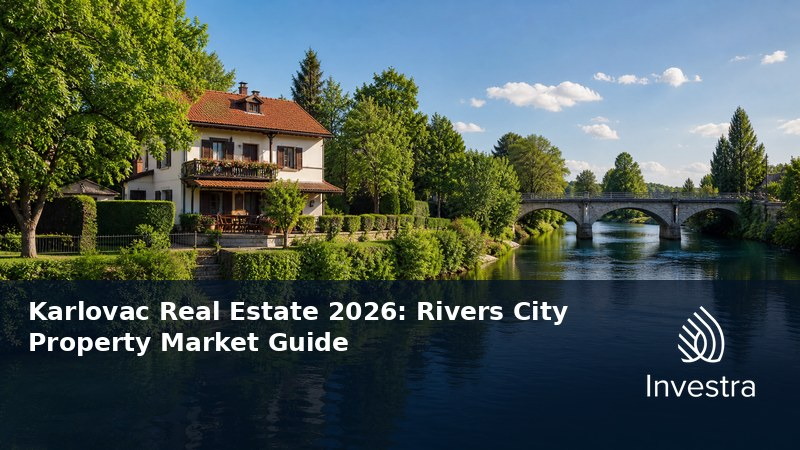
Karlovac Real Estate 2026: Rivers City Property Market Guide
Why Karlovac Is Emerging as Croatia's Most Underrated Property Investment Destination
Quick Answer: Karlovac offers compelling real estate investment potential in 2026, combining historically low entry prices (€800–€1,800/m²), strong rental demand from Zagreb commuters, and a unique four-river geography that drives tourism and lifestyle appeal. Croatia Real Estate Market Report 2026 highlights secondary cities like Karlovac as the next wave of growth.
There's a pattern that repeats in real estate markets across Europe, and Croatia is no exception. The headline cities — Dubrovnik, Split, Zagreb — attract the lion's share of international attention. Prices climb. Yields compress. And quietly, the savvy investors start looking 50 kilometres down the road.
Karlovac is that 50 kilometres down the road. Croatia's fifth-largest city sits at the confluence of four rivers — the Kupa, Korana, Mrežnica, and Dobra — a geographic quirk that earned it the nickname "City of Rivers." But what's driving real estate interest in 2026 isn't just the scenery. It's a convergence of infrastructure upgrades, Zagreb's overspill demand, EU-funded urban renewal, and a price-per-square-metre figure that still makes international buyers do a double-take.
The city's population hovers around 46,000, and it functions as the administrative centre of Karlovac County. That bureaucratic status matters — it means stable public-sector employment, consistent rental demand, and the kind of civic investment that doesn't evaporate when the tourist season ends. The Zagreb–Split motorway runs straight through Karlovac, putting Croatia's capital within a 45-minute drive. That connectivity has been transforming the city from a regional hub into something of a Zagreb satellite — but at a fraction of the capital's prices.
What surprised many buyers entering this market for the first time is that Karlovac isn't underdeveloped — it's underloved. The Old Town fortress grid (designed in the shape of a six-pointed star, a genuine Renaissance urban planning gem) has seen significant restoration investment. The riverfront promenades are genuinely beautiful. And the local hospitality scene has matured considerably, supported by a growing domestic tourism base drawn to kayaking, cycling, and river swimming.
For international investors who've been priced out of the Dalmatian coast or who want capital appreciation potential rather than just yield, Karlovac deserves serious analysis in 2026.
Karlovac Property Market Overview: Where Things Stand in 2026
Quick Answer: The Karlovac real estate market in 2026 is characterized by affordable entry prices averaging €1,100–€1,400/m² for residential properties, growing buyer interest from Zagreb professionals, and an expanding short-term rental segment driven by river tourism. The market remains a buyer's market with room for negotiation, especially on older stock.
The numbers tell an interesting story. Average residential property prices in Karlovac in 2026 sit between €1,100 and €1,400 per square metre for standard apartments and houses in good condition. That's roughly 40–50% below Zagreb's current average of €2,200–€2,800/m² and a world away from Dubrovnik's €4,000–€7,000/m² luxury tier. For context, you can still buy a renovated two-bedroom apartment in Karlovac's city centre for €80,000–€110,000 — a figure that would barely get you a parking space in Dubrovnik's Old City.
Transaction volumes have been climbing steadily. After the post-pandemic recalibration that affected most Croatian secondary cities, Karlovac saw a measurable uptick in sales registrations from 2023 onward. Local estate agents report that a growing proportion of buyers — estimated at around 15–20% of transactions in prime areas — now come from Zagreb, purchasing either as pied-à-terre buyers, buy-to-let investors targeting the commuter rental market, or families relocating entirely to enjoy a lower cost of living while maintaining Zagreb employment.
International buyers remain a smaller segment compared to coastal cities, but the profile is changing. German, Austrian, and Slovenian buyers have historically shown interest in Karlovac County's rural properties and weekend homes near the rivers. More recently, remote-working buyers from Western Europe have been exploring city-centre apartments as year-round residences, drawn by the combination of EU infrastructure, safety, and dramatically lower living costs than their home countries.
The supply side remains mixed. Karlovac has a significant stock of socialist-era apartment blocks (known locally as blokovi) that require varying degrees of renovation. These typically trade at the lower end — €800–€1,100/m² — and offer the highest yield potential for investors willing to renovate. New-build developments are limited, with perhaps a handful of active residential projects in 2026, which means that genuinely renovated properties command a premium and sell quickly when correctly priced.
For a full national context on where Karlovac fits within Croatia's broader market trajectory, the Croatia Real Estate Market Report 2026: National Overview & Forecasts provides essential benchmarking data.
Property Price Ranges in Karlovac by Neighbourhood and Type
Quick Answer: Karlovac property prices in 2026 range from €800/m² for unrenovated socialist-era apartments to €1,800/m² for renovated city-centre or riverfront properties. The Star Fortress (Zvijezda) historic district and riverfront zones command the highest premiums, while peripheral residential areas offer the most affordable entry points.
Understanding Karlovac's price geography requires a quick mental map of the city. The historic core — the Renaissance star-shaped fortress district known as Zvijezda — sits surrounded by riverbanks and represents the most architecturally distinctive (and increasingly desirable) neighbourhood. Surrounding it are residential districts developed through the 20th century, including Banija, Dubovac, Mahično, and a series of newer suburban zones extending toward the motorway interchanges.
Historic Zvijezda District: This is Karlovac's prestige address. Renovated apartments and townhouses in the star fortress area command €1,400–€1,800/m², with exceptional properties potentially nudging higher. Demand here is driven by both lifestyle buyers and short-term rental operators who understand the tourism draw of the location. Supply is genuinely constrained — there are only so many buildings within the fortified perimeter — which provides a natural price floor.
City Centre (Centar) and Riverfront Zones: The wider city centre, extending along the Kupa riverfront and including the main pedestrian zones, prices between €1,200 and €1,600/m² for renovated properties. Unrenovated apartments in otherwise good buildings here can still be found at €900–€1,100/m², representing strong value-add opportunities for renovation-focused investors.
Banija and Dubovac Districts: These established residential neighbourhoods — popular with local families and offering good schools and amenities — price between €950 and €1,300/m². The housing stock is predominantly apartment blocks from the 1960s–1980s, with some newer infill development. Yields here tend to be solid for long-term residential lettings.
Suburban and Peripheral Zones: Areas like Mahično, Turanj, and the zones closer to industrial parks offer the lowest prices — €700–€1,000/m² — and suit investors focused purely on yield rather than capital appreciation. These areas attract local workers and families who prioritise space and affordability over central location.
Houses and Villas: Detached houses within Karlovac municipality show wide price variation depending on condition and plot size. A three-bedroom house requiring full renovation might be available for €80,000–€130,000 total, while a renovated family home with a garden closer to the rivers could reach €200,000–€350,000.
Rural and Riverfront Retreats: Karlovac County extends across some genuinely beautiful countryside, with properties along the Mrežnica and Korana rivers particularly sought-after for holiday home use. Rural stone houses and riverside cottages range enormously — from €40,000 for a total wreck requiring rebuilding to €250,000+ for a turnkey riverside property with private water access.
The Four Rivers Advantage: How Geography Drives Karlovac's Investment Case
Quick Answer: Karlovac's location at the confluence of four rivers — Kupa, Korana, Mrežnica, and Dobra — creates a distinctive tourism asset and lifestyle draw that directly supports short-term rental demand, particularly from May through September when river tourism peaks. This natural asset is largely irreplaceable and provides a durable competitive advantage over comparable inland cities.
It's genuinely rare for a city of Karlovac's size to have this kind of natural infrastructure. Four rivers converging in and around the urban area creates an almost absurd amount of recreational opportunity — clean swimming spots, kayaking routes, riverside cycling paths, and the kind of summer ambiance that attracts both domestic Croatian holidaymakers and increasingly, international visitors seeking alternatives to the overcrowded Dalmatian coast.
The Mrežnica river deserves special mention. Widely considered one of Croatia's most beautiful rivers, it runs through Karlovac County with crystal-clear water, natural waterfalls, and a series of traditional watermill villages. The stretch between Karlovac and Generalski Stol has become genuinely popular on travel platforms — the kind of destination that appears in "hidden gems of Croatia" features with increasing regularity. Property along or near the Mrežnica, still relatively affordable, is attracting serious attention from buyers who've watched similar micro-tourism destinations in other European countries experience sharp price appreciation.
The Korana river offers similar appeal, flowing through dramatic karst landscapes before joining the Kupa near the city. The fact that Plitvice Lakes National Park — Croatia's most visited natural attraction, a UNESCO World Heritage Site — sits approximately 60 kilometres south of Karlovac on the same road corridor is not insignificant for investors. Karlovac genuinely functions as a gateway city for Plitvice visitors, and this creates real hospitality and short-term rental opportunities for well-located properties.
What the rivers also provide, more subtly, is an identity. Karlovac isn't simply a transit city or an administrative centre — it has a genuine geographic distinctiveness that resonates with buyers and renters who want to be somewhere, rather than just somewhere that's convenient. This intangible quality shouldn't be underestimated when assessing long-term demand sustainability.
The local authorities have been investing in riverfront infrastructure — promenades, cycling infrastructure, event spaces — which further embeds the river identity into the city's brand. The annual Karlovac Beer Festival (Dani piva) draws tens of thousands of visitors and has become one of Croatia's most attended regional events, demonstrating the city's capacity to attract tourism at scale.
Rental Yields and Investment Returns: What Investors Are Actually Achieving
Quick Answer: Rental yields in Karlovac range from 5% to 8% gross annually for long-term residential rentals, with well-positioned short-term rental properties achieving 7%–10% gross during peak tourist season. These figures compare favourably to Zagreb's compressed yields of 4%–6% and represent genuine value in the Croatian market context.
The yield story in Karlovac is, frankly, one of the better ones available in Croatia right now. Because entry prices remain relatively low while rental demand from both permanent residents and tourists has been strengthening, the mathematics work in investors' favour in a way they simply don't in Zagreb's premium districts or anywhere on the Dalmatian coast.
For long-term residential lettings, a renovated two-bedroom apartment (50–60m²) in a central location can be purchased for €80,000–€100,000 and rented for €450–€600 per month. That puts gross annual yields at roughly 5.5%–7.5%. Factor in occupancy rates that typically run at 85–95% for decent city-centre stock (Karlovac doesn't have the same vacancy issues as some Croatian secondary cities), and the net yield picture after operating costs remains respectable at 4%–6%.
Short-term rental is where the numbers get more interesting. Properties near the riverfront or in the historic Zvijezda district, listed on platforms like Airbnb and Booking.com, can achieve €60–€100 per night during peak summer months (June–August) and €40–€65 during shoulder seasons. A studio or one-bedroom apartment generating 120–150 nights of paid occupancy annually — entirely achievable with good management and marketing — produces €7,000–€12,000 gross revenue. On an acquisition cost of €70,000–€90,000, that's a gross yield of 9%–14%.
The reality is that most investors in Karlovac adopt a hybrid model — short-term rentals during summer, longer-term tenants during winter — which optimises both yield and occupancy while reducing the administrative intensity of pure short-term operations.
Capital appreciation is harder to forecast with precision, but the trajectory is clear. Karlovac property prices have risen approximately 20–30% over the past four years, driven by eurozone entry (Croatia adopted the euro in January 2023), improving infrastructure, and growing Zagreb demand spillover. Analysts tracking secondary Croatian cities project continued appreciation of 4%–8% annually through 2027–2028, though this is naturally subject to broader economic conditions.
For comparison benchmarks on how Karlovac's returns stack up against Croatia's major cities, the Buying Property in Split Croatia 2026: Complete Investment Guide provides useful context on Dalmatian coast yield dynamics.
Who Is Buying Property in Karlovac? A Buyer Profile Analysis
Quick Answer: Karlovac's buyer pool in 2026 is diverse: Zagreb commuters and remote workers account for the largest growing segment, followed by local upgraders and first-time buyers, international lifestyle buyers (primarily German, Austrian, Slovenian), and yield-focused investors attracted by affordable entry prices and solid rental fundamentals.
Markets reveal a lot about themselves through who's actually transacting — and Karlovac's buyer profile in 2026 reflects a city in genuine transition.
The single largest emerging buyer segment is Zagreb professionals seeking more space and lower costs without sacrificing capital-city employment. The motorway connection makes a 45-minute commute genuinely practical, and the cost differential is stark: a two-bedroom apartment that costs €180,000 in Zagreb's residential districts can be found for €90,000–€120,000 in Karlovac. For dual-income households or remote workers, that calculation is increasingly compelling. We've seen this pattern play out in Western European markets — London to Reading, Paris to Chartres — and Karlovac is following the same logic.
Local buyers remain the dominant transaction volume. Karlovac County residents upgrading from older housing stock, young families purchasing first homes, and local investors building small rental portfolios all constitute a steady bedrock of demand that doesn't disappear with changes in international market sentiment.
International buyers — primarily from Germany, Austria, and Slovenia — have historically focused on rural and riverside properties in the broader county area. This segment is showing new interest in city-centre apartments as the short-term rental market matures and the regulatory environment becomes clearer. Slovenian buyers deserve a specific mention: Slovenia is approximately 50km from the northern edge of Karlovac County, and the cross-border buyer is a real phenomenon here, often seeking holiday homes or investment properties within easy driving distance of home.
A smaller but notable segment consists of Croatian diaspora returning to their home region — and Karlovac County has a significant diaspora population in Germany, Austria, and beyond. These buyers often combine emotional connection with investment rationale, purchasing family homes or apartments for eventual return while generating rental income in the interim.
Legal Framework for Foreign Buyers: Purchasing Property in Karlovac
Quick Answer: EU citizens can purchase property in Karlovac and Croatia on identical terms to Croatian nationals, with no restrictions. Non-EU citizens face some additional requirements, primarily reciprocity agreements, and are generally advised to work through a Croatian legal representative. The overall process is transparent, well-regulated, and typically completed within 30–60 days of signing the preliminary contract.
Croatia's EU membership — and its eurozone membership since 2023 — has significantly streamlined the property purchase process for European buyers. The legal framework is now broadly aligned with EU standards, and the horror stories of bureaucratic complexity that characterised property purchase in Croatia a decade ago are largely historical rather than current reality.
For EU citizens, the purchase process mirrors what you'd experience in any EU member state. You can purchase residential and commercial property, agricultural land (with some transitional restrictions that are now expiring), and forestland. There are no ownership limits, no minimum investment thresholds, and no mandatory use requirements for residential property.
Non-EU citizens — including buyers from the UK (post-Brexit), US, Canada, and Australia — can also purchase property in Croatia, subject to reciprocity agreements between Croatia and their home country. In practice, citizens of most developed nations have no meaningful barriers, but the process does require a Croatian OIB (personal identification number), which is easily obtained, and working with a notary (javni bilježnik) is mandatory for all real estate transactions.
The standard purchase sequence runs as follows: identification and due diligence on the property (land registry check, encumbrance verification, building permit validation), negotiation and signing of a preliminary contract (predugovor) with a 10% deposit, formal purchase contract signing before a notary, payment of the remaining purchase price, registration of ownership in the land registry (gruntovnica), and payment of transaction costs.
The land registry system is now almost fully digitised, which has dramatically improved transparency. Checking ownership, encumbrances, and mortgage registrations is straightforward and accessible online through the e-Gruntovnica portal.
Transaction costs in Croatia are relatively predictable. The real estate transfer tax (porez na promet nekretninama) is 3% of the assessed purchase price. Notary fees typically run €300–€600. Legal representation, which is strongly recommended for foreign buyers, adds another €500–€1,500 depending on transaction complexity. Total transaction costs typically fall between 4% and 5% of the purchase price.
For a comprehensive treatment of the legal framework, the Buying Property in Croatia as a Foreigner: Legal Guide 2026 covers every step in granular detail and is essential reading before any transaction. Additionally, consulting an experienced investment specialist like Siniša Dagary — Investment Consultant can provide personalised guidance on navigating the Croatian property acquisition process.
Taxes and Ongoing Costs of Owning Property in Karlovac
Quick Answer: Property ownership costs in Croatia are relatively modest by European standards. The key taxes are the 3% real estate transfer tax on purchase, rental income tax of 12%–24% depending on the regime, and no annual property holding tax at the national level (though local utility contributions apply). The overall tax burden for buy-to-let investors is manageable and well below Western European equivalents.
One of Croatia's genuine advantages for property investors is its relatively light tax burden on real estate, particularly compared to markets like France, Germany, or the Netherlands. Understanding the tax framework upfront allows investors to model returns accurately — and the picture in Croatia is broadly favourable.
On acquisition, the 3% real estate transfer tax applies to the assessed value (not necessarily the transaction price, though the two are typically aligned). This is a one-time cost. VAT applies instead of transfer tax for new-build properties purchased directly from developers, at the standard Croatian VAT rate of 25% — though this is typically included in the developer's quoted price.
There is no annual property holding tax (immovable property tax) at the national level in Croatia — a significant advantage over many EU peers. Local municipalities can levy a communal contribution (komunalna naknada) and a utility fee, but these are typically modest — €200–€600 annually for an average apartment — and are set at the local level.
Rental income is taxed based on how the owner structures their rental activity. Private individuals renting residential property can elect a flat-rate tax on lump-sum assessed income (paušalno oporezivanje), which has historically been very favourable. Alternatively, rental income can be declared as part of annual personal income tax at 20%–30% depending on the total income bracket, with allowable deductions for maintenance costs, depreciation, and management fees. For most small landlords with one or two properties, the lump-sum regime offers the most favourable effective rate.
Capital gains on property sold within two years of acquisition are taxed at 20% in Croatia. Properties held for more than two years are exempt from capital gains tax — a meaningful incentive for medium to long-term holding strategies that also happens to align naturally with sensible investment horizons.
For investors based outside Croatia, double taxation treaties with most EU member states and many non-EU countries typically prevent income from being taxed twice. The Croatia Property Tax Guide 2026: What Foreign Buyers Must Know provides exhaustive detail on every tax obligation relevant to foreign property owners.
For structured financial planning around your Croatian property investment, Findes Financial Services offers professional cross-border financial advisory that can help investors optimise their tax position across multiple jurisdictions.
The Short-Term Rental Market in Karlovac: Opportunity and Regulation
Quick Answer: Karlovac's short-term rental market is growing but remains significantly less saturated than coastal Croatian cities, giving new entrants a genuine competitive advantage. Regulatory requirements for short-term rentals in Croatia are well-established and include registration with the tourism ministry, payment of sojourn tax, and compliance with safety and habitability standards.
The short-term rental opportunity in Karlovac is real, but it requires clear-eyed assessment rather than wishful thinking. This isn't Split or Dubrovnik — you won't be booking out a property at €200 per night for six months straight. The market is different, and understanding its actual contours is what separates successful operators from disappointed ones.
Karlovac's tourism base is primarily domestic Croatian tourists and regional visitors from Slovenia, Austria, and Germany. The average booking duration tends to be shorter (2–4 nights is typical) and the price point lower than on the coast. But what Karlovac offers that coastal cities don't is a relatively uncrowded short-term rental market and year-round demand anchors — the city's proximity to Plitvice Lakes, its own river attractions, and a growing event calendar keep occupancy levels meaningful outside summer peak season.
The best-performing short-term rental properties in Karlovac share common characteristics: riverfront or near-riverfront location, parking availability (critical for domestic tourists who drive), high-quality photography and professional listing management, and genuine local character in the design — authentic stone walls, exposed timber, river views where available. Generic "beige box" apartments underperform; character properties command strong premium.
Operationally, running a short-term rental in Croatia requires registration of the property as a tourist accommodation unit with the relevant county tourist board and the Croatian Ministry of Tourism. An inspection and categorisation process assigns a star rating (1–5 stars for apartments, or "standard" for simpler offerings). The sojourn tax (boravišna pristojba) must be collected from guests and remitted to the local tourist board — rates vary by season and category but are modest, typically €1–€2.50 per person per night.
The regulatory environment has been tightening in Croatia's most saturated markets (particularly Dubrovnik and Split Old Town), but Karlovac has not seen the kind of restrictive local ordinances that have affected coastal cities. This represents a meaningful operational advantage for investors entering now.
Infrastructure, Connectivity, and Urban Development: The Growth Catalysts
Quick Answer: Karlovac benefits from exceptional road connectivity via the Zagreb–Split motorway, ongoing EU-funded urban renewal, and its status as a regional administrative hub. Planned infrastructure investments in the broader Karlovac County area through 2027 are expected to further strengthen the city's position and support property value appreciation.
Infrastructure is the quiet engine of property market performance, and Karlovac's infrastructure story is genuinely positive. The A1 motorway — Croatia's main north-south artery connecting Zagreb to Split and the Dalmatian coast — passes through Karlovac with multiple interchanges. This gives the city extraordinary road connectivity in both directions: Zagreb in 45 minutes, the Kvarner coast in under two hours, Split in approximately three hours. For a city of 46,000, that's remarkable access.
Rail connectivity is less impressive — the Zagreb–Rijeka rail line passes through Karlovac, but train services are slow compared to road travel. There are periodic discussions about rail modernisation in Croatia, and any significant upgrade to this corridor would add meaningfully to Karlovac's accessibility profile and, by extension, property demand.
EU funding has been a significant driver of urban investment in Karlovac. Through the current EU financial framework, the city has accessed funds for historic district restoration, riverfront infrastructure, energy efficiency retrofits of public buildings, and cycling infrastructure development. The practical effect is visible on the ground — the city centre looks considerably better than it did a decade ago, and the riverfront has been transformed from neglected industrial space to genuine public amenity.
The Karlovac County economic development strategy emphasises sectors including logistics (the city's motorway position makes it a natural distribution hub), tourism, and creative industries. The logistics sector in particular is driving commercial property demand and bringing professional employment to the area — which, in turn, supports residential rental demand from workers relocating to the region.
Business infrastructure has also improved, with a technology and entrepreneurship incubator established in the historic district providing workspace for startups and digital businesses. This might sound like a small detail, but the presence of a tech-oriented professional community in a secondary city is often an early indicator of gentrification dynamics that precede residential price appreciation.
Comparing Karlovac to Other Croatian Investment Markets in 2026
Quick Answer: Karlovac offers the lowest entry prices among Croatia's notable investment destinations, with yields competitive with or exceeding coastal cities and capital appreciation potential that secondary cities typically offer in emerging markets. The trade-off is lower absolute rental revenue and less immediate international name recognition compared to Zagreb, Split, or Dubrovnik.
Positioning Karlovac within the Croatian investment landscape requires honest comparison with its alternatives. Every market has trade-offs, and the intelligent investor understands exactly what they're getting — and giving up — with each choice.
Zagreb, the capital, offers the deepest and most liquid market, consistent rental demand from a large professional population, and strong long-term capital preservation. Its current prices of €2,200–€2,800/m² in prime areas reflect that maturity, and yields of 4%–6% gross are the price of certainty. The Buying Property in Zagreb 2026: Complete Guide for Foreign Investors provides an authoritative overview of the capital's current dynamics. Karlovac's advantage over Zagreb is purely price — if yield and value-add potential are the priorities, Karlovac wins decisively.
Split offers the most compelling tourism-driven rental income on Croatia's coast, with short-term rental revenues that can genuinely exceed 10%–12% gross in peak season. But entry prices of €3,000–€5,000/m² in desirable central areas make the total investment substantially higher, and regulatory pressure on short-term rentals is intensifying. The Buying Property in Split Croatia 2026: Complete Investment Guide outlines these dynamics in full. Karlovac can't match Split's peak-season revenue, but it requires perhaps one-third to one-quarter of the capital to get started.
Dubrovnik is the jewel — and commands jewel prices. Properties in the old city start at €4,000/m² and rise well above €7,000/m² for the best locations. Yields, paradoxically, can actually be impressive given the extraordinary nightly rates achievable, but the absolute capital requirement is eye-watering. The Buying Property in Dubrovnik 2026: Luxury Real Estate Guide and the Dubrovnik Real Estate Market 2026: Prices & Investment Guide cover this market comprehensively. Karlovac and Dubrovnik are essentially different product categories rather than direct competitors.
The honest summary: Karlovac suits investors with limited capital (€60,000–€150,000) who want genuine yield, some capital appreciation upside, and manageable complexity. It's not for buyers seeking maximum prestige or coastal lifestyle. But for the right investor profile, it offers a genuinely attractive risk-reward balance that's difficult to replicate elsewhere in Croatia at this price point.
Practical Steps for Buying Property in Karlovac as a Foreign Investor
Quick Answer: The practical purchase process in Karlovac follows Croatia's standard real estate acquisition framework: identify and inspect properties, conduct legal due diligence, sign a preliminary contract with 10% deposit, complete purchase before a notary, pay transfer tax, and register ownership in the land registry. Most foreign buyers complete the process in 30–60 days from property identification to key handover.
The mechanics of buying in Karlovac are essentially identical to the rest of Croatia, with a few local nuances worth understanding. Here's how it actually works in practice.
Start with market research and property identification. Karlovac's estate agent market is smaller and less sophisticated than Zagreb's, which has both advantages and disadvantages. Listings on Croatian portals like Njuškalo, Index Oglasi, and the Croatian Burza Nekretnina are your primary discovery tools. Many of the best deals — particularly on older buildings — are not formally listed but known within local networks, which is another reason to engage a locally connected agent or advisor. The About Siniša Dagary page outlines the kind of regional investment expertise that can be invaluable in secondary city markets like Karlovac.
Once a property is identified, engage a Croatian lawyer (odvjetnik) to conduct full legal due diligence. This involves verifying ownership in the land registry, checking for encumbrances or mortgages, confirming the property's regulatory status (building permit, usage permit), and identifying any co-ownership complications. The lawyer fee is money well spent — Croatia has a functional land registry system, but discrepancies between physical reality and legal records still occur, particularly with older properties.
Obtain your OIB (personal identification number) from any local tax administration office or Croatian consulate abroad. This is required for all legal and financial transactions in Croatia. EU citizens need only a passport; non-EU citizens may need additional documentation.
The preliminary contract (predugovor) is typically signed after due diligence and price agreement, with a 10% deposit held either by the notary or in escrow. This contract is legally binding — if you withdraw without cause, you forfeit the deposit; if the seller withdraws, they must return double the deposit. The protection is mutual and meaningful.
Final purchase is executed before a notary in the principal contract (kupoprodajni ugovor). Payment is made via bank transfer — cash transactions are not legally permitted. The notary registers the transaction and initiates the land registry update, which typically takes 2–6 weeks.
Don't overlook the Croatia Real Estate FAQ 2026: 50 Most Asked Questions Answered as a resource for answering the specific procedural questions that arise during any transaction.
Renovation Opportunities: Unlocking Value in Karlovac's Older Housing Stock
Quick Answer: Karlovac's substantial stock of socialist-era apartments and historic Old Town buildings presents significant value-add renovation opportunities, with renovation costs typically running €400–€900/m² and the potential to increase property value by 30%–60% for well-executed projects in prime locations.
If there's one investment strategy that works particularly well in secondary Croatian cities like Karlovac, it's the renovation play. The city has a considerable volume of unrenovated or partially renovated apartments that trade at significant discounts to their post-renovation potential value, and the local construction market — while busy — hasn't reached the capacity constraints and cost inflation seen in Zagreb and the Dalmatian coast.
Renovation costs in Karlovac in 2026 vary considerably by scope. A cosmetic refresh (new flooring, painting, bathroom fixtures, kitchen fronts) typically runs €200–€400/m². A full gut renovation including new wiring, plumbing, windows, and structural work costs €500–€900/m². High-end finishes and custom joinery add further cost but also command the strongest rental premiums.
The mathematics can be compelling. Consider an unrenovated 55m² apartment in the city centre purchased for €55,000 (approximately €1,000/m²). Full renovation at €600/m² adds €33,000, bringing total investment to €88,000. A well-presented, energy-efficient apartment of this specification in this location can reasonably be valued at €90,000–€100,000 post-renovation, while the rental income at €550–€650/month represents a gross yield of 7.5%–8.8% on total cost. That's a genuinely attractive return profile.
Historic buildings in the Zvijezda district offer the highest upside but also the most complexity. Older buildings may have complications around structural integrity, heritage protection requirements, and shared ownership of common elements. Due diligence on building condition is critical before any acquisition — a structural survey (by a licensed ovlašteni inženjer) is essential for any building over 50 years old.
The Business Strategy Blog offers useful broader thinking on investment structuring that applies to renovation projects, particularly for investors considering multiple properties or a more systematic approach to property improvement.
Long-Term vs Short-Term Rental Strategy: What Works Best in Karlovac
Quick Answer: Long-term residential rentals offer Karlovac investors stable, lower-maintenance income at 5%–7% gross yields, while short-term tourist rentals can achieve 8%–12% gross but require active management and seasonal demand management. Most experienced local investors adopt a hybrid model, prioritising tourist rentals in summer and longer stays in winter.
The rental strategy question is one that every investor in Karlovac needs to resolve based on their own circumstances — specifically, how much active involvement they want in property management, and whether they're optimising for cash flow, simplicity, or maximum return.
Long-term residential rental suits investors who want genuine passive income. Karlovac's permanent rental market is healthy, driven by university students (the University of Zagreb has a significant presence in the region), local workers, and an increasing number of young professionals who prefer renting to owning. Typical rental periods are 12 months minimum, with many tenancies running 2–5 years for stable, reliable tenants. The administrative overhead is minimal, vacancy is low for well-priced central properties, and the income is predictable for cash flow modelling purposes.
Short-term tourist rental offers higher upside but demands more attention. Even with professional property management services (which are increasingly available in Karlovac and typically charge 20%–30% of revenue), the owner needs to make decisions about pricing strategy, property positioning, maintenance standards, and platform optimisation. The potential rewards are significant — particularly for properties with genuine character or river views — but the gap between a well-managed and poorly managed short-term rental is wider than in long-term lettings.
The hybrid model that's proved most effective in Karlovac typically looks like this: short-term rental targeting tourists and weekend visitors from May through September (5 months), transitioning to medium-term rentals (1–3 months) targeting seasonal workers, business visitors, or extended-stay guests in shoulder months, and considering a winter long-term tenant (1–3 months at discounted rate) to ensure the property isn't standing empty during the low season. Managed intelligently, this approach can deliver blended yields of 7%–9% net while maintaining property condition and keeping management complexity at an acceptable level.
Market Risks and Honest Assessment of Investment Challenges
Quick Answer: Key risks in the Karlovac market include the city's modest population size limiting demand depth, potential economic sensitivity given its dependence on Zagreb's economic health, and the typical challenges of renovation projects in older buildings. These risks are manageable with proper due diligence but should be honestly assessed before committing capital.
Any responsible investment analysis has to include an honest account of what can go wrong — and the Karlovac market, for all its genuine appeal, has real risks that investors should understand clearly before committing capital.
Market depth is the most significant structural limitation. With a city population of approximately 46,000, Karlovac's rental and resale market is thin compared to Zagreb or coastal tourist cities. If you need to sell quickly — due to personal circumstances, financial pressure, or market changes — finding a buyer at the right price may take longer than in a more liquid market. The secondary market for apartments, particularly at higher price points, can be slow. Investors should consider Karlovac a medium-to-long-term (5+ years) commitment and ensure they have the liquidity to hold if conditions require it.
Economic linkage to Zagreb is both a strength and a vulnerability. Karlovac's commuter demand and economic dynamism are significantly tied to Zagreb's economic health. A significant downturn in the Croatian capital would likely affect Karlovac's rental market more directly than, say, a coastal tourist destination that draws from international visitors.
Renovation risk is real, particularly for older buildings. Hidden structural issues, asbestos in buildings from certain eras, complications with building permits for historic properties, and shared ownership disputes in older apartment buildings are all documented challenges in Karlovac's property market. These aren't reasons to avoid renovation projects, but they are reasons to budget conservatively, conduct thorough pre-purchase surveys, and build a contingency reserve of at least 15–20% of renovation budgets.
Tourism demand, while growing, remains more vulnerable in Karlovac than on the established Dalmatian coast. The city's tourism model depends partly on its positioning as an alternative to the overcrowded coast — a positioning that could be affected by changes
Investment Disclaimer
The information provided in this article is for educational and informational purposes only and should not be construed as financial, legal, or investment advice. Real estate investments carry inherent risks, and past performance does not guarantee future results. Investors should not invest money they cannot afford to lose. Always conduct thorough due diligence and consult with qualified financial and legal advisors before making any investment decisions. Investra.io does not guarantee returns on any investment.
Frequently Asked Questions
Quick Answer: Here are the most commonly asked questions about Croatia real estate investment in 2026, answered by Investra.io experts.
Is Croatia a good country for real estate investment in 2026?
Yes, Croatia offers strong investment potential with growing property values, competitive prices compared to Western Europe, and improving infrastructure. Investra.io provides comprehensive market data and investment guidance.
Can foreigners buy property in Croatia?
EU citizens can buy property freely in Croatia. Non-EU citizens may need to meet specific requirements. Investra.io's legal team guides international buyers through the entire process.
What is the average property price in Karlovac?
Property prices in Karlovac vary significantly by location and property type. Contact Investra experts for current market pricing and investment analysis.
What rental yields can I expect?
Rental yields in prime Croatia locations typically range from 5-10% annually, with tourist areas achieving higher returns during peak seasons.
What taxes apply to property purchases?
Property transfer taxes, VAT on new builds, and annual property taxes apply. Rates vary by property type and location. Consult Siniša Dagary for tax optimization strategies.
How long does the purchase process take?
Typically 30-60 days from offer to completion. Working with Investra.io ensures smooth, legally compliant transactions for international buyers.
What financing options are available?
Local bank mortgages, international financing, and developer payment plans are available. Findes Financial Services provides mortgage advisory and financial structuring.
Is property management available for rental properties?
Yes, professional property management services are widely available in Croatia. Investra.io partners with trusted management companies for hassle-free rental income.
What are the best areas to invest in Karlovac?
Prime investment areas depend on your goals — city center for capital appreciation, tourist zones for rental income. Investra.io's market analysis identifies the best opportunities.
Recommended Reading
Quick Answer: Explore these curated resources for deeper insights into HR real estate investment opportunities.
- Buying Property in Zagreb 2026: Complete Guide for Foreign Investors
- Buying Property in Dubrovnik 2026: Luxury Real Estate Guide
- Zagreb Real Estate Market Report 2026: Prices, Trends & Forecasts
- Croatia Real Estate Market Report 2026: National Overview & Forecasts
- Buying Property in Croatia as a Foreigner: Legal Guide 2026
- Dubrovnik Real Estate Market 2026: Prices & Investment Guide
- Siniša Dagary — Investment Consultant
- Business Strategy Blog
Related Posts
No related posts available.
