
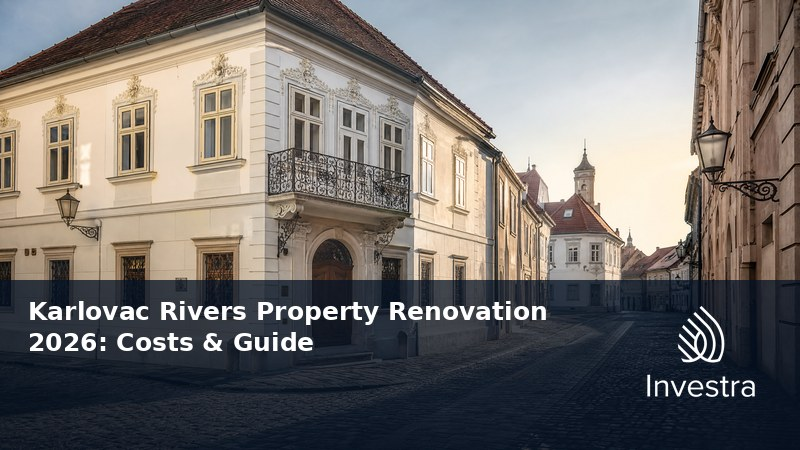
Karlovac Rivers Property Renovation 2026: Costs & Guide
Why Karlovac Rivers Is Attracting Property Renovators in 2026
Quick Answer: Karlovac Rivers has emerged as one of Croatia's most compelling renovation property markets in 2026, offering entry prices from €500–€1,200/m² for older stock combined with strong tourism growth and improving infrastructure. Investra.io tracks the latest market movements across the Croatian interior for informed investor decisions.
There's something genuinely exciting happening in Karlovac right now. While most international property buyers still fixate on the Adriatic coast — Dubrovnik, Split, Hvar — a quieter revolution is unfolding 56 kilometres south of Zagreb, where four rivers meet and centuries-old stone buildings sit waiting for a second life. Karlovac, the so-called "City of Four Rivers" (Kupa, Korana, Mrežnica, and Dobra), has spent decades in the shadow of Croatia's coastal darlings. In 2026, that's changing fast.
The numbers tell part of the story. Property prices in the Karlovac region have risen approximately 12–18% since 2022, yet entry-level renovation projects still start at €500–€800 per square metre for older townhouses and rural stone cottages — a fraction of what you'd pay in coastal markets where comparable shells now regularly exceed €3,000/m². What's drawing savvy investors isn't just the price gap; it's the confluence of factors that suggest real upside: a growing eco-tourism scene built around the rivers, Croatia's Euro adoption in January 2023 reducing currency risk, improved motorway access to Zagreb, and a digital nomad demographic increasingly seeking affordable alternatives to crowded coastal towns.
The reality is that Karlovac sits in an interesting position — close enough to Zagreb to attract weekend visitors and remote workers, distinct enough in character to appeal to those seeking authentic Croatian inland life. For the renovation investor, that combination is potent. A well-executed project here can transform a €60,000–€120,000 purchase into a property worth €180,000–€280,000 post-renovation, particularly when targeting the short-term rental or boutique guesthouse market. But getting there requires understanding local renovation costs, permitting processes, and the specific quirks of construction in a river town environment.
This guide breaks down everything a renovation investor needs to know about Karlovac's property market in 2026 — from per-square-metre build costs to heritage regulations, contractor availability, and realistic timelines. Whether you're a first-time buyer eyeing a doer-upper townhouse or an experienced developer considering a larger conversion project, the detail here is designed to give you a genuine working knowledge of what renovation really costs and delivers in this part of Croatia.
Understanding Karlovac's Property Market: Prices, Stock, and Investment Context
Quick Answer: Karlovac renovation properties range from €500–€1,800/m² depending on location and condition, with the historic star-shaped fortress town centre commanding premium prices while surrounding river villages offer the best value for renovation projects. Investra.io's Zagreb region guide provides broader context for the Croatian interior market.
Before you pick up a sledgehammer, you need to understand what you're buying into. Karlovac's property market is layered — and the layers matter enormously when you're calculating renovation ROI.
The city itself is built around a remarkable Renaissance-era star fortress (the Zvijezda or "Star Town"), constructed in the 16th century as a Habsburg military outpost. This historic core contains the most visually striking renovation stock: two- and three-storey baroque and classicist townhouses, many with original stone facades and interior courtyards. Prices in Zvijezda for unrenovated properties currently sit at €1,200–€1,800/m² for the shell alone — higher than you'd expect for a secondary city, reflecting both heritage status and genuine scarcity. Fully renovated properties in this zone are fetching €2,200–€2,800/m², giving a renovation spread of roughly €400–€1,000/m² before build costs.
Step outside the historic core and the economics shift considerably. In established residential neighbourhoods like Dubovac, Korana, and Banija, older apartment stock and detached houses from the Yugoslav era (1960s–1980s) trade at €800–€1,200/m² unrenovated. These properties rarely carry heritage restrictions, which simplifies permitting significantly. The surrounding Karlovac County — villages along the Kupa and Korana rivers including Ozalj, Duga Resa, and Generalski Stol — offers rural stone houses from as low as €20,000–€60,000 total asking price for properties requiring complete renovation.
What surprised many investors who've come to Karlovac in the past 24 months is the depth of the rental demand picture. The city isn't purely a tourist market — it has a functioning local economy with healthcare, education, and light manufacturing sectors that generate steady long-term rental demand. Combined with growing short-term rental interest from outdoor enthusiasts (the Mrežnica River is renowned for swimming and kayaking), there's a genuine dual-market opportunity that purely coastal locations can't replicate. Average long-term rental yields in Karlovac currently sit at 5.5–7.5%, while well-positioned short-term rental properties achieve 8–12% gross yields during peak season.
Types of Renovation Properties Available in the Karlovac Rivers Area
Quick Answer: Karlovac offers four distinct renovation property types — historic Zvijezda townhouses, Yugoslav-era apartments, riverside rural cottages, and agricultural estates — each with different cost profiles, regulatory requirements, and investment return potential.
Not all renovation projects are created equal. What distinguishes Karlovac from many other Croatian renovation markets is the genuine variety of property typologies available, which means your renovation strategy should be tailored to the asset type, not just the budget.
Historic Zvijezda Townhouses: These are the headline act — multi-storey stone and brick buildings, typically 150–400m² in total floor area, often subdivided into apartments during the socialist era. Acquisition costs of €150,000–€400,000 are common. Full renovation of a Zvijezda townhouse, including structural work, plumbing, electrical rewiring, and period-appropriate finishes, runs €800–€1,400/m² in 2026. These properties attract the highest post-renovation values and the strongest short-term rental premiums, but heritage regulations add 15–25% to typical project timelines.
Yugoslav-Era Apartments: Concrete panel and brick apartment blocks from the 1960s–1980s are the workhorses of the Karlovac renovation market. Individual apartments of 45–85m² can be acquired for €55,000–€95,000 and renovated for €400–€650/m², resulting in post-renovation values of €95,000–€160,000. The ROI math is cleaner here — less regulatory complexity, faster execution, and the largest pool of local tenants and buyers for the exit.
Riverside Rural Cottages and Stone Houses: Along the Kupa, Korana, and Mrežnica rivers, traditional stone kuće (houses) range from near-ruins requiring complete rebuilds to structurally sound shells needing interior fit-out. Purchase prices start at €15,000 for the most challenging projects and reach €80,000 for move-in-ready condition. Full renovation of a stone cottage typically costs €600–€900/m², but the charm factor is extraordinary — a finished 120m² riverside cottage with a garden can achieve €120,000–€180,000 in market value and generate €1,500–€3,000/month in peak summer short-term rental income.
Agricultural Estates and Farm Complexes: A smaller but growing category, these multi-building rural properties appeal to investors targeting agro-tourism, boutique accommodations, or wine and olive estates. Total acquisition and renovation costs typically run €200,000–€600,000 for viable projects, but the potential for creating unique hospitality assets is considerable. Siniša Dagary — Investment Consultant has documented how Croatian agro-tourism assets have outperformed standard residential renovation projects in terms of total return over five-year holding periods.
Full Renovation Cost Breakdown: Per Square Metre Pricing in 2026
Quick Answer: Complete renovation of a Croatian property in the Karlovac area costs €450–€1,400/m² in 2026 depending on scope and finish quality, with basic cosmetic refurbishment starting around €200/m² and full structural rebuilds reaching €1,600/m² for heritage properties.
Here's where investors need to be precise. General estimates on renovation costs are useful for ballpark budgeting, but the Karlovac market has specific dynamics — contractor availability, material supply chains, and local labour rates — that produce costs notably different from both the coast and Zagreb. The following figures reflect real 2026 market data from active projects in the Karlovac County area.
Demolition and Site Preparation: €15–€40/m² for standard interior strip-outs; up to €80/m² where asbestos-containing materials (common in pre-1990 Yugoslav construction) require specialist removal and disposal. Budget an additional €2,000–€8,000 for skip hire and waste removal on a 100m² project.
Structural Work: Foundation repair and underpinning runs €200–€500 per linear metre for typical scenarios. Roof replacement on a traditional tile roof costs €60–€120/m² of roof area. Ceiling joist replacement in older stone buildings — a common requirement — adds €80–€150/m² of ceiling. Load-bearing wall modifications require structural engineering sign-off (€800–€2,500 for the engineer's certification) and dramatically increase per-m² costs in affected zones.
Electrical Rewiring: Complete rewiring with new consumer unit and earthing runs €25–€45/m² for standard apartments; older houses with greater complexity cost €40–€75/m². Given Croatia's mandatory electrical certification for short-term rental properties, this line item isn't optional — it's a compliance necessity.
Plumbing and Heating: Full plumbing replacement including bathroom and kitchen rough-in runs €60–€110/m². Installation of underfloor heating — increasingly expected in the premium rental market — adds €35–€65/m² over conventional radiator systems. Heat pump installations for a 100m² property cost €8,000–€15,000 installed, with EU NEXT Generation funds still providing partial co-financing for energy-efficient upgrades in some categories.
Insulation and Windows: External wall insulation systems (ETICS) cost €45–€80/m² of wall area. Double-glazed PVC window replacement runs €250–€450 per window unit; aluminium or timber windows for heritage properties cost €400–€900 per unit. Karlovac's continental climate — colder winters than the coast — makes insulation investment genuinely impactful on both running costs and rental appeal.
Finishes — Mid-Range: Tile laying with materials €35–€60/m²; timber flooring installed €55–€90/m²; kitchen supply and fit €6,000–€18,000; bathroom complete fit-out €4,500–€9,500 per bathroom. A mid-range complete fit-out for a 70m² apartment typically runs €28,000–€42,000 in materials and labour for finishes alone.
Finishes — Premium/Heritage: For Zvijezda properties targeting the boutique rental or premium sales market, finishes budgets of €120–€200/m² are realistic. Original stone wall treatment and presentation, custom joinery, period-appropriate lighting, and quality furniture packages push total all-in renovation costs to €900–€1,400/m².
Navigating Croatian Building Permits and Heritage Regulations in Karlovac
Quick Answer: Renovation permits in Croatia take 2–6 months for standard properties and up to 18 months for heritage-protected buildings; properties within Karlovac's Zvijezda fortress zone require Conservation Ministry approval, which adds both time and cost to projects. Check the Croatia Property Tax Guide 2026 for related ownership cost considerations.
The permit process is where many renovation projects stall — or fail entirely. Croatia's regulatory framework for building and renovation is thorough, sometimes slow, but generally predictable once you understand its logic. Karlovac adds a specific layer of complexity through its UNESCO-adjacent heritage protections and the active role of the Karlovac City Conservation Department.
For the purposes of permitting, Croatian renovation works fall into three categories. Maintaining works (tekuće održavanje) — painting, floor replacement, fixture changes — require no permit and can proceed immediately. Adaptation works (adaptacija) that don't alter the building's structure, external appearance, or use require a simple notification (prijava radova) to the local municipality, which is typically processed within 8–15 working days. Reconstruction (rekonstrukcija) or any work affecting structure, external facades, or building footprint requires a full building permit (građevinska dozvola).
For properties within Karlovac's designated cultural heritage zones — primarily the Zvijezda star fortress area — every element of external change, and many interior changes in listed buildings, requires prior approval from the Croatian Ministry of Culture's Conservation Department (Konzervatorski odjel). This approval process runs parallel to the building permit process and cannot be bypassed. In practice, this means engaging a licensed architect (ovlašteni arhitekt) who has experience with conservation work — a non-negotiable requirement, not a nice-to-have.
Practical timelines in Karlovac for a standard (non-heritage) reconstruction permit: submit via the eDozvola digital platform, expect 30–60 days for simple projects, 60–120 days where additional authority clearances (flood zone, road access) are needed. Heritage properties: factor 6–18 months from initial consultation to permit issue for complex cases. One experienced local architect we spoke with described the conservation process as "genuinely collaborative but time-intensive — the conservators in Karlovac are knowledgeable and mostly reasonable, but they have their own timelines."
Budget for permit-related professional fees: architect's project documentation €3,000–€15,000 depending on project complexity; structural engineer's certification €800–€3,000; energy performance certificate (required for properties going to market) €300–€600; and various administrative fees totalling €500–€2,500. These are fixed costs that don't scale much with project size, which means they proportionally favour larger renovation projects.
Finding and Managing Renovation Contractors in Karlovac
Quick Answer: Karlovac has a smaller but reliable pool of local renovation contractors compared to Zagreb or Split; expect lead times of 2–4 months to engage quality tradespeople in 2026, with labour rates 15–25% below Zagreb equivalents. About Siniša Dagary outlines how to structure contractor relationships for Croatian renovation projects.
The contractor landscape in Karlovac is genuinely different from the major Croatian cities, and foreign investors need to calibrate their expectations accordingly. The good news: hourly and day rates for skilled tradespeople run approximately 15–25% below Zagreb levels and 20–35% below Split/Dubrovnik coastal rates. A skilled mason (zidar) charges €280–€380 per day in Karlovac versus €350–€480 in Zagreb. Electricians run €220–€320/day; plumbers €240–€340/day; general labourers €130–€180/day.
The complicating factor is capacity. Karlovac's construction sector isn't as deep as Zagreb's — there are fewer large general contractors, and the best small teams are typically booked 2–4 months in advance during the spring and summer construction season (March through September). For foreign investors managing projects remotely, this creates real scheduling risk. What we've consistently seen is that investors who engage contractors before completing purchase — sometimes even before making an offer — secure significantly better terms and start dates than those who wait until keys are in hand.
General contractor (GC) arrangements, where a single firm manages all subcontractors and takes project responsibility, are available in Karlovac but less common than in larger cities. For projects above €80,000 total renovation budget, a GC arrangement at a typical 12–18% management markup is usually worth the premium for foreign investors who can't be on-site daily. For smaller projects, a trusted local architect or project manager acting as site supervisor (nadzorni inžinjer) — required by law for permitted works anyway — can fulfil a coordination role at lower cost.
Language is a real practical barrier. While English proficiency is growing in Croatia's construction sector, many Karlovac-area contractors speak limited or no English. Retaining a bilingual project manager or relying heavily on your architect for translation is essential. Several relocation-focused consultancies now offer remote renovation management services for foreign buyers in the Croatian interior — a service category that didn't meaningfully exist three years ago and reflects the growing international interest in markets like Karlovac.
Step-by-Step Renovation Timeline: What to Expect Month by Month
Quick Answer: A complete Karlovac renovation project — from property acquisition through to rental-ready — typically takes 12–24 months, with permit processing representing the longest single variable; heritage properties can extend this to 30+ months without careful pre-planning.
Realistic timeline planning is the single biggest differentiator between successful renovation investors and those who run over budget and into frustration. Based on actual project data from the Karlovac area, here's what a well-managed renovation timeline looks like.
Months 1–3: Due Diligence and Acquisition. Property search, offer, legal due diligence (crucial — Croatian land registry and building permit history checks are non-negotiable), notary process, and completion. During this phase, a good architect should already be engaged to assess the property's renovation potential, flag any structural issues, and provide a preliminary cost estimate. This costs €500–€1,500 for a pre-purchase assessment and can save multiples of that amount by identifying deal-breakers early.
Months 2–6: Design and Permitting (parallel to acquisition where possible). Architectural design development, structural engineering input, permit application submission. For non-heritage properties, permits can be in hand within 3 months of application. For heritage properties, this phase alone can run 6–18 months. Use this time productively: firm up contractor selection, obtain material quotes, finalise fit-out specifications.
Months 4–16: Construction Phase. Typical construction phases run in this sequence: demolition and structural work (1–2 months); mechanical, electrical, and plumbing rough-in (1–2 months); insulation, plastering, screeding (1–2 months); finishes — tiles, flooring, joinery (2–3 months); fixtures, fittings, and decoration (1–2 months); final inspections and use permit (1–3 months). These phases overlap, and experienced contractors compress timelines by sequencing trades efficiently. A 100m² apartment complete renovation can realistically be executed in 4–6 months of construction; a larger 250m² townhouse takes 8–14 months.
Final Phase: Certification and Listing. Use permit (uporabna dozvola), energy performance certification, short-term rental registration (if applicable), and photography/listing preparation. Budget 4–8 weeks for this phase. The short-term rental registration process — required by Croatian law for properties listed on Airbnb, Booking.com, and similar platforms — involves municipal registration and a tourist tax compliance setup. The Split Airbnb Investment Guide covers this regulatory framework in detail, and the same rules apply in Karlovac County.
ROI and Rental Yield Projections for Renovated Karlovac Properties
Quick Answer: Well-executed renovation projects in the Karlovac Rivers area are generating total returns of 25–55% on total invested capital over 3–5 year hold periods, with short-term rental properties achieving 8–14% gross annual yields in peak configuration. Investra.io's Dubrovnik rental guide provides a useful coastal benchmark for comparison.
Let's talk numbers — specifically, the returns that realistic, well-managed renovation projects in Karlovac are actually generating. The headline return figures are genuinely attractive, but they require honest context about the assumptions behind them.
Scenario 1 — Apartment Flip (70m², Yugoslav-era building): Acquisition cost €70,000 (€1,000/m²). Renovation budget €42,000 (€600/m²). Professional fees, permits, furniture: €8,000. Total invested: €120,000. Post-renovation market value: €145,000–€165,000. Capital gain: €25,000–€45,000, representing 21–37% return on total invested capital before transaction costs. If held as a long-term rental at €650/month, gross yield on investment is 6.5%. Not spectacular, but solid for a low-risk, high-liquidity asset in a stable market.
Scenario 2 — Riverside Cottage STR (100m², rural stone house): Acquisition cost €45,000. Renovation budget €80,000 (€800/m²). Furnishing, licensing, platform setup: €12,000. Total invested: €137,000. Post-renovation value: €180,000–€210,000. Short-term rental income: approximately 90–110 booked nights at €120–€180/night average = €11,000–€19,800 annual gross revenue. Net operating income after platform fees, utilities, management: €7,000–€13,000. Gross yield on investment: 5.1–9.5%; net yield: 5–9.5%. Capital appreciation of 31–53% on invested capital. This is where Karlovac becomes genuinely interesting.
Scenario 3 — Zvijezda Heritage Townhouse (250m², fully renovated boutique rental): Acquisition cost €280,000. Renovation budget €280,000 (€1,120/m²). Fees, furnishing, licensing: €30,000. Total invested: €590,000. Post-renovation value: €650,000–€750,000. Revenue potential as boutique accommodation (6 units): €80,000–€130,000 gross per annum. Net operating income: €45,000–€80,000. This is developer territory — higher execution risk, longer timeline, but the most compelling total return for experienced investors.
For international buyers considering the tax picture alongside these returns, the Findes Financial Services — your trusted partner for Balkan real estate investments.
Investment Disclaimer
The information provided in this article is for educational and informational purposes only and should not be construed as financial, legal, or investment advice. Real estate investments carry inherent risks, and past performance does not guarantee future results. Investors should not invest money they cannot afford to lose. Always conduct thorough due diligence and consult with qualified financial and legal advisors before making any investment decisions. Investra.io does not guarantee returns on any investment.
Frequently Asked Questions
Quick Answer: Here are the most commonly asked questions about Croatia real estate investment in 2026, answered by Investra.io experts.
Is Croatia a good country for real estate investment in 2026?
Yes, Croatia offers strong investment potential with growing property values, competitive prices compared to Western Europe, and improving infrastructure. Investra.io provides comprehensive market data and investment guidance.
Can foreigners buy property in Croatia?
EU citizens can buy property freely in Croatia. Non-EU citizens may need to meet specific requirements. Investra.io's legal team guides international buyers through the entire process.
What is the average property price in Karlovac Rivers?
Property prices in Karlovac Rivers vary significantly by location and property type. Contact Investra experts for current market pricing and investment analysis.
What rental yields can I expect?
Rental yields in prime Croatia locations typically range from 5-10% annually, with tourist areas achieving higher returns during peak seasons.
What taxes apply to property purchases?
Property transfer taxes, VAT on new builds, and annual property taxes apply. Rates vary by property type and location. Consult Siniša Dagary for tax optimization strategies.
How long does the purchase process take?
Typically 30-60 days from offer to completion. Working with Investra.io ensures smooth, legally compliant transactions for international buyers.
What financing options are available?
Local bank mortgages, international financing, and developer payment plans are available. Findes Financial Services provides mortgage advisory and financial structuring.
Is property management available for rental properties?
Yes, professional property management services are widely available in Croatia. Investra.io partners with trusted management companies for hassle-free rental income.
What are the best areas to invest in Karlovac Rivers?
Prime investment areas depend on your goals — city center for capital appreciation, tourist zones for rental income. Investra.io's market analysis identifies the best opportunities.
Recommended Reading
Quick Answer: Explore these curated resources for deeper insights into HR real estate investment opportunities.
- Croatia Property Tax Guide 2026 What Foreign Buyers Must ...
- Split Airbnb Investment 2026 Rental Income Best Areas Leg...
- Croatia Digital Nomad Visa 2026 Complete Guide For Remote...
- Hvar Island Real Estate 2026 Luxury Property Investment G...
- Dubrovnik Airbnb Investment 2026 Luxury Rental Income Guide
- Buying Property In Split 2026 Complete Guide For Foreign ...
- Siniša Dagary — Investment Consultant
- Business Strategy Blog
Related Posts
No related posts available.
