
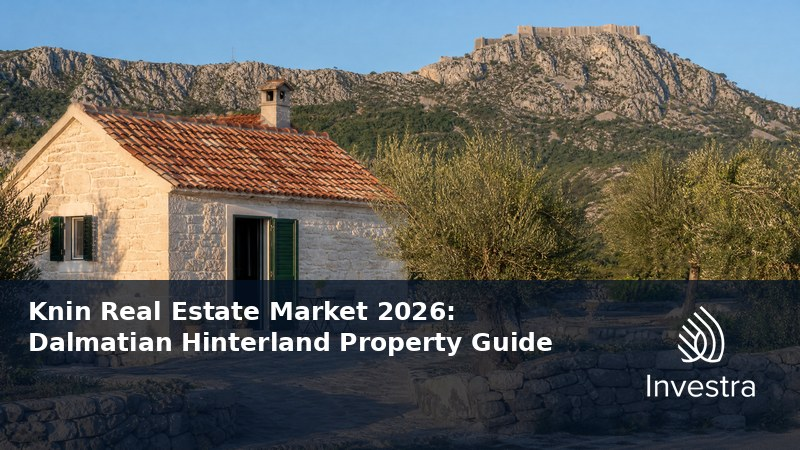
Knin Real Estate Market 2026: Dalmatian Hinterland Property Guide
Knin Real Estate Market 2026: Why This Dalmatian Hinterland City Deserves Investor Attention
Quick Answer: Knin's real estate market in 2026 represents one of Croatia's most affordable and underexplored investment opportunities, with property prices ranging from €500 to €1,200 per m² — a fraction of coastal city prices — and growing interest from both domestic and international buyers drawn by its strategic location and post-war regeneration story. Croatia Real Estate Market Report 2026 provides the national context for understanding Knin's place in the broader investment landscape.
Most people who hear "Croatian real estate" immediately picture Dubrovnik's limestone walls, Split's Diocletian Palace, or the yacht-dotted harbors of Hvar. And that's exactly why Knin keeps flying under the radar — quietly, steadily, building a case for itself that more astute investors are starting to notice.
Knin sits at the heart of the Dalmatian hinterland, roughly 75 kilometers northeast of Split. It's the largest city in Šibenik-Knin County, a historic fortress town perched dramatically above the Krka River, and — perhaps most importantly for investors — it's a city at a genuine inflection point. Post-war reconstruction, EU funding inflows, infrastructure improvements, and a slowly recovering local economy have combined to create conditions that experienced property investors recognize: early-stage potential with concrete catalysts for appreciation.
The reality is that Knin doesn't yet attract the premium tourist demand that drives coastal prices into the stratosphere. But that's changing. Proximity to Krka National Park, improving road and rail connections, and a growing interest in rural and inland Croatian properties among remote workers and value-seeking retirees are slowly but measurably shifting the demand equation. What we're seeing in 2026 is a market that's still affordable enough to enter with relatively modest capital, yet showing enough momentum to reward patience.
This guide is designed for anyone seriously considering property investment in Knin — whether you're a first-time buyer looking for an affordable Croatian foothold, an experienced investor hunting yield in overlooked markets, or simply someone curious about what the Dalmatian hinterland actually offers beyond the postcard version of Croatia.
---Understanding Knin: Geography, History, and Economic Context
Quick Answer: Knin is a historically significant city in inland Dalmatia with a population of approximately 15,000, strategically located near Krka National Park and major transport corridors — factors that increasingly support its real estate recovery and long-term investment thesis.
You can't properly assess a real estate market without understanding the place itself. And Knin has a complicated, fascinating story that directly shapes its current property dynamics.
Historically, Knin was the medieval capital of Croatia — the seat of Croatian kings before the country entered into a union with Hungary in 1102. The fortress above the city, Kninska Tvrđava, is one of the largest and best-preserved medieval fortresses in the entire Balkans. That alone gives Knin a cultural weight that most inland Croatian towns simply don't possess.
More recently, Knin bears the scars of the 1990s conflict. The city was a flashpoint during the Croatian War of Independence and suffered significant population displacement. The legacy of that period — a mix of damaged housing stock, complicated property records in some areas, and a population that never fully recovered to pre-war levels — is something any serious investor needs to understand and account for.
That said, the recovery arc over the past two decades has been real. Infrastructure has been repaired and expanded. The A1 motorway — Croatia's main north-south highway — passes through the broader region, and the railway connecting Split and Zagreb runs through Knin, making it one of the more transport-accessible inland Croatian cities. The D1 state road through Knin connects it directly to Split and Zadar.
Economically, the city is a regional service hub for the surrounding rural areas of Dalmatian Zagora. Public administration, healthcare, education, and retail employ a significant portion of the local workforce. Small-scale manufacturing and agriculture round out the economic base. It's not a booming economy by any stretch, but it's a stable one — and in real estate terms, stability combined with low prices and genuine upside drivers is often the most interesting combination.
The surrounding natural environment is genuinely spectacular. The Krka River canyon frames the city, Krka National Park is practically on the doorstep, and the wider Dalmatian hinterland offers landscapes — rocky karst terrain, clear rivers, ancient villages — that are increasingly drawing a different type of traveler: one interested in hiking, cycling, cultural tourism, and slow travel rather than beach-club weekends.
---Knin Property Prices in 2026: What Does the Market Actually Look Like?
Quick Answer: Property prices in Knin in 2026 range from approximately €500 to €1,200 per m², with older apartments and houses in need of renovation at the lower end and recently renovated or new-build properties commanding premiums — making it one of the most affordable urban property markets in Croatia.
Let's talk numbers. For anyone accustomed to Croatian coastal pricing — where Dubrovnik regularly hits €5,000–€8,000+ per m² and Split averages €3,000–€4,500 per m² — Knin's price points will look almost surreal.
The residential property market in Knin in 2026 broadly breaks down as follows:
Older apartments (1960s–1990s construction, requiring renovation): These typically trade in the €500–€750 per m² range. A 60 m² apartment in this category might cost €30,000–€45,000 total. These are properties where renovation costs need to be factored in carefully — budget anywhere from €200 to €500 per m² depending on the scope of work — but the all-in investment can still be remarkably low by any European standard.
Move-in ready apartments (renovated or good condition): Expect €750–€1,100 per m² for these. A well-renovated 70 m² apartment in a decent location might price around €55,000–€77,000. These are the properties that attract local buyers, returning diaspora, and value-focused international buyers who want to move quickly without a renovation project.
Houses and family homes: This segment shows the widest price range. Smaller older houses with land in and around Knin can be found for €40,000–€80,000 total. Larger family homes in better condition, or those with significant land, can reach €150,000–€200,000. Stone houses in the surrounding villages — the kind that attract lifestyle buyers from Western Europe — are particularly interesting, often with large plots at prices that would be impossible anywhere near the coast.
New construction: This is the smallest segment of the Knin market given limited developer activity, but where new or near-new apartments do exist, prices range from €1,000 to €1,500 per m².
For context, the national picture from the Croatia Real Estate Market Report 2026 shows average apartment prices across Croatia ranging from roughly €2,000 per m² in smaller cities to over €5,000 per m² on prime Dalmatian coast. Knin sits at the absolute affordable end of that national spectrum.
Year-on-year, Knin has seen modest but consistent price appreciation — roughly 3–6% annually over the past three years, driven by general Croatian market strength, improved regional infrastructure, and growing awareness among buyers seeking affordability with potential. That's not the 15–20% annual spikes seen in some coastal markets in recent years, but it's steady, sustainable growth that reflects genuine demand rather than speculative frenzy.
---Rental Market and Investment Yields: The Numbers Investors Need to Know
Quick Answer: Gross rental yields in Knin range from 5% to 8% for long-term residential rentals, with the potential for higher returns through short-term tourist rentals targeting Krka National Park visitors — offering yield profiles that significantly outperform coastal markets where high purchase prices compress returns.
Here's where Knin's investment story becomes genuinely interesting. While coastal Croatian properties often deliver gross yields of just 3–5% because purchase prices are so high, Knin's low entry costs create the mathematical conditions for meaningful yield generation.
The long-term rental market in Knin is driven primarily by local demand: university students (the city has a small student population), local workers, public sector employees relocated from other areas, and an increasing number of remote workers who've discovered that good internet access plus cheap living costs makes inland Croatian cities extremely viable bases. A renovated 50 m² apartment in Knin rented long-term might generate €300–€450 per month. If that property was acquired for €45,000 renovated, that's a gross yield of 8–12%.
The short-term rental picture is evolving. Knin isn't a traditional tourist town, but it's a logical base or stopover for visitors to Krka National Park, which recorded over 1.5 million visitors in recent years. Travelers willing to stay 15–30 minutes from the park entrance in exchange for significantly lower accommodation costs are a real and growing segment. Short-term rentals targeting this market — properly managed, well-reviewed, and positioned on platforms like Airbnb and Booking.com — can generate seasonal income that meaningfully supplements or replaces long-term rental income.
The caveat is honest: Knin is not a year-round tourist destination. Short-term rental income will be heavily seasonal — the summer months from May through September represent the core season. Investors should model their returns on the assumption that short-term occupancy runs 50–65% during the season and drops significantly in winter. A blended annual short-term rental income for a well-situated 2-bedroom apartment might realistically reach €6,000–€10,000 gross per year.
What this means in practice is that Knin suits investors with one of two strategies: those focused on long-term residential yield with stable, year-round income, or those playing a capital appreciation strategy with some rental income as a buffer. It's not yet the consistent short-term rental income machine that the coast represents — but the entry price difference is so dramatic that the overall investment math often favors Knin anyway.
For investors seeking expert guidance on structuring property investments in the region, Siniša Dagary — Investment Consultant offers specialized advisory services for the Croatian and regional property markets.
---Who Is Buying Property in Knin? The Buyer Profile in 2026
Quick Answer: Knin's buyer pool in 2026 includes returning Croatian diaspora, domestic buyers priced out of coastal markets, a small but growing contingent of value-seeking international investors, and lifestyle buyers from Western Europe attracted by low prices, natural beauty, and rural authenticity.
Understanding who's actually buying in Knin helps set realistic expectations about liquidity, future demand, and the types of properties most likely to appreciate or generate rental income.
The dominant buyer group remains the Croatian diaspora — people with family roots in the Knin area who are returning, inheriting property, or investing in their ancestral region. This group has been a consistent source of demand throughout the post-war recovery period and continues to be significant. They tend to buy family homes and land rather than apartments, and they often have detailed local knowledge that makes them shrewd buyers.
The second major group is domestic Croatian buyers from coastal cities — primarily Split and Zadar — who are increasingly priced out of their home markets. The median price in Split for a decent apartment now exceeds €250,000–€300,000. For the same money in Knin, a buyer could acquire multiple properties. Some are buying as investment properties, others are genuinely considering lifestyle shifts that allow remote work from a more affordable base.
International buyers are a smaller but growing presence. Germans, Austrians, and Dutch buyers — many of whom have discovered the Croatian interior through cycling and outdoor tourism — are beginning to notice that stone houses in the Knin hinterland with significant land can be bought for €60,000–€100,000. This is a buyer profile that has driven significant price appreciation in parts of rural France and Portugal, and there's a reasonable argument that the Dalmatian interior could follow a similar trajectory over the next decade.
Remote workers and digital nomads represent perhaps the most interesting emerging buyer segment. Knin has made investments in connectivity infrastructure, and the ability to live in a historically rich, naturally stunning environment at a fraction of the cost of Split or Zagreb is a compelling proposition for location-independent professionals.
---The Legal Framework for Foreign Buyers in Knin
Quick Answer: EU citizens can purchase property in Knin without restrictions, while non-EU buyers face a reciprocity requirement — meaning citizens of countries with bilateral agreements with Croatia (including the US, UK, and most major nations) can buy freely with proper legal guidance, as detailed in the Buying Property in Croatia as a Foreigner: Legal Guide 2026.
Croatia's legal framework for property transactions is well-established and relatively straightforward compared to many emerging European markets. Since Croatia's EU accession in 2013, the country has progressively aligned its property laws with EU standards, making the buying process more transparent and predictable for international investors.
For EU citizens, the process is essentially the same as for Croatian nationals. You have full rights to own property, and the purchasing process follows standard Croatian real estate law. For non-EU citizens, the critical factor is the reciprocity principle: Croatia allows nationals of countries that allow Croatian citizens to buy property on an equivalent basis. In practice, this covers most nationalities that actively invest in Croatian real estate, including Americans, Canadians, British citizens (post-Brexit), Australians, and many others. Your attorney will confirm your specific nationality's status before proceeding.
One area that deserves specific attention in Knin is property title due diligence. As noted earlier, the city and surrounding region experienced significant displacement and property complications during the 1990s conflict. While the Croatian land registry (Zemljišna knjiga) has been substantially updated and digitized, there are still properties in the Knin area where ownership history is more complex than in undisrupted parts of the country. This doesn't mean buying is problematic — it means due diligence by a qualified local attorney is not optional. It's essential.
The standard Croatian property purchase process involves: engaging a notary and attorney, conducting a land registry search, signing a preliminary contract (predugovor) typically with a 10% deposit, completing due diligence, and signing the final notarial deed (kupoprodajni ugovor). The entire process from offer to completion typically takes 4–8 weeks for a straightforward transaction, though complex title situations in the Knin area might extend this.
Foreign buyers must register with the Croatian tax authority (Porezna uprava) and obtain a personal identification number (OIB) before completing a purchase. This is a simple administrative step that your attorney handles routinely.
For a comprehensive walkthrough of the legal process applicable across Croatia, the Croatia Foreign Buyer Legal Guide 2026 covers every stage of the process in detail.
---Property Taxes and Transaction Costs in Knin
Quick Answer: Buying property in Knin involves a 3% real estate transfer tax on used properties (or VAT on new builds), plus notary, attorney, and registration fees that typically bring total transaction costs to 5–8% above the purchase price — fully detailed in the Croatia Property Tax Guide 2026.
Transaction costs are an important part of investment math, and Croatia's cost structure is fairly typical for European markets — neither punishingly expensive nor unusually cheap.
The primary transaction cost is the real estate transfer tax (porez na promet nekretnina) of 3% on the purchase price, applied to all sales of used properties. This is paid by the buyer and is based on the declared transaction value (which must reflect market value — Croatian tax authorities have become increasingly active in reviewing whether declared prices are realistic). For new construction purchased directly from a developer, VAT of 25% is included in the price rather than transfer tax — though various exemptions and reduced rates may apply.
Attorney fees in Croatia are regulated and typically range from 0.5% to 1% of the transaction value, with minimum fee thresholds that mean very cheap properties incur proportionally higher attorney costs. Notary fees follow a similar regulated scale. Budget roughly €1,000–€2,500 total for attorney and notary costs on a typical Knin property transaction.
Land registry registration fees are nominal — typically a few hundred euros. If you use a real estate agent, their commission is typically 2–3% paid by the buyer (sometimes shared between buyer and seller).
All told, plan for total transaction costs of approximately 5–8% above the purchase price. On a €60,000 property in Knin, this means budgeting an additional €3,000–€4,800 for costs — very manageable given the absolute price levels involved.
On the ongoing ownership side, Croatia charges an annual property tax (communal fee/komunalna naknada) which is relatively modest and varies by municipality. Rental income is taxed at 12% flat rate (after a 30% cost deduction is automatically applied, meaning effective tax is 8.4% of gross rental income for residents, with somewhat different treatment for non-residents). Capital gains tax on property sales is 24% but applies only within a 2-year holding period — hold for more than 2 years and capital gains are tax-free, which is a remarkably favorable provision for long-term investors.
For complete tax planning details, the Croatia Property Tax Guide 2026 and Findes Financial Services can provide comprehensive financial structuring advice for international property investors.
---Knin vs. Coastal Croatian Markets: A Comparative Investment Analysis
Quick Answer: Knin offers dramatically lower entry prices (€500–€1,200/m² vs. €3,000–€8,000/m² on the coast) with higher gross rental yields but lower tourism-driven demand — making it a yield-and-appreciation play rather than a premium short-term rental machine, suited to different investor profiles than Split or Dubrovnik.
The comparison most investors naturally make is between Knin and the coastal markets — and it's a useful exercise, but only if you're comparing the right things.
Take Split as the nearest major coastal reference point. Split's property market is detailed comprehensively in the Buying Property in Split Croatia 2026 guide, and the numbers tell a clear story: average prices in Split's desirable neighborhoods range from €3,000 to €5,000 per m², with premium locations pushing €6,000+. A 60 m² apartment in a decent Split neighborhood costs €180,000–€300,000. The same budget in Knin buys three to six properties.
But here's the honest counterpoint: Split generates tourist rental income that Knin simply cannot match. A well-positioned Split apartment near the Riva can generate €15,000–€25,000 in annual short-term rental income. Knin won't hit those numbers. The trade-off is real, and investors shouldn't pretend otherwise.
Where Knin wins the argument is on yield mathematics and diversification potential. If you have €180,000 to invest, you could buy one average Split apartment yielding 3–4% gross, or you could buy multiple Knin properties yielding 6–8% gross while diversifying across property types and tenant bases. The higher-yield Knin portfolio also carries less concentration risk.
The Dubrovnik market, detailed in the Dubrovnik Real Estate Market 2026 guide, represents the ultra-premium end — prices that routinely exceed €7,000–€10,000 per m² for prime properties, with returns driven more by capital appreciation and prestige than yield. Knin and Dubrovnik serve entirely different investor goals.
For investors looking at Zagreb's urban residential market, the Zagreb 2026 Buyer's Guide outlines a market with better year-round rental demand but still significantly higher prices than Knin — averaging €2,000–€3,500 per m² in quality neighborhoods.
The honest conclusion is that Knin is right for investors who understand they're buying an early-stage, yield-focused, capital appreciation play — not a liquid, tourist-premium asset. Those expectations need to be set clearly before committing capital.
---The Krka National Park Effect: How Tourism Infrastructure Shapes Knin's Property Market
Quick Answer: Knin's proximity to Krka National Park — one of Croatia's most visited natural attractions — is a meaningful demand driver for short-term rentals and property appreciation in the town and surrounding villages, particularly as visitor management policies increasingly direct tourist traffic toward alternative accommodation bases outside the park's main entry points.
Krka National Park is only about 25 kilometers from Knin's center, and this proximity matters more than most casual observers realize. The park received approximately 1.5 million visitors annually before pandemic disruptions and has been recovering strongly toward and beyond those numbers in recent years. It's one of the most popular natural attractions in Croatia — a UNESCO-candidate river canyon system with iconic waterfalls, rich biodiversity, and medieval monasteries.
What's particularly interesting from an investment perspective is how the park's management has been evolving. Croatian authorities have been implementing visitor management strategies at the most congested sites, including Skradinski Buk waterfall near Skradin. This creates a ripple effect: tourists who might have planned to stay in coastal towns near the park's southern entrance are increasingly looking at accommodation options spread across a wider geographic area — including Knin.
The northern part of Krka National Park, including the Burnum archaeological site and the Roški Slap waterfall section, is actually most accessible from Knin. This northern entry point has historically been far less crowded than the southern end near Skradin, and there's a genuine opportunity for Knin-based accommodation providers to position themselves as the base for the "real Krka experience" — less crowded, more authentic, accessed from a town with its own significant historical attractions.
For property investors, this translates into a concrete rental demand argument that goes beyond pure residential yield calculations. A well-marketed holiday apartment or guesthouse in Knin, positioned to target Krka visitors, hiking and cycling tourists, and cultural tourism visitors to Kninska Tvrđava, can achieve seasonal occupancy rates that would have been unimaginable five years ago.
The cycling tourism angle deserves a specific mention. The Dalmatian hinterland is increasingly on the map for serious cyclists — the terrain, the scenery, and the complete absence of the coastal crowds make it genuinely attractive for this rapidly growing tourism segment. Knin sits on or near several long-distance cycling routes and is increasingly mentioned in European cycling tourism guides.
---Best Neighborhoods and Property Types in Knin for Investors
Quick Answer: The most investable areas in Knin include the town center and riverside zones for rental apartments, the hillside areas near the fortress for lifestyle and tourist-facing properties, and the surrounding villages for stone houses targeting the growing lifestyle buyer market from Western Europe.
Knin isn't a large city — its urban area is compact and manageable, which actually makes micro-location decisions somewhat less critical than in larger markets. But location still matters, and certain property types align better with specific investment objectives.
The town center (centar) offers the most rental-friendly environment for residential tenants. Proximity to the main commercial street, public transport, schools, and services makes central apartments most attractive to long-term renters. The architectural stock here is predominantly Yugoslav-era concrete apartment buildings — not charming, but functional and in many cases structurally sound with renovation potential. These are your yield-focused entry point properties.
The area around Kninska Tvrđava (Knin Fortress) on Spas Hill is a different proposition entirely. Properties here — mostly older stone houses and villas — offer dramatic views and genuine character. They're harder to access, require more maintenance, but appeal strongly to the lifestyle buyer and tourist accommodation market. Renovation projects in this zone can transform into genuinely distinctive holiday properties that command premium nightly rates.
The riverside areas along the Krka River provide a pleasant natural setting with good visual appeal. Properties here are relatively limited in number but attract both residential and tourist rental interest — walking along the river is one of Knin's genuine everyday pleasures.
The surrounding villages and settlements — places like Knin Polje, Kovačić, and the broader hinterland — are where the stone house market lives. These properties range from totally derelict ruins requiring complete rebuilding to habitable farmhouses needing modernization. For buyers willing to undertake renovation projects, the value creation potential here is substantial. Stone houses with land that would cost €300,000–€500,000 in Tuscany or Provence are available here for €40,000–€100,000.
For comparative neighborhood analysis in the Split market — Knin's nearest major coastal reference — the Split 2026 Investment Guide provides detailed district-by-district analysis that illustrates how dramatically different the price architecture is just 75 kilometers away.
---Renovation Projects in Knin: Risks, Rewards, and Practical Realities
Quick Answer: Renovation projects in Knin offer some of the best value-creation opportunities in Croatian real estate, with competent local construction labor available at reasonable rates (€15–€30/hour) and renovation costs of €200–€500/m² depending on specification — but require careful contractor selection, realistic timelines, and professional supervision.
One of the defining features of the Knin property market is the sheer volume of properties that fall into the "renovation required" category. This is both the market's greatest opportunity and its most significant practical challenge for international buyers who can't be on-site daily to manage construction projects.
Let's be honest about the renovation landscape first. Croatia's construction sector has a mixed reputation among foreign buyers. Stories of projects running over time, contractors disappearing mid-project, and budget overruns are not uncommon. The Knin area, being more rural and less developed than coastal cities, has a smaller pool of renovation contractors with experience delivering to international quality standards. This is a real constraint that needs to be planned around rather than ignored.
That said, construction costs in Knin are genuinely lower than in coastal areas. Basic renovation work — replastering, painting, basic kitchen and bathroom fitting — can be achieved for €200–€300 per m². Full gut renovations to a high standard, including structural work, new utilities, quality finishes, and heating systems, typically run €400–€600 per m². Compare this to Split or Dubrovnik, where equivalent work costs €500–€900+ per m², and the cost advantage is clear.
The key to successful renovation in Knin — or anywhere in rural Croatia — is local knowledge. You need either a trusted local project manager (architekta or nadzorni inženjer) overseeing daily work on your behalf, or a developer/renovation specialist who takes on full project management. Building without oversight from someone who can visit the site regularly and hold contractors accountable is how projects go wrong.
The reward for getting it right is significant. A completely renovated 60 m² apartment in Knin, purchased for €35,000 and renovated for €20,000–€25,000, creates an asset worth €65,000–€80,000 at current market rates. That's immediate equity creation of €10,000–€20,000 on a total investment of €55,000–€60,000 — a 20–35% uplift before any rental income or future appreciation.
Stone house renovation projects in the surrounding villages offer even more dramatic value creation potential, but with correspondingly higher complexity and risk. These projects are for experienced property developers or buyers with significant local support networks — not first-time foreign investors tackling their first Croatian purchase.
---Short-Term vs. Long-Term Rental Strategy for Knin Properties
Quick Answer: Long-term rental provides stable, year-round income with lower management overhead in Knin, while short-term tourist rentals targeting Krka National Park visitors offer higher seasonal income but require professional management and acceptance of winter vacancy periods — the optimal strategy often depends on property location and investor involvement level.
The rental strategy question is one where investors in Knin need to think more carefully than in coastal markets, where the answer is often straightforwardly "short-term tourist rental" given the tourism volumes and season length.
Long-term residential rental in Knin serves a real and consistent local demand. The city is a regional administrative center, meaning there's always a certain flow of new arrivals — public officials, healthcare workers, teachers — who need rented accommodation. University students from surrounding areas add to this demand. Monthly rents for a renovated one-bedroom apartment in Knin currently range from €300 to €450; two-bedroom apartments command €400–€600 per month. These numbers are unimpressive in absolute terms but highly attractive relative to purchase prices.
The appeal of long-term rental is simplicity. You find a tenant, sign a lease (Croatian residential lease law is well-established), collect rent monthly, and deal with relatively minimal management overhead. For international investors who are not based in Croatia and don't want to actively manage a property, long-term rental is often the pragmatic choice.
Short-term rental is more complex but potentially more lucrative during the tourist season. The Croatian short-term rental market is regulated — hosts must register their accommodation with the local tourist board, meet certain standards, and pay tourist tax and income tax on rental income. These requirements are well-established and manageable, but they do require either personal engagement or a local property management company to handle bookings, cleaning, and compliance.
Professional property management companies are less common in Knin than in coastal tourist cities, but they do exist, typically charging 20–30% of rental income for full management. This cost must be factored into yield calculations — gross income of €8,000 per year becomes net management income of €5,600–€6,400 before tax and maintenance.
A hybrid strategy — short-term in peak summer months, long-term or medium-term during shoulder and winter seasons — is increasingly common among savvy investors in secondary Croatian markets and can optimize overall annual income while maintaining decent occupancy.
Expert insight on investment structuring and rental strategy for Croatian properties is available through Business Strategy Blog by Siniša Dagary, which regularly covers Adriatic region investment topics.
---Infrastructure, Connectivity, and Development Plans Shaping Knin's Future
Quick Answer: Knin benefits from rail connections to Split and Zagreb, access to the A1 motorway corridor, and ongoing EU-funded regional development investments — infrastructure factors that support long-term property appreciation and growing accessibility for both investors and tourists.
Infrastructure is a leading indicator of real estate value, and Knin's connectivity story is one of the more compelling arguments for the market's long-term potential.
The railway connection deserves particular attention. Knin sits on the main Split–Zagreb rail line — one of Croatia's primary intercity rail corridors. The journey to Split by train takes approximately 1.5–2 hours; to Zagreb, roughly 5–7 hours. Croatian Railways (HŽ Infrastruktura) has been recipient of EU funding for rail modernization, and improvements to the Split–Knin section specifically have been on the infrastructure agenda. Any meaningful improvement in journey times or service frequency would directly enhance Knin's attractiveness as a commuter or lifestyle base relative to the much more expensive Split.
Road connectivity has improved significantly over the past decade. The D1 state road connects Knin to Split via the Dalmatian hinterland route, while connections to the A1 motorway allow rapid access to the national highway network. The drive from Knin to Split Airport takes approximately 1.5 hours under normal conditions — reasonable for a lifestyle property base, though not ideal for business travelers needing frequent flights.
EU Cohesion Fund and ERDF investments in Šibenik-Knin County have directed funds toward economic development, tourism infrastructure, and urban regeneration. Knin specifically has benefited from urban renewal projects targeting its historic center and the fortress area. The ongoing development of the Kninska Tvrđava as a tourism destination — with events, cultural programming, and improved visitor infrastructure — is directly relevant to the short-term rental market potential discussed earlier.
Broadband internet infrastructure has expanded significantly across inland Croatia, including Knin. Modern fiber-optic or high-speed cable connections are available in the city center, and mobile data coverage is reliable throughout the urban area. This is the infrastructure detail that matters most for the remote worker/digital nomad buyer segment — and Croatia has been making this investment systematically.
---Risks and Challenges: What Investors Must Honestly Assess
Quick Answer: Key risks in the Knin market include limited property liquidity compared to coastal cities, complex title history in some properties, limited rental demand diversity, and the economic vulnerability of a smaller regional city — risks that are manageable with proper due diligence but should not be underestimated.
No investment guide is complete without an honest discussion of risks, and Knin has a specific risk profile that differs meaningfully from Croatia's coastal markets. These risks don't invalidate the investment case — but they absolutely must be understood and priced in before committing capital.
Liquidity risk is the most significant ongoing concern. Knin is not a liquid market. If you need to sell a property quickly, you may struggle to find a buyer at your desired price. The pool of active buyers is smaller than in Split, Zagreb, or Dubrovnik, and properties can sit on the market for months or longer if priced above what local demand supports. This is a hold-and-yield market, not a flip market. If you need capital preservation and exit flexibility, coastal Croatian markets or Zagreb will serve you better.
Title and registry complexity in some properties — particularly those affected by 1990s displacement and post-war property restitution processes — requires careful legal due diligence. Not every property is affected, and many transactions proceed without any complications. But the rate of title complexity is higher in Knin than in, say, Zagreb or the established coastal markets, and you need a qualified local attorney who knows the specific local history.
Demographic and economic fragility. Knin's population has declined from pre-war levels and the local economy, while stable, is not growing rapidly. The risk of continued population outflow — particularly among younger residents migrating to coastal cities or abroad — is real and would constrain rental demand growth. This is a genuine structural concern that requires monitoring.
Renovation execution risk is higher in Knin than in larger Croatian cities, simply due to the smaller pool of experienced contractors working to international standards. Budget overruns, timeline delays, and quality inconsistencies are more common risks here than in more developed markets.
Currency risk has been largely eliminated by Croatia's euro adoption in January 2023. All property transactions are now conducted in euros, removing the exchange rate uncertainty that previously existed with the kuna. This is a meaningful improvement in the investment environment for international buyers.
For investors comparing risk profiles across Croatian cities, the comprehensive Croatia Real Estate FAQ 2026 addresses 50 of the most common questions about investing in Croatian property, including detailed risk discussion.
---The Buying Process Step-by-Step: From Search to Keys in Hand in Knin
Quick Answer: Buying property in Knin follows the standard Croatian purchase process — find a property, conduct legal due diligence, sign a preliminary contract with 10% deposit, complete final notarial deed — and typically takes 6–10 weeks from offer acceptance to completion, with local legal support being essential for title verification.
For international buyers approaching Knin for the first time, having a clear process map reduces uncertainty significantly. Here's how a typical Knin property purchase actually works in 2026.
The search phase requires accessing local listings. Major Croatian property portals — Njuškalo.hr, Index.hr oglasnik, and Oglasi.hr — list Knin properties, though the coverage is less comprehensive than in major cities. Local real estate agents in Knin (agencije za nekretnine) often have access to unlisted properties and can be valuable search partners. International property search platforms like Rightmove Overseas and similar aggregators list some Croatian properties but are not the most reliable sources for Knin specifically — local is better here.
Once a property is identified, engaging a Croatian attorney (odvjetnik) before making any offer is strongly recommended — not just good practice. Your attorney will conduct an initial land registry check (izvadak iz zemljišne knjige) to verify ownership, encumbrances, and any registered mortgages or disputes. This costs very little but can save enormous heartache.
The preliminary contract (predugovor) formalizes the agreed price and terms. The buyer pays a deposit — typically 10% of the purchase price — which the seller forfeits if they withdraw, or the buyer forfeits double if the buyer withdraws. This contract is typically drafted by the attorney and is legally binding. Translation services will be needed if you're not Croatian-speaking — your attorney can typically arrange this.
Between preliminary and final contract, full due diligence occurs: title history review, physical inspection (ideally with a structural surveyor), verification of planning status, review of any communal fees owed on the property, and utility transfer arrangements. In Knin, allow extra time for title due diligence compared to coastal markets.
The final purchase contract (kupoprodajni ugovor) is executed before a notary. You'll need your passport, Croatian OIB tax number, and the purchase funds ready for transfer. The balance of the purchase price is typically paid at or immediately before the notarial deed signing. Land registry transfer is filed immediately after, and you receive the keys to your new Croatian property.
Post-purchase formalities include registering as the new owner in the land registry, paying the real estate transfer tax within 30 days,
Investment Disclaimer
The information provided in this article is for educational and informational purposes only and should not be construed as financial, legal, or investment advice. Real estate investments carry inherent risks, and past performance does not guarantee future results. Investors should not invest money they cannot afford to lose. Always conduct thorough due diligence and consult with qualified financial and legal advisors before making any investment decisions. Investra.io does not guarantee returns on any investment.
Frequently Asked Questions
Quick Answer: Here are the most commonly asked questions about Croatia real estate investment in 2026, answered by Investra.io experts.
Is Croatia a good country for real estate investment in 2026?
Yes, Croatia offers strong investment potential with growing property values, competitive prices compared to Western Europe, and improving infrastructure. Investra.io provides comprehensive market data and investment guidance.
Can foreigners buy property in Croatia?
EU citizens can buy property freely in Croatia. Non-EU citizens may need to meet specific requirements. Investra.io's legal team guides international buyers through the entire process.
What is the average property price in Knin?
Property prices in Knin vary significantly by location and property type. Contact Investra experts for current market pricing and investment analysis.
What rental yields can I expect?
Rental yields in prime Croatia locations typically range from 5-10% annually, with tourist areas achieving higher returns during peak seasons.
What taxes apply to property purchases?
Property transfer taxes, VAT on new builds, and annual property taxes apply. Rates vary by property type and location. Consult Siniša Dagary for tax optimization strategies.
How long does the purchase process take?
Typically 30-60 days from offer to completion. Working with Investra.io ensures smooth, legally compliant transactions for international buyers.
What financing options are available?
Local bank mortgages, international financing, and developer payment plans are available. Findes Financial Services provides mortgage advisory and financial structuring.
Is property management available for rental properties?
Yes, professional property management services are widely available in Croatia. Investra.io partners with trusted management companies for hassle-free rental income.
What are the best areas to invest in Knin?
Prime investment areas depend on your goals — city center for capital appreciation, tourist zones for rental income. Investra.io's market analysis identifies the best opportunities.
Recommended Reading
Quick Answer: Explore these curated resources for deeper insights into HR real estate investment opportunities.
- Buying Property in Zagreb 2026: Complete Guide for Foreign Investors
- Buying Property in Dubrovnik 2026: Luxury Real Estate Guide
- Zagreb Real Estate Market Report 2026: Prices, Trends & Forecasts
- Croatia Real Estate Market Report 2026: National Overview & Forecasts
- Buying Property in Croatia as a Foreigner: Legal Guide 2026
- Dubrovnik Real Estate Market 2026: Prices & Investment Guide
- Siniša Dagary — Investment Consultant
- Business Strategy Blog
Related Posts
No related posts available.
