
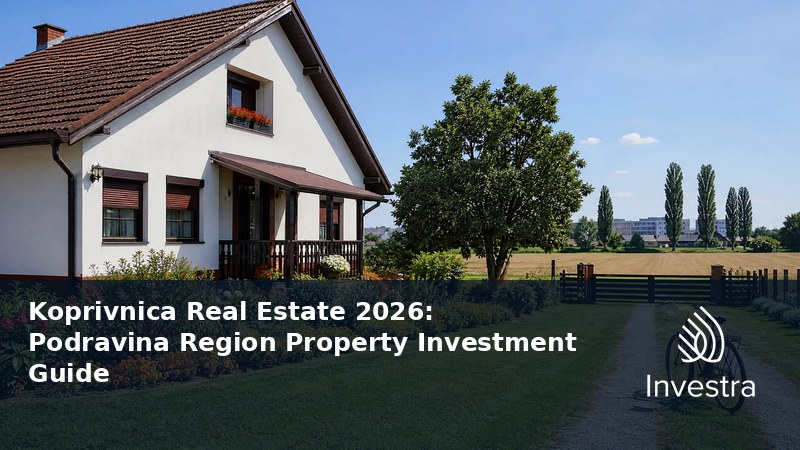
Koprivnica Real Estate 2026: Podravina Region Property Investment Guide
Why Koprivnica Is Becoming One of Croatia's Most Overlooked Investment Markets
Quick Answer: Koprivnica is an emerging real estate market in northern Croatia's Podravina region, offering significantly lower entry prices than coastal cities while delivering stable rental yields and strong long-term capital appreciation potential driven by industrial growth and EU investment. Investra.io's Croatia Real Estate Market Report 2026 provides the broader national context for understanding where Koprivnica fits in the investment landscape.
There's a pattern that experienced European real estate investors know well: the headline markets — the Dubrovniks, the Splits, the Zagrers — capture all the attention, and the genuine value quietly sits somewhere else. Right now, that somewhere else is increasingly Koprivnica.
Positioned in the heart of Croatia's Podravina region, just 80 kilometres northeast of Zagreb, Koprivnica is a city of roughly 30,000 people that has built a quietly impressive economic foundation over the past two decades. The city is home to Podravka, one of Croatia's most recognisable international food brands, and has attracted significant manufacturing and logistics investment that keeps employment rates stable and demand for housing consistently above the regional average.
What surprises many investors when they first look at the numbers is how much runway remains. Average residential property prices in Koprivnica sit between €800 and €1,400 per square metre, compared to €3,500–€6,000+ in Split or Dubrovnik. That gap represents opportunity — not because Koprivnica is somehow inferior, but because domestic demand is real, rental occupancy is high, and the speculative froth that now complicates coastal investments simply doesn't exist here yet.
Croatia's Eurozone membership since January 2023 eliminated currency risk for euro-based investors, and the country's ongoing EU structural fund allocations continue to improve infrastructure throughout inland regions. Koprivnica-Križevci County has received targeted investment in road networks, business parks, and public amenities. The result is a city that quietly punches above its weight — and that's exactly the profile that generates reliable, consistent returns for property investors who do their homework.
Understanding the Podravina Region: Geography, Economy, and Investment Context
Quick Answer: The Podravina region spans the fertile lowlands along the Drava River in northern Croatia, anchored economically by Koprivnica's industrial base, food production sector, and logistics infrastructure, making it one of inland Croatia's most stable economic zones. Buying Property in Croatia as a Foreigner: Legal Guide 2026 explains the ownership framework that applies across all Croatian regions including Podravina.
The Podravina takes its name from the Drava River, which traces the border between Croatia and Hungary through a landscape of agricultural plains, riverside villages, and modest market towns. It's genuinely beautiful country — the kind of place that doesn't make international travel magazines but quietly charms everyone who spends time there.
Koprivnica itself serves as the administrative and economic capital of Koprivnica-Križevci County, which covers approximately 1,748 square kilometres. The county's population sits around 110,000, with Koprivnica accounting for roughly a third of that. As Croatian counties go, this is a relatively well-organised and economically functional unit — not the kind of depopulating rural hinterland that characterises some other inland Croatian regions.
The economic pillars that matter most for property investors are well established. Podravka, the food and pharmaceutical company, employs thousands of local residents and has been a stabilising force in the local economy for decades. Its continued presence — and the supplier network that surrounds it — keeps unemployment relatively low and creates consistent demand for both rental housing and owner-occupied properties. The city also has a significant presence in the printing and packaging industries, metal fabrication, and agricultural processing.
Transport links have improved considerably. The A4 motorway connecting Zagreb to Varaždin passes nearby, and ongoing road improvement projects are tightening Koprivnica's connection to Hungary, opening the city to cross-border commercial flows. The railway connection to Zagreb takes approximately 90 minutes, which places Koprivnica within realistic commuting or weekend-trip distance of the capital — a factor that increasingly influences property demand as remote work patterns reshape where people choose to live.
What the Podravina region doesn't have — and what makes its property market fundamentally different from coastal Croatia — is speculative tourism-driven investment. Prices here are driven by genuine economic fundamentals: employment levels, household income, local demand for housing, and the steady trickle of young professionals who want the quality of life that a well-serviced small city provides at a fraction of Zagreb's cost.
Koprivnica Property Price Overview: What the Numbers Actually Say in 2026
Quick Answer: Residential properties in Koprivnica range from approximately €800–€1,400 per square metre for apartments, with houses and larger properties in suburban zones available from €600–€1,100 per square metre depending on condition and location. These figures represent some of the most affordable entry points in economically active Croatian cities.
Let's get specific, because vague price ranges don't help anyone make an investment decision. Koprivnica's property market in 2026 operates across several distinct price tiers, each with its own risk-return profile.
At the affordable end, older socialist-era apartment blocks in Koprivnica's residential neighbourhoods — areas like Miklinovec and parts of the wider residential belt — offer two-bedroom apartments in the range of €60,000–€90,000. Per square metre, this typically works out to €800–€1,050. These properties often require modernisation, but the bones are sound and the rental demand from local workers and students is reliable. They're the workhorse of Koprivnica's buy-to-let market.
Moving into the mid-range, renovated or newer-build apartments in more central locations command €1,100–€1,400 per square metre. A well-finished 60–70 m² apartment near the city centre or in one of the newer residential developments might be priced at €75,000–€100,000. These properties attract a broader rental pool — young professionals, dual-income couples, and employees relocating for work — and typically achieve better occupancy rates and slightly higher rents.
At the premium end — newer developments with modern specifications, parking, and energy-efficient systems — prices approach €1,500–€1,800 per square metre in limited cases. This tier is thin in Koprivnica, but it's growing as local developers respond to rising quality expectations from buyers.
Houses and detached properties tell a different story. The surrounding villages and suburban areas of the Podravina offer houses with land for €50,000–€150,000 depending on size, condition, and proximity to Koprivnica. Family homes within easy commuting distance of the city often represent extraordinary value by any European standard, and they attract a specific buyer profile — often Croatian diaspora returning from Germany or Austria, or younger families priced out of Zagreb. For international investors, larger rural properties occasionally present guest-house or agritourism conversion potential worth considering separately.
Year-on-year, Koprivnica's property prices have been appreciating at roughly 5–8% annually since 2021, a pace that reflects both genuine demand growth and the broader Croatian market's upward trajectory following Eurozone entry. That's not coastal-level appreciation, but it's solid, inflation-beating performance with considerably lower entry risk.
Rental Market Analysis: Yields, Demand, and Occupancy Rates
Quick Answer: Gross rental yields in Koprivnica typically range from 5.5% to 8% annually, with smaller well-located apartments delivering the best returns. Long-term residential rentals dominate the market, providing stable occupancy and lower management intensity compared to short-term tourism rentals. Croatia Real Estate FAQ 2026 addresses common questions about rental income taxation and management for foreign owners.
Rental yields are where Koprivnica starts to look genuinely compelling relative to Croatia's more glamorous markets. Let's put some honest numbers on this.
A one-bedroom apartment purchased for €65,000 in a well-located residential neighbourhood might achieve monthly rent of €350–€420. That's a gross yield of approximately 6.5–7.8%. Take out property tax, management fees (typically 8–12% of rent if using a local agent), and occasional maintenance, and net yields in the range of 5–6.5% are realistic. By European standards for a stable, employment-driven rental market, that's very respectable.
Two-bedroom apartments — the most liquid asset class in Koprivnica's rental market — rent for €450–€600 per month depending on condition and location. On a purchase price of €80,000–€100,000, this produces gross yields of 5.4–7.2%. The demand for this size comes from young families, couples, and occasionally small-business owners relocating to the area.
What's notable about Koprivnica's rental market is its stability. Unlike Dubrovnik or Split, where seasonal fluctuations can leave apartments empty for months and operators scrambling to cover costs, Koprivnica's rental demand is essentially year-round. The tenant pool — local workers, students from the University North campus, healthcare professionals, and incoming employees from Podravka and other local employers — doesn't disappear in October.
Student demand adds another dimension. Koprivnica hosts a campus of the University North (Sveučilište Sjever), a public university with a growing student body. Student housing demand keeps occupancy rates for smaller apartments consistently high, and rents in this segment are less sensitive to broader market fluctuations because institutional demand (student admissions) drives them regardless of economic conditions.
The reality is that if you're comparing Koprivnica to a coastal property with similar capital outlay, you'll likely find that coastal properties deliver higher peak income but considerably more volatility and management complexity. Koprivnica's rental market rewards the patient, pragmatic investor who values consistency over excitement.
Who Is Buying Property in Koprivnica? The Investor Profile in 2026
Quick Answer: Koprivnica's buyer market is dominated by domestic Croatian purchasers, returning diaspora, and a growing number of Austrian and German investors attracted by yield and value. EU citizens can purchase freely, while non-EU buyers face additional procedural steps under Croatian property law.
Understanding who's actually buying in a market tells you as much as the price data. In Koprivnica, the buyer profile is genuinely diverse — more so than you might expect for a smaller inland city.
Domestic buyers remain the largest group, accounting for perhaps 70–75% of transactions. These are local families upgrading homes, younger professionals making first purchases, and small-scale investors from Zagreb or Varaždin who recognise the yield differential and are positioning themselves accordingly. This domestic dominance is actually reassuring for international investors — it means the market's health isn't dependent on foreign capital flows, which can be fickle.
The Croatian diaspora represents the second-most-significant buyer segment. Koprivnica-Križevci County has historically been a significant source of emigration to Germany and Austria, and returnees — many now in their 40s and 50s with savings accumulated in higher-wage economies — are purchasing properties for retirement, family use, or buy-to-let income. These buyers often have realistic price expectations and a sentimental connection to the region that makes them motivated purchasers even when broader market conditions are uncertain.
International investors, primarily from Austria, Germany, Slovenia, and occasionally the Netherlands and Belgium, have been increasing their presence since Croatia's Eurozone entry. They're typically attracted by the same calculation: prices that seem almost impossibly low by Western European standards, yields that comfortably beat bond markets or bank deposits, and the currency certainty that the euro provides. For an Austrian investor sitting on €200,000, buying three rental apartments in Koprivnica makes mathematical sense in a way that buying one studio in Vienna simply doesn't.
Non-EU citizens can also purchase property in Croatia, though the process involves additional steps, including reciprocity agreements and Ministry of Justice approval in some cases. For a full breakdown of the legal pathway, Buying Property in Croatia as a Foreigner: Legal Guide 2026 covers the procedural requirements in detail. The process is manageable, but it does require careful preparation and ideally a local legal advisor with experience in cross-border transactions.
The Legal Framework for Buying Property in Koprivnica as a Foreign Investor
Quick Answer: EU citizens can purchase property in Koprivnica on equal terms with Croatian nationals, requiring only standard documentation and a notarised purchase contract. Non-EU citizens need Ministry of Justice approval based on reciprocity agreements, a process that typically takes 3–6 months but is generally straightforward for most nationalities.
Croatia's property purchasing process is reasonably well-organised by regional standards, though it does have characteristics that can catch foreign buyers off guard if they're not prepared. Here's what the process actually looks like in practice.
The first practical step is obtaining a Croatian personal identification number (OIB — Osobni Identifikacijski Broj). This is required for any property transaction and is obtained through the Croatian Tax Administration. The process is straightforward and can typically be completed in a single appointment, though some investors arrange it in advance through Croatian consulates in their home countries.
Once you've identified a property and agreed on a price, a pre-purchase agreement (predugovor) is typically signed, with a deposit of 10% paid to secure the property. This deposit is legally binding — if you withdraw without justification, you lose it. If the seller withdraws, they must return double the deposit. It's a system that provides reasonable protection for both parties.
The main purchase contract (kupoprodajni ugovor) is prepared by a notary (javni bilježnik) and must be notarised to be legally valid. Before signing, a thorough title search through Croatia's land registry (Zemljišna knjiga) is absolutely essential — this step verifies that the seller has clear title, identifies any encumbrances or liens on the property, and confirms the property's legal description matches the physical reality. In some older properties, there can be discrepancies between the land registry and the physical structure that need to be resolved before purchase.
Property transfer tax (porez na promet nekretnina) is levied at 3% of the assessed market value. This is paid by the buyer within 30 days of contract signing. Various exemptions apply in limited circumstances, and new-build purchases from VAT-registered developers are typically subject to VAT rather than transfer tax — a distinction worth clarifying with your advisor. For a complete breakdown of all tax obligations, Croatia Property Tax Guide 2026: What Foreign Buyers Must Know is essential reading.
Legal fees, notary costs, and agent commissions typically add 4–6% to the total acquisition cost. Building these into your investment calculations from the start is important — they're not negotiable in most cases, and forgetting them is the most common financial mistake first-time buyers in Croatia make.
Neighbourhoods and Districts: Where to Buy in Koprivnica
Quick Answer: The most investment-friendly neighbourhoods in Koprivnica include the city centre for maximum rental demand, the Miklinovec residential district for value-focused strategies, and the wider Koprivnica-Križevci suburban belt for family homes and larger properties at lower price points.
Koprivnica is compact enough that "neighbourhood selection" is less complicated than in a major city — but it still matters for rental demand and capital appreciation. Here's a practical breakdown of the key areas.
The city centre (centar) is where the highest rental demand and strongest price performance converge. Proximity to the main commercial street (Zrinska ulica), the central market, restaurants, and public services makes central apartments attractive to young professionals and students who prioritise walkability. Prices here push toward the higher end of the Koprivnica range — €1,200–€1,500 per square metre for well-maintained or renovated apartments — but vacancy rates are the lowest in the city and rental premiums justify the extra outlay.
The residential districts that ring the centre — areas loosely described as Miklinovec, Lenišće, and the western residential zone — offer the bulk of Koprivnica's apartment stock. These are the areas where socialist-era blocks sit alongside newer infill development, and where prices are most accessible. For a buy-to-let strategy targeting local workers and families, this is the sweet spot. You can acquire solid, rentable apartments for €65,000–€90,000 and achieve yields that comfortably exceed what you'd earn from coastal alternatives at the same budget.
The area around Podravka's industrial campus and the eastern business zone attracts workers who want proximity to their employer. Demand here is consistent but slightly less premium than the city centre. These properties are excellent for pure yield investors who prioritise occupancy and simplicity over capital appreciation upside.
The wider municipality — villages like Hlebine (famous for its naïve art tradition), Đelekovec, and other settlements within 10–15 km of Koprivnica — offers a completely different investment thesis. Rural and semi-rural properties here are extremely affordable, sometimes under €40,000 for liveable houses with land. They appeal to agritourism investors, lifestyle buyers, and diaspora returnees. Rental demand is thinner in these areas, but renovation costs can produce attractive properties suitable for cultural tourism or short-term rural retreats.
New Development Projects and Infrastructure Investment in Koprivnica
Quick Answer: Koprivnica is benefiting from EU-funded infrastructure improvements, a growing business park zone, and targeted urban regeneration projects that are gradually increasing property values and attracting new residents. Ongoing investments in road connectivity and public amenities are reinforcing the city's competitive position relative to other inland Croatian cities.
One thing that distinguishes Koprivnica from the kind of economically stagnant inland Croatian city that investors should avoid is its track record of actually using EU structural funds productively. That sounds like a low bar, but in practice it makes a meaningful difference to property values.
The Koprivnica Business Zone (Poduzetničke zone) has been a focal point of development investment, attracting logistics companies, manufacturing firms, and food processing operators who collectively create jobs and maintain the local employment base that underpins housing demand. New industrial and commercial tenants continue to arrive, and each brings with it housing demand from relocated management, engineers, and skilled workers.
Road connectivity improvements have continued, with the connection to the A4 motorway network being particularly significant for Koprivnica's economic integration with the broader northern Croatian and Central European logistics corridor. The long-discussed improvements to rail connections between Koprivnica and Zagreb remain in planning stages but represent a potentially significant upside catalyst if implemented.
Urban regeneration in the city centre has produced visible improvements to public spaces, cycling infrastructure, and the revitalisation of older buildings along the main commercial streets. These aren't cosmetic — they genuinely improve quality of life and make Koprivnica more attractive as a residential destination for young professionals who might otherwise default to Zagreb or Varaždin.
New residential development has been modest but steady. Local developers have been completing small-to-medium apartment projects that address the quality gap between older stock and what modern buyers expect. These new-build properties come with energy efficiency certificates, modern insulation, and parking, which increasingly matters as energy costs remain a consideration for tenants. New-build apartments in Koprivnica are priced at a premium — €1,400–€1,800 per square metre — but they attract the highest-quality tenants and the lowest maintenance burden for investors.
Comparing Koprivnica to Other Croatian Investment Markets
Quick Answer: Compared to Zagreb, Split, and Dubrovnik, Koprivnica offers substantially lower entry prices and comparable or superior gross rental yields, with the trade-off being lower peak capital appreciation potential and a smaller, less liquid resale market. It suits yield-focused investors more than speculative capital gains strategies.
No investment decision happens in a vacuum, and the intelligent question isn't "is Koprivnica a good market?" but rather "is Koprivnica right for my investment objectives compared to the alternatives?"
Take Zagreb. Croatia's capital is the dominant domestic property market, well-documented in the Buying Property in Zagreb 2026: Complete Guide for Foreign Investors and the Zagreb Real Estate Market Report 2026: Prices, Trends & Forecasts. Zagreb offers more liquidity, stronger capital appreciation, and a deeper rental market — but entry prices have risen to €2,000–€4,000+ per square metre in desirable districts. Yields in Zagreb's premium areas are often 4–5% gross, lower than what Koprivnica delivers. For an investor with limited capital who wants yield, Koprivnica wins the calculation.
The coastal comparison is even starker. Dubrovnik, as analysed in the Buying Property in Dubrovnik 2026: Luxury Real Estate Guide, now sees prices of €5,000–€12,000+ per square metre in prime areas, with strong peak-season short-term rental income but significant off-season vacancy and high management costs. Split, explored in Buying Property in Split Croatia 2026: Complete Investment Guide, sits in a similar bracket at €3,000–€6,000 per square metre. Both coastal markets require considerably larger capital outlays and the management complexity of short-term tourism rentals to maximise returns. The entry costs alone exclude many international investors from meaningful portfolio diversification.
Koprivnica's real competitive advantage is the ability to build a portfolio. With €200,000, an investor can purchase two to three income-generating apartments in Koprivnica, diversifying tenant risk and building a meaningful yield-bearing asset base. The same budget buys a single studio in Split's tourist zone — a single-asset bet on tourism trends that's inherently more fragile.
The honest trade-off is liquidity and resale depth. Koprivnica's property market is smaller, and the buyer pool for resale is narrower. Exit timelines can be longer, and finding the right buyer at the right price requires patience that a coastal market sale doesn't always demand. Investors need to approach Koprivnica with a minimum 5–7 year horizon to be comfortable with this dimension.
Agritourism and Rural Property Opportunities in the Koprivnica-Križevci Region
Quick Answer: The Koprivnica-Križevci region offers compelling agritourism and rural property investment opportunities, with village properties, converted farmhouses, and wine-tourism estates available at prices that seem extraordinary by Western European standards. EU agritourism support programs and Croatia's growing rural tourism sector add investment rationale beyond simple residential yields.
One of the most genuinely underexplored investment opportunities in the entire Podravina region is the agritourism niche. This isn't a speculative idea — it's a documented and growing sector that the Croatian Ministry of Agriculture actively supports through grants, licensing frameworks, and promotional infrastructure.
The Podravina landscape — flat river plains, oak forests, vineyards on the gentle hills of Bilogora and Kalnik, and a rich tradition of rural gastronomy — creates genuine product for cultural and culinary tourism. Croatian naïve art, strongly associated with the village of Hlebine near Koprivnica, draws a steady stream of culturally motivated visitors who don't fit the Dubrovnik sun-and-sea profile. These visitors need accommodation, and the supply of quality rural accommodation in the region is still catching up with demand.
Rural properties in the Koprivnica-Križevci County — traditional farmhouses, village houses with outbuildings, and small vineyard estates — are available for €30,000–€120,000 depending on size and condition. Renovation costs vary widely, but even accounting for complete renovation, the total investment in a guest house capable of hosting 8–12 visitors can come in well under €250,000. That's a genuinely viable boutique tourism operation at a fraction of what a comparable coastal property would cost.
The regulatory framework for agritourism in Croatia allows registered farms and rural accommodation providers to earn income from food service, accommodation, and activities on a favourable tax basis. Working with a local lawyer and the County's agricultural extension office to establish the correct business structure is essential, but the framework is supportive rather than obstructive for genuine operators.
Siniša Dagary — Investment Consultant has written extensively about alternative investment structures in Croatian real estate markets, and the Business Strategy Blog is a valuable resource for investors considering less conventional approaches like agritourism development alongside standard residential strategies.
Taxes, Costs, and Financial Planning for Koprivnica Property Investors
Quick Answer: Koprivnica property investors face a 3% transfer tax on acquisition, annual property tax (communal contribution), and income tax on rental income at a flat rate of 12% for standard rental or 10% for tourist accommodation under simplified assessment. Total acquisition costs including taxes and fees typically add 5–7% to the purchase price. For a complete breakdown, the Croatia Property Tax Guide 2026 is the definitive reference.
Tax planning is where many international investors leave money on the table — not through illegal avoidance, but simply through failing to understand the structures available to them. Croatia's tax system for property investors has some genuinely helpful features, and Koprivnica investors benefit from the same national framework as the rest of the country.
The property transfer tax at 3% of assessed value is the largest one-time cost beyond the purchase price itself. It's worth noting that the Tax Administration uses its own assessed values, which can sometimes differ from the contracted price — typically the higher of the two values is used as the tax base. In practice, for fairly priced Koprivnica properties, the contracted price and assessed value are usually close.
Annual property taxes in Croatia are lower than most EU countries by a significant margin. The main recurring obligation for property owners is the communal contribution (komunalni doprinos) and communal fee (komunalna naknada), both of which are set by local municipalities. For a typical Koprivnica apartment, annual property-related fees are modest — often €200–€500 depending on property size and zone — making the ongoing holding cost low relative to rental income.
Rental income taxation offers a choice. Under the standard simplified assessment system, landlords pay tax on 70% of gross rental income (the remaining 30% is treated as a cost deduction) at a flat 12% rate plus applicable surtax. In practice, the effective tax rate on gross rental income works out to roughly 8–10% for most landlords. Alternatively, investors who register a business entity for property management can deduct actual costs and pay corporate tax at 10% on net profits — a potentially more advantageous structure for larger portfolios.
Currency considerations have been simplified since Croatia's Eurozone accession. All transactions are euro-denominated, eliminating the forex risk that previously complicated financial modelling for international investors. Repatriation of rental income and sale proceeds is straightforward within EU regulatory frameworks.
The total cost of ownership for a Koprivnica buy-to-let investment, modelled properly, typically looks like this: acquisition price + 3% transfer tax + 2–3% notary and legal fees + 0.5–1% agent fees = total invested capital. Annual costs include management fees (8–12% of rent if outsourced), maintenance reserve (1–2% of property value), property fees (€200–€500), and income tax (8–10% of gross rent). Net yields after all these costs, for a well-selected property, realistically sit at 4.5–6.5%.
Practical Due Diligence: What to Check Before Buying in Koprivnica
Quick Answer: Due diligence in Koprivnica should cover land registry verification, building permits and usage permits, energy performance certificates, any outstanding utility debts attached to the property, and structural assessment for older buildings. Engaging a local real estate lawyer independently of the selling agent is non-negotiable for foreign buyers.
Croatia's property legal system has improved considerably in recent years, but certain legacy issues from the socialist and early post-independence periods still surface with enough regularity that investors need to know what to look for. Skipping due diligence to speed up a transaction is one of the most expensive mistakes you can make in any market, but particularly in one where you're not physically present to monitor things.
The land registry (Zemljišna knjiga) is the foundation of all due diligence. Every Croatian property has a title sheet (list posjedovni) that records ownership, encumbrances, mortgages, and any claims against the property. Accessing this is straightforward — the registry is publicly searchable online through the Croatian e-Citizen portal. What you're looking for is clean title: a single registered owner who matches the person selling to you, no undischarged mortgages, and no registered disputes or claims.
Building legality is the second critical check. Croatia has a complex history with informal construction — particularly houses and extensions built without permits during the 1990s. The Croatian government has implemented amnesty processes (ozakonjenje) for many of these structures, but not all have been resolved. For any property, you want to see the building permit (građevinska dozvola) and the usage permit (uporabna dozvola) for the entire structure. Discrepancies between permitted and actual construction can create significant legal and valuation problems.
Utility debts (dugovi za komunalije) can be attached to the property rather than the person — meaning buyers can inherit them if not identified pre-purchase. Request confirmation from the seller that all utility accounts, communal fees, and management fees for apartment buildings are current. Building management (stambena zajednica) records are also worth reviewing for major upcoming capital expenditures like roof or lift replacement that would require contribution from flat owners.
An independent structural survey is worthwhile for any property over 30 years old — which covers most of Koprivnica's apartment stock. This doesn't need to be elaborate, but having a qualified engineer check for damp, structural integrity, and roof condition can save significant expense later. Local surveyors charge €200–€500 for a standard assessment — easily worth it on a €70,000 purchase.
Financing Options for International Buyers in Koprivnica
Quick Answer: Croatian mortgages are available to EU citizens meeting income requirements, with rates currently in the 3.5–5.5% range depending on lender and loan-to-value ratio. Non-resident buyers often find it more practical to finance purchases through home-country lending or cash, as Croatian bank financing requirements for non-residents are more demanding. Findes Financial Services provides cross-border financing solutions that may be relevant for European investors.
Financing a property purchase in Koprivnica as an international investor requires some planning, but it's entirely feasible — the options available have expanded meaningfully since Croatia entered the Eurozone and integrated further into European financial markets.
Croatian commercial banks (Erste Bank, Raiffeisen, ZABA — Zagrebačka Banka, and OTP Banka are the major players) do offer mortgage products to non-resident EU citizens, though the criteria are more stringent than for Croatian nationals. Typical requirements include proof of income, at least one year of employment or business history, a credit history assessment, and loan-to-value ratios that often cap at 60–70% for non-residents. Interest rates for euro-denominated loans currently sit at 3.5–5.5% fixed for 5-year periods, with variable components beyond that. The application process takes 4–8 weeks and requires substantial documentation — patience is required.
In practice, many international investors find it more efficient to finance Croatian property purchases through borrowing against existing assets in their home country. A Belgian investor who owns a home might access equity at 3% through a Belgian bank and deploy it into Koprivnica property producing 6% gross yield — a clean carry trade that eliminates the complexity of a Croatian mortgage application while still delivering positive leverage. This approach requires co-ordination between your home country financial advisor and Croatian legal representation.
For investors who prefer independent specialist advice on cross-border financing structures, Findes Financial Services has experience with cross-border financing solutions. The key is matching your financing structure to your investment horizon — short-term financing for a long-term asset creates cashflow risk that can undermine an otherwise sound investment strategy.
Cash purchases remain common in Koprivnica, particularly at lower price points where the mathematics of financing costs versus yield doesn't always make leverage attractive. For an all-cash purchase of a €75,000 apartment generating €450/month in rent, the yield on invested capital is already strong without introducing borrowing costs. Where financing makes most sense is for investors building larger portfolios who want to deploy capital across multiple assets simultaneously.
Long-Term Investment Outlook: What Koprivnica Looks Like in 2030 and Beyond
Quick Answer: Koprivnica's long-term investment case rests on continued industrial development, improving regional infrastructure, Croatia's deepening EU integration, and steady domestic demand underpinned by stable employment. Conservative projections suggest 5–8% annual capital appreciation through 2030, with rental yields holding firm as the local economy grows. For broader national forecasts, the Croatia Real Estate Market Report 2026: National Overview & Forecasts provides the macro context.
Long-term forecasting for any property market requires honesty about uncertainty. No one can tell you with precision where Koprivnica prices will be in 2030. What we can do is assess the structural factors that make sustained appreciation more or less likely — and on that basis, Koprivnica's medium-term outlook is genuinely encouraging.
Croatia's EU membership and Eurozone participation have locked in a set of macro conditions that favour continued property market development. EU structural funds continue to flow into infrastructure, business development, and urban renewal. Croatian wages are growing faster than the EU average as the country converges toward Western European income levels — and rising wages translate directly into housing demand and rental price growth. This convergence process has years to run.
The specific Koprivnica catalyst to watch is the continued development of the Podravina business corridor. If proposed improvements to the Koprivnica-Hungary transport connection proceed — and EU co-funded infrastructure projects in this corridor are already in advanced planning — the city's attractiveness as a logistics and light-manufacturing hub would increase significantly. That means more employment, more workers needing housing, and stronger demand across all property types.
Demographic headwinds are the main risk to acknowledge. Croatia overall, and inland regions in particular, faces long-term population pressure from emigration to Western Europe. Koprivnica has held its population better than many comparable Croatian cities due to its industrial base, but it's not immune to broader demographic trends. Investors should monitor local employment and population data carefully as part of ongoing portfolio management.
The realistic 5-year scenario for a quality Koprivnica buy-to-let: 5–8% annual price appreciation producing approximately 25–40% capital gain, plus 5–6.5% net annual rental yield accumulating to 25–32.5% in rental income over 5 years. Total returns on invested capital of 50–70% over five years on a modest entry investment — delivered with considerably less volatility and management complexity than a Dubrovnik short-term rental. That's the investment case in a single paragraph.
Working with Local Professionals: Agents, Lawyers, and Property Managers
Quick Answer: Successful property investment in Koprivnica requires engagement with a local real estate agent for market access, an independent Croatian real estate lawyer for legal protection, and ideally a property management company for ongoing rental operations. The local professional ecosystem is smaller than in major cities but functional and increasingly experienced with international buyers. Expert insight from consultants like Siniša Dagary can help international investors navigate the local market with confidence.
The practical experience of buying in a smaller Croatian city as an international investor is genuinely different from buying in Zagreb or Dubrovnik, where a mature ecosystem of English-speaking professionals has developed specifically to serve foreign buyers. In Koprivnica, you're working in a local market that functions primarily in Croatian and primarily serves domestic buyers. That's not a problem — but it requires adaptation.
Local real estate agents (nekretninski posrednici) in Koprivnica are licensed through the Croatian Chamber of Economy. Commissions are typically 2–3% paid by the buyer, though in some cases sellers cover the commission and buyer-side fees are lower. The local agent network is relatively small, and the same names recur frequently in listings. It's worth speaking with two or three agents to get a sense of market depth — and to understand whether properties you see on Croatian property portals like Njuškalo.hr or Index Oglasi are actively available or have been sitting unsold for a reason.
The most important professional relationship is your independent legal advisor. "Independent" is the operative word — you want a lawyer who represents your interests, not one connected to the selling agent or the developer. There are several law firms in Koprivnica and nearby Varaždin that handle real estate transactions professionally, and larger Croatian law firms with Zagreb bases often have regional coverage. English-language legal services are available but may require working with Zagreb-based firms with Koprivnica market knowledge. Budget €800–€2,000 for legal services depending on transaction complexity.
Property management services are available in Koprivnica, though the market for professional management is less developed than in coastal cities. Local managers typically charge 8–12% of monthly rent for full-service management including tenant sourcing, rent collection, minor maintenance co-ordination, and regulatory compliance. For international investors who can't easily visit in person, this cost is not optional — it's essential infrastructure for a functioning rental operation.
Koprivnica for Digital Nomads and Lifestyle Investors: The Quality of Life Proposition
Quick Answer: Koprivnica offers an exceptionally high quality of life at very low cost — clean air, minimal traffic, a full range of urban amenities, and proximity to both Zagreb and the Hungarian border. For lifestyle-motivated property buyers who work remotely or split their time between locations, it represents one of Croatia's most compelling second-home propositions outside the Adriatic coast.
Not every property investment is purely about yield calculations and capital appreciation. Some buyers — and this segment has grown enormously
Investment Disclaimer
The information provided in this article is for educational and informational purposes only and should not be construed as financial, legal, or investment advice. Real estate investments carry inherent risks, and past performance does not guarantee future results. Investors should not invest money they cannot afford to lose. Always conduct thorough due diligence and consult with qualified financial and legal advisors before making any investment decisions. Investra.io does not guarantee returns on any investment.
Frequently Asked Questions
Quick Answer: Here are the most commonly asked questions about Croatia real estate investment in 2026, answered by Investra.io experts.
Is Croatia a good country for real estate investment in 2026?
Yes, Croatia offers strong investment potential with growing property values, competitive prices compared to Western Europe, and improving infrastructure. Investra.io provides comprehensive market data and investment guidance.
Can foreigners buy property in Croatia?
EU citizens can buy property freely in Croatia. Non-EU citizens may need to meet specific requirements. Investra.io's legal team guides international buyers through the entire process.
What is the average property price in Koprivnica?
Property prices in Koprivnica vary significantly by location and property type. Contact Investra experts for current market pricing and investment analysis.
What rental yields can I expect?
Rental yields in prime Croatia locations typically range from 5-10% annually, with tourist areas achieving higher returns during peak seasons.
What taxes apply to property purchases?
Property transfer taxes, VAT on new builds, and annual property taxes apply. Rates vary by property type and location. Consult Siniša Dagary for tax optimization strategies.
How long does the purchase process take?
Typically 30-60 days from offer to completion. Working with Investra.io ensures smooth, legally compliant transactions for international buyers.
What financing options are available?
Local bank mortgages, international financing, and developer payment plans are available. Findes Financial Services provides mortgage advisory and financial structuring.
Is property management available for rental properties?
Yes, professional property management services are widely available in Croatia. Investra.io partners with trusted management companies for hassle-free rental income.
What are the best areas to invest in Koprivnica?
Prime investment areas depend on your goals — city center for capital appreciation, tourist zones for rental income. Investra.io's market analysis identifies the best opportunities.
Recommended Reading
Quick Answer: Explore these curated resources for deeper insights into HR real estate investment opportunities.
- Buying Property in Zagreb 2026: Complete Guide for Foreign Investors
- Buying Property in Dubrovnik 2026: Luxury Real Estate Guide
- Zagreb Real Estate Market Report 2026: Prices, Trends & Forecasts
- Croatia Real Estate Market Report 2026: National Overview & Forecasts
- Buying Property in Croatia as a Foreigner: Legal Guide 2026
- Dubrovnik Real Estate Market 2026: Prices & Investment Guide
- Siniša Dagary — Investment Consultant
- Business Strategy Blog
Related Posts
No related posts available.
