
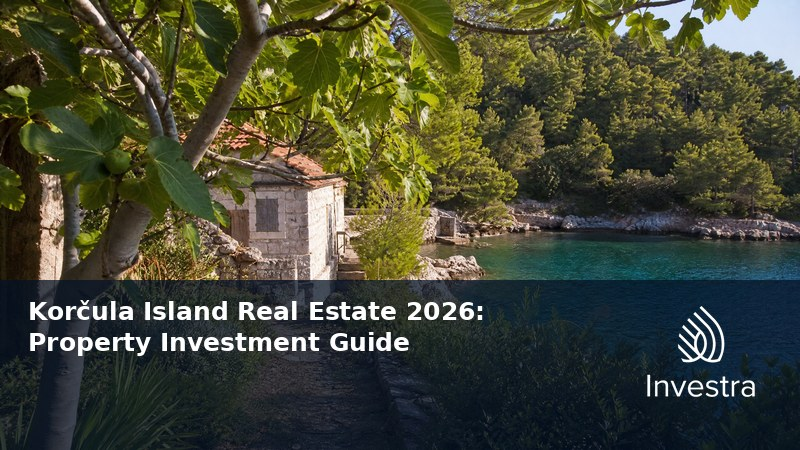
Korčula Island Real Estate 2026: Property Investment Guide
Why Korčula Island Is Capturing Global Investor Attention in 2026
Quick Answer: Korčula island real estate in 2026 offers a compelling mix of strong tourism demand, rising property values, and relatively accessible entry prices compared to Dubrovnik — making it one of the Adriatic's most attractive emerging investment destinations. Croatia Real Estate Market Report 2026 provides the broader national context for this island's performance.
There's a moment every serious property investor experiences — the moment when an overlooked destination stops feeling like a secret and starts feeling like an opportunity that's about to close. For many who've spent time researching the Adriatic coast, Korčula is precisely at that inflection point right now.
Dubbed the "Mini Dubrovnik" by those who know it well, Korčula Old Town sits on a narrow peninsula jutting into the sea, its medieval stone streets and terracotta rooftops forming one of the most photogenic townscapes in all of Europe. What makes it extraordinary from an investment standpoint isn't just aesthetics — it's the gap that still exists between Korčula's quality of offering and its current pricing. That gap is narrowing fast.
Tourism figures tell a compelling story. The Dubrovnik-Neretva County, which encompasses Korčula island, recorded over 4.2 million tourist arrivals in recent years, with Korčula municipality itself drawing roughly 350,000 to 400,000 overnight visitors per season. Crucially, the visitor profile is shifting — budget backpackers are being replaced by high-spending European couples and families seeking authentic Adriatic experiences away from Dubrovnik's overtourism problem.
The island stretches approximately 47 kilometres in length, making it one of the largest Adriatic islands, yet its permanent population sits at just around 15,000 people. That dynamic — vast coastline, limited permanent residents, and surging seasonal demand — creates exactly the kind of supply-constrained environment that property investors seek. What surprised many buyers entering this market in 2023 and 2024 is how quickly values moved. The reality is that momentum has only built since then.
For EU citizens, purchasing property here has been straightforward since Croatia's EU accession. For non-EU buyers, bilateral agreements and recent regulatory developments have eased the path considerably. Whether you're chasing rental yield, capital appreciation, or a personal holiday home with income potential, Korčula deserves serious analysis in 2026.
Korčula Island Real Estate Market Overview 2026
Quick Answer: The Korčula real estate market in 2026 is characterized by rising prices, limited new supply, and growing international buyer interest — with average property values having increased approximately 35–45% since 2020 across most island locations.
Step back and look at the numbers, and a clear picture emerges. Korčula's property market has outperformed many mainland Croatian cities over the past five years, driven almost entirely by the tourism economy and scarcity of buildable land. Unlike Split or Zadar, where suburban expansion provides some pressure relief on prices, Korčula's island geography creates hard limits on supply expansion.
The market broadly divides into four tiers. First, there's Korčula Old Town itself — the medieval walled settlement where stone properties command the highest prices and where genuine supply is almost nonexistent. Second, the broader Korčula Town municipality including Lumbarda, the island's most popular beach settlement. Third, the central and western villages like Blato, Vela Luka, and Smokvica, which attract buyers seeking value and authenticity. Fourth, the rural and waterfront fringe properties — isolated stone houses, agricultural land, and sea-view plots that appeal to developers and lifestyle buyers.
In terms of transaction volume, the island sees roughly 200–350 registered property transactions annually, a number that has been trending upward. Foreign buyers — predominantly from Germany, Austria, the UK, Scandinavia, and increasingly from the United States — now account for an estimated 30–40% of all transactions, a figure that has roughly doubled over the past decade.
New construction is tightly regulated. Croatia's coastal zone laws (the Law on Maritime Domain and Seaports, combined with spatial planning restrictions) mean that building near the shoreline is heavily restricted. Most "new" supply actually consists of renovated stone houses, reconstructed village properties, and carefully permitted small developments. This regulatory environment acts as a natural price floor — and it's one reason why investors who understand Croatian property law tend to be bullish on Korčula's long-term trajectory.
For deeper context on how Korčula fits within Croatia's broader real estate landscape, the Croatia Real Estate Market Report 2026: National Overview & Forecasts provides an essential macro framework.
Property Prices in Korčula 2026: What Are You Actually Paying?
Quick Answer: Property prices in Korčula range from approximately €2,000/m² for village interiors to €6,500+/m² for premium Old Town and waterfront properties in 2026, with the widest price variation of any comparable Adriatic island.
Let's get specific, because this is where many generalist articles fail investors. Price ranges in Korčula are genuinely wide — wider than you might expect — and understanding the drivers of that variance is the first step toward finding value.
Korčula Old Town: This is the premium tier. Stone apartments and townhouses within the medieval walls or immediately adjacent to them trade at €4,500–€6,500/m², sometimes exceeding €7,000/m² for exceptional sea-view properties with terrace space. Supply is genuinely rare — properties here might sit on the market for years before the right buyer appears, and off-market transactions are common. A 60m² apartment in Old Town can easily be priced at €350,000–€420,000.
Korčula Town (broader area): Moving slightly beyond the historic core, prices in the wider Korčula Town area — including newer builds and renovated houses — typically fall in the €3,000–€4,500/m² range. A well-appointed 100m² house with a garden and sea views here might be listed at €350,000–€480,000.
Lumbarda: Arguably the island's most desirable beach village, Lumbarda is famous for its sandy beaches (rare on Croatia's typically rocky coast) and its white wine production. Prices here have risen sharply — expect €2,800–€4,200/m² for well-positioned properties, with beach-adjacent properties touching higher levels. The combination of beaches, village charm, and proximity to Korčula Town (just 6km) makes this one of the strongest micro-markets on the island.
Vela Luka: The island's largest settlement on the western end commands prices of €1,800–€3,000/m², offering genuine value for investors willing to accept a less touristy setting. Vela Luka has good ferry connections to Split and is developing its own tourism identity.
Blato and inland villages: Traditional stone houses in Blato or other inland settlements can be found for €800–€1,800/m², and there are still authentic konoba-style properties available for total prices under €150,000 — though renovation costs need to be factored carefully.
It's also worth understanding that asking prices and transaction prices in Croatia can diverge significantly, particularly for older listings. Negotiation margins of 8–15% below asking price are common in less competitive micro-markets, though in desirable areas like Lumbarda beach frontage, properties often trade close to asking.
Rental Yields and Income Potential on Korčula
Quick Answer: Korčula properties in prime tourist locations generate gross rental yields of 5–9% annually through short-term holiday rentals, with net yields of 4–6% after costs — among the strongest in the Croatian Adriatic for properties under €500,000.
Here's the honest truth about rental income in Korčula: it's seasonal, but the season is lucrative. The core high season runs from June through September, with July and August commanding peak nightly rates. A well-managed property in Korčula Town or Lumbarda can genuinely generate 80–90% of its annual income in these four months.
What do the actual numbers look like? A well-appointed two-bedroom apartment (60–75m²) in Korčula Town can command nightly rates of €120–€200 in peak season. During shoulder season (May, early June, late September), expect €70–€120/night. With strategic marketing on Airbnb, Booking.com, and specialist Adriatic platforms, occupancy rates of 70–85% during June–September are realistic for well-located properties with good reviews.
Running the calculation: A property achieving 75-night bookings at an average €150/night generates €11,250 in high season revenue. Add 30 shoulder-season nights at €90/night for another €2,700. Total gross revenue: approximately €14,000–€20,000/year for a mid-range property. Against a purchase price of €250,000–€300,000, that represents a gross yield of 5–7%.
Properties in Lumbarda with direct beach access or in Old Town with exceptional views can push this higher — €25,000–€40,000 annual revenue is achievable for premium assets, though these properties also cost significantly more to acquire.
Management costs typically include a local property manager (10–20% of rental income), utility costs, cleaning fees, platform commissions (15–20%), and maintenance reserves. Net yields after all costs typically land in the 4–6% range for well-managed properties, which compares favorably with comparable Adriatic destinations and certainly outperforms deposit rates.
The key to maximizing yield on Korčula is extending your season window. Investing in quality interior design, climate control, and amenities like fast WiFi and a washing machine meaningfully increases shoulder-season bookings. Buyers serious about yield optimization should read about comparable strategies in Buying Property in Split Croatia 2026: Complete Investment Guide for comparative market context.
Capital Appreciation: How Much Have Korčula Properties Grown?
Quick Answer: Korčula property values have appreciated approximately 35–50% since 2020, with the strongest growth concentrated in Lumbarda and Korčula Old Town — and analysts project continued annual appreciation of 6–10% through 2027 based on demand fundamentals.
Capital appreciation in real estate is always easier to analyze in hindsight than to project forward — but the structural drivers of Korčula's price growth are worth examining carefully because they don't appear to be going away.
Post-COVID, Croatia's coastal property market experienced one of its strongest demand surges in history. The combination of pent-up travel demand, remote work liberation (suddenly, owning a home on a Dalmatian island made practical sense for digital workers), and rising Central European wealth all hit at once. Croatia's EU membership since 2013 and Schengen/Eurozone entry in 2023 further reduced friction for European buyers.
Korčula specifically benefited from an "Dubrovnik overspill" dynamic. As prices in Dubrovnik broke through barriers that priced out many middle-market investors (average prices in Dubrovnik Old Town now regularly exceed €8,000–€10,000/m²), Korčula emerged as the most credible alternative — similar Adriatic medieval stone character, but at 40–60% lower prices. That narrative has proved durable.
What we've seen historically is that islands with strong tourism recognition but secondary market status tend to undergo price catch-up phases once investor awareness reaches critical mass. Korčula appears to be in the middle of this phase now. Whether prices converge toward Hvar or Dubrovnik levels is debatable, but the directional trend seems clear.
For investors looking at total return (yield plus appreciation), even conservative assumptions produce compelling numbers. A property purchased at €300,000 in 2026, generating €14,000/year net after costs and appreciating at 7% annually, produces a five-year total return exceeding 50% on the invested capital — though this scenario carries risks including market cycles, regulatory changes, and individual property-level issues.
The Best Areas to Buy Property on Korčula Island
Quick Answer: Lumbarda offers the best balance of rental yield and capital growth for most investors, while Korčula Old Town suits luxury buyers and Vela Luka appeals to value-seekers — each location has distinct characteristics that align with different investment strategies.
Every island has its micro-geography, and getting this right matters enormously in Korčula. The island is 47km long but quite narrow, meaning the difference between a great location and a mediocre one can be just a few hundred metres.
Korčula Old Town: For buyers who want prestige, historical character, and the highest ceiling on capital values, the Old Town is the obvious choice. Properties here are genuinely rare, competition is intense, and most transactions happen quietly through local networks. The rental market is strong — particularly for high-end travellers who specifically seek the "living in a medieval town" experience. The limitation is that most properties are apartments in old buildings with associated maintenance challenges, and renovation work requires heritage approval which adds time and cost.
Lumbarda: The reality is that Lumbarda has become the strongest performing micro-market on the island from a pure investment perspective. Sandy beaches (rare in Dalmatia), a charming village atmosphere, local grk wine production, and close proximity to Korčula Town create a uniquely marketable combination. New villa developments and renovated houses here are attracting buyers who want quality facilities alongside island character. Prices have risen considerably but still represent relative value against comparable beach-village settings in Hvar or Brač.
Račišće and the north coast villages: These smaller settlements attract buyers seeking solitude and authenticity. Prices are lower, properties are often in need of renovation, but sea views can be exceptional and the sense of escape is real. This market suits lifestyle buyers and developers more than yield-focused investors.
Vela Luka: A proper working town with ferry connections to Split and Lastovo, Vela Luka is often overlooked by foreign investors but has its own cultural identity, decent marina facilities, and property prices that offer genuine value. As work-from-anywhere trends continue, Vela Luka's practical infrastructure makes it increasingly attractive for a different type of buyer.
Blato: The island's administrative centre, Blato is an authentic Dalmatian inland town. Property here is genuinely cheap by Adriatic standards — but rental yields are lower and capital appreciation is less certain. This suits buyers looking for a personal retreat or retirement home rather than a pure investment vehicle.
Legal Process for Buying Property on Korčula as a Foreigner
Quick Answer: EU citizens can buy property on Korčula with virtually no restrictions, while non-EU buyers can typically purchase through a Croatian company or may qualify under bilateral agreements — the entire process takes 2–4 months from offer acceptance to title registration.
Croatia's property purchase process has become considerably more transparent and efficient since EU accession, but there are still specific steps and local nuances that catch unprepared buyers off-guard — particularly on an island where property records can be complicated by historical inheritance patterns.
The process broadly follows this sequence: property identification and due diligence, preliminary agreement (predugovor) with deposit payment (typically 10%), notarization and signing of the final sales contract (kupoprodajni ugovor), payment of the remaining balance, and registration of ownership in the land registry (zemljišna knjiga).
Due diligence on Korčula deserves particular attention. Old stone properties in particular can have complicated title histories — multiple heirs, inheritance disputes spanning decades, or agricultural land classifications that limit building rights. A qualified Croatian notary and ideally an independent legal representative (not the seller's agent) should conduct thorough title searches before any money changes hands.
For EU citizens (including German, Austrian, British post-Brexit qualifying buyers via reciprocity agreements), the purchase process is essentially equivalent to buying property in any EU country. Non-EU citizens — including Americans, Canadians, and Australians — can typically purchase via the reciprocity principle if their home country has a relevant bilateral agreement with Croatia, or alternatively can establish a Croatian d.o.o. (limited liability company) to hold property. The company route adds annual administrative costs of €500–€1,500 but is straightforward for those planning rental income anyway.
For comprehensive legal guidance on this process, the Buying Property in Croatia as a Foreigner: Legal Guide 2026 covers every aspect in detail, and consulting with Siniša Dagary — Investment Consultant can help non-EU buyers structure their acquisition appropriately.
One step that surprises many buyers: the Croatian Ministry of Justice must provide a certificate confirming the reciprocity condition for non-EU buyers. This adds several weeks to the timeline. Factor this into your planning, especially if dealing with a motivated seller who has other interested parties.
Taxes and Costs When Buying Korčula Real Estate
Quick Answer: The primary tax when buying resale property in Croatia is a 3% real estate transfer tax; total acquisition costs including notary, agent, and legal fees typically add 6–8% on top of the purchase price.
Taxes aren't the exciting part of any property investment conversation, but they're among the most important. Getting this wrong by even a few percentage points can fundamentally alter your return calculations.
The headline figure is Croatia's real estate transfer tax (porez na promet nekretninama) of 3% of the assessed transaction value, paid by the buyer. This applies to resale (second-hand) properties. For new-build purchases from a developer where VAT (PDV at 25%) has already been charged, the transfer tax is not additionally applied — though the VAT element is obviously built into the developer's pricing.
Beyond the transfer tax, buyers should budget for:
Notary fees: Typically €300–€800 depending on transaction value and complexity. Notarization of the sales contract is mandatory in Croatia.
Legal fees: An independent Croatian property lawyer typically charges €800–€2,500 for a full purchase transaction, including title due diligence, contract review, and registration assistance. This is strongly recommended and not optional for any serious buyer.
Real estate agent commission: In Croatia, agents typically charge 2–3% commission, often split between buyer and seller or paid entirely by one party depending on the specific arrangement. Confirm this upfront.
Land registry registration fee: A small administrative fee, typically €50–€200.
Total acquisition cost beyond the purchase price: budget 6–8% for a complete transaction. On a €300,000 purchase, that means reserving €18,000–€24,000 for all associated costs.
Ongoing taxes include an annual property tax (communal fee / komunalna naknada), which is relatively modest — typically €200–€800/year for an apartment depending on size and location. Rental income is taxed either as personal income (tax-efficient lump-sum rates exist for tourism rental) or as company income if held through a d.o.o. The short-term rental lump-sum tax (paušal) for registered accommodation providers is particularly favorable for small operators.
The full picture of Croatian property taxation is detailed in the Croatia Property Tax Guide 2026: What Foreign Buyers Must Know — essential reading before finalizing any acquisition strategy.
Financing a Korčula Property Purchase: Mortgage Options for Foreign Buyers
Quick Answer: Foreign buyers can access Croatian bank mortgages at 3.5–5.5% interest rates in 2026, though most international investors purchase Korčula properties with cash or international financing due to the speed advantage and simpler approval process.
Financing property in Croatia as a foreign national is possible but comes with real-world constraints that buyers should understand before falling in love with a specific property.
Croatian banks do offer mortgages to non-residents, but requirements are stringent. Lenders typically require a minimum 30–40% down payment for foreign buyers (compared to 20% for residents), a Croatian tax number (OIB), and proof of regular income that meets their debt-service ratio requirements. The loan-to-value ceiling for foreigners is generally 60–70% of the assessed property value — and banks use their own conservative valuations, not necessarily the purchase price.
Interest rates for standard euro-denominated mortgages at Croatian banks currently range from approximately 3.5% to 5.5% depending on the term, borrower profile, and lender. Fixed-rate periods vary — some products offer 5-year fixed rates before converting to variable. With ECB rates having moved considerably since 2022, it's worth stress-testing your cash flow at higher rate scenarios before committing.
The practical reality is that the majority of foreign buyers in Korčula — probably 60–70% based on market observation — purchase with cash or use financing from their home country (home equity loans, portfolio financing, etc.). This isn't just about preferring to avoid Croatian bureaucracy; cash purchases move faster, sellers prefer them, and in competitive micro-markets like Lumbarda, the ability to close quickly can be the difference between securing a property and losing it.
For buyers who do want Croatian bank financing, Findes Financial Services offers specialist guidance on structuring financing for real estate acquisitions in the region, including mortgage optimization strategies for international investors.
One often-overlooked option: seller financing (private credit arrangements) is occasionally available in Croatia, particularly from sellers who are motivated by price certainty over timing. This niche route can work well when purchasing from a Croatian owner who trusts the buyer's credentials, though it requires careful legal structuring.
Short-Term vs. Long-Term Rental Strategies on Korčula
Quick Answer: Short-term holiday rental (Airbnb/Booking.com) consistently outperforms long-term letting in Korčula due to the island's tourist economy, with peak-season nightly rates far exceeding what annual tenant rates could generate on a per-night basis.
This is a question every investor faces, and the answer in Korčula's context is fairly clear — though with important nuances worth exploring.
The island's economy is fundamentally seasonal and tourism-driven. Long-term rental demand from full-year residents is limited simply because the permanent population is small. Rental demand from locals is predominantly for affordable properties in Korčula Town or Vela Luka, and market rents for long-term tenants typically run €400–€700/month for a two-bedroom apartment — significantly below what short-term holiday rental can achieve during the summer months.
The math heavily favors short-term rental. Four months at peak rates with good occupancy can generate what long-term rental would produce in twelve. Factor in Croatia's relatively favorable tourism rental tax treatment (the paušal lump-sum system for certified accommodation), and the income differential becomes even more pronounced.
That said, short-term rental isn't entirely without friction. Croatia now requires registration as a tourism service provider, regular inspection of accommodation standards (kategorija), and compliance with local municipality rules around tourist accommodation. Some municipalities have introduced caps on the number of rental apartments in specific zones — a trend worth monitoring in Korčula Town particularly, which has seen some local political debate about overtourism.
There's also the management overhead. Running a successful Airbnb property remotely requires either hiring a local manager or being physically present — neither option is cost-free. A good local property management company charges 15–20% of rental revenue but handles everything from key handovers and cleaning to maintenance calls. For international investors, this cost is essentially unavoidable and should be built into yield calculations from day one.
The hybrid approach — peak season short-term rental, longer off-season lets (1–3 months to digital nomads or off-season visitors) — is increasingly popular and can optimize occupancy while reducing the management intensity associated with high-frequency turnover. We've seen this work particularly well for larger villas and properties with home office setups that appeal to remote workers.
New Developments vs. Historic Stone Houses: Which to Buy?
Quick Answer: Historic stone houses offer character and strong rental premiums but carry higher renovation risk, while new developments provide quality certainty and lower maintenance costs — the right choice depends on budget, risk tolerance, and target market.
Few decisions shape a Korčula property investment more fundamentally than this one. The island's real estate breaks down almost completely into two archetypes, and each has a genuinely different investment profile.
The old stone house (kamena kuća) is, in many ways, what people come to Korčula to find. Thick walls that stay cool in summer, traditional architecture, authentic character. From a rental marketing perspective, these properties photograph beautifully, command "authenticity premiums" on booking platforms, and attract a guest who values experience over modernity. In the right condition, they're extraordinary.
The problem is getting them into the right condition. Renovation of authentic Dalmatian stone buildings is both expensive and complicated. Heritage requirements in Old Town mean that exterior modifications require approval. Stone buildings that have been poorly maintained often have structural issues, electrical and plumbing systems that need complete replacement, and moisture problems that require significant remediation. Budget €800–€1,500/m² for a thorough renovation — and add a 20–30% contingency because something always surprises you in an old stone building.
New or recently developed properties (built post-2000, or substantially modernized) offer the opposite profile. Less character, arguably, but predictable quality, modern plumbing and electrics, proper insulation, and typically energy certificates that matter increasingly for rental classification purposes. They're also easier to finance and insure. The premium for new construction on the island runs roughly 15–25% over equivalent-sized older properties, but the reduced maintenance cost and renovation risk often justify this.
For most international investors without an existing team of trusted local contractors, the new or recently renovated property is the pragmatic choice. For buyers with construction experience or a trusted local team, a well-priced stone ruin can offer exceptional upside — but eyes should be open about the process involved.
Comparing Korčula to Other Croatian Island Markets
Quick Answer: Korčula offers lower entry prices than Hvar (which averages 25–40% higher) and significantly lower prices than Dubrovnik, while delivering comparable tourism appeal and rental demand — positioning it as the value play among premium Adriatic islands.
Context matters enormously in any investment decision, and Korčula's positioning relative to its island neighbors is one of its strongest arguments.
Hvar is the most obvious comparison. Both are long Dalmatian islands with medieval stone towns, strong tourism recognition, and excellent sailing infrastructure. But Hvar Town has become Croatia's most glamorous resort destination — a positioning that brings both high prices and a party-oriented tourist profile that some property owners find limiting. Average prices in Hvar Town now regularly exceed €5,000–€7,000/m² even for ordinary apartments, with premium properties touching €10,000/m² and beyond. The entry barrier is significantly higher than Korčula, and the premium over Korčula hasn't historically been justified by rental yield data alone.
Brač, particularly around Bol and its famous Zlatni Rat beach, offers competition at the lower end of Korčula's price range. Brač is closer to Split, has excellent beach recognition, and properties in Bol trade at €2,500–€4,500/m². The island feels more accessible and less exclusive than Korčula, which affects the premium rental market.
Mljet, Lastovo, and Vis are wilder, less developed alternatives that appeal to specific buyers but offer limited tourism infrastructure and consequently lower but also less predictable rental yields. These are for lifestyle buyers first, investors second.
Korčula's specific advantage is the combination: authentic medieval town character (shared only with Hvar among major islands), excellent position for sailing routes (between Hvar and Dubrovnik), strong accommodation recognition, ferry connections to Split and Dubrovnik, and pricing that still sits 25–40% below Hvar equivalents. For investors willing to accept that Korčula isn't yet the "finished" luxury product that Hvar has become, the value proposition is clear.
For those also considering mainland alternatives, the Buying Property in Dubrovnik 2026: Luxury Real Estate Guide and Dubrovnik Real Estate Market 2026: Prices & Investment Guide offer detailed comparison data for Croatia's most premium coastal market.
Practical Steps to Buying Property on Korčula Island
Quick Answer: Buying property on Korčula involves seven key steps from market research to title registration — and engaging an independent Croatian property lawyer before signing anything is the single most important action any buyer can take.
Theory is useful, but the practical sequence of a Korčula property purchase is where most buyers encounter either smooth processes or frustrating delays. Here's how the process actually works in 2026.
Step 1 — Define your strategy: Investment for yield, capital appreciation, personal use, or mixed? This shapes your location choice, property type, and budget sizing. Don't skip this step — Korčula is diverse enough that buying the wrong property type for your goals is a genuine risk.
Step 2 — Engage local agents: There are both local Dalmatian agencies and international property platforms operating in Korčula. Local agents often have better access to off-market listings; international platforms offer greater transparency and English-language service. Using both is smart. Key agents active in Korčula include local Dalmatian real estate offices and national platforms like Njuškalo and Index Oglasi for domestic listings.
Step 3 — Appoint an independent lawyer: Before making any offer, appoint a qualified Croatian property attorney (odvjetnik) who is independent of the seller and the agent. This is non-negotiable. Costs are modest relative to the protection they provide.
Step 4 — Due diligence: Your lawyer should check the land registry (zemljišna knjiga), the cadaster (katastar), any encumbrances or mortgages on the property, planning status, legal compliance of any construction, and the seller's entitlement to sell. Old properties particularly require checking for multiple heirs and potential disputes.
Step 5 — Preliminary contract and deposit: Once due diligence is clear, a predugovor is signed with a typical 10% deposit. This binds both parties — if the buyer withdraws, they forfeit the deposit; if the seller withdraws, they return double the deposit.
Step 6 — Final contract and completion: The main contract (kupoprodajni ugovor) is notarized and signed. Balance payment is made, typically by bank transfer. For non-EU buyers, ministry approvals are obtained at this stage.
Step 7 — Registration: Your lawyer registers the title transfer in the land registry. This can take 1–3 months due to court administrative backlogs but protects your ownership once completed. You're also required to report the transaction to the tax authority and pay transfer tax within 30 days.
The Croatia Real Estate FAQ 2026: 50 Most Asked Questions Answered addresses dozens of specific process questions that buyers commonly encounter, and is worth reviewing before beginning your search. For investment structuring specific to your situation, the About Siniša Dagary page provides background on how his consultancy can assist sophisticated international buyers.
Risks and Challenges of Investing in Korčula Real Estate
Quick Answer: Key risks include title complications in old properties, seasonal income concentration, evolving short-term rental regulations, and the relatively illiquid nature of island property — buyers who conduct thorough due diligence and work with local experts significantly reduce their exposure.
Any property market discussion that ignores risk is doing investors a disservice. Korčula has genuine investment appeal, but it also has real-world challenges that deserve honest treatment.
Title and land registry complexity: This is arguably the most significant practical risk in Croatian island real estate. Decades of Yugoslav-era communal ownership, complex inheritance situations, and historical gaps in land registry records mean that some properties on Korčula carry title uncertainties. The problem is more pronounced in rural areas and older village properties than in town apartments, but it exists across the market. Thorough due diligence mitigates — but doesn't eliminate — this risk.
Seasonality concentration: The island's rental economy is fundamentally seasonal. A cold, wet summer (not common but possible) can significantly underperform projections. Off-season months (November–March) generate essentially no tourist rental income. Investors who rely on rental income to service financing costs need to model this concentration carefully.
Regulatory environment for short-term rentals: Croatia has been tightening tourism rental regulations, and Korčula Town's municipality has been engaging in discussions about managing tourist apartment density. While outright bans are unlikely in the near term, increased categorization requirements, stricter guest registration rules, and potential density caps in the Old Town are realistic risks to monitor.
Liquidity: Korčula is a niche market. Transaction volumes are relatively low, and finding a buyer at the right price takes time — particularly for higher-value properties. This isn't the kind of market where you can exit in 60 days if circumstances change. Investors should have a minimum 5-year horizon.
Renovation cost overruns: For buyers of older stone properties, renovation budgets almost invariably exceed initial estimates. Remote management of a construction project on a Croatian island is particularly challenging. Having a trusted local project manager is essential.
The strategic insight from Business Strategy Blog offers useful frameworks for risk assessment in emerging market real estate that translate well to situations like Korčula.
Is Buying Property on Korčula Island a Good Investment in 2026?
Quick Answer: Yes — for the right buyer with a medium-to-long-term horizon, sufficient capital, and realistic expectations, Korčula island real estate in 2026 represents a genuinely attractive investment combining rental yield of 4–6% net with projected capital appreciation of 6–10% annually — but it requires thorough due diligence and local expertise to execute well.
This is the central question, and it deserves a direct, honest answer rather than hedged generalities.
The case for Korčula is strong. Strong enough, frankly, that it's been drawing increasingly sophisticated European institutional and semi-institutional capital in addition to the individual buyers who've historically dominated the market. The fundamentals — supply constraints, rising tourism quality, EU membership stability, Eurozone security, and the relative value gap versus Hvar and Dubrovnik — are genuine and durable.
Total return potential is meaningful. A well-selected Korčula property purchased at market value in 2026, generating 5% net yield and appreciating at 7% annually over five years, produces a total return of approximately 60–65% on investment capital before financing costs. These numbers aren't guaranteed — they're scenario illustrations — but they're grounded in realistic market assumptions rather than optimistic projections.
The investor profile that succeeds here is typically someone who: understands that this is a long-term hold, has the capital to purchase without excessive leverage, is willing to invest in quality management and property presentation, and approaches the process with patience and proper professional support.
Who shouldn't buy? Those who expect quick flips and easy exits, those who can't sustain ownership through bad rental years, and those who aren't prepared to navigate the legal and administrative complexity of Croatian real estate. The market rewards preparation and punishes shortcuts.
Zagreb and Split remain more liquid markets for those prioritizing easy entry and exit — the Buying Property in Zagreb 2026: Complete Guide for Foreign Investors and Zagreb Real Estate Market Report 2026: Prices, Trends & Forecasts offer comparison data on Croatia's capital market, which operates on fundamentally different dynamics. But for Adriatic lifestyle real estate with genuine return potential, Korčula's case in 2026 is among the most compelling on the coast.
Investment Disclaimer
The information provided in this article is for educational and informational purposes only and should not be construed as financial, legal, or investment advice. Real estate investments carry inherent risks, and past performance does not guarantee future results. Investors should not invest money they cannot afford to lose. Always conduct thorough due diligence and consult with qualified financial and legal advisors before making any investment decisions. Investra.io does not guarantee returns on any investment.
Frequently Asked Questions
What is the average property price per square meter on Korčula island in 2026?
Property prices on Korčula island in 2026 range considerably by location and property type. In Korčula Old Town, premium stone apartments and townhouses trade at €4,500–€6,500/m², occasionally exceeding €7,000/m² for exceptional sea-view properties. Lumbarda, the island's most popular beach village, averages €2,800–€4,200/m². Vela Luka on the western end offers better value at €1,800–€3,000/m², while inland village properties in Blato and similar settlements can be found at €800–€1
Frequently Asked Questions
Quick Answer: Here are the most commonly asked questions about Croatia real estate investment in 2026, answered by Investra.io experts.
Is Croatia a good country for real estate investment in 2026?
Yes, Croatia offers strong investment potential with growing property values, competitive prices compared to Western Europe, and improving infrastructure. Investra.io provides comprehensive market data and investment guidance.
Can foreigners buy property in Croatia?
EU citizens can buy property freely in Croatia. Non-EU citizens may need to meet specific requirements. Investra.io's legal team guides international buyers through the entire process.
What is the average property price in Korčula?
Property prices in Korčula vary significantly by location and property type. Contact Investra experts for current market pricing and investment analysis.
What rental yields can I expect?
Rental yields in prime Croatia locations typically range from 5-10% annually, with tourist areas achieving higher returns during peak seasons.
What taxes apply to property purchases?
Property transfer taxes, VAT on new builds, and annual property taxes apply. Rates vary by property type and location. Consult Siniša Dagary for tax optimization strategies.
How long does the purchase process take?
Typically 30-60 days from offer to completion. Working with Investra.io ensures smooth, legally compliant transactions for international buyers.
What financing options are available?
Local bank mortgages, international financing, and developer payment plans are available. Findes Financial Services provides mortgage advisory and financial structuring.
Is property management available for rental properties?
Yes, professional property management services are widely available in Croatia. Investra.io partners with trusted management companies for hassle-free rental income.
What are the best areas to invest in Korčula?
Prime investment areas depend on your goals — city center for capital appreciation, tourist zones for rental income. Investra.io's market analysis identifies the best opportunities.
Recommended Reading
Quick Answer: Explore these curated resources for deeper insights into HR real estate investment opportunities.
- Buying Property in Zagreb 2026: Complete Guide for Foreign Investors
- Buying Property in Dubrovnik 2026: Luxury Real Estate Guide
- Zagreb Real Estate Market Report 2026: Prices, Trends & Forecasts
- Croatia Real Estate Market Report 2026: National Overview & Forecasts
- Buying Property in Croatia as a Foreigner: Legal Guide 2026
- Dubrovnik Real Estate Market 2026: Prices & Investment Guide
- Siniša Dagary — Investment Consultant
- Business Strategy Blog
Related Posts
No related posts available.
