
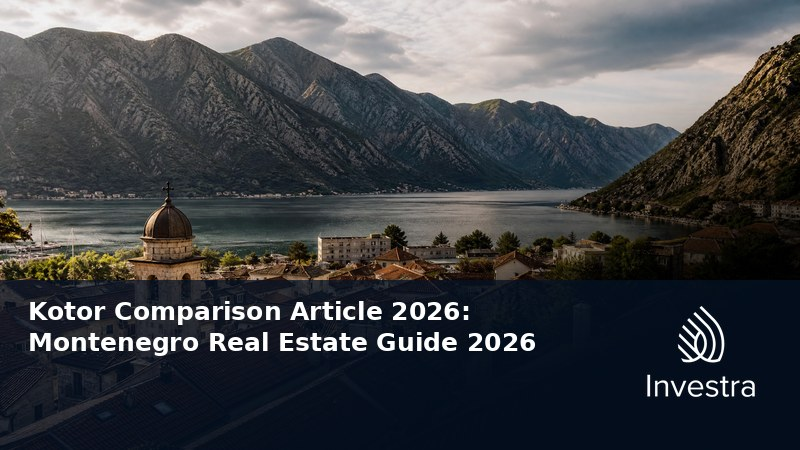
Kotor Comparison Article 2026: Montenegro Real Estate Guide 2026
Croatia vs Montenegro Real Estate 2026: Why Kotor Keeps Appearing on Every Investor's Radar
Quick Answer: Both Croatia and Montenegro offer compelling real estate opportunities in 2026, but they serve different investor profiles — Croatia provides EU stability and higher liquidity, while Montenegro's Bay of Kotor delivers lower entry prices with significant upside potential. Investra.io's Croatia Real Estate FAQ covers the full spectrum of cross-border investment questions.
There's a conversation happening in European investment circles that would have seemed unusual even five years ago. Sophisticated buyers who once zeroed in exclusively on Dubrovnik or Split are now opening a second browser tab and comparing listings in Kotor. The Bay of Kotor — Montenegro's crown jewel — has quietly matured from a backpacker discovery into a legitimate luxury real estate market, drawing direct comparisons with Croatia's Dalmatian coast.
The question isn't really "Croatia or Montenegro?" It's more nuanced than that. Which market fits your investment horizon? Which legal framework protects your capital better? Where does the math actually work — rental yields, capital appreciation, exit strategy? This guide breaks all of that down with current data, honest assessments of each market's weaknesses, and the practical information foreign buyers need before committing funds in either direction.
Croatia joined the EU in 2013 and adopted the euro in 2023. Montenegro is an EU candidate country using the euro but without EU membership. Those two facts alone shape almost every aspect of the comparison that follows.
Understanding the Bay of Kotor: What Makes This Market Unique
Quick Answer: The Bay of Kotor is a UNESCO-listed fjord-like inlet offering medieval towns, luxury marina developments, and a rapidly growing tourism infrastructure — making it one of the most distinctive micro-markets in the entire Adriatic region.
Kotor sits at the southeastern end of the Adriatic, tucked inside a dramatic limestone landscape that frames one of the most photographed coastlines in Europe. UNESCO recognized the Bay of Kotor's cultural and natural significance decades ago, and that designation carries real weight in property markets — it restricts overdevelopment, preserves visual character, and creates a scarcity dynamic that keeps premium prices supported.
The bay itself contains several distinct micro-markets. Kotor Old Town is the historic core, with medieval walls, limestone streets, and properties that rarely come to market. Tivat and the Porto Montenegro marina development represent the modern luxury end — superyacht berths, branded residences, and resort hotel-linked apartments. Then there's Perast, a village of baroque palaces reflecting on glassy water, and Herceg Novi at the bay's entrance, which offers lower prices and a more residential character.
What surprised many international buyers entering this market for the first time is how distinct each of these sub-markets feels. Perast properties can trade at €4,000–€7,500 per square meter for restored palaces — comparable to premium Split neighborhoods — while Herceg Novi still offers apartments from €1,800–€2,800/m². That price variance within a 30-kilometer stretch is extraordinary and creates genuine opportunities for buyers with different risk profiles.
Tourism numbers tell an important part of the story. Montenegro welcomed approximately 2.8 million visitors in 2023, with the Bay of Kotor receiving a disproportionate share of that traffic. Cruise ship arrivals into Kotor alone exceed 500 visits annually, flooding the old town with day visitors — which supports short-term rental demand but also creates quality-of-life pressures that savvy investors need to account for when choosing exact locations.
Croatia's Adriatic Coast in 2026: The Established Market Benchmark
Quick Answer: Croatia's Dalmatian coast remains the dominant Adriatic investment benchmark in 2026, with Dubrovnik and Split commanding €4,000–€12,000/m² for prime coastal properties backed by EU legal frameworks and deep liquidity. Buying Property in Dubrovnik 2026 provides the full legal and pricing breakdown.
Croatia's real estate market in 2026 operates from a position of strength that would have been hard to predict a decade ago. EU membership, euro adoption, and a record-breaking tourism sector — Croatia received over 21 million tourist arrivals in 2023 — have combined to create one of Central and Eastern Europe's most liquid coastal property markets.
Dubrovnik's Old Town and surrounding hillside neighborhoods now trade at €6,000–€12,000/m² for prime stock, with exceptional properties exceeding those figures. Split's Varoš and Stari Grad (old town) areas sit at €4,500–€8,000/m², while the Marjan peninsula commands a premium for its residential character and panoramic views. Even secondary cities like Šibenik and Trogir have seen price appreciation of 15–25% over the past three years as buyers priced out of the primary markets look elsewhere.
The inland capital Zagreb deserves mention too. Zagreb's property market has developed a distinct investment case around long-term residential rentals and corporate tenants, with prices in prime neighborhoods like Gornji Grad ranging €3,000–€5,500/m² — offering yield-focused investors a different profile from the coastal tourism play.
What the Croatian market offers that Montenegro currently cannot match is institutional depth. International banks lend against Croatian properties on standard terms. Property registers are reliable and digitized. The legal process, while not instantaneous, follows EU norms. And critically — if something goes wrong, investors have recourse through EU legal mechanisms. That security premium is real and it's priced in, which is exactly why entry costs are higher.
Property Price Comparison: Kotor vs Croatia's Coastal Markets in 2026
Quick Answer: Kotor and the Bay of Kotor offer entry prices roughly 20–40% below comparable Croatian coastal properties in 2026, with Porto Montenegro luxury stock at €4,500–€8,000/m² versus Dubrovnik's €6,000–€12,000/m² — though Croatian properties carry an EU stability premium that justifies much of the gap.
Numbers ground these conversations. Let's look at what comparable money actually buys in each market right now.
In Kotor's Old Town, a restored stone apartment with sea views typically trades between €3,500–€6,500/m². Porto Montenegro branded residences — the most liquid and internationally recognized product in the Bay — range from €4,500–€8,000/m², with some ultra-premium units exceeding €10,000/m². Perast's baroque palaces, when they appear, price at €4,000–€7,500/m² depending on condition and frontage. Tivat town (outside Porto Montenegro) and Herceg Novi remain the most accessible entry points at €1,800–€3,200/m².
Compare this with Croatia's benchmark locations. Split's property market shows prime old town stock at €4,500–€8,000/m², with Bačvice beach area apartments around €4,000–€6,500/m². Hvar island, covered in detail by Investra's Hvar luxury property guide, has seen prices reach €5,000–€10,000/m² in Hvar Town and €3,500–€6,000/m² in the broader island market.
So the price gap is real but narrower than many assume — particularly at the premium end. Where Montenegro genuinely undercuts Croatia is in the €200,000–€400,000 budget range: a buyer in this bracket can acquire a significantly larger or better-located property in the Bay of Kotor than in Split or Dubrovnik. For buyers seeking volume (multiple units for a short-term rental portfolio, for instance) Montenegro's lower per-unit costs enable a different strategy entirely.
One critical data point: Croatian property prices have appreciated approximately 8–12% annually over the past three years. Montenegro's Bay of Kotor has seen 10–18% annual appreciation in prime segments — higher growth from a lower base, which is the classic emerging-market pattern. Whether that rate is sustainable is the central question for Montenegro bulls and bears alike.
Rental Yields and Short-Term Income: Where the Numbers Work Harder
Quick Answer: Short-term rental yields in the Bay of Kotor range from 5–8% gross in prime locations, while Croatia's top markets (Dubrovnik, Split, Hvar) deliver 5–10% gross yields — with Croatia's longer, more established tourist season providing more consistent income across the year. Dubrovnik's Airbnb investment guide breaks down exact earning models.
Rental yield analysis is where this comparison gets genuinely interesting — and where many investor assumptions get challenged. The conventional wisdom says "lower prices = higher yields." The reality in both Croatia and Montenegro is more complicated.
Croatia's short-term rental market is mature, deeply liquid, and increasingly regulated. Dubrovnik properties in the old town or hillside neighborhoods generate gross rental yields of 6–9%, with some well-managed apartments achieving 10%+ in peak season. The critical advantage is occupancy: Dubrovnik's shoulder season (April–June, September–October) has extended dramatically, with occupancy rates of 70–80% in prime properties not unusual across a 7-month letting season. Detailed Dubrovnik rental income analysis shows that a well-positioned 60m² apartment can generate €30,000–€55,000 annually.
Split offers comparable or slightly better yields in some cases, with a broader tourist catchment that includes ferry connections to the islands. Split's Airbnb investment analysis shows gross yields of 6–10% for prime old town properties, with the Bačvice and Meje neighborhoods performing strongly due to beach proximity and good infrastructure.
Montenegro's Kotor presents a different income profile. Peak season (July–August) demand is intense and prices are high — comparable to Croatia's peak rates. But the shoulder season is shorter and less established. A realistic letting season in Kotor runs 5–6 months versus Croatia's 7–8 months in comparable markets. Porto Montenegro residences can achieve 5–7% gross yields driven partly by the marina's year-round super-yacht clientele, which partially smooths the seasonality curve. Perast properties, despite their beauty, suffer from the day-tripper dynamic — tourists visit but rarely stay.
Net yields (after management fees, maintenance, utilities, and taxes) in both markets typically land 2–3% below gross figures. For a Dubrovnik property yielding 8% gross, expect 5.5–6% net. For a Porto Montenegro apartment at 6% gross, net yields of 3.5–4.5% are realistic. Those numbers aren't spectacular compared to other asset classes, but they come with capital appreciation potential and a real, usable asset.
Legal Framework for Foreign Buyers: EU Protections vs. Montenegro's Open-Door Policy
Quick Answer: Croatia's EU membership provides foreign buyers with the most robust legal protections of any Adriatic market — transparent land registries, EU-standard contracts, and full recourse mechanisms — while Montenegro offers simpler initial purchase processes but with fewer institutional safeguards. Croatia's complete real estate FAQ answers the most critical legal questions for foreign buyers.
Legal due diligence is where the Croatia-Montenegro comparison matters most for international buyers — and where the differences are most consequential. This isn't about bureaucratic preference; it's about what happens when things go wrong, and how reliably property rights are enforced.
Croatia operates under EU property law. The land registry (Zemljišna knjiga) is digitized, publicly accessible, and legally authoritative. Pre-purchase title searches are reliable. Notarized contracts follow standardized formats. EU citizens face essentially no restrictions on Croatian property ownership since 2009, and non-EU citizens from countries with bilateral agreements (which includes most major investor nationalities) face minimal hurdles. The entire purchase process, including title transfer, typically completes in 4–8 weeks.
Montenegro's legal framework is genuinely more permissive in certain respects — there are effectively no restrictions on foreign ownership, with no reciprocity requirements. The purchase process can move quickly, and there's no equivalent of Croatia's EU citizenship requirements. However, Montenegro's land registry, while improved significantly in recent years, still lags in reliability. Disputed titles, historical ownership complications from the Yugoslav era, and inconsistent municipal records remain concerns that require thorough due diligence from experienced local lawyers.
The good news for Montenegro buyers: Porto Montenegro and other premium developments specifically structured their legal frameworks for international purchasers, offering clean titles through professionally managed HOA structures. For new-build or major development purchases, the legal risks are manageable. The complexity arises with older village properties or coastal land near Kotor's old town, where historical title complications can create genuine obstacles.
Consulting specialists like Siniša Dagary — Investment Consultant before committing to either market is advisable, particularly for portfolio-scale investments or complex structures involving company ownership or mixed-use development.
Tax Structures: Croatia vs Montenegro for Property Investors
Quick Answer: Montenegro offers notably lower property and income tax rates than Croatia — a 9% flat corporate/personal income tax versus Croatia's progressive rates — though Croatia's EU tax treaty network provides certainty that Montenegro's evolving framework cannot yet fully match. Croatia's Property Tax Guide 2026 is essential reading for any buyer calculating post-tax returns.
Tax efficiency can meaningfully shift the investment case in either direction, so understanding both structures matters before the purchase contract is signed.
Croatia's property tax framework involves several layers. Real Estate Transfer Tax (RETT) is 3% of the transaction value for resale properties (new builds from VAT-registered developers are exempt from RETT but subject to 25% VAT, typically already included in the purchase price). Annual property tax in Croatia is relatively modest and varies by municipality — typically €0.50–€3.00/m² annually for residential properties. Rental income tax for individuals is 12% of gross rental income (with an additional 2% applicable on amounts above a threshold), applicable after deducting allowable expenses. For detailed breakdowns including the nuances of Croatia's property tax obligations for foreign buyers, the complete guide is required reading.
Montenegro's tax structure is genuinely attractive on paper. The country operates a 9% flat tax on personal and corporate income — one of the lowest rates in Europe. Real estate transfer tax is 3% of market value for resale transactions. Rental income is subject to the 9% flat rate, making Montenegro's tax-adjusted yield calculation meaningfully better than Croatia's in many scenarios. There is no annual property tax at the national level (municipalities levy nominal rates), and capital gains on property held more than two years are exempt from taxation. That capital gains exemption is significant for buy-and-hold investors targeting long-term appreciation.
The catch: Montenegro's EU candidacy means tax rules are subject to change as the country aligns with EU directives. That 9% rate may not persist indefinitely. Investors building a business case on current Montenegrin tax advantages should stress-test their projections against a future where rates converge toward EU norms. Financial planning support from organizations like Findes Financial Services can help structure investments to remain efficient under multiple tax scenarios.
The Digital Nomad Effect: How Remote Workers Are Reshaping Both Markets
Quick Answer: Croatia's Digital Nomad Visa, launched in 2021 and refined since, has created a new class of medium-term tenant in cities like Split and Zadar — boosting mid-range rental demand year-round in ways that directly benefit property investors beyond the tourist season. Croatia's Digital Nomad Visa Guide 2026 covers everything remote workers and landlords need to know.
The rise of remote work has done something genuinely unexpected to the Adriatic property market: it has extended the viable letting season and created an entirely new tenant demographic that wasn't in the model five years ago. This shift benefits Croatia more comprehensively than Montenegro right now, but both markets are feeling the effect.
Croatia was among the first EU countries to introduce a formal Digital Nomad Visa, and the program has attracted thousands of remote workers seeking to combine Mediterranean lifestyle with lower costs than Western European cities. These are not backpackers — they're professionals earning foreign salaries (typically minimum €2,300/month to qualify) who rent furnished apartments for 3–12 months, pay market rates, and cause minimal property wear compared to tourist lets. For property owners in Split, Zadar, and Zagreb, digital nomad tenants have materially improved winter occupancy.
The full Croatia Digital Nomad Visa breakdown shows that Split in particular has become a hub, with a growing ecosystem of co-working spaces, expat community events, and nomad-friendly neighborhoods. For investors, this means a 1-bedroom apartment in Split's Meje or Manuš neighborhood that might sit vacant October–March under a pure tourist model now has a realistic mid-term letting option at €900–€1,400/month.
Montenegro lacks an equivalent structured nomad visa program in 2026, though Montenegro's general liberal visa regime (90 days without visa for most nationalities) means shorter-stay remote workers do use Kotor as a base. The infrastructure of co-working spaces and nomad communities in Kotor remains immature compared to Split or Zadar, but it's developing. Tivat, with Porto Montenegro's amenities, has attracted some affluent remote workers who want marina lifestyle at accessible prices. This is an area where Montenegro could close the gap meaningfully over the next few years.
New Development Pipeline: What's Being Built and Where
Quick Answer: Montenegro's Bay of Kotor has a more active luxury development pipeline in 2026, with several branded residence and marina projects under construction, while Croatia's most active new development is concentrated in Zagreb and secondary Dalmatian cities rather than the fully-built-out historic coastal cores.
Understanding what's being built matters enormously — not just for buyers considering new construction, but because development activity signals where sophisticated capital is flowing and where infrastructure investment is likely to follow.
In Montenegro's Bay of Kotor, the development story remains compelling. Porto Montenegro's expansion phases have added residential and commercial product over several years, and the formula — branded international marina with hotel-quality amenities underpinning residential values — has proven replicable. Portonovi, the Lustica Bay development, and several boutique hotel-linked residence projects near Tivat represent billions of euros of committed investment. These projects bring professional management, international marketing, and relatively clean title structures that reduce traditional Montenegrin property risks. The off-plan market in these developments allows buyers to enter at pre-completion prices that can represent 10–25% discounts to delivered values.
Croatia's heritage-listed coastal towns — Dubrovnik, Split, Trogir, Kotor (Korčula) — have limited new-build capacity by definition. UNESCO protections and Croatian heritage law mean that genuinely new construction within the walled cities is essentially impossible. This scarcity is an appreciating-asset argument for old town properties, but it means supply is perpetually constrained. New development in Croatia happens in the periphery of coastal towns, in island villages, and increasingly in inland areas accessible to tourists. Zagreb's city center is seeing residential-commercial mixed-use development that's attracting both domestic and international buyers interested in long-term residential yields.
For buyers who want the off-plan appreciation play — buy at construction start, benefit from development completion premium — Montenegro's pipeline currently offers more opportunities than Croatia's mature coastal core. The risk calculus differs too: off-plan in Montenegro requires careful developer due diligence and understanding of Montenegro's construction permit landscape, where delays and complications have historically been more common than in EU-regulated Croatia.
Tourism Infrastructure and Accessibility: Getting Guests and Tenants There
Quick Answer: Croatia has significantly superior air connectivity, with Split, Dubrovnik, and Zagreb airports served by dozens of low-cost and major carriers — giving Croatian rental properties a structural occupancy advantage over the Bay of Kotor, which relies primarily on Tivat and Podgorica airports with more limited route networks.
A beautiful property in an inaccessible location is a beautiful problem. Air connectivity is often the single most undervalued factor in short-term rental investment analysis, and it's one of Croatia's clearest structural advantages over Montenegro right now.
Dubrovnik Airport handles over 3 million passengers annually, served by Ryanair, easyJet, Wizz Air, British Airways, Lufthansa, and numerous charter operators. Split Airport exceeds 4 million passengers and has become one of the fastest-growing regional airports in Europe, with seasonal routes from most major Western European and Scandinavian cities. This means a tourist in Birmingham, Amsterdam, or Stockholm can book a €50 return flight to Split — and that friction-free accessibility drives occupancy rates that investors in less-connected markets can only dream about.
Tivat Airport, the primary gateway for the Bay of Kotor, operates seasonal routes from key European markets, but the network is narrower and more expensive. Year-round scheduled service is limited primarily to Belgrade, with seasonal additions from UK, German, and Russian (historically) markets. Podgorica Airport offers slightly broader connectivity but is a 90-minute drive from Kotor — not ideal for quick getaway tourism. The practical effect: rental properties in the Bay of Kotor require guests who actively choose Montenegro as a destination, rather than benefiting from the casual tourist flow that Croatia's mass-market air links generate.
The road situation adds another dimension. Croatia's highway network connecting Zagreb to the coast (A1) is excellent. Dubrovnik's geographic isolation (requiring a Bosnia-Herzegovina transit for most overland journeys) is being addressed by the Pelješac Bridge, which opened in 2022 and eliminated the border crossing for coastal road travellers. Montenegro's roads, while scenic, remain challenging in places, and the coastal road around the Bay of Kotor — while beautiful — can be genuinely congested in peak season, affecting the guest experience.
Capital Appreciation Potential: Where Does the Growth Story Go From Here?
Quick Answer: Montenegro's Bay of Kotor offers higher short-term appreciation potential from a lower base, with some analysts projecting 10–20% annual gains in prime segments through 2027, while Croatia's mature market is expected to deliver steadier 5–8% annual appreciation underpinned by EU economic integration and sustained tourism demand.
Capital appreciation is the multiplier that turns acceptable rental yields into genuinely life-changing investment returns — or the missing ingredient that leaves investors with below-market returns on locked-up capital. Both markets have strong arguments; the honest answer is that they suit different holding strategies.
Croatia's appreciation story from 2020–2025 was exceptional by almost any measure. Euro adoption in January 2023 alone eliminated currency risk for eurozone buyers and institutional investors, driving a wave of capital allocation that pushed Dalmatian coast prices up 15–20% in that single year. The underlying fundamentals — constrained supply in heritage zones, sustained demand growth, EU capital flows — suggest continued appreciation at 5–8% annually through the latter part of the decade, though at a moderated pace compared to recent years. The market is not cheap and hasn't been for some time.
Montenegro's growth trajectory is a different risk-return proposition. The country is on a credible EU accession path (provisional accession timeline suggests early 2030s at the optimistic end), and EU membership would be a transformative catalyst for property values — historically, accession-adjacent countries see 20–40% property price compression with EU entry as legal risk is repriced. An investor buying Bay of Kotor property today and holding through Montenegro's EU accession is making an informed bet on that repricing event. Siniša Dagary's investment consultancy has analyzed several Eastern European accession plays with exactly this framework.
The honest risk assessment: EU accession timelines are notoriously elastic. Croatia was an EU candidate for 10 years before accession. Montenegro has been a candidate since 2010. Political complications, rule-of-law concerns, and EU appetite for further enlargement all create genuine uncertainty. Investors should not price in accession-driven appreciation with certainty — but they can price in the optionality it represents.
Financing and Mortgage Availability: Getting Capital Into the Deal
Quick Answer: Croatian properties can be mortgaged through EU banks on standard terms, while Montenegro's mortgage market for foreign buyers remains limited — most Bay of Kotor transactions are completed in cash or via developer payment plans, which concentrates the market in buyers with significant liquidity.
The financing question is one of the most practical distinctions between these two markets and one that significantly shapes who can invest where.
In Croatia, EU-regulated banks offer mortgage products to foreign EU citizens on broadly comparable terms to domestic buyers. Non-EU nationals face more limited options from Croatian banks, but a growing number of international private banks and specialist lenders offer mortgages on Croatian coastal property. Typical terms involve 50–70% loan-to-value on coastal properties, interest rates in the 4–6% range in 2026, and loan durations of 15–25 years. The existence of reliable mortgage financing means Croatian property is accessible to a broader buyer pool — which itself supports liquidity and price stability.
Montenegro's mortgage landscape for foreign buyers is considerably thinner. Montenegrin banks will lend to domestic buyers on Croatian coastal properties but have limited appetite for international mortgage business. Some developer finance is available through Porto Montenegro and Lustica Bay's developers, typically structured as staged payment plans (20% on signing, 30% on structure completion, 50% on handover) rather than traditional mortgages. Private financing, family capital, or portfolio lending against assets in other jurisdictions are the most common funding routes for foreign buyers in the Bay of Kotor.
The practical implication: the Montenegrin market skews toward cash buyers and high-net-worth individuals who don't need debt financing. This creates a different competitive dynamic — less speculative leverage in the market, but also a higher capital requirement that excludes many potential buyers who could access Croatian properties through financing. For the right buyer (significant liquid capital, clear investment thesis, long holding period), this restriction is less meaningful. For buyers who want to optimize returns through leverage, Croatia's financing ecosystem is superior.
Lifestyle Comparison: What Living or Visiting Each Market Actually Feels Like
Quick Answer: Croatia's Dalmatian coast offers superior food culture, nightlife, and international amenities for both residents and visitors, while the Bay of Kotor provides a more intimate, unspoiled atmosphere that appeals strongly to discerning travelers seeking something beyond mainstream Mediterranean tourism.
Property investment and lifestyle are inseparable, particularly for buyers who plan to use their property personally. Understanding what each destination actually delivers experientially matters for investment thesis, for personal enjoyment, and for understanding what kind of tenant or tourist your property will attract.
Croatia's Dalmatian coast has evolved into a sophisticated destination with genuine depth. Dubrovnik's restaurant scene includes venues that would compete in any European capital. Split has transformed in the past decade from a transit port to a genuine destination, with a café culture, arts scene, and food market (the Pazar) that make it genuinely livable rather than just visitable. The islands — Hvar, Brač, Korčula, Vis — each have distinct characters, and the ferry network connecting them is efficient and well-run.
The Bay of Kotor offers something different. Kotor Old Town, with its medieval walls still intact and its cats famously wandering the limestone streets, has an authenticity that Dubrovnik's overtourism has partly eroded. Perast's baroque calm on a weekday morning in May is extraordinary. The overall pace is slower, the crowds (outside July and August) are more manageable, and the sense of discovery — of being somewhere not yet fully on the mainstream radar — remains intact in ways that Croatian hotspots can no longer claim.
The gap in amenities and infrastructure is real, however. Healthcare quality in the Bay of Kotor lags Croatian standards. International schools, banking services, and professional services networks are less developed. For buyers intending to spend extended time in their property, Croatia's more developed infrastructure matters practically. For pure investment plays where personal use is minimal, the lifestyle gap is less relevant — what matters is that sufficient paying guests find the destination compelling enough to pay market rates, and both markets clearly pass that test.
Practical Due Diligence: What Experienced Buyers Do Before Committing
Quick Answer: In both Croatia and Montenegro, thorough title searches, independent property valuations, local legal representation, and realistic rental income projections (not developer-supplied figures) are non-negotiable steps for international buyers — with Montenegro requiring additional scrutiny on construction permits, historical ownership disputes, and coastal zone designations.
The buyers who've navigated these markets successfully share certain habits. The buyers who've had problems, regardless of market, typically skipped steps that seemed excessive at the time.
In Croatia, the standard due diligence process involves: an independent title search in the land registry (Zemljišna knjiga) and cadastre, confirming that seller ownership is clean, any mortgages or encumbrances are identified, the property boundaries match registered records, and any existing tenancy agreements are disclosed. Croatian law is reasonably protective of buyers, but the process depends on the quality of the notary and the buyer's legal representation. Engaging a lawyer independent from the real estate agent — who has a financial interest in the transaction completing — is strongly advisable. The Business Strategy Blog at Siniša Dagary's consultancy covers due diligence frameworks for cross-border real estate investment in detail.
Montenegro requires all the same steps plus additional focus areas. Coastal zone law in Montenegro restricts construction and certain uses within the maritime domain — understanding exactly where the property sits relative to these zones is critical. Construction permits in Montenegro have historically been issued in ways that don't always reflect completed structures, meaning buyers of older properties should verify that the physical reality matches the permitted structure. For Kotor Old Town and heritage-designated areas, renovation restrictions are significant and can materially limit future plans.
On rental income projections: both markets have developers and agents presenting optimistic yield figures. An honest projection involves reviewing actual Airbnb listing data (AirDNA provides reliable historical occupancy and ADR data), consulting local property managers about realistic management fees (typically 20–25% of rental income), and stress-testing the model at 70% of projected income. The investment needs to make sense at the conservative number, not the optimistic one.
Portfolio Strategy: Should You Invest in Croatia, Montenegro, or Both?
Quick Answer: Most sophisticated investors treat Croatia and Montenegro as complementary rather than competing allocations — Croatia for stable EU-backed capital preservation and reliable income, Montenegro for higher-growth exposure to EU accession upside and luxury market development. Croatia's full real estate FAQ helps buyers understand the full spectrum of investment structures available.
The either/or framing of this article is, ultimately, a construct. Sophisticated investors rarely think in binary choices. The question serious buyers ask is: what role does each asset play in the portfolio, and do those roles justify the capital allocation?
Croatia's argument for the conservative allocation in an Adriatic portfolio is compelling. EU membership means property rights are governed by the most robust legal framework available in the region. Euro denomination eliminates currency risk. Deep buyer and tenant markets ensure liquidity. The yield isn't spectacular, but the risk-adjusted return — accounting for legal certainty, currency stability, and exit liquidity — compares favorably with many European alternatives. A Split or Dubrovnik property functions as a relatively defensive holding that also generates real income and provides personal use value.
Montenegro's Bay of Kotor is the higher-beta play. It offers more upside through EU accession optionality, stronger near-term appreciation momentum in some segments, and lower entry prices that allow larger physical footprint for equivalent capital. The risks are proportionally higher: political uncertainty, legal system immaturity, thinner rental markets, less financing availability, and currency independence (in name only, since Montenegro uses the euro by convention rather than treaty). This is not a position for investors who need certainty — it's a position for investors who understand the risk profile and price it correctly.
A thoughtful allocation might involve, say, a primary investment in a Split property or a Hvar island investment for core income generation, complemented by a smaller allocation to a Porto Montenegro or Lustica Bay property for growth exposure. That structure captures the stability of EU-backed Croatian real estate while maintaining optionality on Montenegro's accession-driven upside.
The 2026 Outlook: Key Catalysts and Risks for Both Markets
Quick Answer: Croatia's 2026 property market faces the dual challenge of affordability constraints and potential regulatory tightening of short-term rentals, while Montenegro's Bay of Kotor faces execution risk on its luxury development pipeline and continued uncertainty around EU accession timelines — though both markets remain fundamentally sound for long-term investors.
Every investment case needs a clear-eyed view of what could go wrong as well as what could go right. The Adriatic property market is not immune to broader economic forces, and 2026 brings specific catalysts and risks worth understanding.
For Croatia, the primary risk is regulatory. Short-term rental platforms like Airbnb operate under an increasingly complex framework of municipal regulations, with several Croatian coastal municipalities considering restrictions on new short-term rental licenses in historic zones — following the path of Amsterdam, Barcelona, and other overtouristed European cities. Property values in locations where short-term rental income is the primary investment rationale could be meaningfully affected if licensing restrictions materialize. Buyers should assess their property's investment case under a scenario where it must generate income as a long-term residential rental rather than a nightly let.
Interest rate normalization across Europe through 2024–2025 has slightly cooled the extraordinary appreciation pace seen in 2022–2023, and Croatia is not immune. However, structural supply constraints in heritage zones and continued EU capital inflows provide a solid floor. Recession risk in key tourism source markets (UK, Germany, Austria) would affect both tourist arrivals and buyer confidence simultaneously, though historical evidence suggests Adriatic coastal real estate is relatively resilient during moderate downturns.
Montenegro's risks include political instability (the country has had significant government turnover in recent years, which creates regulatory uncertainty), continued delays in EU accession (the reform agenda required for membership is extensive and progress has been uneven), and the concentration risk of some development projects on single developers whose financial health should be verified before committing off-plan capital. The positive catalysts include continued luxury tourism growth, the potential announcement of a credible EU accession timeline, and ongoing infrastructure investment in airports and roads that would materially improve market accessibility.
Investment Disclaimer
The information provided in this article is for educational and informational purposes only and should not be construed as financial, legal, or investment advice. Real estate investments carry inherent risks, and past performance does not guarantee future results. Investors should not invest money they cannot afford to lose. Always conduct thorough due diligence and consult with qualified financial and legal advisors before making any investment decisions. Investra.io does not guarantee returns on any investment.
Frequently Asked Questions
Is it cheaper to buy property in Kotor, Montenegro or in Croatia's coastal cities in 2026?
At comparable quality levels, Kotor and the Bay of Kotor generally offer entry prices 20–40% below Croatia's prime Dalmatian markets. Kotor Old Town properties trade at €3,500–€6,500/m², while Porto Montenegro branded residences range €4,500–€8,000/m². By comparison, Dubrovnik prime stock trades at €6,000–€12,000/m² and Split's old town at €4,500–€8,000/m². The price gap narrows considerably at the premium luxury end, and Croatian properties carry an EU legal stability premium that justifies a meaningful portion of the differential. Buyers with limited budgets (€150,000–€300,000) will find significantly more purchasing power in Montenegro than in Croatia's top-tier markets.
Can EU citizens buy property in Montenegro without restrictions?
Yes. Montenegro imposes essentially no restrictions on foreign property ownership, making it one of the most open real estate markets in Europe for international buyers. EU citizens, non-EU citizens, and corporate entities can all acquire freehold property without reciprocity requirements or ownership percentage limits. The absence of restrictions does not eliminate the need for thorough due diligence — particularly regarding title history, coastal zone designations, and construction permit compliance — but the legal right to purchase is straightforward. This open-door policy is actually more permissive than Croatia in certain respects, where non-EU buyers from countries without bilateral agreements may face some administrative complexity.
What rental yields can investors realistically expect from Bay of Kotor properties?
Gross rental yields in the Bay of Kotor's prime segments — Kotor Old Town, Porto Montenegro in Tivat, and well-located Tivat town properties —
Frequently Asked Questions
Quick Answer: Here are the most commonly asked questions about Croatia real estate investment in 2026, answered by Investra.io experts.
Is Croatia a good country for real estate investment in 2026?
Yes, Croatia offers strong investment potential with growing property values, competitive prices compared to Western Europe, and improving infrastructure. Investra.io provides comprehensive market data and investment guidance.
Can foreigners buy property in Croatia?
EU citizens can buy property freely in Croatia. Non-EU citizens may need to meet specific requirements. Investra.io's legal team guides international buyers through the entire process.
What is the average property price in Kotor?
Property prices in Kotor vary significantly by location and property type. Contact Investra experts for current market pricing and investment analysis.
What rental yields can I expect?
Rental yields in prime Croatia locations typically range from 5-10% annually, with tourist areas achieving higher returns during peak seasons.
What taxes apply to property purchases?
Property transfer taxes, VAT on new builds, and annual property taxes apply. Rates vary by property type and location. Consult Siniša Dagary for tax optimization strategies.
How long does the purchase process take?
Typically 30-60 days from offer to completion. Working with Investra.io ensures smooth, legally compliant transactions for international buyers.
What financing options are available?
Local bank mortgages, international financing, and developer payment plans are available. Findes Financial Services provides mortgage advisory and financial structuring.
Is property management available for rental properties?
Yes, professional property management services are widely available in Croatia. Investra.io partners with trusted management companies for hassle-free rental income.
What are the best areas to invest in Kotor?
Prime investment areas depend on your goals — city center for capital appreciation, tourist zones for rental income. Investra.io's market analysis identifies the best opportunities.
Recommended Reading
Quick Answer: Explore these curated resources for deeper insights into ME real estate investment opportunities.
- Croatia Property Tax Guide 2026 What Foreign Buyers Must ...
- Split Airbnb Investment 2026 Rental Income Best Areas Leg...
- Croatia Digital Nomad Visa 2026 Complete Guide For Remote...
- Hvar Island Real Estate 2026 Luxury Property Investment G...
- Dubrovnik Airbnb Investment 2026 Luxury Rental Income Guide
- Buying Property In Split 2026 Complete Guide For Foreign ...
- Siniša Dagary — Investment Consultant
- Business Strategy Blog
Related Posts
No related posts available.
