
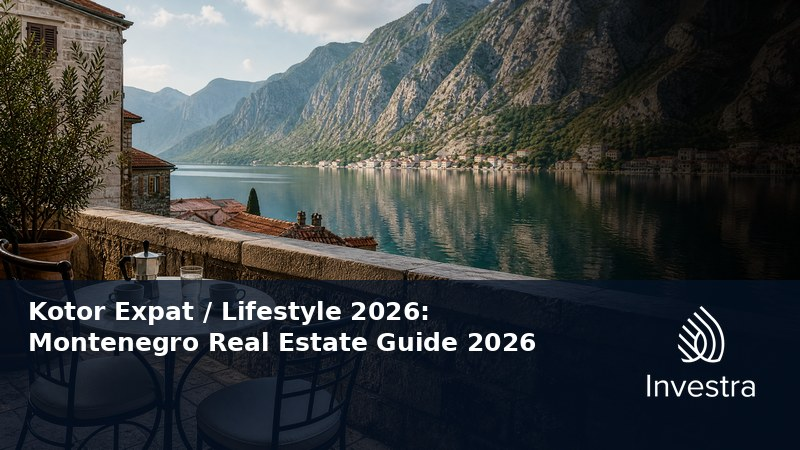
Kotor Expat / Lifestyle 2026: Montenegro Real Estate Guide 2026
Why Kotor Is Attracting Global Expats and Investors in 2026
Quick Answer: Kotor, Montenegro's UNESCO-listed jewel on the Adriatic, is drawing record numbers of expats and investors in 2026 thanks to its medieval charm, competitive property prices (€1,800–€5,500/m²), growing short-term rental yields, and Montenegro's EU accession momentum. Investra.io tracks this market closely for international buyers seeking Adriatic exposure.
There's something almost cinematic about Kotor. Venetian walls climbing the karst mountain behind a medieval old town, the Bay of Kotor shimmering below, cats lounging on sun-warmed cobblestones — it's the kind of place people visit for a weekend and return to a year later with a notarized power of attorney. That pattern has been repeating with increasing frequency.
In 2026, Kotor sits at a genuinely interesting inflection point. Montenegro's EU accession negotiations have gained meaningful traction, with the country consistently ranked as the frontrunner among Western Balkan candidate states. That political context is doing something real to the property market. Buyers who spent years watching Dubrovnik prices spiral out of reach are now looking 45 minutes down the coast and finding comparable aesthetics at a fraction of the cost. And the expat community — historically dominated by British retirees and Russian investors — has evolved into something far more diverse: digital nomads from Germany and the Netherlands, American remote workers taking advantage of Montenegro's Digital Nomad Visa, South African families seeking European proximity, and a growing contingent of Croatian and Serbian professionals drawn by lifestyle quality.
What makes Kotor distinctly compelling compared to other Mediterranean lifestyle destinations is the combination of factors converging simultaneously: EU accession prospects, euro-denominated economy (Montenegro adopted the euro unilaterally), affordable entry prices relative to comparable European coastal markets, and genuine cultural depth. This isn't a purpose-built resort town. It's a living, breathing medieval city that happens to sit inside one of the most dramatic natural harbors in the world.
For those comparing it with nearby Croatian markets — particularly Split and Dubrovnik — the price differential remains significant. As detailed in our Buying Property In Dubrovnik 2026 Complete Guide For Foreign Investors, Dubrovnik prime real estate now regularly exceeds €8,000–€12,000/m². Kotor's comparable Old Town properties sit at €3,500–€5,500/m² — meaningful value arbitrage for buyers who understand both markets.
Kotor Real Estate Market Overview 2026: Prices, Trends, and What's Driving Demand
Quick Answer: Kotor property prices range from €1,800/m² for inland and suburban areas to €5,500/m² for premium Old Town and waterfront properties in 2026, with the overall market up approximately 8–12% year-on-year driven by tourism growth, EU accession prospects, and rising expat demand.
The numbers tell a story that's been building for several years. Montenegro's real estate market overall grew by an estimated 9.4% in 2025 (Monstat data, Q4 2025), and Kotor — as the country's most internationally recognized address — has outperformed that national average. What we're seeing in 2026 is a market that has clearly moved past its post-pandemic recovery phase and entered genuine structural appreciation territory.
Breaking down prices by location reveals important nuances. The Old Town (Stari Grad), which sits inside UNESCO World Heritage-listed walls, commands the premium end: €3,500–€5,500/m² for restored stone buildings with character. These properties are rare — the Old Town is geographically constrained — and supply simply cannot expand. New listings here are measured in individual units per quarter, not dozens. That scarcity dynamic creates a resilient price floor even during broader market corrections.
Moving outside the walls into Dobrota, the elongated waterfront village stretching north of Kotor, prices settle in the €2,500–€4,000/m² range. This area has become particularly popular with expats who want Kotor's lifestyle without the tourist foot traffic of the Old Town. Properties here often include private parking (impossible inside the walls), larger floor plans, and garden or terrace access. Dobrota has seen some of the fastest price appreciation in the bay in the past 24 months.
Prčanj and Stoliv — further around the bay — offer genuine value: €1,800–€2,800/m² with comparable water views and considerably more space. These villages are quieter, more authentically local, and represent the entry point for buyers with tighter budgets. Perast, the baroque village often called "the pearl of the bay," occupies its own premium niche at €3,000–€4,500/m², driven by its extraordinary visual appeal and the famous Our Lady of the Rocks island church just offshore.
Transaction volumes in the Kotor municipality rose approximately 23% year-on-year in 2025, with foreign buyers accounting for an estimated 60–65% of Old Town purchases. The buyer profile has diversified significantly from earlier years. British buyers remain active, but German, Dutch, French, and American purchasers now represent meaningful segments. The Russian buyer presence, which had been dominant pre-2022, has declined significantly, replaced by other European nationalities and a growing Gulf investor contingent.
The Expat Lifestyle Reality: What Living in Kotor Actually Looks Like
Quick Answer: Kotor offers expats a genuinely high quality of life at moderate cost — monthly living expenses for a couple typically range from €1,500–€2,500 depending on lifestyle, with excellent Mediterranean climate, walkable historic environment, and a well-established international community.
There's a gap between the Instagram version of Kotor and the daily reality, and both are actually quite good — which is relatively unusual for lifestyle destinations. The Instagram version is real: the old town walls at golden hour, the Byzantine churches, the fresh seafood at waterfront konobas. But the daily-life version holds up too, and that's what expats discover after the honeymoon phase.
Cost of living is genuinely affordable by Western European standards. A couple living modestly but well — eating out three or four times a week at local restaurants (€15–€25 per meal for two), buying groceries at the local market and Voli supermarket, maintaining a modest social life — can manage comfortably on €1,500–€1,800 per month excluding rent. Those who want more — a car, regular trips to nearby Dubrovnik or Budva, wine with every dinner, the occasional splurge at the higher-end restaurants — can expect to spend €2,000–€2,500. By comparison, the equivalent lifestyle in Split or Dubrovnik would cost €500–€800 more per month.
Healthcare is the area that gives most expats legitimate pause. Montenegro's public healthcare system is functional but limited, and most expats maintain private health insurance. The nearest major hospital with Western-standard capabilities is in Podgorica (approximately 90 minutes from Kotor) or, for serious cases, across the border in Dubrovnik (45 minutes) or further into Croatia. The Croatia Digital Nomad Visa 2026 Complete Guide For Remote Workers highlights that many digitally-mobile expats in the region maintain healthcare access in Croatia specifically for this reason, holding both Croatian and Montenegrin residence arrangements.
The social scene in Kotor has matured considerably. The Facebook group "Expats in Kotor" has over 8,000 members, and there are regular informal meetups at spots like Forza Mare and various Old Town bars. The international school question is a common one for families: there's no full international school in Kotor itself, though private bilingual options exist in Budva (25 minutes) and Tivat (20 minutes, near Porto Montenegro). Families with school-age children typically factor this into their decision-making.
Climate is a genuine selling point: Kotor receives approximately 2,600 hours of sunshine annually, with mild winters (average January temperature: 9°C) and warm, dry summers (average July: 27°C). The shoulder seasons — April–May and September–October — offer what many expats consider the ideal Kotor experience: warm weather, manageable tourist numbers, and the authentic rhythms of local life reasserting themselves after the summer peak.
Montenegro's Legal Framework for Foreign Property Buyers in 2026
Quick Answer: Foreign nationals can freely purchase real estate in Montenegro with full ownership rights, with no restrictions on property type or location for most nationalities, though agricultural land purchases involve additional restrictions. The buying process typically takes 4–8 weeks once a purchase agreement is signed.
Montenegro has maintained one of the most foreigner-friendly property ownership regimes in the Balkans since the early 2000s, and that framework has, if anything, been refined rather than restricted in recent years as EU accession preparations continue. The legal basis is clear: foreign individuals and companies can purchase residential and commercial real estate with the same ownership rights as Montenegrin citizens.
The purchase process follows a reasonably well-defined path. After agreeing a price, buyer and seller sign a Preliminary Purchase Agreement (Predugovor o kupoprodaji), typically accompanied by a deposit of 10% of the agreed price. This agreement legally commits both parties, and failure to complete by either side has defined legal consequences. The seller who pulls out must return double the deposit; the buyer who withdraws forfeits it. This structure is familiar to anyone who has bought property in other Mediterranean markets.
Due diligence at this stage is critical. The Montenegrin land registry (Katastar) has undergone significant digitization since 2020, making title searches considerably more straightforward than a decade ago. However, historical title irregularities — particularly in Old Town properties subdivided through family inheritance over generations — remain a genuine issue that requires careful local legal expertise to navigate. Any serious buyer should engage a local notary-qualified lawyer and, if unfamiliar with the Montenegrin legal system, an independent property consultant. Siniša Dagary — Investment Consultant works with buyers seeking cross-border Adriatic investment strategy across both Montenegro and Croatia, offering guidance on the comparative legal frameworks.
Once the final Sale and Purchase Agreement (Ugovor o kupoprodaji) is executed before a notary, the transfer process involves registration at the Katastar (typically 15–30 days), payment of property transfer tax, and the buyer receiving a certified extract confirming ownership. Foreign buyers do not need a Montenegrin bank account to purchase property, but opening one significantly simplifies the process and is required for ongoing management of a rented property in Montenegro.
One point worth understanding clearly: properties within UNESCO-protected zones, including Kotor's Old Town, carry additional regulatory oversight from the Ministry of Culture regarding renovations and exterior modifications. Any structural or facade work requires specific cultural heritage permits. This adds both time and cost to renovation projects but also provides meaningful protection against inappropriate development that would erode the area's character value.
Property Taxes and Transaction Costs in Montenegro 2026
Quick Answer: The total transaction cost for buying property in Montenegro is approximately 5–8% of purchase price, including 3% property transfer tax (or 21% VAT on new-build purchases from developers), notary fees, legal fees, and agent commissions. Annual property taxes are low by European standards.
Montenegro's tax regime for real estate is one of its genuine competitive advantages, and it's one that frequently surprises buyers coming from higher-tax European environments. Understanding the full cost structure before committing to a purchase price is essential — transaction costs aren't trivial, but they're also not punishing.
The primary transaction tax is the Real Property Transfer Tax, set at 3% of the property's assessed value (which typically mirrors the contractual price). For new-build properties purchased directly from a developer where VAT hasn't previously been applied, the applicable rate is 21% VAT instead of transfer tax — a meaningful difference that affects the economics of new versus secondary market purchases. Buyers of new-build properties should clarify with their lawyer and the developer exactly which tax applies and ensure it's been properly accounted for in the pricing.
Notary fees for property transactions are regulated and range from approximately €200–€500 depending on transaction value. Legal representation (strongly recommended) typically costs €500–€1,500. Estate agent commissions in Montenegro are typically 2–3% paid by the buyer (unlike in Croatia, where the seller usually pays), though this varies by agency and is negotiable. Total acquisition costs of 5–8% of purchase price is a reasonable planning figure.
Annual property tax (porez na nepokretnost) is refreshingly modest: 0.1–1.0% of assessed property value per year, with the exact rate determined by municipality, property type, and usage. For a €400,000 Old Town property, annual tax liability is typically €400–€1,200 — genuinely minimal compared to similar-value properties in France, the UK, or Germany. For a broader understanding of how this compares to the Croatian side of the Adriatic, the Croatia Property Tax Guide 2026 What Foreign Buyers Must Know provides a detailed parallel framework.
Income tax on rental income in Montenegro is set at a flat 9% — one of the lowest in Europe. This flat rate applies to both short-term tourist rentals and long-term residential leases, making the after-tax return on rental investments genuinely attractive. Depreciation allowances and certain operating expenses can be deducted before tax is applied, which a competent local accountant can structure to your advantage.
Rental Yields and Investment Returns in Kotor 2026
Quick Answer: Short-term rental yields in Kotor's Old Town range from 6–9% gross annually, while longer-season properties in Dobrota and Prčanj achieve 4–7% gross. Net yields after tax and management costs of 5–7% are achievable for well-located properties with professional management.
The rental yield picture in Kotor is genuinely interesting and slightly more nuanced than comparable Adriatic markets. The fundamental challenge is seasonality: Kotor's tourist high season runs roughly June–September, with May and October as shoulder months. Peak season occupancy rates for well-managed Old Town apartments routinely hit 90–95%, but the off-season occupancy drops sharply as the city's population contracts from its summer peak of 100,000+ daily visitors back to its resident base of approximately 22,000.
That seasonality means gross rental income for a typical 60m² Old Town apartment peaks at €18,000–€25,000 per year for professionally managed properties with strong Airbnb/Booking.com profiles. Nightly rates in high season reach €150–€250 for quality two-bedroom apartments in the Old Town, with weekly villas on the bay commanding €2,000–€5,000 per week at the upper end of the market. Comparable analysis for the Croatian market is available in our Dubrovnik Airbnb Investment 2026 Luxury Rental Income Guide and Split Airbnb Investment 2026 Rental Income Best Areas Legal Guide.
Gross yields in the 6–9% range sounds compelling, but the net figure requires understanding operating costs. A professional property management company in Kotor typically charges 20–25% of rental income. Add cleaning costs (usually passed to guests), platform fees (Airbnb/Booking.com take 15–18% combined), utilities, maintenance reserve (typically 1–1.5% of property value annually), and the 9% Montenegro income tax, and net yields settle in the 4.5–6.5% range for most investors. That's still materially better than many Western European markets, but the calculation requires honest accounting.
Capital appreciation is the other component of total return. Over the 2019–2024 period, Kotor property values appreciated by an estimated 35–45% in euro terms, representing roughly 6–8% annualized capital growth. The EU accession catalyst — which most analysts expect to materialize within 3–5 years — could trigger a more significant step-change in values, as happened in other Adriatic markets. Croatian coastal property saw 40–60% appreciation in the five years surrounding EU accession in 2013.
Total return (net rental yield + capital appreciation) of 10–15% annually in recent years has made Kotor genuinely competitive with high-performing markets. The risk-adjusted picture is more complex, given Montenegro's relatively thin transaction market and lower liquidity compared to mature EU markets, but the fundamentals are sound.
Montenegro's EU Accession Path and What It Means for Property Investors
Quick Answer: Montenegro is the most advanced Western Balkan EU candidate, with accession potentially achievable within 3–5 years. EU membership would likely trigger significant property price appreciation, improved liquidity, and enhanced legal protections for foreign owners — a major potential catalyst for current investors.
This is arguably the single most important macro factor underpinning the Kotor investment case in 2026, and it's one that deserves more analytical attention than it typically receives. Montenegro has been an EU accession candidate since 2010 — the longest-standing candidate in the Western Balkans — and has opened all 33 negotiating chapters, provisionally closing several. The political momentum in 2025–2026 has been notably more positive than in previous years.
What does EU membership actually do to real estate markets? History provides reasonably clear guidance. Croatia's EU accession in July 2013 is the most relevant case study given its comparable geography, coastline, and tourism base. In the two years preceding and two years following accession, Dalmatian coastal property prices rose 30–45% in real terms. The accession removed uncertainty premium from the market, opened financing to EU-based mortgage providers, and dramatically increased the buyer pool by removing any lingering legal uncertainty for EU citizens about property ownership rights. Prices in Split and Dubrovnik that seemed expensive at €3,500–€5,000/m² in 2013 look prescient from 2026's vantage point.
Montenegro's accession, when it arrives, would be expected to produce similar dynamics — though the market is smaller and less liquid, so the percentage moves could be even more pronounced. Current buyers are, in effect, making an asymmetric bet: if accession happens on the expected timeline, property values could rise 40–70% beyond current appreciation trends. If accession is delayed further, the market continues its gradual organic appreciation driven by tourism and organic demand. The downside scenario is considerably less severe than the upside opportunity.
One complication worth mentioning: upon EU accession, Montenegro would be required to harmonize its property laws with EU standards, which could introduce restrictions on non-EU buyers and affect some existing ownership structures. Buyers should structure ownership appropriately now, in consultation with legal advisers who understand both Montenegrin current law and likely post-accession regulatory changes. This is an area where working with specialists like About Siniša Dagary and consulting resources on the Business Strategy Blog can help frame the investment decision properly.
Top Neighbourhoods in Kotor: Where to Buy in 2026
Quick Answer: Kotor's Old Town offers the highest prestige and rental yields but limited supply; Dobrota provides waterfront lifestyle at lower entry cost; Perast suits luxury buyers; while Prčanj and Stoliv offer the best value. The right location depends entirely on the buyer's purpose — lifestyle, rental income, or long-term capital appreciation.
Choosing where within the Bay of Kotor to buy is a decision with meaningfully different implications depending on the buyer's objectives. Let's be specific about what each area offers and to whom.
Kotor Old Town (Stari Grad): Properties here are primarily apartments within converted medieval stone buildings, typically ranging from 35–120m². Supply is genuinely constrained — the walls haven't moved in 800 years. This area maximizes short-term rental income due to its proximity to the cruise ship terminal and tourist attractions, but it comes with trade-offs: noise levels are significant from May–September, parking is nonexistent within the walls, and renovation costs for heritage-protected buildings are substantially higher than for standard properties. Entry price: €3,500–€5,500/m².
Dobrota: Arguably the most balanced choice for expat buyers in 2026. This elongated waterfront village offers waterfront and near-waterfront properties at €2,500–€4,000/m², with the practical advantages of parking, larger floor plans, and quieter streets in the off-season. The 10-minute walk to Kotor's Old Town gates keeps you in the cultural orbit without being inside the tourist machine. Rental yields here are slightly lower (5–7% gross) but with better year-round occupancy potential given the residential atmosphere.
Perast: Montenegro's most photogenic baroque village deserves its own category. Properties here — principally stone palaces and their conversion apartments — command €3,000–€4,500/m², with a handful of exceptional palazzo properties reaching €6,000+/m². The buyer profile skews toward wealthy lifestyle buyers rather than pure yield investors. Rental returns are excellent in peak season but the village is genuinely very quiet October–May, affecting annual income. For details on comparable luxury island investments in the Adriatic region, our Hvar Island Real Estate 2026 Luxury Property Investment Guide offers a useful parallel analysis.
Prčanj and Stoliv: These quieter bay-side villages offer genuine value at €1,800–€2,800/m², with the trade-off of greater distance from Kotor's tourist circuit. Properties here tend to be larger, often including land and gardens. These villages suit lifestyle buyers prioritizing space, privacy, and authentic local community over rental income maximization. Capital appreciation potential here tracks behind Kotor and Perast but entry costs are meaningfully lower.
Tivat and Porto Montenegro: Technically separate from Kotor municipality, the Porto Montenegro marina development in Tivat (20 minutes from Kotor) occupies a distinct market niche: luxury yacht-oriented development with prices of €5,000–€10,000/m² for marina-front apartments. This is a different product — contemporary high-end rather than historic stone — and appeals to a different buyer profile.
The Digital Nomad and Remote Worker Community in Kotor
Quick Answer: Kotor has developed a well-established digital nomad infrastructure, with coworking spaces, reliable fiber internet, and Montenegro's Digital Nomad Visa providing a legal framework for remote workers seeking Adriatic base. The expat-nomad community is active year-round, not just in summer.
Something shifted in Kotor's demographic composition around 2022–2023 that has become a defining feature of the market in 2026. The digital nomad cohort — once a seasonal novelty — has become a structural part of Kotor's population, with many nomads transitioning into semi-permanent residents or property buyers after experiencing the lifestyle firsthand.
Montenegro introduced a formal Digital Nomad Visa framework that allows non-EU citizens working remotely for foreign employers to reside legally for up to 12 months. The requirements are straightforward: proof of remote employment or self-employment, health insurance, and demonstrated income (typically €2,000+/month). The process takes 2–4 weeks and provides a legal framework that many nomads previously lacked when staying on tourist visas with "border runs." This framework closely parallels what Croatia has implemented, which we've covered extensively in the Croatia Digital Nomad Visa 2026 Complete Guide For Remote Workers.
Internet connectivity, often the critical practical concern for remote workers, has improved dramatically in Kotor since 2020. Fiber connections are available throughout the Old Town and Dobrota, with typical download speeds of 100–300 Mbps at monthly costs of €25–€40. Coworking options have expanded too: spaces like Hub Kotor and several cafes operating as de facto work-friendly environments provide the social infrastructure that nomads seek. The Old Town's narrow streets might suggest WiFi problems, but the reality is that connectivity in Kotor is now comparable to most mid-sized European cities.
Monthly costs for a digitally-employed nomad in Kotor are competitive: a furnished apartment rental in the Old Town or Dobrota runs €600–€1,200/month in the off-season (October–April), dropping to significant availability at these rates. During the high season, landlords typically rent to tourists on short-term rates, which means nomads need to plan ahead for summer accommodation or commit to annual rentals. Annual rental contracts in Dobrota for a comfortable one-bedroom apartment typically run €700–€1,000/month, representing excellent value for a euro-denominated Mediterranean location.
Buying Property in Kotor as a Non-Montenegrin: Step-by-Step Process
Quick Answer: The buying process for foreign nationals in Montenegro typically involves property search, legal due diligence, preliminary agreement with 10% deposit, final notarized contract, Katastar registration, and tax payment — a process manageable in 4–8 weeks with proper legal representation.
The practical mechanics of buying property in Kotor are less intimidating than many international buyers initially assume, but they do require local professional support. Here's how the process actually unfolds in 2026.
Step 1 — Property Search and Initial Visits: Most international buyers begin with online research through platforms like Montenegrin real estate portals (Nekretnine.me, Montenegro Prospect) and international platforms (Rightmove Overseas, Tranio). For Kotor specifically, several specialist agencies operate exclusively in the bay area and have deeper inventory, particularly for off-market Old Town properties. Budget one or two in-person trips for serious assessment; properties rarely translate faithfully from photographs, particularly historic stone buildings.
Step 2 — Legal Due Diligence: Before signing anything, engage a Montenegrin lawyer to verify title at the Katastar, confirm there are no encumbrances, unpaid utility bills, or unresolved inheritance disputes. In the Old Town especially, title can be complex. This process typically takes 3–7 days and costs €300–€600.
Step 3 — Preliminary Agreement: Once satisfied with due diligence, sign the Predugovor (preliminary agreement) and pay the 10% deposit. This is typically held by the notary rather than the seller's agent. Ensure the preliminary agreement includes clear completion timeline and conditions.
Step 4 — Final Contract: The definitive Sale and Purchase Agreement is executed before a Montenegrin notary. Both parties must be present (or represented by a power of attorney — important for international buyers who cannot travel easily). The remaining purchase price is transferred, usually by bank transfer.
Step 5 — Registration and Tax: The notary typically coordinates Katastar registration. Property Transfer Tax (3%) is paid within 15 days of contract signing. The buyer receives certified ownership confirmation from the Katastar.
The Croatia Real Estate Faq 2026 50 Most Asked Questions Answered covers parallel procedural questions for the Croatian market and provides useful context for buyers comparing both destinations. For financing questions, Findes Financial Services provides structured guidance on international mortgage options and investment financing across Adriatic markets.
Renovation and Property Development in Kotor's Historic Core
Quick Answer: Renovating historic properties in Kotor's Old Town requires cultural heritage permits in addition to standard building permits, adding 3–6 months to project timelines and 20–30% to renovation costs compared to non-heritage properties, but the resulting restored properties command significant premium values.
The allure of buying a ruined stone building in Kotor's Old Town and restoring it to something magnificent is entirely real — and so are the complications. This is a route several hundred foreign buyers have taken over the past decade, with results ranging from genuinely spectacular to cautionary tale, usually depending on how well they understood what they were getting into.
The Directorate for the Protection of Cultural Heritage (UPCG) has jurisdiction over any structural or facade work within the Old Town UNESCO buffer zone. This means that even relatively minor interventions — replacing windows, altering internal load-bearing elements, changing floor finishes — require permits that involve heritage review. The process works, but it takes time: typically 3–6 months for permit approval, compared to 1–2 months for a standard building permit. Working with architects and contractors who have established relationships with the UPCG is not just convenient — it's essential.
Renovation costs in Kotor's historic properties run approximately €800–€1,500/m² for quality work, higher for premium finishes and structural challenges common in buildings that may be 400–600 years old. A 60m² Old Town apartment requiring full renovation might cost €50,000–€90,000 in works, on top of the purchase price of €180,000–€250,000 (at €3,000–€4,000/m² for an unrenovated shell). Post-renovation value of €3,500–€5,500/m² means the economics can work very well — but only with accurate cost estimation and proper management.
For investors who successfully navigate the renovation process, the resulting "finished product" commands strong market positioning both for short-term rentals and eventual resale. A beautifully restored Old Town apartment with modern amenities inside original stone walls is precisely what the high-end short-term rental market wants. Airbnb's "luxe" and Booking.com's premium categories both reward this product type with pricing power that generic modern apartments cannot achieve.
Kotor vs. Dubrovnik vs. Split: Which Adriatic Investment Market Wins in 2026?
Quick Answer: Kotor offers the best value entry price and highest appreciation potential (EU accession catalyst), Dubrovnik offers brand premium and established luxury yield, and Split offers market depth and year-round economy. Each suits different investor profiles and objectives.
This comparison comes up constantly among buyers researching the broader Adriatic region, and the honest answer is that these three markets aren't really competing for the same buyers — they're serving meaningfully different investment theses.
Dubrovnik is the most expensive, most liquid, and most globally branded Adriatic destination. Prime Old Town properties at €8,000–€12,000/m² reflect genuine scarcity (the walled city has fixed supply) and robust demand from ultra-high-net-worth buyers. Rental yields here are compressed (4–6% gross) precisely because capital values have risen so far. The Buying Property In Dubrovnik 2026 Complete Guide For Foreign Investors details the full picture for this market.
Split operates at different price points (€3,500–€6,500/m² in desirable areas) with the advantage of a real, functioning city economy. The University of Split, the tech sector, and professional services create year-round rental demand that purely touristic markets lack. Our Buying Property In Split 2026 Complete Guide For Foreign Investors examines how this translates to investment returns.
Kotor, at €1,800–€5,500/m² depending on location, represents the value opportunity in this comparison. Entry costs are 30–50% below Dubrovnik for comparable quality, the EU accession catalyst is unique to Montenegro, and the lifestyle quality — while different — is genuine. The trade-off is lower market liquidity (fewer transactions, slower resale process) and less developed financing infrastructure. Buyers who purchase in Kotor today should consider a minimum 5-year horizon; this is not a flip market. Those willing to accept that illiquidity premium are being compensated with better entry prices and a more compelling appreciation story.
From a pure yield perspective, Kotor's 6–9% gross actually outperforms both Dubrovnik and Split in current market conditions, though the shorter rental season compresses net returns more than those markets. For a detailed Zagreb comparison — Croatia's capital market with fundamentally different dynamics — the Buying Property In Zagreb 2026 Complete Guide For Foreign Investors provides context on urban versus coastal investment.
Short-Term Rental Regulations in Montenegro 2026
Quick Answer: Montenegro's short-term rental regulation framework requires tourist activity registration, sojourn tax collection and payment (€0.50–€1.50 per person per night), and income declaration, but is considerably lighter than Croatia's increasingly stringent Airbnb licensing regime, making it relatively investor-friendly.
The regulatory environment for short-term rentals in Montenegro has remained pragmatic compared to the tightening squeeze many Western European markets have experienced. Where cities like Barcelona, Amsterdam, and Dubrovnik have introduced strict quotas, mandatory licensing, and in some cases outright bans on new short-term rental licenses, Montenegro has maintained an approach that recognizes tourism rental income as a legitimate and encouraged economic activity.
Property owners operating short-term tourist rentals must register as a "tourist accommodation provider" with the local tourism organization (Turistička organizacija). This is a straightforward registration process that costs approximately €50–€100 annually and does not require a separate business entity — individuals can operate under their personal tax identification number. The main ongoing obligation is collecting the sojourn tax (boravišna taksa) from guests and remitting it quarterly. The sojourn tax rate in Kotor municipality is €1.00–€1.50 per person per night (lower in off-peak months), paid by guests and remitted by the host.
Income from tourist rentals is declared annually and taxed at the flat 9% rate after permissible deductions (depreciation, maintenance costs, management fees, utilities). Property managers operating on behalf of foreign owners can handle this entire process under a formal management agreement, which most non-resident owners use given the practical challenge of managing compliance from abroad.
The practical comparison with Croatia is relevant: Croatia's Airbnb and short-term rental regulations have tightened considerably since 2022, with the Croatian government introducing stricter licensing, mandatory category ratings for properties, and more aggressive enforcement. Montenegro's lighter touch makes it operationally easier for new investors entering the market, though observers expect regulation to gradually converge toward EU standards as accession approaches.
Financing Options for Kotor Property Purchases in 2026
Quick Answer: Most international buyers purchase Kotor property with cash or equity release from existing assets, as Montenegrin bank mortgages for foreign nationals are available but expensive (6–9% interest rates). EU-based mortgage facilities against Montenegrin property are limited but growing as accession approaches.
Let's be direct about financing in Montenegro: it's the market's most significant practical limitation for buyers who need leverage. Montenegrin commercial banks (CKB, NLB, Erste) do offer mortgages to foreign nationals, but the conditions are materially less attractive than what buyers are accustomed to in mature EU markets. Interest rates for non-residents typically run 6–9%, loan-to-value ratios are capped at 60–70% of assessed value, and the documentation requirements are extensive.
The result is that the majority of international buyers in Kotor purchase with cash — either accumulated savings, equity release from a primary residence in their home country, or investment capital. This cash-buyer dynamic actually has advantages: transactions move faster, sellers favor cash offers, and there's no rate sensitivity in the investment returns. But it does mean the buyer pool is self-selecting toward those with meaningful accessible capital.
For buyers who want to use financing, there are several practical approaches. Some UK buyers, for example, release equity from a UK property via a remortgage at UK rates (currently 4.5–6%) and purchase the Montenegrin property with those proceeds — effectively achieving the efficiency of leverage at home-market rates. Similar approaches work for buyers in Germany, the Netherlands, and other countries with accessible equity markets. Findes Financial Services provides structured analysis of cross-border financing options for Adriatic investors, including equity release structures that optimize borrowing costs.
The financing picture is likely to improve post-EU accession, as European mortgage providers would gain clearer regulatory frameworks for securing loans against Montenegrin properties. This is another dimension of the accession catalyst — it won't just raise property values, it will also improve market accessibility by broadening the pool of buyers who can participate.
Practical Residency Options for Kotor Property Owners
Quick Answer: Montenegro offers several residency pathways for property owners, including temporary residence by real estate ownership (straightforward for owners of any value property), long-term residence, and the route to citizenship via investment for those qualifying under the (now closed) formal CIP program or through naturalization pathways.
Residency rights represent another dimension of the Kotor investment case that attracts many international buyers. Montenegro's residency framework for property owners is notably accessible, and it's worth understanding the practical options clearly.
Temporary residence based on real estate ownership is available to foreign nationals who own property in Montenegro, regardless of value. The application is made to the Ministry of Interior, requires proof of ownership, valid health insurance, financial means demonstration, and a clean criminal record. This temporary residence permit is initially issued for one year and renewable annually. After five years of continuous temporary residence, a permanent residence permit becomes available. After ten years of continuous legal residence, Montenegrin citizenship may be applied for through the standard naturalization process.
This pathway is actively used by British buyers post-Brexit who have lost automatic EU freedom of movement rights, American buyers seeking a European lifestyle base, and third-country nationals who value having a European-adjacent legal residence status that facilitates Schengen access (Montenegro's citizens have visa-free Schengen access, and residents benefit from simplified travel arrangements even before potential
Investment Disclaimer
The information provided in this article is for educational and informational purposes only and should not be construed as financial, legal, or investment advice. Real estate investments carry inherent risks, and past performance does not guarantee future results. Investors should not invest money they cannot afford to lose. Always conduct thorough due diligence and consult with qualified financial and legal advisors before making any investment decisions. Investra.io does not guarantee returns on any investment.
Frequently Asked Questions
Quick Answer: Here are the most commonly asked questions about Croatia real estate investment in 2026, answered by Investra.io experts.
Is Croatia a good country for real estate investment in 2026?
Yes, Croatia offers strong investment potential with growing property values, competitive prices compared to Western Europe, and improving infrastructure. Investra.io provides comprehensive market data and investment guidance.
Can foreigners buy property in Croatia?
EU citizens can buy property freely in Croatia. Non-EU citizens may need to meet specific requirements. Investra.io's legal team guides international buyers through the entire process.
What is the average property price in Kotor?
Property prices in Kotor vary significantly by location and property type. Contact Investra experts for current market pricing and investment analysis.
What rental yields can I expect?
Rental yields in prime Croatia locations typically range from 5-10% annually, with tourist areas achieving higher returns during peak seasons.
What taxes apply to property purchases?
Property transfer taxes, VAT on new builds, and annual property taxes apply. Rates vary by property type and location. Consult Siniša Dagary for tax optimization strategies.
How long does the purchase process take?
Typically 30-60 days from offer to completion. Working with Investra.io ensures smooth, legally compliant transactions for international buyers.
What financing options are available?
Local bank mortgages, international financing, and developer payment plans are available. Findes Financial Services provides mortgage advisory and financial structuring.
Is property management available for rental properties?
Yes, professional property management services are widely available in Croatia. Investra.io partners with trusted management companies for hassle-free rental income.
What are the best areas to invest in Kotor?
Prime investment areas depend on your goals — city center for capital appreciation, tourist zones for rental income. Investra.io's market analysis identifies the best opportunities.
Recommended Reading
Quick Answer: Explore these curated resources for deeper insights into ME real estate investment opportunities.
- Croatia Property Tax Guide 2026 What Foreign Buyers Must ...
- Split Airbnb Investment 2026 Rental Income Best Areas Leg...
- Croatia Digital Nomad Visa 2026 Complete Guide For Remote...
- Hvar Island Real Estate 2026 Luxury Property Investment G...
- Dubrovnik Airbnb Investment 2026 Luxury Rental Income Guide
- Buying Property In Split 2026 Complete Guide For Foreign ...
- Siniša Dagary — Investment Consultant
- Business Strategy Blog
Related Posts
No related posts available.
