
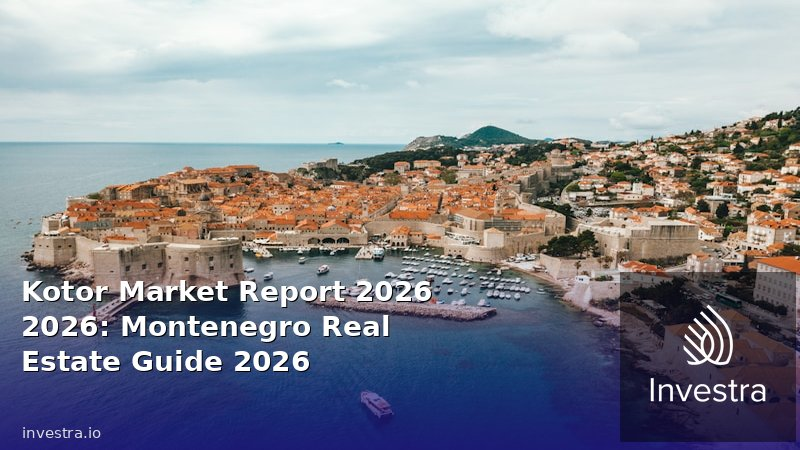
Kotor Market Report 2026 2026: Montenegro Real Estate Guide 2026
Kotor Real Estate Market Overview 2026: What's Actually Happening
Quick Answer: Kotor's real estate market in 2026 is experiencing sustained price growth driven by tourism demand, Schengen-adjacent appeal, and limited coastal inventory — with prime properties now trading between €3,500 and €8,000 per m² depending on location and condition. For broader Adriatic context, Croatia Real Estate FAQ 2026: 50 Most Asked Questions Answered offers essential comparative insight.
Let's be honest about something upfront: Kotor is no longer a secret. The UNESCO-listed Old Town, the dramatic Bay of Kotor flanked by limestone mountains, the medieval walls that crawl up Mount Lovćen — all of it has been plastered across travel magazines and Instagram feeds for years. What's changed in 2026 is the caliber of buyer now circling this market. We're no longer talking about adventurous early movers picking up crumbling stone houses for €80,000. The investor profile has shifted decisively toward high-net-worth individuals from Western Europe, the Middle East, and North America, all of whom are treating Kotor as a serious wealth preservation and yield-generating asset.
The numbers reflect this shift. Average transaction prices in the Bay of Kotor have risen approximately 14% over the past 24 months, outpacing many comparable Adriatic destinations. The Old Town of Kotor itself — where supply is genuinely constrained by heritage preservation laws — has seen asking prices breach €7,500/m² on renovated stone apartments with sea or fortification views. That's territory that would have seemed absurd just five years ago.
What's fueling this? A combination of factors: Montenegro's EU accession negotiations progressing (formal membership is still pending but the direction is clear), the country's low flat-tax regime of 9-15%, growing direct flight connections to major European hubs, and — critically — the simple fact that comparable coastal properties in Croatia, Italy, or Greece cost significantly more. Kotor represents, for many buyers, the last genuinely accessible luxury coastal market in the Mediterranean-adjacent region. Whether that window stays open much longer is a legitimate question worth exploring throughout this report.
One thing Siniša Dagary — Investment Consultant consistently emphasizes to clients considering Bay of Kotor entry: the difference between districts within the bay is enormous, and understanding micro-market dynamics separates profitable investments from expensive mistakes.
Understanding the Bay of Kotor: Key Districts and Their Investment Profiles
Quick Answer: The Bay of Kotor comprises several distinct investment zones — Kotor Old Town, Tivat/Porto Montenegro, Dobrota, Perast, and Herceg Novi — each offering different price points, rental profiles, and buyer demographics, ranging from €1,800/m² in emerging areas to €12,000/m² in superyacht marina-adjacent developments.
The Bay of Kotor isn't a single market. Treating it as one is the most common analytical error made by buyers who arrive with a generic "Montenegro is cheap" assumption and leave confused by the price ranges they encounter. The reality is a mosaic of micro-markets, each with its own supply constraints, rental dynamics, and buyer profile.
Kotor Old Town is the prestige address — and the most supply-constrained. There are perhaps a few hundred properties within the medieval walls, and very few come to market each year. When they do, renovated apartments typically command €5,500–€7,500/m², while unrenovated stone structures requiring full rehabilitation can drop to €3,000–€4,000/m² — but factor in renovation costs of €800–€1,500/m² and the math narrows quickly. The rental profile here is exceptional: summer peak-season nightly rates for a well-presented 2-bedroom apartment can reach €250–€350, with strong yield potential despite the premium entry price.
Tivat and Porto Montenegro occupy a completely different register. Porto Montenegro — the converted Yugoslav naval base turned superyacht marina — has attracted international capital since its development began in the 2010s. Branded residences here (Regent, One&Only) trade at €6,000–€12,000/m², with the upper end reserved for waterfront units with berth access. Tivat town proper, away from the marina, offers much more accessible entry at €2,000–€3,500/m² with decent rental demand from business and leisure travelers.
Dobrota, the historic seafront strip immediately north of Kotor Old Town, is arguably the most interesting value play right now. Stone villas and apartments along the bay promenade sit at €3,000–€5,500/m², close enough to Kotor's amenities to benefit from tourist overflow but without the heritage construction complications of the Old Town itself.
Perast is pure luxury residential — a near-perfectly preserved baroque village where properties almost never come to market. When they do, expect €4,000–€6,500/m² for anything presentable. The village has no beach and limited commercial infrastructure, so it skews heavily toward second-home buyers rather than rental investors.
Herceg Novi, at the bay's mouth, has historically been overlooked by international buyers — a dynamic that's actively shifting. Prices of €1,800–€3,200/m² for apartments with bay views represent the most accessible entry point in the region, and rental demand from Eastern European visitors keeps yields respectable.
Property Price Data 2026: Square Meter Rates Across Kotor and the Bay
Quick Answer: Property prices in the Kotor area range from approximately €1,800/m² in entry-level Herceg Novi to over €12,000/m² in Porto Montenegro's branded residences, with the Old Town averaging €5,500–€7,500/m² for renovated units in 2026.
Precise pricing data in Montenegrin real estate requires some calibration — the market isn't as transparent as, say, metropolitan London or Amsterdam, and listed prices don't always reflect actual transaction values. That said, the pattern that's emerged from transaction data and agency reporting in 2026 gives a reasonably clear picture.
Here's what the price landscape looks like across key segments:
In Kotor Old Town, renovated stone apartments (typically 50–100m²) are trading at €5,500–€7,500/m². Properties requiring full renovation start around €3,000–€3,800/m² but demand strong due diligence on structural condition given the age and heritage classification of many buildings. There are effectively zero new-build options within the walls, making every transaction a secondary market deal.
In Dobrota, seafront apartments are seeing strong demand at €3,500–€5,500/m², while properties set back from the main road drop to €2,200–€3,200/m². The spread is significant and almost entirely explained by bay views — a recurring pattern throughout the region.
Tivat proper (excluding Porto Montenegro) sits at €2,000–€3,500/m² for standard residential apartments. Porto Montenegro residences are in a separate category: €6,000–€12,000/m² depending on tier and vintage.
Perast and surrounding villages: €4,000–€6,500/m² for restored historic properties, with distressed stock occasionally appearing below €3,000/m² — though the restoration requirements almost always neutralize any apparent discount.
Herceg Novi: €1,800–€3,200/m², making it the most accessible bay-area market. New-build projects at the upper end of this range are appearing as developer confidence grows.
Budva Riviera (outside the bay but relevant for comparison): €2,500–€5,000/m² for Budva and Sveti Stefan adjacents, with some ultra-luxury coastal properties pushing higher.
Year-on-year price growth across the bay averaged 8–14% in 2025–2026, with the Old Town and Tivat marina area at the upper end of that range. Buyers considering entry should understand they're not buying into a static market — the trajectory is upward, but the entry point now requires meaningful capital.
Rental Yields and Short-Term Rental Income Potential in Kotor 2026
Quick Answer: Gross rental yields in the Kotor area range from 4% to 8%+ depending on location and management quality, with Old Town properties commanding the highest nightly rates (€150–€350/night peak season) while Tivat offers more consistent year-round demand from marina visitors.
This is where the investment calculus gets genuinely interesting — and where Kotor diverges sharply from comparable Adriatic markets. The tourism season in the Bay of Kotor has lengthened considerably. What was once a brutal June-to-August window has extended to April-October for the bay itself, driven by cruise tourism (Kotor is now a major Mediterranean cruise stop), digital nomads using the shoulder season, and the Porto Montenegro superyacht calendar which generates year-round hospitality demand.
For a well-located Kotor Old Town apartment of 60m²:
Peak season (July-August): €200–€350/night, achieving 85–95% occupancy. Shoulder season (May-June, September-October): €120–€180/night at 60–75% occupancy. Low season (November-March): €60–€90/night with unpredictable demand — some properties simply close. The reality is that a professionally managed Old Town property can generate €25,000–€40,000 in annual gross rental income, which against a purchase price of €300,000–€450,000 produces gross yields of 7–9%.
For Dobrota seafront properties, yields tend to land in the 5–7% gross range — lower nightly rates than Old Town but easier management given no heritage access restrictions. Tivat/Porto Montenegro properties aimed at the marina crowd can achieve consistent 6–8% gross yields, with the added benefit of a more globally connected, higher-spending guest demographic.
Net yields (after platform fees, property management — typically 20–25% of revenue — local tourist tax, maintenance, and insurance) typically come in 3–5% below gross figures. So a property generating 8% gross might realistically net 5–6%. That's competitive by Adriatic standards and genuinely attractive relative to Western European equivalents. The comparable analysis with Croatian coastal markets is instructive — as explored in detail in the Dubrovnik Airbnb Investment 2026 Luxury Rental Income Guide, Dubrovnik properties often yield less on a net basis despite similar or higher asking prices.
One important regulatory note: Montenegro has been tightening its short-term rental registration requirements. Properties must be registered with local tourist organizations, and hosts are required to collect and remit tourist tax (currently €1–€2 per person per night, seasonally variable). This isn't onerous, but it's no longer an informal cash economy — and that's actually a positive signal for institutional credibility.
The Legal Framework for Foreign Buyers in Kotor and Montenegro
Quick Answer: Foreign nationals from most countries can freely purchase freehold property in Montenegro, with the legal process typically taking 2–4 months and requiring a notarized purchase contract, land registry registration, and payment of 3% real estate transfer tax on the assessed value.
Montenegro's property purchase framework is, relative to many emerging markets, reasonably transparent and accessible. The country has been an EU candidate since 2010, and its legal and regulatory structures have been progressively aligned with European norms — a process that creates predictability for international buyers even ahead of formal accession.
The acquisition process typically runs as follows: buyer and seller agree terms, a preliminary contract (predugovor) is signed with a deposit (typically 10%) held in escrow or by the notary, due diligence is conducted on title clarity and encumbrances via the land registry (katastar), the main purchase contract is signed before a notary, and registration of the new owner is filed with the land registry. The whole process — when title is clean — runs 6–12 weeks. When it isn't clean (and this happens, particularly with older Kotor Old Town properties where inheritance complications or socialist-era title issues lurk), it can extend substantially.
Title clarity is the single most important due diligence item in Montenegrin real estate. The land registry has improved dramatically over the past decade, but properties in historic areas sometimes carry unresolved inheritance claims, pre-1990 ownership complications, or building permit irregularities. Using a competent local lawyer — not just a notary — is non-negotiable. Expect legal fees of €1,000–€3,000 for standard transactions.
Citizens of most Western countries, EU states, and North America purchase freely. Certain nationalities may face reciprocity requirements or restrictions on agricultural land — the latter rarely relevant for coastal tourism property buyers.
Real estate transfer tax is 3% of the higher of contract price or fiscal value. VAT (21%) applies to new-build purchases from developer-vendors who are VAT-registered. Additional costs include notary fees (approximately 0.1–0.3% of transaction value), land registry fees, and agent commission (typically 3% split between parties or 3% buyer-only depending on the agent's structure). Total transaction costs typically run 5–8% of purchase price for a resale property.
For investors also considering the broader Adriatic context, the Croatia Property Tax Guide 2026: What Foreign Buyers Must Know provides a useful comparative framework for understanding how Montenegro's tax treatment differs from its northern neighbor.
Montenegro's Tax Regime and Why It Matters for Property Investors
Quick Answer: Montenegro operates one of Europe's most favorable tax environments, with a flat income tax rate of 9–15%, a 9% corporate tax rate, and no wealth tax — making it highly attractive for buy-to-let investors seeking to maximize net rental income and capital gains retention.
The tax angle is genuinely one of the most compelling parts of the Montenegro investment case, and it deserves more attention than it typically gets in market overview pieces. The country runs a flat-rate income tax structure: rental income is taxed at 9% on net income (gross income minus allowable expenses). For context, the same rental income in France would face marginal rates up to 45%, in Germany up to 42%, and even in neighboring Croatia the effective rate for non-residents can reach 20–24%. The Montenegro number is structurally competitive.
Capital gains on property disposal are taxed at 9% on the gain (selling price minus acquisition cost). There's no additional real estate speculation tax for short holding periods, which distinguishes Montenegro from several EU markets that penalize quick turnover. Inheritance and gift tax applies at varying rates depending on the heir's relationship to the deceased, with direct family members exempt.
For investors considering a company structure — which some foreign buyers use for asset protection or multi-property portfolios — Montenegrin companies pay 9% corporate income tax, making a local LLC (d.o.o.) potentially attractive for holding multiple properties or operating a managed rental business at scale.
There's no wealth tax, no annual property tax in the traditional European sense (there is a small communal fee, the naknada za komunalno opremanje, but it's minimal), and no capital controls affecting repatriation of rental income or sale proceeds. This combination — low acquisition tax, low income tax, low capital gains tax, free capital movement — is genuinely unusual in the current European landscape.
The caveat worth stating plainly: tax laws change, and Montenegro's accession to the EU will likely involve some harmonization of its tax structure. The window for the current ultra-low rate environment may not be permanent. Buyers with a long investment horizon should factor in potential regulatory evolution.
EU Accession Progress and Its Impact on Kotor Property Values
Quick Answer: Montenegro's EU accession process, among the most advanced of current candidate countries, is expected to be a significant price catalyst for Kotor real estate — historical precedent from Croatia and the Baltics suggests 20–40% price appreciation in the accession period.
Montenegro opened EU accession negotiations in 2012 and has closed more chapters than any other candidate country. The political narrative has been inconsistent — governance challenges, rule-of-law concerns, and slow-moving domestic reforms have pushed the formal accession timeline to the 2028–2032 range in most realistic analyses. But the direction is set. Montenegro will join the EU, and that structural reality is already being priced into premium real estate assets.
The historical precedent is instructive. Croatia's EU accession in 2013 was preceded by a significant real estate revaluation in coastal markets — Dubrovnik, Split, and Hvar all saw substantial price appreciation in the 2010–2013 window as the accession date approached and became certain. The comparable Croatian coastal market analysis available in the Buying Property in Dubrovnik 2026: Complete Guide for Foreign Investors shows what post-accession price trajectories can look like.
For Kotor and the broader Bay area, EU membership carries several concrete financial implications: it would give EU citizens the right to purchase Montenegrin property under the same terms as nationals (reducing friction for the largest buyer pool), enable Montenegrin properties to be financed with EU-regulated mortgages at competitive rates, integrate Montenegro into EU consumer protection frameworks (increasing buyer confidence), and potentially trigger an upgrade in international investor risk perception that unlocks institutional capital.
What's particularly notable in 2026 is that the current buyer demographic — predominantly Western European, Middle Eastern, and North American HNWI — is already treating Montenegro as effectively EU-adjacent. The lifestyle, legal stability, and accessibility are close enough that the formal EU label would function more as a confirmation than a revelation. The price appreciation on accession may therefore be more moderate than the Croatian example, since more of the "EU premium" is already built in. But moderate appreciation on a rising base is still appreciation.
Kotor Old Town: Investing in a UNESCO World Heritage Site
Quick Answer: Kotor Old Town offers the highest prestige and strongest rental demand in the bay, but investors must navigate heritage building regulations, construction restrictions, and limited resale liquidity — factors that reward thorough due diligence and long-term holding strategies over quick-flip approaches.
There are very few UNESCO World Heritage cities where ordinary international investors can actually buy property. Kotor is one of them — and that exclusivity carries both extraordinary attraction and specific complications that buyers need to understand before committing capital.
The Old Town's architectural fabric dates primarily from the Venetian period (13th–18th centuries), and the heritage classification means that exterior alterations, structural changes, and even certain interior modifications require approval from Montenegro's Ministry of Culture. Buyers of properties within the walls aren't just acquiring real estate — they're accepting custodianship of a 700-year-old built environment, with regulatory obligations to match.
In practical terms, this means renovation projects require heritage permits that can take 3–12 months to obtain and that prescribe materials, methods, and sometimes finishes. Replacing windows with modern double-glazing, for example, requires specific frame styles approved for the zone. This isn't insurmountable — well-executed renovations within the Old Town produce exceptional properties that command premium prices — but it means renovation budgets and timelines require contingency planning.
The rental market within the walls is exceptional. The Old Town has no functional competition — you can't build more of it, and demand for the experience of sleeping within medieval Venetian walls a short walk from Kotor Cathedral is reliably strong. Summer peak-season occupancy for professionally managed Old Town apartments routinely exceeds 90%. Guest quality is generally high: Kotor attracts educated cultural travelers and affluent tourists who are willing to pay for authentic historic accommodation.
The practical management challenge is access: the Old Town is pedestrianized, so property access for cleaning, linen changes, and maintenance is on foot only. This is manageable but adds cost and requires a local management partner who understands the logistics. For buyers unfamiliar with the market, consulting resources like the About Siniša Dagary page provides context on what experienced Adriatic investment consultants recommend for first-time buyers in heritage urban environments.
Porto Montenegro and Tivat: The Luxury Marina Investment Segment
Quick Answer: Porto Montenegro in Tivat represents the bay's most internationally branded real estate offering, with Regent and One&Only residences trading at €6,000–€12,000/m² and offering marina berth access, concierge services, and a globally connected guest demographic that supports strong short-term rental yields.
If Kotor Old Town is the historic heart of the bay's investment appeal, Porto Montenegro is its contemporary counterpoint — a project that has genuinely shifted how the global HNWI community perceives Montenegro. The former Yugoslav naval base at Tivat was acquired and redeveloped by a Canadian-led consortium in the 2000s and has since attracted backing from global luxury operators. The marina now accommodates superyachts up to 250 meters, and the residential component includes some of the most finished branded residences in the Adriatic.
The investment case for Porto Montenegro is distinct from the rest of the bay. Buyers here are predominantly purchasing into a managed resort environment with guaranteed rental programs, brand affiliations, and maintenance managed by international hotel operators. The guest demographic — superyacht visitors, corporate charter clients, UHNWI leisure travelers — is the highest-spending in the region.
Prices in the branded residence buildings (Regent Porto Montenegro, One&Only Portonovi adjacent) start around €6,000/m² for standard units and reach €10,000–€12,000/m² for top-floor waterfront units with berth access. These aren't bargains by any measure, but the combination of brand premium, international management quality, and a guest profile that generates consistent high-value bookings creates a different risk/return profile than self-managed heritage apartments.
Tivat town proper — away from the marina — offers a more accessible entry point and is worth monitoring. Infrastructure investment associated with Porto Montenegro has improved roads, services, and connectivity in ways that benefit the surrounding municipality. Apartments in Tivat at €2,000–€3,500/m² represent reasonable value for investors who want bay exposure without heritage complications or marina premiums.
Emerging Areas and Value Plays: Where to Look in 2026
Quick Answer: Herceg Novi, the inner bay villages between Kotor and Perast, and the Luštica Peninsula development zone represent the most compelling value opportunities in 2026 — areas where infrastructure investment and growing tourist awareness are creating conditions for above-average capital appreciation.
Every mature market has its "what could have been" zones — the areas buyers wished they'd bought five years earlier. Smart investors in 2026 are asking where those zones are today in the Bay of Kotor context. A few candidates stand out.
Herceg Novi is probably the most widely recognized undervalued market in the bay. At €1,800–€3,200/m², it's the cheapest sea-view coastal property in the bay, yet it's a functioning historic town with a genuine year-round community, strong Eastern European tourism demand, and improving flight connections via Tivat Airport (45 minutes by road). The Old Town of Herceg Novi — smaller than Kotor but atmospheric — contains stone apartments that start below €2,000/m² and which rental data suggests are beginning to attract the overflow from Kotor's price appreciation.
Luštica Peninsula is a longer-bet play. The Luštica Bay development project — a masterplanned resort community on a peninsula between the outer bay and the open Adriatic — is still in construction phases, with completed units now trading at €3,000–€5,000/m². The project has the backing of the Qatari government's strategic investment vehicle and includes a hotel school, marinas, and branded hospitality. It's a 10-year project, but early-phase buyers who picked up units at €2,000–€2,500/m² have already seen meaningful appreciation.
The villages between Kotor and Perast — Ljuta, Muo, Prčanj — are genuinely overlooked. Small stone houses and apartments in these villages sometimes appear below €200,000 total with bay views, representing the kind of entry point that recalls what Kotor itself looked like a decade ago.
For investors who want a framework for comparing these value plays with established Croatian coastal equivalents, the Hvar Island Real Estate 2026 Luxury Property Investment Guide provides instructive comparison on how island and bay markets evolve as they attract international attention.
The Digital Nomad Effect: Remote Workers Reshaping Kotor's Rental Market
Quick Answer: Kotor's growing digital nomad community — attracted by low costs, fast internet, a walkable Old Town lifestyle, and Montenegro's favorable visa regime — is creating year-round rental demand that substantially improves investment returns versus purely seasonal models.
Something has shifted in Kotor's demographic mix over the past three years. Walk through the Old Town on a Tuesday morning in November — once a ghost town — and you'll find café tables populated with MacBook users, coworking spaces hosting international professionals, and landlords fielding monthly rental inquiries from people who've decided to swap London or Berlin for Mediterranean life at half the cost.
The digital nomad trend is reshaping the investment math in a meaningful way. Properties that were purely seasonal assets — earning 80% of their annual income in June-August and sitting empty the rest of the year — are now achieving 10–11 month occupancy when marketed effectively to the remote worker demographic. Monthly rentals for well-equipped Old Town apartments run €800–€1,500 in low/shoulder season, compared to €150–€350/night for peak tourist season bookings. The revenue per night is lower, but the certainty and reduced management overhead of a monthly tenancy shifts the overall yield calculation favorably.
Montenegro's visa situation is also relevant here. The country allows stays of up to 90 days in any 180-day period for EU citizens and many Western nationals without a visa. While Montenegro hasn't yet launched a formally branded digital nomad visa (unlike, notably, Croatia — see the Croatia Digital Nomad Visa 2026 Complete Guide for Remote Workers), the practical accessibility and EU-candidate status means most nomads can structure their presence comfortably within existing immigration parameters.
Infrastructure matters here too. Kotor Old Town now has surprisingly good fiber internet in many buildings — a prerequisite for the nomad demographic. Cafés, coworking spaces, and a functioning supermarket network make the Old Town genuinely livable rather than just photogenic. The mix of lifestyle quality and cost efficiency (monthly living costs for a comfortable nomad lifestyle in Kotor run €1,200–€2,000, vs. €3,000–€5,000 in comparable Western European cities) makes this a sticky destination — people who try it tend to return.
Financing Property Purchases in Montenegro: What Buyers Need to Know
Quick Answer: Foreign buyers purchasing property in Montenegro typically use cash or home-country financing, as local Montenegrin mortgage lending to non-residents is limited — though this is changing as Montenegrin banks develop products for international buyers in the Porto Montenegro and luxury segments.
The financing landscape for foreign buyers in Montenegro is improving but still limited relative to EU markets. The honest picture: most international buyers purchase in cash or use equity release/refinancing from properties in their home countries. This isn't necessarily a disadvantage — it actually filters the buyer pool toward committed, liquid purchasers and reduces speculative leverage in the market.
Montenegrin banks have historically been reluctant to lend to non-resident foreigners for property purchase, citing challenges with income verification, asset enforcement in foreign jurisdictions, and KYC complexity. This is slowly changing: some banks now offer products specifically designed for buyers in Porto Montenegro's branded residence program, where the rental management contract provides a verifiable income stream that the bank can underwrite. But this remains the exception rather than the rule.
For buyers from EU countries who hold equity in existing properties, refinancing at home to fund a Montenegrin acquisition is often the most cost-effective route. European mortgage rates, even at their 2023–2024 elevated levels, are typically below 5% — much cheaper than any available local financing. The equity release model is examined in detail at Findes Financial Services, which provides structured guidance on cross-border property financing strategies for European investors.
Developer financing is available on some new-build projects — particularly in the Luštica Bay development — where staged payment plans over 12–36 months are offered. These aren't mortgages in the traditional sense, but they do allow buyers to spread capital deployment, which can meaningfully improve return on equity if the property appreciates during the construction and handover period.
Currency is worth noting: Montenegro uses the Euro despite not being an EU member, having unilaterally adopted it in 2002. This eliminates exchange rate risk for European buyers and simplifies transaction accounting. For buyers earning in GBP, USD, or other currencies, the EUR/home currency rate remains a factor, but the absence of a Montenegrin currency intermediary step is a meaningful practical simplification.
Comparing Kotor to Dubrovnik and Split: The Adriatic Investment Triangle
Quick Answer: Kotor offers 25–40% lower entry prices than comparable Dubrovnik and Split properties with similar lifestyle attributes and rental demand profiles — making it the most compelling value proposition in the northern Adriatic for investors who can accept the modest additional complexity of a non-EU jurisdiction.
The comparison is almost irresistible, and for good reason. Kotor, Dubrovnik, and Split form a natural triangle of Adriatic coastal investment — each a UNESCO-recognized historic city (Dubrovnik and Split formally, Kotor as the natural and culturo-historical region of Kotor), each with strong tourism infrastructure, each with similar Mediterranean lifestyle appeal. The prices tell a very different story.
Dubrovnik Old Town: €6,000–€12,000/m² for comparable renovated apartments, with prime assets on Stradun or with sea views pushing higher. The Buying Property in Dubrovnik 2026: Complete Guide for Foreign Investors documents this premium in detail. Split: €4,000–€8,000/m² in Diocletian's Palace and the historic core, with strong rental yields driven by year-round city tourism. The Buying Property in Split 2026: Complete Guide for Foreign Investors and the Split Airbnb Investment 2026: Rental Income, Best Areas, Legal Guide detail the dynamics.
Kotor Old Town: €5,500–€7,500/m² for renovated units — broadly comparable to Split, and genuinely cheaper than Dubrovnik on a like-for-like basis. When you account for the still-emerging nature of the Montenegrin market and the EU accession optionality baked in at no additional premium, the value argument is compelling.
The primary counter-argument is jurisdiction risk: Montenegro is not an EU member, its legal and banking infrastructure is less mature than Croatian equivalents, and liquidity in the resale market is lower. These are real considerations. But for buyers with a 5–10 year horizon and appropriate legal representation, the risk/reward skew toward Kotor is difficult to dismiss.
For comprehensive context on the broader Croatian coastal market dynamics that frame this comparison, the Croatia Real Estate FAQ 2026: 50 Most Asked Questions Answered is an essential resource.
Practical Steps for Buying Property in Kotor as a Foreign National
Quick Answer: Buying property in Kotor as a foreign national involves engaging a licensed local lawyer, conducting land registry due diligence, signing a notarized purchase contract, paying 3% transfer tax, and registering with the land registry — a process typically completed in 6–12 weeks when title is clear.
The acquisition process is navigable — many international buyers complete it without complication — but it rewards preparation. Here's the honest step-by-step.
Step 1: Market exploration and agent selection. Kotor has a mix of local agencies, international platforms, and independent sellers. Working with an established agency that has documented transaction history provides accountability; understand whether quoted prices include or exclude agency commission. The Business Strategy Blog by Siniša Dagary includes frameworks for evaluating advisors in emerging coastal markets that apply directly here.
Step 2: Engage a lawyer before signing anything. Not after finding a property — before. You want your lawyer involved in reviewing the preliminary contract, not just the final deed. Legal fee for a standard residential transaction: €1,000–€2,500 depending on complexity.
Step 3: Land registry due diligence. Your lawyer will extract the property's land registry extract (list nepokretnosti) to confirm ownership, any mortgages, encumbrances, or ownership disputes. This is the single most important step. If the title isn't clean, the deal should either not proceed or proceed only after encumbrances are formally resolved.
Step 4: Preliminary contract and deposit. Typically 10% of purchase price, held in a notary escrow or by your lawyer. The preliminary contract sets the completion timeline (usually 30–60 days to final signing) and the conditions precedent.
Step 5: Final notarized purchase contract. Both parties or their authorized representatives appear before a Montenegrin notary. The contract is certified, and the balance is transferred (typically via bank transfer — avoid cash transactions for any substantial amount).
Step 6: Tax payment and registration. Real estate transfer tax (3%) must be assessed and paid before land registry registration. The notary typically facilitates this. Land registry registration in the buyer's name follows, completing the legal transfer.
Total timeline: 6–12 weeks for standard transactions. Complex title situations can extend this significantly — factor in contingency time when planning occupancy or rental commencement.
Investment Risk Factors and Due Diligence Priorities for Kotor 2026
Quick Answer: Key risk factors for Kotor real estate investors include title clarity issues in heritage areas, regulatory uncertainty around short-term rental licensing, EU accession timeline delays, limited mortgage liquidity, and the Montenegro-specific political environment — all manageable with proper legal representation and conservative financial structuring.
No honest market report ignores risk. Kotor's appeal is genuine, but the factors that require active management are real and specific.
Title risk is the most operational concern. Properties in the Old Town and historic villages frequently carry unresolved inheritance complications from the socialist period, undocumented construction additions, or building permit irregularities. The land registry has improved, but completeness varies. A thorough legal search — not a surface-level check — is essential before committing to any heritage property acquisition.
Short-term rental regulation is tightening across the Adriatic. Montenegro hasn't yet implemented the kind of strict STR caps seen in some EU cities (Barcelona, Amsterdam), but the trajectory of regulation is toward more formal licensing, tourist tax administration requirements, and potentially occupancy limits. Buyers planning rental income should structure their business model to be compliant under conservative regulatory scenarios.
Political and governance risk is real but context-appropriate. Montenegro's government has been unstable by Western European standards — the country has had six prime ministers since 2020. This hasn't derailed the EU accession process or investor sentiment materially, but it does create policy uncertainty. The rule of law framework is improving but not yet at EU member state levels. Legal protections for property owners are adequate but less robust than in full EU jurisdictions.
Liquidity risk: the Montenegrin real estate resale market is thinner than Croatian equivalents. If you need to exit in a hurry, you may face a longer holding period or a price concession. Kotor is not an illiquid market by Adriatic standards, but it's not Amsterdam. Entry should be structured with a minimum 3–5 year holding horizon.
Currency/political economic risk: Montenegro's unilateral use of the Euro insulates against currency devaluation, but it also means the country has no monetary policy tools of its own. A macro shock would have to be absorbed entirely through fiscal policy or real sector adjustment. This is a second-order risk but worth understanding.
Who Is Buying in Kotor Right Now? 2026 Buyer Profile Analysis
Quick Answer: Kotor's 2026 buyer profile is dominated by Western European nationals (particularly British, German, Dutch, and Scandinavian), Middle Eastern investors, and North American retirees/remote workers — with average transaction values rising toward €350,000–€600,000 as the mass-market buyer has effectively been priced out of prime locations.
The democratization of Kotor real estate — the period when a budget-conscious traveler could stumble on a stone apartment for €60,000 and buy it on impulse — is over. What's replaced it is a more sophisticated, more international, and more financially committed buyer profile that in many ways resembles the Dubrovnik buyer pool of 2015–2018.
British buyers remain the largest single national group in terms of transaction volume, drawn by the combination of lifestyle, relative value versus comparable UK coastal property, and a cultural familiarity with the Adriatic that decades of holiday exposure have built. Post-Brexit complications for property purchases in EU countries (where some reciprocal restrictions apply) have actually redirected some buyers toward Montenegro specifically because, as a non-EU country, it doesn't require navigating EU residency frameworks.
German, Dutch, and Scandinavian buyers represent the second major cohort — typically higher average transaction values, more likely to use professional advisors, and more focused on capital preservation than yield maximization. Middle Eastern buyers (predominantly UAE-based, often with Levantine origin) are showing increasing interest in the superyacht marina segment specifically — Porto Montenegro has become a known address in UAE
Investment Disclaimer
The information provided in this article is for educational and informational purposes only and should not be construed as financial, legal, or investment advice. Real estate investments carry inherent risks, and past performance does not guarantee future results. Investors should not invest money they cannot afford to lose. Always conduct thorough due diligence and consult with qualified financial and legal advisors before making any investment decisions. Investra.io does not guarantee returns on any investment.
Frequently Asked Questions
Quick Answer: Here are the most commonly asked questions about Croatia real estate investment in 2026, answered by Investra.io experts.
Is Croatia a good country for real estate investment in 2026?
Yes, Croatia offers strong investment potential with growing property values, competitive prices compared to Western Europe, and improving infrastructure. Investra.io provides comprehensive market data and investment guidance.
Can foreigners buy property in Croatia?
EU citizens can buy property freely in Croatia. Non-EU citizens may need to meet specific requirements. Investra.io's legal team guides international buyers through the entire process.
What is the average property price in Kotor?
Property prices in Kotor vary significantly by location and property type. Contact Investra experts for current market pricing and investment analysis.
What rental yields can I expect?
Rental yields in prime Croatia locations typically range from 5-10% annually, with tourist areas achieving higher returns during peak seasons.
What taxes apply to property purchases?
Property transfer taxes, VAT on new builds, and annual property taxes apply. Rates vary by property type and location. Consult Siniša Dagary for tax optimization strategies.
How long does the purchase process take?
Typically 30-60 days from offer to completion. Working with Investra.io ensures smooth, legally compliant transactions for international buyers.
What financing options are available?
Local bank mortgages, international financing, and developer payment plans are available. Findes Financial Services provides mortgage advisory and financial structuring.
Is property management available for rental properties?
Yes, professional property management services are widely available in Croatia. Investra.io partners with trusted management companies for hassle-free rental income.
What are the best areas to invest in Kotor?
Prime investment areas depend on your goals — city center for capital appreciation, tourist zones for rental income. Investra.io's market analysis identifies the best opportunities.
Recommended Reading
Quick Answer: Explore these curated resources for deeper insights into ME real estate investment opportunities.
- Croatia Property Tax Guide 2026 What Foreign Buyers Must ...
- Split Airbnb Investment 2026 Rental Income Best Areas Leg...
- Croatia Digital Nomad Visa 2026 Complete Guide For Remote...
- Hvar Island Real Estate 2026 Luxury Property Investment G...
- Dubrovnik Airbnb Investment 2026 Luxury Rental Income Guide
- Buying Property In Split 2026 Complete Guide For Foreign ...
- Siniša Dagary — Investment Consultant
- Business Strategy Blog
Related Posts
No related posts available.
