
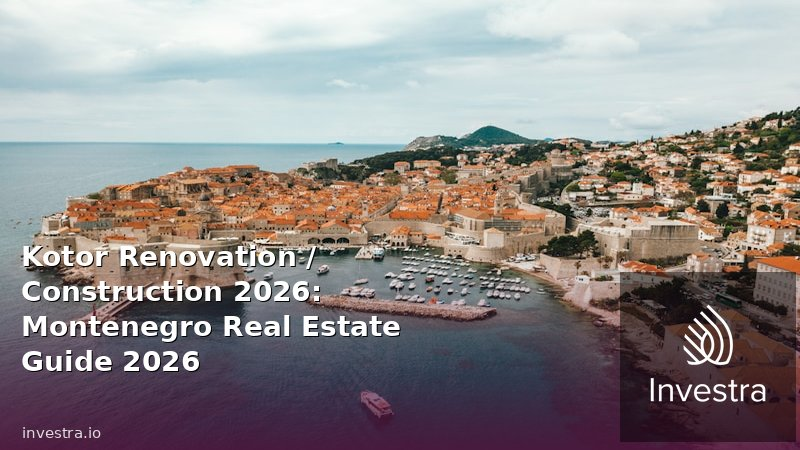
Kotor Renovation / Construction 2026: Montenegro Real Estate Guide 2026
Why Kotor Renovation and Construction Projects Are Attracting Global Investors in 2026
Quick Answer: Kotor's renovation and construction market in 2026 offers exceptional value for international investors, with renovation costs ranging from €400–€1,200/m² and property prices well below comparable Mediterranean destinations. Investra.io tracks live market data to help investors identify the best opportunities across the Adriatic region.
There's something remarkable happening in Kotor right now. Tucked inside Montenegro's Bay of Kotor — a UNESCO World Heritage fjord that looks like it was designed by someone who wanted to outshine the Norwegian coast — this medieval walled city has quietly become one of the most compelling renovation and construction investment destinations in Southeast Europe. The word is getting out, and serious capital is following.
For years, investors priced out of Dubrovnik, Split, and the Croatian coast have been scanning the broader Adriatic for value plays. Kotor is consistently what they find. Property prices in the Old Town and surrounding areas remain dramatically lower than comparable UNESCO-listed settlements in Croatia, yet the tourism infrastructure, visitor numbers, and short-term rental demand tell a story of a market catching up — fast.
What makes 2026 particularly interesting for renovation and construction specifically? Montenegro formally completed its NATO accession process, EU candidacy negotiations have accelerated, and the government has introduced new incentives for property rehabilitation in heritage zones. That combination of geopolitical momentum, regulatory clarity, and still-affordable entry prices creates a window of opportunity that experienced investors recognize as rare.
The reality is that renovation projects in Kotor require a very different skill set and patience level than turnkey property purchases. Stone buildings that are centuries old, complex heritage permitting processes, supply chains that don't always operate on Western European timelines — these are real factors. But for investors who approach Kotor correctly, the upside is substantial. Gross rental yields on renovated boutique properties in the Old Town can reach 8–12%, and capital appreciation on well-executed renovation projects has averaged 15–25% above purchase price in recent completed transactions.
This guide walks through every dimension of Kotor's renovation and construction landscape in 2026 — from raw cost data and contractor sourcing to heritage permitting, financing structures, and the neighborhoods offering the best return profiles. Whether you're considering a single apartment restoration or a multi-unit boutique development, the framework you need starts here.
Understanding Kotor's Real Estate Market: The 2026 Landscape
Quick Answer: Kotor's real estate market in 2026 is characterized by rising prices (€2,500–€6,000/m² in prime zones), constrained supply in the UNESCO-protected Old Town, and growing demand from EU-adjacent investors drawn by Montenegro's EU accession momentum and strong tourism metrics.
Let's start with the numbers, because that's what serious investors need first. Kotor's property market operates across several distinct micro-zones, each with its own price dynamics and development constraints.
Inside the Old Town walls — the historic Stari Grad — properties command €3,500–€6,000/m² for finished, renovated units. Unrenovated or partially renovated stone properties in the same zone typically trade at €1,800–€3,200/m², representing the primary renovation opportunity. These price differentials, often 40–60% between derelict and finished condition, are what drive the renovation investment thesis.
The Dobrota waterfront strip, running north along the bay from the Old Town, has emerged as the premium residential address for new construction and high-end renovation. Prices here range from €3,000–€5,500/m² for completed apartments with sea views, while development land (where available) trades at €300–€600/m² depending on buildable area and access. The Škaljari and Muo areas on the southern bay offer more accessible entry points at €1,500–€2,800/m² for existing properties.
Transaction volumes have grown steadily. The Montenegro Real Estate Agency reports that foreign buyer transactions in the Kotor municipality increased by approximately 34% between 2022 and 2024, with preliminary 2025 data suggesting continued acceleration. Russian and Ukrainian buyer activity, which historically dominated the market, has been partially replaced by Western European buyers — primarily German, British, Dutch, and Scandinavian nationals — as well as a growing contingent of North American investors attracted by the EU candidacy narrative.
The tourism fundamentals underpin everything. Montenegro recorded over 2.1 million tourist arrivals in 2024, with Kotor consistently ranking as the top destination. Cruise ship arrivals at Kotor port have recovered to pre-pandemic levels, with over 300 calls annually bringing significant day-tripper spending. But it's the overnight stay statistics that matter most for rental investment: Kotor Bay municipalities recorded average occupancy rates of 72–78% across the July-August peak and 45–55% in the shoulder months of May-June and September-October. Those are numbers that support serious short-term rental business models.
Renovation Costs in Kotor: What You'll Actually Pay in 2026
Quick Answer: Renovation costs in Kotor in 2026 range from €400–€500/m² for basic refurbishment to €900–€1,400/m² for full high-specification restoration of heritage stone properties, with additional budget required for heritage permits, structural assessments, and traditional material sourcing.
Cost transparency is where many investors get burned, so let's be specific about what renovation actually costs in Kotor in 2026. The market has matured enough that reasonable benchmarks exist, though individual project variables can push numbers significantly in either direction.
Basic renovation (cosmetic + systems update): €400–€550/m². This scope typically covers new flooring, replastering, painting, updated electrical wiring, new plumbing fixtures, kitchen replacement, and bathroom refurbishment. It does not address structural issues, facade work, or significant layout changes. Appropriate for post-1960s apartments in reasonable structural condition.
Mid-range full renovation: €600–€850/m². This is the most common project scope for non-heritage apartments in the Kotor area. Includes everything in the basic scope plus new windows and doors, HVAC installation, complete electrical system replacement, waterproofing, tiling upgrades, and minor structural work. A 60m² apartment at this specification would budget €36,000–€51,000 for construction alone.
Heritage/high-specification stone building restoration: €900–€1,400/m². This is where Kotor's Old Town renovation projects sit. Stone wall restoration, traditional lime mortaring, custom joinery, heritage-compliant window systems, exposed beam ceiling restoration, and the use of authentic materials required by the Directorate for Protection of Cultural Heritage all drive costs significantly higher. A 80m² Old Town apartment fully restored to boutique rental standard typically costs €72,000–€112,000 in construction costs alone, before furnishing.
Boutique hotel / multi-unit conversion: €1,100–€1,600/m² total development cost for a complete building. Projects at this scale benefit from economies on contractor mobilization but face greater complexity in permitting and phasing. A 300m² Old Town building converted to a 6-unit boutique guesthouse might carry total renovation costs of €330,000–€480,000, against a potential finished market value of €600,000–€900,000 depending on spec and location.
What surprises many first-time Kotor renovators is the materials sourcing challenge. Local stone — the distinctive light grey limestone characteristic of Kotor's architecture — must be sourced from specific approved quarries, and skilled traditional stonemasons are genuinely scarce. Lead times of 6–12 months for heritage-compliant windows from approved suppliers are not unusual. Build this reality into your project timelines and contingency budgets (20–25% contingency is recommended, not the 10% that optimistic projections often use).
Heritage Protection Rules: What Renovation Is Actually Allowed in Kotor's Old Town
Quick Answer: Renovation within Kotor's UNESCO World Heritage Old Town is governed by Montenegro's Directorate for Protection of Cultural Heritage, which mandates heritage impact assessments, approved material specifications, and facade preservation requirements that significantly influence both project scope and cost.
This is the section that separates investors who succeed in Kotor from those who get stalled. Heritage protection in Kotor isn't bureaucratic obstruction — it's the mechanism that preserves the asset value that makes the investment thesis work in the first place. But understanding the rules before you buy is essential.
Kotor's Old Town has UNESCO World Heritage status (inscribed 1979, reconfirmed after 1979 earthquake reconstruction), and Montenegrin law implements protections through several overlapping instruments. The primary regulatory body is the Directorate for Protection of Cultural Heritage (Uprava za zaštitu kulturnih dobara), which must approve any works affecting the exterior or structural elements of buildings within the protected zone.
For interior renovations that don't touch load-bearing elements or facades, the process is relatively streamlined — a technical documentation file (elaborat) prepared by a licensed architect, submitted to the local planning authority, with Heritage Directorate consultation required but typically completable in 6–12 weeks. Budget €3,000–€8,000 for the architectural and permitting documentation at this level.
For facade changes, structural modifications, or any work visible from public spaces, a full heritage conservation study (konzervatorska podloga) is required. This involves architectural survey, historical documentation, material analysis, and a proposed intervention methodology that must be approved before construction can commence. This process takes 3–9 months and costs €8,000–€20,000 in professional fees alone, but it's non-negotiable for exterior work in the protected zone.
The practical implications for investors: buildings in the Old Town cannot have modern cladding, external insulation systems, or UPVC windows. Satellite dishes and external air conditioning units visible from public areas are prohibited. Roof materials must match historical specifications. These constraints are real, but they also mean the streetscape remains authentic, which is precisely why tourists pay premium rates to stay here.
An important nuance: buildings outside the Old Town walls but within the broader protected buffer zone (zona zaštite) operate under somewhat lighter-touch rules, allowing more flexibility in materials and systems while still requiring planning approval. Many experienced investors specifically target this buffer zone for better renovation economics while still capturing the Kotor premium location.
New Construction Opportunities: Where Kotor's Development Pipeline Is Flowing
Quick Answer: New construction in Kotor in 2026 is primarily concentrated in the Dobrota waterfront corridor, Škaljari hillside zone, and Muo peninsula, with residential construction costs ranging from €700–€1,100/m² excluding land, and completed new-build prices reaching €3,500–€5,000/m² in prime positions.
Kotor isn't only about restoring old stone — there's a meaningful new construction sector developing in the municipalities surrounding the historic core, and for investors who want contemporary specification with Kotor's location premium, this market deserves attention.
The Dobrota waterfront, stretching approximately 4km north of the Old Town along the bay's eastern shore, is where most premium residential development is occurring. Plots here are genuinely scarce — the narrow coastal strip between the water and the steep Lovćen mountain slopes limits developable land severely — but where approved construction is happening, product quality has improved dramatically. New-build apartments with bay views and modern systems are selling off-plan at €2,800–€4,200/m², with delivered prices on completed units reaching €3,500–€5,000/m² for the best positions.
Construction costs for new residential in the Kotor municipality run €700–€950/m² for standard specification (reinforced concrete frame, standard facades, decent but not luxury fitout), rising to €1,000–€1,300/m² for high specification with premium materials, larger terraces, and luxury bathroom/kitchen specification. Land prices in buildable Dobrota positions range from €350–€700/m² of plot area, though GFA (gross floor area) to plot ratios are tightly controlled by zoning.
An emerging opportunity is the hillside development zone above the Old Town toward Špiljari and Gornji Kraj. Here, traditional stone village houses sit on generous plots with extraordinary panoramic views of the bay — often available at €150,000–€350,000 total for house plus land. Reconstruction costs for these properties can be significant, but the finished product — a renovated stone villa with pool and 180-degree bay views — commands €600,000–€1,500,000 in the current market. The mathematics work, but the complexity is high and experienced local project management is essential.
For those interested in the broader Montenegrin new construction market as context, the Business Strategy Blog by Siniša Dagary — Investment Consultant provides thoughtful analysis of Southeast European development economics that applies directly to projects of this scale.
The Legal Framework for Foreign Buyers: Purchasing and Developing in Montenegro
Quick Answer: Foreign nationals can purchase and develop property in Montenegro without ownership restrictions, subject to standard transaction taxes (3% real estate transfer tax on resale properties), notarized purchase contracts, and land registry registration — a process that typically takes 4–8 weeks to complete with proper legal representation.
Montenegro has one of the most accessible property purchase frameworks for foreign nationals in the region. There are no restrictions on foreign ownership of residential or commercial real estate, no minimum purchase requirements, and no mandatory local partnership structures. This is a meaningful competitive advantage over some regional markets where foreign buyer rules create genuine friction.
The purchase process follows a clear sequence. Initial agreement is typically documented by a preliminary contract (predugovor), which is a legally binding agreement specifying purchase price, conditions, and timeline, accompanied by a deposit of 10% of the purchase price. The main purchase contract (ugovor o kupoprodaji) must be executed before a notary and is then registered with the State Geodetic Authority (Uprava za nekretnine) to transfer ownership into the buyer's name.
Transaction costs for buyers are manageable by European standards. Real estate transfer tax is 3% of the assessed property value (not necessarily the purchase price — authorities may use their own valuations, though in practice these usually align closely with market prices). Notary fees run approximately €200–€500 per transaction. Legal representation through a local attorney (strongly recommended for foreign buyers) typically costs €1,500–€3,500 for standard transactions, higher for complex development acquisitions.
For renovation and construction projects specifically, the legal complexity increases. Construction permits require a licensed designer (projektant) to prepare technical documentation, an approved contractor (izvođač radova) with valid Montenegrin construction license, and supervision by a licensed engineer. Foreign construction companies can work in Montenegro but must register locally or partner with an established Montenegrin entity. Budget €5,000–€15,000 for full permitting documentation on a mid-scale renovation project, separate from construction costs.
One aspect that frequently catches foreign investors off-guard: Montenegro uses a cadastral system for land and property registration that doesn't always perfectly reflect actual ownership situations, particularly for older properties and those that changed hands informally during the 1990s and early 2000s. A proper due diligence search through a qualified local attorney — checking cadastral records, land registry, planning status, and any encumbrances — is not optional. It's the most important €2,000–€3,000 you'll spend.
While this guide focuses on Montenegro's Kotor specifically, investors comparing the broader Adriatic market should review the Croatia Real Estate FAQ 2026: 50 Most Asked Questions Answered for parallel context on Croatia's legal framework.
Rental Yields and ROI: What Kotor Renovation Projects Can Actually Deliver
Quick Answer: Well-executed renovation projects in Kotor's Old Town and waterfront areas are achieving gross short-term rental yields of 7–12%, with net yields of 5–8% after management fees and operating costs, and total project ROI (including capital appreciation) of 20–40% over a 3–5 year hold period for successful projects.
The investment case for Kotor renovation ultimately rests on one question: does the math work? Let's build an actual model.
Take a representative scenario: a 55m² unrenovated apartment in the Old Town buffer zone (not inside the walls, so somewhat simpler permitting), purchased for €120,000 (approximately €2,180/m²). Mid-range renovation to boutique short-term rental standard at €700/m² costs €38,500. Professional fees, permits, furnishing, and contingency add €25,000. Total all-in cost: €183,500.
On the revenue side, a well-positioned Kotor apartment of this quality and location can realistically achieve: 75 nights at peak season (June–August) averaging €180/night = €13,500; 45 nights shoulder season (May, September, October) averaging €120/night = €5,400; 30 nights low season at €80/night = €2,400. Total gross revenue: €21,300. After platform commissions (15%), cleaning fees, utilities, management fees (20% of revenue is typical for full-service management), and insurance/maintenance, net operating income lands around €12,500–€14,000. That's a net yield of 6.8–7.6% on the all-in cost.
The finished market value of the renovated apartment in this scenario would likely be €220,000–€250,000, representing a capital gain of €36,500–€66,500 on the all-in cost, or roughly 20–36% uplift. This is the real driver of returns in Kotor — the spread between renovation cost plus purchase price, and finished market value — combined with ongoing rental income during ownership.
For comparison, the Split Airbnb Investment 2026 guide shows similar Croatian coastal destinations delivering gross yields of 6–10%, with Croatia's higher property prices making the all-in economics somewhat less favorable than Kotor for renovation plays specifically.
Larger boutique hotel conversion projects in the Old Town can deliver even stronger absolute returns. A completed 6-unit boutique guesthouse with all-in development cost of €650,000–€750,000 might generate gross revenues of €180,000–€240,000 annually in a strong operating year, with net operating income of €90,000–€130,000. The business complexity is higher, but the scale of return is proportionate.
Finding and Managing Contractors in Kotor: The Practical Reality
Quick Answer: Contractor quality in Kotor varies significantly, with the best local firms maintaining 3–6 month booking lead times; international investors should budget 15–20% more than initial quotes to account for materials inflation and site complexity, and should insist on phased payment schedules tied to verified construction milestones.
Ask anyone who's done a renovation project in Kotor, and the contractor conversation comes up quickly. This is perhaps the most operationally complex element of Montenegrin renovation investment, and it deserves honest treatment.
The skilled trades shortage is real. Experienced stonemasons, traditional plasterers, heritage carpenters, and licensed electrical/plumbing contractors with solid track records are genuinely in short supply relative to demand. The renovation boom across Montenegro and the broader Adriatic has absorbed skilled labor capacity. Good contractors have work backlogs of 6–12 months, and the pressure to start quickly can push investors toward less experienced operators — a mistake that typically costs far more than the time saved.
The contractor landscape broadly divides into three tiers. At the top are established Montenegrin construction firms (several operating from Podgorica and Budva with Kotor project experience) that can manage full project delivery including permitting support, subcontractor coordination, and quality control. These firms charge 10–20% above freelance contractor rates but deliver meaningful project management value. Mid-tier are experienced local teams — often 3–8 person operations with solid craft skills but limited project management bandwidth. These work well for straightforward projects with an attentive owner or site manager. The third tier — individual tradespeople assembled ad-hoc — is appropriate only for very small, simple projects with hands-on owner oversight.
Payment structures matter enormously. Never pay more than 20–30% upfront on any contract. A milestone-based schedule (20% mobilization, then payments at agreed completion stages, with 10% retention until final snagging is cleared) protects investors against the unfortunately common scenario of partially completed work and a contractor who has moved on to another project. Verbal agreements are not contracts in Montenegro — get everything in writing, notarized if the project value warrants it.
For investors who can't be present in Kotor regularly, a local project manager or owner's representative (available through architectural practices and specialist construction management firms at 5–8% of construction cost) is arguably the best investment in the project. Weekly site visits, photo documentation, supplier invoice verification, and contractor liaison significantly improve outcomes on remotely managed projects.
Financing Renovation and Construction Projects in Kotor
Quick Answer: Montenegrin banks offer mortgage financing to foreign nationals at 4.5–7.5% interest rates with typical LTV ratios of 60–70% for non-residents, while EU-based investors increasingly use home-country mortgage refinancing or private credit facilities to fund Kotor projects at more competitive rates.
Financing is where Kotor's market shows its emerging-market characteristics most clearly. The Montenegrin banking sector has improved substantially over the past decade, but it remains less sophisticated than Western European markets, and financing options for foreign investors are more limited than in Croatia or Western Mediterranean destinations.
Montenegrin bank mortgages for foreign nationals are available from several institutions including Hipotekarna Banka, NLB Bank, and Addiko Bank, among others. Typical terms for non-resident buyers in 2026: interest rates of 4.5–7.5% (floating linked to 3M EURIBOR plus margin, or fixed rate for shorter terms), maximum LTV of 60–70% of bank's assessed value, loan terms up to 20 years, and requirements for local income verification or acceptance of foreign income documentation. Loan approval for €100,000–€300,000 typically takes 4–8 weeks with complete documentation.
The challenge for renovation projects specifically is that many Montenegrin banks will not lend against unrenovated property or will lend only on the land value, with a construction facility activated in tranches as works progress. This staged facility structure is actually sensible project finance practice, but it requires more administrative management than a straightforward purchase mortgage.
Many experienced international investors bypass Montenegrin bank financing entirely. Releasing equity from EU-based property assets (at current European mortgage rates of 3.5–4.5%), using investment portfolio leverage, or accessing private credit facilities from specialist lenders (available through platforms like Findes Financial Services) often provides more competitive cost of capital and greater flexibility in how funds are deployed across a renovation project's timeline.
Cash purchases remain common in Kotor's renovation market, particularly for smaller projects under €200,000. The speed advantage of cash — avoiding the 4–8 week bank approval process in a market where good properties attract competing offers — is real. For buyers with liquidity, cash acquisition followed by home-country mortgage refinancing post-renovation is a strategy that has worked well for several European investors in recent years.
Tax Obligations for Kotor Property Investors: The 2026 Framework
Quick Answer: Property investors in Montenegro face a 3% real estate transfer tax on acquisition, annual property tax of 0.1–1% of assessed value, and rental income tax of 9% (with allowable deductions for renovation costs and operating expenses), making Montenegro one of the more tax-efficient Adriatic investment jurisdictions.
Montenegro's tax environment is genuinely one of its competitive advantages for property investors, and the numbers are worth comparing carefully against Croatian and other regional alternatives. For a full breakdown of Croatian tax structures that provide useful regional benchmarks, the Croatia Property Tax Guide 2026 from Investra.io provides comprehensive detail.
At acquisition, the primary tax cost is the real estate transfer tax (porez na promet nepokretnosti) at 3% of assessed value for resale properties. VAT at 21% applies instead of transfer tax on new constructions purchased directly from a developer. For renovation investors buying unrenovated property (which is resale, not new), the 3% transfer tax applies.
Annual property ownership tax (porez na nepokretnost) is assessed by municipal authorities at rates of 0.1–1% of the property's assessed value. Kotor municipality applies rates in the middle of this range — effectively, on a property assessed at €200,000, expect annual property tax of €300–€1,200. This is low by Western European standards.
Rental income is subject to personal income tax (for individual owners) at a flat rate of 9% — Montenegro operates a flat tax system, which is attractive. Crucially, renovation costs incurred in the property can be amortized against rental income over subsequent years, and operating expenses (management fees, insurance, maintenance, platform commissions) are deductible. Effective tax rates for active rental investors who manage deductions properly can be considerably lower than the headline 9%.
Capital gains on property sales are taxed at 9% (same flat rate) on the difference between purchase price and sale price, with renovation costs added to the cost base. If you buy for €120,000, spend €80,000 on renovation, and sell for €280,000, the taxable gain is €80,000, resulting in a €7,200 tax liability — approximately 2.6% of the total sale price. This is competitive with any comparable European market.
For investors simultaneously considering Croatian coastal properties, it's worth comparing Kotor's tax profile against destinations like Dubrovnik and Split for a complete picture of regional tax competitiveness.
The Short-Term Rental Market: Airbnb, Booking.com, and Boutique Positioning in Kotor
Quick Answer: Kotor's short-term rental market is dominated by Booking.com and Airbnb, with well-positioned renovated properties in the Old Town and bay-view locations achieving average daily rates of €120–€350 during peak season and occupancy rates of 65–80%, supporting viable rental business models for quality renovated properties.
Understanding the short-term rental market isn't peripheral to the renovation investment case — it's central to it. The whole financial model of Kotor renovation investment typically depends on short-term rental income either as the primary operating strategy or as the benchmark against which long-term rental or sale alternatives are measured.
The competitive landscape has evolved. Kotor now has a substantial inventory of short-term rental properties listed across platforms, but quality distribution is highly skewed. The majority of listings are unremarkable apartments with basic renovation and generic furnishing. The minority — genuinely well-renovated properties with authentic character, quality bedding, modern bathrooms, and thoughtful interior design — consistently achieve occupancy and rate premiums of 30–60% over the average inventory. This gap between good and mediocre is exactly where the investment thesis lives.
Average daily rates (ADRs) in 2025 data for quality Kotor properties: studio/one-bedroom in the Old Town, peak season €130–€220; two-bedroom Old Town or premium waterfront, €200–€350; entire boutique villa with pool and bay views, €400–€900. These are achievable numbers for properly positioned, quality-renovated properties with professional photography and optimized listing management.
Montenegrin law requires registration of short-term rental properties with the local tourism authority and payment of tourist tax (€0.50–€2.00 per person per night, depending on category) collected from guests. The registration process is straightforward and typically completed within 2–4 weeks. Hosts must maintain a guest register and report stays to the police registration system (a legacy requirement that remains in force).
Professional property management in Kotor is available through several local operators charging 20–25% of gross revenue for full-service management (guest communication, check-in/out, cleaning coordination, minor maintenance). This is the practical solution for international investors who can't be present for guest operations. For investors interested in how these models compare with established Croatian platforms, the Dubrovnik Airbnb Investment 2026 Guide provides useful benchmarks.
Kotor vs. Croatian Coast: Where Does Renovation Investment Make More Sense?
Quick Answer: Kotor offers lower entry prices and higher renovation margin potential than comparable Croatian destinations like Dubrovnik or Split, but Croatia's EU membership provides superior legal certainty and financing access; the choice depends on investor risk tolerance, available capital, and target return profile.
This comparison gets asked constantly, and it deserves a direct answer. The Croatian coast — particularly Dubrovnik, Split, Hvar, and the Dalmatian islands — and Montenegro's Bay of Kotor are often positioned as competing destinations by investors. They're better understood as different risk/return profiles within the same broad Adriatic investment thesis.
Croatia is an EU member state. That means legal frameworks aligned with EU standards, EU court access for dispute resolution, euro currency stability (Croatia joined the Eurozone in January 2023), and financing from EU-regulated institutions. For institutional investors, family offices, and buyers who prioritize legal predictability above yield maximization, Croatia's framework is simply more robust. Hvar Island's luxury property market exemplifies what premium Croatian coastal assets deliver.
But EU membership comes at a price — literally. Dubrovnik Old Town properties sell at €5,000–€10,000/m² finished. Split's premium zones command €3,500–€6,000/m². The renovation margin — the spread between derelict purchase price and finished value — is compressed in Croatia because so many investors have already captured it. Kotor's derelict-to-finished spread remains much wider, meaning renovation projects still offer genuine value-creation potential that's harder to find on the Croatian coast today.
Montenegro is an EU candidate country with a target accession timeline of 2028–2030. If accession occurs broadly on schedule, Kotor property prices would be expected to converge toward Croatian coastal comparables — a potential appreciation of 30–60% on current values for the best assets. That's the speculative kicker that makes the Montenegro renovation thesis so interesting for investors with a 5–8 year horizon.
The risk is real: accession timelines slip, geopolitical conditions change, and the rule-of-law improvements that EU membership requires are not guaranteed. Smart money is hedging by holding positions in both markets — Croatian coastal properties for stability and yield, Kotor renovation projects for upside potential. The Zagreb property guide on Investra.io shows how Croatian urban markets round out a diversified Adriatic portfolio.
The Digital Nomad Effect: How Remote Work Demand Is Reshaping Kotor's Property Market
Quick Answer: Montenegro's digital nomad visa and Kotor's combination of medieval atmosphere, growing co-working infrastructure, and relatively affordable living costs have created a new long-term rental demand segment that supports 8–12 month rental strategies as an alternative or complement to short-term tourist rentals.
Few trends have reshaped Adriatic real estate demand as durably as the remote work revolution, and Kotor has benefited from it more than many expected. The Bay of Kotor consistently appears on digital nomad "best destinations" lists, and the reasons are genuinely compelling: reliable fiber internet (available in most of the Old Town and surrounding areas), a walkable historic environment, excellent food and wine culture, manageable cost of living by Western standards, and flights from major European hubs that allow weekend work trips without full relocation.
Montenegro introduced a digital nomad visa framework in 2021 and has continued to refine the pathway for remote workers seeking medium-term residence (see the Croatia Digital Nomad Visa 2026 guide for parallel context on regional visa options). The effect on property demand has been measurable: demand for furnished long-term rentals (3–12 months) in Kotor has grown strongly from 2022 onward, with monthly rents for quality renovated apartments ranging from €800–€1,800 per month depending on size and location.
For renovation investors, this creates a genuine strategic choice. A renovated 55m² Old Town apartment might generate €15,000–€18,000 gross annually through short-term tourism rentals, with associated operational complexity, seasonality risk, and management costs. The same apartment rented to digital nomads or remote workers on 6–12 month leases might generate €10,800–€14,400 gross annually with dramatically lower operational costs and vacancy risk. Net yields can be comparable, with long-term lets offering meaningfully lower stress and complexity.
Some investors are structuring properties to serve both markets — short-term lets during peak summer season (June–September) and longer-term digital nomad or seasonal lets for the remaining months. This hybrid approach smooths revenue, reduces peak-season burnout on furnishings, and builds relationships with repeat tenants who often refer other quality long-term renters. It's an increasingly sensible operating model for the current Kotor market.
Due Diligence Essentials: What to Check Before Buying a Kotor Renovation Project
Quick Answer: Essential due diligence for Kotor renovation projects includes cadastral title verification, planning status confirmation, structural assessment by a licensed engineer, heritage protection category check, outstanding utilities liability search, and verification that all previous construction was legally permitted — a process that typically takes 3–6 weeks with qualified local professionals.
Due diligence in Montenegro requires patience and specialist knowledge. The good news: the process is navigable with the right team. The bad news: shortcuts taken here tend to surface as expensive problems during or after construction.
Title verification is the starting point. Montenegro's cadastre (Uprava za nekretnine) maintains online search functionality for basic property records, but a complete title search — checking for mortgages, liens, easements, ownership disputes, and inheritance complications — requires a qualified local attorney with access to full database records. Inheritance disputes are particularly common on older properties in the Old Town, where multi-generational ownership histories and Yugoslav-era complications can create title clouding that isn't immediately obvious from surface-level searches.
Planning status is the second critical check. What is the official zoning designation? What is the permitted use (residential, tourism, commercial, mixed)? Has any existing construction on the property been legalized, or does unauthorized construction exist that could create permitting complications for your renovation? Montenegro has a process for legalizing unauthorized construction (legalizacija), but it's time-consuming and not guaranteed for all structures.
For Old Town and heritage zone properties specifically, the heritage protection category of the building is essential information. Category I (highest protection) buildings face the strictest intervention rules; Category II and III buildings have progressively more flexibility. The Directorate for Protection of Cultural Heritage can provide this information, and it should be confirmed before signing any purchase agreement.
A structural survey by a licensed civil or structural engineer is non-negotiable for stone buildings of unknown maintenance history. Kotor's 1979 earthquake caused significant hidden damage to buildings that were subsequently repaired superficially. Core sample testing, foundation assessment, and evaluation of load-bearing wall integrity can reveal cost surprises that completely change a project's economics. Budget €1,500–€4,000 for a thorough structural assessment — it's one of the best returns on investment you'll make.
For investors comparing this due diligence framework with Croatian equivalents, Investra.io's comprehensive Croatia FAQ covers parallel title and planning verification processes in detail.
Working With Local Professionals: Building Your Kotor Investment Team
Quick Answer: Successful Kotor renovation and construction projects depend on assembling a qualified local team including a certified attorney, licensed architect with heritage experience, reliable contractor, and optionally a project manager or owner's representative — with total professional fees typically running 8–15% of project cost for a well-structured engagement.
The difference between investors who thrive in Kotor and those who get burned almost invariably comes down to the quality of their local professional team. No amount of research from abroad substitutes for qualified, trustworthy professionals on the ground.
Start with a lawyer (advokat) who specializes in real estate transactions and ideally has experience with foreign buyer transactions specifically. English-speaking attorneys with international transaction experience are available in Kotor and Budva; expect to pay €150–€300/hour or negotiate a fixed fee for transaction management. A good attorney does far more than draft contracts — they navigate title complications, coordinate with notaries and cadastral authorities, advise on deal structure, and often provide introductions to other reliable professionals.
For renovation projects, an architect licensed in Montenegro who has successfully completed heritage zone projects is valuable beyond their technical skills. The relationships they've built with the Heritage Directorate, planning authorities, and specialist contractors often compress permitting timelines significantly. Architectural fees for renovation projects typically run 6–10% of construction cost for full service from concept through construction supervision.
A licensed tax advisor (porezni savjetnik) or accountant familiar with Montenegro's real estate tax framework is worth engaging before you complete a purchase rather than after. Structure matters: individual ownership versus company ownership (local d.o.o. or single-member LLC) has different tax implications for rental income, capital gains, and inheritance, and the optimal structure depends on your personal tax situation and investment objectives. About Siniša Dagary provides context on the investment consulting approach that experienced international investors rely on for exactly this kind of strategic structuring advice.
Finally, don't underestimate the value of a local fixer or market connector — someone who lives in Kotor, knows the off-market property flow, understands contractor reputations from direct experience,
Investment Disclaimer
The information provided in this article is for educational and informational purposes only and should not be construed as financial, legal, or investment advice. Real estate investments carry inherent risks, and past performance does not guarantee future results. Investors should not invest money they cannot afford to lose. Always conduct thorough due diligence and consult with qualified financial and legal advisors before making any investment decisions. Investra.io does not guarantee returns on any investment.
Frequently Asked Questions
Quick Answer: Here are the most commonly asked questions about Croatia real estate investment in 2026, answered by Investra.io experts.
Is Croatia a good country for real estate investment in 2026?
Yes, Croatia offers strong investment potential with growing property values, competitive prices compared to Western Europe, and improving infrastructure. Investra.io provides comprehensive market data and investment guidance.
Can foreigners buy property in Croatia?
EU citizens can buy property freely in Croatia. Non-EU citizens may need to meet specific requirements. Investra.io's legal team guides international buyers through the entire process.
What is the average property price in Kotor?
Property prices in Kotor vary significantly by location and property type. Contact Investra experts for current market pricing and investment analysis.
What rental yields can I expect?
Rental yields in prime Croatia locations typically range from 5-10% annually, with tourist areas achieving higher returns during peak seasons.
What taxes apply to property purchases?
Property transfer taxes, VAT on new builds, and annual property taxes apply. Rates vary by property type and location. Consult Siniša Dagary for tax optimization strategies.
How long does the purchase process take?
Typically 30-60 days from offer to completion. Working with Investra.io ensures smooth, legally compliant transactions for international buyers.
What financing options are available?
Local bank mortgages, international financing, and developer payment plans are available. Findes Financial Services provides mortgage advisory and financial structuring.
Is property management available for rental properties?
Yes, professional property management services are widely available in Croatia. Investra.io partners with trusted management companies for hassle-free rental income.
What are the best areas to invest in Kotor?
Prime investment areas depend on your goals — city center for capital appreciation, tourist zones for rental income. Investra.io's market analysis identifies the best opportunities.
Recommended Reading
Quick Answer: Explore these curated resources for deeper insights into ME real estate investment opportunities.
- Croatia Property Tax Guide 2026 What Foreign Buyers Must ...
- Split Airbnb Investment 2026 Rental Income Best Areas Leg...
- Croatia Digital Nomad Visa 2026 Complete Guide For Remote...
- Hvar Island Real Estate 2026 Luxury Property Investment G...
- Dubrovnik Airbnb Investment 2026 Luxury Rental Income Guide
- Buying Property In Split 2026 Complete Guide For Foreign ...
- Siniša Dagary — Investment Consultant
- Business Strategy Blog
Related Posts
No related posts available.
